
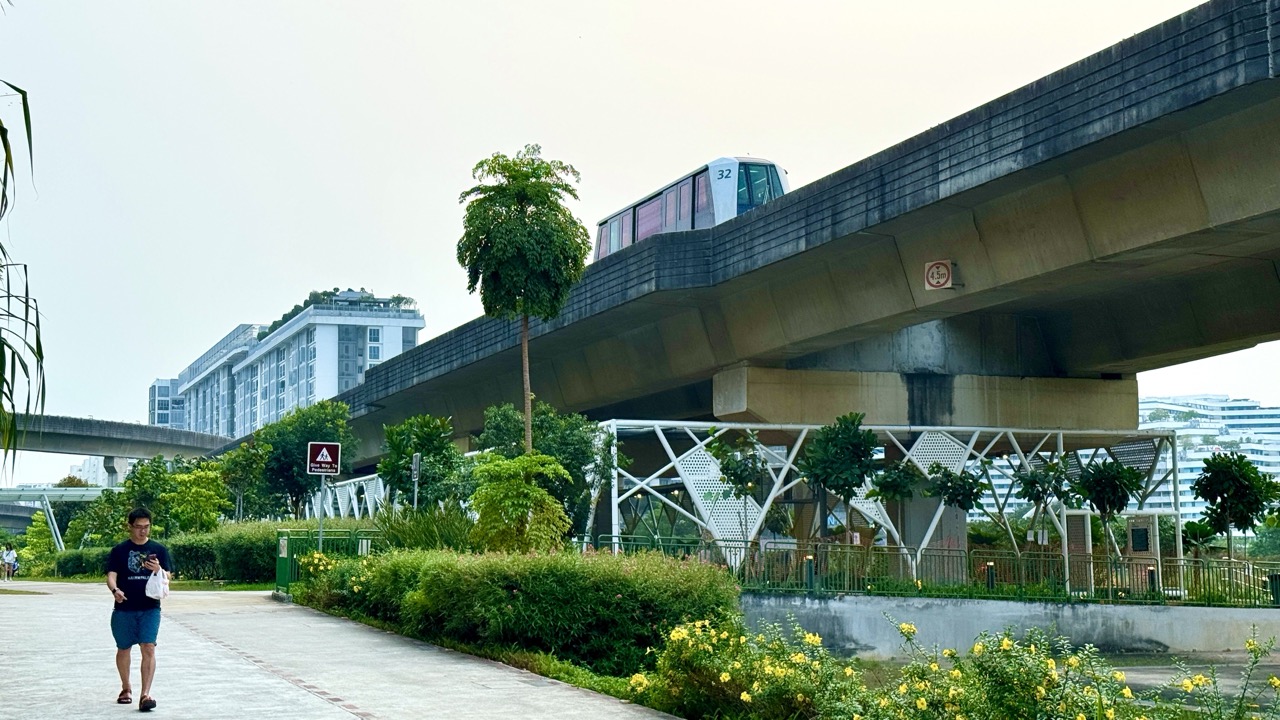
Punggol Green is the community space beneath the rail viaduct between Punggol MRT and Sam Kee LRT, and it is a great example of how an ordinary route can also become a place to play, exercise, meet and rest. In an August 2024 account, Singapore’s Urban Redevelopment Authority describes a 1.2-hectare linear park with play areas, fitness facilities, flexible court space and community features. Our freshly uploaded October 2026 photographs show the idea at ground level: an LRT train above, people playing basketball below, a shared path beside the tracks and families using nearby play areas.
If you’re a Punggol parent wondering whether this is a good stop on the way home, begin small. You do not need a sports booking or an elaborate weekend itinerary just to observe this remarkable piece of everyday urban design. Take a short, supervised stroll through the publicly accessible areas, identify the court and playground edges, follow current signs and let your family’s actual energy decide the next step. Where specific court-booking arrangements or opening times matter, verify them through the responsible operator instead of assuming the photographs tell you.

Quick facts: Punggol Green, Sam Kee and the space beneath the tracks
- What: Punggol Green, a linear community park below the rail viaduct between Punggol MRT and Sam Kee LRT.
- Published size: 1.2 hectares in URA’s 27 August 2024 account.
- Built for: a mixture of public recreation, play, movement, informal gathering and flexible community uses.
- Visible in our new photographs: train movements, basketball games, walks, shared paths, play areas and the public realm near One Punggol.
- Not established by photos alone: whether a specific court needs booking at a given time, today’s permitted game types or the operating hours of any facility.
- Safest first action: read posted signs, protect pedestrian movement, choose a suitable place to pause and check weather before starting active play.
The official source worth reading is URA’s How Punggol Green Became a Community Focal Point. It records interviews about residents’ involvement, the decision to use under-viaduct space for a park and the flexible design of court and play areas. It is a design retrospective, not a live reservation calendar. Our separate Punggol Green history owns the completion chronology; this new guide is about how families can understand and respectfully use the space today.
Why a park beneath an LRT line is such a Punggol idea
Many people picture a park as a patch of green separate from transport, housing or shopping. Punggol Green challenges that picture. The railway line is infrastructure that moves people. Underneath it sits land that could have remained an overlooked strip. Instead, that strip was designed for the ordinary life of the neighbourhood. The result is interesting because the movement above and the activity below have different purposes yet share the same corridor.
That does not mean every square metre beneath a viaduct is suitable for recreation. Land use depends on safety, engineering, access and management decisions. URA’s published interview describes the work behind Punggol Green and why the public space was intentionally designed. Our photographs show a current scene, but you should not generalise from it to other viaducts. Railway infrastructure is not a climbing frame; always respect physical boundaries, barriers and signs around tracks and columns.
The lesson for a family is simple: useful spaces can be made from places people pass every day. A path that once felt like a connector may now hold a playground, a court, a resting place and an opportunity to meet neighbours. This doesn’t require visitors to praise every element uncritically. Ask which uses feel comfortable, which areas need better courtesy and what design choices make it easier for different age groups to share.
The photographs: one corridor, several very different journeys
Look at the picture with the train overhead and players below. The train serves people making journeys beyond this immediate scene. The court serves people spending time there. Nearby, another person may simply be walking home. Those are different rhythms. A well-used public space gives each rhythm room. If ball play spills into a walking route, safety and courtesy become immediate questions; if pedestrians obstruct court entry, the friction works in the other direction.
Photos are useful evidence of what was happening at a particular moment. They do not disclose a person’s name, why they were there or whether they had booked a space. We should not infer those details. Likewise, a picture of basketball doesn’t mean the area is exclusively a basketball training facility. URA describes multi-use intentions. The on-site rules and appropriate operator guidance decide what is currently permitted.

What makes Punggol Green different from a typical isolated court
A court tucked into a street corner serves one main purpose: sport. Punggol Green’s broader arrangement invites more than one type of visit. URA specifically discusses playgrounds for younger and older children, fitness corners for seniors, an artist’s corner, a ground graphic and a flexible multi-sport court. A person who does not play basketball may still appreciate a short walk, a place to watch others enjoy sport or a connection between town-centre destinations.
This flexibility has a benefit and a challenge. It lets people choose how to use public space without paying for a formal programme. But it also requires negotiation. Someone practising ball-handling, a caregiver supervising a toddler and a commuter hurrying to the MRT have different levels of attention and different stopping patterns. A thoughtful design provides opportunities for use; considerate behaviour makes those opportunities work in real life.
The route between Punggol MRT and Sam Kee LRT
URA places Punggol Green along the corridor from Punggol MRT to Sam Kee LRT. Those names provide broad orientation, not a promise about the exact path you should take at every junction. Check current pedestrian access, wayfinding and any temporary works. When you approach from the town centre, notice how buildings, the rail structure, walkways and public spaces sit together. There may be several legitimate routes depending on your starting point and destination.
The best route is not always the shortest line on a map. For a parent with a toddler, the priority could be crossings and a manageable stroller path. A teenager might value clear wayfinding and a comfortable return toward the station. An older person may choose a quieter approach with fewer changes in level. Don’t insist everybody take a route because it looks direct from above; use current access and personal preference.
If you need the full public transport explanation, read Punggol MRT, LRT, Buses, Walking and Cycling. Punggol Green is a ground-level community space, not a new rail service or a substitute for official station signage.
What to notice on the shared walking and cycling path

The corridor includes pathways where pedestrians and riders may interact. Our photograph gives a useful starting point, but it does not settle the legal classification of every metre. Singapore distinguishes dedicated cycling paths, pedestrian-only paths and shared paths, and markings matter. Read the signs you actually encounter. The NParks guide to path types and LTA’s active mobility rules explain why the same-looking stretch of pavement can have different permitted uses.
For families, teach three habits: keep an awareness of people approaching from behind, move aside before stopping for photos, and cross designated paths predictably. Children often change direction abruptly when they see a playground or a passing train. Hold younger children’s hands where appropriate and discuss where it is safe to stop. A shared path is not a place to stage a ball game or leave scooters across the walking line. If the route feels too crowded, pause in a suitable area away from moving traffic.
How to share the basketball area respectfully
A public court may look welcoming, but ‘public’ does not automatically mean ‘walk in at any time for any activity’. Check on-site notices about permitted sport, organised sessions, reservations, time limits and conduct. A group already playing may have an arrangement that isn’t obvious from a photograph. If you want to join, ask courteously rather than stepping into play. If you only want to watch, stand outside the active playing area and out of the path of stray balls.
For a beginner, the best basketball experience might be practising in a suitable available space at a quieter time, with no pressure to perform. But never assume a group can occupy a booked or managed court because it looks empty for a few minutes. Our One Punggol Basketball Court: Booking Enquiries deals with that separate practical question. This article stays with the lived corridor and how the different users affect one another.
Ball games are exciting and occasionally unpredictable. Do not leave bags, water bottles or prams near the playing edge where someone could trip or collide with them. Watch the court boundaries and any equipment condition. If a child wants to retrieve a ball that has rolled toward a vehicle route, station access or restricted area, stop and ask an adult for help. A basketball is replaceable; safety isn’t.
Why the playgrounds beneath the tracks matter

One of the new photographs shows play equipment beneath the elevated railway. For a young child, this may be the feature they remember long after the adults have forgotten the design discussion. That is fine. Playgrounds are not merely places for burning off energy; they are settings where children practise movement, turn-taking, risk judgement and social negotiation. These benefits arise through enjoyable, age-appropriate play, not by completing prescribed tasks at every piece of equipment.
Read the playground’s age guidance and condition on arrival. Inspect for obvious hazards, slippery surfaces, broken fixtures or overcrowding. Do not assume shade from rail infrastructure makes play safe in every type of weather. Heat, lightning and other hazards require separate judgement. A supervising adult should stay within a position where they can respond appropriately for the child’s age and abilities.
When several children want the same equipment, use the moment to teach waiting and courtesy without turning it into a lecture. Give smaller children time to finish an activity before expecting them to switch. If older children play energetically, an adult may choose a different part of the playground for a younger one. There is no need to describe another child as badly behaved simply because a shared space is busy. Observe first, help when needed and model how to make room.
The value of different activity levels in one place
A preschooler climbing, a teenager playing basketball and an older resident taking an easy walk do not share a training plan. Punggol Green’s design intent recognises that a community has people with very different reasons for going out. The park can support activity without requiring every visitor to compete, join a class or meet an exercise target. Sometimes accompanying someone is the whole point.
If a family contains both very energetic and less mobile members, agree on a modest shared visit. One person might enjoy seeing a little court play while another rests nearby where suitable seating is actually available. Avoid asking anyone to stand for a long time simply because the rest of the group wants to continue. Participation can mean watching, taking photos of the architecture without capturing strangers closely or discussing what makes the environment comfortable.
A fifteen-minute visit after school
For a busy weekday, a short pause at Punggol Green can be enough. Walk the safe public route, watch a train pass from an appropriate place, point out one recreation area and let the child choose whether to look longer or return home. Avoid telling children they must play for a fixed period to ‘make it worthwhile’. After a difficult school day, rest and conversation may be more useful than another demanding activity.
If you are collecting a child, maintain the arrangements agreed with the school or caregiver. Do not suggest that children change their usual transport route spontaneously because a playground looks attractive. Plan the visit with the responsible adults. Carry water when appropriate and leave adequate time for homework, meals and sleep without making every afternoon a rigid timetable.
A thirty-minute visit for a mixed-age family
Begin by walking through the shared public space at a comfortable pace. Ask everyone which of the visible features interests them: the court, the train, the play equipment or the architecture. Spend one short interval at a suitable stopping point, one watching or participating in a permitted activity, and the remainder returning calmly. This is a suggested family routine, not an operator programme and not a guaranteed route duration.
If weather changes or someone gets tired, shorten it. The most successful afternoon might end after ten minutes. For a family planning a meal or library stop afterwards, use the One Punggol Guide for the hub’s facilities. Don’t treat a short park visit as proof that you should also fit in three more activities.
An hour of observation for older students
Students interested in Geography, Design & Technology or Social Studies can treat the corridor as a public-space observation exercise, provided they remain in legal public areas and respect others’ privacy. Instead of surveying strangers, count only broad categories of visible activity during a brief, agreed interval: walkers, ball games, people stopping and people using play equipment. Record the time and weather. These observations are not representative of a whole day and should never identify individuals.
Then ask how the design allows these uses to coexist. Are walking routes clear? Is the recreation area visible? Where do transitions between movement and stopping happen? What cannot be concluded from a single visit? A thoughtful student may say, ‘At this time I observed several activities, but I cannot claim the park is always busy.’ That sentence shows more analytical maturity than a sweeping judgement based on one crowded photograph.
How this place teaches urban planning without a textbook lecture
Many urban-planning questions begin with scarcity. Land in a city serves competing purposes, and creating additional public space can require careful design. The Punggol Green case is useful precisely because the rail viaduct already existed and the ground around it needed a purpose. URA’s account describes public consultation, recreation demand and flexibility as part of the process. Students can examine the problem, the design response and the public uses visible afterwards.
A good discussion will also ask about maintenance. Lighting, cleaning, equipment condition, drainage and management all affect how comfortable a public space remains. These are not glamorous photo subjects, but they matter to everyday residents. A park that invites people to use it must also be maintained and shared responsibly. The design is only the beginning; ordinary collective care helps sustain it.
What the passing train teaches us about time
A train passing above a court is a vivid contrast. The train moves by timetable and operating needs. The people below choose their own pace, sometimes not moving at all. For younger students, it’s a fun way to talk about fast and slow or movement and stillness. For older students, it’s an opportunity to distinguish transport efficiency from the separate value of public places where people can linger.
Avoid turning it into a live rail-frequency experiment unless you have an appropriate, safe and accurate method. One photograph cannot establish train frequency, capacity or punctuality. If a student’s question concerns actual services, the operator’s current published timetable or announcements should be the source. Our Sam Kee LRT history explains when the station began service, not the live service pattern during your walk.
What ‘shade’ does and does not mean
The viaduct can shelter parts of the ground from direct sunlight, and URA identifies that advantage in discussing how the space can be used. But shade is not air-conditioning. High humidity, ambient heat and vigorous exercise can still affect comfort and health. It also does not make an outdoor court or playground a safe place to remain during thunderstorms and lightning. A structural roof overhead is not a substitute for a suitable lightning-safety decision.
Before longer exercise, check official weather and heat guidance. Sport Singapore advises preparation, sensible hydration and postponing outdoor activities when lightning is a risk. An ill person, a vulnerable older adult or a young child may need a more cautious plan than another visitor. If someone becomes unwell, stop the activity and obtain appropriate help. For more detailed heat considerations, use our Punggol heat-stress guide.
The shared-path question: can everyone cycle everywhere?
No general assumption is safe. Singapore has different kinds of public paths with different rules. In some places, pedestrians and riders share a path; elsewhere a pedestrian-only route runs beside a dedicated cycling route. Don’t decide that a surface permits cycling solely because it looks wide. Observe markings and posted signs, use the designated path and slow or dismount when conditions require it.
This is particularly important near playgrounds. A child may dash unexpectedly toward something interesting. Riders should leave enough room and avoid fast movement near vulnerable users; pedestrians should not stage a group photo in the active riding line. If a rider wants to photograph the elevated track, stop in a safe location first. Read NParks’ Using Our Routes and Trails Safely for current general etiquette.
When the court is busy: five ways to preserve the outing
- Watch from an appropriate spot instead of insisting on joining an active game.
- Ask about current access or booking arrangements if the plan depends on playing.
- Move to a different permitted activity rather than using another group’s court space.
- Shorten the visit when a young child is tired, hungry or overstimulated.
- Return another day rather than turning an ordinary public court into an argument.
A busy court can be evidence that the space is valued, but it can also create a challenge when demand exceeds availability. Both truths can coexist. The question for an individual family is not how to ‘beat the crowd’; it’s how to have a worthwhile visit without making things harder for the people already there.
Photography, neighbours and privacy
The new images show the public realm and some people using it. They do not justify identifying individual players or speculating about their personal lives. When photographing a community court, a wider scene or architectural view generally tells the story without invasive close-ups. Respect any posted restrictions. Do not publish children’s faces or conversations without appropriate permission. And don’t obstruct a narrow walking route while composing a shot.
The background matters as much as the foreground: tracks, pillars, court boundaries and a clear path explain why this location is interesting. A responsible caption says what is visible and leaves unknown facts unknown. ‘Basketball players below Sam Kee LRT’ is supportable from our photo metadata; ‘players preparing for a tournament’ would be an invented story unless separately verified.
For families with an older person or someone using a mobility aid
Choose a visit that fits the person, not an assumed ideal outing. Ask how much walking they want and whether a shorter route, places to pause or a particular entrance would help. While Punggol Green is a public corridor, this article does not verify the accessibility of every metre or every play facility. Check real kerbs, gradients, surfaces and temporary closures. Public access in a broad sense is not proof that every approach is step-free.
There is no reason everyone must play sport. A family can enjoy conversation, outdoor air where conditions are suitable and the chance to see an active neighbourhood. If a route is too noisy or uncomfortable, use a different one without treating the adjustment as a failure. A well-planned outing keeps the dignity and preferences of everyone in view.
If you have one adult and two children
Choose one manageable destination within the corridor and keep both children in sight. A toddler wanting playground time and an older child wanting basketball can create a genuine supervision problem. Don’t split them between facilities that cannot be safely supervised together. Decide whether a supervised playground visit is realistic, or whether the family should return with another adult for sport. The right choice depends on the children, the space and the adult’s capacity.
Tell the children the plan before the visit. ‘We’ll walk to the play area, look at the court from outside and go home after a short stop’ sets a clear expectation. It also makes an early exit easier if conditions change. There is no obligation to extract the maximum possible recreation from a shared park every time.
What to do if the area is closed, wet or unavailable
Follow closures and temporary barriers even if a photo from another day shows people using the area. Wet courts can be slippery; damaged equipment and standing water should not be ignored. If there is active maintenance, give the workers space. The public space is valuable precisely because it can be enjoyed repeatedly, so protecting it is more sensible than forcing one session through poor conditions.
For a last-minute alternative, you could choose an appropriate open public destination elsewhere in Punggol, a library or simply home. Verify current facility access first. The Complete Punggol Guide helps families compare wider options. You don’t need to travel to a distant venue merely because a particular court is occupied.
How residents can help a good public space stay good
URA’s account emphasises shared stewardship. Dispose of litter properly, avoid damaging equipment, report hazards through appropriate channels and treat nearby residents and staff with respect. A public space must be usable by people who are not part of your group. Keep sound and activity suitable for the time and place, especially around residential routes, and follow any operating rules.
Parents can teach children to leave a space ready for the next person. That may mean checking for dropped snack wrappers, carrying away drink bottles and placing bags where they do not interfere with others. It is a small habit, but it turns the abstract phrase ‘community ownership’ into everyday behaviour. A neighbourhood does not stay welcoming through design alone.
A simple observation challenge for primary pupils
Ask three friendly questions during a brief walk: what is above us, what is below us and what is beside us? A younger child can answer ‘train’, ‘court’ and ‘path’. An older child can explain why the three uses should not interfere with one another. This exercise helps children describe spatial relationships while keeping the visit playful. The idea is not to test a child’s vocabulary against other children.
Back at home, let the child sketch a three-layer picture: elevated train, people below and a public path alongside. The drawing need not be architecturally accurate. Label any invented details as imagination. You can compare it with the original photo and discuss one thing the photograph shows well and one thing it does not reveal. That is the beginning of visual literacy.
A careful fieldwork exercise for secondary students
Choose one research question, such as ‘How does this corridor support both movement and recreation?’ Create a simple observation table with time, date, weather, public-space use and a note about uncertainty. Record broad activities, not names or faces. Do not survey strangers, photograph minors in close-up or enter a restricted area. Make a small evidence-based claim and clearly limit it to the observation period.
Then compare with URA’s design account. Does the use you observed reflect the intended flexible design? Perhaps it does at the time you visited. That does not mean all stakeholders feel the same way or every maintenance problem has been solved. Distinguishing intent from actual observed use is an essential research skill. It makes a short neighbourhood walk relevant to Geography without pretending it replaces a properly designed research study.
Frequently asked questions
Is Punggol Green the same as Punggol Green Primary School?
No. This guide is about the linear community park beneath the railway viaduct between Punggol MRT and Sam Kee LRT, not the school with a similar name.
Does Punggol Green have basketball facilities?
URA’s account describes a flexible multi-sport court and mentions basketball activity. The October 2026 photos show basketball being played. Check current permitted activities and booking or access notices at the actual court.
Is the space covered, so it is safe during a thunderstorm?
No. Shade under a viaduct does not by itself provide lightning safety. Stop outdoor activities and follow official weather advice when lightning threatens.
Can children use the playground?
Our photos show play facilities. Parents should check posted age guidance, equipment condition, weather and supervision needs on arrival rather than assume every area suits every child.
Where can I find the court booking rules?
Use the relevant managing agency and current on-site signs. The separate One Punggol basketball booking guide explains enquiries. A photo is not evidence that booking is or is not required.
Are all the paths for cyclists?
No such blanket claim can be made. Check current path markings and legal categories. Some areas are shared, some are pedestrian-only and others are dedicated cycling routes.
Is it suitable for a very short family outing?
Yes, a brief supervised look at the public realm can be an enjoyable option if the area is accessible and conditions are suitable. There is no need to participate in organised sport.
How old is the park?
The history guide records the park’s completion in 2022. URA’s interview explaining the design and community contribution was published in August 2024. Those are different dates and different kinds of evidence.
Primary sources and related Punggol guides
- URA — How Punggol Green Became a Community Focal Point (27 August 2024).
- URA — Playful Spaces, Joyful Places, including under-viaduct community uses.
- NParks — Types of Paths and safe use of park connectors.
- Sport Singapore — sports safety and health check.
- History of Punggol Green and Sam Kee LRT history.
- Complete Punggol Guide — the town-level starting point.
Photography: eduKatePunggol’s newly uploaded October 2026 images of the Sam Kee / Punggol Green corridor and public activities. Reviewed 22 October 2026. Images document observed spaces, not individual identity, official reservations, present-day facility hours or universal access. Follow the operator and on-site rules for every visit.


