
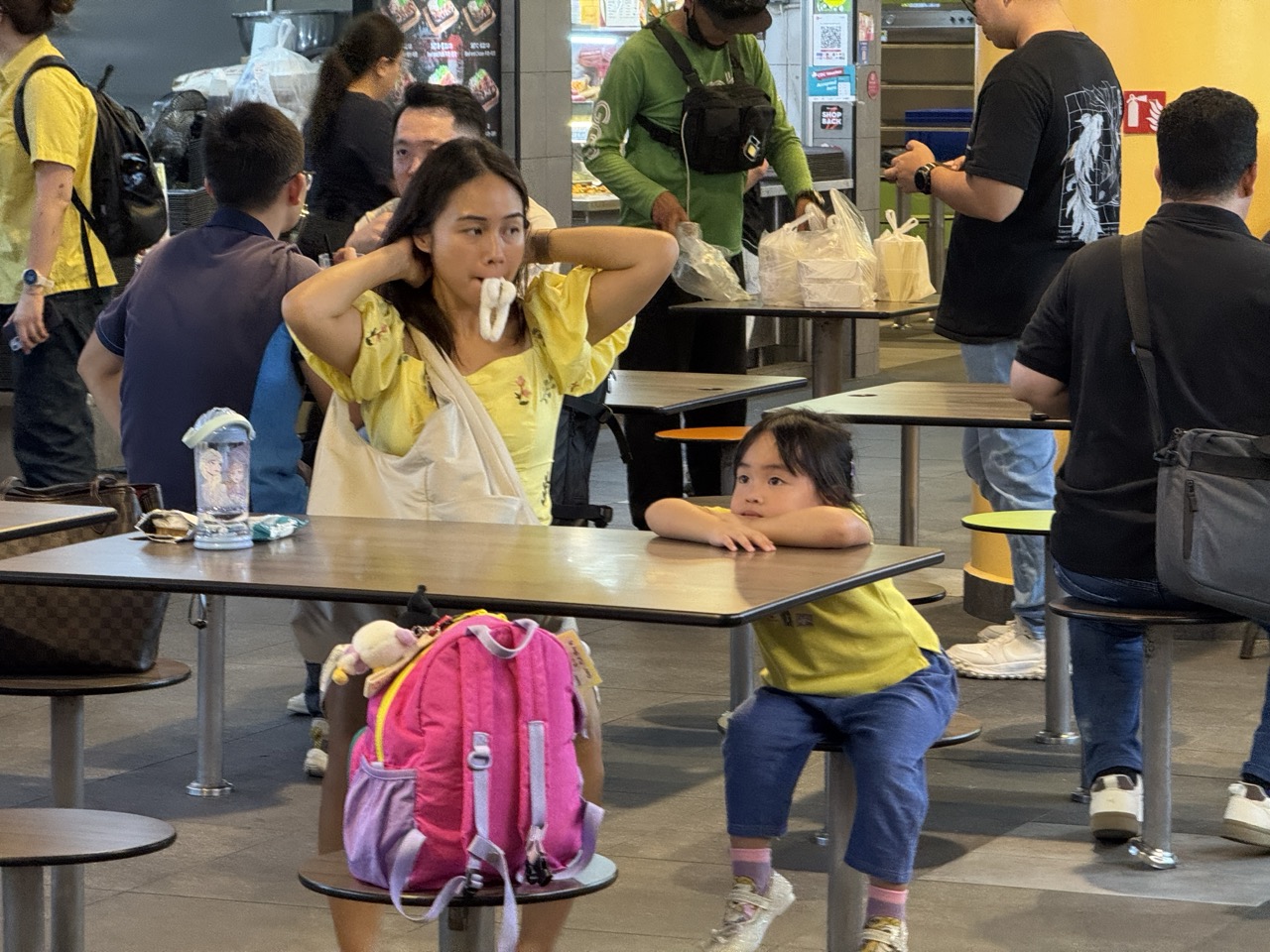
A strong PSLE English picture conversation begins with an accurate observation, then develops a sensible response rather than merely naming everything in the photograph. Parents in Punggol can practise this with familiar local scenes: a family at a hawker centre, passengers alighting from a bus, a train passing above a basketball court, a busy night market and the entrance to the regional library. Our newly uploaded October 2026 photographs provide real settings that children can talk about without having to travel or invent facts.
For the 2026 PSLE English Language Paper 4, the official Singapore Examinations and Assessment Board (SEAB) format lists Reading Aloud for 15 marks and Stimulus-Based Conversation using one photo stimulus for 25 marks; oral communication has 20% weighting overall. This article is original home practice, not a reproduction or prediction of examination stimuli. The photograph does not need to match a future examination question for the child to practise describing evidence, expressing a reasoned opinion and explaining a personal experience.

The quick answer: how to speak about a Punggol photo
- Step 1: Observe. State two details you can genuinely see, such as a stall counter and a queue.
- Step 2: Interpret cautiously. Explain what the scene might suggest, using ‘may’, ‘could’ or ‘seems’ when needed.
- Step 3: Answer the question. Don’t spend all the time listing objects when asked about choices, values or personal experience.
- Step 4: Develop. Give a reason, a specific example and an implication; avoid empty phrases like ‘because it is good’.
- Step 5: Listen and respond. Treat the oral component as a conversation rather than a memorised essay.
- Source: the 2026 PSLE English format is published by SEAB; our exercises use original Punggol photographs, not official exam tasks.
A separate eduKatePunggol guide, Understanding the 2026 PSLE English Oral, owns the detailed examination format. Our role here is narrower and more practical: provide realistic local photographs, worked conversations, common mistakes and an at-home method that a parent can use without turning every meal or train ride into a stressful lesson.
What the official oral task is assessing
Stimulus-Based Conversation is not a competition to identify the maximum number of things in a picture. Candidates respond to questions and develop ideas in conversation. A photograph is a starting point that may encourage discussion of familiar experiences, decisions, behaviour or views. Different questions can be asked about the same image, so memorising one paragraph for each possible subject is a fragile strategy.
The most dependable preparation is to observe carefully and explain meaning. If an examiner asks whether young people should help keep public places clean, the student must address that idea rather than repeat a list of chairs and tables. The details in the picture help anchor the reply, but they do not replace it. Parents can help by asking one clear question and then one natural follow-up.
Begin with evidence, not an invented story
Imagine a child sees several people waiting at a food counter. ‘There is a queue’ may be accurate. ‘Everyone in the queue is angry’ is not supported unless the expression and context really justify that inference. ‘Some customers may be waiting for their orders’ is a careful possibility. This distinction is one of the strongest habits a young speaker can develop.
An unsupported invented story often creates further problems. Once the pupil claims that the customers are upset, they may spend the rest of the answer explaining emotions and complaints no one could see. A better response states what is visible, considers plausible explanations and moves toward the examiner’s actual question. Confidence comes from accurate reasoning, not colourful guessing.
Describe two useful details rather than ten unrelated objects
A hesitant student may buy time by saying there is a table, a chair, a bag, another chair, some people, a sign and more people. The description is not necessarily wrong, but it lacks purpose. Ask which two details matter to the question. For a prompt about patience, the queue and the ordering counter are relevant; the colour of a distant wall probably is not.
A strong opening might be: ‘The photo shows diners waiting near food stalls in a shared hawker centre. Some people are collecting meals while others are sitting.’ The student has identified a setting and activity without making personal claims. That gives a natural bridge to discussing queue etiquette, choices or helping others.
Use words that distinguish fact from possibility
Phrases such as ‘I can see’, ‘it appears’, ‘they may be’ and ‘this suggests’ can express appropriate certainty. A child should not add them mechanically to every sentence. They are useful when the photograph does not clearly establish a detail. ‘A bus is stopping’ is different from ‘The passengers may be heading home’, and the pupil should know why.
Vocabulary precision is better than inflated language. ‘The area looks busy’ is often safer than ‘The place is unbearably overcrowded’ if the photo captures only one section. The point is to communicate what is actually known. This habit also helps in Paper 2 visual-text comprehension and ordinary written explanation, though those are separate examination tasks.
Practice scene one: a meal at One Punggol Hawker Centre
The first image shows people near dining tables and food-collection activity at One Punggol. A natural oral question is: ‘How can people make a busy public dining place pleasant for everyone?’ The pupil might discuss waiting one’s turn, making space for people carrying hot food, keeping tables clean and speaking courteously. These are reasoned ideas prompted by the scene, not a claim about the specific diners’ behaviour.
A weak answer would say, ‘Everyone should be good because being good is important.’ A developed answer might explain that leaving bags across an aisle makes it harder for people to walk safely with food, so keeping the way clear shows consideration. Notice the pattern: specific action, why it matters and its effect. The photo gives context, while the pupil supplies the explanation.
A full model response about sharing public space
Here is an original practice answer: ‘I think people can make a hawker centre more pleasant by thinking about the next person who uses the table. When I finish eating, I should return my tray and throw away my litter. I would also move my bag away from the walkway because someone carrying hot soup may need more space. These small actions are useful because the centre is shared by many families, not just mine.’
The response is not an official marking exemplar or a sentence to memorise word for word. Its strength lies in the clear personal position, concrete behaviour and explanation. A child could replace tray return with another suitable action. Encourage them to speak naturally and offer one genuine experience when asked, rather than recite an adult’s polished script.
A follow-up question needs a new layer of thinking
Suppose a parent asks: ‘What if you see another diner leave a dirty table?’ The pupil should not merely repeat, ‘We must return trays.’ They might explain that they would clear their own area first, avoid arguing with strangers and tell staff appropriately if there is an immediate safety problem. The answer becomes more thoughtful because it considers what the child can reasonably do.
The purpose of a follow-up is to explore the student’s judgement. Teach the child to pause, listen for the difference in question and respond at an age-appropriate level. A claim such as ‘I will arrest the person’ is dramatic but unrealistic. Specific, measured action is often clearer than an exaggerated promise.
Practice scene two: passengers at the Punggol Bus Interchange
The October images show passengers waiting near seats and railings, plus others stepping off a bus. A useful original prompt is: ‘Why is it important to be considerate when using public transport?’ A pupil can discuss letting people alight before moving forward, keeping walkways clear and recognising that some commuters may need more time.
Avoid inventing the passenger’s destination, employment or medical condition. The photo shows a place and actions, not private lives. If the child wants to mention priority seating, frame it generally: some people may benefit from a seat or assistance, and passengers should follow signage and respond thoughtfully. This brings the answer back to a principle the student can defend.
An example that moves beyond description
A reasonable answer is: ‘Public transport is shared, so even small actions affect other passengers. For example, if I stop in front of the bus door to check my phone, people behind me may have difficulty getting out. I should move to a safe spot first and then look for directions. This is especially important in a busy interchange because everyone may be travelling to a different place.’
Notice that the student’s example need not describe a specific photographed person. They can use a hypothetical personal choice to show understanding. That avoids stereotyping strangers and demonstrates transfer from the picture to a wider situation. The parent should ask whether each idea is connected logically, not count the number of advanced vocabulary words.
When the child has no matching personal experience
A child may not regularly take the bus alone. That should not prevent a thoughtful answer about public transport. They can draw on supervised journeys, experiences at school or what they have observed in shared spaces. If a question asks directly about something they have not done, a truthful response can acknowledge that and explain what they would do.
Inventing a dramatic story about rescuing a stranger is unnecessary. ‘I have not experienced that exact situation, but I would ask an authorised staff member for help’ can be a meaningful answer when followed by a reason. Personal examples are useful when genuine; otherwise, carefully explained possible actions are more credible than false autobiography.
Practice scene three: a train above a basketball court
One October image shows a Punggol LRT train travelling on elevated tracks above a basketball area. An original question might be: ‘Why should neighbourhoods provide spaces for sport and recreation?’ The image supports a discussion of different activities taking place near public transport, but it does not establish the players’ ages, team membership or the court’s reservation conditions.
A child could explain that accessible community spaces help people exercise, meet friends and practise cooperation. To develop the response, ask what makes shared courts work well: taking turns, respecting people already playing and keeping walkways clear. There is no need to claim every resident enjoys basketball. The student should recognise different interests and needs.
A developed response about neighbourhood recreation
Try this: ‘I think neighbourhood sports areas are useful because children and adults can have opportunities to be active without travelling very far. In the picture, a basketball area is near an elevated train line, which shows that different spaces can be used for different purposes. I would like residents to take care of the equipment and follow the rules so other groups can use the area safely too.’
This answer links evidence, purpose and responsibility. It also avoids suggesting that the train itself is part of the court. If the pupil adds a personal experience of playing badminton or running with friends, encourage a small true detail: what they enjoyed, what challenge they faced and what they learnt.
Practice scene four: a busy Punggol night market
The photographs show biryani queues, burgers, macaroni and cheese and drinks at the October pasar malam. A possible prompt is: ‘Do you think night markets are enjoyable places for families?’ This is an opinion question, not a request for a universal ranking of food stalls. The student should consider choice, family time and the practical challenges of crowds or queues.
A thoughtful answer might be positive but qualified: ‘I think they can be enjoyable because families can look at different foods together, but parents need to keep younger children close when the place is busy.’ The photograph provides a visible context for that claim. A strong speaker does not need to say every food item is delicious or every visitor feels happy.
The importance of a balanced answer
A child may believe an oral response must choose an extreme side: night markets are either wonderful or terrible. Encourage a direct position plus a realistic consideration. For example, the market may be fun for someone who likes trying snacks but less comfortable for a visitor who dislikes long queues. That does not weaken the opinion; it shows the student can think about more than one situation.
Balance need not mean speaking for five minutes or listing every possible disadvantage. One thoughtful contrast can be enough. An answer is stronger when the contrast leads to a practical conclusion, such as going at a suitable time or choosing a shorter visit. The child learns to defend a position without dismissing others.
Practice scene five: Punggol Regional Library
The new media library includes a photo of the regional library’s presence at One Punggol. Unlike interior photos of shelves, an exterior or signage view does not show specific reading areas, programmes or today’s available seats. A good prompt could be: ‘Why is reading important for young people?’ The pupil can answer from personal experience without pretending that the image verifies every library facility.
A developed response might explain that reading helps build vocabulary, introduces new ideas and encourages imagination. If the child says they enjoy a certain book, ask for one small example of what they learnt or felt. This is more credible than declaring ‘reading makes everyone successful’ without qualification. The photograph serves as an entry point to a familiar subject.
A model answer about choosing books
Consider: ‘I enjoy visiting a library because I can explore books I would not have thought of buying. Sometimes I pick a story because the title interests me, but I read the first few pages to see whether it suits me. If the book is too difficult, I can try another one. I think libraries are helpful because they make reading opportunities available to different people.’
The answer gives a personal preference, an example and a broader idea. Its language is natural enough for a Primary 6 conversation, rather than stuffed with adult phrases. A pupil who prefers non-fiction could substitute their own experience. The purpose of a model is to reveal how reasoning works, not to replace the child’s voice.
How to move from a picture to a larger issue
One useful habit is to ask which broader idea the photo may represent. A bus scene can connect to courtesy and safety; a sports court to sharing and health; a market to choices and budgeting; a library to learning; a hawker centre to community life. These topics are not guaranteed exam prompts, but they are accessible material for practising discussion.
After the pupil names the broader idea, require one connection back to visible evidence. If they say the photo concerns community spirit, ask what in the photograph led them there and whether other interpretations are possible. This stops answers from drifting into generic memorised speeches unrelated to the stimulus.
Why a sentence with ‘because’ is not automatically developed
A student may say, ‘Reading is important because it is good.’ Grammatically it contains a reason marker, but it does not supply a meaningful reason. Ask the child to replace ‘good’ with a specific effect. ‘It helps me learn words that I can use when writing’ is more precise. Add a real example if the question and time permit.
Similarly, ‘We must be polite because politeness is important’ is circular. Try ‘We should let passengers alight first because the door becomes less crowded and everyone can move more safely.’ Now the reason explains a mechanism. Teaching this distinction often helps more than memorising ten elaborate connectors.
Common mistake: narrating a private story from strangers’ expressions
A photograph of a public place may include faces, but visible expressions are incomplete evidence. A child who says ‘that man is angry because he missed his bus’ has invented both emotion and cause unless the stimulus explicitly supports them. The answer may sound vivid, yet it is fragile if the examiner asks how the child knows.
Teach careful alternatives: ‘The passenger seems to be checking something on his phone’ or ‘People may be looking for directions.’ Then explain what the student would do in a similar situation. The learner develops language precision while respecting privacy. It is possible to express empathy without pretending to know a stranger’s personal circumstances.
Common mistake: reciting a speech instead of answering
Some pupils prepare long paragraphs on values, social responsibility or healthy living. A memorised speech may sound fluent until a question asks something narrower. For example, ‘Would you join the basketball players?’ needs a personal answer before a grand discussion of national health. The child should listen to the scope of the question.
Practise with short prompts that change direction: ‘What would you do?’, ‘Why?’, ‘What if your friend disagreed?’ and ‘Can you give an example?’ Each requires a slightly different response. Conversation is flexible. A student who pauses and answers directly can communicate more effectively than one who launches into an unrelated prepared monologue.
Common mistake: using impressive words incorrectly
A child may learn words such as ‘magnificent’, ‘metropolitan’ or ‘benevolent’ and force them into every oral response. Misused vocabulary can obscure a simple idea. Encourage accurate words that the pupil genuinely understands: orderly, considerate, convenient, crowded, patient, welcoming or practical when context supports them.
An adult can extend the child’s vocabulary gradually. If they say ‘the place is very busy’, ask whether ‘bustling’ fits the image. Then consider the difference between ‘bustling’ and ‘chaotic’. These are not synonyms in every situation. The child should explain why a word matches the photo, not select it because it sounds advanced.
Common mistake: giving an example that proves nothing
Suppose a pupil argues that libraries are useful because ‘I went to a library once.’ That is a personal event, but the connection to the claim is incomplete. Ask what happened there that illustrates the benefit. Perhaps the child discovered a book about a topic they liked or learnt to choose a book independently.
A good example is specific enough to strengthen the reasoning but not so long that it overwhelms the question. Teach students to return to the point after the example: ‘That is why I think having a local library helps children explore interests.’ The answer now has a beginning, development and return to the question.
How parents can prompt without correcting every word
A parent may feel tempted to interrupt each sentence for pronunciation, tense or vocabulary. Constant correction can make the child cautious and less willing to speak. Instead, listen through a complete response and choose one important issue for feedback. If the child answered directly with a genuine reason, acknowledge that strength before discussing a factual or language problem.
Then ask for one retry. For example: ‘You said the queue was long because everyone liked the food. Could you give a more careful explanation?’ The pupil might change it to ‘The stall may be popular, but we cannot tell from the photo alone.’ That small revision builds judgement without turning practice into a confrontation.
A helpful diagnostic: was the answer actually responsive?
After a child’s response, ask: could somebody listening identify the question from the answer? If the prompt concerns helping an older passenger but the child spends a minute describing bus colours, the speech lacks focus. The problem is not necessarily grammar or confidence; it may be question interpretation.
Teach the pupil to begin with the requested position or action: ‘I would offer help politely if the person seemed to need it.’ Then explain why and add an example. This direct-first approach is especially useful for students who have many ideas but struggle to organise them into a clear response.
The difference between a reason and an assumption
A reason explains why a proposed action makes sense. An assumption fills a gap in evidence. ‘I should not block the walkway because people need room to pass safely’ is a reason. ‘The people in this photograph are all rushing home from work’ is an assumption unless the stimulus makes it clear. Students can learn to separate them with a simple question: ‘How could I know that?’
If the child cannot know from the image, they can soften the claim or remove it. This is more than exam technique; it is responsible communication. Local photographs show public life but should not turn anonymous residents into invented characters with specific jobs, schools or family relationships.
One image, three possible questions
The same Punggol hawker-centre photograph can support different original questions. ‘What could you do to help keep the centre pleasant?’ asks for action. ‘Why do families enjoy eating together?’ asks for reasons and personal experience. ‘Should children learn to order food for themselves?’ asks for an opinion with conditions. A student cannot answer all three adequately with one memorised script.
Try asking the child each question on separate days. Notice what changes in the opening sentence and type of example. They should use the same image as a starting context but adapt the answer’s purpose. This is one of the clearest ways to teach genuine conversation rather than recitation.
A quick self-check after every response
Ask the pupil four questions: Did I answer what was asked? Did I give a meaningful reason? Was my example relevant and genuine? Did I say anything I could not know from the picture? Keep this checklist short enough to remember. A child should not attempt to mentally score twenty criteria while speaking.
For practice, the adult can listen and note one of the four areas. On the second attempt, focus on improving that area. Gradual changes reveal progress more clearly than telling the child their entire answer was ‘not good enough’. Learning is easier when the correction identifies the actual missing move.
A five-day Punggol photo-conversation routine
Day one: use the hawker image to practise observing two relevant details and explaining shared responsibility. Day two: use the bus image to discuss helping others and safe behaviour. Day three: use the LRT and court image for recreation and shared spaces. Day four: use the pasar malam image for choice, spending and family time. Day five: use the library image for reading habits and lifelong learning.
Keep each session reasonably short, perhaps ten to fifteen minutes depending on the child. Those are suggested home-practice durations, not SEAB examination timings. Use one or two prompts per session, with a chance for a corrected retry. The method builds transferable speaking skills without turning the entire home evening into an oral rehearsal.
How to compare the first and final attempt
Record the child’s own answer privately with appropriate consent if the family finds it useful, or simply take brief notes. On the first day, note whether the answer was direct, relevant and sufficiently explained. After several sessions, use another photo and the same criteria. Don’t compare children against siblings or promise an examination grade based on one practice conversation.
A measurable improvement might be fewer unsupported assumptions, clearer answers to the actual question, more specific examples or less dependence on repeated adult prompts. These are observable behaviours. A long answer is not automatically a better answer. The goal is accurate and appropriate communication.
What a child can do when stuck
A short pause is not disastrous. Teach the pupil to return to the question and choose one straightforward point. If asked about community sports, they might start with ‘I think having courts nearby is helpful because…’ and develop it from there. The photograph can supply a detail that anchors the explanation.
Avoid memorising a large list of emergency phrases that occupy half the answer. A natural ‘Let me think about that’ may be appropriate in conversation, but it should lead to an actual response. The adult can model calm thinking rather than rushing to fill every silence. Comfort grows through practice with meaningful questions.
How to prepare for questions that move beyond the scene
Stimulus-Based Conversation can lead from what is visible to the student’s own ideas and experiences. A bus photograph might prompt discussion of helping others; a library photo may open a question about reading at home. This transition is not a trick. It tests whether the learner can communicate about familiar contexts instead of only describing pictures.
A good practice pattern is ‘What do you notice?’, ‘What do you think?’ and ‘What would you do?’ The final question often requires the student to select an action and explain why. Some questions may ask for a counterpoint or a different perspective. Vary the prompts to build flexibility.
Why the Punggol images are useful even beyond PSLE
Primary 3 and Primary 4 pupils can begin with descriptive sentences, sequence words and simple reasons. Primary 5 and Primary 6 pupils can develop more nuanced opinions and accurate inference. Secondary students can use the same photos for discussion, situational writing or source-based reasoning, though assessment formats differ.
The photographs are locally familiar, which can lower the barrier to conversation. But familiarity must not replace precise observation. A child who regularly visits One Punggol may know things that are not in the image. Encourage them to say ‘From my experience’ when adding that information, separating personal knowledge from visible evidence.
The value of an authentic speaking voice
A polished sample answer can help parents understand structure, but real pupils do not need to sound like professional broadcasters. A child who explains a sensible view clearly, listens and responds with appropriate language demonstrates useful communication. Overrehearsed phrases may make the speech unnatural and less responsive.
Invite the child to say the idea in their own words. If they are shy, begin with an easy genuine question about a photo they enjoy. Build from one clear sentence to an explanation and example. The aim is not perfect performance at home; it is flexible communication in an unfamiliar conversation.
How to use a picture ethically
The photographs include people in everyday public settings. They should be used for observation and general discussion without identifying individuals or making claims about their religion, school, relationships or personal circumstances. An adult should not invite a child to gossip about a stranger in order to generate a lively response.
Respectful speaking practice also teaches media literacy. The pupil learns to describe a scene while recognising that a camera captures only selected details. That habit supports better reading, writing and responsible participation in community life beyond examination preparation.
A parent-friendly closing question
After several examples, ask the child: ‘Which of these photos would you find easiest to talk about, and why?’ The pupil may choose the basketball court because they play sport, or the library because they love books. Let them explain their preference, then invite one thoughtful contrast. A personal, well-reasoned answer can be more persuasive than a generic list of benefits.
End practice while the child is still willing to engage. The next conversation should feel possible, not like another punishment. A familiar Punggol photograph is a doorway into clear thinking and confident expression; it should not become an excuse to extend homework indefinitely.


Frequently asked questions
Does the 2026 PSLE English oral use a photo stimulus?
Yes. The SEAB 2026 English Language examination format specifies a photo for Stimulus-Based Conversation.
How many marks are assigned to Stimulus-Based Conversation?
The 2026 PSLE English Paper 4 format lists 25 marks for it, alongside 15 for Reading Aloud.
Are these real PSLE examination pictures?
No. They are original October 2026 Punggol photographs selected for independent learning practice.
Do the practice questions predict the exam?
No. They are examples of conversation skills, not forecasts of actual examination topics or prompts.
Should children describe everything in a photo?
No. Select relevant observations and answer the examiner’s particular question.
What does a cautious inference sound like?
For something not clearly established, phrases such as ‘may be’ or ‘it seems’ can express uncertainty appropriately.
What is a strong reason?
A meaningful explanation of why an action or viewpoint matters, supported by a specific effect or example.
Does longer always mean better?
No. Clear, responsive development is more useful than a long unrelated speech.
What if the child does not have a personal story?
A truthful answer with a carefully reasoned hypothetical example may be better than inventing an experience.
What if the child forgets a word?
Use a simpler word you understand and keep the idea clear rather than force an unsuitable advanced term.
How can parents correct responses?
Listen first, identify one important improvement and allow a short retry instead of interrupting every sentence.
Can Primary 3 and Primary 4 pupils use these photos?
Yes, for age-appropriate description, reasons and vocabulary. The PSLE marking format itself is for the examination year.
Is a bus passenger’s job or destination visible?
Not necessarily. Do not make claims about personal identity or private plans from the image.
Can a student use local knowledge?
Yes, when relevant, but distinguish personal experience from what the photograph actually shows.
How often should we practise?
A short repeatable routine is more sustainable than exhaustive drilling. The five-day plan here is optional home practice.
Is reading aloud covered in this guide?
Only the examination context is mentioned; this article focuses on Stimulus-Based Conversation.
Can the same photo have different questions?
Yes. The examiner’s question determines whether the pupil should explain, evaluate, suggest or recount.
Which error should be corrected first?
Usually failure to answer the question or an important unsupported assumption, before minor decorative vocabulary issues.
Will this approach guarantee a grade?
No. Progress depends on the learner and wider language competence; practice develops observable communication habits.
Where is the official examination format?
SEAB’s PSLE Formats Examined in 2026 page links to the English Language 0001 examination syllabus.
Official references and Punggol learning links
- SEAB — 2026 PSLE Examination Formats, English Language 0001.
- SEAB — 17 July 2026 Statement on Appropriate English Assessment.
- 2026 PSLE English Paper 4: Oral and Photo Conversation.
- One Punggol Hawker Centre Photo Guide.
- Punggol Bus Interchange Photo Guide.
- Punggol Green and Sam Kee Community Courts.
- Punggol in Pictures: October 2026 Photo Archive.
- eduKate Punggol English Education Overview.
Reviewed 23 October 2026. These are original photo-supported oral practice questions and responses, not official SEAB specimen answers, predicted exam questions or performance guarantees. The photographs were drawn from eduKatePunggol’s October uploads. Descriptions do not identify or speculate about members of the public. Always use the latest SEAB documents for examination-format decisions.


