
In Parliament on 22 March 1995, the government said that more than 55% of HDB flat applications were for Singapore’s North-East sector, while relatively few flats would be available there in the next few years because Punggol reclamation had to take place before construction could begin. The record captures a housing-demand problem before Punggol 21: families wanted homes in the region faster than the land could be prepared.
For readers searching Punggol HDB waiting list 1995, 55% North-East applications or why some applicants faced long waits, two boundaries matter. The 55% referred to the broader North-East sector, not Punggol alone. And the four-year wait mentioned in debate illustrated a particular upgrader’s situation, not a universal waiting time for every household.
Did you know? this is one of the clearest historical examples of housing demand colliding with a physical bottleneck. More applications could not instantly create more Punggol flats because some of the future town first needed land reclamation, ground preparation, roads, drainage and utilities.
The Crazy-Rich Idea: Housing Supply Begins Before a Flat Exists
A completed flat is the end of a long chain:
land → reclamation → ground preparation → infrastructure → construction → allocation → occupation.
If one early stage is constrained, later stages cannot simply be accelerated by demand alone.
The 55% Figure Was Regional, Not Punggol-Specific
The parliamentary discussion referred to applications for the North-East sector.
That broader geography included places beyond the later Punggol planning area. It is therefore incorrect to write that 55% of all HDB applicants wanted Punggol specifically.
A Four-Year Wait Was an Illustration, Not a Universal Rule
The debate discussed different waiting times by location, flat type and applicant category.
The four-year reference concerned an upgrader seeking a North-East flat. It should not be converted into “every Punggol family waited four years”.
Reclamation Was a Precondition, Not the Whole Housing Programme
Creating land where water had been does not create a neighbourhood by itself.
After reclamation, planners still need to manage soil, drainage, roads, utilities, schools, transport and the sequence in which precincts become usable.
Demand Is Geographical
Housing demand is not one national number spread evenly across Singapore.
Families care about proximity to relatives, work, schools, familiar districts and transport. A region can therefore have excess demand even when housing exists elsewhere.
1995 Came Before Punggol 21
HDB dates the public unveiling of Punggol 21 to 1996.
The March 1995 debate is important because it shows that the supply problem and reclamation dependency were already visible before the better-known town vision was launched.
The Asian Financial Crisis Is a Later Explanation, Not a 1995 Cause
Later economic conditions did affect Punggol’s development.
But the March 1995 source identifies a pre-crisis physical constraint: future housing land still had to be formed and prepared.
An Economics Lesson: Supply Can Be Inelastic in the Short Run
When land and construction capacity cannot expand quickly, a surge in demand does not produce immediate supply.
Punggol’s reclamation requirement is a real-world example of short-run supply rigidity.
A Geography Lesson: Demand and Infrastructure Are Both Located
A flat in another part of Singapore may not substitute perfectly for a household seeking the North-East.
Location changes the practical value of housing.
An English Lesson: “Applications for the North-East” Is Not “Applications for Punggol”
Keeping the regional qualifier prevents a large numerical claim from being narrowed beyond what the source actually says.
Evidence Boundaries
- The 22 March 1995 parliamentary record says more than 55% of HDB applications were for the North-East sector.
- The figure is not Punggol-only.
- The four-year example concerned a particular upgrader situation.
- The debate identifies reclamation as a near-term supply constraint.
- Later BTO systems and present-day waiting-time rules should not be projected backward into 1995.
Evidence Anchor
The core source is the 22 March 1995 Singapore parliamentary debate.
The crazy-rich Punggol lesson is that housing wealth depends on invisible preparation. Before blocks could rise, planners had to create and service the land beneath them—and families waiting for homes felt that engineering timeline directly.
In March 1995, demand for new HDB flats in Singapore’s North-East sector was already very strong — but Punggol’s future housing land was not ready. During a parliamentary debate on 22 March 1995, the government said that more than 55% of HDB flat applications were for the North-East sector. It explained that relatively few flats would be available there in the next few years because land reclamation in Punggol had to take place before construction could begin. An upgrader waiting for a flat in the North-East could therefore face a four-year wait.
The numbers are extraordinary, but they are often misread. The 55% referred to applications for the North-East sector, not applications specifically to Punggol. And the four-year illustration concerned a particular applicant situation, not a universal wait for every household. Getting those distinctions right reveals an important chapter of Punggol’s transformation: people were queuing for a part of Singapore whose future homes required substantial physical work before any blocks could rise.
The 1995 facts at a glance
- Source: Singapore parliamentary debate, 22 March 1995, during consideration of expenditure for the 1995–96 financial year.
- Demand: the minister said that more than 55% of applications were directed to the North-East sector.
- Constraint: reclamation in Punggol was needed before part of the building programme could begin.
- Illustrated wait: an upgrader seeking a North-East flat could wait about four years.
- Comparison in that debate: the minister gave substantially shorter examples for certain flat types in Woodlands.
- Timing: this was before the Punggol 21 blueprint unveiled in 1996, not a report about the later Punggol 21 Plus waterway scheme.
Why did so many applicants want the North-East?
The North-East of Singapore was already attractive to households seeking a new home. Its demand included places beyond today’s Punggol estate, so the parliamentary figure cannot identify exactly what share wanted a unit in the Punggol planning area. Still, the statement tells us that the pressure on housing supply was geographically uneven. Developers and planners could not assume that an islandwide total of available flats translated into equal choice everywhere.
Singaporeans do not choose homes solely by the number of units on a spreadsheet. Family ties, familiar neighbourhoods, transport, schools, jobs, affordability and the hope of staying close to relatives shape demand. In a growing part of the island, those preferences could concentrate faster than land and buildings could become available.
Before a flat could be built, the coastline had to be remade
A common picture of public housing is straightforward: choose a site, build blocks and move people in. Punggol showed why that is incomplete. Portions of the eventual town depended on reclamation, the creation of buildable land and the engineering that allows people to live safely on it. Major construction cannot simply be fast-forwarded because an application queue is long.
Reclamation changes the coastline, but it does not by itself create a neighbourhood. After the land is formed, planners must consider soil conditions, drainage, services, access, roads, utilities, schools and the sequence in which precincts can function. These systems take time and have dependencies. The 1995 parliamentary exchange is valuable because it connects a visible social problem — the wait for a flat — to an invisible precondition: the work of preparing land.
What did the government actually say in Parliament?
The official discussion can be read in the 22 March 1995 parliamentary record. The minister explained differences in waiting time by location and flat type. For an applicant seeking a four-room flat in Woodlands, he gave a comparatively short allocation estimate; for a five-room flat there, he described another range. He then turned to the unusually high demand for the North-East and the limited near-term supply while Punggol reclamation was pending.
That passage is not an HDB booking notice, a promise to a particular family or a map showing exactly which reclaimed parcel would host which eventual block. It is a policy explanation from the period. Its importance is the relationship it lays out between where households wanted to live and the physical availability of future housing land.
A four-year wait: exactly who was the example about?
The minister’s four-year reference was to an upgrader waiting for a flat in the North-East region. An upgrader was an existing homeowner seeking a different flat, as distinct from certain first-time applicants and other housing categories. Rules and queues differed by scheme. It would be misleading to advertise this as ‘every family in Punggol waited four years’, because the source does not say that.
The debate also discusses the Registration of Flats System and the pressures it faced. This was an earlier allocation environment and should not be confused with present-day Build-To-Order exercises, today’s priority rules or current waiting-time metrics. Housing policy changes, and the same familiar term — ‘application’ — may refer to different processes across decades.
Why the national supply number did not solve a local waiting list
Imagine a country where 100 hypothetical households seek homes, and more than 55 of them prefer one broad region. Building 100 flats elsewhere does not remove the mismatch. It may increase total supply, yet the popular region remains constrained. This is a simplified numerical example, not a reconstruction of the actual 1995 applicant dataset.
This is a useful lesson in geography and economics: demand is located, and infrastructure is located too. Time, transport costs and social connections make one district different from another. Looking only at a national production target can conceal the experience of a family whose preferred area has no available flats.
The roles of planning, reclamation and home allocation
- Planning: deciding where residential, transport, civic and open-space uses should fit in the future town.
- Land works: reclamation and other engineering required before buildings and supporting infrastructure can safely proceed.
- Construction: turning the prepared plan into housing blocks, services and access routes.
- Allocation: using the policy and queue rules then in force to match applicants with available flats.
- Community formation: the gradual arrival of schools, shops, transport, healthcare and daily routines after residents begin moving in.
The stages interact, but they are not interchangeable. A plan can exist before land works finish; land works can proceed before homes are allocated; families may arrive before every planned amenity opens. Punggol’s later history illustrates all these overlapping rhythms.
What changed in 1996?
HDB’s historical overview dates the first unveiling of the Punggol 21 waterfront-town blueprint to 1996, a year after the parliamentary discussion. The idea promised a more attractive and integrated living environment, but the existence of a blueprint did not dissolve the pre-existing construction and infrastructure constraints. Later economic conditions also affected development.
A complete timeline therefore starts earlier than the publicity of 1996. The 1995 debate is evidence that high demand and the need to prepare new land were already in tension. That helps readers understand why a visionary announcement and the completion of an individual housing precinct can be separated by many years.
How this connects to the 1997–1998 Asian financial crisis
Readers often hear that Punggol’s planned development slowed because of the Asian financial crisis. That is an important later part of the story, but it should not be projected backwards to explain every earlier delay. The March 1995 debate identifies a concrete pre-crisis constraint: reclamation work needed before building. The later downturn added a different obstacle, affecting demand and development schedules.
Separating these causes is basic historical reasoning. One challenge was physical and infrastructural; another was economic and emerged later. They may have combined in the town’s long evolution, but they did not begin on the same day or operate in precisely the same way.
What can a present-day town model teach us about 1995?
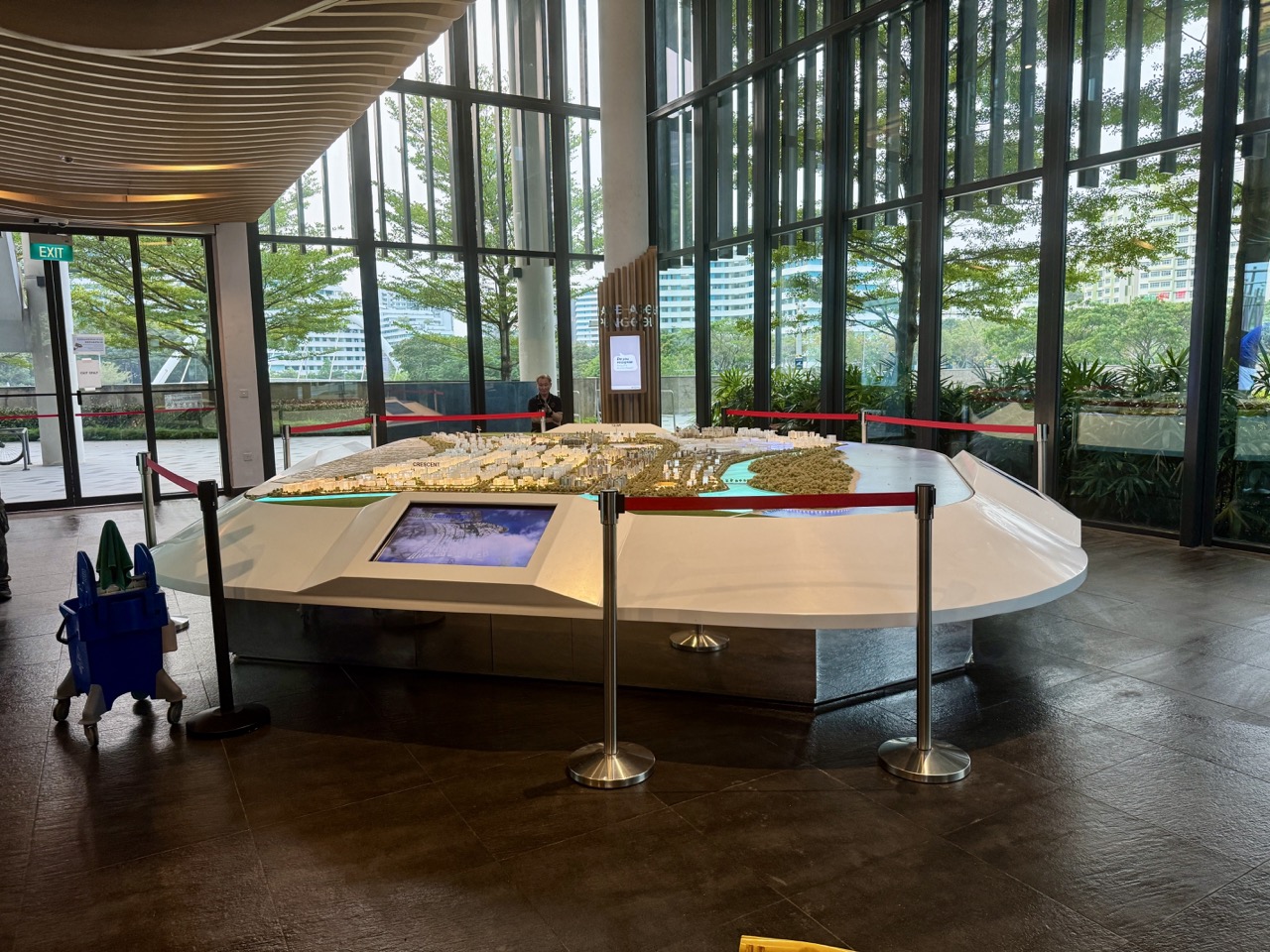
Punggol now has an extensive transport network, new schools, parks, commercial centres and neighbourhoods that would have been difficult to imagine as a finished whole in 1995. The contemporary scale model at Punggol Discovery Cube can help families see how land uses fit together today. It cannot, by itself, identify which housing parcels were delayed by reclamation in March 1995.
The feature image used here is a present-day model of Punggol. It illustrates the idea of long-range town planning, not a reproduction of the 1995 master plan. For historical map work, a date-stamped outline plan and reclamation records are better sources than a modern tourist or learning display.
A timeline from waiting list to new town
- 22 March 1995: Parliament discusses HDB waiting periods; the North-East attracts more than 55% of applications, and Punggol land reclamation is identified as a supply constraint.
- 1996: the Punggol 21 blueprint is unveiled as a vision of waterfront living.
- 1997–1998: the Asian financial crisis affects Singapore’s economic environment and subsequent development.
- 2000s: housing development and transport links mature in stages, with differences between neighbourhoods.
- 2007: the Punggol 21 Plus vision renews the area’s waterfront ambitions.
- 2011 onward: the waterway and associated neighbourhood amenities become familiar features of the town.
Learning activity: read percentages without confusing their denominator
Ask a secondary-school student to underline the words immediately after a percentage. Is the statistic about the whole country, a planning region, a town, first-time buyers or upgraders? For the 1995 figure, the denominator was applications in the policy discussion, and the geography was the North-East sector. That does not give a reliable number of Punggol applicants on its own.
Next, explain the four-year period in one sentence that states the applicant group. Finally, write one sentence distinguishing the 1995 physical constraint from the later financial-crisis disruption. These three exercises turn a historical article into a lesson in Mathematics, History, English and civic literacy at once.
Where to go deeper in Punggol’s housing history
Explore the wider sequence through Punggol land reclamation and coastline change, the 1998 planning report, development delays after 1997 and the December 2002 BTO exercise. These documents cover later, distinct stages rather than replacing the March 1995 explanation.
Frequently asked questions
Did 55% of Singapore’s flat applicants want Punggol?
The cited statement said more than 55% of applications were for the North-East sector. It did not mean 55% were specifically for Punggol.
Did every Punggol applicant have to wait four years in 1995?
No. The four-year example concerned an upgrader seeking a North-East flat. Allocation periods could vary by applicant category, flat type and area.
Was Punggol 21 already launched by March 1995?
No. HDB dates the unveiling of the Punggol 21 blueprint to 1996. The March 1995 speech instead captures demand and land-preparation issues before that unveiling.
Was the Asian financial crisis the reason stated in the 1995 debate?
No. The specific explanation then was the need to reclaim land in Punggol before the building programme could begin. The Asian financial crisis followed in 1997–1998.
Can current HDB waiting times be inferred from these figures?
No. They are historical policy statements, not current application advice. Use HDB’s current official releases for today’s programmes.
Sources and date-checking notes
- Parliamentary debate, 22 March 1995 — applications, waiting times and the Punggol land-reclamation explanation.
- Housing & Development Board, Punggol town history — the 1996 Punggol 21 blueprint and later stages.
- National Heritage Board, History of Punggol — reclamation and the sequencing of development.
- Prime Minister’s Office, Punggol Waterway opening speech, 23 October 2011 — retrospective account of subsequent phases.
The bigger lesson is simple: a housing queue is not just paperwork. In Punggol’s case it was tied to the physical shape of a future town — and the calendar of a coastline that had yet to be prepared for homes.


