
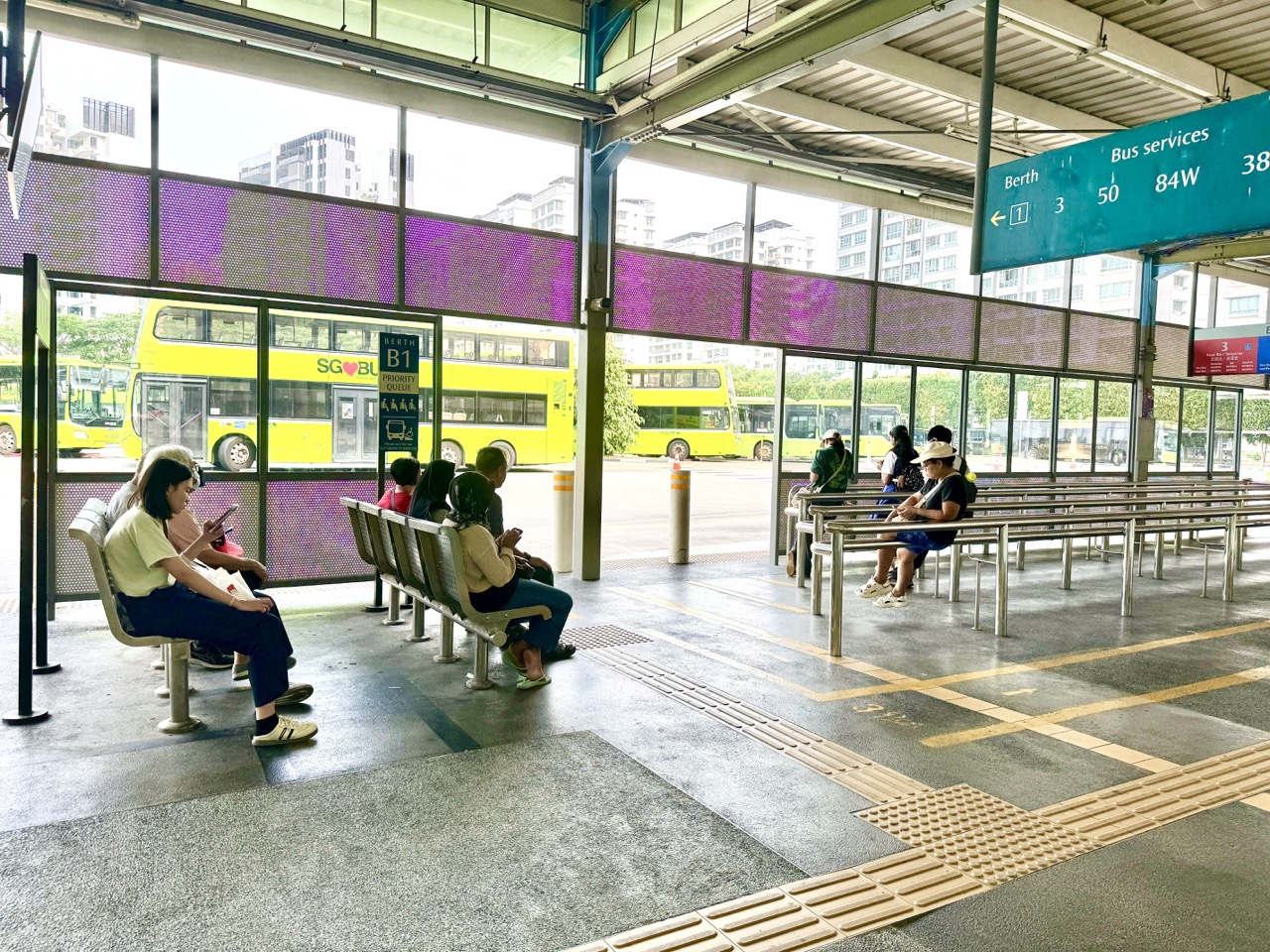
Punggol Bus Interchange is the bus interchange beside Punggol MRT/LRT station at 70A Punggol Place, Singapore 828865. Older photographs, including our new October 2026 photo batch, call it Punggol Temporary Bus Interchange. The word ‘Temporary’ was dropped from the public name on 29 June 2025; the interchange itself did not disappear. A second, separate Punggol Coast Bus Interchange opened on that same date in Punggol Digital District. Knowing the difference can save a family an unnecessary journey to the wrong terminus.
The new photographs capture something more ordinary than a ribbon-cutting: passengers waiting near seats and railings, stepping off buses and checking their next move. These scenes make a useful Punggol parent-and-commuter guide. Which berth is for boarding, how can children learn to recognise a service, why should older route screenshots be checked, and what happens when a new interchange changes where a service begins? This article answers those practical questions instead of reproducing another giant bus-number list.

Punggol Bus Interchange: quick information for 2026
- Main town-centre interchange: Punggol Bus Interchange, formerly Punggol Temporary Bus Interchange, beside Punggol MRT/LRT.
- Address: 70A Punggol Place, Singapore 828865, according to the transport directory.
- Different interchange: Punggol Coast Bus Interchange beside Punggol Coast MRT and Punggol Coast Mall in Punggol Digital District.
- Major confirmed change: Services 34 and 117/117M moved from the main Punggol interchange to Punggol Coast on 29 June 2025.
- Photo record: passenger waiting and alighting activity in October 2026, not a live berth map.
- For departures: check current operator displays or LTA travel information; static websites do not supply a reliable real-time next bus.
- Future upgrade: LTA announced on 18 August 2026 that enhancement works at Punggol and five other interchanges would begin in 2027.
LTA’s 20 May 2025 release confirms the Punggol Coast opening and route changes. Its 18 August 2026 announcement describes planned interchange upgrades. Land Transport Guru provides the older interchange’s history and name update. For full route comparison, our existing Punggol versus Punggol Coast Bus Interchange remains the dedicated destination guide. Here we concentrate on the experience of waiting, alighting and making the right onward connection.
Why the word ‘Temporary’ persists in a permanent-looking town centre
Temporary can describe how an interchange was originally designed, rather than how many years commuters will use it. Punggol’s older interchange was planned to be adaptable as the new town developed. A temporary facility can become an important fixture of daily life as routes, housing and shopping destinations grow around it. That history explains why many people still use the name even after it has formally changed.
Land Transport Guru records that the authority dropped ‘Temporary’ from the interchange’s name on 29 June 2025. Our October 2026 image metadata still uses the older words. The appropriate response is not to delete historical labels from every image but to explain them clearly. The current name and the former name refer to the same town-centre interchange, not to two separate bus stations.
What opening Punggol Coast changed
Punggol Coast Bus Interchange opened on 29 June 2025, integrated with Punggol Coast MRT station and Punggol Coast Mall in the Punggol Digital District. LTA linked the project to improved access to the district’s workplaces and the Singapore Institute of Technology campus. It was more than the opening of a new waiting room: the bus network changed with it, moving certain routes and extending their coverage.
Services 34 and 117/117M are particularly important examples. They previously used Punggol Bus Interchange but moved to Punggol Coast on the new hub’s opening date. For a reader who has an old route screenshot, the service number may look right while the origin terminal is wrong. That mismatch matters when arranging a family meetup or a school commute. The latest official service information should decide the journey.
How to distinguish two interchanges with the same town name
Start with the full name. ‘Punggol Bus Interchange’ refers to the older town-centre location by Punggol MRT/LRT. ‘Punggol Coast Bus Interchange’ refers to the newer integrated hub at Punggol Coast. They serve related but distinct transport nodes. The word Coast is not a minor detail you can ignore when arranging where to meet someone.
A simple message helps: ‘Meet at Punggol Bus Interchange, by Punggol MRT NE17’ or ‘Meet at Punggol Coast Bus Interchange, by Punggol Coast MRT’. Add the correct service and destination when relevant. Avoid descriptions such as ‘the bus terminal near the mall’, because Punggol has shopping facilities beside both rail nodes. Precision reduces delays without requiring anyone to memorise every street.
Why the October photos show a better story than a giant route table
Our three photographs do not display a complete, readable service directory. Instead they show a waiting area and commuters alighting from buses. Those scenes are useful precisely because they describe the human experience of using a transport node: sitting or standing, collecting belongings, moving away from doors and deciding the next leg of a journey. They remain relevant when individual services are retimed.
A route table is sometimes essential, but a static copy ages quickly. The new photos let us explain safe movement and wayfinding without inventing live information. Use the existing Punggol interchanges route directory for broader service listings, then verify specific journeys through LTA or the bus operator.
What the waiting photo actually establishes
The picture labelled ‘Passengers Waiting at Punggol Temporary Bus Terminal’ shows people near seats and railings. It documents a moment of public transport use, not the exact service each person was awaiting, a fixed capacity, a particular accessible seating policy or the average wait that afternoon. Identifying an individual’s destination from where they happen to sit would be speculation.
A responsible caption stays narrow: ‘Passengers in a waiting area at Punggol Bus Interchange, photographed in October 2026.’ It may retain the older name as a metadata note, but should not say the photo proves the interchange is closing. When somebody searches for a service, current information is more useful than an apparently confident inference about the people in the background.
Before joining a line, ask three questions
Which destination do I need? Which bus service and direction serve that destination? Where does that service board today? Ask in that order. A passenger who joins the nearest queue before confirming the correct service may discover too late that it is for a different route. Two buses can share familiar place names while heading in different directions.
Use the present electronic displays, berth signs and official route information. If the sign appears inconsistent with an app, ask an authorised staff member instead of declaring the other source wrong on sight. Temporary diversions and operating changes are real possibilities. Your goal is a correct and safe journey, not winning an argument about which screenshot is newer.
Boarding and alighting are not the same activity
At a bus interchange, arriving passengers need to leave vehicles and move toward their destinations, while departing passengers join queues to board. The interchange manages these flows through designated spaces. Our two alighting photographs record part of the first flow. They do not establish that the same bus-door position is where a new passenger should wait for service.
Move clear of the bus after alighting, then stop at a suitable public point to identify the next connection. Don’t stand in the vehicle movement area while checking a phone. If you are boarding, look for the actual queueing berth rather than walking up to a bus in an alighting zone. Follow staff instructions when the arrangement changes.
A three-step routine after your bus arrives
First, check that all members of your group have their bags, phones and essential belongings. Second, step off the bus safely and move away from the door and passenger flow. Third, look for the appropriate direction signs to the MRT, LRT, another bus or a walking exit. This sequence prevents a family from clustering beside the door to debate where to go.
If there are children, assign age-appropriate responsibility before the bus stops. The adult should remain responsible for supervision and for any heavy stroller or luggage. Avoid sending a child back onto a bus alone to retrieve an item; ask staff for the correct lost-property process. An orderly arrival is usually more useful than a hurried one.
Why a phone in the photograph tells us little
One commuter in the new images appears to be checking a phone. That is all we can say. They may be looking at a message, work information, a map or something unrelated to transport. We cannot know, and the article does not need to invent a backstory. Public photography can describe a shared environment without turning a stranger into a fictional character.
The broader lesson is that many travellers depend on mobile information, yet a phone is only one navigation resource. If a device is low on battery or an app fails, the physical berth signs, station notices and authorised staff remain important. A family should know its actual destination and service rather than rely exclusively on a live screen.
Moving from the interchange to Punggol MRT
Punggol MRT is on the North East Line and connects with the Punggol LRT system. The main bus interchange is adjacent to this town-centre transport node. Follow public wayfinding and pedestrian connections to the correct station entrance. Don’t attempt to cut across bus lanes or restricted roads simply because a station roof is visible.
For a group with children or an older relative, allow comfortable time for the walking connection, fare gates and any lift use. A map’s short-looking line may omit the time needed at traffic signals or crowded passages. The safe route is the intended public route, not the shortest line someone draws between two logos on a phone.
Why Punggol LRT directions need checking too
LTA describes the Punggol LRT as a local system operating on loops linked to the town-centre MRT interchange. It is a convenient way to reach neighbourhood stations, but the correct loop and platform depend on the intended destination. An unfamiliar passenger should not assume every arriving train will visit their station in the expected order.
Teach children to read the station name and current platform display, not simply to recognise an LRT train. If the traveller is uncertain, it is sensible to pause and ask station staff. The aim of learning a route is to know how to verify and adapt, not to move quickly while guessing.
A family meeting point needs more detail than ‘Punggol’
Imagine two relatives arriving separately, one by MRT and one by bus. If they agree only to meet ‘at Punggol’, the plan may leave them on opposite sides of a busy station or, worse, at different interchanges. Choose a permitted public meeting point with a recognisable sign and tell everyone the full location name.
A good plan does not block passenger queues, entrances or alighting paths. If a relative is late, stay in a safe place and update them privately rather than searching through restricted areas. For children, the family should have an age-appropriate agreed procedure for a missed meeting, involving authorised staff or known caregivers rather than arbitrary strangers.
What to do with an outdated service number on a screenshot
Check the screenshot date first. Then ask whether it shows a route, a boarding berth, an operating time or a terminus. These can change independently. The 2025 transfer of Services 34 and 117/117M shows how a valid older map can become misleading for a current trip. The route number may remain familiar while the starting terminal has moved.
Rather than forwarding a stale image with a quick correction in small print, send the current operator link or a clearly dated instruction. A traveller should be able to use the information without decoding a chain of amendments. For major personal commitments, check the route on the travel day as well as when making the plan.
A practical scenario: heading toward Changi Airport
An old Punggol guide might tell a visitor to take Service 34 from the main town-centre interchange. LTA moved the service’s terminus to Punggol Coast in June 2025. This means an airport journey planned from the old point may be wrong at its very first step. Verify the present boarding location and the route to the correct airport terminal before travelling.
This does not mean every airport journey must use that specific bus. Other public-transport options may suit the traveller depending on origin, luggage and timing. The point is to use current information to choose among real options. A screenshot from before the 2025 change is evidence of history, not a current airport itinerary.
How to help a Primary 1 child use the interchange
A younger child may be able to recognise a bus’s colour without understanding that route direction and stop number matter. During an accompanied trip, point to the service digits and read the destination together. Keep the explanation simple: ‘We check the bus number and where it is going before we get on.’ There is no need to challenge the child with a test while adults are rushing toward closing doors.
The adult remains responsible for supervision near bus movement areas. If the child becomes distracted, hold hands where appropriate and move to a safe position. Building early familiarity with public transport is useful, but an ability to spot numbers does not establish readiness for independent travel.
How an older pupil learns reliable route-checking
Older primary pupils can practise a short four-part routine: full destination, service number, direction and berth. Ask them to explain what they would do if the usual bus were missing or the display showed a change. A sound answer includes checking current signs, consulting authorised staff and using the family’s agreed communication method.
Independent travel is a separate judgement about maturity, risk and the specific journey. Parents should not treat one confident explanation or a familiar commute as a guarantee. Practise safely together before altering supervision arrangements. When a pupil feels uncertain, stopping to check is a success, not something to criticise.
Teenagers and the transport-network story
The Punggol and Punggol Coast interchanges are a useful urban-geography example. The older node served the developing residential town; the newer integrated hub adds connections for emerging employment, education and community destinations. A network grows by changing routes as well as building new facilities. Those changes create benefits, but they also require users to update familiar habits.
A secondary student can compare published LTA planning objectives with their own observations without claiming universal outcomes. Some journeys may become more convenient, while others require a different boarding point. The thoughtful question is ‘Which origin and destination are being compared?’ rather than an unsupported verdict that every passenger is better or worse off.
Why bus-stop codes can be useful
Singapore transport information uses numerical identifiers for stops and interchanges. A stop code can help distinguish similarly named places in journey planners. The main Punggol interchange has appeared with code 65009 in transport listings, while Punggol Coast uses a separate code. Such details should still be checked against current systems rather than treated as immutable route instructions.
A child learning about information systems can appreciate the difference between a place identifier and a service number. A bus service connects places; a stop code identifies a location. Renaming a place and moving a service are two different operations. That distinction helps explain why one town name can appear in several transport records.
Waiting areas belong to everyone
The photograph shows seating near a waiting space, but it does not prove that every berth has identical facilities. Respect priority arrangements and leave adequate room for people moving with walkers, wheelchairs, strollers or luggage. Keep bags off narrow pedestrian paths. A seat may be particularly important to a person who cannot stand comfortably for long.
A disability or health need is not always visible. Avoid challenging a stranger’s use of a designated area based on appearance. Follow current signage and seek staff assistance for practical questions. Courtesy is easier when people understand that their own timetable is only one of many journeys passing through the same space.
What to do when the queue moves quickly
Some boarding queues advance in bursts when a bus opens its doors. Keep your belongings close and be prepared to move, but don’t push. Allow passengers to alight in accordance with the actual boarding arrangement, and do not stand too close to vehicle movement areas. If you need extra time, use appropriate priority facilities or seek authorised assistance where available.
A parent should not ask a young child to drag heavy baggage while the adult races ahead to secure a seat. Stay together and let the boarding sequence work. If you cannot board safely, check the next option rather than force an unsafe manoeuvre. Missing one departure is inconvenient; getting hurt is much worse.
Rain and wet-weather transfers
Rain can make surfaces slippery and umbrellas difficult to handle in crowds. Close umbrellas thoughtfully before boarding or entering enclosed passages, and keep dripping items away from other passengers where possible. Follow any temporary barriers or staff directions. A transfer may take longer when people move carefully or wait for sheltered access.
Allow more margin for a trip with a stroller or person using a mobility aid. A sheltered-looking area in a photograph is not evidence that the entire journey is sheltered or that every path is currently step-free. Choose routes based on the actual day’s conditions. There is no reward for reaching a platform a minute sooner after taking an unsafe shortcut.
When travelling with large bags or a stroller
A large bag or stroller changes the space a person needs. Keep items under control without blocking doors or walking routes. Follow the operator’s current boarding arrangements for wheelchairs and strollers; these can differ according to vehicle and facility. Don’t presume that the newest interchange’s equipment and the older interchange’s facilities are identical.
Plan enough time to negotiate lifts or other suitable routes. If the intended passage is unavailable, staff may be able to direct you to an alternative. Avoid carrying an occupied mobility device up a staircase without an appropriate safe arrangement. The journey should fit the actual traveller, not a generic fastest-route claim.
A full bus or an unexpected berth change
Public transport sometimes runs differently from a traveller’s expectation. A bus may be crowded, the display may change or a queue may be redirected. The correct response is to observe current instructions and decide whether to wait for another suitable departure. Do not demand that the bus stop where an older article pictured it or try to board in a restricted zone.
For people heading to an appointment, a planned buffer gives room to adapt. A person who has left only the exact advertised travel time may find any disruption stressful. Buffer time is not wasted time when it prevents rushed decisions, especially for families with children or older relatives.
Missing a bus is not a reason to run across the interchange
A bus pulling away can be disappointing. Do not enter bus circulation areas, ignore a barrier or reach toward a moving vehicle to stop it. Move back to a permitted public waiting point, check the next appropriate service and update anyone waiting for you. Drivers and interchange staff have safety responsibilities that cannot be suspended for an individual late passenger.
Parents can rehearse this with children before any independent journey. ‘If I miss my bus, I stop, check the next one and follow the agreed family plan.’ Knowing how to recover from a small mistake is more valuable than encouraging the child to dash after the vehicle.
If you get on the wrong bus
Recognising the mistake early helps, but the response must still be safe. Do not distract the driver while the vehicle is moving or try to exit outside a normal stop. Alight at an appropriate permitted stop and use current official transport information to plan the correction. If the traveller is a child, the family should have an age-appropriate way to contact a known adult or authorised transport staff.
The prevention is simple: check service, direction, berth and destination before boarding. Those checks matter more after a network change because a familiar bus number may no longer begin at the old terminus. Accuracy is a travel habit, not a personality trait.
Planning a commute around an appointment
A medical visit, lesson or school pickup has a deadline outside the transport system. Work backwards from the required arrival time, using a realistic estimate for bus travel, transfer, walking and waiting. Check service frequency and any current alerts. Avoid a plan in which missing one exact bus causes immediate failure.
For a school pickup, the caregiver also needs the school’s authorised dismissal arrangement. Being at the correct interchange does not establish permission to collect a pupil or identify the correct gate. The school’s own notice should govern that part of the journey. Separate transport logistics from school safety procedures.
A hypothetical mathematics model of bus waiting
Suppose, in a classroom exercise, a bus departs every 12 minutes without variation. If someone arrives at a uniformly random point in the interval, the expected wait is six minutes. This is a clean mathematical model, not a live claim about any Punggol bus service. Actual schedules, traffic and passenger arrival habits may differ.
Ask a student what assumptions the model requires. If people deliberately arrive near published departures, their arrivals are no longer uniformly random. If service intervals vary, the expected wait changes. Naming those limitations is part of doing Mathematics well. An inaccurate assumption does not become reliable simply because the arithmetic is correct.
A small Geography exercise using the two nodes
Draw a simplified map with Punggol MRT and its bus interchange at one point, and Punggol Coast MRT and interchange at another. Add a hypothetical home, school and workplace. Discuss how relocating a bus terminus might change access for different travellers. Keep distances or travel times as hypothetical unless verified through current maps and service data.
Older students can ask what LTA intended by connecting the growing Punggol Digital District and SIT to the bus network. Compare the official 2025 announcement with present observations. Don’t conclude from one passenger photograph that the route change succeeded or failed for all residents. Urban planning is evaluated through more than one moment.
A systems-thinking view of arriving buses
An interchange is a sequence of coordinated movements. A bus arrives; passengers alight; the vehicle moves according to its operating arrangements; boarding happens at the appropriate berth; the service departs. Information systems, cleaning, staff supervision and maintenance support the process. Each step can affect the next.
A student can model this as a flowchart without recording identifiable commuters or stepping into restricted spaces. Ask what happens if an alighting area is obstructed or the departure display is temporarily unavailable. The exercise explains why rules about standing areas and route information matter. It is not an opportunity to blame transport staff for a delay observed once.
A photo-reading exercise: what is inside the frame?
One photo concentrates on people waiting, while the other two record people getting off a bus. That framing can influence whether a viewer imagines the interchange mainly as a waiting place or a movement corridor. Neither impression is a complete account. A photograph captures a selected moment from one position.
Ask a student to write a strictly factual caption followed by an interpretation with appropriate uncertainty. ‘Passengers alighting at Punggol Bus Interchange’ is a description. ‘The image suggests this location is used for transfers’ is an interpretation. ‘Everybody here is going home’ is an unsupported statement. The difference is a small but powerful literacy skill.
Photography and personal privacy
Do not photograph people closely in public transport settings simply to make an article look busy. Respect any posted photography rules and staff directions, avoid capturing payment details or identifiable children, and never block alighting flows to stage a shot. A wide contextual image may give the reader more useful information with less intrusion.
The October images supplied here are used for broad transport context. We do not identify the passengers, speculate about their homes or claim to know which bus they used. Ethical captions focus on place, infrastructure and visible activity. A commuter does not become a public figure because they appeared in the corner of a picture.
The 2027 Punggol interchange enhancement programme
LTA’s 18 August 2026 news release says work at Punggol and five other interchanges is planned to start in 2027. The programme includes improved commuter amenities, accessibility features and staff facilities, with works phased to minimise disruption. This is a future project statement; it is not proof that the older Punggol interchange had already closed or changed all its berths in October 2026.
Readers should look for specific future notifications rather than invent exact closure months or temporary bus placements. A planned programme can change the physical journey, but operational notices will provide the detailed directions when needed. As of this article’s date, the safest general rule remains to follow current signs.
How inclusive features change real experiences
Additional seating, tactile guidance, accessible toilets and better queue arrangements can make a substantial difference to some commuters. Yet an official upgrading programme does not guarantee identical features at every interchange or that every item is already available. The published LTA release describes broad categories of improvements, and site-specific details may follow.
Ask what a person actually needs rather than assume from age or appearance. Somebody may value a seat, another a clear tactile route, another a baby-care space. A guide should identify the responsible official source and recommend current confirmation. That is more useful than a grand statement that a building has become ‘fully accessible’ from photographs alone.
What the newer Punggol Coast interchange offers
LTA’s 2025 opening release describes barrier-free access at entrances, priority queue zones with seating, wheelchair-accessible toilets, baby-care facilities and a commuter care room at Punggol Coast. Those amenities are relevant if the traveller is using that specific hub. They cannot automatically be transferred to the older Punggol interchange just because both include the town’s name.
When planning a trip with a child, an older person or someone with accessibility needs, use the details for the exact facility you will use. Consider how you will reach it, not just what is inside. The journey between two buildings may contain challenges that no brochure about a single terminal explains.
Commuters, drivers and frontline staff share a system
Bus operators and interchange employees have tasks that passengers may not notice: traffic coordination, wayfinding, service recovery, cleaning and assisting people during disruptions. Public transport works because passengers follow the designated routes and workers can perform these duties without interference. A photograph showing a bus is not a complete picture of those responsibilities.
Ask staff concise questions at appropriate places and times. Do not enter an operations room or staff area because the public information is confusing. If you see a barrier, assume it is there for a reason until an authorised person explains otherwise. Respect for operational boundaries helps protect the shared service.
When a phone battery dies
A journey plan should not disappear entirely with a flat battery. Know the full place name and the route you intended to use. Physical signs, current display boards and authorised staff provide ways to recover. Families can carry essential contact information privately when appropriate, without putting sensitive identity documents, passwords or financial details on a publicly visible card.
For older children, practise the contingency while an adult is present. The point is to know a safe official source of help, not to approach any stranger and share personal information. Confidence grows from knowing what to do when a familiar tool fails.
Using the interchange with grandparents
Older relatives may know the route well but have a habit formed before a service was relocated. Rather than assuming they are confused, explain the exact change in a respectful way: the main Punggol interchange remains, but some services moved to Punggol Coast in 2025. Ask which connection they intend to use and help verify the current berth.
Travel time, seating, noise and comfortable walking routes may matter more to one person than another. A considerate family plan starts with the relative’s own preferences. Avoid promising that every boarding zone has seating based on one photograph. Check the actual interchange and allow time to pause.
Public-space courtesy begins before boarding
Passengers need clear paths for moving luggage, accessing lifts, entering the station and leaving buses. Don’t spread bags across a walkway or stop an entire group at the edge of an alighting platform. If you need to read a message, move to an appropriate side area. Look out for people approaching from behind.
These actions may seem tiny, but at a busy interchange many small obstructions accumulate. Parents model the shared-space habits that children carry into buses, libraries, hawker centres and schools. Courtesy is not merely polite language; it is arranging your movements so other people can get where they are going.
When network information changes again
Punggol’s bus network is part of an evolving town. Additional routes, adjustments and temporary diversions may occur after this article is published. That is why dated articles should state the changes they verify without claiming permanent completeness. The 2025 service moves and 2026 enhancement announcement are grounded facts as of the date described.
For tomorrow’s boarding position, however, choose a live official source. A good guide teaches readers which source owns each answer. Historical chronology belongs to archives, route diagrams belong to transport operators and current platform instructions belong to the actual interchange.
A simple before-and-after checklist
Before travel: name the correct interchange, check the current service and direction, identify any transfer, allow buffer time and agree on the meeting point. At the interchange: read present signs, join the designated queue, supervise children and keep movement routes clear. After arrival: collect belongings, leave the alighting area and confirm the onward journey.
If something changes, reassess calmly. Missing a bus or needing a different berth is a solvable logistics problem, not a reason to run through vehicle lanes. The easiest travel skill to develop is the habit of checking before acting. That lesson will still apply when the town’s transport network changes again.


Frequently asked questions
Is Punggol Temporary Bus Interchange still there?
Yes. The old ‘Temporary’ name was dropped on 29 June 2025; the main Punggol Bus Interchange remains beside Punggol MRT.
Where is the main Punggol Bus Interchange?
Transport directories list 70A Punggol Place, Singapore 828865, beside Punggol MRT/LRT.
Is Punggol Coast the same interchange?
No. Punggol Coast is a separate integrated transport hub connected to Punggol Coast MRT and mall.
When did Punggol Coast Bus Interchange open?
29 June 2025, according to LTA’s opening announcement.
Where did Service 34 move?
LTA moved its terminus from the old Punggol interchange to Punggol Coast on 29 June 2025. Check the current route and berth.
What about Services 117 and 117M?
They also moved to Punggol Coast in June 2025. Current operating arrangements should be checked with the operator.
Why does a 2026 photo still say Temporary?
The media title preserves an older name. It does not mean the main interchange is closed or the new Coast interchange is the same building.
Can I board where the photos show people alighting?
Do not assume so. Boarding and alighting locations may differ. Use actual signage and staff instructions.
Which bus is pictured?
The image metadata does not verify a readable route identity. The article deliberately makes no claim about which services the pictured passengers used.
Can I transfer to Punggol MRT?
The main interchange is adjacent to Punggol MRT/LRT. Follow current public pedestrian and station directions.
Will Punggol Bus Interchange be upgraded?
LTA announced enhancement works beginning in 2027 for Punggol and five other interchanges. Follow subsequent notices for details.
Is the old interchange closing during renovations?
No specific current closure plan is established by this dated article. Check future official construction notices rather than assume.
Does Punggol Coast have priority facilities?
LTA’s opening release describes barrier-free entrances, priority seating, accessible toilets and other care facilities at Punggol Coast.
Are these same amenities at the old interchange?
Some seating is visible in the photos, but the full current amenity set must be confirmed for the actual facility.
What if an old online map disagrees with a current berth?
Prefer current operator and on-site instructions. Check the date and purpose of the older map.
What if I miss a bus?
Stay in permitted public areas, check the next suitable departure and avoid running toward departing vehicles.
Can a child travel alone from this interchange?
Readiness depends on the particular child and route. Families should assess and rehearse a safe plan rather than rely on age alone.
May I photograph passengers?
Follow facility rules, protect privacy and avoid close-ups of identifiable strangers or children without appropriate permission.
Where do I get live bus departure times?
Use LTA, operator or interchange live displays. A static article cannot guarantee real-time departures.
Which guide explains the two interchange locations?
See the separate Punggol Bus Interchange vs Punggol Coast Bus Interchange guide linked earlier.
Why is the name difference important?
Because it changes where somebody should wait, board or meet a family member. Transport place names are not just decorative labels.
Official evidence and related Punggol guides
- LTA — Punggol Coast Bus Interchange Opening and Routes, 20 May 2025.
- LTA — Six Bus Interchanges to Be Enhanced, 18 August 2026.
- Land Transport Guru — Punggol Bus Interchange History and Naming.
- LTA — Sengkang–Punggol LRT.
- LTA — Bus Services.
- Punggol Bus Interchange vs Punggol Coast.
- Punggol Bus Route and Interchange Guide.
- Understanding Transport in Punggol.
- Complete Punggol Guide
Reviewed 23 October 2026. The three October 2026 eduKatePunggol photographs are used as documentary images of waiting and alighting. Their historical ‘Temporary’ label is explained, not treated as the current interchange name. Current berths, routes, hours, amenities and closures are the responsibility of the relevant transport operator and official signage. The identities and journeys of people in the photographs are not inferred.


