
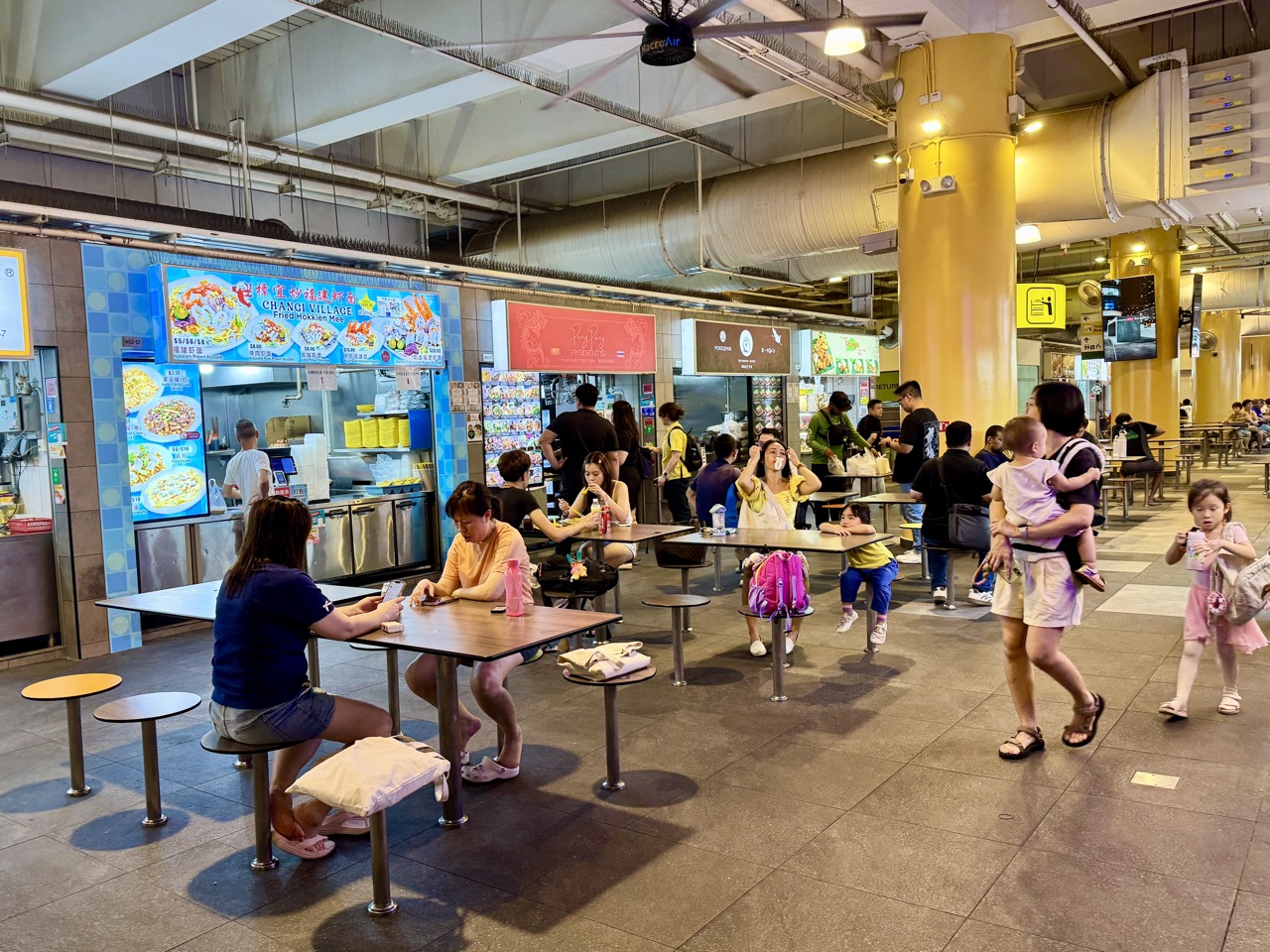
One Punggol Hawker Centre is on Level 2 of the community hub at 1 Punggol Drive. Our new October 2026 photographs show customers ordering and food-delivery workers collecting meals in the same public dining space. This article follows the practical handover journey: the kitchen prepares the order, someone collects it, and the surrounding footpaths and dining tables remain useful to everybody. It is not a delivery-platform promotion or a claim about any photographed worker’s employment, pay or personal identity.
One Punggol Hawker Centre sits on Level 2 of One Punggol at 1 Punggol Drive, Singapore 828629. Hawkermania took over centre management from 15 August 2026. The newly uploaded October 2026 images show diners near food counters while delivery workers collect orders. They capture an everyday challenge: food prepared for a person who will eat elsewhere moves through the same public space as food bought by somebody sitting at a table. The arrangements have to coexist without blocking or confusing one another.
A simple pickup involves several distinct steps: a customer places an order, the stall receives it, staff prepare and pack it, a collector finds the correct counter, the handover is checked, and food is transported safely. Our photograph cannot verify any pictured worker’s platform, pay or employment classification. This guide concentrates on the shared environment, practical handover habits and published food-safety principles rather than making claims about individuals.

One Punggol food pickup: quick answers
- Venue: One Punggol Hawker Centre, Level 2, 1 Punggol Drive, Singapore 828629.
- 2026 operator: Hawkermania took over management on 15 August 2026 after Timbre+ Hawkers’ tenure ended.
- Photographed activity: food vendors, dine-in customers, takeaway queues and delivery collectors in the same public dining area.
- Key distinction: an order pickup point is not necessarily the same space as the dine-in ordering queue or tray-return station.
- Food safety: SFA says food-delivery businesses must transport ready-to-eat meals without compromising safety; appropriate packaging and temperature control matter.
- Practical visitor response: follow current operator and stall signage, keep pedestrian routes open and do not infer rules from where another person happened to stand.
Why this is a different article from the ordinary hawker-centre guide
People searching for One Punggol Hawker Centre may want prices, dishes, opening hours or directions. Those questions are handled by the existing hawker-centre guide and Level 2 family photo guide. A delivery pickup is a narrower question. It adds another flow of people and meals that a general diner may not immediately notice.
This article therefore explains the order handover and shared-space decisions without pretending to be a directory of delivery platforms. A customer waiting at a table, a vendor managing several tickets and a collector seeking an order may all use the same few metres differently. Understanding each role helps reduce assumptions and makes the setting easier for families and older students to understand.
A delivery order creates a journey before anyone eats
For a dine-in meal, the customer usually goes to the stall, orders, collects food and returns to a table. For an app-based or otherwise arranged delivery, the eater may never enter the hawker centre. Instead, information about an order travels to the food vendor while another person is expected to collect the package. That makes accuracy at handover important, because the person taking the food may not be the person who chose it.
The photograph captures only part of that chain. It does not show the customer’s address or message, the payment arrangement or whether a courier is an employee, contractor or platform worker. A responsible explanation stays with the visible public activity and uses official sources for wider rules.
Why the stall and the collector can experience the same delay differently
A vendor may be preparing several orders while also serving walk-in customers. A delivery collector may arrive according to an estimated ready time but find that the order is still being packed. A diner in the next queue may simply want lunch before a scheduled appointment. These people have different clocks and priorities, yet their actions interact in a shared space.
The solution is not to blame whichever person is visible in the photograph. A meaningful assessment would need actual order timing, staffing and service information. For everyday courtesy, the useful rule is to ask concise questions, respect the current queue arrangements and avoid obstructing other people while waiting.
Order placement is a different stage from collection
An electronic order can arrive at a stall before the assigned collector appears. In some systems, the collector may be assigned later; in others, dispatch timing follows different rules. A public photograph cannot establish which arrangement applied at One Punggol or to a pictured transaction. We should not assume that every courier has identical app features or collection instructions.
For an explanatory model, separate order receipt, preparation, packaging, readiness notification, collection and delivery. Each stage could affect waiting time. Students can sketch the sequence without attributing proprietary workflow details to a particular platform or vendor.
Why an order number matters
When many meals are in preparation, an order number or equivalent identifier can help staff give the correct package to the correct collector. It is not necessary to publish the number of a real customer’s order to teach the concept. In a hypothetical example, two orders might contain the same dish but different customisations, so identifying the item by food name alone could create confusion.
A collector should follow the stall’s current handover process and confirm only the details appropriate to that transaction. Diners waiting nearby can give staff and collectors enough space to check the package. Accuracy saves time later and protects the customer’s expectations.
The pickup counter and the payment counter need not be identical
A customer paying at a stall may queue at the menu board while a delivery collector is directed to another point for prepared orders. Some counters are too small for a fully separate flow, so procedures vary. The photographs do not establish a universal layout or a standing right for any visitor to skip a line.
The safe response is to read current signs and follow the staff’s instructions. If there is no clear label, ask briefly rather than cutting through customers or stationing a large bag across an aisle. Good conduct does not require special treatment; it requires clarity about which process is being served.
A hot meal still needs safe handling after it leaves the kitchen
SFA says food-delivery businesses must transport ready-to-eat food in a manner that does not compromise food safety. Its guidance points to suitable packaging and maintaining appropriate hot or cold conditions through the delivery process. The fact that food has been cooked is not a reason to leave it open or handle it carelessly on the journey.
The detailed precautions depend on the food and delivery arrangement, and the public photograph does not show the state of each insulated bag. This article does not certify an individual collector’s practice. It explains why the safe transport stage matters just as much as preparation when the eater is somewhere else.
Packaging is part of the product the customer receives
A takeaway customer needs more than good cooking. The container must suit the food, prevent avoidable spilling and protect the meal during collection and transport. Soup, beverages, rice dishes and fried foods may have different packaging challenges. A bag that appears closed in a photograph does not let us assess seal strength, leak risk or food temperatures.
A family can appreciate packaging as part of the service without opening or photographing someone else’s order. Older pupils can discuss how product design, hygiene and waste requirements interact. The aim is to understand trade-offs rather than insist that one disposable material solves every problem.
Why two drinks are not handled exactly like a hot rice meal
Hot rice, cold desserts and drinks may need different protection during a journey. SFA’s food-delivery guidance emphasises the appropriate maintenance of hot and cold chains. A container suitable for a dry sandwich may not be reliable for a large soup; a cold dessert may lose quality when exposed to heat.
None of this allows a passer-by to decide that a particular pictured package is unsafe. What matters is the specific product, packing method, transport duration and controls. Those details belong to the vendor and responsible delivery operator. For a school example, use imaginary meals and discuss what each would require.
Delivery collectors and dine-in diners share limited walking space
The Level 2 photographs show customers at tables and movement near multiple food counters. A collector with a large insulated bag may need enough room to approach the pickup point safely. At the same time, diners are carrying hot trays, older visitors may be walking slowly and families may have young children. None of these users has exclusive ownership of the aisle.
A considerate rule is to move to an appropriate waiting position rather than stopping across the route. Keep bags under control, avoid standing in doorways and follow venue signage. Good circulation is a shared responsibility, not a judgement about one group of workers.
What to do when the collection point is crowded
If several collectors arrive together, the stall may need time to identify ready orders. Joining a loose cluster at the counter without knowing whose order is ready can create confusion. A clearer process relies on the current counter instructions and a way to identify orders without blocking paying customers.
Visitors who are not collecting food can also help by leaving a suitable clear path. If the pickup area is not obvious, do not assume that the spot where a person stood in the photograph is a permanent designated point. Management may change arrangements over time or after a renovation.
One Punggol’s 2026 operator change is not a new delivery-policy guarantee
The Ministry of Sustainability and the Environment confirmed that Timbre and NEA agreed to end Timbre’s tenancy on 14 August 2026. Hawkermania took over from 15 August 2026. This is a genuine management milestone that affects which organisation to consult for current facility matters, but it does not establish that every delivery pickup process changed on the same date.
Older web pages may continue referring to Timbre-operated systems, menus or programmes. Use current operator notices for practical details instead of assuming an old loyalty arrangement or collection workflow still applies. A separate management change does not let a blogger invent new opening hours, pickup zones or platform partnerships.
A delivery bag in the picture is not a person’s employment record
Different people can make deliveries through different arrangements. Some may meet the statutory definition of a platform worker, others may be employees or self-employed providers. Singapore’s Platform Workers Act introduced protections from 1 January 2025 for workers who meet the relevant definition, including CPF contributions, work injury compensation and representation arrangements.
We cannot determine a person’s legal status, operator, income or protections from clothing or a photograph of an insulated bag. Anyone needing personal employment advice should examine their actual agreement and MOM’s official guidance. This article is about the public pickup environment, not profiling identifiable workers.
What a short wait might teach a Secondary student
Imagine a purely hypothetical stall receiving ten delivery orders in fifteen minutes and completing eight. Under simplified assumptions, a backlog of two builds during that interval. If walk-in orders are handled simultaneously, the picture becomes more complicated because the same workers or equipment may serve both flows.
Students can model two sources of arrival rather than treating everyone in a single line as the same kind of order. The actual rates at One Punggol are unknown. A good answer explains the variables and notes that real meal preparation can overlap and customers may cancel or change orders.
How to read a photograph without inventing a rider’s story
A scene of collectors and diners may tempt a writer to say workers are racing between jobs or that a particular app is assigning too many orders. Those claims involve private information and wider system data not supplied by the image. A photograph documents visible movements at one time and angle.
A precise caption says that people are collecting food while others queue or dine. That is useful enough. For any claim about working conditions, operating rules or the industry, seek current official information and proper evidence. Ethical publishing is especially important when the subjects are workers who did not volunteer to be case studies.
A family meal and a delivery pickup can happen comfortably together
A family arriving for lunch should first identify a suitable table and current stall queues rather than worry about every person carrying a takeaway bag. Most people are simply completing different tasks in the same food environment. The centre’s design and management arrangements help determine where activities belong.
If a collector needs space to retrieve an order, diners can avoid crowding the counter. In return, collectors can keep thoroughfares clear and move away after handover. Small courtesies are often more useful than sweeping rules that assume conflict between groups.
The broader lesson: food delivery is a service system
The customer rarely sees the entire path from order receipt to consumption. The kitchen prepares, someone collects, the route is travelled, and the buyer receives food. Information, timing and hygiene connect the stages. A failure at any one stage can affect the whole experience even when the food was well cooked.
For students, drawing this chain is a practical lesson in systems thinking. For families, understanding the chain encourages realistic expectations about preparation and collection. For public discussion, it reminds us to avoid blaming people from one isolated photograph. A shared venue works through coordination, not a single heroic action.
Why a ready notification is not proof that every item is packed
In a delivery system, the message that an order is ready and the physical handover need to align. An alert may indicate the next step for a collector, but only the vendor’s actual current process determines whether a package can be taken. A public article should not infer the design of a named app from a photograph of someone standing near a stall.
In a hypothetical workflow, staff might prepare a drink at the end while the main dish is already packed. That final step can matter to the customer even though the order looks almost complete. Clear communication reduces confusion when multiple parties have different information about timing.
The difference between order accuracy and order speed
A pickup completed in a few seconds is not successful if it is the wrong meal. Correct identifying details, suitable packaging and the right collection process all matter. Vendors and collectors can have different ways of verifying an order, and those procedures should be followed rather than improvised from a third-party article.
For a classroom example, imagine two orders with identical main dishes but different sauces. Handing over the wrong package is an accuracy failure even if the queue moved fast. A responsible system balances speed with checking and food safety. The important metric is not simply how rapidly somebody leaves the counter.
When a customer is standing in the same aisle as a collector
Our new images include Level 2 food queues and tables in close proximity. A dine-in buyer may be looking at a menu while a courier is trying to see a pickup number. If everyone stands immediately in front of the same narrow space, a small confusion can become a bottleneck. The solution is to respect current queue and waiting areas.
There is no reason for a customer to resent all delivery collectors or for a collector to treat other diners as obstacles. Everyone is legitimately using a food venue. Courtesy means not blocking access, listening to staff and moving away once the relevant transaction is complete.
What a vendor might do to organise two streams of orders
A counter may handle walk-in orders and remote orders through different channels. In a hypothetical design, one screen could show incoming orders while another area holds completed packages, but this is not a claim about the exact configuration of One Punggol stalls. The practical requirement is clear status information and safe handover.
A student studying service design can ask where errors might arise: a printed ticket could be misplaced, two customers may have similar names or a collector might arrive early. Those are potential failure modes that deserve thoughtful design. Do not inspect private screens or publish actual customer order data during an informal visit.
Why the same queue length may hide different kinds of work
A line of ten walk-in customers does not tell us how many remote orders are being prepared in the kitchen. Likewise, seeing three delivery bags by a counter does not tell us how many meals are inside each order. Counting people and counting completed meals are different measurements. A fair operational assessment requires consistent definitions.
For students, label a diagram with ‘walk-in arrivals’, ‘remote-order arrivals’ and ‘completed food packages’. Then explore what happens when one stream suddenly grows. The exercise reveals why one photograph cannot support claims about a hawker’s productivity or a rider’s waiting time across the entire day.
The hot-versus-cold transport problem
SFA’s requirements for food-delivery businesses state that transported ready-to-eat food must remain safe, with the industry guidance emphasising appropriate packaging and hot or cold chain management. A container can appear secure from the outside and still fail to maintain the right conditions, which is why visual impressions are not enough.
A hypothetical lunch combining hot noodles and a chilled dessert raises a question about separate thermal needs. The responsible provider must use arrangements suited to the food. A family should not use an online photo to accuse a pictured worker of mishandling a meal or promise that every delivery will remain at a particular temperature.
Why a delivery worker is not automatically a food handler
Singapore Food Agency distinguishes workers preparing or handling food in the food-preparation sense from people transporting already packed meals. Its delivery-business guidance says delivery workers are not required to take the WSQ Food Safety Course Level 1 simply for delivery because they are not directly involved in preparing the food.
That distinction should not be mistaken for an exemption from transport safety. Food still must be delivered without compromising its condition. Legal categories matter, and one worker might have additional duties in a particular arrangement. The actual activity and applicable guidance determine the responsibilities; a photograph cannot settle the person’s full job description.
The Platform Workers Act needs the correct legal definition
MOM’s Platform Workers Act has applied from 1 January 2025 and provides specified protections for people who meet the definition of platform worker, including work-injury compensation, CPF contributions and representation. The definition depends on a qualifying platform work agreement and management control, not simply a person carrying a delivery bag.
Some delivery workers may be employees or self-employed individuals under arrangements outside that definition. An image cannot reveal contract terms, birth year, contribution elections or earnings. This guide links to MOM for the general distinction while leaving personal advice to accurate individual records and the applicable authority.
A photograph should never disclose a customer’s delivery address
Order labels, phones and receipts can carry names, contact information or destinations. A public photographer does not need those details to explain how a hawker centre works. Frame the surrounding public activity rather than zoom in on readable private information. Where an image accidentally contains sensitive details, do not reproduce them in captions.
Students learning ethical media production can still describe a package handover and public queue. The aim is to understand workflow, not expose individual customers. A clean, useful article protects people who came to buy lunch or do their work rather than participate in a research project.
Why there is no universal ‘correct pickup spot’ in an old photo
Collection instructions can change with stall operations, operator management, refurbishment or safety needs. A person photographed standing near one counter does not establish that everyone should wait there later. It might have been a temporary place to check an order, or simply a moment on the way through.
For a live pickup, the current vendor and centre management instructions prevail. For a public dining visit, follow posted signs and avoid blocking areas used to carry food. A photo-led guide should help people recognise the environment while refusing to invent a permanent pickup policy.
How families can help keep a clear passage
Parents sometimes stop beside a busy counter to discuss several menu choices. That can unintentionally block a collector’s route, a cleaner’s cart or a person carrying a tray. Move to a safe side area to decide what to eat before approaching the relevant queue. Once the meal is collected, move away from the stall before opening every container.
These habits make life easier for dine-in visitors too. People using wheelchairs, mobility aids or strollers may need additional turning space. A crowded hawker centre is not designed around one person’s preference; consideration for others makes the room work better.
What a pickup means for older residents and mobility-aid users
A customer with limited mobility may need more time to choose food or find a comfortable route. That should not be treated as a delay to be criticised. Delivery collection creates another demand for space, but it does not remove the importance of inclusive public passage.
The exact Level 2 access route and waiting arrangements should be checked on site, especially where a lift or temporary barrier affects movement. A photograph of a wide aisle cannot prove that every approach is step-free or suitable. Ask the relevant person about their needs rather than assume them from age or appearance.
Clean tables and delivery collections are separate systems
NEA’s Clean Tables initiative requires diners to clear table litter and return used trays and crockery appropriately. A delivery collector picking up packed meals is ordinarily not taking the same journey as a dine-in customer returning plates. The two streams may pass near one another, but they serve different tasks.
Avoid using a used-tray return station as an improvised waiting place for food deliveries or personal bags. Follow the centre’s signs. The October photographs include an utensil area; a utensil point should not be labelled as a tray-return point merely because both relate to dining equipment.
What to do if a package appears incomplete
The appropriate response depends on whether you are the person collecting or the customer receiving the meal. A collector should use the designated verification and contact process rather than open sealed packages without authorisation. A customer who receives a missing or incorrect item should follow the vendor or platform’s reported problem process.
Do not publish a worker’s face, vehicle registration or private contact details during a dispute. Keep relevant evidence such as order confirmations within appropriate channels. This article is not an instruction to accuse workers on social media because a meal was delayed or missing.
Why a missed estimated time is not proof of misconduct
A preparation-time estimate or pickup-time prediction is affected by order volume and the rules of a specific system. If one meal is not ready at the predicted moment, the reasons could vary. The photographer cannot know the true cause from a single waiting scene, and the article does not claim a specific vendor or collector behaved improperly.
A good analysis distinguishes the time an order was received, the time food was ready, the time it was collected and the time it reached the eater. Without those timestamps, the word ‘delay’ may refer to different stages. Data quality comes before assigning responsibility.
How to model the food-delivery chain in a classroom
An older student can draw six stages: order received, food prepared, food packed, collector arrives, handover checked and delivery completed. Put a hypothetical time beside each stage, then ask how a variation in one step affects the whole process. This is a form of systems and operations reasoning that does not require any real person’s order details.
For example, a three-minute packaging delay could affect collection even if cooking finished on time. If the collector arrived later than planned, preparation and arrival times interact differently. The example should remain fictional because the photographs do not contain a validated dataset of One Punggol orders.
A Mathematics problem about two order streams
Imagine a fictional stall receiving eight walk-in orders and six delivery orders in ten minutes. It completes twelve orders. Under a simplified single shared queue, two orders remain outstanding. If five new orders arrive in the next period and twelve are completed, the backlog may be cleared, provided capacity and order mix permit it.
This is a teaching model, not measured throughput for any One Punggol stall. Students should mark which numbers represent arrivals and which represent completions. They should also question the assumption that every order needs identical preparation time. That critical step distinguishes an applied problem from mere arithmetic.
A service-design exercise for a clearer collection area
Ask students to imagine a counter that serves both dine-in and delivery customers. They can propose readable signs, unobstructed standing areas and a simple way to distinguish ready orders. The goal is to reduce confusion while preserving accessibility and pedestrian circulation. A diagram can be drawn on paper without photographing real customers’ screens.
Then critique the design. Does it create a bottleneck near an exit? Could somebody using a mobility aid understand it? Does it allow staff to correct a wrong order privately? A good solution must balance several people’s needs, not simply make delivery collectors move fastest.
A food-science exercise about safe transport
Young learners can ask why hot and cold food need different transport arrangements. The answer involves avoiding temperature conditions that compromise safety and quality; the exact regulatory requirements should be taken from SFA guidance. Older students can discuss why container materials, insulation and time influence transport conditions.
Do not conduct unsafe experiments by leaving cooked meals at room temperature for extended periods and then eating them. A school demonstration can use non-food materials or approved educational methods instead. The real meal should always be handled in accordance with proper food-safety practice.
Why packaging creates environmental trade-offs
Sealed or insulated packaging can protect a meal, but some materials also create waste. A delivery service must balance hygiene, leakage, thermal performance, cost and disposal. It would be simplistic to declare that every reusable container is always appropriate for every delivery or that every disposable package is irresponsible.
Students can compare possible design criteria without making factual claims about the specific packaging used by photographed vendors. The most useful exercise names the trade-offs and explores lawful, safe options. A local food centre connects environmental questions to everyday purchasing decisions.
A parent’s short conversation while waiting for lunch
When children notice people collecting bags of food, parents can explain that some meals are prepared for people who will eat elsewhere. The collector’s job is to transport an order, while the stall prepares it. You can describe this without identifying the person or discussing private earnings.
A young child might ask why a collector waits in a different area. The answer is that the venue’s actual process may separate ordering from pickup, and the family should follow the posted instructions. Keep the conversation kind and short, particularly when staff are busy.
A calm thirty-minute family meal is still the priority
A family visiting One Punggol does not need to plan around the delivery industry. Its goal may simply be lunch between a library visit and another errand. Before ordering, choose an appropriate table if one is available, identify a suitable stall and agree who supervises children while hot food is collected.
Delivery workers are part of the scene, but not a distraction that must dominate the outing. Keep children out of crowded serving aisles, move thoughtfully with trays and return used crockery. A little consideration makes the space work for both the people eating there and those collecting meals for others.
How to document the October image accurately
A grounded caption might say that people are collecting orders while other customers queue in One Punggol Hawker Centre. An ungrounded caption would identify someone as a worker for a particular app, guess their wages or allege they had been waiting for twenty minutes. The photo does not contain those verified facts.
The same discipline applies to claims about popularity and service quality. One busy moment cannot prove that the entire venue is always crowded. Treat the image as a dated observation, then use current primary sources for management, laws and food-delivery standards.
What the August 2026 management change means for future readers
NEA appointed Hawkermania from 15 August 2026 after the previous operator’s tenure ended. The centre remains part of the socially-conscious enterprise hawker centre model, but particular programmes and operating arrangements may evolve. A dated photo guide should name that transition rather than copy the former operator’s information as though it remained current forever.
For a specific delivery pickup zone, stall contact or operating hour, the current vendor and operator are the right sources. For workers’ legal rights, MOM is authoritative. For safe transport, SFA provides the relevant framework. These roles should not be mixed merely because they all relate to a meal collected from the same building.
A simple final checklist for an actual pickup
Identify the correct One Punggol venue and floor, read the relevant stall or delivery instructions, approach without obstructing other diners and verify the order in the authorised way. Carry it using appropriate, clean transport equipment and follow the current platform or customer handover instructions. Avoid sharing private order details publicly.
These steps are general, not a replacement for an individual operator’s safety and collection policy. A consumer waiting at the same venue can do their part by leaving walking space and respecting workers. The aim is not to enforce imagined rules from a photograph but to make real shared space easier to use.


Frequently asked questions about food delivery pickups at One Punggol
Where is One Punggol Hawker Centre?
Level 2 of the One Punggol community hub at 1 Punggol Drive, Singapore 828629.
Who manages it in October 2026?
Hawkermania, appointed from 15 August 2026 after Timbre+ Hawkers’ tenure ended.
What do the new photographs show?
Food counters, dine-in customers, people collecting meals and a Level 2 dining space.
Do all riders collect food from one central desk?
This article has not verified a universal collection desk. Check each current stall or operator’s instructions.
Does a collection point remain the same every day?
Do not assume so from an old photograph; on-site arrangements can change.
Is a pickup queue the same as the dine-in queue?
Not necessarily. The relevant vendor and current operating arrangement determine the process.
Can a delivery collector skip every line?
No blanket entitlement is established. Follow the counter’s actual collection instructions.
Why does an order number matter?
It can help confirm that the prepared package matches the intended transaction.
Can I photograph an order label?
Avoid publishing customer names, addresses, telephone numbers or identifying order information.
Do food delivery businesses have food-safety duties?
Yes. SFA requires safe transportation of ready-to-eat food.
Must a delivery worker take WSQ Food Safety Course Level 1?
SFA says delivery-only workers who do not handle preparation are not required to take that course solely for delivery.
Are all delivery workers legally platform workers?
No. MOM’s definition depends on actual arrangements and management control.
What protections exist for qualifying platform workers?
MOM describes work injury compensation, CPF contributions and representation rights under the Platform Workers Act.
Can the photo establish someone’s platform or pay?
No. Appearance and a delivery bag cannot verify employment terms or earnings.
How can families help?
Keep aisles clear, follow stall queues, supervise children and avoid obstructing collectors or diners.
Should a collector open a sealed package to verify it?
Follow the authorised vendor or platform process rather than opening food packaging without permission.
What if a meal is incorrect?
Use the provider’s relevant problem-reporting and resolution channels with appropriate evidence.
Are all stalls available on delivery apps?
No such blanket claim is made. Current platform and vendor listings determine availability.
Does an operator change prove all delivery rules changed?
No. A management transition and a particular stall’s operating procedure are separate facts.
Is a food package always safe because it looks closed?
No. Appropriate preparation, packaging, transport time and thermal conditions also matter.
Do delivery orders make dine-in customers less important?
Both are legitimate flows; the venue and vendors manage their interaction.
Can students use the photographs for research?
Yes, for visual context and hypothetical workflow analysis, without intruding on private information.
Can a long queue establish poor service?
No. Proper evaluation requires defined arrivals, throughput, timing and context.
Where can I find today’s pickup instruction?
Use the current vendor, relevant platform and centre management instructions.
What if there is a temporary closure?
Check updated notices rather than assuming a photographed counter is operating.
How can I reduce confusion at a counter?
Identify the order correctly, ask concise questions and move away after pickup.
Is the article an endorsement of a delivery service?
No. It is an independent, photograph-led explanation of the shared food environment.
Official references and related Punggol guides
- SFA — Requirements for Food Delivery Businesses
- MOM — Who Is a Platform Worker?
- MOM — Platform Workers Act Protections
- MSE — One Punggol Hawker Centre Operator Transition
- NEA — Operator-managed Hawker Centres
- One Punggol Level 2 Photo and Family Dining Guide
- Working in Punggol — Delivery Riders and Platform Work
- One Punggol Integrated Hub Guide
October 2026 photo record and editorial review on 23 October 2026. The original images illustrate public ordering and collection. They do not identify a pictured courier’s employer, platform, contract, income, order contents or exact waiting time. Current counter instructions, legal definitions and SFA food-delivery requirements belong to the relevant authorities and providers.


