
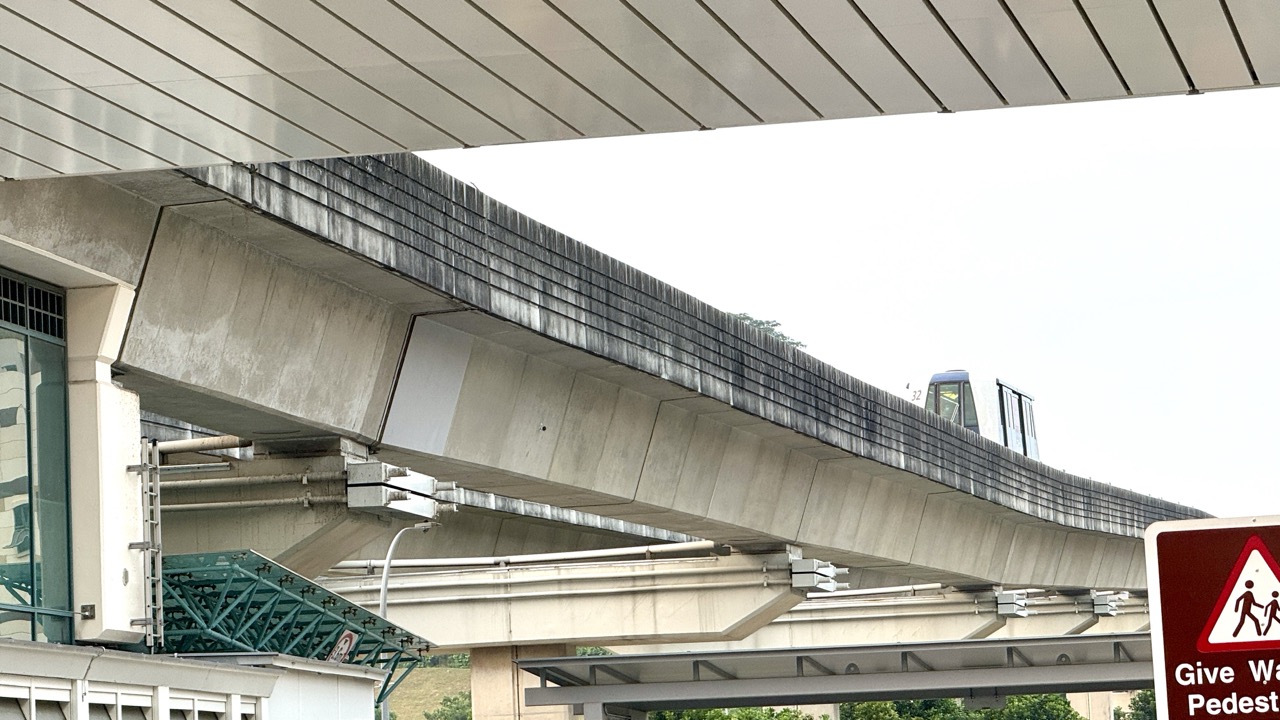
Want to photograph a Punggol LRT train passing near Sam Kee? Our new October 2026 photo collection shows exactly how interesting the scene can be: an elevated train, basketball courts underneath, a path alongside the viaduct and the wider One Punggol neighbourhood. You can use those photographs to learn composition, shutter speed, motion blur and careful visual storytelling—without entering rail property, standing in a road or interrupting people who are simply playing sport.
The first rule matters more than the camera: only photograph from a lawful, safe public position where photography is permitted, follow signs and transport staff instructions, and never climb barriers or approach tracks for a better angle. The Punggol LRT serves local neighbourhoods on two loops connected with Punggol MRT. Near Sam Kee, URA documents Punggol Green, a 1.2-hectare under-viaduct community park completed in 2022. That combination makes the area an excellent visual subject, but the photographs do not prove that every viewpoint is permanently open or that a particular train arrives at a predictable moment.

Sam Kee LRT train photography: quick-start guide
- Subject: Punggol LRT trains on the elevated West Loop infrastructure around Sam Kee and Punggol Green.
- Useful original images: train-only views, a train above basketball courts, and shared-path scenes from the October 2026 eduKatePunggol archive.
- First safety rule: stay on lawful, permitted public paths and viewing areas; avoid roads, construction sites, tracks, viaduct maintenance spaces and barriers.
- For a clear moving train: good light, steady framing and a sufficiently fast shutter can help reduce subject blur; exact settings depend on the device and conditions.
- For a sense of motion: panning or intentionally slower exposure can create blur, but experiment only while standing safely away from active paths.
- For the best story: include enough context—court, path, greenery or the railway structure—to show what makes Sam Kee recognisably Punggol.
- Privacy: don’t make identifiable children at playgrounds or sports courts the subject without appropriate permission.
- No drone shortcut: Singapore’s drone rules are separate; check CAAS and OneMap, including restricted airspace and permits, before considering any flight.
Official context comes from LTA’s Sengkang–Punggol LRT overview, URA’s Punggol Green design account, LTA’s active-mobility rules and CAAS drone restrictions. For facilities and general walking guidance, use the already-published Punggol Green under the LRT guide. This article is about making careful photographs and understanding the resulting images.
Why trains make challenging but rewarding photographs
A building sits still while you choose a frame. A train does not. It moves through the scene, appears at a position you did not entirely control and may disappear before you have adjusted exposure or composition. That makes railway photography a friendly introduction to anticipation. You plan the background and safe camera position first, then react when the train passes.
There’s no need to rush after it. Another service may come later, but use current operating information rather than assume a fixed interval from a photograph. If you miss the moment, keep the safe position or simply enjoy the walk. A photographer who stays out of everybody’s way has already made a more important decision than one who gets the perfect shot by creating a hazard.
What makes Sam Kee more than a generic train image
In our October photographs, the elevated railway sometimes shares the frame with neighbourhood sports. A person can be shooting basketball below as the train passes overhead. That contrast explains two uses of the same urban corridor: public transport carries people onward, while recreation invites them to stay. Including both lets a single picture tell a story about how Punggol works.
URA’s 2024 article describes Punggol Green as a 1.2-hectare public space under the viaduct between Punggol MRT and Sam Kee LRT, completed in 2022. The place has an urban-design history separate from the railway’s opening. A good caption can identify the transport and park context without claiming to know why an individual player was there.
Choose a safe place before thinking about camera settings
Look for a lawful public location where stopping will not block pedestrians, cyclists, mobility-aid users or people entering a court. Avoid the edge of a roadway, active cycling lanes, slopes beside tracks, restricted service areas and any point requiring you to climb a barrier. A wider angle from a safe location is better than a close-up that endangers you or others.
A path can be public yet still be too busy for a tripod or a person standing still for several minutes. Check local signs and choose a place where the photographer and bag fit comfortably off the movement line. If no suitable place exists, move on. There is no obligation to produce a photograph at every attractive angle.
A photo doesn’t grant permanent access to its camera position
One of the mistakes in copying online photographs is assuming the photographer’s exact viewpoint remains available. Paths can be affected by maintenance, events, diversions and temporary barriers. An image may have been captured with a different lens from a lawful position farther away than it appears. Do not use perspective as a set of instructions to approach the viaduct.
On the day, current barriers and site management determine access. If a desired viewpoint is blocked, find another legal composition rather than enter a restricted zone. Readers benefit more from an honest photograph of the view actually available than a dramatic frame obtained by ignoring rail safety.
Make the train a subject, not necessarily the whole picture
A photograph tightly filled with train windows may show the vehicle but lose the sense of Punggol. Including the elevated track, public space and background buildings can provide scale and local character. Our images that combine the passing train and basketball court make that relationship immediately visible. They are especially useful for explaining why this location differs from a generic transport photo.
Before shooting, decide what the photograph is about. If it is the train, simplify the frame around it. If it is the town, leave space for the court and walkway. Neither choice is automatically superior. A good photographer can make two deliberately different pictures from the same safe location without treating other park users as stage props.
Work with movement through the frame
Imagine a train entering from the left and moving toward the right. Leaving some visible space in the direction of travel can make the composition feel more natural. The viewer sees where the train is going. If the train is framed against clutter, changing your angle slightly within a safe standing area can help separate it from poles and buildings.
Do not step into a bicycle path to apply a rule about leading space. Composition rules are optional; safety is not. Sometimes a strong image places the train near an edge because the viaduct and sports court tell the more important story. Experiment through framing, not by chasing the vehicle.
How to hold a phone steadily
A modern smartphone can take a useful train photo without an expensive camera. Hold the phone with both hands, keep elbows comfortable and avoid leaning over railings. Use the normal camera view rather than making a dangerous reach toward the subject. Stabilisation reduces camera shake, though it cannot by itself freeze a moving train.
Take one moment to focus on the subject and decide the background. If the train passes quickly, a short burst or sequence may give you a choice of frames, depending on your phone’s features. Avoid staring at the screen while walking. Stop safely, compose and photograph; then put the device away before moving.
Shutter speed: why some trains look sharp
A camera records light over a period. A shorter exposure generally reduces the distance a moving subject travels during that exposure, helping it appear sharper. A longer exposure allows more movement and can produce blur. The exact result also depends on train speed, distance, focal length and the direction of movement relative to the camera.
On a camera with manual controls, an illustrative starting point for daylight action could be around 1/500 second, followed by adjustment. It is not a guarantee: a faster subject or closer angle may require a shorter exposure, while poor light may make high shutter speeds difficult. Phones often choose shutter speed automatically, so you may need to use their supported action or manual features.
Freeze motion versus show motion
A sharp train can highlight vehicle shape and station context. A motion-blurred train can communicate speed and movement. These are different storytelling goals, not simply a correct photo and a mistaken one. A photographer can deliberately choose between them by adjusting exposure and tracking technique.
For a first attempt, aim for an ordinary sharp image in good light. Once you can hold the camera steadily and frame from a safe position, experiment with intentional blur. The train will continue moving regardless of your shutter choice; the effect is created by how light is recorded. Don’t allow a camera experiment to interfere with your awareness of other path users.
Panning: keeping the moving subject in the frame
Panning means moving the camera smoothly to follow a subject while taking the photograph. When successful, the subject can appear relatively sharper against a streaked background, communicating motion. It takes practice and a suitable shutter setting. The result is not automatic; many attempts may be partially blurred.
Stand still in a safe, permitted area and pivot the camera with your upper body. Do not move your feet into another user’s path or lean over a barrier. Stop if the movement would endanger anyone. A gentle practice with an imaginary subject or a stationary framing exercise at home is often enough before trying a passing train.
Why side-on motion feels faster than a train approaching
A subject moving across your frame can shift position rapidly between moments. One approaching almost directly may appear to move less across the image even if its actual speed is similar. This is a perspective effect: the apparent motion depends on how the real movement relates to the camera’s viewing direction.
A student can compare the train images from different angles without claiming the service accelerated. It is also why motion blur alone cannot establish a train’s actual speed. To measure speed properly would require distance and time evidence from a suitable method; the photographs provide neither. An interesting image is not automatically a speedometer.
Focus first on something you can predict
A passing train may be easier to photograph if you focus on the approximate area where it will enter the frame. Phones may recognise the moving subject automatically, but autofocus performance varies. A manual camera may allow pre-focusing on a part of the track area visible from your safe position.
Never cross into railway property to inspect distance or focus. You are making a photograph from public space, not surveying the rail infrastructure. Check the final image for sharpness later rather than remaining glued to the screen near a busy public path.
What a wide-angle lens does to the viaduct
A wide-angle field of view can fit the railway, courts and open space into one picture. It is especially useful when the story is about layered land use. However, objects near the frame edge may appear stretched, and the train may look smaller than it felt in person. The choice is a visual trade-off.
A longer focal length can make distant structures look more tightly grouped, but it doesn’t physically bring a safe viewpoint closer to the tracks. Digital zoom may reduce detail, depending on the phone. Try to choose a suitable composition from an already safe place rather than alter your position to replicate an apparently dramatic telephoto picture.
The foreground helps explain scale
A path, tree, bench or court boundary can give viewers a sense of the train’s height and the space below. Without context, the elevated structure might be hard to place in the town. Our October photos with basketball players provide a familiar human-scale activity, but a photographer should not make identifiable children the centre of a public blog picture without appropriate permission.
You can achieve a similar sense of scale using built objects rather than faces: court lines, pillars, walkway edges and greenery. A careful caption tells readers what is visible and leaves out personal speculation. People can be part of public life without becoming identifiable characters in your article.
Photographing people at the sports court responsibly
A basketball game can add energy to a railway image. Yet the players are not necessarily there to be photographed. Respect requests not to be included, avoid close-up identifiable images without suitable permission and never enter the playing area to get a better angle. A stray ball and a photographer looking through a screen are a poor combination.
A wide architectural view can often tell the story without centring anyone’s face. If children are involved, be especially careful. A school project does not automatically override privacy or give permission to film a person. This is an important distinction for a site that publishes community photographs.
Why a picture can make a quiet place look crowded
Photographers choose frames. If ten people are clustered near one court, a tight crop can make the entire park seem busy. A wide view might reveal more open space. Neither automatically proves how the location behaves across a whole day. Timing and perspective influence the viewer’s impression.
An older student can compare two photos and discuss what lies outside the frame. Do not claim that Sam Kee is permanently crowded or empty based on the most striking image. A reliable photo essay combines visual interest with honest limits. A single frame can document a moment without becoming a survey.
Light makes moving subjects easier or harder
Bright daylight gives a camera more light to work with, which can help preserve a short exposure and lower sensor noise. Under heavy cloud or late in the evening, the camera may need longer exposure or higher sensitivity. Train images can become blurrier or grainier under those conditions, especially with a phone that chooses settings automatically.
You do not need to keep shooting until darkness makes the photo dramatic. If the footpath becomes less comfortable or visible, finish the session. The best lighting condition is one you can use safely and with an enjoyable amount of effort. A missed evening photo can be another day’s opportunity.
Exposure compensation and bright backgrounds
A bright sky behind the viaduct can cause a phone to darken the train and structures, making the subject appear silhouetted. That may be an intentional look, but it can also hide detail. Many cameras let you adjust exposure compensation or tap on a subject to influence metering. Use the supported controls and review the result from a safe standing position.
An image does not need to show every detail. Sometimes a silhouette communicates structure well; sometimes a balanced exposure better records the train. Explain your choice in the caption rather than editing the image so aggressively that it appears to show a different time or weather condition. Documentary photography benefits from faithful presentation.
Why high-contrast editing deserves restraint
Adding contrast can improve legibility, while extreme saturation or artificial sharpening may distort the scene. A photo intended as a local record should preserve the character of the place. It is reasonable to correct mild exposure issues, crop out irrelevant clutter or straighten a horizon; it is not appropriate to add buildings, erase barriers or imply a train was at a point it never reached.
If you create an artistic composite, label it clearly. A visual art image and a documentary record serve different purposes. The original October Punggol photo set is useful because the pictures correspond to named locations and visible moments. Trust grows when editing choices do not change the factual claim.
A good caption includes the location and the limitation
Try this: ‘Punggol LRT train passing near Sam Kee station above the Punggol Green recreation corridor, photographed October 2026.’ It describes the known scene and date. It does not assert which service the train was operating, the exact speed or the identities of people playing below.
Better captions are not necessarily longer. They name the subject, place and relevant time without inventing private details or operational information. If a reader needs current train timings, link to the operator. If they need the history of Sam Kee, use the existing historical article. The photograph and these sources answer different questions.
Alt text describes the image rather than advertising the article
Alt text helps people who use assistive technology understand the visual content. A useful description for the train-and-court photo might be ‘Punggol LRT train above an outdoor basketball court near Sam Kee’. There is no need to repeat the full headline, claim a service time or fill the field with unrelated search phrases.
A clear text alternative is part of making a local photo essay genuinely accessible. If the image is primarily decorative, the treatment may differ according to the publishing system. For meaningful documentary images, describe the scene concisely and accurately. Alt text is a communication tool, not a place to hide invented facts.
Metadata can be helpful without revealing personal details
A photograph may contain an upload date, camera details or location descriptions. These can support archival work, but they must be interpreted carefully. Uploading an image in October does not automatically establish the exact capture time, the train’s route or the speed of the passing vehicle. A camera’s exposure settings describe how the image was made, not every condition outside the frame.
Think before publishing precise location metadata that might expose a person’s home or routine. Public landmarks need broad identification; children’s private travel patterns do not. A good archive keeps useful place and date information while excluding unnecessary personal identifiers.
A student comparison of sharp and blurred trains
At home, choose two images of moving subjects from your own safe collection, one sharp and one blurred. Ask what differences might explain the result: exposure duration, camera movement, subject direction and available light. Try to identify which explanation is supported and which needs more information.
Do not assume all blur comes from high speed. Camera shake, focus errors and subject motion can all blur a photograph. The exercise develops a scientific habit: separate competing explanations and avoid deciding the answer from one dramatic visual clue. No work near active railway infrastructure is required to learn this.
A hypothetical shutter-speed calculation
Suppose a fictional object appears to move across the image at a constant rate. Reducing exposure duration from 1/60 second to 1/600 second decreases the time during which the sensor accumulates movement to one tenth. Under the simplifying assumption that other conditions remain equal, the distance the image moves across the sensor during exposure also becomes about one tenth.
That is a mathematical relationship, not a prediction of exactly how sharp a real Punggol train will appear. Camera movement, focus, light and the optical system also affect the result. A Secondary student can use the ratio to explain why faster shutters often help with moving subjects while recognising that exposure requires enough light.
A family photo walk can be very short
You do not need to cover the whole Punggol LRT West Loop. A safe public stop near a suitable view may provide one or two interesting frames before you continue with a normal family outing. If the area is crowded, wet or uncomfortable, leave. The child may prefer watching the train to taking pictures, and that is a perfectly good result.
A brief outing also reduces the temptation to photograph everyone in the park. Choose one clear subject, observe the context and keep the path usable. When a train passes, enjoy the moment even if the shutter was a second late. The purpose is curiosity about the neighbourhood, not a demand for perfect technical results.
What if the train does not arrive during your visit?
Service intervals depend on real operations, and no photograph can establish the next arrival. You can use a current operator source to understand the network, but there is no reason to stay in a crowded or unsafe position waiting indefinitely. Photograph the stationary viaduct, court or public landscape instead, or end the session.
This flexibility is a useful lesson for beginner photographers. A good plan has a primary subject and a reasonable alternative. You do not need to pursue a train down the line or move into a restricted area because the opportunity seems to be getting away. Railway infrastructure is a shared public utility, not a photography studio.
The public path beside the tracks has its own users
Our media library includes a path running beside the elevated track, with a family walking in one view. Other visitors may be cycling or walking for exercise. LTA distinguishes pedestrian-only paths, footpaths, cycling paths and shared paths; their permitted uses depend on present markings and the device involved.
Do not block the path with a tripod or camera bag while planning a composition. Move aside before stopping and check both directions for people approaching. A photographer’s attention narrows dramatically when concentrating on a viewfinder, so the safest approach is to settle into a suitable off-path position first.
Do not use a drone merely to copy a dramatic angle
An aerial photograph might appear attractive, but operating an unmanned aircraft in Singapore is subject to CAAS requirements, including restrictions near certain airspace and locations. The rules can involve registration, permits, flight areas and other conditions depending on the aircraft and purpose. Punggol’s proximity to aviation and regulated areas makes casual assumptions especially unwise.
CAAS directs pilots to check OneMap’s unmanned-aircraft information for no-fly and restricted areas. This article does not authorise a drone flight or assess a particular location’s eligibility. For the family or beginner photographer, a handheld camera from a lawful public location is a more straightforward way to learn about the rail corridor.
How to separate train photography from railway trespass
Tracks, service walkways, maintenance areas and the elevated viaduct are infrastructure, not public photography platforms. Do not enter them, climb protective structures, defeat gates or use a restricted emergency exit to reach a better angle. Avoid any attempt to interfere with vehicles or signalling. A photograph is never worth putting railway workers or commuters at risk.
If a transport or park employee gives a lawful instruction about where to stand or whether photography is allowed, follow it. Public access can be subject to local rules and temporary closures. Make your next picture from another permitted place or stop shooting. Technical advice cannot override access restrictions.
Why photographing the courts tells an urban-planning story
The Punggol Green project turned underused space beneath an elevated railway into community recreation. URA’s article explains that residents were consulted during development and that the area includes play, fitness and court uses. Our photograph of a train above basketball players makes the principle visible without needing a complex diagram.
The image is stronger when captioned with the actual place and planning source. It cannot prove how every resident feels about the park, how many people use it on average or whether a particular court is available now. For those questions, different evidence is required. That separation between a picture and a planning account is part of good local journalism.
A Primary English writing exercise from one frame
Ask a Primary pupil to describe only what can be seen: elevated train, court, players and path. Then invite one sentence about what might happen next, clearly as imagination. This teaches the difference between observation and storytelling. The pupil can use words such as above, beneath, beside and moving naturally rather than memorising them from an isolated list.
An older pupil can practise a photo-based conversation: ‘Why do you think people enjoy a place where they can play near public transport?’ The response can offer a reason, an example and a limitation. There is no need to claim that the pupil knows the pictured players’ opinions. Accurate language and personal voice are more valuable than a prepared slogan.
A Secondary Geography exercise about spatial layers
Draw a simple sketch of the railway above the court and the path next to it. Label each function and explain why they have different movement requirements. The rail moves passengers along fixed infrastructure; a court supports play; a path connects pedestrians and permitted riders. The drawing should make these relationships clearer without pretending to be an engineering plan.
Then ask what else would need to be checked before evaluating the park: accessibility, maintenance, shade at different hours and the experiences of diverse users. A photograph cannot settle those questions alone. The student learns how to use visual evidence as a starting point for structured inquiry.
An experiment in composition without using people as props
Choose two different crops of the same original train photograph. One crop includes the sports court and more of the park; the other focuses tightly on the vehicle and track. Ask what each emphasises and what each omits. This can be done at home on a copy of the file with no need to photograph strangers repeatedly.
Respect the original. Do not edit it so that it appears to show a dangerous or prohibited event that never occurred. A documentary caption should reflect the resulting frame accurately. Creative choices are valuable when they are transparent about what they change.
What a thoughtful Punggol railway photo essay looks like
A short photo essay could begin with a wide image of the viaduct and shared space, continue with a moving train, then include a context detail such as the court boundary or path. The captions would describe the fixed structures, movement and human-scale uses. They would not need to identify any individual player or invent train frequency.
This is not an itinerary with exact filming positions or a promise that every angle is accessible. It is an editorial sequence that can be assembled from the existing safe photographs. Readers who want route details can use official transport information and the Punggol Green guide. The purpose here is photographic literacy.
A final checklist before publishing a train picture
Check that the subject and location are correctly identified, the date is accurate, the image hasn’t been manipulated misleadingly and no unnecessary private information appears. If identifiable children or passengers are visible, consider appropriate permission or a different crop. Use clear alt text and caption any uncertainty rather than hiding it.
Finally, verify any operational claim with the actual authority. The photo documents a train near Sam Kee in October 2026; it cannot say when the next one arrives. A picture of a court does not confirm a booking. Keeping those boundaries clear is what turns a pleasing image into a trustworthy local record.


Frequently asked questions
Where is Sam Kee LRT?
Sam Kee is on the Punggol LRT system in the vicinity of One Punggol and Punggol Green. Use current station and public-path information.
Is it safe to photograph an LRT train?
Only from a lawful, permitted public position that does not obstruct other users; never enter rail or restricted maintenance areas.
Can I photograph from the elevated tracks?
No. Do not enter tracks, viaduct service areas or other restricted railway infrastructure.
Why is the photo of a moving train blurry?
Possible causes include subject motion, camera shake, focus and exposure duration. A single image may not distinguish them.
What shutter speed should I use?
A short daylight exposure such as around 1/500 second can be an illustrative starting point on a camera with manual controls, but results depend on conditions.
Can a phone take a clear moving train?
Yes, depending on light, focus, camera features and steadiness; a costly dedicated camera is not necessary for a useful first attempt.
What is panning?
Following a moving subject smoothly with the camera to create a particular relationship between subject sharpness and background blur.
Should I use a tripod on the shared path?
Never obstruct a path. Use equipment only where permitted and where it does not interfere with others.
Does a photo show the train’s real speed?
No. Speed measurement requires additional distance and time evidence; perspective and shutter speed affect visual blur.
What makes this location visually interesting?
The railway and Punggol Green recreation uses appear in the same urban corridor, as URA documents.
Can I photograph children playing basketball?
Avoid intrusive identifiable images of children without appropriate permission, and never enter an active court to stage a photo.
Is Punggol Green under the viaduct?
Yes. URA describes a 1.2-hectare community space under the corridor between Punggol MRT and Sam Kee LRT.
Is the Punggol LRT on one loop?
LTA describes the Punggol LRT system as two loops connected to Punggol MRT, serving 14 stations.
Can I use flash toward trains?
Avoid distracting or interfering with transport operations; comply with any posted restrictions and staff directions.
Can I fly a drone there?
Don’t assume so. CAAS drone requirements and OneMap’s current restriction information must be checked for the particular aircraft and location.
What if a viewing point is closed?
Respect barriers and choose another lawful location or end the session. A historic photo does not confer current access.
How should I caption the image?
Name the visible train, Sam Kee/Punggol context and date, while avoiding invented routes, speeds and personal information.
Can a child use the photo for a school project?
Yes, for language, geography, visual literacy or motion concepts, without entering restricted space or photographing people intrusively.
Does the photograph establish the next train time?
No. Use current official service information for journey planning.
What is the difference between a documentary and artistic edit?
An artistic image may transform the scene; label such changes clearly rather than presenting them as an untouched record.
Where can I learn more about the park?
Use the linked URA Punggol Green account and the site’s separate under-LRT community-space guide.
Official sources and related Punggol guides
- Land Transport Authority — Punggol LRT Network.
- Urban Redevelopment Authority — Punggol Green Community Space, 27 August 2024.
- URA — Playful Spaces, Joyful Places.
- LTA — Active Mobility Rules and Public Path Etiquette.
- CAAS — Requirements for Flying Unmanned Aircraft.
- CAAS — No-Fly Zones and OneMap Drone Information.
- Punggol Green Beneath the LRT — Community Uses and Walking.
- Sam Kee LRT History.
- Punggol in Pictures — October 2026 Archive
Editorial review: 23 October 2026. Original illustrative photographs are from eduKatePunggol’s October 2026 Punggol LRT and Sam Kee upload. All shutter speeds and worked calculations are examples, not specifications or measurements of the pictured train. Photographers must respect rail property, public-path rules, local photography restrictions and other people’s privacy.


