
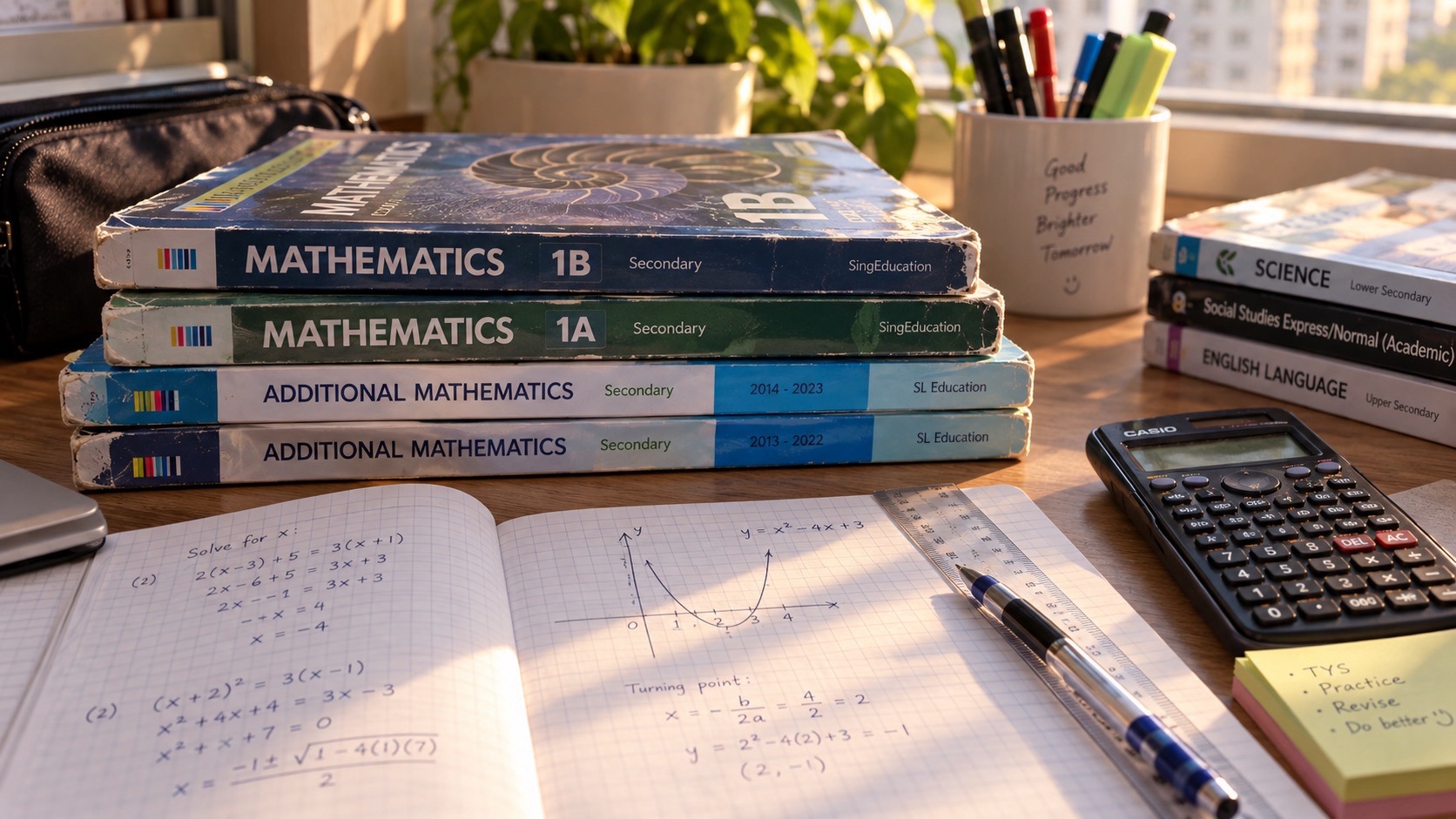
Is your child ready to move from Primary 5 to Primary 6 Mathematics and the 2027 PSLE? Check the foundations that later questions depend on: number facts, fraction equivalence, percentage meaning, decimal place value, equal groups, area, cuboid volume and independent interpretation of unfamiliar word problems. A child does not need to race through next year’s textbook to build useful readiness.
Punggol families can learn more from a ten-minute diagnostic than from comparing two headline test percentages. A child who can represent a ratio but miscalculates multiplication needs an arithmetic repair. A child who calculates perfectly but cannot tell whether a given number is a total or a difference needs work on representation. Good preparation begins at that first unstable point, then checks whether the correction transfers to a new question.
This parent-and-student learning guide provides thirty original worked diagnostics, a method for recording independent reasoning, a six-week consolidation schedule and a bridge to the existing Punggol Mathematics articles. It is not an official PSLE paper or a standardised placement test. Every example involving money, cards or activities is invented for teaching, and no numerical result is presented as real school or local student data.
Choose your diagnostic route
Use the syllabus, original worked checks and the six-week repair plan in the order that suits your child’s current learning.
- What the official Primary Mathematics progression says
- Readiness is a chain of dependencies, not a list of chapters
- Thirty original worked readiness checks
- Three learning paths: repair, stabilise and extend
- Six-week preparation route with an evidence checkpoint
- An effective fifteen-minute parent conversation
- What three-student tuition should actually change
- Frequently asked questions
- Official and eduKate learning routes
What the official Primary Mathematics progression says
The MOE 2021 Primary Mathematics syllabus, updated October 2025, applies to Primary 6 from 2026 and organises learning into number and algebra, measurement and geometry, and statistics. A parent should use this progression together with the child’s school instructions. A topic’s relationship to earlier skills matters more than its place on a commercially produced exercise-book cover.
Under the revised 2026 SEAB Standard Mathematics 0008 format, both papers carry 50 marks; Paper 1 is non-calculator while Paper 2 allows an approved calculator. These are verified 2026 facts. Families preparing for 2027 should check the eventual year-specific examination information rather than assume the booklet structure or examination calendar is already confirmed.
Foundation Mathematics 0038 has a separate syllabus and assessment. This Standard-oriented learning map cannot decide a pupil’s subject path. Match practice to the child’s school level and ask teachers about any placement question. A readiness diagnostic is meant to uncover teaching needs, not make an unsupported claim about future examination eligibility or achievement levels.
Readiness is a chain of dependencies, not a list of chapters
| Earlier skill | Later skill that uses it | Symptom to investigate |
| Multiplication and division | Averages, ratios, cuboid volume | Correct diagram but wrong product or quotient |
| Equivalent fractions | Fraction division, percentages and comparison | Adds denominators or changes the whole |
| Decimal place value | Money, percentages and measures | Answer off by a factor of ten |
| Area and perimeter | Circles and composite figures | Counts an inside joining edge or uses cm² for a boundary |
| Bar models and equal groups | One-variable equations and word problems | Calculates before defining an unknown |
| Reading a table | Averages and data interpretation | Treats a group mean as one observation |
Consider a pupil who cannot solve a missing-height problem. The problem may be a volume topic, but the earliest weakness could be multiplication, rectangle area, division or the difference between square and cubic units. Teaching ‘volume = length × width × height’ repeatedly may not repair the actual error. Instead, draw a rectangle of unit squares, add identical layers and ask how many layers a stated volume represents.
The same dependency principle applies to percentages. A child who knows that 20% equals one fifth may still fail a reverse discount when the printed price is 80% of the original. The arithmetic can be accurate while the wrong quantity was named 100%. A careful tutor asks which amount existed before the change and which amount remains afterward. That one question can prevent several unnecessary calculation steps.
How to use this diagnostic fairly
- Split the thirty questions into short sessions. Try the first ten foundation items before the next ten mixed relationships and ten previews.
- Let the child attempt each problem independently before hints. Record independent, prompted or not-yet-secure rather than only right or wrong.
- Ask for an explanation of one correct answer as well as one incorrect answer; correct digits can be obtained by lucky guessing.
- Capture the first wrong mathematical decision and its reason, not a general label such as careless.
- Repeat an unseen version two days later and again after a week to test genuine retention.
This is a classroom-style observation procedure, not a validated psychological assessment. Do not use it to assign a permanent label to a pupil or to compare siblings. A current Primary 5 student may not yet have encountered some Primary 6 preview topics; record that as ‘not yet taught’ rather than as failure. The value comes from seeing which foundations have already been taught and are stable enough for extension.
Thirty original worked readiness checks
Original diagnostic 1. Common factor
Question. Find the greatest common factor of 24 and 36.
Worked answer. 12, because both numbers are divisible by 12 and share no larger factor.
Mathematical idea. Common factors help simplify fractions.
Check. 24/12 = 2 and 36/12 = 3.
What to listen for. First ask the pupil what a common factor means rather than announcing that this is a highest-common-factor question. Many pupils can find twelve by trial; the real understanding is that the same factor divides both values exactly. This feeds later simplification of fractions and equivalent ratios.
Original diagnostic 2. Equivalent fractions
Question. Find 3/4 + 1/8.
Worked answer. 3/4 = 6/8, so answer 7/8.
Mathematical idea. Fractions must have equally sized parts before addition.
Check. 7/8 − 1/8 = 3/4.
What to listen for. Give an equivalent fraction a visible model. One quarter of a strip must be divided into two equal eighths before it can be added to another eighth. A student who keeps unlike pieces separate develops a general rule that is more useful than memorising ‘find a common denominator’.
Original diagnostic 3. Fraction of a whole
Question. Find 5/6 of 72.
Worked answer. One sixth is 12; five sixths = 60.
Mathematical idea. The whole must be divided into six equal units.
Check. 60/72 simplifies to 5/6.
What to listen for. Make the meaning of ‘of’ explicit. Five sixths of seventy-two means seventy-two has been divided into six equal parts and five chosen. The answer is smaller than the whole, and the inverse fraction comparison provides a quick reasonableness check.
Original diagnostic 4. Decimal addition
Question. Find 3.75 + 2.60.
Worked answer. 6.35, aligning tenths and hundredths.
Mathematical idea. Place values carry more meaning than the position of the last visible digit.
Check. 6.35 − 2.60 = 3.75.
What to listen for. Place-value errors deserve a targeted correction. A decimal such as 2.60 still contains six tenths and zero hundredths. A pupil who adds visible digits without aligning units is practising symbol matching rather than understanding quantity.
Original diagnostic 5. Quarter of a total
Question. Find 25% of 160.
Worked answer. One quarter of 160 = 40.
Mathematical idea. 25% is 25 out of 100, the same as one quarter.
Check. 40 × 4 = 160.
What to listen for. Twenty-five percent is a quarter. A child who recognises that link can calculate quickly without a calculator, but the result only makes sense after the reference whole is identified. Ask whether the entire 160 belongs to the same collection.
Original diagnostic 6. One equal price
Question. Six identical imaginary tickets cost $48. Find the price of one.
Worked answer. 48 ÷ 6 = $8.
Mathematical idea. Six identical prices build the full amount.
Check. 6 × 8 = 48.
What to listen for. Equal groups are the beginning of algebraic reasoning. If six identical tickets cost forty-eight dollars, one ticket has a price that can be represented by a letter. The multiplication fact and the equation describe the same situation.
Original diagnostic 7. Rectangle area
Question. Find area of a 15-cm by 8-cm rectangle.
Worked answer. 15 × 8 = 120 cm².
Mathematical idea. Area counts square units covering the interior.
Check. 120 divided by one side 15 gives the other side 8.
What to listen for. Ask the learner to draw one square-centimetre tile. A rectangle area tells how many such tiles cover the surface, not how many centimetres are traced along its boundary. The unit checks the choice of operation.
Original diagnostic 8. Cuboid volume
Question. Find volume of a 10-by-6-by-4-cm cuboid.
Worked answer. 10 × 6 × 4 = 240 cm³.
Mathematical idea. Each 1-cm layer has base area 60 cm².
Check. 60 × 4 = 240.
What to listen for. A cuboid can be viewed as repeated rectangular layers. Counting the base area and number of layers exposes the difference between cm² and cm³. If the pupil counts only cubes visible from the front, use a small physical model.
Original diagnostic 9. Missing triangle angle
Question. A triangle has angles 65° and 55°. Find the third.
Worked answer. 180 − 65 − 55 = 60°.
Mathematical idea. Three interior angles of a triangle total 180°.
Check. 65 + 55 + 60 = 180.
What to listen for. Triangles may be rotated or drawn approximately. The angle-sum rule remains 180 degrees and should be applied to the three interior angles, not external angles created by extensions. A check by addition is faster than redrawing the whole figure.
Original diagnostic 10. Reading a data table
Question. Three fictional counts are 18, 22 and 15. Find the total.
Worked answer. 18 + 22 + 15 = 55.
Mathematical idea. A total is the sum, not a mean or the last recorded value.
Check. 55 − 18 − 22 = 15.
What to listen for. Show three table entries and ask what they each represent. A table sum is not an average and a total is not a percentage. Naming the observed quantity now prepares the pupil for Primary 6 averages and data interpretation.
Original diagnostic 11. Repeated groups plus extra
Question. Four identical packs hold n pencils each; nine extra pencils make 45. Find n.
Worked answer. 4n + 9 = 45, so n = 9.
Mathematical idea. The equal groups and separate extra quantity are different parts.
Check. 4 × 9 + 9 = 45.
What to listen for. A simple equation should be read as equal groups plus an additional fixed part. Ask what one n represents and why nine is separate. A bar model and the algebraic sentence 4n + 9 = 45 should tell the same story.
Original diagnostic 12. Fraction remaining
Question. Two fifths of the collection are red. What fraction is not red?
Worked answer. 1 − 2/5 = 3/5.
Mathematical idea. Parts of the same whole sum to one.
Check. 3/5 + 2/5 = 1.
What to listen for. The complement of a fraction uses the same reference whole. If two fifths of an actual collection are red, the remaining three fifths covers every item not red. A different denominator might mean the pupil has silently changed the whole.
Original diagnostic 13. Rectangle perimeter
Question. A rectangle has sides 13 cm and 7 cm. Find perimeter.
Worked answer. 2 × (13 + 7) = 40 cm.
Mathematical idea. Perimeter measures all four exposed sides.
Check. 13 + 7 + 13 + 7 = 40.
What to listen for. For perimeter, trace each exposed edge. It is possible to multiply the length and width correctly but calculate area instead of boundary. Make the answer unit a deliberate choice before proceeding.
Original diagnostic 14. Sharing mass
Question. 960 g is shared equally among eight small bags. Find mass per bag.
Worked answer. 960 ÷ 8 = 120 g.
Mathematical idea. A mass per bag is one equal share, not total mass.
Check. 120 × 8 = 960 g.
What to listen for. A mass shared equally among bags is an amount per bag. A correct arithmetic result with a wrong label shows that the child has not yet connected the number to what is being measured.
Original diagnostic 15. Additive pattern
Question. Complete 5, 12, 19, __, __.
Worked answer. Add seven each time, giving 26 and 33.
Mathematical idea. Differences between consecutive numbers reveal the rule.
Check. 12 − 5, 19 − 12, 26 − 19 and 33 − 26 all equal seven.
What to listen for. Predict a sequence’s next value by naming its relationship, not by assuming every pattern doubles. Additive and multiplicative patterns can look similar over two terms, so a pupil should compare several consecutive steps.
Primary 6 preview: what is taught next is a bridge, not an exam claim
The next fifteen questions deliberately introduce or revisit concepts that become prominent in the Primary 6 sequence. A current Primary 5 pupil should not be penalised for material not yet taught in school. The diagnostic purpose is to identify which earlier representations are ready for new learning and which should be consolidated first.
Original diagnostic 16. Divide a proper fraction
Question. Calculate 3/4 ÷ 3.
Worked answer. 3/4 × 1/3 = 1/4.
Mathematical idea. Three equal shares each receive less than the original amount.
Check. 3 × 1/4 = 3/4.
What to listen for. Sharing a fractional amount among whole-number recipients differs from asking how many fractional-size groups fit. The first produces smaller equal shares. Have the pupil draw a strip to show why the result is one quarter.
Original diagnostic 17. Fraction-sized groups
Question. Calculate 2/3 ÷ 1/6.
Worked answer. 2/3 = 4/6; quotient = 4.
Mathematical idea. The divisor describes the size of each group, not a number of recipients.
Check. 4 × 1/6 = 2/3.
What to listen for. A small divisor can produce a larger numerical quotient. The question asks how many one-sixth units fit into two thirds. Convert to four sixths and the answer becomes a direct count, not a surprising calculator result.
Original diagnostic 18. Ratio from a total
Question. A:B = 3:5. Together they have 80. Find both.
Worked answer. Eight parts total; one part is 10. A = 30; B = 50.
Mathematical idea. The 80 refers to the whole collection.
Check. 30 + 50 = 80.
What to listen for. The ratio 3:5 says one group has three equal parts for every five in the other. With a known total, all eight parts describe the whole. Ask the pupil to state why the eight—not just the first three—was used.
Original diagnostic 19. Ratio from a difference
Question. A:B = 2:7. B exceeds A by 25. Find both.
Worked answer. Five parts equal 25, so one part is five. A = 10; B = 35.
Mathematical idea. The given number is the gap between groups, not their combined total.
Check. 35 − 10 = 25.
What to listen for. A ratio difference supplies a different reference. Five parts represent the gap between seven and two, while nine parts would represent the combined total. The answer must match the exact wording of the question.
Original diagnostic 20. Reverse a percentage
Question. A fictional item costs $96 after a 20% discount. Find the original price.
Worked answer. $96 is 80%, so original is 96 ÷ 0.8 = $120.
Mathematical idea. The discounted amount is not the reference whole.
Check. 20% of $120 is $24; sale price is $96.
What to listen for. A discounted price is a remaining percentage of the original. If the child adds twenty percent of ninety-six to ninety-six, they will recover the wrong starting value because the percentage is now applied to the wrong base.
Original diagnostic 21. Percentage increase
Question. A count goes from 160 to 184. What is the percentage increase?
Worked answer. Change is 24; 24/160 = 15%.
Mathematical idea. The original count is the 100% reference.
Check. 160 × 1.15 = 184.
What to listen for. Percentage increase uses the original value as denominator. The amount of increase alone is not a percentage, and the new larger total is not automatically the correct reference. Ask the learner to identify the earlier 100%.
Original diagnostic 22. One-variable equation
Question. Solve 5x + 7 = 47.
Worked answer. 5x = 40; x = 8.
Mathematical idea. Undo addition before dividing the equal groups.
Check. 5 × 8 + 7 = 47.
What to listen for. An equation can be solved by undoing operations in reverse order. The fixed seven was added after multiplying x by five; subtract it first. Substitution into the original equality validates the result.
Original diagnostic 23. Substitute a value
Question. Evaluate 3x + 5 when x = 4.
Worked answer. 3 × 4 + 5 = 17.
Mathematical idea. 3x is multiplication and x stands for a specified number.
Check. 12 + 5 = 17.
What to listen for. A letter does not have to mean an unknown every time. Here x is supplied and the task is substitution, with 3x representing a product. This distinction supports later algebra where symbols describe relationships.
Original diagnostic 24. Circle circumference
Question. Use π = 22/7 to find circumference when radius is 7 cm.
Worked answer. 2 × 22/7 × 7 = 44 cm.
Mathematical idea. Circumference measures a boundary, not covered area.
Check. Diameter is 14; π × 14 = 44.
What to listen for. Radius and diameter are different lengths. A drawn line from centre to boundary is a radius; a line across the circle through the centre is a diameter. Geometry errors often begin before the formula is selected.
Original diagnostic 25. Semicircle perimeter
Question. Radius is 7 cm and π = 22/7. Find the full perimeter.
Worked answer. Curved arc 22 cm plus diameter 14 cm gives 36 cm.
Mathematical idea. The straight base is part of the half-circle boundary.
Check. 22 + 14 = 36.
What to listen for. A semicircle’s curved arc is only half a circumference; its full perimeter includes the straight diameter. Trace the actual exposed boundary and label centimetres, not square centimetres.
Original diagnostic 26. Quarter-circle area
Question. Radius is 14 cm and π = 22/7. Find one-quarter circle’s area.
Worked answer. Full circle area 616 cm²; one quarter = 154 cm².
Mathematical idea. Quartering area does not quarter radius.
Check. 4 × 154 = 616.
What to listen for. The quarter-circle area retains the original radius, then takes a quarter of the full disk area. Dividing the radius by four would change the radius, and area would then change much more dramatically.
Original diagnostic 27. Average of observations
Question. Find the average of 10, 12, 14 and 16.
Worked answer. Sum 52 ÷ 4 = 13.
Mathematical idea. Mean is the total equally shared across observations.
Check. 13 × 4 = 52.
What to listen for. An average is a total evenly redistributed, even when no individual observation equals the average. Ask what is being counted and how many values are involved before dividing.
Original diagnostic 28. One missing observation
Question. Five values average 18; four have total 72. Find the fifth.
Worked answer. Five values total 90, so missing = 18.
Mathematical idea. Average × count reconstructs the hidden whole.
Check. (72 + 18)/5 = 18.
What to listen for. When an average and count are known, the original total can be reconstructed. The missing observation is the difference between that total and the known entries; comparing only the missing number with the average is unreliable.
Original diagnostic 29. Cube edge
Question. A cube has volume 216 cm³. Find the edge.
Worked answer. 6 × 6 × 6 = 216, so 6 cm.
Mathematical idea. All three cube dimensions are equal; the edge is not volume divided by three.
Check. 6³ = 216.
What to listen for. A cube is not three edges added together. Its volume multiplies the same edge three times. The number six is an edge length, while 216 describes a three-dimensional quantity.
Original diagnostic 30. Missing cuboid height
Question. Volume is 360 cm³; base sides are 12 cm and 5 cm. Find height.
Worked answer. Base area = 60 cm²; height = 360/60 = 6 cm.
Mathematical idea. Reverse volume = base area × height.
Check. 12 × 5 × 6 = 360.
What to listen for. A missing cuboid height is an inverse layer-counting question. Dividing volume by base area gives how many centimetre-thick layers fill the box. Units and multiplication supply independent checks.
Three learning paths: repair, stabilise and extend
Repair: Return to the first insecure relationship. If equivalent fractions are unclear, draw differently partitioned wholes before introducing fraction division. If area and volume are confused, cover a surface in square tiles and then stack layers of cubes. An earlier foundation is not beneath a Primary 5 child; it is the support on which later reasoning depends.
Stabilise: Use short mixed questions that revisit already-taught ideas without naming the method. A pupil who always performs well under a ‘Percentages’ heading may still fail when the same relationship appears in a word problem. Change the wording, check the reference whole and return to the question after two days.
Extend: When the foundation is secure, compare a bar model with an algebraic equation or two different cuboids with the same volume. Such extension builds transfer, not just greater difficulty. The goal is for the student to explain why a method works under a changed condition.
Six-week preparation route with an evidence checkpoint
| Week | Focus | At-home evidence |
| 1 | Multiplication, factors and decimals | Correct arithmetic and reverse calculation without hints |
| 2 | Fraction equivalence and part-whole percentage | Reference whole stays consistent in changed examples |
| 3 | Bar models and equal unknown groups | Can translate a short story into a diagram and equation |
| 4 | Area, perimeter, volume and units | Names whether answer uses cm, cm² or cm³ |
| 5 | Mixed ratio, averages and circle previews | Can choose a representation without a topic heading |
| 6 | Delayed retrieval and mini diagnostic | Can solve an unseen variant after two days or a week |
A six-week plan is not a promise of improvement by a particular date. A child who is weak in multiplication may need additional focused time; a confident learner can move rapidly to new contexts. Parents should also preserve time for school assignments, CCAs, rest and reading. The quantity of practice is less useful than its clear learning purpose.
An effective fifteen-minute parent conversation
Ask the child to show how they know that three quarters are six eighths, or why a rectangle’s area has square units. Then ask one familiar word problem in different words. The learner’s explanation exposes whether a method is understood or simply copied from the page before.
If an answer is wrong, ask what was first confusing. Avoid immediate correction by giving every step. Use a small concrete version, such as two equal groups with a few counters, then restore the original values and allow a fresh attempt. Save only the essential evidence: first mistake, repaired idea, and a new independent check.
A good parent can help without becoming the mathematics teacher for every chapter. The task is to notice patterns, communicate them to the class teacher or tutor, and create calm opportunities for retrieval. If the child independently corrects an old mistake in a new context, acknowledge the mathematical process rather than celebrating only speed.
What three-student tuition should actually change
A three-pupil small-group tutorial can support different learning routes. One pupil may need a fraction-strip demonstration, a second might need to stop applying ratio totals to differences, and a third could benefit from explaining steps clearly in an equation. Giving all three identical worksheets would waste the diagnostic information.
The teacher can start with a shared model, observe individual written reasoning, offer short targeted corrections and finish with unseen independent problems. Whether the child studies at school, at home or with a tutor, genuine progress is the ability to choose and check a method without constant teacher prompts.
eduKate’s small-group tutorial framework emphasises diagnosis, first-principles rebuilding and gradual independent transfer. Punggol parents can use the same questions when evaluating any extra support: what weak link was found, what changed in teaching, and what evidence shows the learner can now manage the idea alone?
Eight parent–student case studies: from the first error to a reliable retry
Case study 1: When the arithmetic is correct but the model is wrong
Suppose a pupil sees A:B = 3:5 and is told B exceeds A by 20. The pupil divides 20 by eight, the sum of the parts, rather than by the difference of two parts. Their division may be impeccable, but the result does not represent the given condition. The repair begins by drawing three equal boxes for A and five for B. The gap is two boxes, so each box represents ten; A is thirty and B is fifty.
After the correction, give a new question with A:B = 4:7 and a difference of 18. Ask for the sizes of both groups without announcing that it is a ‘difference ratio’ problem. Three parts equal eighteen, so the values are twenty-four and forty-two. This checks whether the child has learned to identify the reference before calculating.
Case study 2: When a fraction calculation gives the wrong size
A pupil may calculate 2/3 ÷ 1/6 and answer 2/18 because they have multiplied or divided the printed numerators and denominators mechanically. Instead of showing the reciprocal trick again immediately, rewrite two thirds as four sixths and ask how many one-sixth pieces fit. Four pieces fit, so the answer must be four. Only then explain why multiplying by the divisor’s reciprocal yields the same result.
Use a contrast question immediately afterward: 2/3 ÷ 3. Here the operation describes sharing the fractional amount among three recipients, resulting in 2/9 for each. Comparing the two stories helps distinguish equal sharing from measuring group counts. A child who can explain why one quotient is greater and the other smaller has acquired useful number sense.
Case study 3: When units are treated as decoration
A child who computes 12 × 5 × 6 = 360 may write 360 cm² even when the question asks for cuboid volume. The arithmetic alone cannot tell the tutor whether the child understands the difference between surface and space. Rebuild the solid as a 12-by-5 rectangular base containing sixty unit squares, then stack six one-centimetre layers to obtain 360 unit cubes.
The follow-up task should reverse the relationship. Give volume 360 cm³ and base area 60 cm², then ask for height. The answer is six centimetres because cubic units divided by square units give a length. This test reveals whether the pupil has understood dimensional relationships rather than memorised a three-number product.
Case study 4: When a correct method does not survive a new sentence
A child may solve 4x + 9 = 45 easily, but fail the same relationship written as ‘four equal packets and nine loose pencils total forty-five’. The difficulty is not necessarily algebraic manipulation. It may be recognising which quantity repeats and which quantity is fixed. Ask the pupil to name one packet’s pencil count, draw four equal boxes and label nine extra items beside them.
After the model is secure, show the written equation and compare it with the boxes. Next change the context to four identical stationery sets and a separate fee; ask the pupil to build the equation without hints. The child should preserve four repeated unknown costs plus one fixed fee. That is a transfer test between language and symbols.
Case study 5: When an average conceals the total
A missing-value problem tells the learner that five observations average eighteen and four known values sum to seventy-two. A pupil may subtract seventy-two from eighteen because those are the two numbers visible in the question. The essential bridge is recognising that five values with mean eighteen must total ninety. Then the unknown observation is ninety minus seventy-two, or eighteen.
A useful variation changes the count: six values average eighteen, and five known values total ninety-six. The whole must be 108, leaving a missing value of twelve. Ask whether the difference in result came from the new count, the known subtotal or both. This reasoning supports more complex statistics without introducing advanced formulas.
Case study 6: When an exam score obscures a narrow gap
Suppose a child earns a moderate score on a mixed paper, with losses mainly from one weak representation of fractions and one confusing unit conversion. Repeating the entire syllabus may be inefficient. Copy two short examples, note the first wrong step, teach the missing relationship and give a new question of the same structure two days later. The intervention is small but measurable.
If the next attempt is independent and correct, broaden the mix of topics. If the same problem returns, simplify the representation further. When a child becomes upset or fatigued, stop and return after rest. The purpose of an error log is to guide learning decisions, not to create an intimidating archive of deficiencies.
Case study 7: When early acceleration is the wrong solution
A pupil who can complete a complex-looking Secondary 1 equation with teacher prompting may still be weak in Primary 5 decimal place value. That achievement is not useless, but it does not remove the missing foundation. Before pushing further ahead, check whether the learner can solve simple fraction, percentage and division questions unaided. Weak number sense can make later symbolic work unnecessarily expensive.
The more meaningful extension for a confident child is to solve one problem in two forms: an equal-parts bar model and a simple equation. Ask why both represent the same numbers and what assumptions each requires. This develops generalisation without treating speed through the next textbook as a measure of intelligence.
Case study 8: When a parent and tutor compare evidence
At a consultation, parents can bring a recent school worksheet, one corrected problem and one new independent attempt. The most useful question is not ‘How many more marks will tuition guarantee?’ but ‘Which mathematical decision keeps going wrong and how will the next lesson test whether it is repaired?’ A good reply should identify an observable skill and a realistic sequence of teaching.
One pupil may need concrete fraction strips; another might need tighter working presentation; a third could benefit from interleaving familiar topics. A small group only becomes effective when the teacher uses such differences to adapt the work. Progress can be reviewed by looking at how the pupil reasons on unseen questions, not just by collecting completed pages.
A practical one-page record for the school–home bridge
Record the date and topic, the pupil’s first attempted representation, the first point of uncertainty, a brief correction, a new independent problem and the date of the follow-up. Keep the record simple enough to use. A useful entry might read: ‘Pupil used total parts instead of difference parts in a ratio problem; drew two-group bars; solved a new question after forty-eight hours without a hint.’ This is more actionable than ‘careless ratio error’.
Invite the child to select one problem they can now explain clearly. Give them room to demonstrate the reasoning and its check. Learning is becoming more independent when the pupil names the correct whole, operation and unit without the adult supplying each step. The objective is a steady transition to Primary 6 school work, not a forced imitation of a full PSLE examination before the child has begun the school year.
Frequently asked questions
Should Primary 5 students finish the Primary 6 textbook early?
Not automatically. Secure the earlier mathematical ideas, preview suitable new relationships and align with the school. Completing chapters ahead does not show independent understanding.
Is the 2027 PSLE examination format final?
SEAB’s revised 2026 Standard Mathematics format is the official year-specific document verified for this guide. Check a later 2027 publication when issued.
Should Foundation Mathematics pupils use the whole checklist?
No. Foundation Mathematics follows a distinct syllabus and assessment. Ask the school about the current subject path and use level-appropriate practice.
My child can calculate but cannot form a word-problem equation. What now?
Teach the translation between equal groups, a simple bar and a mathematical sentence. More arithmetic drills alone will not fix uncertainty about what an unknown represents.
What if one error keeps returning?
Return to the simplest representation that makes the relationship visible, practise one new application and check again after a delay. A copied correction is not durable mastery.
How much home practice is necessary?
There is no universal quota. Choose a few short purposeful tasks based on the observed error, allow time to explain and preserve a sustainable routine alongside other responsibilities.
Official and eduKate learning routes
- MOE Primary Mathematics syllabus updated October 2025 — official scope.
- SEAB PSLE formats examined in 2026 — the confirmed year-specific reference.
- Primary 5 Mathematics Punggol study guide — worked foundations.
- Primary 6 PSLE Mathematics topic index — distinct focused learning routes.
- 2027 Paper 1 preparation and 2027 Paper 2 preparation — future assessment skills.
- Simple linear equations, ratio and fractions, and cuboid volume — topic-specific examples.
The transition goal is a learner who can explain what a number means before performing an operation. When families repair the earliest shaky concepts, ask for independent reasoning and make practice sustainable, Primary 6 becomes a clearer next chapter rather than a race.


