
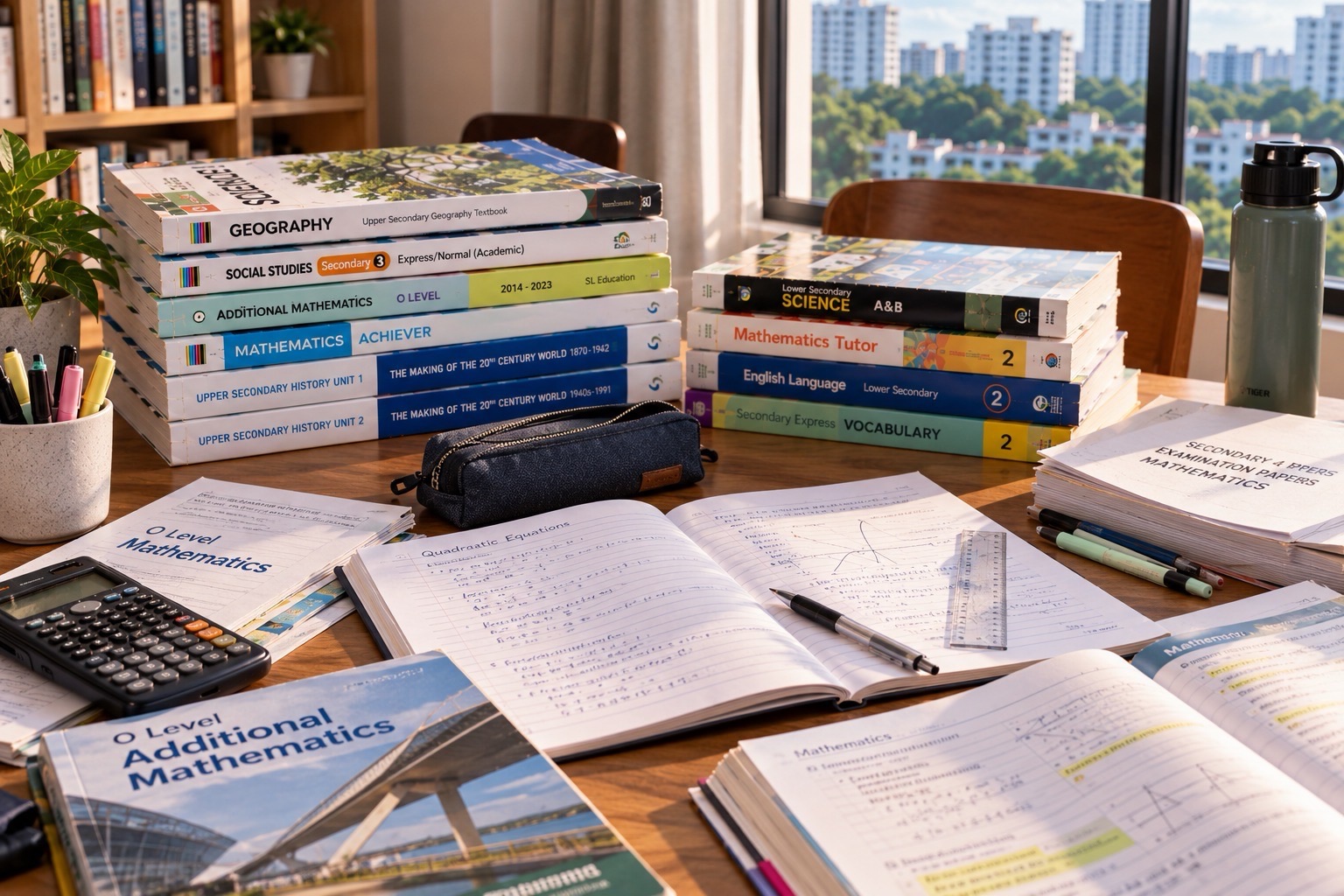
How should a Punggol pupil prepare for PSLE Mathematics Paper 1 in 2027? Make non-calculator number sense reliable first, then practise choosing the correct operation, eliminating implausible multiple-choice answers, presenting short-answer working and checking each result in its original context. Accuracy is not the same thing as speed. The best early preparation makes each calculation understandable, then gradually reduces the time needed.
The revised 2026 Standard PSLE Mathematics (0008) structure is the latest official PSLE Mathematics format available in the SEAB sources checked for this guide. It allocates 50 marks and 1 hour 10 minutes to non-calculator Paper 1. Booklet A contains 18 multiple-choice questions, ten worth one mark and eight worth two marks; Booklet B contains 12 two-mark short-answer questions. For 2027, families must verify the official SEAB format when it is issued rather than assume that every administrative detail is unchanged.
This Punggol guide provides an original thirty-question practice bank, a diagnostic decision tree, careful time-planning exercises and a home-to-tuition learning route. It is not an official mock examination. The practice examples deliberately cut across fractions, percentages, number operations, ratio, algebra and geometry because Paper 1 assesses mathematics, not a single tuition chapter. The quantities are invented for learning; they are not local survey data or results attributed to real students.
Find your Paper 1 learning step
Follow the official reference, practise original non-calculator questions, then use the checks, diagnostics and revision plan below.
- What is confirmed, what is not, and why that distinction matters
- What to diagnose before starting a practice paper
- The Paper 1 four-pass technique
- Thirty original Paper 1-style mathematical checks — not a specimen paper
- When does multiple-choice elimination count as mathematical reasoning?
- Booklet B short answers: how much working is enough?
- The correction log: evidence instead of labels
- A practical four-week no-calculator improvement routine
- Small-group tutoring: what should be different from another worksheet?
- Frequently asked questions for Punggol parents
- Official sources and related Punggol guides
- Elimination by units and scale
Other Punggol learning routes
What is confirmed, what is not, and why that distinction matters
SEAB publishes the examination specifications, while MOE specifies the learning curriculum. In the 2026 PSLE Mathematics page, Standard Mathematics is subject 0008, separate from Foundation Mathematics subject 0038. The 2026 examination document states the Paper 1 booklet breakdown, duration and no-calculator rule. These are confirmed 2026 facts and sensible starting assumptions for learning—not an independently verified 2027 timetable.
The MOE 2021 Primary Mathematics syllabus, updated October 2025, has applied to Primary 6 from 2026. Families entering Primary 6 in 2027 can use it to organise concepts, then check subsequent official updates. The syllabus places understanding, application and problem-solving at the centre of learning. A Paper 1 plan should therefore develop arithmetic and representation together.
| 2026 Standard Mathematics 0008 | Published structure | Preparation implication |
| Paper 1, Booklet A | 10 one-mark MCQs + 8 two-mark MCQs | Accurate selection from four choices and sound reasoning |
| Paper 1, Booklet B | 12 short-answer questions, two marks each | Correct answers and visible methods when needed |
| Paper 1 total | 50 marks in 1 hour 10 minutes | Plan, practise and check without a calculator |
| Paper 2 for comparison | 50 marks in 1 hour 20 minutes; calculator allowed | Keep a separate structured-working practice route |
| 2027 PSLE | Verify SEAB’s year-specific notice when published | Do not represent the 2026 format as a confirmed 2027 announcement |
Under the published 2026 short-answer marking explanation, a one-part two-mark short answer can receive a method mark if the final answer is incorrect but the method is correct. For two-part short answers, each correct part carries one mark. This does not mean every rough line of working automatically earns credit. It means that correct method and careful presentation are worth developing, while the question’s own instructions must still be followed.
What to diagnose before starting a practice paper
A pupil may know multiplication tables but misread what an unknown refers to. Another may understand the problem perfectly and make errors simplifying fractions. A third may perform short questions well but lose time checking every arithmetic step from the beginning. Those pupils need different repairs. Give three small prompts first: explain a simple ratio, solve an unfamiliar numerical equation, and identify a wrong answer without calculating the whole problem.
Watch the first incorrect mathematical decision. If the pupil confuses 3:5 with 3/5 of the total, the issue is the referent of a fraction. If a pupil knows a discount leaves 80% but multiplies by the 20% removed, the issue is identifying the given percentage. If a pupil uses a correct relationship but divides six times seven as 43, the issue is arithmetic retrieval. Labelling a child careless conceals the useful evidence.
Ask the learner to explain one correct answer as well. A pupil who answers a question accurately by guessing among four choices may have performed less reliable reasoning than a pupil who writes a clear process but makes one recoverable arithmetic slip. Confidence should be anchored to the method and its independent verification, not just to the mark.
The Paper 1 four-pass technique
- Pass 1 — identify. What is known? What must the answer measure? Is the printed number a whole, a part, a rate, an area or a count?
- Pass 2 — model. Choose a short number sentence, bar model, equivalent fraction, diagram or mental relationship. Do not let an answer option dictate the method.
- Pass 3 — calculate. Use exact, legal non-calculator arithmetic; cancel common factors where valid; keep intermediate values clear.
- Pass 4 — verify. Check the operation with a reverse calculation, estimate or substituted value. Restore the expected unit.
For a straightforward MCQ, these passes may happen mentally in seconds. For a two-mark short-answer item, it may be worth writing the model and one intermediate calculation. The point is that every learner practises a stable mathematical process before trying to beat the clock.
Thirty original Paper 1-style mathematical checks — not a specimen paper
Original worked check 1 · Multiplication and place value
Question. Find 36 × 25 without a calculator.
Worked answer. 25 is one quarter of 100, so 36 × 25 = (36 ÷ 4) × 100 = 900.
Underlying idea. Regroup a product using multiplication structure, not repeated written addition.
Verification. Check 900 ÷ 25 = 36. An answer of 90 has lost a place-value factor.
Original worked check 2 · Divide a larger whole number
Question. Find 504 ÷ 7.
Worked answer. Seven groups of 72 give 7 × 70 + 7 × 2 = 490 + 14 = 504, so the quotient is 72.
Underlying idea. Partition the quotient into easy multiples.
Verification. The inverse product 7 × 72 reconstructs 504.
Original worked check 3 · Proper fraction of a whole
Question. Find 3/8 of 64.
Worked answer. One eighth of 64 is 8, so three eighths is 3 × 8 = 24.
Underlying idea. Dividing into eight equal parts precedes selecting three parts.
Verification. 24 ÷ 64 = 3/8. If the answer exceeds 64, the model is wrong.
Original worked check 4 · Decimal multiplication
Question. Calculate 2.4 × 15.
Worked answer. 2.4 × (10 + 5) = 24 + 12 = 36.
Underlying idea. Distribution makes the decimal operation transparent.
Verification. 2.4 × 10 is 24, so 36 is plausible for multiplying by 15.
Original worked check 5 · A fractional difference
Question. Calculate 5/6 − 1/4.
Worked answer. Convert to twelfths: 10/12 − 3/12 = 7/12.
Underlying idea. Subtract parts of an equal-size whole; do not subtract denominators.
Verification. 7/12 + 1/4 = 10/12 = 5/6.
At this checkpoint, shuffle the question order and remove the chapter labels. Ask the child to decide what operation belongs before calculating. A pupil who recognises the same arithmetic only after hearing a topic name has not yet transferred the concept to unfamiliar assessment wording.
Original worked check 6 · Unit-fraction division
Question. Calculate 3/4 ÷ 1/8.
Worked answer. 3/4 = 6/8, so there are 6 one-eighth units.
Underlying idea. This is measured group-counting, not sharing among eight pupils.
Verification. 6 × 1/8 = 3/4. The quotient should exceed the dividend numerically.
Original worked check 7 · Sharing a proper fraction
Question. Calculate 4/5 ÷ 2.
Worked answer. 4/5 × 1/2 = 4/10 = 2/5.
Underlying idea. Two equal recipients receive half of the original fractional amount.
Verification. Two shares of 2/5 reconstruct 4/5.
Original worked check 8 · Percentage as part of a whole
Question. Calculate 15% of 240.
Worked answer. 10% is 24 and 5% is 12. Together 36.
Underlying idea. Decompose 15% into familiar percentage parts.
Verification. 36 ÷ 240 = 0.15, or 15%.
Original worked check 9 · A known sale price
Question. A fictional item costs $80 and is discounted 25%. Find its sale price.
Worked answer. One quarter of $80 is $20. Price after discount = 80 − 20 = $60.
Underlying idea. Twenty-five percent is a part removed from the original price.
Verification. $60 is 75% of $80.
Original worked check 10 · Recover a total from a part
Question. A hypothetical collection has 45 red counters, or 30% of all counters. Find the total.
Worked answer. 10% is 45 ÷ 3 = 15. Full 100% is 10 × 15 = 150 counters.
Underlying idea. The given 45 is not the whole, only the stated 30%.
Verification. 30% of 150 = 45.
This set combines percent, fraction and ratio references. Ask the student which number is the total, which is a part and whether a given difference is being mistaken for a combined whole. The method should follow the measured relationship, not the nouns in a story.
Original worked check 11 · Two-part ratio
Question. Red:blue = 2:3 and there are 40 objects in total. How many are blue?
Worked answer. Five equal parts make 40, so one part is 8; blue = 3 × 8 = 24.
Underlying idea. Use the sum of the parts only because the number 40 is explicitly the whole.
Verification. The other group is 16; 16 + 24 = 40 and 16:24 = 2:3.
Original worked check 12 · Ratio from a difference
Question. A:B = 4:7, and B exceeds A by 15. Find A.
Worked answer. Difference is three parts, so one part equals 5; A = 4 × 5 = 20.
Underlying idea. The provided 15 is a difference, not a total.
Verification. B = 35, so B − A = 15 and A:B = 4:7.
Original worked check 13 · Averages
Question. Find the mean of 10, 14, 12 and 20.
Worked answer. Total = 56; number of values = 4; average = 14.
Underlying idea. The mean is the total evenly redistributed.
Verification. 14 × 4 = 56; 14 is between 10 and 20.
Original worked check 14 · Missing value from an average
Question. Five numbers average 18. Four sum to 70. Find the fifth.
Worked answer. Required total = 5 × 18 = 90; missing value = 90 − 70 = 20.
Underlying idea. Recover the full total before subtracting the known subtotal.
Verification. 70 + 20 = 90, and 90 ÷ 5 = 18.
Original worked check 15 · A simple equation
Question. Solve 5x + 7 = 47.
Worked answer. 5x = 40 after subtracting 7; x = 8.
Underlying idea. Undo addition before dividing into five equal groups.
Verification. 5 × 8 + 7 = 47.
The next group introduces mean and algebra. Ask what a letter represents before substitution and what each observed value represents before dividing to find an average. Being able to name a quantity is evidence of understanding, not wasted examination time.
Original worked check 16 · Another equation
Question. Solve 9y − 13 = 50.
Worked answer. Add 13 to both sides: 9y = 63; y = 7.
Underlying idea. The inverse of subtracting 13 is adding 13.
Verification. 9 × 7 − 13 = 50.
Original worked check 17 · Substitution
Question. Find 4a + 9 when a = 6.
Worked answer. 4 × 6 + 9 = 24 + 9 = 33.
Underlying idea. The letter stands for a specified numerical value; 4a means four times a.
Verification. Substitution back into the expression reproduces 33.
Original worked check 18 · Fraction and percent equality
Question. Express 3/5 as a percentage.
Worked answer. 3 ÷ 5 = 0.6, so the fraction is 60%.
Underlying idea. A proportion out of one whole converts to a proportion out of 100.
Verification. 60% = 60/100 = 3/5 after simplifying.
Original worked check 19 · Circle circumference
Question. Using π = 22/7, find circumference when radius is 7 cm.
Worked answer. 2 × 22/7 × 7 = 44 cm.
Underlying idea. Circumference measures the length around the circle.
Verification. Diameter is 14 cm; π × 14 = 44 cm.
Original worked check 20 · Circle area
Question. Using π = 22/7, find circle area when radius is 7 cm.
Worked answer. 22/7 × 7 × 7 = 154 cm².
Underlying idea. The square on radius represents a covered two-dimensional region.
Verification. Four quarter-circles would each have area 38.5 cm².
Geometry problems can be short but demand exact reading. Encourage pupils to label radius versus diameter, draw a boundary trace, and predict linear or square units before multiplying. A mathematically attractive number with the wrong quantity is not a complete answer.
Original worked check 21 · Semicircle perimeter
Question. A semicircle has radius 7 cm. Use π = 22/7. Find its full perimeter.
Worked answer. Curved arc is 22 cm and straight diameter is 14 cm; perimeter = 36 cm.
Underlying idea. Half a circumference is not the complete boundary of a semicircle.
Verification. Trace 22 + 14; the unit is cm rather than cm².
Original worked check 22 · Quarter-circle perimeter
Question. A quarter circle has radius 14 cm. Find its full perimeter using π = 22/7.
Worked answer. Arc = 22 cm; two radii = 28 cm. Total = 50 cm.
Underlying idea. The curved edge and both straight radii remain exposed.
Verification. 22 + 14 + 14 = 50.
Original worked check 23 · Cuboid volume
Question. A rectangular cuboid measures 8 × 5 × 4 cm. Find volume.
Worked answer. 8 × 5 × 4 = 160 cm³.
Underlying idea. Volume counts three-dimensional unit cubes.
Verification. One 8-by-5 layer contains 40 cubes; four layers give 160.
Original worked check 24 · Missing cuboid height
Question. A cuboid’s base area is 24 cm² and volume 168 cm³. Find height.
Worked answer. 168 ÷ 24 = 7 cm.
Underlying idea. The volume is seven layers of 24 cm².
Verification. 24 × 7 = 168 cm³. The result measures a length.
Original worked check 25 · Square angle
Question. A square corner is split into 35° and another angle. Find the other angle.
Worked answer. The corner totals 90°, so 90° − 35° = 55°.
Underlying idea. A square guarantees right angles regardless of how it is drawn.
Verification. 35 + 55 = 90.
At this stage, compare two student explanations of the same number. Which one identifies the appropriate property and which one applies a memorised formula without checking? The aim is not to write more words than necessary, but to make the mathematical premise visible.
Original worked check 26 · Parallelogram angle
Question. One interior angle of a parallelogram is 75°. Find an adjacent angle.
Worked answer. Adjacent angles total 180°, so the angle is 105°.
Underlying idea. Opposite sides are parallel, giving supplementary neighbouring corners.
Verification. 75 + 105 + 75 + 105 = 360°.
Original worked check 27 · Triangle interior angle
Question. A triangle has angles 48° and 67°. Find the third angle.
Worked answer. 180° − 48° − 67° = 65°.
Underlying idea. The sum of interior angles of a triangle is 180°.
Verification. 48 + 67 + 65 = 180.
Original worked check 28 · Whole versus part in a fraction
Question. Three quarters of 80 pupils participate in an imaginary event. How many participate?
Worked answer. One quarter is 20; three quarters = 60 pupils.
Underlying idea. The denominator four divides the known whole into equal shares.
Verification. 60 ÷ 80 = 3/4.
Original worked check 29 · A remaining amount
Question. A fictional household uses 2/5 of 75 cards. How many cards remain?
Worked answer. Used = (2/5) × 75 = 30. Remaining = 75 − 30 = 45.
Underlying idea. The question asks for the complement of the used part, not the used amount itself.
Verification. Three fifths of 75 = 45.
Original worked check 30 · Estimate before selecting an option
Question. Is 398 × 6 closer to 600, 1200, 2400 or 6000?
Worked answer. 398 × 6 = 2388, which is closest to 2400.
Underlying idea. Rounding 398 to 400 gives 2400 as a quick estimate, then exact multiplication confirms.
Verification. The difference from 2400 is only 12; the other options are far away.
The final mini-set tests whether the child can estimate, compare answer options and verify an unfamiliar number relationship. An independent estimate is especially valuable in multiple-choice questions because one plausible wrong option can match a common arithmetic error.
When does multiple-choice elimination count as mathematical reasoning?
Selecting an answer by eliminating impossible options can be sensible if the elimination uses a genuine property. For example, when the radius of a semicircle is seven centimetres, its full perimeter must be more than the 22-centimetre curved arc because the straight diameter contributes another fourteen. An option smaller than 22 can be rejected before computing the whole expression. This uses geometry, not lucky guessing.
A ratio problem offers another example. If two groups are in the ratio 2:3 and contain 40 objects together, their respective counts must be multiples of two and three times a common unit; they must also add to 40. Options that do not satisfy both properties can be eliminated. Nevertheless, an elimination method must still determine one correct answer rather than merely reduce four options to two equally plausible guesses.
Teach learners to separate estimation from exact calculation. Rounding 398 × 6 to 400 × 6 suggests an answer near 2400; it does not prove the exact product is 2400. When the options are close, exact computation is necessary. When they are widely separated, a good estimate may already distinguish the correct range. Both methods belong in a well-developed Paper 1 strategy.
Booklet B short answers: how much working is enough?
Short-answer questions differ from structured long-answer questions. A pupil should write the requested result clearly in the provided answer space, in the unit required by the question. Where there is one two-mark part and the answer is wrong, the published 2026 specification allows a method mark for a correct method. That is a reason to show the decisive calculation rather than only a guessed number, but not a reason to fill the page with redundant algebra.
A reliable compact pattern is one mathematical relationship, one calculation and a final answer. For a missing-height question: ‘Base area = 24 cm²; height = 168 ÷ 24 = 7 cm.’ The statement is short yet communicates the reason for division. For a ratio word problem, state the number of equal parts and the value of one part; then give the requested group count. Good working protects both the student’s thinking and the marker’s interpretation.
Students should not assume that a missing written unit always loses a mark under the same rule for every question. SEAB says the required answer unit is provided in the examination and candidates must give the answer in that unit. Practising correct units in daily work remains a valuable habit because the unit also helps confirm that the pupil found the right kind of quantity.
A time plan that adapts to the learner
| Practice stage | What the pupil does | Why it helps |
| Untimed diagnosis | Solve a short mixed set while describing each model. | Find the first conceptual or arithmetic weak link. |
| Gentle time awareness | Record approximate minutes for familiar and unfamiliar items separately. | See where slow work comes from without pressuring a pupil who is rebuilding. |
| Short mixed sets | Attempt eight to ten original questions without prompts. | Test topic switching instead of repeated same-type drills. |
| Full paper rehearsal | Use the official year-appropriate paper duration and format when available. | Practise pacing, answer checking and sensible skipping. |
| Post-paper correction | Classify each lost mark by source, repair and retry after a delay. | Convert assessment data into a learning plan. |
An arbitrary rule such as thirty seconds for every one-mark item can be unhelpful because some pupils need an extra moment to interpret a diagram while others lose time on basic products. The 2026 Paper 1 has 70 minutes for 30 questions, but marks and demands vary. Train a sequence of calm choices: secure clear questions, mark an uncertain item to revisit, avoid getting trapped, and reserve checking time after enough work has been attempted.
A timed routine should not begin while foundational concepts are unstable. First teach the mathematics correctly; then gradually practise it at the pace of assessment. Increasing speed before fixing a wrong ratio model merely produces a wrong answer faster. Progress is visible when the pupil handles a new question accurately with less prompting, not when an adult reports an impressive worksheet count.
The correction log: evidence instead of labels
| Error type | Evidence to collect | Next lesson |
| Arithmetic recall | The pupil models correctly but miscalculates products or equivalent fractions. | Teach one small number fact, then check it across three unfamiliar contexts. |
| Wrong referent | The pupil divides a stated difference by the sum of ratio terms. | Ask which quantity the given number measures before selecting parts. |
| Equation meaning | The pupil writes 5x + 7 = 47 but divides 47 by 5 first. | Use equal groups and remove the fixed seven first. |
| Geometry label | The pupil treats diameter as radius or area as perimeter. | Name centre, radius, covered region and outer boundary. |
| Time management | The pupil spends several minutes re-solving a one-mark item. | Practise a concise verification and move on when the method is secure. |
Parents can use a single notebook page with the date, a small copy of the question, the first incorrect step, the corrected reason and the date for a second attempt. Avoid recording only ‘careless mistake’ or ‘did not read’. These are labels, not explanations. More precise entries such as ‘treated 30% as the whole’ or ‘used radius 14 when diameter was 14’ tell the teacher where to start.
The learner should eventually be able to propose the correction independently. If the pupil can see and explain why an earlier method was wrong, try an unseen problem of the same structure after two days and again after a week. This spaced review protects against merely copying a correction once and forgetting the underlying relationship.
A practical four-week no-calculator improvement routine
| Week | Learning emphasis | Short home practice | Evidence of independent progress |
| 1 | Number facts, fractions and decimal place value | Three sessions of ten to fifteen minutes, with reverse checks | Correct products and equivalent fractions without calculator reliance |
| 2 | Ratios, percentages and unfamiliar wording | Mix total, part and difference contexts | Names the reference quantity before choosing arithmetic |
| 3 | Algebra, measurement and geometry | Mix equations, volume and circle problems | Shows the correct property and unit without a topic hint |
| 4 | Integrated mixed sets and paper-style clarity | Short timed work followed by diagnosis and delayed retry | Accurate unseen questions with less explanation needed from adults |
This is a planning framework, not a promise that every pupil will repair mathematics in four weeks. If a child has a significant multiplication or fraction gap, that foundational repair deserves more time. If the pupil is secure, the challenge is to make reasoning transferable and efficient rather than to rehearse elementary questions solely for volume.
Small-group tutoring: what should be different from another worksheet?
A well-run small group can begin with the same four-minute mental retrieval task and still give each pupil a different next step. One pupil may need the concrete meaning of a ratio, another might need careful fraction equivalence, and another could practise eliminating MCQ distractors by estimation. The tutor observes each line of working, intervenes briefly where necessary, and tests transfer on an unfamiliar problem.
A small class is useful because the teacher can hear the reasoning behind a mistake. It is not a guarantee of an AL1 grade. Parents considering Mathematics tuition should ask to see how the child’s errors are classified, how independent work is checked, and how progress is compared with earlier evidence. A weekly timetable and a stack of worksheets are delivery arrangements, not proof of learning.
eduKate’s broader small-group Mathematics tutorial framework emphasises diagnosis, careful sequencing and independent transfer. That principle is useful for a Punggol family whether a learner works primarily through school, home practice or tutoring. The aim is ownership of the mathematical process.
Frequently asked questions for Punggol parents
Will the 2027 PSLE Mathematics Paper 1 definitely have the same format as 2026?
Do not assume that without a year-specific SEAB publication. The 2026 revised format is the confirmed reference for the methods and sample allocation explained here. Check SEAB when 2027 subject details are released.
Is a calculator allowed on the revised Standard PSLE Paper 1?
Under the confirmed 2026 Standard Mathematics format, no. Paper 1 is non-calculator; Paper 2 permits an approved calculator. Practise mental and written arithmetic accordingly.
Should a child guess if unsure in multiple-choice?
A learner should attempt mathematical elimination and estimation first, then follow the examination’s own answer instructions. Training solely by random guesses hides weak reasoning and does not help the next unfamiliar question.
Does a one-mark MCQ require a long written solution?
No. A short precise mental or written process is often enough for practice. The pupil must still know why the chosen option is correct, particularly when one distractor matches a familiar misconception.
How can parents help without sitting beside every question?
Ask for one explanation of an unfamiliar problem and one independent check. Help classify the mistake and return to it after a delay. Constant prompting can make a pupil look fluent without establishing independent understanding.
Is Paper 1 preparation the same as the no-calculator fraction division workbook?
No. This guide trains whole-paper reasoning across mathematical strands and item types. The fraction division workbook specialises in one arithmetic skill and its inverse checks.
Where should a struggling pupil start?
Begin with the earliest incorrect step on school work. If the child forms the right model but computes incorrectly, work on number sense. If the child computes accurately after a model is supplied but cannot choose the model, practise translating fresh stories.
Official sources and related Punggol guides
- SEAB 2026 PSLE examined formats — the latest examined-year index verified for this guide.
- SEAB Mathematics 0008, examined from 2026 — the published booklet structure, marking notes and calculator rule.
- MOE 2021 Primary Mathematics syllabus, updated October 2025 — curricular foundations.
- Punggol Primary 6 Mathematics overview and topic links — broader concept practice.
- Averages and missing values, simple linear equations and circles and composites — focused topic repair.
The final aim is a child who can decide, calculate and check without having the method named in advance. When number facts are reliable and the model is understood, Paper 1 becomes a sequence of manageable questions rather than a race against unfamiliar symbols. Preparation should make confidence evidence-based and maintain enough flexibility to follow SEAB’s eventual 2027 instructions.
Why the first five minutes of practice matter
A short warm-up should recover facts already taught, not introduce five unfamiliar tricks. Start with simple multiples, fraction equivalents and one percentage comparison. Give the pupil a chance to notice their own errors before being corrected. If a familiar fact has become unstable, this is useful information for planning a focused repair.
An early check can also tell a tutor how much cognitive effort the child is spending on arithmetic. A learner who needs thirty seconds to recall 7 × 8 may have less attention available to reason about a complex ratio problem. Supporting the foundation reduces the load on working memory without lowering the mathematical goal.
Ask what the learner could now explain to a classmate. A strong answer names a relationship, such as why 3/4 is six eighths, rather than simply repeating a numerical product. Explanation and speed can develop together, but explanation should come first.
Elimination by units and scale
A correct-looking number can still be wrong when the question asks for a different quantity. A student may find the area of a rectangle but report centimetres instead of square centimetres; or find the number of litres in a tank but answer in millilitres. Train the habit of predicting a unit as soon as the question is read.
Scale is another safeguard. If the perimeter of a full circle with radius seven is 44 cm, the curved arc of its semicircle is 22 cm and its full perimeter is 36 cm. A result of 154 is likely to be an area-related confusion, not a reasonable perimeter. Similar cross-checks can expose diameter errors quickly.
Encourage pupils to eliminate options only when the reason is valid. A near-match in numerical value is not enough; the answer must satisfy the stated quantity and unit. A short explanation such as ‘perimeter includes the straight diameter’ offers a reliable basis for rejecting a distractor.
What to do when a child freezes at a new layout
When an unfamiliar story causes hesitation, do not immediately name the required formula. Ask the pupil to identify what is measured, which quantities are known and what type of answer is requested. A short sketch or equivalent fraction can make the relation visible before any algorithm begins.
A child might know ratio well when A:B is printed but struggle when the statement reads ‘for every two red counters there are three blue counters’. The mathematical quantities are unchanged, but the representation has moved from notation into words. Practising that translation can be more effective than increasing speed on familiar notation.
After a worked explanation, change the nouns and the position of the given number. Then ask for an independent attempt. The pupil should select the right method without the prompt ‘this is a ratio question’. That transfer is the strongest short-term evidence that the lesson has changed understanding.
Comparing paper practice with school evidence
One practice score is not a complete diagnosis. A pupil might achieve a high mark on a topic-sorted worksheet but struggle when the topics are mixed and no heading identifies the method. Parents should compare a few unfamiliar questions, the clarity of working, and whether old errors recur after several days.
A tutor can preserve three small samples: the original incorrect attempt, a corrected explanation and an independent answer to an unseen related question. These show whether the learner has moved from imitation into useful skill. The evidence can be reviewed without assigning an excessive quantity of homework.
If a pupil’s time improves but accuracy declines, slow down and examine why. If the accuracy improves but a diagram still requires substantial teacher help, continue with representation work. A good plan responds to the observed pattern rather than announcing that all pupils must follow the same practice quota.
Beyond the examination: number sense as a lifelong tool
The same reasoning helps children evaluate offers, read data displays, estimate quantities and explain choices. A quick 25% calculation makes sense when one realises that 25% is a quarter. A fraction comparison becomes more meaningful when the child can identify a shared whole. These are mathematical literacies that remain useful after PSLE.
An examination practice session should therefore end with one sentence about meaning: What did the quotient count? What did 100% refer to? Why was the diameter excluded from the boundary? The answer need not be long. It should reveal that the pupil can connect the symbols to a situation.
The transition to Secondary 1 then becomes less abrupt. Students who recognise unknowns, quantities and inverse operations can attach new algebraic notation to ideas they already understand. This is a more sustainable foundation than collecting dozens of memorised solutions.


