
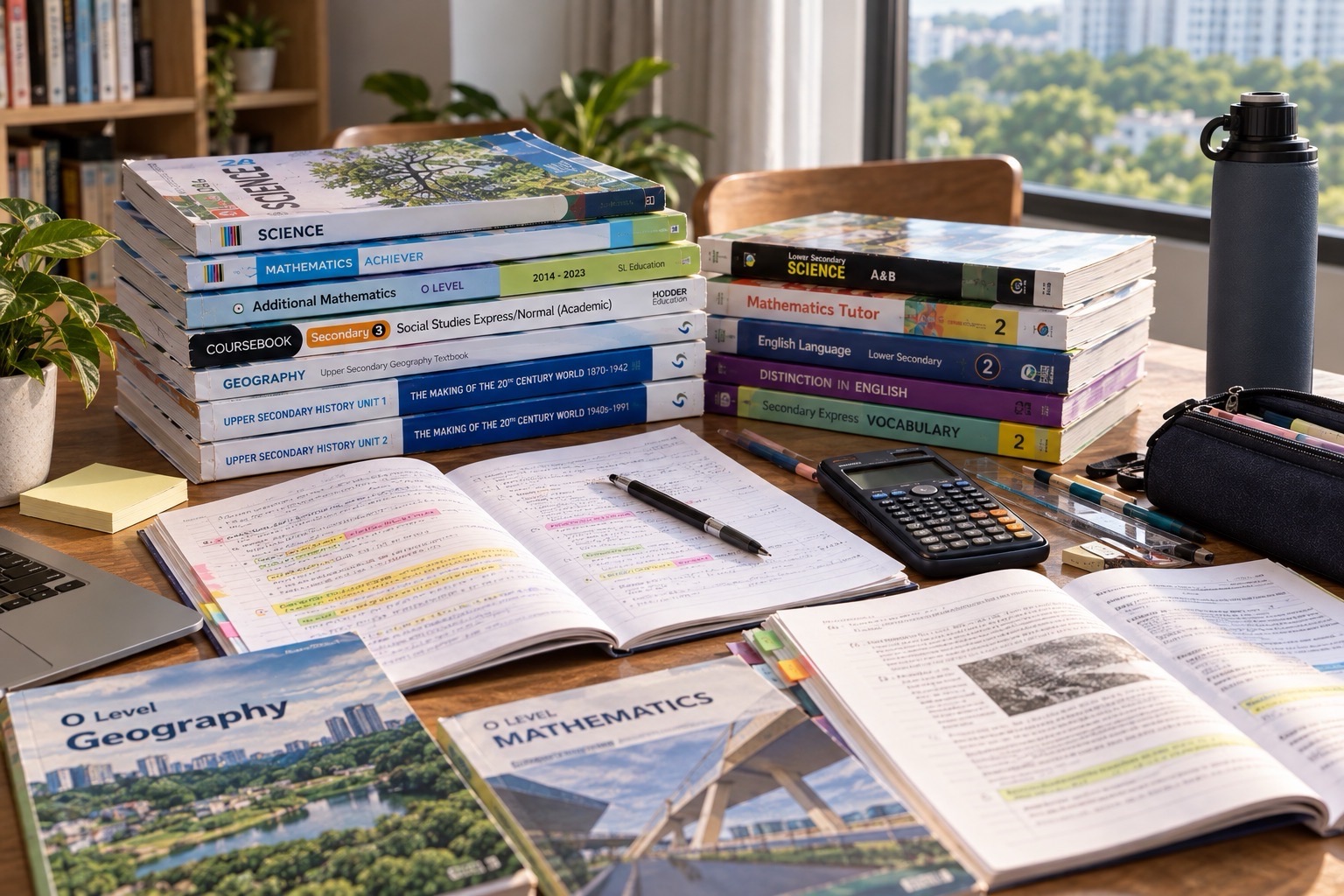
What should a pupil write in PSLE Mathematics Paper 2? Start with the quantity relationship, show the decisive calculation steps, use an approved calculator only for permitted arithmetic, and give the answer in the required unit. If a question combines ratio, area or algebra with a second condition, solve one relationship at a time. A longer answer does not become clearer by including every possible formula; it becomes clearer by showing why each chosen step is relevant.
For Punggol families beginning 2027 PSLE Mathematics preparation, the confirmed official reference currently available is the revised 2026 Standard Mathematics 0008 examination document. Its Paper 2 is worth 50 marks and takes 1 hour 20 minutes, with five two-mark short-answer questions and ten structured or long-answer questions contributing another 40 marks. An approved calculator is permitted. The precise 2027 arrangements should be checked against SEAB’s later year-specific publication.
This guide is a complete learning reference, not a prediction of examination questions. It contains twenty-four original multistep examples, separate discussions of mathematical representation and writing, a parent diagnostic, a model 90-minute small-group tutorial and a four-week preparation route. Punggol locations are not used as invented data sources: numbers about containers, purchases, cards and geometry are clearly hypothetical.
The confirmed 2026 Paper 2 structure and the 2027 preparation boundary
The SEAB 2026 PSLE format index distinguishes Standard Mathematics (0008) from Foundation Mathematics (0038). Under the Standard subject’s format examined from 2026, Paper 2 permits calculator use. Its 5 short-answer questions have 2 marks each. Its 10 structured/long-answer questions are individually worth 3, 4 or 5 marks and together contribute 40 marks. The entire examination has 100 marks across the two papers.
SEAB’s published instructions say structured/long-answer candidates must show methods of solution clearly and write answers in the spaces provided. This is not a claim that every intermediate line earns a separate mark. Marking depends on the actual item and scheme. It is an instructional reason to practise a legible chain of mathematical statements rather than relying on unsupported final numbers.
The MOE primary curriculum updated October 2025 includes number, algebra, measurement, geometry and statistics, with problem solving embedded across strands. These topics appear in many possible combinations. A Paper 2 guide should therefore teach how to organise a response to an unfamiliar problem, rather than inventing an ‘official Paper 2 chapter’.
| Confirmed 2026 paper detail | Student task | Important caution |
| Paper 2, 80 minutes | Plan, reason and show the necessary steps | Check the 2027 published examination instructions when available |
| Five two-mark short answers | Give precise requested results and units | A short question is not always conceptually trivial |
| Ten structured/long-answer items | Explain the link from given data to requested quantity | No assumption that one fixed number of lines equals marks |
| Calculator allowed | Use for arithmetic after a valid model is chosen | It cannot interpret an unfamiliar story for the child |
| Standard subject code 0008 | Practise the correct syllabus and item style | Foundation Mathematics 0038 has separate requirements |
A five-stage working system that makes long answers readable
- Read the target. Underline whether the question asks for the original price, remaining amount, group count, length, area, average, or volume. Write an answer-unit cue.
- Represent the structure. Choose a bar, labelled diagram, table, number sentence, ratio parts or a simple equation. State what each quantity represents.
- Resolve dependencies. First calculate what a later line needs. If the requested height depends on base area, calculate the base area before dividing the volume.
- Calculate and label. Keep exact intermediate values where suitable; use the allowed calculator carefully for long arithmetic but do not replace reasoning with a button sequence.
- Check against the story. Reverse an equation, reconstruct a total, trace an exposed boundary or compare the answer with an estimate and the stated unit.
A common mistake in a long answer is to begin by manipulating every printed number before defining what the question asks. For instance, if a pupil sees ‘$180 after a discount’ alongside ‘20%’, multiplying 180 by 20% is quick but may calculate the wrong quantity. If the printed $180 is 80% of the original, the first task is reconstructing 100%. The arithmetic follows that statement. A calculator cannot supply the missing reference.
The method can be very concise. For a cuboid with base area 75 cm² and volume 900 cm³, the working ‘height = 900 ÷ 75 = 12 cm’ tells a complete story. If the base area itself must be found from two dimensions, show that first. More writing is not automatically more rigorous. Clear dependency is the important feature.
How to choose between a bar model, equation, diagram and table
| Question structure | Useful initial representation | Warning sign |
| A whole is divided in a ratio | Equal-part bar or ratio-unit table | Pupil confuses total and difference |
| Known percentage is not 100% | 100% reference bar | Pupil applies a percentage to the wrong base |
| Repeated groups plus a fixed number | Simple equation or bar model | Pupil cannot say what the variable means |
| Circle joined to a rectangle | Labelled figure and boundary trace | Interior join counted in the outer perimeter |
| Volume with missing height | Base-area layer model | Pupil treats cm² as a height |
| Two averages from different groups | Totals and observation counts in a table | Pupil averages the group means directly |
A pupil can often solve the same mathematical story using more than one legitimate representation. A model may expose quantities clearly while an equation is shorter. What matters is fidelity to the problem: does the chosen representation preserve the right total, the right number of groups and the right units? Teaching only one drawing convention may leave students stranded when a new question uses a different sentence structure.
Twenty-four original multistep worked Paper 2 practice problems
Original structured problem 1 · Transfer after a ratio allocation
Problem. A hypothetical collection is divided between A and B in ratio 3:5, with 96 items altogether. Twelve items move from B to A. Find their new ratio.
Step-by-step solution. Eight ratio parts make 96; one part is 12. Initially A = 36 and B = 60. After transfer A = 48 and B = 48. New ratio = 1:1.
Why these steps belong together. The transfer changes group sizes but not the combined total.
Independent check. 48 + 48 = 96; twelve were moved rather than added.
Original structured problem 2 · Recover groups from a difference
Problem. A:B = 4:7 and B has 36 more cards. Find A, B and their total.
Step-by-step solution. Three ratio parts correspond to 36, so one part = 12. A = 48, B = 84, total = 132.
Why these steps belong together. The supplied 36 is the difference of the groups, not the sum.
Independent check. 84 − 48 = 36 and 48:84 = 4:7.
Original structured problem 3 · A fraction of the remainder
Problem. A hypothetical school activity has 150 cards. Two fifths are used, then one third of the remaining cards are used. How many remain?
Step-by-step solution. First use = 2/5 × 150 = 60; remainder = 90. Second use = 1/3 × 90 = 30. Final remainder = 60 cards.
Why these steps belong together. The second fraction refers to the remainder, not the original 150.
Independent check. 60 + 30 + 60 = 150.
Original structured problem 4 · Reverse a discount
Problem. A fictional learning set is sold for $204 after a 15% discount. Find its original price.
Step-by-step solution. Sale price represents 85%. Original = 204 ÷ 0.85 = $240.
Why these steps belong together. Define the 100% original price before using the multiplier.
Independent check. 15% of $240 = $36; $240 − $36 = $204.
Read the first four cases as variations on hidden quantities. A transfer does not alter a total, a ratio difference is not a combined whole, a fraction of a remainder changes its reference and a discounted price is not 100%. To prepare for an unseen structured question, the pupil should name the changing reference before the calculation begins.
Original structured problem 5 · Two percentage changes
Problem. A fictional item initially costs $500. Its price falls by 10%, then by 20% of its reduced price. Find the final price.
Step-by-step solution. After first reduction: $500 × 0.9 = $450. Second reduction: $450 × 0.8 = $360.
Why these steps belong together. The second percentage uses the reduced base.
Independent check. $50 + $90 + $360 = $500; total reduction is 28%, not 30%.
Original structured problem 6 · Weighted average of unequal groups
Problem. Four pupils average 18 pages, while six pupils average 23 pages. Find the overall average.
Step-by-step solution. First total = 4 × 18 = 72. Second total = 6 × 23 = 138. Combined total = 210 for ten pupils, giving 21 pages.
Why these steps belong together. Group means need weighting by their group sizes.
Independent check. 10 × 21 = 210; the result lies between 18 and 23.
Original structured problem 7 · One missing observation
Problem. Seven numbers have mean 18. Six known values total 102. Find the seventh.
Step-by-step solution. Required total = 7 × 18 = 126. Missing value = 126 − 102 = 24.
Why these steps belong together. The mean encodes a total across all seven data entries.
Independent check. (102 + 24) ÷ 7 = 18.
Original structured problem 8 · Rectangular tank depth
Problem. A tank has inside base 30 cm by 20 cm and contains 4.8 litres of water. Find water depth.
Step-by-step solution. 4.8 L = 4800 cm³. Base area = 600 cm². Depth = 4800 ÷ 600 = 8 cm.
Why these steps belong together. Convert litres before using a base measured in square centimetres.
Independent check. 600 × 8 = 4800 cm³ = 4.8 L.
The next four cases move from percentages to data and tank volume. An average encodes a total, while a tank’s water depth depends on base area. Both are inverse-relationship problems, but their units tell a different story. If a pupil starts with a formula without identifying the measured quantities, pause and rebuild the physical or statistical meaning.
Original structured problem 9 · Cube edge and face area
Problem. A cube has volume 343 cm³. Find its edge and the area of one face.
Step-by-step solution. 7³ = 343, so edge = 7 cm. Face area = 7 × 7 = 49 cm².
Why these steps belong together. Recover the length before computing the two-dimensional face.
Independent check. 49 cm² × 7 cm = 343 cm³.
Original structured problem 10 · Added water raises a level
Problem. A rectangular tank has base 30 cm by 15 cm. How much does its water depth rise when 1.8 litres are added without overflow?
Step-by-step solution. Added volume = 1800 cm³; base area = 450 cm². Rise = 1800 ÷ 450 = 4 cm.
Why these steps belong together. Find a change in height, not an absolute water depth.
Independent check. 450 × 4 = 1800 cm³.
Original structured problem 11 · A rectangle joined to a semicircle
Problem. A 28-cm by 20-cm rectangle has a semicircle of radius 14 cm attached externally along its 28-cm side. Find total area using π = 22/7.
Step-by-step solution. Rectangle = 560 cm². Semicircle = 1/2 × 22/7 × 14² = 308 cm². Combined area = 868 cm².
Why these steps belong together. Add non-overlapping covered regions; the shared edge contributes no area.
Independent check. 868 − 308 = 560 cm².
Original structured problem 12 · Composite external perimeter
Problem. A 20-by-14-cm rectangle has a radius-7 semicircle attached along a 14-cm side. Find its external perimeter using π = 22/7.
Step-by-step solution. Rectangle perimeter = 68 cm; exclude joined 14-cm edge; add semicircular arc 22 cm. Total = 76 cm.
Why these steps belong together. Trace only exposed segments; the diameter is internal.
Independent check. 68 − 14 + 22 = 76 cm.
This stage crosses three-dimensional volume into geometric area and exposed perimeter. Even where all problems contain similar-looking measurements, the operations differ. A student should mark the requested quantity on the diagram and determine whether an attached edge is interior, whether a cut-out subtracts area, and what the resulting unit must be.
Original structured problem 13 · Angle split in a parallelogram
Problem. A parallelogram has one angle of 68°. Its neighbouring angle is split into 35° and x. Find x.
Step-by-step solution. Neighbouring angle = 180° − 68° = 112°. Thus x = 112° − 35° = 77°.
Why these steps belong together. First use the parallelogram property, then the given split.
Independent check. 68 + 35 + 77 = 180° along the neighbouring pair.
Original structured problem 14 · Missing quadrilateral corner
Problem. A quadrilateral has interior angles 92°, 105°, 80° and x. Find x.
Step-by-step solution. Interior sum is 360°. x = 360 − (92 + 105 + 80) = 83°.
Why these steps belong together. A quadrilateral can be split into two triangles.
Independent check. 92 + 105 + 80 + 83 = 360°.
Original structured problem 15 · An equation reused
Problem. Solve 6x + 9 = 81, then find 3x + 5.
Step-by-step solution. 6x = 72; x = 12. Thus 3x + 5 = 36 + 5 = 41.
Why these steps belong together. The second requested value depends on the first solution.
Independent check. 6 × 12 + 9 = 81; 3 × 12 + 5 = 41.
Original structured problem 16 · Stationery purchase
Problem. Six identical exercise books plus one $9 pen set cost $81. Find the price of four exercise books.
Step-by-step solution. Six books cost 81 − 9 = $72; one costs $12; four cost $48.
Why these steps belong together. Separate the fixed cost, determine one equal group’s value, then scale.
Independent check. 6 × 12 + 9 = 81; 4 × 12 = 48.
Algebra and angular constraints ask pupils to justify each intermediate line. In an equation, an operation applied to both sides preserves equality; in a parallelogram, supplementary angles arise from the geometry of parallel sides. The final number matters, but the reason behind the step makes the solution easier to verify independently.
Original structured problem 17 · Percentage increase with a base
Problem. A fictional reading target grows from 320 to 368 pages. Find the percentage increase.
Step-by-step solution. Increase = 48; fraction of original = 48/320 = 0.15. Increase = 15%.
Why these steps belong together. The original 320 is the reference 100%.
Independent check. 15% of 320 = 48; 320 + 48 = 368.
Original structured problem 18 · Fractions and measured groups
Problem. Three quarters of a litre is divided into portions of one eighth of a litre. How many portions can be made?
Step-by-step solution. 3/4 ÷ 1/8 = 3/4 × 8 = 6 portions.
Why these steps belong together. The divisor is portion size; the quotient counts portions.
Independent check. 6 × 1/8 = 3/4 litre.
Original structured problem 19 · A curved shaded region
Problem. A 14-cm square contains a quarter circle of radius 14 cm centred at one corner. The quarter-circle region is removed. Find remaining area using π = 22/7.
Step-by-step solution. Square = 196 cm²; quarter circle = (1/4) × 22/7 × 14² = 154 cm²; remaining = 42 cm².
Why these steps belong together. Subtract removed area, not the surrounding perimeter.
Independent check. 42 + 154 = 196 cm².
Original structured problem 20 · Average after adding a value
Problem. Five observations average 16. A sixth value is 28. Find the new average.
Step-by-step solution. Old total = 5 × 16 = 80. New total = 108; new mean = 108 ÷ 6 = 18.
Why these steps belong together. Adding an observation changes both total and number of values.
Independent check. 6 × 18 = 108.
Later problems reuse fractions, averages and ratios in new contexts. Students should recognise that a ratio is a comparison, a fraction can represent a proportion of a whole or a measured group, and an average is a total divided by a number of observations. These representations are compatible, but not interchangeable.
Original structured problem 21 · Ratio from a known partner
Problem. A:B = 5:7. B has 49 objects. Find A, total and A’s fraction of total.
Step-by-step solution. Seven parts = 49, so one part = 7. A = 35, total = 84. A fraction = 35/84 = 5/12.
Why these steps belong together. The known 49 belongs to B only; the whole has 12 ratio parts.
Independent check. 35:49 simplifies to 5:7 and 35 + 49 = 84.
Original structured problem 22 · Semicircle area and perimeter
Problem. A semicircle has radius 7 cm. Use π = 22/7. Find its area and full perimeter.
Step-by-step solution. Area = (1/2) × 22/7 × 7² = 77 cm². Curved arc = 22 cm; diameter = 14 cm; perimeter = 36 cm.
Why these steps belong together. Area measures coverage; full perimeter needs the straight edge.
Independent check. Two semicircle areas make 154 cm²; 22 + 14 = 36 cm.
Original structured problem 23 · Weekly data total
Problem. Four study sessions average 25 minutes. A fifth session lasts 45 minutes. Find the average of all five.
Step-by-step solution. Original total = 4 × 25 = 100 min. New total = 145 min. New mean = 145 ÷ 5 = 29 minutes.
Why these steps belong together. Rebuild the total and increase the count by one.
Independent check. 29 × 5 = 145; the average rises towards the longer session.
Original structured problem 24 · Bar model with a remainder
Problem. A collection of 84 cards is split between two pupils in ratio 4:3. The pupil with four parts gives six cards to the other. Find new totals and ratio.
Step-by-step solution. Seven parts = 84, so one part = 12. Initial 48 and 36; after transfer 42 and 42. New ratio = 1:1.
Why these steps belong together. The total stays 84; only allocation changes.
Independent check. 42 + 42 = 84, and six moved from the larger initial share.
The final examples deliberately combine different learning strands. At this point, ask the pupil to select a method without seeing a chapter title and to explain which information determines each step. That is the main transfer test for Paper 2: can the student organise unfamiliar information rather than reproduce a worked example?
What a calculator helps with—and what it cannot do
The calculator is permitted in the confirmed 2026 Standard Mathematics Paper 2, subject to the examination’s approved-device rules. It can divide 204 by 0.85 accurately after the pupil has decided that 204 represents 85% of the original price. It cannot identify the 85% relationship from the words. Similarly, it can compute 4800 ÷ 600 efficiently but cannot know whether the answer should be a water depth, a tank capacity or a change in height.
Train pupils to estimate before pressing keys. If $204 is a discounted price, an original value around $240 is sensible; $20.40 is not. If 4.8 litres occupies a 600-cm² base, the height should be a small number of centimetres, not thousands. Estimating a scale is particularly useful when a pupil accidentally enters 4.8 instead of 4800, or reverses a division.
The calculator should reduce arithmetic effort, not replace working lines. A structured answer might show ‘4.8 L = 4800 cm³; base = 30 × 20 = 600 cm²; height = 4800 ÷ 600 = 8 cm’. This is an economical, readable sequence. Writing only ‘8’ gives neither the quantity relationship nor the unit. The exact mark consequences depend on the question and scheme, but the educational difference is clear.
Ten recurring long-answer mistakes and precise repairs
| Error | First unstable decision | A targeted repair |
| Uses the total ratio-part count for a known one-group amount | Reference of the known number | State whether the given amount is a group, difference or entire collection |
| Uses the first total for a second fraction of remainder | Reference whole has changed | Draw separate before/after bars |
| Treats the discounted price as 100% | Incorrect percentage base | Label the original amount 100% before arithmetic |
| Averages two unequal group means directly | Ignores sample size | Rebuild each group’s total |
| Confuses cm² with cm³ | Dimensions of quantities unclear | Describe one base layer and its thickness |
| Counts the diameter inside an attached semicircle | Interior edge versus external perimeter | Trace only the outside boundary |
| Writes a correct formula for the wrong shape | Misread diagram labels | Mark the radius, height or right angle given |
| Omits the answer’s unit | Does not connect result to quantity | Predict unit before calculation |
| Presses keys before forming the relationship | Arithmetic substituted for reasoning | Write one equation with named quantities first |
| Stops after finding an intermediate value | Does not re-read the target | Underline the actual requested quantity again |
The pupil’s 90-second final verification routine
At the end of a longer question, return to the final sentence. Does the requested answer represent a price before a discount, a number of items remaining, an angle, a length or a volume? Restore the appropriate unit and check that an intermediate total was not accidentally submitted as the final answer. If time is short, make this check on the least secure questions rather than blindly recomputing everything.
Reverse operations supply fast evidence. Multiply a proposed height by the base area. Recombine groups after a transfer to see whether the total is conserved. Add the removed region back to a composite area. Substitute an algebraic value into the original equation. A check is strongest when it directly tests the original conditions, not when it merely repeats the same calculation with the same potential mistake.
A practical habit is to mark a small check symbol beside a part only after the verification is complete. A pupil who adds check marks mechanically will not improve. A pupil who can say ‘the transferred ratio still totals 96’ or ‘the resulting cube edge reconstructs 343 cm³’ has performed useful mathematical control.
A parent diagnostic using four genuinely different problems
Give the pupil a ratio transfer problem, a reverse-percentage problem, a shaded composite-area problem and a data-average problem. Do not label them by topic. Ask the child to describe how they know which method belongs, then allow the calculation. Observe whether the first error is in understanding the situation, representing quantities, performing arithmetic, or checking the required unit.
The result may reveal that the child knows the method but struggles with calculator entry; or uses the calculator accurately but does not know what number to enter; or can solve familiar diagrams while failing when the shape is rotated. Those are different needs. Save the pupil’s working and one corrected example; review the same mathematical structure after two days using a different story.
If a pupil becomes upset or exhausted, reduce the set and return later. A useful diagnostic does not need to mimic the emotional pressure of an examination. It needs to provide enough evidence to select the next teaching move. Support should focus on independence, not an impressive quantity of extra work.
A ninety-minute small-group lesson built around written reasoning
| Approximate stage | Tutor action | Student evidence |
| Opening retrieval | Short mixed recall of fractions, simple equations and geometry facts | Can recall facts without a chapter prompt |
| Shared example | Model a multistep ratio or percentage relationship | Can name the given total and requested quantity |
| Guided variants | Change one condition and compare two methods | Can explain what changes in the model |
| Independent problems | Three pupils each attempt unseen but level-appropriate tasks | Each pupil shows their own chain of reasoning |
| Error analysis | Review the first incorrect decision, not just the last number | Can identify why a particular step failed |
| Delayed practice plan | Assign a few short retrieval checks before the next lesson | Can retry without a template or live prompt |
In eduKate’s small-group teaching philosophy, the value lies in noticing individual working rather than having a smaller room for the same lecture. One pupil may need concrete bar models, another a clearer equation definition, and another a disciplined unit check. The tutor can provide different follow-up tasks even after the class shares a common explanation. A class size by itself cannot guarantee an examination result.
A four-week Paper 2 learning route
| Week | Main question | Original practice focus | Evidence of progress |
| 1 | What relationship does the problem express? | Translate ratio, percent and algebra stories into models | Pupil chooses representation before calculating |
| 2 | What information must be found first? | Missing totals, lengths, averages and changed quantities | Pupil orders dependent steps correctly |
| 3 | What does a clear solution look like? | Mixed geometry, volume and multistep short-answer work | Working states method, operations and units |
| 4 | Can the learner solve and check unfamiliar problems independently? | Unlabelled mixed sets with delayed correction | No prompt needed to select the first step |
A four-week plan is a guide to the sequence of teaching, not a guarantee of improvement. If the pupil cannot divide fractions reliably, it may be better to work on that first than to practise complicated ratio stories. Where skills are already strong, move to transfer tasks that change context, order of information and representation. The lesson should be paced by observed readiness.
How Paper 1 and Paper 2 preparation should complement each other
The Punggol Paper 1 guide concentrates on exact no-calculator computation, MCQ reasoning and concise short answers, using the confirmed 2026 format as its reference. This Paper 2 guide concentrates on extended solution chains, method presentation and the judicious use of the permitted calculator. The same mathematical concepts underpin both, but the assessment tasks encourage different practice habits.
A pupil who solves a multistep Paper 2 model correctly yet struggles to multiply without a calculator should practise foundational arithmetic as well. Conversely, a pupil who excels in quick calculations but cannot decide how to represent a story needs sustained modelling work, not simply harder multiplication. Combining the two forms of practice produces more balanced mathematical independence.
Frequently asked questions
Does Paper 2 allow a calculator?
In the official Standard PSLE Mathematics format examined from 2026, yes, an approved calculator is permitted. Refer to SEAB’s year-specific approved-device instructions and later 2027 format once available.
Does showing more lines automatically earn more marks?
No. Good working makes relevant relationships and calculations visible. The marker assesses correct mathematical method and answers according to the actual question and marking scheme. Redundant lines do not compensate for a faulty model.
How should a child start an unfamiliar word problem?
Name the quantity requested, identify which numbers are totals versus parts or changes, and use a short bar model, table, diagram or equation to show the relationship before arithmetic.
Can a pupil use algebra instead of a bar model?
Where a sound equation expresses the given relationship and is appropriate for the pupil’s syllabus, yes. The stronger question is whether the child understands the equation’s meaning and can verify the result.
What if a child gets a correct number but cannot explain it?
Ask them to recreate the relationship in a different context and show an independent check. A lucky or memorised number is weaker evidence of learning than a result supported by a model that transfers.
Are these actual 2027 examination questions?
No. All worked examples here are original study exercises. The 2026 published format is the official structural reference. The exact 2027 arrangement should be verified when SEAB issues the relevant document.
Should we ignore Paper 1 until structured problems improve?
No. The confirmed 2026 Standard format gives both papers 50 marks. A balanced learning plan addresses number fluency and extended reasoning, guided by the pupil’s actual errors.
Official sources, Punggol companion lessons and the Secondary 1 bridge
- SEAB PSLE formats examined in 2026 — the current checked year-specific format index.
- SEAB Standard Mathematics 0008 examination format from 2026 — structured answer requirements and calculator permissions.
- MOE Primary Mathematics syllabus updated October 2025 — the official learning scope.
- Punggol 2027 PSLE Paper 1 preparation — non-calculator computation and MCQ selection.
- Ratio and fraction links, cuboid volume and reverse percentages — topic-specific repair routes.
- Primary 6 Mathematics 2026 topic index — broader original worked practice.
- eduKate Secondary 1 Mathematics teaching approach — first principles, small-group attention and independent learning.
Closing thought: a structured Mathematics solution is a small explanation of why a quantity is what it is. It identifies the right relationship, finds necessary intermediate values, computes accurately and checks that the final answer belongs to the original story. Train that ability and pupils can approach a new problem with a plan instead of a collection of memorised guesses.
The difference between an explanation and an arithmetic transcript
A weak answer may contain several calculations in sequence without stating why they were chosen. For example, ‘$204 ÷ 0.85 = 240’ is numerically correct for recovering a 15%-discounted price, but a clearer solution first says that the sale price represents 85% of the original. The explanatory line connects the operation to the stated story.
This distinction matters in multi-part questions, where the second part may use the first result differently. A student who knows why an original price is 240 can next compute its discount, compare a new percentage change, or test an alternative sale price. A pupil who simply copied the division may not be able to extend it.
In revision, ask the student to annotate one line with a short description of the quantity it calculates. Avoid requiring a full sentence at every step; a compact label such as ‘base area’, ‘remaining fraction’ or ‘original 100%’ is often enough. The goal is clarity, not length.
Why checked units improve reasoning
Units reveal whether a student has found the requested type of quantity. A height should be expressed in centimetres, a circle area in square centimetres, and a liquid amount may be requested in litres. A result of 8 from 4800 cm³ divided by 600 cm² is 8 cm of height, not 8 cm² or 8 litres.
Converting units early is particularly important for tank problems. One litre equals 1000 millilitres, and one cubic centimetre equals one millilitre. When a tank base is measured in square centimetres, a volume in litres must be converted to cubic centimetres before division. Ignoring the conversion can produce a numerically neat but physically impossible depth.
A useful verification is dimensional: cm³ ÷ cm² gives cm. This does not replace the geometry, but it confirms that the arithmetic corresponds to the type of answer sought. As pupils progress to Secondary 1, keeping quantities and units connected remains valuable.
A school-paper postmortem that leads to better next lessons
After completing a mixed practice set, students should not simply copy a correct answer onto the original attempt. Identify the first point where the working departed from a valid relationship. Was the numerator of a fraction taken from the wrong whole? Was a hidden diameter counted in a composite perimeter? Was a known group mean treated as one data value?
Write down that specific reason and create one new problem that tests the same idea in a changed context. A geometry error can be retried with a rotated diagram; a ratio error with a difference rather than a total; a percentage error with an increase rather than a decrease. A successful unseen attempt gives more evidence of learning than reproducing the corrected question.
Parents and tutors should keep the number of corrections manageable. One carefully diagnosed misconception repaired and retained may matter more than a large stack of exercises completed mechanically. The challenge is selecting which small practice task will produce genuine independence.
Preparing to follow future SEAB instructions
Parents should revisit the examination’s official year-specific documents before finalising full-paper practice arrangements. Details such as approved devices, item formats and administrative schedules belong to SEAB. An article written before those notices are available can offer durable mathematical techniques but should not present a future paper structure as a confirmed official announcement.
A practical approach is to separate the stable teaching plan from the format checklist. The stable plan covers concepts, representation, calculation, reasoning and checking. The checklist covers the official duration, booklet arrangement, calculator permissions and any changed instructions for the actual sitting year.
This makes the preparation resilient. If an administrative detail changes, a child who can still construct and solve an equation or explain a curved perimeter has not lost the mathematical ability. Good preparation protects skills while keeping the format facts accurate.


