
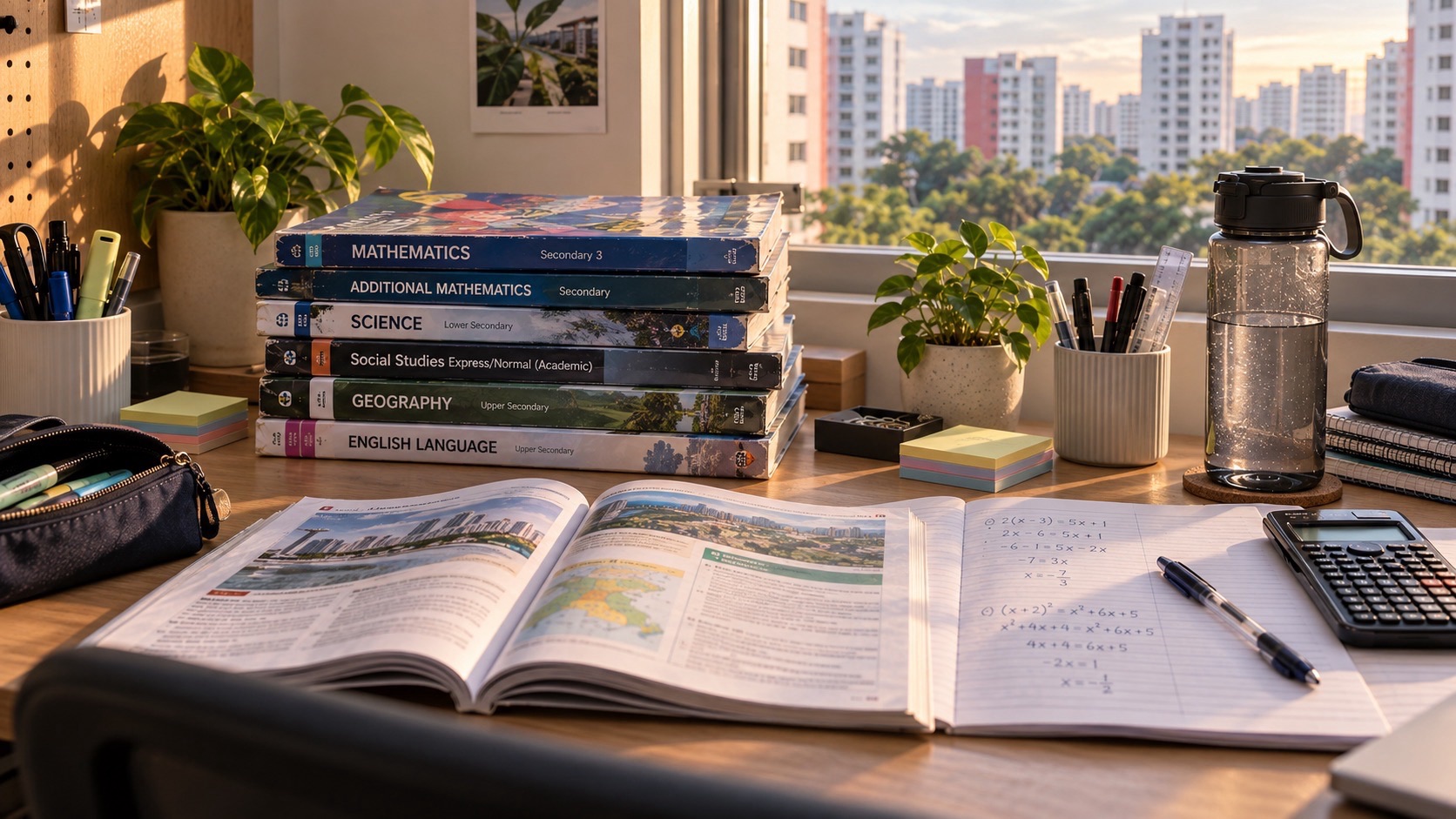
Should a PSLE Mathematics pupil use a bar model or algebra for a word problem? Choose the representation that makes the given quantities and the unknown relationship most visible. A bar model is often excellent for totals, equal parts, ratios and before–after changes; a simple equation can be faster when an unknown is repeated with a fixed addition or subtraction. Neither is automatically the ‘top student’ method. The goal is an accurate, understandable solution that can be checked.
For Punggol families preparing for the 2027 PSLE, the important skill is recognising the mathematical structure before choosing a method. A child may draw a beautiful bar and still label the whole incorrectly, or write a neat equation that uses the wrong quantity as x. Both fail for the same underlying reason: the model did not match the words. This guide compares methods on twenty-eight original problems and explains how to decide when to draw, write, tabulate or calculate.
The MOE Primary Mathematics syllabus updated October 2025 emphasises problem-solving, representation and reasoning. The revised 2026 Standard PSLE Mathematics 0008 format supplies the latest confirmed paper rules checked here; the 2027-specific examination arrangements should be verified when released. All numerical stories below are original learning examples, not official past-year questions.
The answer is not always more algebra
If a pupil already understands how to share a total in the ratio 2:3, five equal bar parts make the relationship visible. A formal unknown such as x may add little. If the problem states that five identical notebooks and a fixed $7 item cost $67, an equation 5x + 7 = 67 is concise and transparent; an equal-part bar also works. Choosing whichever method the child can explain accurately is more important than imposing one style.
At Primary 6, a sound mathematical representation must preserve the quantities and the relationships, not merely resemble a familiar worked example. In Secondary Mathematics, algebra becomes more general, but a visual model remains valuable for interpreting words and checking expressions. Teaching algebra by dismissing drawings can remove a helpful bridge; teaching only drawings without introducing symbolic notation can make later transitions harder.
Some challenging examination or enrichment problems can be represented by more elaborate equations than the primary syllabus requires. Those can be discussed as extensions, not labelled as mandatory Primary 6 procedures. The first priority is a reliable interpretation that stays within the student’s level and allows independent verification.
The five-question representation decision
- What is the unknown? Name it: one notebook price, one ratio unit, an original quantity, remaining cards, a height, or a group average.
- What kind of relationship is given? A total, a difference, equal repeated groups, a fractional remainder, a percentage change, or a geometrical property?
- Can a short picture show it directly? Equal-part bars help with ratio; labelled diagrams help with geometry; tables help with changing observations.
- Would one equation be clearer? For repeated unknowns plus a fixed amount, write a simple equation and solve by balanced inverse operations.
- How will I check? Reconstruct a total, reverse an equation, substitute a value, or compare with the original unit and constraints.
| Problem signal | Often helpful first representation | Most common false shortcut |
| Two groups with a total and ratio | Equal-part bar | Divide by the wrong group’s part count |
| Two groups with a difference and ratio | Bars aligned to show gap | Divide difference by sum of ratio terms |
| Repeated unknowns plus fixed amount | One-variable equation or equal-box bar | Use the fixed number as part of every group |
| Original percentage not shown | 100% before/after bar | Use final amount as the original whole |
| Average with missing entry | Total-and-count table | Subtract known values from the average itself |
| Circle joined to another shape | Labelled geometry drawing | Count internal join in external perimeter |
| Water tank with a missing height | Base-area layer model | Confuse area with three-dimensional volume |
The same story can have two correct models
Take a fictional stationery purchase: five identical notebooks plus a separate $7 item cost $67. In a bar model, draw five equal boxes plus one fixed seven-unit block that together make 67. The five boxes must total 60, so each equals 12. In algebra, let x be the price of one notebook, in dollars. Then 5x + 7 = 67, so 5x = 60 and x = 12. Both solutions use exactly the same relationship.
The value of comparing models lies in noticing what stays unchanged. The bar’s equal boxes correspond to 5x; the separate fixed block corresponds to seven; the total corresponds to 67. If a pupil cannot explain that correspondence, simply copying the final equation may not build durable understanding. If a pupil can explain it, they can choose the shorter method without losing meaning.
Now change the story to ‘five notebooks together cost $60, and a separate $7 item is added’. The meaning of the numbers remains clear; solving x = 60 ÷ 5 gives 12. This is why a good method choice depends on the relation, not on decorative details. Teaching students to notice those invariant relationships makes word problems more manageable.
Twenty-eight original paired worked examples: choose the shortest honest model
Original paired worked example 1 · Equal notebooks and a fixed item
Problem. Five identical notebooks and a $7 item cost $67. Find one notebook’s price.
Bar, picture or table. Five equal bar parts total 67 − 7 = 60. Each = $12.
Equation or calculation. Let x be one notebook price. 5x + 7 = 67; 5x = 60; x = 12.
Method decision. Both methods show five identical quantities plus a separate fixed cost.
Independent check. 5 × 12 + 7 = 67.
Original paired worked example 2 · Three groups and an extra quantity
Problem. Three packets contain the same number of beads, with five extra beads making 41. Find one packet’s count.
Bar, picture or table. Three equal boxes total 41 − 5 = 36, so each is 12.
Equation or calculation. 3x + 5 = 41, so 3x = 36 and x = 12.
Method decision. The extra five belong outside the repeated groups.
Independent check. 3 × 12 + 5 = 41.
Original paired worked example 3 · Four identical objects
Problem. Four identical objects plus nine spare objects make 57. Find each group’s count.
Bar, picture or table. Four equal boxes total 57 − 9 = 48; each has 12.
Equation or calculation. 4x + 9 = 57; 4x = 48; x = 12.
Method decision. A repeated equal group can be shown pictorially or symbolically.
Independent check. 4 × 12 + 9 = 57.
Original paired worked example 4 · Subtraction after equal groups
Problem. Six identical boxes contain x items each. Five are removed from the collection, leaving 67. Find x.
Bar, picture or table. Restore the five removed: six boxes total 72; each 12.
Equation or calculation. 6x − 5 = 67; 6x = 72; x = 12.
Method decision. The removal happens after the original equal groups are combined.
Independent check. 6 × 12 − 5 = 67.
Original paired worked example 5 · Seven identical packs
Problem. Seven identical packs plus 15 extra tokens total 99. Find tokens per pack.
Bar, picture or table. Seven equal parts total 99 − 15 = 84; each 12.
Equation or calculation. 7x + 15 = 99; x = (99 − 15)/7 = 12.
Method decision. The fixed extra is not repeated seven times.
Independent check. 7 × 12 + 15 = 99.
Original paired worked example 6 · Ratio with a known total
Problem. A:B = 2:3, total 75. Find both groups.
Bar, picture or table. Five equal bar parts make 75; one part = 15; groups are 30 and 45.
Equation or calculation. Optional comparison: A = 2u, B = 3u, so 5u = 75 and u = 15.
Method decision. An equal-part bar is often simplest when the ratio and combined total are known.
Independent check. 30 + 45 = 75; 30:45 = 2:3.
Original paired worked example 7 · Ratio 3:5
Problem. A:B = 3:5 and there are 96 objects. Find both.
Bar, picture or table. Eight bar parts = 96, so each = 12. A = 36; B = 60.
Equation or calculation. 3u + 5u = 96; u = 12; A = 36, B = 60.
Method decision. The ratio part count is the sum only because the given number is the total.
Independent check. 36 + 60 = 96.
The first seven questions demonstrate a useful transition: repeated unknown groups can be drawn as equal boxes or written as coefficients of one variable, while a part-to-part ratio is often easier to see with unit bars. A pupil should be able to explain the correspondence between five boxes and 5x. If the explanation is unclear, the shorter symbolic method is not yet a secure shortcut.
Original paired worked example 8 · Ratio 4:7
Problem. Two groups have ratio 4:7 and 121 items altogether. Find each.
Bar, picture or table. Eleven bar parts = 121, so one part = 11. Counts are 44 and 77.
Equation or calculation. 4u + 7u = 121; 11u = 121; u = 11.
Method decision. The algebra is a translation of the equal-part model, not a separate trick.
Independent check. 44 + 77 = 121.
Original paired worked example 9 · Ratio 5:8
Problem. A:B = 5:8 and total 117. Find both.
Bar, picture or table. Thirteen parts = 117, one part 9. A = 45, B = 72.
Equation or calculation. 5u + 8u = 117; u = 9.
Method decision. The whole is split into thirteen ratio units.
Independent check. 45 + 72 = 117.
Original paired worked example 10 · Ratio difference of two parts
Problem. A:B = 3:5; B exceeds A by 20. Find both.
Bar, picture or table. The two-part difference is 20; one part 10. A = 30, B = 50.
Equation or calculation. B − A = 5u − 3u = 2u = 20; u = 10.
Method decision. The gap, not the combined bar, represents the given 20.
Independent check. 50 − 30 = 20.
Original paired worked example 11 · Ratio difference of five parts
Problem. A:B = 4:9; their difference is 35. Find both.
Bar, picture or table. Five parts = 35, each 7. Groups are 28 and 63.
Equation or calculation. 9u − 4u = 35, so u = 7.
Method decision. The difference determines the value of one part.
Independent check. 63 − 28 = 35.
Original paired worked example 12 · Larger ratio difference
Problem. A:B = 2:7; B is 45 greater. Find both.
Bar, picture or table. Five parts = 45; one part = 9. A = 18, B = 63.
Equation or calculation. 7u − 2u = 45, so u = 9.
Method decision. A bar’s aligned endpoints make the gap visible immediately.
Independent check. 63 − 18 = 45.
Original paired worked example 13 · Fraction of a whole
Problem. Three fifths of 120 cards are blue. How many are not blue?
Bar, picture or table. Draw five equal parts; two are not blue. Two fifths of 120 = 48.
Equation or calculation. Let b be blue count: b = 3/5 × 120 = 72; not blue = 120 − 72 = 48.
Method decision. The reference whole remains 120 cards.
Independent check. 72 + 48 = 120.
Original paired worked example 14 · Fraction of 98
Problem. Two sevenths of 98 counters are red. Find non-red counters.
Bar, picture or table. Seven equal bar parts; five remain. Each part 14, so remainder 70.
Equation or calculation. Red = 2/7 × 98 = 28, hence non-red = 98 − 28 = 70.
Method decision. A complement can be found by either subtracting a part or counting remaining parts.
Independent check. 28 + 70 = 98.
Difference-ratio questions reveal why the correct reference matters. When B exceeds A by twenty, the given twenty represents the gap between the bars, not both bars together. A written equation can express that gap, but the picture often makes the relationship easier to see. Choose the representation that prevents the first incorrect mathematical decision.
Original paired worked example 15 · Fraction of remainder
Problem. Two fifths of 150 cards are used; then one third of what remains is used. Find what finally remains.
Bar, picture or table. First bar removes 60, leaving 90; second bar removes 30, leaving 60.
Equation or calculation. Remaining = 150 × 3/5 × 2/3 = 60; this compact product is optional after the stages are understood.
Method decision. The second fraction refers to a new remainder, not the old whole.
Independent check. 60 + 30 + 60 = 150.
Original paired worked example 16 · Twenty-five percent
Problem. 25% of 160 imaginary items are selected. Find the number not selected.
Bar, picture or table. One quarter is 40, leaving three quarters = 120.
Equation or calculation. Remaining = 160 × (1 − 0.25) = 120.
Method decision. The complement 75% refers to the same original 160.
Independent check. 40 + 120 = 160.
Original paired worked example 17 · Price after a discount
Problem. A fictional item costs $96 after a 20% discount. Find the original price.
Bar, picture or table. Draw 100% as five equal 20% blocks; four blocks are $96. One block $24; five blocks $120.
Equation or calculation. 0.8x = 96, so x = 120.
Method decision. Here the given $96 represents the remaining 80%, not the original 100%.
Independent check. 120 − 20% of 120 = 96.
Original paired worked example 18 · Count after a growth
Problem. An invented group has 230 members after 15% growth. Find original membership.
Bar, picture or table. The new amount is 115%. One percent = 230/115 = 2; 100% = 200.
Equation or calculation. 1.15x = 230, so x = 200.
Method decision. A before/after bar shows that the new amount is greater than 100%.
Independent check. 200 + 15% of 200 = 230.
Original paired worked example 19 · Average with one hidden score
Problem. Four observations average 18 and three total 51. Find the fourth.
Bar, picture or table. Four equal-average units total 72; the known subtotal is 51; missing = 21.
Equation or calculation. Let x be missing: (51 + x)/4 = 18, hence x = 72 − 51 = 21.
Method decision. The mean encodes a total, so a total table is often clearer than a length bar.
Independent check. (51 + 21)/4 = 18.
Original paired worked example 20 · Another average missing entry
Problem. Five scores average 24; four sum to 94. Find the fifth.
Bar, picture or table. Five mean shares total 120; missing = 120 − 94 = 26.
Equation or calculation. (94 + x)/5 = 24, so x = 26.
Method decision. The model represents an implied total, not five identical original scores.
Independent check. (94 + 26)/5 = 24.
Original paired worked example 21 · Attached semicircle area
Problem. A 20-by-14-cm rectangle has an external semicircle of radius 7 cm attached along the 14-cm edge. Find combined area, π = 22/7.
Bar, picture or table. Draw separate non-overlapping regions: rectangle 280 cm², semicircle 77 cm²; total 357 cm².
Equation or calculation. Area = 20 × 14 + (1/2)π × 7² = 357 cm².
Method decision. A labelled geometry diagram is essential; an abstract equation follows the decomposition.
Independent check. 357 − 77 = 280.
Fractional remainders and reverse percentages are common sources of reference changes. A first operation may be based on the initial whole, while a second fraction is taken from a smaller remainder. Similarly, a sale price might represent 80% of an original price. Drawing a fresh bar after each change can protect meaning; a symbolic product is efficient only once the reference is understood.
Original paired worked example 22 · Composite external perimeter
Problem. For the previous attached shape, find outer perimeter.
Bar, picture or table. Trace three exposed rectangle sides: 20 + 20 + 14 = 54 cm, plus curved arc 22 cm; total 76 cm.
Equation or calculation. 2(20 + 14) − 14 + π × 7 = 76 cm.
Method decision. The joined diameter is an interior line and must be excluded.
Independent check. 54 + 22 = 76.
Original paired worked example 23 · Missing height
Problem. A cuboid volume is 360 cm³, and its base measures 12 × 5 cm. Find height.
Bar, picture or table. Draw layers over a 60-cm² base; 360 ÷ 60 = 6 cm.
Equation or calculation. V = 12 × 5 × h = 360, hence h = 6 cm.
Method decision. A base-area layer model reveals the inverse multiplication.
Independent check. 12 × 5 × 6 = 360 cm³.
Original paired worked example 24 · Cube from volume
Problem. A cube occupies 216 cm³. Find edge.
Bar, picture or table. A unit-cube model shows three equal factors; 6 × 6 × 6 = 216, so edge 6 cm.
Equation or calculation. e³ = 216 and e = 6 cm; cube-root notation is an optional bridge.
Method decision. The edge is a length, not volume divided by three.
Independent check. 6³ = 216.
Original paired worked example 25 · Two numbers and a difference
Problem. Two quantities total 75 and one exceeds the other by 15. Find both.
Bar, picture or table. Draw two aligned bars; remove the extra 15 to leave two equal parts totalling 60. Smaller 30; larger 45.
Equation or calculation. Let smaller x; x + (x + 15) = 75; x = 30 (a labelled extension in algebraic notation).
Method decision. Bars expose the equal core and additional difference.
Independent check. 30 + 45 = 75; 45 − 30 = 15.
Original paired worked example 26 · Sequential spending
Problem. A pupil starts with 180 imaginary tokens, uses one third, then one quarter of the remainder. Find what remains.
Bar, picture or table. First removes 60, leaving 120; second removes 30, leaving 90.
Equation or calculation. 180 × (2/3) × (3/4) = 90.
Method decision. The reference whole changes after the first use.
Independent check. 60 + 30 + 90 = 180.
Original paired worked example 27 · Ratio transfer
Problem. A:B = 3:5, total 80. Ten items move from B to A. Find new ratio.
Bar, picture or table. Eight parts = 80, so initial A=30 B=50. After transfer A=40 B=40; ratio 1:1.
Equation or calculation. Start 3u=30, 5u=50, then A’=30+10 and B’=50−10.
Method decision. Transfer changes group sizes but preserves total.
Independent check. 40 + 40 = 80.
Original paired worked example 28 · Linear pattern
Problem. A pattern is represented by 4n + 3. At which position does the value equal 47?
Bar, picture or table. Imagine four equal groups plus a fixed three; remove three from 47 and divide by four: n=11.
Equation or calculation. 4n + 3 = 47 gives n = 11.
Method decision. Both methods identify n as pattern position, not the value itself.
Independent check. 4 × 11 + 3 = 47.
The final seven examples demonstrate that not every problem naturally belongs to a ratio bar. Averages are often best with total-and-count tables, geometry with a labelled shape, and volume with a base-area layer model. Algebra can then record the relation concisely. The guiding skill is selecting the representation that preserves the quantities and supports a reliable check.
A diagnostic: when a pupil chooses a pretty but incorrect model
One pupil draws five equal parts because a question states A:B = 2:3, then divides a given difference of 15 by five. The bars look tidy, but the number fifteen describes the gap of one part, not the combined total of five parts. Another pupil writes 0.8x = 96 for a discount question but later substitutes x = 96 because they have forgotten that x represents the original. In both cases the core weakness is a lost quantity definition.
Ask the child to point to the exact words represented by each bar segment or algebraic term. ‘Five parts’ must correspond to the combined whole, while ‘one part difference’ must correspond to the stated gap. If the words cannot be mapped to the representation, stop before computing. This is the moment where a few seconds of explanation can save several wrong lines.
| Visible mistake | What to ask | What a corrected model should show |
| Sum of ratio terms used for a difference | What does the given number measure? | Only the overhanging parts correspond to the difference |
| Bar model shows unequal boxes described as equal | What makes these groups identical? | The repeated quantities must share one unit value |
| Letter changes meaning during working | What is x on this line? | One consistent unknown with its unit |
| Uses 20% of the discounted price to reverse a discount | Where is the original 100%? | Final price labelled as remaining 80% |
| Draws a composite area bar without shape | Which line is actually the boundary? | Labelled geometry diagram with external edge tracing |
| Uses equations for averages but loses the count | How many values are there? | Total = average × count before subtracting known observations |
A quick five-step plan for unseen PSLE word problems
First, underline the target quantity and its expected unit. Second, identify whether the given number is a whole, a group, a difference or a remainder. Third, choose a representation with the fewest hidden assumptions: bar, table, labelled diagram or equation. Fourth, calculate one dependency at a time rather than mixing all printed numbers together. Fifth, reconstruct the original relation to verify the proposed answer.
These steps should eventually become a brief mental habit. For a familiar ratio sharing question, drawing five boxes may take seconds. For a more complex before-and-after problem, a new bar after the transfer may be justified. For a one-variable equation, algebra can be shorter than a large drawing. The learner’s explanation decides whether the representation is trustworthy.
The method also makes wrong starts easier to repair. If a pupil cannot choose between dividing by five ratio parts or three difference parts, they should return to the wording before proceeding. A different answer option or a faster calculator sequence cannot rescue an incorrect quantity relationship.
A four-week method-selection training route
| Week | Practice emphasis | Evidence of progress |
| 1 | Read totals, groups, differences and unknowns; draw simple bars | The pupil labels the reference quantity before arithmetic |
| 2 | Compare equal-box bars with one-variable equations | Can explain why each term corresponds to a part of the story |
| 3 | Use percentage bars, data tables and geometric sketches when appropriate | Chooses a representation without being told the chapter |
| 4 | Solve unseen mixed problems and check through inverse relations | Independent selection and verification survive changed wording |
Practice should be short enough for attentive explanation. A student who has just understood the meaning of a fractional remainder may benefit from two carefully varied questions rather than twenty repetitions of the same nouns. Keep one example for delayed review after two days or a week. If the corrected method persists under a new context, progress is more credible.
How a small-group tuition lesson can teach representation
Three pupils may arrive with different modelling needs. One can solve equations but misread ratios; another draws clear bar models but is reluctant to use symbols; a third uses both but omits units and checks. A useful tutor should not force all three into the same preferred method for every question. Instead, observe the first uncertainty, model a clearer representation and test transfer to a new problem.
A 90-minute lesson might begin with a shared story solved both visually and algebraically, then give each pupil an individual task. The class can compare explanations, identify invalid assumptions and practise choosing methods on unlabeled questions. The key evidence is whether the pupil can make the decision unaided by the end, not whether the teacher has displayed the most sophisticated equation.
Parents considering tuition can ask what the child will bring to the first session, how the tutor identifies weak links and how independent performance is tracked. The eduKate small-group Mathematics tutorial framework describes diagnosis, first-principles teaching and transfer. The same educational principle can help Punggol families evaluate support without assuming tuition is necessary for every pupil.
What this means for Paper 1 and Paper 2
The published 2026 Standard Mathematics Paper 1 uses non-calculator questions, including MCQ and short answers. A correct bar or simple equation can guide exact mental and written arithmetic. Paper 2 permits an approved calculator and contains longer structured questions where clear working matters. Neither paper rewards selecting a fashionable method for its own sake; the mathematical relationships must be sound.
The 2027 Paper 1 preparation guide focuses on non-calculator fluency and answer selection, while the Paper 2 preparation guide concentrates on multistep reasoning and working presentation. Both use the confirmed 2026 format for reference while awaiting any year-specific 2027 publication.
Eight method-choice case studies for parents and pupils
Case study 1: The ratio difference that masquerades as a total
Suppose A:B = 4:7 and the question gives a difference of eighteen. A bar should display four equal boxes for A and seven for B, with three boxes protruding. The protruding section is eighteen, so one part is six and the quantities are twenty-four and forty-two. Dividing eighteen by eleven would be wrong because eleven boxes represent the combined total, a quantity never supplied.
Algebra can encode the same relationship by letting u represent the size of one part: 7u − 4u = 18. Thus u = 6. Ask the child why subtraction, not addition, was used in the equation. If they can explain that the known amount is a gap, the method choice is justified.
Case study 2: The fixed extra that should not be multiplied
A word problem says five identical packets and seven extra pencils make a total of sixty-seven. A correct bar has five equal boxes plus one fixed part marked seven. Only the boxes repeat. The equation 5x + 7 = 67 states the same thing when x is the number per packet. An incorrect equation 5(x + 7) = 67 would place seven extra pencils in every packet.
Ask the learner to match each symbol with a phrase in the sentence. The coefficient five means there are five packets; seven means seven loose pencils altogether. A short check with x = 12 restores 5 × 12 + 7 = 67. If the pupil can explain that check, algebra is helping rather than hiding the relationship.
Case study 3: The changed whole after a second action
Suppose a pupil has 180 tokens, uses one third, then uses one quarter of what remains. The first action removes sixty, leaving 120. The second quarter is calculated from 120, not 180, so thirty more are used and ninety remain. Two bars, one for the original and one for the remainder, make the changing reference visible.
A compact expression 180 × 2/3 × 3/4 = 90 reaches the same result. That expression is efficient only when the pupil knows why two thirds remain after the first action and three quarters after the second. Ask for a verbal explanation before endorsing the shortcut.
Case study 4: The geometry question a bar model cannot replace
A rectangle of 20 cm by 14 cm has a semicircle of radius 7 cm attached along the 14-cm edge. For area, add the rectangle and semicircle regions. For perimeter, omit the shared diameter from the external boundary and add only the semicircular arc. A ratio bar does not show which geometric edges are exposed and could conceal that important distinction.
The right initial representation is a labelled geometric sketch. After tracing the boundary, an equation can summarise the measurement: 2(20 + 14) − 14 + 22 = 76 cm using π = 22/7. The drawing supplies the interpretation; the equation records the calculation.
Case study 5: The average where a table is clearer
Five observations average twenty-four. Four known observations sum to ninety-four. A table with columns for count, mean and total is often clearer than a decorative bar: count five, mean twenty-four, total 120. The fifth observation equals 120 − 94 = 26. The key relationship is average times count equals total.
An equation (94 + x)/5 = 24 also works, but the pupil must understand what the denominator five counts. An algebraic answer is not stronger than a table if the child cannot explain the observations. Either representation should be checked by reconstructing the mean.
Case study 6: The cube whose edge cannot be found by a linear bar
A cube has volume 216 cm³. Its unknown edge is the length repeated in three perpendicular dimensions. An equal-parts bar that adds three identical lengths would suggest an incorrect value of 72. Instead, draw stacked square layers and seek a number whose product with itself three times is 216; six is the answer.
Later algebra may express this as e³ = 216, but the physical layer model explains why cubing is involved. The three dimensions are multiplied rather than added. A student who can distinguish the dimensions and verify 6 × 6 × 6 = 216 has understood the relationship.
Case study 7: The before–after transfer that keeps its total
Two groups have ratio 3:5 and eighty objects altogether. The first has thirty and the second fifty. When ten objects move from B to A, the quantities become forty and forty, but the total remains eighty. Two labelled before-and-after bars make it easy to see that no items were created or lost.
An algebraic table with before, change and after columns works too. The verification is the conservation of the combined total and the new ratio 1:1. If a pupil adds ten to both groups instead, the representation has failed to capture the direction of transfer.
Case study 8: The future examination year that does not determine the method
A family preparing for the 2027 PSLE can practise choosing models now, but the eventual 2027 examination format must be checked from SEAB when published. The revised 2026 Standard Mathematics document offers a confirmed reference, not an excuse to guess a new administrative rule. Bar models, sensible equations, diagrams and verification remain useful mathematical skills independently of booklet counts.
A balanced plan therefore teaches the concepts first and maintains a separate list of official examination details to recheck. This keeps the child’s understanding stable while permitting the family to adjust time practice or device rules if the actual 2027 publication requires it.
The two-minute explanation test
Choose an original word problem, ask the pupil to draw or write their preferred representation and then request a second form. For example, an equal-part bar may be translated into a one-variable equation. The learner should be able to point to the same quantity in both representations and explain why the answer satisfies the story. This comparison teaches structure, not merely presentation.
When the second form is less efficient, the pupil can still explain why. A geometry diagram should often lead the solution while an equation records the calculation; an average may be clearer in a small table than in a bar. Sound mathematical judgment includes knowing when not to force a familiar method.
Frequently asked questions
Does algebra always earn more marks than a bar model?
No. Correctness, clarity and the requirements of the actual question matter. A concise model that represents quantities accurately can be better than a complicated equation that the pupil cannot justify.
Is the bar model too basic for Primary 6?
No. It remains a useful representation for part-whole and ratio relationships. Students can also learn to translate the same model into mathematical notation as their readiness develops.
What if a pupil gets the right answer with an unusual method?
Ask whether the method is mathematically valid, reproducible and clearly explained. Different legitimate approaches can be valuable. A correct answer obtained by an unsupported guess offers weaker evidence of mastery.
Should my child learn algebra before ratio?
Follow the school’s syllabus sequencing and the child’s foundations. Ratio and algebra are related but not the same chapter. Equal-part reasoning and understanding unknown quantities can support both.
Can both methods work for a ratio difference question?
Yes. An equal-part bar may show the gap directly, while an equation using a ratio unit can express the same relationship. The learner must identify the difference correctly in either form.
How should a parent respond if the model is wrong?
Ask the pupil to match each drawn part or algebraic term to a phrase in the problem. The first mismatch is the point to repair. Then test a new version without providing the method.
Will the 2027 examination necessarily use the 2026 format?
Do not assume that until SEAB publishes the year-specific information. Mathematical interpretation and method selection remain valuable across formats.
Official references and further Punggol Mathematics learning
- MOE Primary Mathematics syllabus, October 2025 update — official learning scope.
- SEAB PSLE Mathematics formats examined in 2026 — confirmed reference information.
- Primary 5-to-Primary 6 readiness diagnostic — foundational support before extended word problems.
- Simple equations, ratio and fraction links, reverse percentages — focused technique practice.
- Punggol Primary 6 Mathematics topic index — broader original problems.
- Structured Paper 2 working — detailed method presentation.
Final idea: the best Mathematics representation is the one that preserves what the question actually says. A drawing, table or equation should clarify the same quantities, not disguise them. When a learner can choose a method independently, calculate accurately and check it in the original story, word problems become more manageable and the transition to Secondary Mathematics is better grounded.


