
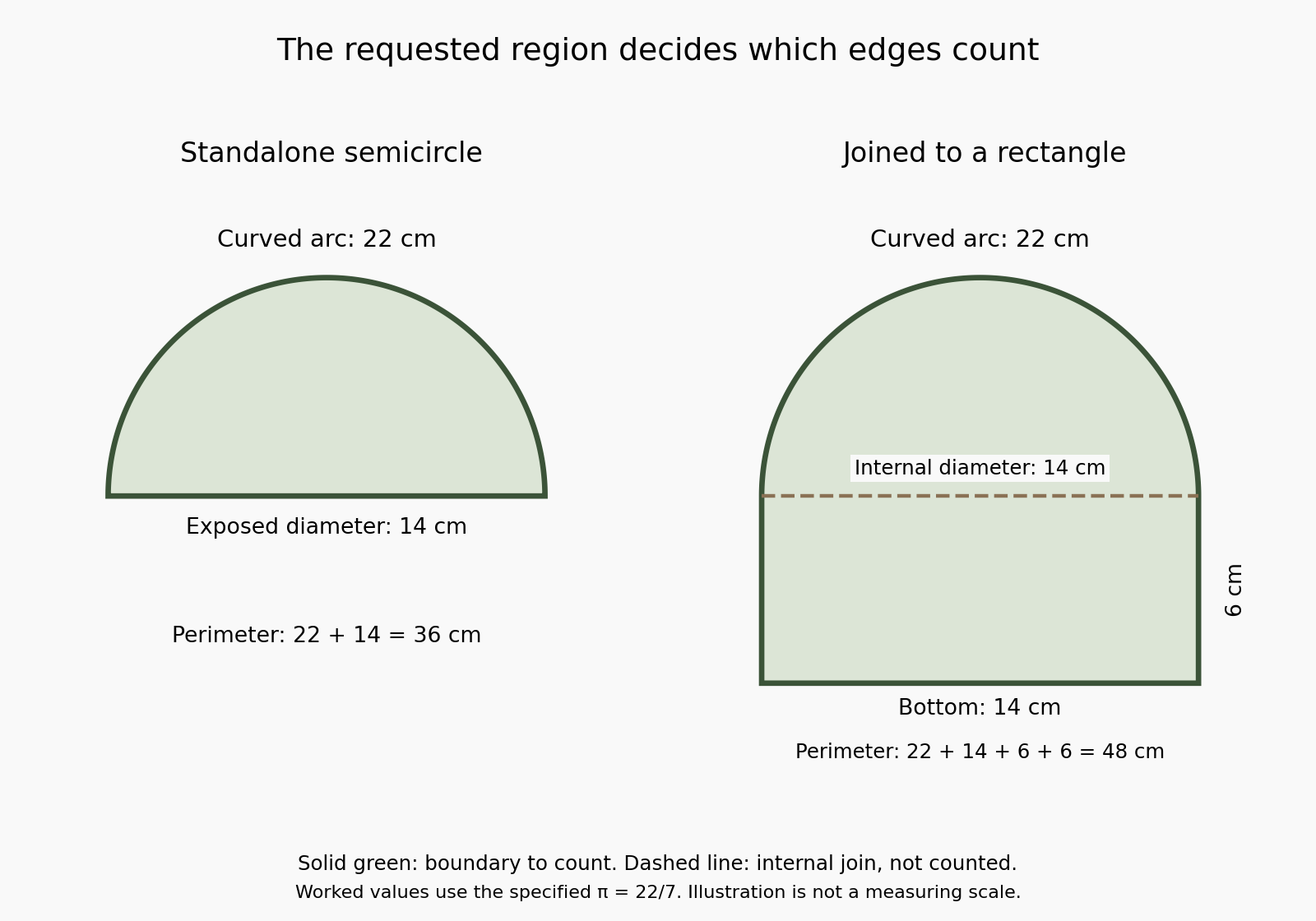
Quick answer: Primary 6 circle problems become manageable when a pupil distinguishes radius from diameter, area from perimeter, and the visible outside boundary from a hidden joining edge. A full circle has circumference πd (or 2πr) and area πr². A semicircle uses half the circular area, but its full perimeter includes its straight diameter. A quarter circle’s perimeter includes both straight radii.
For Punggol families preparing with the 2026 PSLE Mathematics syllabus, these details matter more than racing to remember formulas. Many pupils can recite πr², yet use the diameter as r or count a joined edge that is not visible on the outside of a composite shape. A short diagram and a careful boundary trace can repair the error without adding dozens of look-alike worksheets.
This guide offers sixteen original fully worked examples, a structured mistake diagnosis, a four-week plan and parent questions that test whether an answer is understood. Any Punggol-inspired garden, pathway, badge or design described below is a fictional teaching situation, not a measurement of a particular public facility or a prediction of the examination.
What is within the revised Primary 6 Mathematics syllabus?
The MOE Primary Mathematics syllabus (2021, updated October 2025) includes circumference and area of a circle; area and perimeter of a semicircle or quarter circle; and composite figures built from squares, rectangles, triangles, semicircles and quarter circles. Related Primary 6 measurement topics include volume and dimensions of cubes and cuboids, but three-dimensional measurement is not the subject of this article.
The SEAB 2026 Standard Mathematics 0008 syllabus specifies two papers worth 50 marks each: Paper 1, 1 hour 10 minutes without a calculator, and Paper 2, 1 hour 20 minutes with a calculator. The revised examination has 45 questions in total. These examples are independent study material. There is no promise that any particular shape or calculation appears in a given paper.
When an exam question specifies a value of π, use that instruction consistently. In the teaching examples below, π = 22/7 is used where a radius or diameter is a convenient multiple of seven; a problem explicitly using π = 3.14 is identified separately. Keep exact values when requested and round only according to a question’s requirements.
First principles: a circle is measured in two different ways
Circumference is a distance measured around the outside of a circle. It has linear units such as centimetres or metres. Area measures the space inside the boundary and therefore has square units such as cm² or m². The fact that both formulas contain π does not make them interchangeable.
Imagine a circle cut from paper. A string laid once around its rim measures the circumference. The coloured paper surface measures the area. If a child cannot tell which part of the paper is being counted, asking for another formula may only conceal the confusion.
| Quantity | Meaning | Formula | Units |
| Radius r | Distance from centre to boundary | r = d ÷ 2 | cm, m, … |
| Diameter d | Straight line through centre from boundary to boundary | d = 2r | cm, m, … |
| Circumference C | Distance around a full circle | C = πd = 2πr | cm, m, … |
| Area A | Surface inside a full circle | A = πr² | cm², m², … |
| Semicircle curved edge | One-half of a circle’s circumference | πr | cm, m, … |
| Quarter-circle curved edge | One-quarter of a circle’s circumference | πr ÷ 2 | cm, m, … |
The radius is half the diameter. Two circles with different radii can share the same underlying formulas because π expresses the relationship between a circle’s circumference and diameter. For area, the radius is multiplied by itself before the expression is multiplied by π. A child who mistakenly does π × r × 2 when asked for area has probably confused the meanings rather than simply copied one number wrongly.
The missing-edge trap: a joined semicircle is different from a standalone semicircle
A standalone semicircle has one curved half-circumference and a straight diameter. Its perimeter is πr + 2r. If the diameter is used to join the semicircle to a rectangle, however, that joining line lies inside the completed outline. It should not be included in the composite figure’s external perimeter.
The same boundary logic works for a quarter-circle joined along one radius to another piece. Always decide which line segments face the outside and which are internal construction or joining lines. A pupil who traces the perimeter with a pencil tip and stops at each corner often discovers the difference more reliably than a child who writes a formula instantly.
Area uses a different process: add non-overlapping surface regions when parts are joined, and subtract cut-out or unshaded regions when a portion is removed. Internal join lines do not affect the area sum. The same composite figure can therefore have one obvious area model and a very different perimeter path.
Sixteen original PSLE circle and composite-shape examples
Worked example 1: circumference from a radius
Question. A circular badge has radius 7 cm. Using π = 22/7, find the circumference.
Working. C = 2 × (22/7) × 7 = 44 cm.
Teaching point. The radius is known directly; the circumference is a linear distance, so do not square it.
Check. Diameter = 14 cm. C = πd = (22/7) × 14 = 44 cm.
Worked example 2: area from the same radius
Question. The badge in Example 1 has radius 7 cm. Find its area.
Working. A = (22/7) × 7 × 7 = 154 cm².
Teaching point. The radius appears twice because area measures a two-dimensional surface.
Check. The square unit is necessary; 154 cm would describe a length, not an area.
Worked example 3: circumference from a diameter
Question. A circle has diameter 21 cm. Find its circumference using 22/7.
Working. C = (22/7) × 21 = 66 cm.
Teaching point. When diameter is supplied, πd is the shortest valid formula. Do not double the diameter again.
Check. Radius is 10.5 cm, giving 2 × (22/7) × 10.5 = 66 cm.
Worked example 4: find the radius from a circumference
Question. A hypothetical circular sign has circumference 31.4 cm. Use π = 3.14 to find the radius.
Working. C = 2πr. Therefore r = 31.4 ÷ (2 × 3.14) = 31.4 ÷ 6.28 = 5 cm.
Teaching point. Work backwards from the known distance around the outside.
Check. 2 × 3.14 × 5 = 31.4 cm.
Worked example 5: standalone semicircle perimeter
Question. A semicircle has radius 14 cm. Use 22/7 to find its whole perimeter.
Working. Curved edge = πr = (22/7) × 14 = 44 cm. Straight diameter = 28 cm. Total perimeter = 44 + 28 = 72 cm.
Teaching point. Half the circumference is not the whole semicircle perimeter. The straight edge is part of a standalone shape.
Check. The answer must exceed the curved length alone, which is 44 cm.
Worked example 6: standalone semicircle area
Question. Find the area of a semicircle of radius 14 cm using 22/7.
Working. Area = ½ × (22/7) × 14 × 14 = ½ × 616 = 308 cm².
Teaching point. Half the full circle area is correct because two matching semicircles cover one full circle.
Check. Double 308 to recover a full-circle area of 616 cm².
Worked example 7: quarter-circle area
Question. A quarter-circle sector has radius 14 cm. Find its area using 22/7.
Working. Area = ¼ × (22/7) × 14 × 14 = 616 ÷ 4 = 154 cm².
Teaching point. Quarter means one of four equal area regions of a complete circle.
Check. Four quarters give 616 cm².
Worked example 8: quarter-circle perimeter
Question. The quarter circle in Example 7 has radius 14 cm. Find its whole perimeter.
Working. Quarter arc = ¼ × 2 × (22/7) × 14 = 22 cm. Two straight radii give 28 cm. Perimeter = 22 + 28 = 50 cm.
Teaching point. The quarter-arc is only one part of the boundary; two straight edges must be added.
Check. The perimeter is longer than its curved arc of 22 cm.
Worked example 9: a smaller standalone semicircle
Question. A semicircle has diameter 14 cm. Find its perimeter and area, using 22/7.
Working. Radius = 14 ÷ 2 = 7 cm. Arc = πr = 22 cm. Perimeter = 22 + 14 = 36 cm. Area = ½ × (22/7) × 7 × 7 = 77 cm².
Teaching point. This is a complete two-part answer; one linear quantity and one square-unit quantity.
Check. Two copies of its surface make the complete radius-7 circle with area 154 cm².
Worked example 10: rectangle with an attached semicircle: area
Question. A fictional sign consists of a rectangle 20 cm long and 14 cm wide, plus a semicircle attached along one 14-cm side. The shapes do not overlap in area. Find its total area.
Working. Rectangle area = 20 × 14 = 280 cm². Semicircle radius = 7 cm; its area is 77 cm². Total = 280 + 77 = 357 cm².
Teaching point. The attached straight diameter has no area of its own; it is simply a joining boundary.
Check. The answer should exceed the rectangle’s area of 280 cm².
Worked example 11: rectangle with an attached semicircle: perimeter
Question. For the sign in Example 10, find its outside perimeter using 22/7.
Working. The three exposed rectangle sides total 20 + 20 + 14 = 54 cm. The semicircle arc measures 22 cm. Total perimeter = 54 + 22 = 76 cm.
Teaching point. Do not also count the 14-cm diameter where the two shapes are joined. It is internal, not outside.
Check. Trace 20, 14, 20 and the 22-cm arc once each: total 76 cm.
Worked example 12: a two-semicircle stadium shape
Question. A design consists of a rectangle 20 cm long and 14 cm wide, with a semicircle attached to each 14-cm end. The end curves form one full circle of radius 7 cm. Find the area and perimeter.
Working. Area = 20 × 14 + (22/7) × 7² = 280 + 154 = 434 cm². Outside perimeter = 2 × 20 + 2π × 7 = 40 + 44 = 84 cm.
Teaching point. Two half-circles combine to one full circle; the two rectangle ends are internal joins.
Check. The only straight outside pieces are two 20-cm lines. Two half-circle arcs total 44 cm.
Worked example 13: shading inside a square
Question. A square has sides of 14 cm. A quarter circle of radius 14 cm is drawn with its centre at one corner and lies entirely inside the square. Find the square region outside the quarter circle.
Working. Square area = 14² = 196 cm². Quarter-circle area = 154 cm². Shaded remainder = 196 − 154 = 42 cm².
Teaching point. The task asks for the complement within the square, so subtraction—not addition—is required.
Check. The quarter circle fits within the square, and the remainder is positive and smaller than 196.
Worked example 14: cut-out semicircle area
Question. A rectangle is 20 cm long and 14 cm wide. A semicircular hole with diameter 14 cm is removed along a 14-cm edge. Find the remaining area using 22/7.
Working. Rectangle area = 280 cm². Cut-out semicircle area = 77 cm². Remaining area = 280 − 77 = 203 cm².
Teaching point. An inward cut-out reduces the amount of material. The direction of change is visible from the diagram.
Check. 203 + 77 = 280 cm².
Worked example 15: cut-out semicircle perimeter
Question. For the shape in Example 14, the semicircle forms a new inward curved boundary. Find the perimeter of the remaining shape.
Working. The outer straight portions are 20 + 20 + 14 = 54 cm; the inward arc is π × 7 = 22 cm. Total boundary length = 76 cm.
Teaching point. Cutting out a curve changes area and boundary differently. The removed straight 14-cm side is replaced by a 22-cm curved edge.
Check. A rectangle alone had perimeter 68 cm; the notch increases its perimeter by 22 − 14 = 8 cm.
Worked example 16: what changes when radius doubles?
Question. Circle A has radius 7 cm and Circle B has radius 14 cm. Find their respective circumferences and areas using 22/7.
Working. Circle A: circumference 44 cm, area 154 cm². Circle B: circumference 88 cm, area 616 cm². Circumference doubles; area becomes four times as large.
Teaching point. The perimeter uses one radius factor, whereas area contains r × r. Doubling both radius factors multiplies the area by four.
Check. 88 ÷ 44 = 2 and 616 ÷ 154 = 4.
A boundary-tracing method that stops most perimeter mistakes
Before touching a formula, place a tiny dot on the shape’s outside edge and move clockwise, naming every exposed straight or curved part exactly once. Draw a light crossing through any joining line that becomes internal. For a rectangle with a semicircle attached to its 14-cm end, the trace visits two 20-cm lengths, the opposite 14-cm length and one 22-cm arc. It never travels down the diameter that lies between the two surfaces.
This method creates a visible proof: the perimeter sum matches a journey around the outside. A pupil who writes ‘rectangle perimeter + half-circle perimeter’ is counting the join twice; tracing makes the duplicated line easy to see. A child may still calculate the correct answer by a subtraction shortcut, but that shortcut should be rooted in the boundary picture.
For an inward notch, the trace moves along the concave arc. The direction of bending does not change the arc’s length. A notch can remove area while increasing perimeter, as Example 15 demonstrates. That apparent contradiction is not an error; the two quantities measure different features.
How to use diagrams even when a question says ‘not drawn to scale’
A printed shape often illustrates a relationship without accurately showing the lengths. When the paper says ‘not drawn to scale’, do not estimate a radius by looking at the drawing. Use the stated measurements and mathematical relationships. If a semicircle is attached across the full width of a 14-cm rectangle, its diameter is 14 cm because of the stated geometry, not because the illustration looks roughly right.
Mark every length that can be inferred reliably: a diameter is twice its radius; the opposite sides of a rectangle are equal; a square’s sides are equal. If a diagram includes multiple curves, identify which have the same centre, radius or diameter before calculating. The diagram organises the information but does not replace the evidence.
Common error diagnosis for PSLE circle questions
| What the pupil wrote | What the error indicates | Focused repair |
| π × 14² when the given diameter is 14 | Diameter treated as radius | Draw a 14-cm line through the centre; mark two 7-cm radii. |
| ½πr for whole semicircle perimeter | Straight diameter omitted | Trace the curved edge and straight edge separately. |
| πr for quarter-circle perimeter | Uses half the full circumference rather than quarter arc plus radii | Split the circle into four equal sectors and colour only one arc. |
| Adds all rectangle sides and a joined diameter | Internal join counted | Trace only the external boundary with a pencil. |
| Adds areas for a removed notch | Fails to identify subtraction region | Shade the material still present, then subtract the hole. |
| Writes cm after an area | Unit mismatch | Ask whether the answer measures string or surface. |
| Uses 3.14 in one line and 22/7 in the next | Inconsistent approximation | Follow the question’s π instruction throughout. |
| Rounds midway and loses accuracy | Premature rounding | Keep exact intermediate values; round at the requested endpoint. |
A quick home diagnostic for Punggol Primary 6 pupils
Prepare two blank circles and a hand-drawn rectangle-with-semicircle. On the first circle label the diameter 14 cm and ask the child to find the radius without using a formula sheet. On the second circle ask for the distance around and the space inside. Finally ask the child to trace the outside of the joined shape and cross out the internal join.
Listen for conceptual language: ‘radius is half diameter’, ‘perimeter is the length around’, ‘area is the region inside’, and ‘we do not count the joined diameter’. A child who can say these ideas but makes one multiplication error needs different support from a pupil who cannot identify the exterior boundary. Record the earliest unstable step.
For a pupil who is already comfortable, add the inward-notch problem. Ask whether removing part of a rectangle can reduce the area while increasing the perimeter. This is a strong test of understanding because the surprising result cannot be memorised as a one-line formula.
Four-week plan: from radius to unfamiliar composite shapes
| Week | Core focus | Original short practice | Mastery evidence |
| 1 | Radius, diameter, π, circumference and area | Two circles with r = 7 and d = 21; compare units | Pupil chooses the correct formula before substituting. |
| 2 | Semicircle and quarter circle | Find arcs, straight edges, perimeters and areas | Pupil includes each exposed straight radius or diameter exactly once. |
| 3 | Composite additions and cut-outs | Rectangle plus semicircle, square minus quarter circle | Pupil chooses addition or subtraction from the shaded region. |
| 4 | Mixed unseen questions and exam presentation | One full circle, one notch, one joined figure in random order | Pupil annotates boundary, solves, checks units and explains direction. |
This is an illustrative learning sequence, not a guarantee of PSLE results after four weeks. It may take longer when division, fractions or measurement units are weak. A pupil who has learned the material quickly can deepen the reasoning by explaining multiple approaches, not simply rushing into material outside the Primary 6 specification.
What a small-group tuition lesson should observe
In eduKate’s three-student tutorial approach, a teacher can set one shared perimeter problem and observe very different reasoning. One child may fail to halve a diameter; another may understand the dimensions but count a joined edge twice; a third may write correct formulas and omit square units. Giving everyone the same correction would waste information.
A well-paced 90-minute session can open with retrieval of radius–diameter relationships, teach one clear diagram, guide pupils through a joined shape, then set separate corrections. Before the session ends, each pupil should solve an unseen example and describe what was counted. Follow-up practice can revisit the idea a few days later in a mixed set rather than repeating one page of nearly identical drawings.
Small groups are a teaching format, not a guarantee of top marks. Parents should look for a tutor who identifies the actual weak link, explains the concept and verifies independent transfer. For families considering attendance, a consultation with marked schoolwork can clarify whether tuition is necessary at all.
Paper 1 versus Paper 2: mathematics, not mechanical formula recall
Paper 1 of the revised Standard PSLE Mathematics format does not allow calculators. Pupils benefit from fluency with dividing even diameters by two, multiplication by 7 and 14, simple fractions of a circle, and appropriate use of a provided π value. Estimation still matters: a semicircle’s area should be half that of its corresponding circle.
Paper 2 allows calculators and can include structured or long-answer items. A calculator cannot decide whether a semicircle is a cut-out or an addition, or whether its diameter is part of the exposed boundary. Working should communicate the decomposition, formula, units and final conclusion. In marking, use the official requirements of the question, not an imagined universal rule about how many steps earn a mark.
Extended geometry workshop: fourteen unfamiliar composite-shape checks
The earlier sixteen worked problems establish the standard circle, semicircle and quarter-circle formulas. This further workshop shifts the focus from recognising a formula to interpreting the exposed boundary and the actual shaded region of an unfamiliar figure. Every drawing described here is hypothetical. Use π = 22/7 throughout unless a problem specifies a different value.
Before calculating, ask a learner to highlight the radius or diameter in one colour, trace the exposed outline in another, and shade only the region requested. The distinction between a semicircle’s curved arc and its full perimeter is critical. When a semicircle is attached to a rectangle along its diameter, that diameter is inside the combined shape and should not be counted in the outside perimeter.
Each problem intentionally includes a mathematical check. For length answers, reassemble the full circumference or trace the boundary in named sections. For areas, add a removed region back to the answer or subtract an attached region to recover the original figure. This is a practical form of proof available to a Primary 6 child, not an additional complex formula.
Original extension 17 — a second semicircular boundary
Question. A semicircle has radius 21 cm. Find the curved arc and total perimeter.
Worked solution. Full circumference is 2 × 22/7 × 21 = 132 cm. Curved arc is 66 cm. Diameter is 42 cm. Perimeter = 108 cm.
Reasoning. The 66-cm arc is only one component of the exposed boundary; the straight diameter closes the shape.
Independent check. Trace 66 cm around the curve and 42 cm across the base to reconstruct 108 cm.
Original extension 18 — large semicircular region
Question. A semicircle has radius 21 cm. Find its area.
Worked solution. Full circle area = 22/7 × 21 × 21 = 1386 cm². Half is 693 cm².
Reasoning. Halve the full circle’s area, not its radius. Halving radius instead would reduce area to one quarter.
Independent check. Two identical semicircles would cover 1386 cm², confirming the result.
Original extension 19 — quarter-circle curved arc
Question. A quarter circle has radius 21 cm. Find only its curved arc length.
Worked solution. Full circumference is 132 cm. One quarter = 33 cm.
Reasoning. A quarter turn corresponds to a quarter of the circular boundary. The two radius edges are excluded because the question asks only for the arc.
Independent check. Four equal quarter arcs of 33 cm re-form the 132-cm circumference.
Original extension 20 — quarter-circle complete perimeter
Question. For the same radius-21 quarter circle, find the entire perimeter.
Worked solution. The curved arc is 33 cm. Two straight radii contribute 21 + 21 = 42 cm. Perimeter = 75 cm.
Reasoning. A quarter-circle outline has three pieces. Multiplying the full circumference by one quarter captures only the curved one.
Independent check. 33 + 42 = 75 cm, a length rather than an area.
Original extension 21 — quarter-circle shaded area
Question. A quarter circle has radius 21 cm. Find its area.
Worked solution. Full area = 1386 cm². Quarter area = 1386 ÷ 4 = 346.5 cm².
Reasoning. One quarter of a disk covers one quarter of its area while retaining the original radius.
Independent check. Four equal quarters total 1386 cm², and the unit is square centimetres.
Original extension 22 — square and an attached half circle
Question. A square has side 14 cm. A semicircle of radius 7 cm is attached externally along one complete side. Find the combined area.
Worked solution. Square = 196 cm²; semicircle = 77 cm². Together = 273 cm².
Reasoning. The semicircular diameter matches the 14-cm side of the square. The two regions do not overlap, so add.
Independent check. Subtracting 77 cm² from 273 cm² restores the square’s original 196 cm².
Original extension 23 — the same figure’s outer boundary
Question. Find the full outside perimeter of the 14-cm square with the attached radius-7 semicircle.
Worked solution. The square starts with 56 cm of perimeter. Remove the joined side of 14 cm and add the curved semicircular arc of 22 cm: 64 cm.
Reasoning. The joined diameter is internal and is not part of the outside outline.
Independent check. Three exposed square sides total 42 cm; adding the 22-cm arc gives 64.
Original extension 24 — quarter circle removed from a square
Question. A 14-cm square contains a quarter circle of radius 14 cm centred at one corner. The quarter circle is cut out. Find the remaining area.
Worked solution. Square = 196 cm²; quarter circle = 154 cm². Remaining = 42 cm².
Reasoning. The removed quarter circle occupies the corner, leaving a curved triangular-looking region along the opposite two sides.
Independent check. Adding the removed 154 cm² to 42 cm² reconstructs the 196-cm² square.
Original extension 25 — outside perimeter of the curved leftover
Question. For the previous square-minus-quarter-circle figure, find the perimeter of the remaining region.
Worked solution. The remaining boundary comprises the top side 14 cm, right side 14 cm and quarter-circle arc 22 cm. Total = 50 cm.
Reasoning. The other two sides lie within the removed region and do not remain exposed along the leftover shape.
Independent check. 14 + 14 + 22 = 50 cm; tracing is safer than blindly adjusting the old square perimeter.
Original extension 26 — shaded quarter-segment after a triangle
Question. A quarter circle of radius 14 cm contains a right triangle with legs 14 cm on its two radii. Find the curved part outside the triangle but inside the quarter circle.
Worked solution. Quarter circle = 154 cm². Triangle = 1/2 × 14 × 14 = 98 cm². Curved region = 56 cm².
Reasoning. The shaded region and triangle partition the quarter-circle area.
Independent check. 56 + 98 = 154 cm². Neither region’s perimeter is required.
Original extension 27 — a notch in a rectangle
Question. A 20-cm by 14-cm rectangle has a semicircular notch of radius 7 cm cut inward along a 14-cm side. Find its remaining area.
Worked solution. Rectangle = 280 cm²; semicircular notch = 77 cm². Remaining area = 203 cm².
Reasoning. The shape loses material, so subtraction rather than addition is appropriate.
Independent check. 203 + 77 = 280 cm²; the original rectangle is reconstructed.
Original extension 28 — why a notch can increase perimeter
Question. For the same notched rectangle, find the exposed perimeter.
Worked solution. Original rectangle perimeter = 68 cm. The former 14-cm straight side is replaced by a semicircular arc of 22 cm. New perimeter = 76 cm.
Reasoning. An inward curve remains exposed even though material has been removed. Area and perimeter do not have to move in the same direction.
Independent check. 68 − 14 + 22 = 76 cm, and every external boundary segment has been accounted for.
Original extension 29 — two half-circle ends
Question. An illustrative running-track outline consists of two straight 30-m sides joined by two semicircular ends of radius 7 m. Find the full outline length.
Worked solution. Two straights contribute 60 m. The semicircular arcs together make a radius-7 full circumference of 44 m. Total = 104 m.
Reasoning. Join the two half-circle arcs conceptually, then add the straight sections. The diameters are hidden construction lines.
Independent check. 60 + 44 = 104 m. This is a fictional diagram, not the dimensions of any Punggol facility.
Original extension 30 — reverse circumference to radius
Question. A circle’s circumference is 88 cm using π = 22/7. Find radius and area.
Worked solution. Radius = 88 ÷ (2 × 22/7) = 14 cm. Area = 22/7 × 14² = 616 cm².
Reasoning. The question works backwards from a boundary to a radius, then uses that radius to find coverage.
Independent check. 2π × 14 = 88 cm; 616 cm² is not a length.
Teaching checkpoint: explain identical perimeters with different areas
Compare two 20-cm by 14-cm rectangles: in one, attach a radius-7 semicircle externally along a 14-cm side; in the other, cut a matching semicircle inward from that side. Their original rectangle perimeters are 68 cm. In both cases, a 14-cm straight boundary is replaced by a 22-cm semicircular arc, so each resulting perimeter is 76 cm. The areas differ: 280 + 77 = 357 cm² for the attached shape, and 280 − 77 = 203 cm² for the cut-out shape.
This contrast is a strong diagnostic because it defeats two shallow rules: ‘adding a piece always adds its entire perimeter’ and ‘removing material always lowers perimeter’. Neither statement is generally correct. The way to know a perimeter is to trace the new outside outline. The way to know an area is to account for covered non-overlapping regions. Ask the pupil to describe the two operations before calculating.
A second checkpoint: identify the original radius in every sub-shape
When a semicircle is placed on the end of a 14-cm-wide rectangle, its diameter is 14 cm, so its radius is 7 cm. If the question already states a radius of 14 cm, its diameter is 28 cm. Pupils sometimes copy a length from the rectangle straight into πr² without checking whether it labels a radius or a diameter. Have the child draw a small centre point on each circular part and mark the radius from that point to the arc.
The diagram should not be treated as a photographic measurement. If the written length and the apparent shape seem inconsistent because of printing or page scaling, use the stated geometrical relationships. When the figure is ambiguous, name the assumed attachment edge rather than inventing dimensions. Strong mathematics begins by preserving exactly the data given.
Rechecking an answer without calculating everything twice
Students can verify geometrical results by reversing an area operation or combining parts. Two semicircles of the same radius re-form a circle; four quarter-circle areas of the same radius total the whole disk; a rectangle with a semicircular notch regains its original area when the removed semicircle is added back. For perimeter, a boundary trace identifies every exposed straight and curved section and helps detect double-counted joining edges.
If an answer is for area, the unit should be square centimetres or square metres. If for perimeter or arc length, the answer uses ordinary centimetres or metres. If a child finds that doubling the radius would not increase area by a factor of four, revisit the area expression πr². These small checks are fast enough to use in examination practice and durable enough to transfer to Secondary Mathematics.
Frequently asked questions
Should my child use 22/7 or 3.14 for π?
Use the value instructed by the question. When a numerical approximation is not specified, follow the school’s current approach and present the expression or rounding as requested. Do not mix approximations midway.
Is the perimeter of a semicircle always half the circumference of a circle?
No. The curved arc is half the circumference, but a standalone semicircle also has a straight diameter. Its full perimeter is πr + 2r.
Why is the diameter excluded when a semicircle is joined to a rectangle?
The shared diameter is an internal join. Perimeter measures only the external boundary of the finished shape. The straight line may still be used to infer the semicircle’s radius.
Can area go down while perimeter increases?
Yes. Removing a semicircular notch can replace a shorter straight boundary with a longer curved boundary even while removing surface area.
Does a circle’s area double when its radius doubles?
No. Its circumference doubles, but the area becomes four times as large because the radius is squared in πr².
Are composite figures part of the official Primary 6 scope?
Yes. The updated MOE syllabus explicitly includes composite figures made from squares, rectangles, triangles, semicircles and quarter circles. The way they are combined determines whether addition or subtraction is needed.
What if a child knows every formula but cannot start a word problem?
Begin with naming what is asked, labelling the measurements, tracing a perimeter or shading an area. A formula is the last part of the representation step, not the first.
When should parents seek Mathematics tutoring for this topic?
If a child can interpret unseen diagrams, choose correct formulas and verify answers independently, additional tutoring may be unnecessary. Repeated diameter, boundary or units mistakes are a reason to seek targeted explanation and inspect the child’s working rather than only the score.
Next reading: the Punggol PSLE Mathematics series
- Simple linear equations — the balance principle and one unknown.
- Ratio and fraction links — parts, wholes and equivalent relationships.
- Reverse percentages — rebuilding the original whole.
- Average and missing values — totals, counts and checking.
- Primary 6 Mathematics synthesis and 30 worked problems — a wider review across topics.
Authoritative sources and teaching direction
- MOE Primary Mathematics syllabus (updated October 2025) — circle, perimeter, area and composite-figure content.
- SEAB Standard Mathematics 0008 (examined from 2026) — official assessment objectives, paper durations and calculator rules.
- SEAB PSLE formats examined in 2026 — Standard and Foundation subject specifications.
- eduKate’s Secondary 1 Mathematics teaching model — first principles, diagnosed errors and transfer.
What mastery looks like: The pupil can take an unfamiliar drawing, recognise what is inside and outside, choose consistent measurements, solve accurately and explain why an internal join is excluded or a shaded region is subtracted. Those thinking habits carry into Secondary Mathematics and beyond.


