
Quick answer. Primary schools in Punggol follow Singapore’s national Ministry of Education (MOE) system. Children normally enter Primary 1 in the year they turn seven, complete a six-year curriculum and sit the Primary School Leaving Examination (PSLE) in Primary 6. Punggol does not set independent admission, curriculum or examination rules. Its local differences concern school campuses, programmes, places, transport routes and the everyday experiences of children.
Parents choosing a Punggol primary school should first establish the correct Primary 1 registration phase and official distance category, then compare the child’s learning needs, school environment and actual commute. A name, ranking or neighbour’s experience cannot substitute for a current MOE school profile or a personal fit assessment. The same practical reasoning applies later when PSLE results lead into Secondary 1 school choices.
This parent guide, reviewed in October 2026, traces the system from registration to the transition after PSLE, with original examples, a useful school comparison framework, a learning-repair plan, questions and official sources. Admission dates and vacancies change annually, so use the relevant live MOE portals when making a binding decision.
Primary education in Punggol: quick reference
| Stage | National system | What a Punggol family should do |
|---|---|---|
| Before P1 | MOE phased registration for eligible children | Check birth dates, phase, address, vacancies and alternatives |
| P1–P2 | Foundation learning, no weighted tests or exams | Build reading, number sense, school routines and confidence |
| P3–P4 | Subject knowledge and more demanding reasoning | Diagnose conceptual gaps early and discuss teacher feedback |
| P5–P6 | Subject levels, advanced work and PSLE | Choose targeted practice and plan post-PSLE school options |
| Secondary transition | Posting Groups and Full Subject-Based Banding | Compare academic fit, culture, options and travel |
1. Know who runs primary education in Punggol
The primary school system is national. MOE publishes curriculum frameworks, Primary 1 registration rules and SchoolFinder information. Schools provide teaching, care, co-curricular programmes, routines and school-specific support. SEAB administers national examinations in its remit. A school may develop its own character, programmes and culture, but it cannot invent a different statutory P1 ballot rule or redefine the national PSLE scoring scheme for local residents.
Parents often encounter three very different kinds of statements: a law or official rule, a school-specific operational arrangement, and an opinion about what children need. The first requires an MOE or SEAB source; the second requires the current school website or a direct enquiry; and the third should be judged against the actual child rather than internet popularity. Writing that distinction into a family planning notebook solves many apparent contradictions.
For example, a parent may be told that a school is popular, another may say it has strong arts activities, and a third may claim that living a five-minute walk away guarantees entry. These are not interchangeable claims. The first is community perception, the second can be checked against school programmes, and the third needs the exact MOE distance and balloting rules.
Strong decisions begin by identifying what is knowable now and what remains uncertain until registration. The objective is not to make a child’s future risk-free. It is to use evidence well enough that the child starts school in a sensible environment.
2. Which primary schools are in the Punggol area?
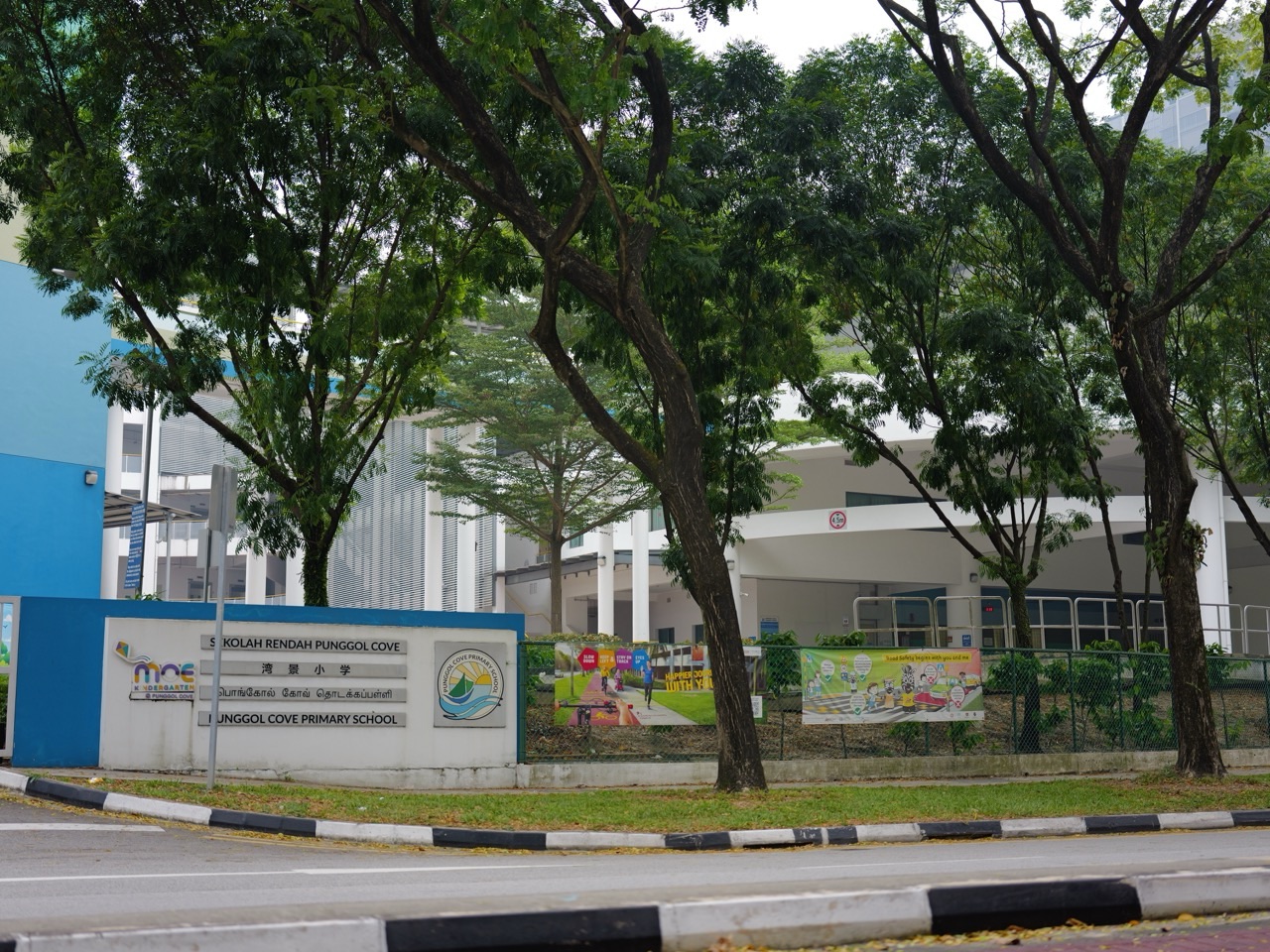
School campuses familiar to Punggol families include Edgefield Primary, Greendale Primary, Horizon Primary, Mee Toh School, Northshore Primary, Oasis Primary, Punggol Cove Primary, Punggol Green Primary, Punggol View Primary, Valour Primary and Waterway Primary. Treat this as a useful orientation, not an exhaustive list, a ranking or a claim about vacancies. Always verify each current school profile in MOE SchoolFinder before relying on it.
The locality label “Punggol” covers households with very different transport situations. Someone near Punggol Coast may find Northshore convenient; someone elsewhere in town may cross multiple roads or rely on an LRT journey. The apparent closeness of a school on a map does not tell a parent how long a six-year-old needs to reach its actual entrance on a wet weekday morning.
SchoolFinder can help identify school type, address, programmes, languages, support and contact details. Then use the school’s official website for current hours, visitor arrangements, co-curricular activities and explanations of its educational approach. A school’s strengths should be understood through real examples, not treated as a marketing slogan.
Make a shortlist of schools that are realistic for the child and the caregivers. A strong shortlist includes at least one option with an especially reliable journey. School choice is a six-year family logistics decision as well as an education decision.
3. Primary 1 registration: five phases, not one open application
The official 2026 P1 registration process for Singapore Citizen and Permanent Resident children uses five phases: Phase 1, 2A, 2B, 2C and 2C Supplementary. Each phase has its own eligibility conditions, available places and deadline. International students follow a separate route and should consult the official instructions rather than attempt to apply through the wrong phase.
For the 2026 registration exercise, MOE’s portal described children born from 2 January 2020 to 1 January 2021 inclusive as the applicable cohort for entry the following year. Birth-date boundaries matter, and future cohort dates should be verified by the portal rather than estimated from a child’s birthday party or preschool year.
Families need to understand the difference between qualifying for a particular phase and being guaranteed a place. Eligibility to submit an application is not a promise of admission, especially where demand exceeds available places. MOE’s rules govern priority and balloting. A successful application in an earlier phase may also affect options later; always read the current withdrawal or amendment procedure carefully.
A practical calendar starts with birth-year eligibility, then phase eligibility, then school choice, then documents and deadlines. Check that the adult using the registration portal has the necessary access and that everyone with parental responsibility has agreed on the application. Do not wait until the final hour to investigate missing child details or address records.
4. What the phases mean for a Punggol parent
Phase 1 generally concerns children with a sibling currently studying in the chosen primary school. Other phases include specific types of qualifying connections or participation defined by MOE, while Phase 2C is broadly important for children still seeking a place after previous phases. The exact wording matters: membership, volunteering, family links and school-related conditions must satisfy official requirements, not simply resemble something a neighbour described.
A family might mistakenly assume that living close to a school permits admission through every phase. That is incorrect. Distance affects priority where the process specifies it; it does not create eligibility for a phase intended for a different category of applicant. Another family might believe attending an MOE Kindergarten at a host school reserves the child’s later P1 place. It does not eliminate the separate registration process.
When unsure, identify the phase and locate the matching official eligibility text. Keep documentary evidence ready if the phase requires it. Ask the school for clarification when needed, but distinguish a staff member’s operational guidance from the published national rule. This also helps families moving to Punggol from overseas, whose circumstances may differ.
A good application strategy is careful, not speculative. Choose the school intentionally, understand the possible ballot and discuss alternatives in advance. Never make children responsible for adult disappointment about a registration result.
5. The 1km and 2km question: official distance versus real travel
MOE uses home–school distance categories in relevant P1 priority and balloting rules. Parents often refer to within 1km, between 1km and 2km and beyond 2km. These categories are determined according to official distance methodology. They are not interchangeable with an app’s pedestrian route or an estate agent’s approximate straight-line claim.
Punggol’s canals, covered walkways, roads, MRT infrastructure and residential precinct shapes make this distinction especially important. A school can appear very close from an upper-floor window yet require a more complicated pedestrian route. Conversely, an official distance category may be favorable even though the safest weekday route takes longer than expected. Admission eligibility and sustainable commuting must be assessed separately.
Families moving into a new BTO or resale flat should check the applicable address rules and evidence. If a parent wants to use an eligible caregiver’s address, MOE has a specific declaration process and conditions; a grandparent’s address cannot be borrowed casually to secure priority. Read the current residence and documentation requirements before acting.
Record the official distance category beside the specific child, school and entry year, then independently test travel time at the actual school-start period. That double check prevents a false sense of certainty from either a map pin or a property brochure.
6. Balloting is an allocation procedure, not a measure of school quality
When eligible applicants exceed available places, admission priorities and balloting can come into play. The practical point is that historic data describe a past registration exercise, not the next one. New flats, families’ moving patterns, siblings and changes in applications can shift pressure from one Punggol school to another.
MOE provides past vacancy and balloting information to help parents form informed expectations. Use it to identify potential uncertainty, not to calculate an admission guarantee. A year without a ballot can be reassuring context, but it is not an entitlement. Likewise, oversubscription tells you little about whether the school is best suited to your child.
Parents can compare several options using a decision table: qualifying phase, current official distance, previous vacancy context, travel, programmes, pastoral support and childcare. A school that performs well across most important family factors may be a stronger decision than one selected only because its historical demand appears impressive.
Be thoughtful in your language at home. A child who does not receive the family’s first choice has not failed an examination. Explain that adults must follow a registration process and several schools can provide a strong education. Preserving confidence matters more than winning an argument with an online ranking.
7. Choosing a school: learning fit, belonging and everyday reliability
Good primary-school choice is not only academic. Consider whether your child needs a particularly predictable transition, enjoys hands-on inquiry, benefits from arts exposure, or needs additional language support. Review the school’s learning environment, Applied Learning Programme, Learning for Life Programme, co-curricular choices and student support information. Programmes should be evaluated by what children actually do, not by impressive titles.
At a school visit, ask how teachers welcome anxious P1 children, communicate when a pupil falls behind and encourage those who are ready for additional challenge. Look for specific evidence: classroom routines, opportunities for explanation, library use, group work and ways to resolve social difficulties. A polite question about the process for seeking help often reveals more than a general claim of academic excellence.
Next map logistics: pick-up responsibilities, school-based student care, possible younger sibling routes, school bus arrangements and caregiver contingencies. If an older relative helps each day, calculate the walking and waiting time from that person’s route rather than the parents’ ideal journey.
There is no universally correct ranking of Punggol schools. A school should be judged by the relationship between what it offers and what the child needs over six years. Strong daily attendance, meaningful teaching and stable family support are not secondary considerations.
8. The P1–P2 years: developing foundations without test culture
MOE has removed weighted assessments and examinations for P1 and P2. The purpose is not to stop checking learning. It is to encourage appropriate teaching, feedback and development rather than excessive early test pressure. A child’s progress may appear through classwork, conversation, reading, problem solving and teacher observations instead of frequent formal examination grades.
English foundations include listening, speaking, basic reading comprehension, meaningful vocabulary and sentence construction. Mathematics includes number sense, place value, arithmetic relationships, measurement and interpreting simple stories about quantities. Mother Tongue develops through suitable listening, speaking, reading and writing opportunities. Children also need time for physical activity, arts, relationships and character development.
Parents should observe the underlying skill. If a child writes 304 when asked to write thirty-four, investigate place value. If they read a paragraph fluently yet cannot retell it, investigate meaning rather than pronunciation. If they know 6 + 4 = 10 but cannot explain how to make ten in another way, give conceptual practice.
Ten calm minutes of reading and conversation may be better than an hour of unhappy worksheets after student care. Build confidence in asking questions and correcting errors, because the habits formed in the first two years support every later subject.
9. Primary 3 and 4: questions become more conceptual
By P3 and P4, students face more demanding language, mathematics and science tasks. Science forms part of the primary curriculum from Primary 3. Children learn to observe, compare, identify patterns and explain phenomena, not merely repeat vocabulary. Mathematics increasingly asks them to interpret multi-step word problems and represent relationships.
Parents often first notice a difficulty when the worksheet looks unfamiliar. A child might have mastered simple arithmetic but struggle to decide which operation belongs in a word problem. Another might know that evaporation involves a change of state yet be unable to explain why moving air helps wet clothes dry. These are reasoning problems; more memorised definitions alone may not solve them.
A useful diagnostic routine is to ask the child to explain the question in ordinary language, show the first step and identify where the reasoning stopped. Reduce the difficulty while preserving the principle, teach that principle clearly, and then vary the context to test transfer. Do not mark a copied model answer as evidence that the child understands it.
Continue nurturing social confidence, physical activity and interests. P3 and P4 are developmental years, not merely preparation camps for P6. Children build resilience when adults recognise their growth across different domains, not when every evening is converted into a test.
10. Primary 5 and 6: subjects, levels and a sensible revision plan
P5 and P6 bring greater academic demand and decisions about curriculum levels, including Standard and Foundation arrangements where applicable under primary Subject-Based Banding. These decisions are made within school and MOE rules and should account for strengths and readiness by subject. Do not generalise from one weak subject to the child’s entire ability.
If the child struggles in Mathematics, investigate number sense, fraction concepts, interpretation and multi-step planning before choosing a more intensive revision plan. If Science answers are imprecise, ask whether the issue is conceptual knowledge, question reading or a missing causal explanation. For English, separate vocabulary, grammar, inference, writing organisation and task understanding. Each bottleneck needs a different response.
Build a short review cycle. Use actual schoolwork, categorise mistakes, reteach the first weak idea, practise in a new setting and retest. Balance revision with sleep, physical activity and a realistic weekly timetable. A child who understands a concept but is permanently tired may not show the learning reliably in an assessment.
PSLE preparation should make learning clearer and more accurate, rather than turning children into answer-copying machines. Familiarity with exam conditions has value near the examination, but it is no substitute for understanding during the preceding years.
11. PSLE Achievement Levels and what a total actually means
PSLE uses Achievement Levels (ALs) across English Language, Mathematics, Science and Mother Tongue Language, subject to official special cases such as exemptions and Foundation-level subjects. For Standard subjects, AL1 is the strongest band and AL8 is the weakest. The overall PSLE Score is the sum of the four subject ALs, generally ranging from 4, the best possible total, to 32.
A fictional child receives English AL3, Mathematics AL2, Science AL4 and Mother Tongue AL3. Their total is 3 + 2 + 4 + 3 = 12. It is not a percentage average or the student’s class rank. Another child may also total 12 through a different pattern of subject strengths, which is why the number alone cannot guide every learning or school choice.
Foundation-level subjects have their own scoring treatment; parents should use the current MOE calculator instead of applying Standard-level arithmetic carelessly. Likewise, overall scores are not an exact forecast of a named school’s future cut-off, because cohort results, preferences and posting rules shape actual outcomes.
A good discussion after receiving results asks what the child is ready to study next, which environments support their interests and what travel is workable. Avoid telling a child that the score determines their lifetime worth. It describes achievement for a particular transition, not a permanent ceiling.
12. Beyond PSLE: Full Subject-Based Banding changes the language
Secondary 1 cohorts entering since 2024 are under Full Subject-Based Banding rather than the former fixed Express, Normal (Academic) and Normal (Technical) stream labels for new entrants. Posting Groups facilitate admission. Once in secondary school, students may take different subjects at G1, G2 or G3 levels according to national rules, school provision and individual readiness.
This means old charts showing only stream cut-offs are not sufficient for a child now preparing to leave Punggol primary school. A family should use current MOE resources to understand Posting Groups, subject-level options and the fit of individual schools. Higher demand in one subject does not automatically describe the student’s ability in every other subject.
Interest and route still matter. A pupil may travel outside Punggol to a secondary school offering an appropriate programme. That opens opportunities but adds an extra daily cost in time, transport and fatigue. A CCA that extends into the evening changes the real journey. Visit the route on a school day where possible.
The transition should be described positively and accurately: children have different profiles, the system provides a range of subject demands, and students can develop as they mature. The objective is good learning and opportunity, not the maintenance of a single childhood label.
13. Original Mathematics worked example: fractions and meaning
Consider a fictional P4 student who sees: “There are 168 books. Three-eighths are borrowed. How many remain?” They multiply 168 by 3 and produce 504, which is larger than the total. Rather than merely writing a cross beside the answer, investigate whether the child understands a fraction of a quantity.
Divide 168 into eight equal groups: 168 ÷ 8 = 21. Three groups are borrowed: 3 × 21 = 63. The number left is 168 − 63 = 105 books. Another method is to calculate the five-eighths that remain, 168 × 5 ÷ 8 = 105. Ask the child why both approaches agree and why 504 could not possibly be correct.
Now change the story. Two-fifths of 150 oranges are sold; how many remain? The answer is three-fifths of 150, or 90. If the child can explain both cases independently, the principle is starting to transfer. If they simply memorise a sequence of symbols and become lost when words change, rebuild with diagrams or objects.
This is the core of effective support: identify the reasoning error and repair it. A student with a missing concept needs explanation; a student with a correct method but poor question reading needs a different intervention. Generic practice volume cannot replace a good diagnosis.
14. Original Science worked example: explaining a process
Imagine a P5 Science task: Two identical wet cloths are placed under the same conditions, except that air moves more rapidly across one. Why might that cloth dry sooner? An incomplete response says, “Wind makes it dry.” A stronger response identifies water evaporation and explains how moving air removes water vapour near the surface, allowing evaporation to continue more effectively.
The answer should connect observation to mechanism. The observation is the difference in drying time. The mechanism involves liquid water changing to water vapour and the effect of air movement. A carefully designed investigation should control other important factors, such as the cloth type, starting wetness, exposed area and temperature.
Punggol’s waterfront makes moving air a familiar experience, but a walk at the Waterway is not automatically a fair scientific test. Ask what other variables might be changing. This helps students distinguish a useful everyday observation from reliable evidence. It also encourages thoughtful curiosity about the neighbourhood.
The same habits strengthen comprehension and mathematics: describe what the question asks, identify the principle, connect evidence or quantities logically, then check the conclusion. Asking children to explain their thinking is often more powerful than giving them another model answer to memorise.
15. Original English worked example: an inference with evidence
A P4 comprehension passage might say: “Amira waited by the gate long after the final bell. Each time a car turned the corner, she stood on tiptoe. When her father finally appeared, she ran forward without collecting the umbrella beside her.” The question asks how Amira probably felt while waiting, and which details support the inference.
A sensible answer is that Amira was eager or anxious to see her father. The supporting evidence is her repeated reaction when cars approached and her immediate rush when he arrived. A weak answer merely says, “She was happy,” without linking the emotion to any detail. Another weak answer copies the whole paragraph and hopes the examiner identifies the relevant part.
Teach a reusable structure: state the inference, select the strongest evidence and explain the relationship. Then ask whether another emotion could also fit the passage, and what detail would strengthen one interpretation over another. This helps children learn that reading comprehension is reasoning from language, not guessing the teacher’s preferred feeling.
At home, use the same technique while reading a storybook or discussing a character in a familiar tale. Ask “What makes you think that?” and wait for a specific line or action. The method is transferable to English, Mother Tongue reading and later Humanities work.
16. School reports are a starting point, not a full diagnosis
A report showing weak Mathematics performance tells parents which subject needs attention, but not necessarily why. Ask for representative mistakes. Separate conceptual misunderstanding, question interpretation, working presentation, memory, attention and time pressure. If a student understands a problem orally but loses track while writing, the intervention differs from a student who never understood the quantities.
Similarly, weaker English marks might arise from vocabulary, inference, grammar, writing structure or comprehension stamina. A strong tutor or teacher should explain which component is weak and how instruction will address it. “Needs more practice” is not enough unless the type of practice is specified and its expected effect can be checked.
Ask for a short demonstration. Can the child explain a worked example without copying? Can they solve a related unfamiliar problem? Can they correct their own error after a hint? When support succeeds, the adult should gradually remove prompts rather than keep the child permanently dependent.
Tuition in Punggol should be a response to a defined need, not a ritual that follows automatically from age. Protect CCAs, friendships and sleep. Children cannot reliably learn if every available hour becomes compulsory revision.
17. A four-week intervention for a primary-school difficulty
Week 1 — Gather and classify. Choose one subject and three to five recent pieces of work. Mark each difficulty as meaning, concept, method, communication, careless checking or timing. Speak to the child about the step where they became unsure. Use school feedback to decide which single bottleneck is worth addressing first.
Week 2 — Rebuild from a smaller case. If fractions are difficult, use equal groups and diagrams. If reading inference is weak, practise one short paragraph and justify an interpretation. If Science explanations are vague, link an observable event to one clear mechanism. Keep sessions brief enough for focused feedback.
Week 3 — Vary the context. Change numbers, stories and surface features without changing the underlying idea. Ask for an explanation before looking at the answer key. This tests whether the child has learned a method rather than a particular worksheet. Track independent successes and where hints remain necessary.
Week 4 — Review and taper. Use a fresh short task and compare it with the starting evidence. If the child improves, reduce help slowly and allow schoolwork to show the change. If not, revisit the diagnosis and seek teacher advice. More hours are not automatically the solution to a wrong diagnosis.
18. Student care, CCAs, transit and the real Punggol timetable
Schooling does not end at the last lesson. A child may attend student care, use the library, practise sports or music and then travel home. The household must make room for meals, physical activity, homework, play, conversation and sleep. An excellent-looking after-school plan on paper may leave a young child exhausted by Thursday.
Test routes around the actual school timetable, not only on an off-peak weekend. Account for MRT and LRT waits, roads, bad weather and the time a small child needs to move. If a grandparent handles pick-up, ensure the route is manageable for that person. A family with two school-age children may need a compromise that makes both schedules work.
Tuition may help when a precise skill gap persists, but compare the benefits against lost rest and travel. Ask any provider how they diagnose, teach and check a weakness. Class size can improve opportunities for feedback, but it does not by itself demonstrate teaching quality. A child who understands independently is the strongest sign that support has worked.
Review the week each term as academic load and CCA demands change. A resilient plan has margins for illness, late meetings and surprise school activities. A packed timetable with zero flexibility is rarely a learning advantage.
19. Special educational needs, school communication and well-being
Children arrive at primary school with different strengths, languages, developmental histories and support needs. If a child cannot follow some instructions, struggles with peer relationships or becomes distressed during transitions, ask the teacher what happens in specific situations. A concrete observation provides a better starting point than a broad label like “weak” or “uncooperative”.
MOE schools have processes and support provisions for different learner needs; the details and suitability should be checked with the individual school. Parents should work with educators to identify what has been tried, what helps and when professional input may be useful. Do not interpret a brief classroom observation as a medical diagnosis or assume that every school offers identical services.
Communication systems such as Parents Gateway help with routine notices, but more substantial concerns may require a direct conversation and agreed follow-up. Keep notes of observations, school guidance and the next review date. Ask the child what they experience and listen without turning the discussion into an interrogation.
A school is part of a wider support network. Parents help with sleep, routines and context; teachers observe classroom learning; appropriately qualified professionals assess persistent developmental or health issues. The aim is participation and growth with dignity, not an argument about who is to blame.
20. Make a six-year plan without trying to predict a child’s life
At P1, build security and confidence. At P2, strengthen reading and number sense. At P3 and P4, help the child explain unfamiliar tasks and identify where a concept becomes difficult. At P5 and P6, adjust practice to actual needs, understand the examination and explore future school options. Review the plan regularly; do not assume a fixed talent profile at age seven.
A Punggol household may move flats, add a younger sibling, change work hours or discover that the child has a new interest. The sensible schooling plan can accommodate those changes. A reputation-led plan that requires one specific journey or one specific result may create avoidable stress when everyday life changes.
The PSLE Score matters for secondary-school transition, but not because it measures character or guarantees adult success. National pathways continue to evolve, and students develop at different paces. A child who learns to ask questions, check assumptions, practise deliberately and seek help has acquired useful capabilities beyond any examination result.
The guiding question is simple: What does my child understand today, what is the next useful skill, and which school, family routine and support arrangement will help them acquire it? Revisit that question after each major transition. It is a better compass than a static list of supposedly superior schools.
Frequently asked questions from Punggol parents
At what age should a child register for Primary 1?
Children ordinarily enter P1 in the year they turn seven, with official birth-date boundaries. The 2026 exercise involved the cohort born from 2 January 2020 to 1 January 2021 inclusive. Check the portal for your child’s exact cohort instead of relying on a general age estimate.
How many P1 registration phases were there in 2026?
Five: Phase 1, Phase 2A, Phase 2B, Phase 2C and Phase 2C Supplementary for eligible Singapore Citizen and Permanent Resident children. Each has separate eligibility and timing. International students use a different process and should consult MOE directly.
Does a home within 1km guarantee admission?
No. Distance priority may help within the applicable rules, but the number of applicants, phase eligibility, vacancies and balloting still matter. The official MOE distance methodology must be used. A short walking route is not itself proof of the 1km category.
May I apply to two schools in one P1 phase?
No. MOE’s registration guidance permits only one school application per phase. Changes and withdrawals have specific procedures and time limits. Make the family decision carefully and retain confirmation of a completed submission.
Does MK attendance reserve a host school’s P1 place?
Do not assume that it does. MOE Kindergarten enrolment and Primary 1 registration are separate processes with their own eligibility and allocation rules. A preschool should be chosen for care and development, not on the assumption of an automatic future reservation.
Where can I compare schools in Punggol?
Use MOE SchoolFinder to review current location, school type, programmes and support details. Follow up with school websites and, where possible, appropriate visits. Older lists may omit new schools or retain outdated services, so confirm current information.
Is a popular school necessarily the best?
Popularity may reflect many family choices, but it is not a direct measurement of the right environment for your child. Compare practical access, teacher support, culture, student care and programme fit. Historical ballots do not measure individual learning quality.
Does P1 have formal examinations?
MOE removed weighted assessments and exams for P1 and P2. Learning is still taught and observed. Parents can support language, numbers, curiosity and classroom routines without turning early primary years into repeated formal testing.
When does primary Science begin?
Science is formally taught as a primary subject from Primary 3. Children can develop inquiry habits well before that through play, observation and conversation. In P3 onward, focus on evidence, concepts and clear causal explanations rather than isolated memorisation.
How does the PSLE AL total work?
For the usual four-subject scoring framework, add the subject Achievement Levels across English, Mathematics, Science and Mother Tongue. The overall result generally ranges from 4, best, to 32. Foundation-level scoring and special cases have additional rules, so consult MOE’s calculator.
What does a PSLE Score of 12 mean?
It is a sum of four achievement bands, not a percentage or rank. Different subject profiles can add to 12. The actual Secondary 1 posting outcome also depends on current posting rules, school preferences, available places and cohort conditions.
Can my child enter secondary school outside Punggol?
Yes. Secondary school posting is a national system, so parents can consider schools elsewhere subject to admission rules. The commute, CCAs, subject options and the child’s independence should be part of the decision.
Do secondary schools still use fixed Express and Normal streams?
For new Secondary 1 cohorts since 2024, Full Subject-Based Banding uses Posting Groups and subject levels G1, G2 and G3. Advice based only on old fixed-stream charts may be outdated. Check MOE guidance for the relevant cohort.
What if my child struggles with fractions in P4?
Check whether the child understands equal parts, fraction of a quantity and what the story asks. Use a simpler example or bar model, then vary the problem to test understanding. Simply assigning more timed questions may reinforce a misunderstood procedure.
What if English comprehension is weak?
Identify the component: vocabulary, literal understanding, inference, evidence selection, sentence structure or reading stamina. Ask the child to explain the answer and point to supporting details. Teach the missing thinking move instead of asking for generic extra pages.
How do we balance tuition and CCAs?
Start with the entire timetable, including travel, student care, sleep and meals. Add learning support for a clearly identified need and review progress after a short period. Protect non-academic activities and family time; overloading the week can reduce the benefit of otherwise good teaching.
Who should I contact about a persistent learning or well-being concern?
Begin with the class or form teacher, share specific observations and request a plan. The school can explain available processes and support. For significant developmental or health concerns, seek appropriately qualified professional advice rather than relying on online diagnoses.
Primary sources for confirmation
- MOE P1 Registration Portal: verify your child’s eligibility, phases and official registration procedure.
- MOE P1 phases and dates: follow the latest exercise.
- MOE P1 application guidance: address documentation, caregiver declarations and portal use.
- MOE SchoolFinder: current schools and programmes.
- MOE PSLE and Full Subject-Based Banding hub: understand the next transition.
- Official PSLE score-calculation guide: illustrated AL examples.
- MOE education development overview: P1–P2 assessment reforms and other changes.
Related Punggol guides
- Preschool, childcare and MOE Kindergarten in Punggol
- Understanding compulsory primary education
- Singapore’s school transfer system
- P1 admission for international students
Explore the complete four-part Punggol education system series: Part 1: Preschool and MOE Kindergarten · Part 2: Primary schools, P1 and PSLE · Part 3: Secondary schools, Full SBB and SEC · Part 4: ITE, polytechnics, JC, MI and SIT.
Updated 18 October 2026. Independent educational information, not a school endorsement, personalised admissions decision or official MOE notice. Verify the exact entry year, school status, application rules and examination framework with the official authorities.


