
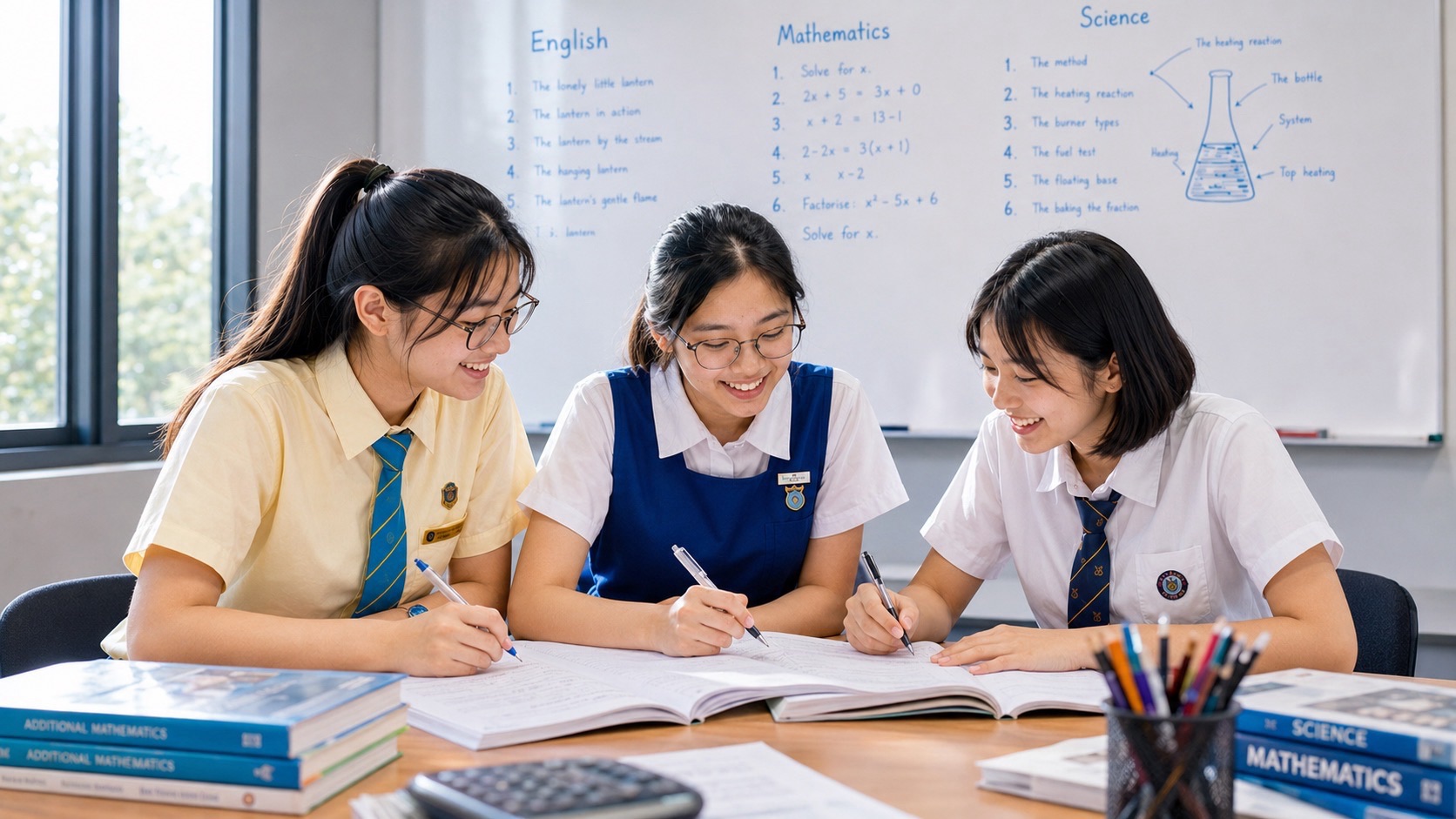
Continuous writing tuition in Punggol should do more than teach students to produce longer compositions. The deeper work is to help a learner understand a topic, choose a viable direction, organise ideas, control pacing, develop details, use vocabulary precisely and revise with purpose. For PSLE English, Secondary English, G3 English and SEC preparation, continuous writing is where language knowledge becomes sustained expression.
The core aim of continuous writing is coherent development from beginning to end. A strong student should be able to interpret the task, decide what the piece is really about, plan enough to avoid wandering, build paragraphs that each do useful work, maintain relevance, vary sentence structure, control vocabulary and grammar, and finish with an ending that belongs to the piece rather than merely stops it.
Explore related English guides and choose your next reading step.
At eduKatePunggol, continuous writing is treated as a decision-making system. Weak vocabulary can limit precision. Weak reading can limit ideas and topic interpretation. Weak grammar can damage clarity. Poor planning can produce irrelevant paragraphs. Poor revision can leave a promising draft underdeveloped. Strong tuition identifies the first weak link and repairs it.
For the existing stage-specific routes, see PSLE Composition Relevance & Structure — Topic Control, Causality and Continuous Writing and Secondary Continuous Writing — Ideas, Structure, Voice and SEC Exam Control.
Continuous Writing Is Not “Write More”
Length is visible, so students often mistake it for quality. A longer composition may still be repetitive, unfocused or poorly developed.
The better question is whether each paragraph contributes something necessary.
A good piece has movement. The ideas develop, the story changes, the argument advances or the reflection deepens.
Continuous writing therefore depends on selection. The writer must know what to include, what to leave out and what deserves more space.
Topic Interpretation Comes First
A beautifully written piece can still underperform if it only loosely fits the topic.
Students need to identify the exact demand of the question before planning.
A narrative topic may require a particular kind of event, emotion or change. An argumentative or discursive topic may require evaluation, comparison or a clear position.
A useful habit is to rewrite the topic in simple language: “This question is really asking me to show…” or “I need to explain whether…”
That sentence becomes the control line for the whole piece.
Relevance Is the First Mark-Saver
Students often think relevance is obvious, but many compositions drift because interesting ideas pull them away from the task.
A strong writer keeps returning to the core question: does this paragraph help answer the topic?
Relevance does not mean repeating the title. It means the events, examples and explanations all serve the central idea.
For PSLE-specific work, see PSLE Composition Relevance & Structure.
Planning Should Be Short but Useful
Overplanning can waste time. Underplanning can create chaos.
The goal is a compact plan that protects structure without freezing creativity.
For narrative writing
- starting situation;
- trigger or problem;
- development;
- turning point;
- consequence;
- ending or reflection.
For argumentative or discursive writing
- position or direction;
- main point 1;
- main point 2;
- main point 3;
- counterpoint where useful;
- conclusion.
The plan should be clear enough to prevent wandering and flexible enough to change if a stronger idea appears.
Causality Makes Narrative Writing Feel Real
Weak narratives often become a list: this happened, then this happened, then this happened.
Stronger narratives use causality: because this happened, the character made a decision; because of that decision, a new problem emerged; that problem forced a change.
Causality creates momentum.
Students should ask after each major event: what changed because of this?
The Turning Point Must Matter
A climax or turning point should not feel like a sudden decoration inserted because the student was told every story needs one.
It should arise from the earlier situation and change what follows.
A good turning point may be a decision, discovery, confrontation, mistake, realisation or reversal. The important feature is consequence.
If the story would be almost the same without it, the turning point is probably weak.
Pacing: Not Every Moment Deserves the Same Space
Routine actions can move quickly. Important moments deserve expansion.
Students often spend too long on introductions and rush the central event. Better pacing reserves detail for the places where emotion, conflict or change matters most.
A useful question is: where should the reader slow down?
That is where description, dialogue, internal thought and sensory detail can become valuable.
Specific Detail Beats Decorative Detail
Description is useful when it reveals something important.
A trembling hand may show fear. A crumpled receipt may reveal neglect. A quiet corridor may create anticipation.
Random adjectives add length without meaning.
Students should choose details that advance character, setting, mood or action.
See How to Choose Specific Details Without Overloading the Composition.
Show and Tell Should Work Together
“Show, don’t tell” is useful advice only when applied intelligently.
Writers need both. Showing slows the reader down and makes an important moment vivid. Telling moves time forward and summarises less important information.
A composition that shows everything becomes exhausting. A composition that tells everything becomes flat.
Strong writing chooses where to show and where to tell.
See How to Balance Showing and Telling Without Overwriting Every Scene.
Dialogue Must Earn Its Place
Dialogue is useful when it reveals conflict, character, misunderstanding, decision or change.
Weak dialogue simply repeats information the reader already knows.
Students should ask: why does this line need to be spoken?
If the answer is “because dialogue looks good”, it probably does not belong.
Emotion Should Be Built, Not Announced
Writing “I was very sad” tells the reader the label. Stronger writing may reveal sadness through action, thought, silence or choice.
But emotional writing should remain controlled. Every sentence does not need to become dramatic.
The reader should feel the emotion because the situation and details support it.
Foreshadowing Should Be Light
Foreshadowing can prepare the reader for later events, but heavy foreshadowing gives the story away.
A small object, unusual comment or brief unease may become meaningful later.
The key is subtlety.
See How to Use Foreshadowing Without Giving the Story Away.
Theme Should Emerge From the Story
Students often force a moral into the final paragraph: “I learnt that honesty is the best policy.”
A stronger theme is usually already visible in the choices and consequences of the story.
The ending can reflect on what changed without turning the piece into a lecture.
See How to Develop Theme Without Forcing a Moral.
Sentence Variety Should Serve Meaning
Students are often told to “vary sentence structures”, but variation for its own sake can sound artificial.
Short sentences can create emphasis. Longer sentences can build flow or complexity. Fragments may occasionally work for voice, where appropriate. Questions can create reflection.
The writer should choose structure according to purpose.
See How to Control Sentence Rhythm and Variation Without Sounding Forced.
Vocabulary: Precise Beats Impressive
Rare vocabulary is not automatically strong vocabulary.
A precise ordinary verb can be better than an unusual word used approximately. Collocation matters. Register matters. Tone matters.
Students should aim for words that fit the scene, idea and voice.
For the wider system, see The Core Aim of Punggol English Tuition | English Vocabulary.
Grammar: Control First, Variety Second
Continuous writing exposes grammar more clearly than isolated worksheets because the student has to generate language independently.
The priority is stable tense, clear sentence boundaries, accurate reference and coherent relationships between clauses.
Once control is stable, students can vary structures more confidently.
See The Core Aim of Punggol English Tuition | English Grammar.
Paragraphs Need Jobs
Every paragraph should do something.
A paragraph may establish context, develop conflict, provide evidence, explain a reason, contrast viewpoints or show consequence.
Students improve when they can name the job of each paragraph.
A paragraph with no clear job often contains repetition or drift.
Introductions Should Start the Real Piece
A long atmospheric opening can consume time without moving the writing forward.
Strong introductions establish the situation, conflict or line of thought quickly enough that the reader understands the direction.
Students should avoid spending one-third of the composition “setting the scene” unless the setting itself is central.
Endings Should Complete, Not Abruptly Stop
A good ending resolves the central movement of the piece.
In narrative writing, the consequence or realisation should feel earned. In argumentative writing, the conclusion should synthesise rather than repeat every earlier sentence.
The ending should leave the reader with a sense that the piece has arrived somewhere.
Continuous Writing and Reading
Students write better when they read widely because reading provides models of pacing, voice, structure and idea development.
The aim is not to copy plots or sentences. It is to notice decisions.
How did the writer open the scene? When did the paragraph break? How was tension built? How was an example introduced?
Reading becomes a source of craft knowledge.
See The Core Aim of Punggol English Tuition | Reading Comprehension.
Continuous Writing and Situational Writing
These two writing tasks are different but connected.
Situational writing prioritises audience, purpose and required information. Continuous writing prioritises sustained development and coherence.
Both require task interpretation, organisation, vocabulary and grammar.
See The Core Aim of Punggol English Tuition | Situational Writing.
Primary Continuous Writing
At Primary level, continuous writing is usually closely connected to composition and narrative development.
Students need strong topic relevance, workable story structure, clear sequence, specific detail and manageable language.
The goal is not literary sophistication. It is coherent storytelling that shows control.
For the wider Primary route, see Primary English Tuition.
PSLE Continuous Writing
PSLE continuous writing requires the student to interpret the topic, use picture prompts intelligently where applicable, choose a relevant direction and sustain the composition under time.
Students should avoid forcing memorised stories into topics that do not fit.
See PSLE Composition Picture Prompts — Topic Interpretation and Image Choice.
For the wider examination system, see PSLE English Tuition.
Secondary Continuous Writing
Secondary continuous writing requires greater independence and a wider range of possible forms.
Students may need to write narratives, personal reflections, discursive pieces or argumentative responses depending on the syllabus and task.
The common requirement is sustained, coherent expression.
See Secondary Continuous Writing — Ideas, Structure, Voice and SEC Exam Control.
G3 and SEC Continuous Writing
At G3 and SEC level, continuous writing should show increasingly mature control of ideas, structure, language and audience expectations.
Students need flexibility. They should not depend on one memorised narrative or argument structure.
For the broader routes, see G3 English Tuition and SEC English Tuition.
The Continuous Writing Error Log
- topic interpreted too broadly;
- opening too long;
- plot has events but little causality;
- turning point arrives suddenly;
- paragraph lacks a clear job;
- description does not support the scene;
- dialogue repeats information;
- vocabulary is forced;
- tense shifts;
- ending is abrupt;
- argumentative example does not prove the claim;
- revision focuses only on grammar.
An error log helps the student see patterns instead of treating every composition as a completely new problem.
Revision Should Happen in Layers
Students often try to fix everything at once. A better revision loop separates meaning from polish.
- First: check topic relevance and structure.
- Second: check paragraph development.
- Third: check sentence clarity and grammar.
- Fourth: improve vocabulary precision.
- Fifth: polish punctuation and final presentation.
There is little value correcting commas in a paragraph that should be deleted.
See The Revision Loop — Edit Meaning First, Then Grammar, Precision and Polish.
Timed Writing Should Come After the Method Is Stable
Students need exam timing, but speed should not be trained on top of confusion.
A useful progression is untimed planning, guided timed sections, full timed writing and then integrated Paper 1 practice.
When timing breaks down, diagnose the cause. Is planning too long? Is the student stuck choosing vocabulary? Is the introduction oversized? Is revision inefficient?
Different causes need different fixes.
Small-Group Continuous Writing Tuition
A small group is useful because students can compare how different writers solve the same prompt.
One student may choose a narrative, another a reflective approach. The tutor can compare relevance, structure, paragraph development and language choices.
The group should not produce identical compositions. It should produce stronger judgement.
See Small Group English Tuition.
What Parents Can Do at Home
- Ask the child what the topic is really asking.
- Ask for a one-minute verbal plan before writing.
- Ask what each paragraph is supposed to do.
- Ask where the most important moment or idea is.
- Ask whether the ending grows naturally from the piece.
- Avoid rewriting the composition for the child.
- Encourage revision in layers rather than one giant correction session.
These questions help the student retain ownership of the writing.
How to Tell Whether Continuous Writing Is Improving
- The student interprets topics more accurately.
- Plans become shorter and more useful.
- Introductions become more efficient.
- Paragraphs have clearer jobs.
- Narrative events connect causally.
- Important moments receive better pacing.
- Description becomes more selective.
- Vocabulary sounds more natural.
- Grammar errors repeat less often.
- Endings feel earned.
- Timed writing becomes calmer.
- Fresh prompts require less tutor scaffolding.
The strongest sign is adaptability: the student can meet a new topic without searching memory for a memorised story.
Frequently Asked Questions
How can my child improve continuous writing?
Start with topic interpretation and structure before vocabulary. A clear relevant piece with controlled language is stronger than a decorative but unfocused piece.
Should students memorise model compositions?
Use models to study decisions, structure and language. Avoid dependence on full memorised stories.
How important is vocabulary?
Very, but precision matters more than rarity. Vocabulary should fit the scene, idea and tone.
Why does my child write long but still score modestly?
The issue may be relevance, development, pacing, grammar or paragraph purpose. Length alone is not quality.
Should every story have dialogue and description?
Only when they serve the story. Techniques should be used because they help meaning, not because a checklist demands them.
How much planning is enough?
Enough to protect direction and structure, but not so much that writing time disappears. The exact amount depends on the student and task.
Helpful Reading for Punggol Families
- PSLE Composition Relevance & Structure
- PSLE Composition Picture Prompts
- Secondary Continuous Writing
- Choose Specific Details Without Overloading the Composition
- Balance Showing and Telling
- Develop Theme Without Forcing a Moral
- English Writing Skills
- Situational Writing
The Core Aim of Continuous Writing
The core aim is sustained, coherent development.
Interpret the topic. Choose a viable direction. Plan just enough. Keep every paragraph relevant. Develop important ideas. Control pacing. Use precise vocabulary. Maintain grammar. Revise meaning before polish.
Those habits make continuous writing more than an examination component. They teach students how to hold an idea across an entire piece of writing.
For Punggol families, this is the continuous-writing standard worth looking for: relevance before decoration, structure before flourish and independent judgement before memorised stories.
At eduKatePunggol, the destination is a writer who can face a fresh prompt and know how to build something coherent from it.
Arrange a Parent–Student Consultation
Bring recent compositions, school Paper 1 work and marked feedback. We can identify whether the main bottleneck is topic interpretation, planning, structure, paragraph development, vocabulary, grammar, pacing or revision.
Visit eduKatePunggol for the wider English, Mathematics and Science learning routes.
eduKatePunggol
83 Punggol Central
Singapore 828761
Near Punggol MRT and Waterway Point
Premium small-group tuition
By appointment
Properly taught kids shine a bright light into the future.


