
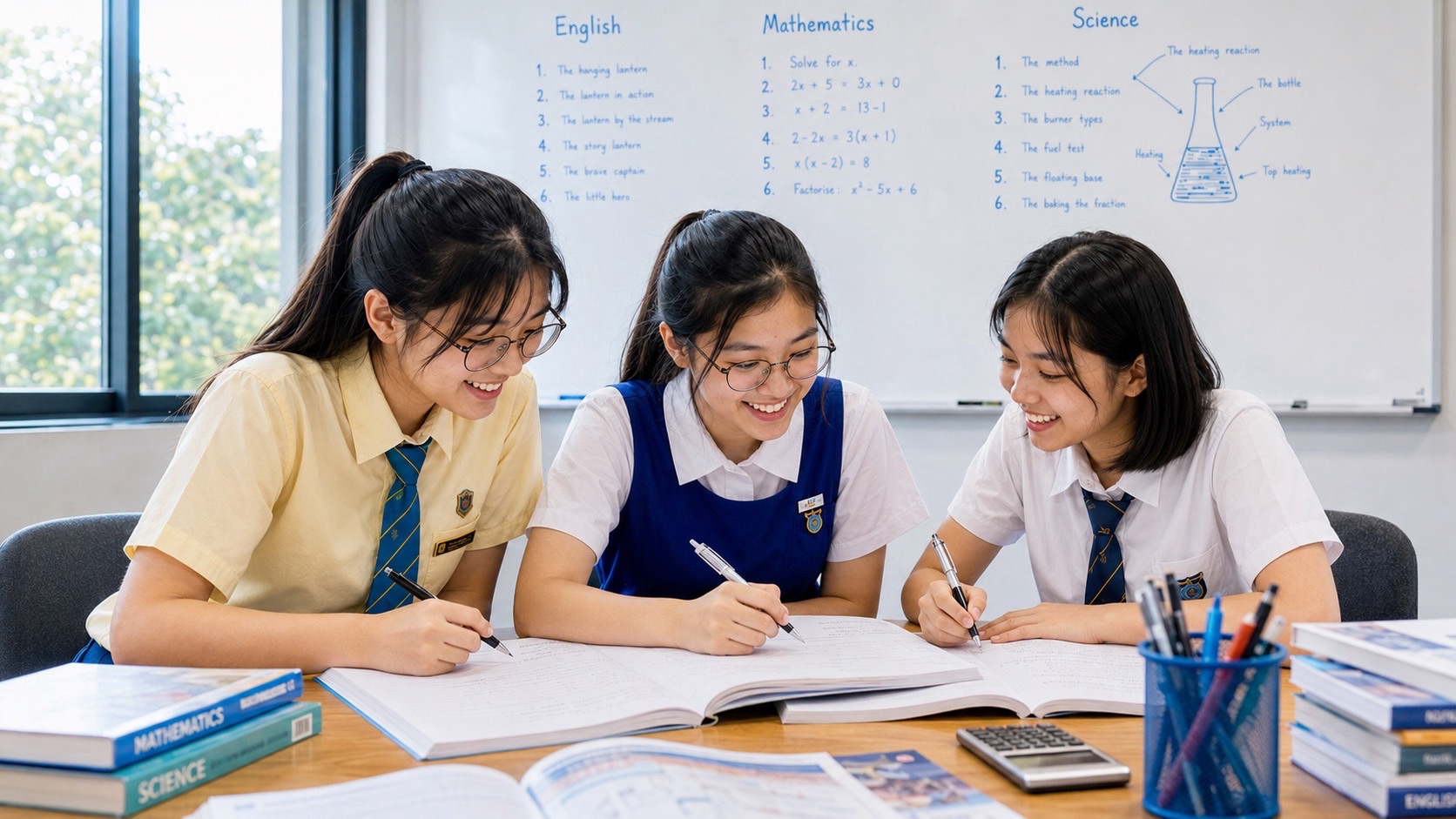
Secondary Continuous Writing tuition in Punggol should build the student’s ability to generate, organise and sustain a complete piece of writing under examination conditions. The challenge is not simply vocabulary. A strong response needs a clear interpretation of the topic, enough relevant content, logical structure, controlled paragraphing, appropriate voice, accurate grammar and enough time left to review what was written.
The current 2027 SEC English framework includes Continuous Writing within the writing paper. The demand varies by subject level. For example, the G1 K100 syllabus requires candidates to choose from two topics and produce a shorter continuous text, while the G3 K300 syllabus requires candidates to choose one of four topics and produce a substantially longer response. Tuition should therefore align to G1, G2 or G3 while preserving the same core writing architecture: understand the task, generate relevant content, organise the response and maintain language control.
This page is the tuition-specific owner for Secondary Continuous Writing in Punggol. It routes into the broader Secondary English Tuition in Punggol owner, the year-level Secondary 1–4 routes and the G1/G2/G3 pathways. It complements the wider writing-skill pages without replacing them.
The first writing skill is choosing what the task is really asking
Students often begin drafting too quickly. A topic may appear familiar, but the exact wording can require a different angle, stance or text type from the one the student has practised before.
A useful pre-writing routine asks:
- What is the exact topic obligation?
- What type of response will answer it best?
- What content is relevant and what is merely interesting?
- What sequence will make the writing easy to follow?
- What voice or stance fits the task?
Idea generation should produce usable content, not a long brainstorm
Students sometimes confuse quantity of ideas with quality of planning. Tuition should help the learner select ideas that can be developed clearly rather than list many undeveloped possibilities.
For narrative or personal writing, useful planning may focus on:
- the central situation;
- the main decision or tension;
- the consequence;
- the turning point;
- the resolution and meaning.
For argumentative or discursive writing, useful planning may focus on:
- the position or controlling idea;
- the strongest reasons;
- specific examples;
- possible counterpoints;
- the final qualification or conclusion.
Structure should make the reader’s job easier
Paragraphing is not decorative spacing. Each paragraph should perform a clear job. The reader should be able to follow how one part leads to the next.
| Weak signal | Possible structural problem | Tuition response |
|---|---|---|
| Paragraphs are very long | Several ideas have been merged | Separate paragraph purpose |
| Writing feels jumpy | Transitions or causal links are missing | Rebuild sequence and relationship |
| Introduction is long but vague | Controlling idea is unclear | State direction earlier |
| Conclusion repeats the introduction | No final synthesis | Return to significance or qualification |
Voice should fit the writing task
Voice is not a collection of impressive phrases. It is the consistent way the writing positions the reader and carries the idea. A reflective piece, argument and narrative do not need to sound the same.
Tuition should therefore develop control over sentence rhythm, stance, vocabulary and detail rather than teach one generic “good writing” style.
Vocabulary should serve meaning
Students often weaken otherwise clear writing by forcing advanced words into unsuitable contexts. Better vocabulary work develops precision, collocation and register. The word should make the sentence clearer, sharper or more exact.
The broader vocabulary route is Vocabulary and Register.
Grammar must survive inside real writing
A student can score well on grammar exercises and still write inaccurate prose. Continuous Writing places grammar under cognitive load because the learner is planning ideas, choosing vocabulary, managing paragraphs and tracking time at the same moment.
Tuition should therefore test grammar through fresh writing, not only isolated drills. Repeated errors should be logged and revisited after a delay.
Secondary 1–2: build writing architecture before examination pressure
Secondary 1 and 2 should develop topic interpretation, paragraph purpose, idea development and revision habits. Students should learn to plan enough to create direction without spending excessive time before writing.
Use Secondary 1 English Tuition and Secondary 2 English Tuition.
Secondary 3: widen topic range and reduce tutor dependence
Secondary 3 should expose students to varied topics and text types so they stop depending on familiar story plots or memorised argument structures. The learner should be able to plan a fresh response from the task itself.
Use Secondary 3 English Tuition and Secondary 3 SEC Runway.
Secondary 4: calibrate quality against time
In Secondary 4, final-year tuition should identify which part of the writing process is costing the most marks or time. Some students plan too little. Others overplan. Some produce strong ideas but weak language accuracy. Others write accurately but fail to develop enough content.
Use Secondary 4 English Tuition and Secondary 4 SEC Final-Year Calibration.
G1, G2 and G3: scale the demand, keep the same writing logic
The required length, task range and language demand vary by subject level, but the core writing process remains stable: interpret the topic, select relevant content, organise the response, maintain language control and review efficiently.
What a 3-pax Continuous Writing lesson can do
Three students can respond to the same topic in different ways. That contrast helps learners see that there is not one memorised answer. The tutor can compare planning, paragraph purpose and language choices before each student revises independently.
The group should be matched by year and subject level. Use How Should a 3-Pax English Class Be Matched?.
Parent checklist for Continuous Writing tuition
- Can the student interpret a fresh topic accurately?
- Can the learner generate enough relevant content?
- Does each paragraph have a clear purpose?
- Does vocabulary improve precision rather than decorate?
- Does grammar remain stable under writing load?
- Can the student complete the task within the time available?
- Can feedback transfer to the next unfamiliar prompt?
- Are tutor prompts decreasing?
Continuous Writing tuition is working when the student can face a new topic without panic, make a clear decision about what to write, build a coherent response, control the language and finish with enough independence to repeat the process under examination conditions.
Build Continuous Writing as a decision process, not a memorised product
Strong continuous writing begins before the first sentence. The student interprets the topic, decides what kind of response fits, chooses relevant content, organises the sequence and controls voice. Writing quality falls when the learner starts producing sentences before making these decisions.
The Punggol tuition role is to make those decisions visible in a small-group setting, then test whether the student can reproduce them on a fresh topic without depending on a model essay.
Use a four-question planning gate
- What is the topic really asking?
- What response shape fits this task?
- What is the strongest relevant content?
- What must the reader understand by the end?
A student who cannot answer these questions clearly is not ready to draft, even if they have memorised many good phrases.
Idea quality depends on relevance before originality
Students often chase “creative ideas” and produce content that is vivid but weakly connected to the topic. Relevance should come first. The learner should be able to explain why the chosen event, example or argument answers the task.
Originality is valuable only when the response remains controlled.
Teach paragraph purpose explicitly
Each paragraph should do a job: establish context, develop tension, reveal change, explain a reason, present evidence, contrast an idea or close the response. If the student cannot name the paragraph’s job, the writing often drifts.
A paragraph plan should therefore contain purpose before detail.
Use local observation to improve detail without forcing local stories
Punggol can help students notice sound, movement, weather, public behaviour, transport, waterfront space and neighbourhood detail. These observations can strengthen descriptive control, but the student should not force every composition to be set in Punggol.
The local environment is a source of sensory and social observation, not a mandatory plot.
Voice should emerge from point of view and purpose
Voice is not a collection of dramatic phrases. It comes from what the narrator notices, how the narrator interprets events, sentence rhythm, vocabulary choices and the emotional distance from the scene.
Students should practise changing the same event through different voices rather than memorising one “good writing” style.
Use sentence control before vocabulary display
A sophisticated word in an unstable sentence weakens the response. Students should secure clause control, punctuation, reference clarity and sentence boundaries before reaching for decorative vocabulary.
Vocabulary becomes powerful when it increases precision rather than merely sounding advanced.
Teach editing by error family
- Meaning unclear.
- Reference unclear.
- Sentence boundary weak.
- Tense unstable.
- Word choice imprecise.
- Paragraph purpose missing.
- Ending does not resolve the main idea.
Students improve faster when they recognise repeated error families instead of correcting every red mark as an unrelated event.
Use the 3-pax class to compare different valid responses
Three students can answer the same topic differently. One may choose a personal narrative, another a reflective structure, another a more direct exposition where the task permits it. Comparing the responses helps students see which choices were effective and why.
The tutor should compare planning logic, paragraph control and language decisions rather than impose one model essay.
Use timed planning separately from timed writing
Some students write slowly because planning is weak. Others plan for too long and leave insufficient drafting time. Practise the planning phase on its own so the learner can become faster at topic interpretation and structure selection.
Then practise full-task timing once the planning decisions are stable.
Fresh-topic transfer is the real test
A student can revise one essay until it becomes excellent and still remain weak at writing. The stronger evidence is a fresh topic where the learner must interpret, plan, draft and edit without seeing the model beforehand.
Tuition should therefore protect enough unseen writing for transfer testing.
Use delayed rewriting to test retention
After feedback, do not always rewrite immediately. Return several days later and ask the student to apply the same writing principle to a new paragraph or new topic. If the principle survives the delay, learning is becoming more durable.
Teach endings as consequence, not decoration
A strong ending should complete the logic of the response. In narrative writing, something should have changed, been understood or become visible. In more expository writing, the final paragraph should sharpen the position rather than merely repeat the introduction.
Students should ask: what is different at the end because this response happened?
Use school feedback to choose the next writing job
If the school teacher repeatedly identifies weak organisation, the tuition lesson should not spend most of its time on vocabulary. If language accuracy is strong but content is thin, the next job should change.
The Punggol Tuition Consultation evidence model applies here: the intervention should follow the repeated school pattern.
Build a writing evidence dashboard
| Layer | What to watch |
|---|---|
| Interpretation | Does the response answer the actual topic? |
| Planning | Are ideas selected and sequenced before drafting? |
| Paragraph control | Does each paragraph have a clear purpose? |
| Voice | Is the tone appropriate and sustained? |
| Language | Are sentences controlled and vocabulary precise? |
| Timing | Can the student finish within the required conditions? |
| Transfer | Does the skill appear on fresh topics? |
The exit condition is independent control on a fresh topic
Continuous Writing support should reduce when the student can interpret a new topic, build a purposeful plan, draft coherently, control language and complete an appropriate edit without the tutor carrying the structure.
The local Punggol class has then done its job: it has made the writing decisions visible, practised them in a small group and returned ownership to the student.
Build a writing revision ladder instead of correcting everything at once
Students often improve slowly because every draft receives too many corrections across too many layers at the same time. A stronger process uses a revision ladder. The learner fixes meaning and structure first, then paragraph control, then sentence clarity, then language precision. Surface errors are easier to repair after the response itself is stable.
This keeps feedback teachable. The student can understand which decision mattered most instead of experiencing the draft as a wall of red marks.
Revision 1: does the response actually answer the topic?
Before correcting vocabulary or punctuation, check whether the content is relevant and whether the response has a clear direction. A beautifully written paragraph that does not serve the topic still weakens the whole composition.
The student should be able to explain the relationship between each major paragraph and the task.
Revision 2: does the structure carry the reader?
Ask whether events, reasons or ideas appear in a sequence that is easy to follow. Look for abrupt jumps, repeated points, missing transitions and paragraphs that perform the same job twice.
Structural revision often produces larger gains than replacing several individual words.
Revision 3: does each paragraph have enough development?
A thin paragraph may contain the right idea but not enough explanation, detail or consequence. Ask what the reader still needs to know. In narrative writing, this may be action, thought or change. In expository writing, it may be evidence, explanation or contrast.
The goal is depth with purpose, not length for its own sake.
Revision 4: make sentence relationships explicit
Weak writing can contain correct sentences that do not connect logically. Teach the learner to check how one sentence leads to the next. Does the second sentence explain, contrast, extend or result from the first?
Once the relationship is clear, conjunctions and transitions become easier to choose accurately.
Revision 5: improve precision rather than decorate
Vocabulary revision should ask whether a word is accurate, specific and natural in context. Replacing a common word with a rare word is not automatically an improvement.
Students should prefer language that sharpens meaning over language selected mainly to sound impressive.
Use comparison between first draft and final draft as evidence
Keep both versions for selected tasks. The student can then identify what changed: clearer topic control, better paragraph order, stronger development, fewer vague references or more precise language. This makes progress visible in the text itself.
The comparison also helps the tutor see whether feedback is transferring or whether the same revisions must be repeated every week.
Protect unseen writing after revision work
Revision proves that the student can improve a known draft with feedback. It does not prove independent writing control. After one or two revised pieces, assign a fresh topic under more independent conditions and compare the same writing layers.
The student is progressing when the fresh draft already contains decisions that previously required correction.
Use one recurring writing target at a time
If the learner’s main weakness is paragraph development, keep that target visible across several different topics. If the learner’s main weakness is sentence control, track that instead. A recurring target allows the student to retrieve the same writing principle under changing content.
Once the target becomes reliable, move to the next bottleneck.
The strongest evidence is reduced tutor intervention
Eventually the tutor should be able to ask fewer planning questions, mark fewer structural problems and spend more time on refinement. The student should arrive with a stronger plan, more coherent paragraphs and more accurate self-editing.
That is the deeper goal of Continuous Writing tuition: not a collection of polished essays, but a writer who can repeatedly make good decisions on unfamiliar topics.
Continue Through the English System
Explore the Punggol English reading library for related guides.


