
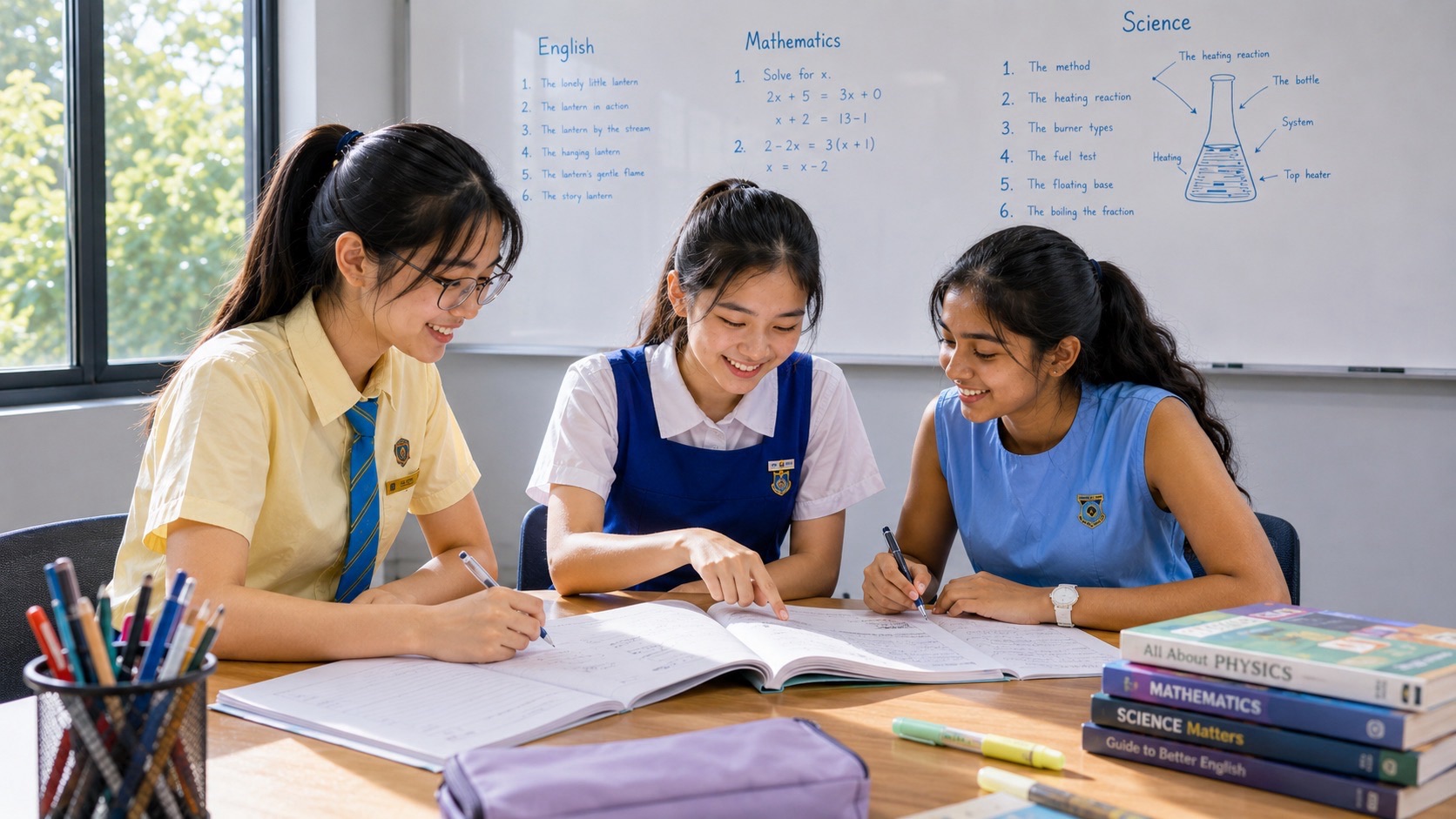
PSLE composition picture-prompt tuition in Punggol should teach Primary 6 students to use the pictures as thinking tools rather than as a story they must copy. In the official 2026 PSLE English Continuous Writing task, candidates write at least 150 words on a given topic. Three pictures are provided as different angles of interpretation, and the composition must be based on at least one of them. The topic remains the controlling instruction.
This distinction matters. Students sometimes choose the most visually interesting picture and then build a story that only loosely relates to the topic. Others try to force all three pictures into one composition even when that makes the plot artificial. Strong tuition should teach the learner to begin with the topic, compare the picture possibilities, and choose the image or images that support the clearest relevant composition.
This page is the tuition-specific owner for PSLE picture-prompt composition in Punggol. It routes into the PSLE Paper 1 Writing owner, the protected legacy PSLE Continuous Writing tuition owner, and Primary 6 PSLE English Tuition. The official 2026 task design is described in the SEAB English Language syllabus.
Topic first, picture second
The topic tells the student what the composition must be about. The pictures offer possible directions. Tuition should therefore train the child to paraphrase the topic before choosing an image.
- What does the topic really require?
- What event, decision, feeling or conflict could express that topic?
- Which picture gives the strongest starting point?
- Can the picture be used naturally rather than inserted awkwardly?
- Would using a second picture make the composition stronger or merely busier?
Using one picture well is enough
Students do not need to force all three pictures into the composition. The official requirement is to base the composition on at least one picture. A focused story built around one image can be much stronger than a crowded story trying to include everything.
The picture should create a story possibility, not dictate the entire plot
A picture is a prompt, not a complete narrative. Tuition should help students ask what happened before the image, what decision happens around it, and what consequence follows.
| Weak use of picture | Stronger use |
|---|---|
| Mentions the object once | Makes the image central to the event or decision |
| Forces all three pictures into one story | Selects only the image(s) that strengthen relevance |
| Describes the picture without plot movement | Uses it to trigger cause, conflict or consequence |
| Copies a memorised story onto any picture | Builds the story from the topic and image together |
A useful planning chain: topic → image → event → consequence
Instead of brainstorming many disconnected ideas, students can use a compact chain:
- Topic: what must the composition show?
- Image: which picture offers the clearest route?
- Event: what happens that makes the topic visible?
- Decision: what does the character choose or fail to choose?
- Consequence: what changes because of that decision?
- Resolution: how does the ending complete the topic?
Relevance should be tested before drafting
A composition can be beautifully written and still drift away from the topic. Before drafting, tuition should ask the learner to state in one sentence how the planned story answers the topic. If that sentence is vague, the plan is not ready.
The related skill route is How to Stay Relevant to the Question in English Writing.
Primary 5: practise interpretation without full exam pressure
Primary 5 is a good year to show students many topics and picture sets, then practise choosing a direction quickly. Not every exercise needs to become a full composition. Sometimes the most valuable work is five minutes of topic-and-picture planning.
Primary 6: calibrate originality against control
In Primary 6, originality is useful when it remains relevant and executable under time. Tuition should not reward a complicated plot simply because it is unusual. A simpler, coherent composition that develops the topic fully is often a better examination strategy.
Use Primary 6 Final English Calibration.
What a 3-pax picture-prompt lesson can reveal
Three learners may choose different pictures for the same topic. That is useful. The tutor can compare which choice creates the strongest relevant story route and why, then let each child draft independently.
Parent checklist for PSLE picture-prompt composition tuition
- Can the child explain the topic in their own words?
- Can the learner choose a picture for a clear reason?
- Is at least one picture used meaningfully?
- Does the story remain focused on the topic?
- Can the child avoid forcing all pictures into the story?
- Can a simple causal plan be built quickly?
- Are tutor prompts decreasing?
PSLE picture-prompt tuition is working when the child no longer treats the pictures as a puzzle to squeeze into the story. The learner should use them as optional routes into a composition that remains clearly controlled by the topic.
Continue Through the English System
Explore the Punggol English reading library for related guides.
Explore the Primary Composition reading library for related guides.


