
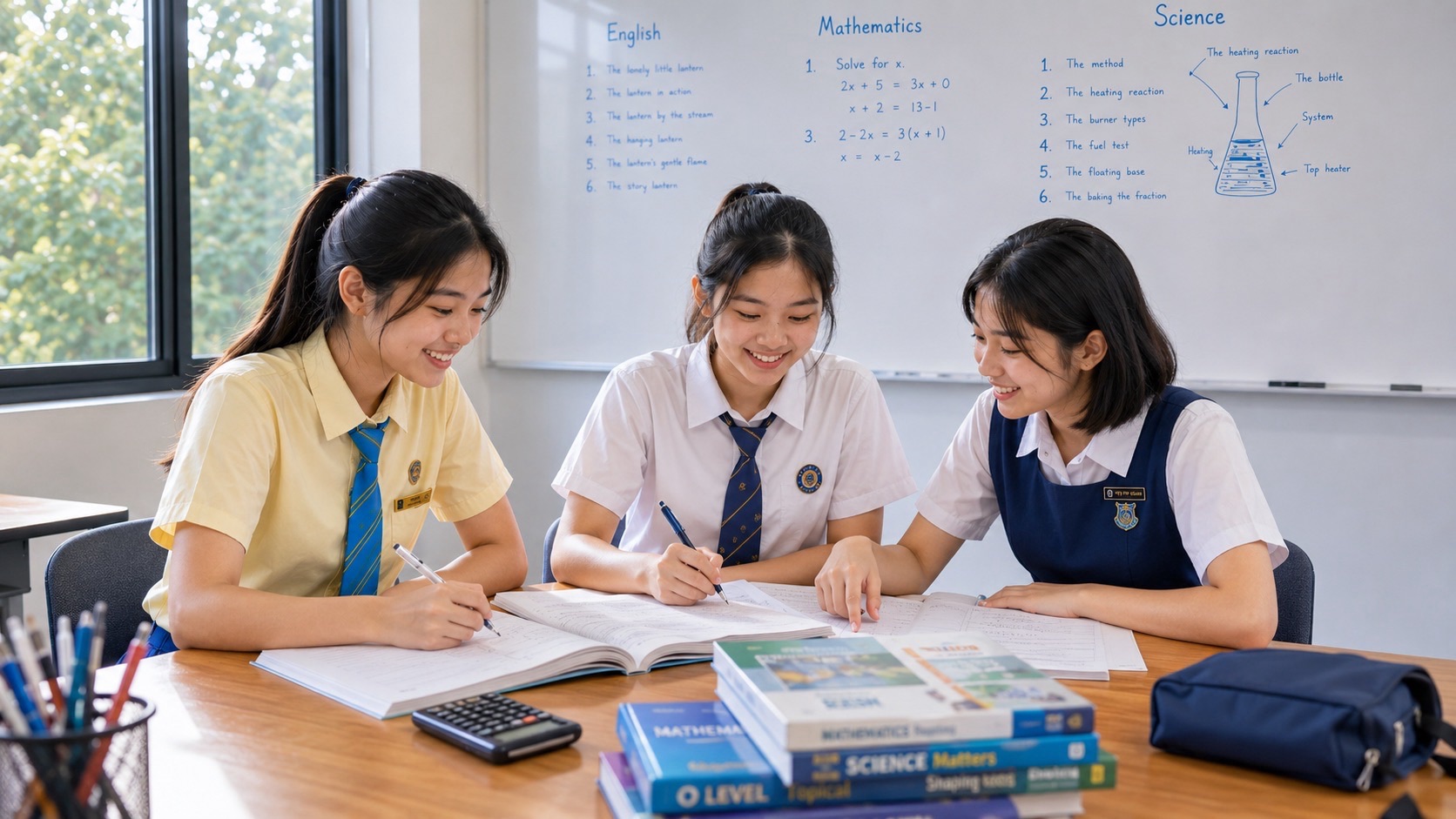
PSLE composition tuition in Punggol should train a Primary 6 learner to stay relevant to the topic while building a coherent piece of continuous prose. In the official 2026 PSLE English Paper 1 format, Continuous Writing is worth 36 marks. Candidates write at least 150 words on a given topic and must base the composition on at least one of three provided pictures. The task rewards relevant and well-developed writing, not simply length or decorative vocabulary.
Many students do not have a “writing” problem in the broad sense. They have a relevance-and-structure problem. Their sentences may be grammatical and their vocabulary may be strong, but the composition drifts from the topic, events feel random, paragraphs do not perform clear jobs, or the ending does not complete the story’s main idea. Strong tuition should diagnose those structural weaknesses directly.
This page is the tuition-specific owner for PSLE composition relevance and structure in Punggol. It routes into the PSLE Paper 1 Writing route, the protected legacy PSLE Continuous Writing tuition owner, and the skill companions Writing Relevance and Cause and Effect in Composition.
The topic is the contract
The composition must remain meaningfully connected to the given topic from beginning to end. The topic should shape the central event, character decision or consequence—not appear once in the introduction and disappear.
Before drafting, tuition should ask the child to finish this sentence:
This story is about __________, and the topic is shown when __________.
If the learner cannot complete that statement clearly, the plan is probably not focused enough yet.
A strong plot is a chain of causes and consequences
Weak compositions often feel like lists of events: first this happened, then that happened, then something else happened. Stronger writing shows why one event creates the next.
- A character wants something.
- A problem or decision appears.
- The character acts.
- The action creates a consequence.
- The consequence forces another decision.
- The turning point resolves the central tension.
This cause-and-effect chain makes the story feel earned rather than random.
Paragraphs should have jobs
Paragraphing is not simply breaking a long piece into smaller blocks. Each paragraph should advance the composition in a clear way.
| Possible paragraph job | What it does |
|---|---|
| Setup | Establishes situation, character or expectation |
| Trigger | Introduces the event that changes the situation |
| Escalation | Raises difficulty or consequence |
| Turning point | Forces the decisive action or realisation |
| Resolution | Shows what changed and completes the topic |
The turning point should matter
A turning point is not simply the most dramatic sentence. It is the moment when the story changes direction because of a decision, discovery, mistake or consequence.
The related skill route is How to Build a Strong Turning Point and Climax.
A good ending should complete the topic
Students sometimes finish with a generic moral that could be attached to any story. A stronger ending grows from what actually happened. It may show consequence, changed understanding, repaired relationship or a decision that closes the central problem.
Vocabulary cannot rescue weak structure
Advanced vocabulary is useful only when it helps the reader see the event, emotion or relationship more precisely. If the plot is irrelevant or incoherent, richer words do not solve the underlying problem.
This is why tuition should fix topic control and causality before spending large amounts of lesson time decorating sentences.
Primary 5: practise structure before full PSLE pressure
Primary 5 is a useful year to train topic interpretation, causal planning, turning points and endings. Students can practise outlines and selected paragraphs without writing a full composition every time.
Primary 6: diagnose the actual writing loss
In Primary 6, tuition should use marked school compositions to identify whether the main problem is relevance, structure, grammar, vocabulary, time, or all of these. Different causes need different repair.
The broader diagnostic route is Primary 6 English Paper 1 Writing Loss Map.
What a 3-pax composition lesson can reveal
Three students can plan three different stories from the same topic. Comparing those plans helps learners see which one stays closest to the topic, which has the clearest causal chain and which creates the strongest turning point before each student writes independently.
Parent checklist for PSLE composition tuition
- Can the child explain how the planned story answers the topic?
- Does one event cause the next?
- Does each paragraph have a job?
- Is the turning point meaningful rather than random?
- Does the ending complete the central idea?
- Is vocabulary serving the story rather than distracting from it?
- Can the learner reproduce the structure on a fresh topic?
- Are tutor prompts decreasing?
PSLE composition tuition is working when the child can build a relevant, causal and coherent piece of writing from a fresh topic under time. Structure should make the story easier to understand, and relevance should remain visible from the opening decision to the final paragraph.
Continue Through the English System
Explore the Punggol English reading library for related guides.
Explore the Primary Composition reading library for related guides.


