
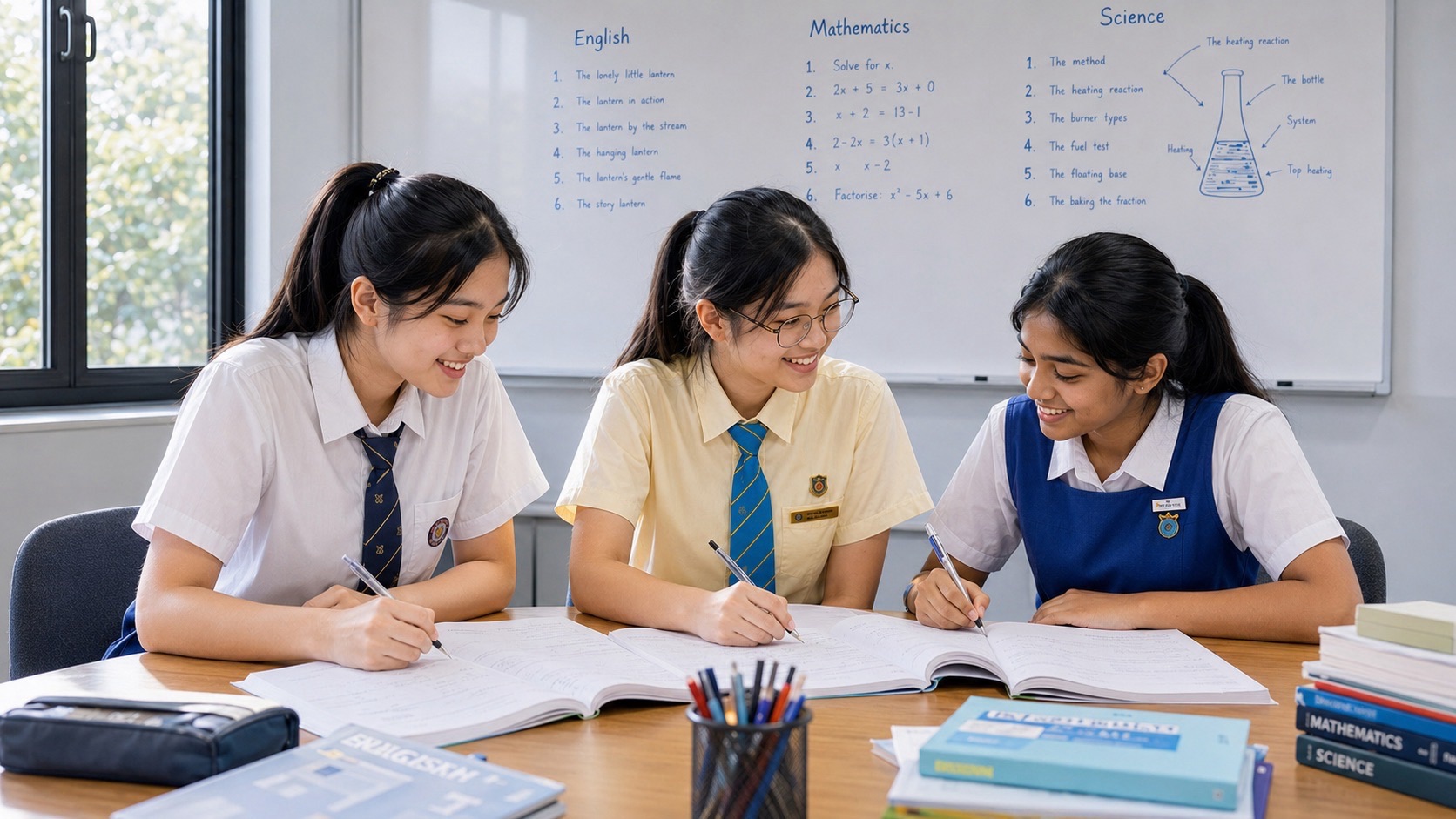
SEC English tuition in Punggol should do more than rename old examination preparation with a new certificate label. The deeper work is to help students build the language control required for the 2027 Singapore-Cambridge Secondary Education Certificate: reading comprehension, writing, vocabulary, grammar, listening, oral communication, summary, editing and exam execution at the appropriate G1, G2 or G3 subject level. For parents searching for 2027 SEC English tuition, the most useful question is not “What changed in the exam name?” but “What English capabilities must my child now be able to use independently?”
The core aim of SEC English tuition is continuity through change. The certificate framework changes from 2027, but strong English still depends on the same durable abilities: understand unfamiliar texts, distinguish evidence from inference, communicate for audience and purpose, control sentence meaning, paraphrase accurately, listen actively, speak responsively and work under time. Tuition should therefore prepare the student for the new SEC context without reducing learning to a new set of labels.
Explore related English guides and choose your next reading step.
At eduKatePunggol, SEC preparation is organised around the learner’s subject level and error profile. G1, G2 and G3 English are not treated as three disconnected worlds. They share a language spine, but differ in complexity, depth, independence and examination demands. The tutor’s job is to identify what the student can already do, what remains unstable and what must become automatic before the examination.
For the wider parent guide, see Secondary Schools Parent Guide to Sec 1–4, G1/G2/G3 and SEC English. For the subject-level routes, see G1 English Tuition, G2 English Tuition and G3 English Tuition.
What Changes With the Singapore-Cambridge SEC
From 2027, the Singapore-Cambridge Secondary Education Certificate replaces the separate GCE N- and O-Level certificates for school candidates. Under Full Subject-Based Banding, students take subjects at G1, G2 or G3 levels according to their subject arrangements rather than carrying one whole-student stream label.
For English Language, SEAB’s 2027 subject listings identify K100 for G1, K200 for G2 and K300 for G3. Earlier syllabus codes remain shown as references for 2026 and before.
Parents can check the current official listings at SEC G1, SEC G2 and SEC G3.
The important educational point is not merely the new code. Students still need to read, write, listen and speak at the level demanded by their subject.
The SEC Does Not Remove the Need for Strong Foundations
A new examination framework can make families feel that everything must be relearned. In English, that is rarely true.
The learner still depends on vocabulary, grammar, reading comprehension, writing control, listening and oral communication. The examination structure determines how those abilities are assessed, but the language foundation remains cumulative.
A student who cannot track pronoun reference will still struggle in comprehension. A student with weak vocabulary will still find paraphrase difficult. A student who cannot organise ideas will still struggle in writing and oral.
That is why SEC tuition should begin with the learner rather than the paper format.
The Core SEC English Learning System
- Read the task accurately.
- Understand the language and context.
- Identify the evidence or communicative purpose.
- Retrieve the relevant vocabulary and grammar.
- Choose an appropriate response strategy.
- Execute clearly under time.
- Check for meaning and avoidable errors.
- Review the mistake.
- Transfer the correction to a fresh task.
This cycle works across G1, G2 and G3, even though the sophistication of the task changes.
G1 SEC English: Build Usable Independence
At G1, the aim is reliable functional English across writing, language use and comprehension, listening and oral communication.
Students need accessible but meaningful challenge. Support may be more explicit and steps more clearly modelled, but the long-term goal remains independence.
G1 tuition should not become “easier worksheets forever”. It should help the student understand, write, listen and speak with increasing self-reliance.
See The Core Aim of Punggol English Tuition | G1 English Tuition.
G2 SEC English: Strengthen Meaning, Organisation and Control
At G2, students need a stronger combination of comprehension, writing, vocabulary, grammar, listening and spoken interaction.
The learner is expected to handle increasingly complex language while still communicating clearly and appropriately. The teaching focus should therefore move beyond simple correctness toward connected meaning and purposeful expression.
A G2 student may need explicit work on inference, paragraph development, situational writing, cloze reasoning, editing and oral elaboration.
See The Core Aim of Punggol English Tuition | G2 English Tuition.
G3 SEC English: Precision, Analysis and Independent Exam Control
G3 places greater pressure on precision, interpretation, summary, language effect, writing development and independent control.
Students need to explain why language works, not only what it means. They must select evidence carefully, paraphrase faithfully, write with register and structure, and manage a wider range of questions under time.
For many students, Secondary 3 is the runway and Secondary 4 is the consolidation year.
See The Core Aim of Punggol English Tuition | G3 English Tuition.
Writing Under SEC: Purpose Before Polish
Across the subject levels, strong writing begins with understanding the task. The student must know who they are writing for, why they are writing and what information or ideas need to be developed.
Situational writing requires audience and purpose. Continuous writing requires sustained relevance and development. Editing requires awareness of recurring language errors.
Fancy vocabulary cannot rescue a piece that misunderstands the task.
For the wider writing system, see The Core Aim of Punggol English Tuition | English Composition.
Comprehension Under SEC: Evidence Still Matters
Regardless of subject level, comprehension depends on understanding what the text actually supports.
Students need to identify main ideas, track relationships, distinguish literal information from inference and answer to the correct scope.
At higher levels, language effect, summary and more subtle interpretation become increasingly important. At every level, unsupported guessing remains a weak strategy.
See The Core Aim of Punggol English Tuition | Reading Comprehension.
Vocabulary Under SEC: Precision Beats Difficulty
Students sometimes respond to examination pressure by collecting increasingly rare vocabulary. That is not the most useful route.
SEC English rewards language that communicates meaning accurately. Vocabulary should therefore be taught through context, collocation, word families, register and nuance.
At G1, the priority may be useful high-frequency and school vocabulary. At G2, precision and flexible use become more important. At G3, nuance, connotation and language effect matter increasingly.
See The Core Aim of Punggol English Tuition | English Vocabulary.
Grammar Under SEC: Control Meaning, Then Edit
Grammar should help students understand and build sentences. Tense, agreement, articles, pronouns, connectors, clauses and punctuation all carry meaning.
Editing becomes more efficient when the student knows their personal error profile. One learner may need to watch articles and prepositions. Another may need tense consistency or sentence boundaries.
The aim is not to memorise every grammar label. It is to recognise structures and repair errors independently.
See The Core Aim of Punggol English Tuition | English Grammar.
Listening Under SEC: Hear What Matters
Listening requires students to construct meaning while information is moving. There is no unlimited rereading.
Students should learn to identify the main idea, retain relevant details, anticipate what a question requires and recognise distractors.
A wrong answer should be diagnosed. Was the issue attention, vocabulary, memory, misunderstanding or a distractor? Practice becomes more efficient when the cause is known.
For focused work, see Secondary Listening — Main Idea, Detail, Note-Taking and SEC Exam Control.
Oral Under SEC: Interaction, Not Recitation
Strong oral preparation builds a student who can listen, answer, develop and adapt.
Memorised scripts may sound polished on familiar prompts but become fragile when the examiner asks a different follow-up question.
Students need flexible structures: answer directly, explain, give an example, connect to the question and respond to what the other person actually says.
See The Core Aim of Punggol English Tuition | English Oral.
Summary and Paraphrase: A High-Value G3 Skill
At G3, summary makes several skills visible at once: comprehension, selection, paraphrase and concise expression.
Students should first decide which points are relevant. Only then should they compress and paraphrase. Trying to select and rewrite simultaneously often leads to omitted points or changed meaning.
The wider lesson applies beyond summary: changing wording is only successful when the idea is preserved.
See Secondary Summary Writing — Selection, Paraphrase, Word Limit and G3 SEC Control.
SEC Preparation Should Follow the Student’s Error Profile
A useful error profile might show patterns such as:
- reading: misses contrast and condition words;
- vocabulary: understands broadly but confuses close synonyms;
- grammar: repeated article and preposition errors;
- writing: ideas are relevant but underdeveloped;
- comprehension: answers are too broad;
- summary: paraphrase changes meaning;
- listening: distractors are chosen because wording is familiar;
- oral: answers are relevant but stop too early;
- timing: one section consumes too much time.
That profile tells the tutor what to repair first.
Do Not Confuse New Labels With New Learning Problems
A change in certificate name can create understandable anxiety. Families may feel that students need a completely new study method.
The better approach is to separate administrative change from learning change.
The SEC structure matters. Subject codes matter. Paper formats matter. But a student still needs to understand text, choose language, organise ideas and communicate.
The most durable preparation is therefore capability-first and format-aware.
Full Papers Are Useful — After the Method Is Stable
Full SEC-style papers are valuable for timing, stamina and integration. They are not always the fastest way to repair a specific weakness.
If a student keeps losing marks in summary, another full paper may simply reproduce the same problem. A targeted summary lesson followed by a fresh transfer task is more efficient.
A useful cycle is: full paper → diagnose → targeted repair → fresh component → delayed review → next full paper.
Timed Practice Should Be Progressive
Students need time control, but speed should not be trained on top of confusion.
Start with accurate method, then timed components, then mixed sections, then full-paper integration.
If the student is slow, identify why. Weak vocabulary, overplanning, repeated rereading and uncertainty require different remedies.
The Role of Secondary 1 and Secondary 2
SEC preparation should not begin only in the examination year.
Secondary 1 and 2 are the hidden preparation years in which reading depth, vocabulary, grammar, writing and oral habits become more sophisticated.
Students who build these foundations early need less emergency repair later.
See Secondary 1 English Tuition and Secondary 2 English Tuition.
The Role of Secondary 3
Secondary 3 is the integration year. Students should begin combining comprehension, summary, writing, editing, listening and oral into a more independent system.
There is still time to repair foundations, but examination control becomes increasingly important.
See Secondary 3 English Tuition.
The Role of Secondary 4
Secondary 4 is the reliability year. Students need fewer new strategies and stronger execution of the strategies that already work.
Revision becomes more selective. Timing becomes more realistic. Full-paper performance matters more. The tutor should progressively remove scaffolding.
See Secondary 4 English Tuition.
Why Small-Group SEC English Tuition Can Work
English learning benefits from interaction. Students need to explain, compare, defend, revise and respond.
In a three-student group, each learner can remain visible while still hearing different interpretations and writing choices.
The tutor can inspect individual error patterns, question each student and use peer discussion without allowing anyone to disappear into a large class.
The goal is not to make all three students produce identical answers. It is to teach them how to judge what a strong answer requires.
What Parents Should Look For in SEC English Tuition
- The tutor understands G1, G2 or G3 requirements rather than using one generic programme.
- The student’s error profile is explicit.
- Corrections are tested on fresh tasks.
- Writing is taught through audience, purpose and development.
- Comprehension is anchored to evidence.
- Vocabulary includes context and collocation.
- Grammar moves into self-editing.
- Listening mistakes are diagnosed.
- Oral practice includes real follow-up questions.
- Timed practice is progressive.
- Full papers are used diagnostically.
- The student becomes less dependent over time.
How to Tell Whether SEC English Tuition Is Working
- The student understands the subject-level demands more clearly.
- Fresh tasks cause less hesitation.
- Comprehension answers are more precise.
- Writing is more appropriate to audience and purpose.
- Vocabulary is used more naturally.
- Recurring grammar errors decrease.
- Listening mistakes become easier to diagnose.
- Oral responses adapt to follow-up questions.
- Timed performance stabilises.
- Corrections reappear in later independent work.
- Full-paper results become less volatile.
- The student can explain what they are improving and why.
The strongest sign is increasing independence across unfamiliar tasks.
Frequently Asked Questions
What is SEC English?
SEC English refers to English Language taken under the Singapore-Cambridge Secondary Education Certificate framework beginning from 2027, with subject levels including G1, G2 and G3.
What are the 2027 English subject codes?
SEAB lists G1 English as K100, G2 English as K200 and G3 English as K300 for 2027 school candidates.
Is SEC English completely different from the earlier system?
The certificate framework changes, but many durable language abilities remain familiar: writing, comprehension, listening, oral communication, vocabulary and grammar.
Should tuition focus only on the paper format?
No. Students need format familiarity, but capability should come first. A familiar format does not compensate for weak language.
When should SEC preparation begin?
Secondary 1 and 2 should build foundations, Secondary 3 should integrate them, and Secondary 4 should increase reliability and timed performance.
Does every student need the same SEC English programme?
No. G1, G2 and G3 differ in demand, and individual students have different error profiles. Tuition should respond accordingly.
Helpful Reading for Punggol Families
- Secondary Schools Parent Guide to Sec 1–4, G1/G2/G3 and SEC English
- How G1, G2 and G3 English Work Under Full Subject-Based Banding
- Secondary G1 English and the 2027 SEC K100 Transition
- Secondary G2 English and the 2027 SEC K200 Pathway
- Secondary G3 English and the 2027 SEC K300 Pathway
- SEAB SEC G1 Syllabuses 2027
- SEAB SEC G2 Syllabuses 2027
- SEAB SEC G3 Syllabuses 2027
The Core Aim of SEC English Tuition
The core aim is not to chase a new certificate label. It is to prepare the student to use English independently inside the new framework.
Read accurately. Understand evidence. Choose vocabulary precisely. Control grammar. Write for purpose. Listen actively. Speak responsively. Work under time. Recover when the task is unfamiliar.
Those abilities travel across G1, G2 and G3 and remain valuable after the examination itself.
For Punggol families, this is the SEC English tuition standard worth looking for: format awareness without format obsession, targeted diagnosis without random drilling, and steady movement toward independence.
At eduKatePunggol, the new SEC is treated as a framework. The learner remains the centre.
Arrange a Parent–Student Consultation
Bring recent Secondary English papers, writing, summary work, listening results or oral feedback. We can identify the student’s subject-level needs and decide whether the next step should be foundational repair, component integration, timed practice or full SEC English preparation.
Visit eduKatePunggol for the wider English, Mathematics and Science learning routes.
eduKatePunggol
83 Punggol Central
Singapore 828761
Near Punggol MRT and Waterway Point
Premium small-group tuition
By appointment
Properly taught kids shine a bright light into the future.


