
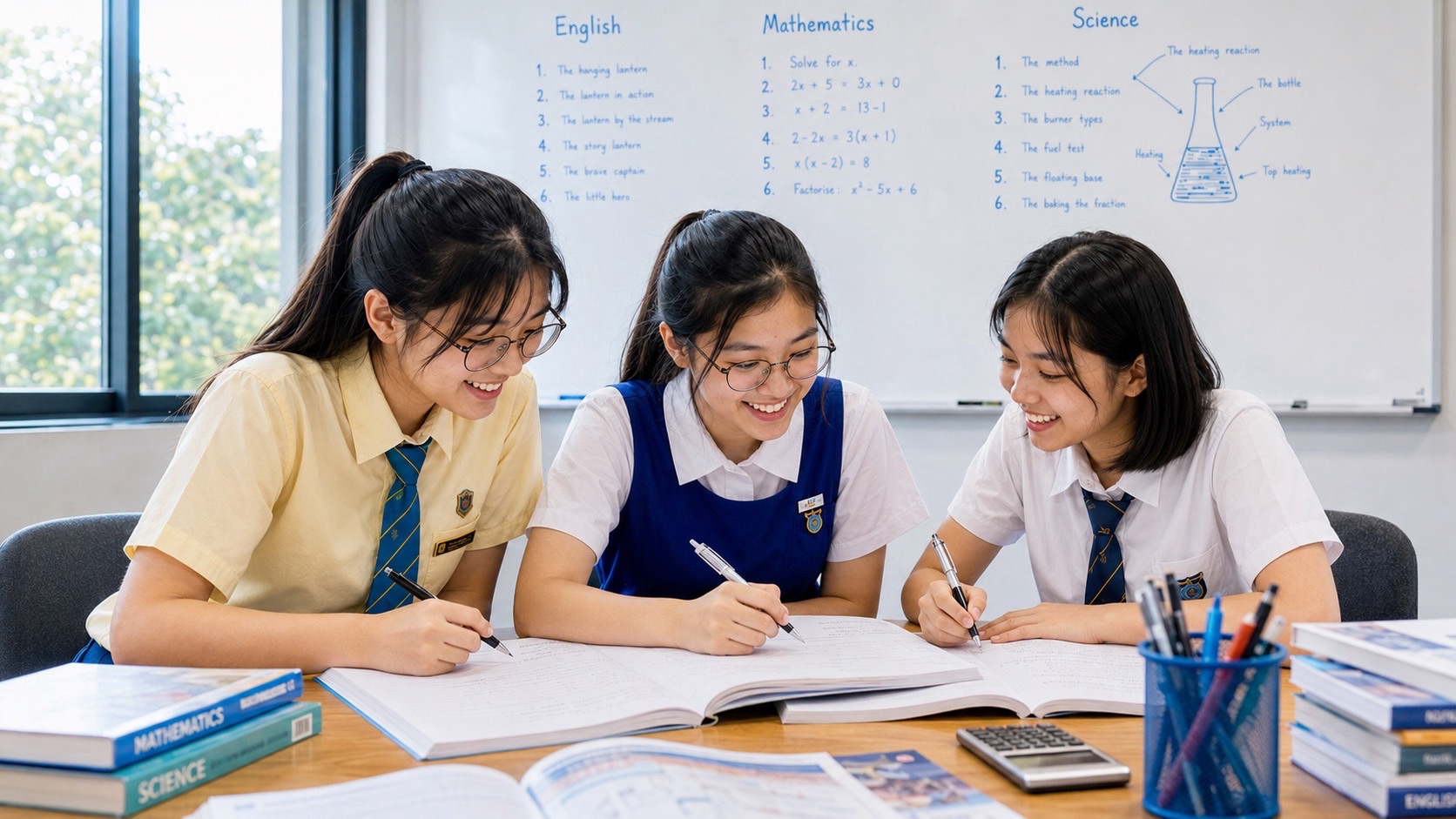
Punggol Science Tuition should deliberately build Science critical thinking because students are constantly asked to do more than recall a fact. They must decide which evidence matters, distinguish observation from inference, compare explanations, evaluate methods, spot unsupported claims and change their conclusion when the data does not fit their first idea.
The core aim of critical thinking in Punggol Science tuition is to make reasoning visible and evidence-led. A strong Science student should ask: What do I know? What does the evidence actually show? Which model best explains it? What alternative explanation is possible? What assumption am I making? What would change my mind? Those questions turn Science from answer hunting into disciplined judgement.
Explore related Science guides and choose your next reading step.
Critical Thinking in Science Is Evidence Discipline
Critical thinking is sometimes described vaguely as “thinking harder.” In Science, it can be made much more concrete.
Students examine claims, evidence, assumptions, models and limitations. They decide how strongly the evidence supports a conclusion.
The Core Aim: Claim → Evidence → Reasoning → Limitation
A useful critical-thinking routine asks four questions.
- What is the claim?
- What evidence supports it?
- What scientific reasoning connects the evidence to the claim?
- What limitation or alternative explanation remains?
This structure works in practical, data and open-ended questions.
Observation Is Not the Same as Inference
Students should separate what was directly observed or measured from the explanation they are proposing.
This distinction prevents them from treating assumptions as facts.
Correlation Is Not Automatically Causation
Two variables changing together does not prove one directly caused the other.
Students should ask whether other variables could explain the pattern and whether the experimental design supports a causal claim.
Critical Thinking Requires Alternative Explanations
When the data could fit more than one model, students should compare which explanation is better supported.
This is especially useful for strong students because it moves beyond one-answer recall.
Ask What Evidence Would Change Your Mind
A powerful scientific question is, “What result would make this explanation less likely?”
This forces students to think beyond confirmation and consider how a model could be tested.
Primary Science Can Build Critical Thinking Gently
Young students can compare two explanations, identify which observation supports a claim and notice when someone has guessed beyond the evidence.
Critical thinking can begin with simple, concrete situations.
PSLE Science Critical Thinking Is Often Hidden Inside Application
A student may need to infer from data, judge which variable matters or reject a tempting explanation.
The skill is not separate from syllabus knowledge; it is how the knowledge is used.
Secondary Science Makes Critical Thinking More Explicit
Upper-secondary students increasingly evaluate methods, data quality, uncertainty, models and quantitative relationships.
The student should learn to defend a conclusion with evidence rather than authority.
Physics Critical Thinking: Check the Model Against Reality
Students should question whether a calculated result is physically plausible and whether the assumptions of the model fit the situation.
Sense-checking is critical thinking in quantitative form.
Chemistry Critical Thinking: Separate Observation From Chemical Claim
A colour change or precipitate is evidence. The identity or reaction mechanism is an inference based on chemical knowledge.
Students should know which layer they are stating.
Biology Critical Thinking: Respect Variation and Complex Systems
Biological systems often involve many interacting factors.
Students should be cautious about simple one-cause explanations when the evidence supports a more complex interpretation.
Practical Evaluation Is Critical Thinking
When students identify a flaw, they should explain why it matters and propose an improvement that addresses it.
Generic improvements are weaker than matched reasoning.
Graph Interpretation Is Critical Thinking
Students should distinguish what the graph demonstrates from what they already know about the topic.
The data constrains the claim.
Critical Thinking Protects Against Misconceptions
A student who asks whether an explanation fits all the evidence is less likely to cling to an intuitive but wrong model.
Critical Thinking Strengthens Inquiry
Inquiry requires choosing what to measure, controlling variables and deciding whether the conclusion is justified.
Critical Thinking Strengthens Application Questions
Unfamiliar questions force students to decide which details matter and which are surface noise.
See Science Application Questions.
Use “Which Claim Is Better Supported?”
Present two plausible statements and ask the student to compare them using evidence.
This moves discussion away from confidence and toward justification.
Use “What Assumption Are You Making?”
Students often make hidden assumptions about scale, conditions, measurement or mechanism.
Making those assumptions explicit improves reasoning.
Use “What Does the Evidence Not Tell Us?”
This question teaches restraint.
Good scientific thinking includes knowing the boundary of a conclusion.
Use “What Else Could Explain This?”
Alternative explanations make students test the strength of the preferred model.
They do not need to invent endless possibilities—only reasonable ones relevant to the evidence.
Strong Students Need Ambiguous Evidence Sometimes
Perfect textbook data can make reasoning too easy.
Messier data, anomalies and competing explanations provide richer critical-thinking practice.
Struggling Students Need Clear Evidence First
Critical thinking should not become cognitive overload.
Use simple claims and clean data first, then gradually introduce ambiguity.
The Critical-Thinking Error Map
- Claim not supported by evidence.
- Observation confused with inference.
- Correlation treated as causation.
- Alternative explanation ignored.
- Assumption left unexamined.
- Conclusion stronger than the data.
- Anomaly dismissed without reason.
- Authority accepted instead of evidence.
A Weekly Critical-Thinking Routine
- One claim-and-evidence question.
- One alternative-explanation question.
- One practical limitation.
- One graph where evidence constrains the claim.
- One changed-context application.
- One reflection on what would change the conclusion.
Small repeated routines make scientific judgement more automatic.
Parents Can Support Critical Thinking Without Debating Every Answer
- Ask, “What evidence supports that?”
- Ask, “What else could explain it?”
- Ask, “What are you assuming?”
- Ask, “What would change your mind?”
- Ask, “What can the data not prove?”
These are scientific questions, not traps.
How the eduKate Ecosystem Connects
For evidence reading, see Science Graphs and Data.
For experimental reasoning, use Science Experiments.
For the wider education-level treatment, see The Core Aim of Punggol Education | Critical Thinking.
Frequently Asked Questions
What is critical thinking in Science?
Evaluating claims, evidence, assumptions, explanations and limitations rather than accepting the first plausible answer.
Can critical thinking be taught to Primary students?
Yes. Start with simple evidence comparisons, predictions and explanations, then increase complexity gradually.
How does critical thinking help Science exams?
It improves data interpretation, practical evaluation, application, open-ended answers and checking.
How do we know critical thinking is improving?
Students justify claims with evidence, notice assumptions, consider alternatives and make more cautious, accurate conclusions.
The Core Aim, in One Sentence
The core aim of Science critical thinking in Punggol tuition is to teach students to ask whether a claim is truly supported by the evidence and whether another explanation could fit better.
Strong Science is not just knowing what to say. It is knowing why the evidence earns the conclusion.


