
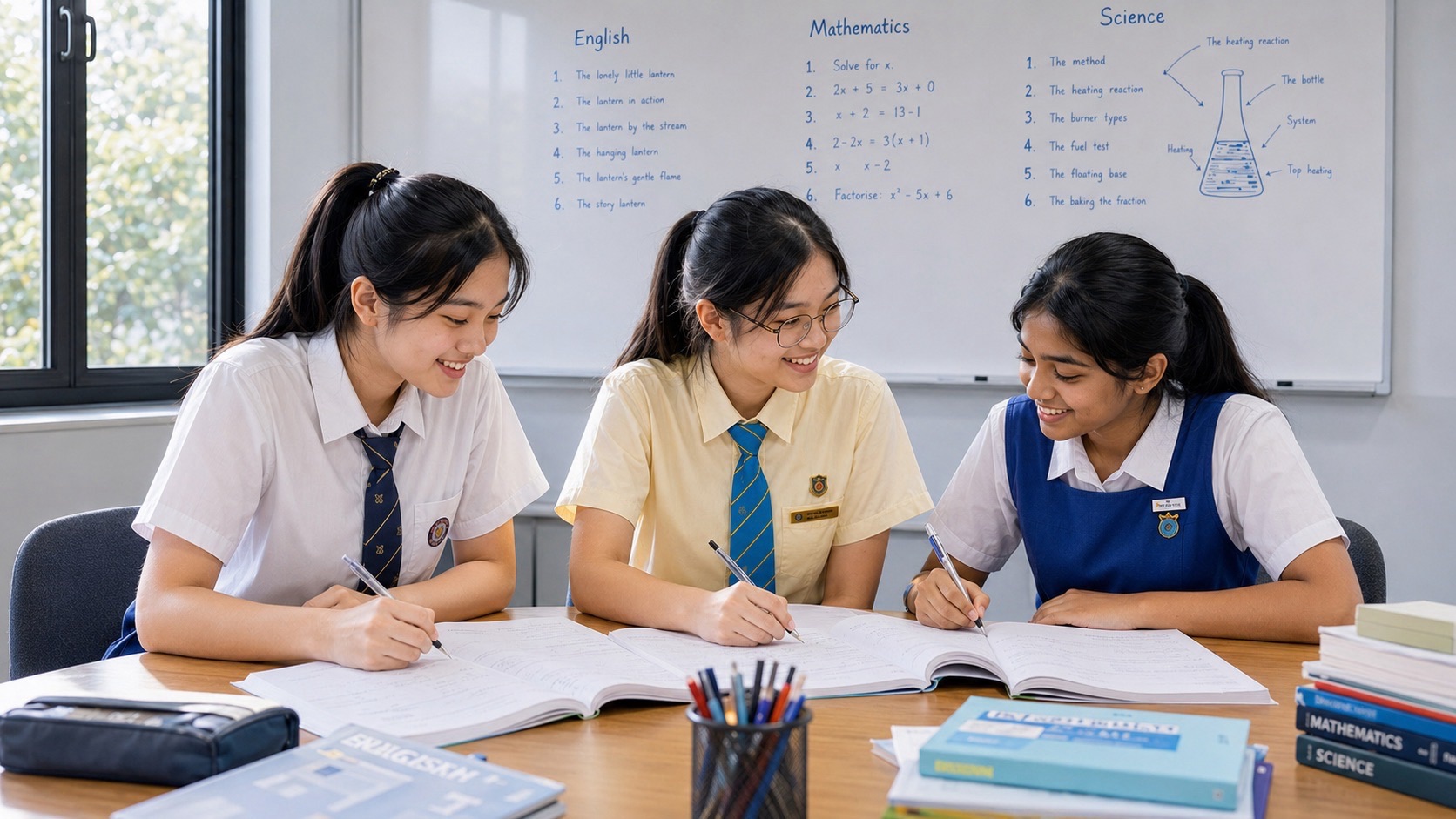
Punggol Science Tuition should prepare students for Science application questions because examinations rarely reward knowledge only when it appears in the exact form used in class. The object may change, the experiment may look unfamiliar, the graph may be drawn differently or two concepts may be combined. Students who rely on recognition can feel as though they have never learned the topic even when the underlying Science is familiar.
The core aim of Science application questions in Punggol tuition is to train transfer. Students should learn to strip away the surface story, identify the scientific model, locate the relevant evidence and rebuild the answer for the new context. Application is not a mysterious “higher-order” skill that appears only at exam time. It can be trained deliberately by changing one condition at a time and asking what stays scientifically the same.
Explore related Science guides and choose your next reading step.
Application Means Using the Same Model in a New Surface Context
A question about a new animal, machine, material or experiment may still test a familiar relationship.
The student’s job is to recognise what remains invariant beneath the story.
This is why concept mastery and application are inseparable.
The Core Aim: Strip the Story → Find the Model → Use the Evidence
A useful application routine has three moves.
- Strip away unfamiliar names and surface details.
- Identify the scientific model or relationship.
- Use the evidence and conditions to construct the answer.
Students can then check whether the answer still makes sense in the given context.
Application Questions Are Not “Trick Questions”
Students often call an unfamiliar question a trick because the context was not practised exactly.
A better framing is that the question is testing transfer.
This reduces anxiety and directs attention to the underlying Science.
Change One Feature at a Time During Training
Application skill can be built gradually.
Start with a familiar question, then change the object. Next change the diagram. Then change one condition or combine two ideas.
Gradual variation teaches the student what is essential and what is superficial.
Primary Science Application Starts With Everyday Contexts
Primary students can apply familiar concepts to household objects, plants, animals, materials and simple systems.
The tutor should ask what property, force, process or system explains the new example.
This keeps application connected to meaning rather than exam fear.
PSLE Science Application Requires Flexible Open-Ended Reasoning
PSLE questions often use unfamiliar setups to test familiar models.
Students should identify the concept before worrying about exact wording.
See PSLE Science Tuition.
Secondary Science Application Requires Representation Switching
Secondary students may meet the same concept through a graph, equation, particle diagram, circuit or experimental setup.
Application therefore includes switching representation as well as context.
See Secondary Science Tuition.
Physics Application: Identify the System and Relationship
An unfamiliar device can often be reduced to familiar quantities, forces, energy transfers or circuit relationships.
The student should ask what physical system is being modelled before choosing an equation.
Chemistry Application: Identify the Reaction or Particle Model
A new substance or setup may still belong to a familiar reaction family or particle relationship.
Students should connect observation, particles and symbols rather than search for an identical memorised example.
Biology Application: Trace the System
A new organism or biological scenario can often be understood through familiar structure-function or process relationships.
Ask what enters, what changes, what is transported and what consequence follows.
Application Questions Often Mix Topics
A strong question may combine heat with materials, transport with diffusion or chemistry with data analysis.
Students should identify each contributing model rather than assuming every question belongs to one chapter only.
Evidence Still Comes First
Application does not mean guessing creatively.
The answer must remain constrained by the data, diagram, graph or condition in the question.
Scientific transfer is disciplined, not imaginative free play.
Application Questions Reveal Weak Concept Boundaries
If a student applies the wrong concept, the issue may be confusion between similar ideas.
This is why contrast practice—example versus non-example—is so valuable.
Application Questions Reveal Hidden Misconceptions
A misconception may stay hidden in familiar questions because the student knows the expected answer pattern.
Change the context and the old mental model can reappear.
Use Prediction Before Solving
Ask what the student expects before calculating or reading all the options.
Prediction activates the model and makes contradictions visible.
If the result differs from expectation, the student has a reason to investigate.
Use “What Stayed the Same?”
After comparing a familiar and unfamiliar question, ask which scientific relationship stayed constant.
This helps students learn the invariant model.
The habit gradually makes transfer faster.
Use “What Changed the Answer?”
Alter one condition and ask which part of the reasoning must change.
Students learn that some features matter scientifically while others are decorative.
This builds causal control.
Use Multiple Representations of the Same Concept
A concept can be expressed as words, graph, diagram, table or equation.
Ask students to translate among them.
Representation flexibility is one of the strongest forms of application skill.
Application in MCQ Requires Discrimination
Multiple-choice application questions often use plausible distractors based on surface similarity.
The student should test each option against the underlying model.
See Science MCQ.
Application in Open-Ended Questions Requires Reconstruction
Students must build the explanation for the new context rather than reproduce a memorised paragraph.
The condition, mechanism and effect may be familiar even when the nouns are new.
See Science Open-Ended Questions.
Application in Practical Questions Requires Design Transfer
An unfamiliar apparatus should still be analysed through variables, measurement, controls and evidence.
Students who understand inquiry can adapt more confidently.
Application in Data Questions Requires Evidence Discipline
The graph may look unfamiliar, but the reading routine remains axes, units, scale, pattern, comparison and explanation.
The Application Error Map
- Surface details mistaken for the core concept.
- Wrong model selected.
- Evidence ignored.
- Known model not retrieved.
- Representation change causes confusion.
- Two concepts combined incorrectly.
- Answer copied from a familiar question without adaptation.
- Correct model used but condition-specific detail missed.
These errors should guide the next variation task.
Blocked Practice Comes Before Mixed Application
Students need initial fluency before being asked to transfer broadly.
Teach the concept clearly, practise several direct questions, then introduce changed contexts.
Application is not a substitute for basic understanding.
Mixed Practice Builds Faster Transfer
Once several concepts are stable, mix them.
Now the learner must choose the model rather than being told the chapter.
This is closer to real assessment conditions.
Strong Students Need More Novelty
Strong learners can handle contexts with imperfect data, competing explanations or multiple plausible approaches.
Application should increase judgement, not only difficulty.
Struggling Students Need Controlled Variation
Change one feature at a time so the student can see what stayed constant.
Too much novelty at once can hide the concept instead of teaching transfer.
Application Should Be Retested After Delay
A student may solve the new example immediately after tuition because the model is fresh.
Bring a different application back days later.
Delayed transfer is stronger evidence of mastery.
Past Papers Are Rich Application Sources
Past papers provide mixed contexts and representations.
They are most useful when the student explains which underlying model each unfamiliar question tested.
See Science Past Papers.
A Weekly Application Routine
- One familiar question.
- One same-model changed-context question.
- One representation change.
- One mixed-topic question.
- One explanation of what stayed the same.
- One delayed transfer retest.
This trains application deliberately rather than hoping it appears automatically.
Parents Can Support Application Thinking
- Ask, “What Science idea is this really about?”
- Ask, “What changed from the example you know?”
- Ask, “What stayed the same?”
- Ask, “What evidence in the question matters?”
- Ask, “Would the answer change if this condition changed?”
These prompts help students look beneath the surface.
How the eduKate Ecosystem Connects
The broad concept route is Science Concept Mastery.
For cumulative preparation, use Science Revision and Science Assessment.
Frequently Asked Questions
What are Science application questions?
Questions that require students to use familiar scientific concepts in unfamiliar contexts, representations or combinations.
Why do students struggle with application even when they know the topic?
They may rely on surface recognition, have weak concept boundaries or struggle to retrieve the correct model without a chapter cue.
How can application skill be trained?
Change one feature at a time, use multiple representations, mix topics and ask what scientific relationship remains the same.
Is application only for strong students?
No. All students can build transfer gradually once the underlying concept is stable.
How do we know application skill is improving?
Students recognise familiar models in new contexts, adapt explanations correctly and need fewer hints when wording or representations change.
The Core Aim, in One Sentence
The core aim of Science application questions in Punggol tuition is to teach students to recognise the same scientific model under new surfaces and rebuild the answer for the context in front of them.
Application becomes less mysterious when the learner knows what to ignore, what to preserve and which evidence actually matters.


