
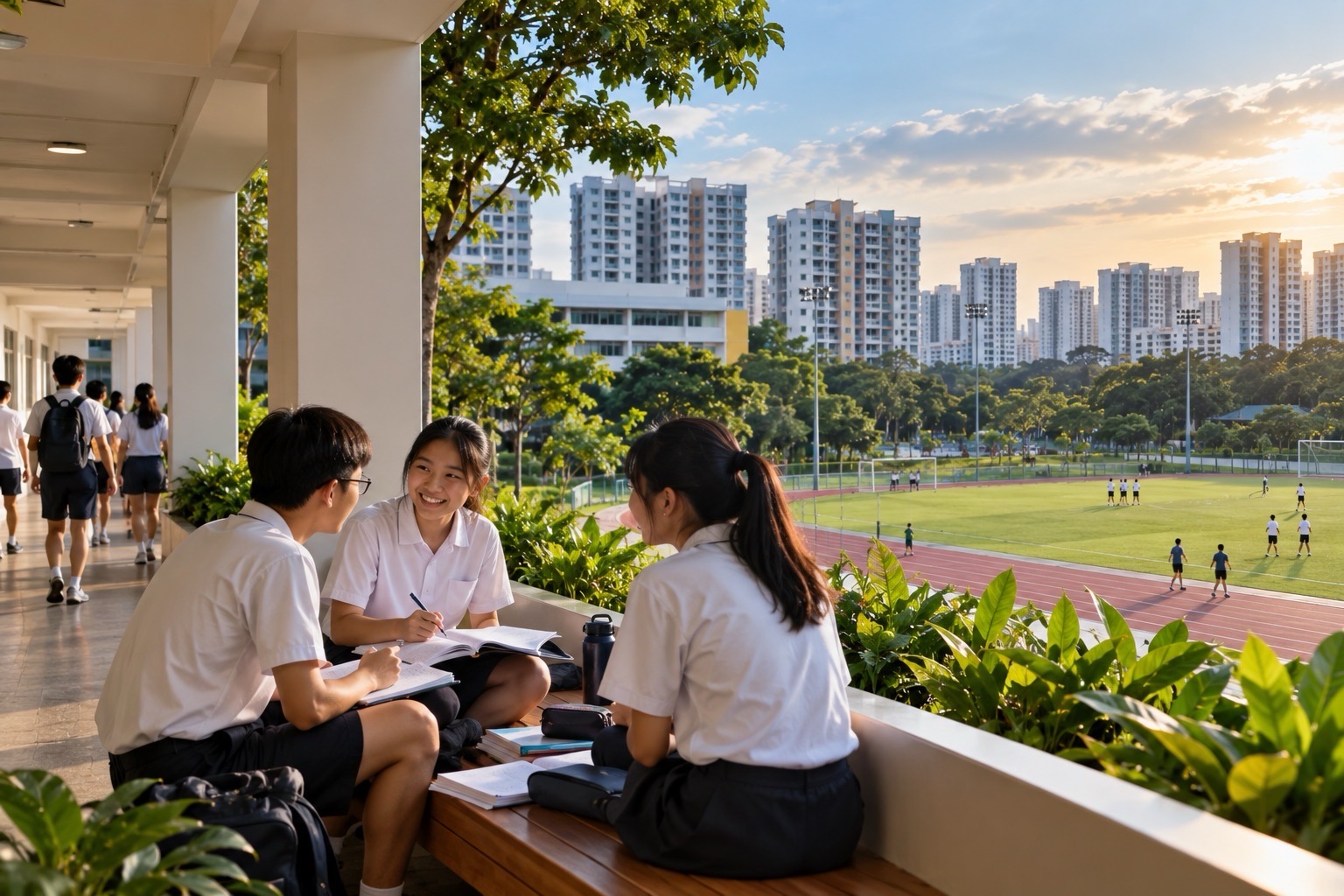
Co-Curricular Activities (CCA) in Singapore are a major part of school life, especially in Secondary school. For Punggol families searching for CCA Singapore, secondary school CCA, LEAPS 2.0, CCA points or how CCA affects post-secondary admission, the useful answer is this: CCA is not an optional decoration attached to academics. In Secondary school, CCA is compulsory, and the system is designed to develop interests, character, teamwork, leadership, service, resilience and belonging beyond the classroom.
The important twist is that CCA is both developmental and recorded. Under LEAPS 2.0, Secondary students build recognised attainment across four domains—Participation, Achievement, Leadership and Service. At graduation, the overall co-curricular attainment can be recognised as Excellent, Good or Fair. Under the current framework, Excellent gives 2 bonus points and Good gives 1 bonus point for relevant post-secondary admission aggregates, while Fair does not translate into bonus points. But the healthiest way to understand CCA is not “How many points can my child collect?” It is “What can my child become by showing up, contributing and staying long enough to get good at something?”
Explore related education-system guides and choose your next reading step.
That question matters in Punggol because CCA changes the entire school week. It affects dismissal time, transport, meals, homework, tuition, sleep, friendships and sometimes school choice itself. A child who loves football, band, drama, robotics or a uniformed group may experience Secondary school very differently depending on whether the school offers the right environment.
This Punggol Education System guide explains how CCA works, the four main categories, why it is compulsory in Secondary school, how LEAPS 2.0 works, what the bonus points mean, how attendance and long-term participation matter, how Strategic Partnership CCA expands options beyond the child’s school, and how families can choose a CCA without turning four years of growth into a points-collecting exercise.
What Is a CCA?
CCA stands for Co-Curricular Activity.
It is organised learning beyond the academic timetable.
Students learn through sustained participation in activities that require practice, teamwork, discipline, responsibility and contribution.
MOE treats CCA as one of the key areas of the co-curriculum, alongside other student-development experiences such as Values in Action, student leadership and enrichment or life-skills programmes.
That is why CCA should not be described as simply “after-school activity”.
It is part of the school’s educational programme.
Is CCA Compulsory in Secondary School?
Yes. MOE’s Secondary-school transition guidance states that CCA is compulsory for all Secondary-school students.
This is one of the biggest practical differences children notice when moving from Primary to Secondary school.
In Primary school, CCA participation can be broader in format and may depend on the school’s programme and age level.
In Secondary school, every student is expected to participate in a CCA as part of the co-curricular system.
That means the family should treat CCA timing as part of the normal weekly timetable, not as an occasional add-on.
For the wider transition, see Punggol Education System | Secondary 1 Posting.
The Four Main CCA Categories
Secondary-school CCAs are generally grouped into four broad categories:
- Clubs and Societies;
- Physical Sports;
- Uniformed Groups; and
- Visual and Performing Arts.
Each category can develop similar core capabilities in different ways.
A student in football may learn resilience through repeated training and competition.
A student in concert band may learn it through ensemble discipline and performance.
A student in robotics may learn it through problem-solving and iterative design.
A student in Scouts or NPCC may learn it through drills, service, outdoor activity and leadership.
The activity changes.
The developmental purpose remains.
Clubs and Societies
Clubs and societies can include areas such as robotics, Infocomm, debate, media, entrepreneurship, environmental activities, games, photography and other interest-based groups.
These CCAs are useful for students who enjoy making, discussing, designing, organising or exploring an intellectual interest beyond academic lessons.
They can also become important pathways for students who discover strengths that are not obvious from examination scripts.
A student who is quiet in class may become the person who can solve a technical problem for the whole team.
Physical Sports
Sports CCAs teach more than physical skill.
Students learn training discipline, tactical thinking, teamwork, recovery, emotional control and how to perform under pressure.
The schedule can be demanding, especially during National School Games periods or intensive training cycles.
Parents should therefore consider not only whether the child likes the sport, but whether the weekly training load can coexist with sleep, travel and schoolwork.
A good CCA stretches the student.
It should not quietly dismantle the rest of the week.
Uniformed Groups
Uniformed Groups can include organisations such as NCC, NPCC, Scouts, Girl Guides, Red Cross Youth and others depending on the school.
They often place strong emphasis on discipline, teamwork, service, outdoor competence, leadership and progressive responsibility.
Students may experience camps, drills, service activities, badges, leadership roles and national-level events.
For some teenagers, the structured progression is exactly what helps confidence grow.
Visual and Performing Arts
Visual and Performing Arts CCAs can include choir, concert band, dance, drama, orchestra, ensembles and other art forms.
Students build technical skill through repeated rehearsal, but they also learn stage discipline, listening, timing, ensemble awareness and courage.
MOE’s arts framework emphasises lifelong appreciation as well as performance.
A student does not need to become a professional musician or actor for four years of artistic practice to matter.
Learning to create something together is already an education.
CCA Should Influence Secondary-School Choice
Families often compare schools using PSLE Score ranges first.
CCA fit deserves a place in the conversation too.
If the child has a strong existing interest, check whether the school offers that CCA.
If the child has no fixed interest, check whether the school offers enough variety for exploration.
MOE SchoolFinder lists each school’s current CCA offerings, which makes it one of the most useful tools before Secondary 1 choices are submitted.
For Punggol families, compare Secondary Schools in Punggol and confirm the latest CCA list directly through MOE SchoolFinder.
Why Staying in One CCA Matters
LEAPS 2.0 rewards sustained engagement because development takes time.
The first year is often orientation.
The second year builds competence.
Later years create opportunities to contribute, lead, compete, mentor younger students and understand the CCA more deeply.
Changing CCA every year may expose the student to many things, but it can also prevent the student from staying long enough to move from beginner to contributor.
This is why LEAPS 2.0 gives higher participation recognition for sustained engagement, especially when the student remains active and contributes well.
What Is LEAPS 2.0?
LEAPS 2.0 is MOE’s co-curricular recognition framework for Secondary-school students.
LEAPS stands for Leadership, Enrichment, Achievement, Participation and Service, though the formal recognition framework focuses on four main domains:
- Participation;
- Achievement;
- Leadership; and
- Service.
The framework is designed to recognise the whole co-curricular experience rather than reduce CCA to competition medals.
A student can grow through commitment, leadership, service and contribution even without winning a national title.
LEAPS 2.0 Domain 1: Participation
Participation recognises sustained involvement in a school-based CCA.
Attendance matters.
So does continuity.
The framework gives progressively stronger recognition to students who participate over more years, remain in the same CCA and demonstrate active contribution and exemplary conduct.
The published LEAPS examples use at least 75% attendance in each year for key participation thresholds.
That is an important practical reminder.
A student cannot build deep CCA learning by appearing only when convenient.
LEAPS 2.0 Domain 2: Achievement
Achievement recognises representation and accomplishment beyond ordinary participation.
Representation can include being selected and endorsed to represent the school or another endorsed organisation in competitions, performances, festivals, conferences or exhibitions.
Accomplishment recognises awards and achievements at those events.
The achievement does not always have to come from the student’s main school CCA if the external activity is properly recognised and endorsed within the framework.
This allows talented students to be recognised more broadly without pretending every achievement must come from one school club.
LEAPS 2.0 Domain 3: Leadership
Leadership is broader than being CCA captain.
LEAPS 2.0 can recognise leadership through:
- class responsibilities;
- CCA appointments;
- student leadership roles;
- committee work;
- student-led projects;
- leadership workshops or modules; and
- recognised programmes such as the National Youth Achievement Award.
The educational idea is important.
Leadership is not a badge.
It is the ability to take responsibility, coordinate with others, make decisions and serve a group.
LEAPS 2.0 Domain 4: Service
Service recognises students’ contribution to school and community.
MOE’s framework states that every Secondary-school student contributes at least six hours per school year to the community.
Students may participate in Values in Action projects and receive recognition for planning, service and reflection.
The point is not to accumulate volunteer hours like supermarket points.
The strongest service experience teaches the student to notice a real need, contribute meaningfully and think about what changed because of the work.
Excellent, Good and Fair: What the Final CCA Attainment Means
At the end of the graduating year, LEAPS 2.0 converts the four domains into an overall co-curricular attainment.
The current framework recognises:
- Excellent;
- Good; and
- Fair.
Excellent currently translates into 2 bonus points for applicable post-secondary admission aggregates.
Good translates into 1 bonus point.
Fair does not translate into bonus points.
This is where many families first become intensely interested in LEAPS.
But the final label is the output of several years of participation, not something a student can manufacture in the final month of Secondary 4.
What Does “Excellent” Require?
Under the current LEAPS 2.0 framework, Excellent requires at least Level 3 in all four domains, with at least Level 4 in one domain.
That is a balanced requirement.
A student cannot simply dominate one area and ignore the rest.
The system asks for sustained participation, achievement, leadership and service in combination.
A published MOE example shows a student reaching Excellent with strong multi-year participation, school representation, leadership responsibility and meaningful service.
What Does “Good” Require?
Good requires at least Level 1 in all four domains, plus stronger attainment in a specified combination of domains.
For example, the framework can recognise Good where a student reaches at least Level 2 in three domains, or meets other qualifying combinations involving higher attainment in one or more domains.
This is why students should not obsess over one single CCA metric.
The framework rewards breadth across the co-curricular experience.
What Does “Fair” Mean?
Fair means the student has not met the combination required for Good or Excellent.
It does not mean the student learned nothing.
A student may still have gained friendships, fitness, technical skill or confidence.
But under the formal LEAPS recognition framework, the attainment does not generate bonus points.
Parents should use this information as feedback early enough to understand what is missing, rather than discovering it only at graduation.
CCA Bonus Points: The Part Parents Search For
Under current LEAPS 2.0 rules:
- Excellent = 2 bonus points;
- Good = 1 bonus point;
- Fair = 0 bonus points.
These bonus points are used in relevant post-secondary admission aggregates.
The current 2026 Joint Admissions framework includes CCA bonus points in applicable JC, Polytechnic and ITE admissions calculations.
MOE has also published the revised bonus-point system for the new JC L1R4 framework from 2028, retaining the same CCA recognition of 2 bonus points for Excellent and 1 for Good, while the overall bonus-point cap for the new L1R4 system changes.
Students graduating into the 2028 Post-Secondary Admissions Exercise should still check the final MOE rules for their cohort because the admissions system is transitioning alongside the new SEC examination.
Why Chasing Bonus Points Can Ruin CCA
A student who chooses every activity only by asking “Does this give points?” may optimise the record while weakening the experience.
CCA works best when the student actually cares enough to stay.
Interest creates practice.
Practice creates competence.
Competence creates contribution.
Contribution creates leadership and achievement opportunities.
Those are exactly the things LEAPS 2.0 recognises.
The paradox is that students often build stronger records when they stop treating the record as the only reason to participate.
How Secondary 1 Students Usually Choose a CCA
Schools use different CCA selection processes.
A school may organise CCA showcases, trials, introductory sessions or choice forms.
Some CCAs have physical, safety or selection requirements.
Others are open more broadly.
A Secondary 1 student should consider three things:
- Interest: Would I still want to do this after the novelty disappears?
- Fit: Can I handle the physical, technical or performance demands?
- Schedule: Can I sustain the training days with travel and schoolwork?
The best CCA is not always the one the child is already good at.
Sometimes Secondary school is exactly where a new strength is discovered.
What If the Student Does Not Get the First CCA Choice?
Disappointment is common, especially when a popular sport or performing group has limited places.
The child should not conclude that the school year is ruined.
A second-choice CCA can become a major source of identity once the student develops skill and friendships there.
The important thing is to enter the new CCA with enough openness to actually try.
Repeatedly telling the child “You should have got your first choice” keeps the student emotionally attached to a door that has already closed.
Can Students Change CCA?
CCA changes can be considered, but schools generally encourage sustained participation because long-term involvement produces stronger developmental outcomes.
A request to change should therefore have a real reason.
Useful reasons can include:
- serious mismatch;
- medical limitations;
- well-being concerns;
- major timetable or logistical issues; or
- a genuinely better developmental fit.
“I am bored after three sessions” is weaker evidence.
Before changing, the student should understand whether the difficulty is temporary beginner discomfort or a true mismatch.
Strategic Partnership CCA: When the School Does Not Offer the Activity
Singapore has also expanded Strategic Partnership Co-Curricular Activities, or SP-CCA, to give Secondary students access to selected CCAs that their own school does not offer.
SP-CCA is centrally organised through partnerships involving MOE and external agencies such as SportSG.
Students in an SP-CCA do not need a second school-based CCA because the programme is designed to deliver comparable learning outcomes.
MOE expanded the sports SP-CCA portfolio by adding Canoeing from 2025 and Hockey from 2026, building on existing options such as Athletics and Water Polo.
Current offerings and eligibility should always be checked with the school and MOE because centralised programmes can change.
SP-CCA Is Useful—but Geography Returns
A centralised CCA creates opportunity.
It also creates travel.
A Punggol student joining an SP-CCA may need to cross Singapore several times a week for training.
That means families should calculate the real weekly cost in:
- travel time;
- transport cost;
- meal timing;
- homework hours;
- sleep; and
- recovery.
A rare CCA can be worth the journey.
But the family should decide with the full timetable visible.
CCA and Direct School Admission
CCA talent can also connect with Direct School Admission to Secondary school and Junior College.
Some schools offer DSA talent areas in sports, performing arts, leadership, debate and other areas.
But DSA should not distort ordinary CCA participation.
A Primary student should not be pushed into a sport solely because an adult imagines a future admission advantage.
DSA works best when genuine talent and sustained interest already exist.
For the local route, see DSA From Punggol Schools.
CCA and the School Day
CCA changes the clock.
A Secondary student may finish ordinary lessons in the early afternoon and remain in school until evening for training or rehearsal.
That changes:
- lunch;
- transport;
- homework start time;
- tuition scheduling;
- family dinner; and
- sleep.
Parents should treat CCA day as a different type of weekday.
Trying to run the same homework and tuition load as a non-CCA day often creates unnecessary exhaustion.
See What Happens in Punggol on CCA Day.
CCA and Tuition: Do Not Stack the Week Until It Breaks
A common Punggol scheduling problem is CCA followed immediately by tuition followed by late homework.
It can work occasionally.
It is a poor default system.
If the child returns home exhausted at 8:30 pm twice a week, adding heavy tuition on both nights may reduce the quality of everything.
Better options include:
- placing tuition on non-CCA weekdays;
- using one weekend slot;
- reducing frequency when school support is sufficient;
- protecting at least one low-load evening; and
- allowing stronger students to study independently instead of automatically adding classes.
Tuition should solve an identified learning problem.
It should not occupy every empty square in the calendar.
CCA and Sleep
Adolescents need sleep.
CCA does not cancel that biology.
A student who trains hard, travels home, eats late, completes homework and sleeps too little may look “disciplined” for several weeks and then begin making careless errors, losing motivation or becoming chronically tired.
The weekly schedule should protect recovery.
Physical sports need it.
Performing arts need it.
Clubs and uniformed groups need it.
Learning needs it too.
CCA and Food
Long CCA afternoons create a simple problem: hunger.
A student who eats lunch at 12:30 and trains until 6:00 cannot rely on willpower as nutrition.
Families should plan:
- a proper lunch;
- a practical pre-CCA snack where appropriate;
- water;
- post-CCA dinner; and
- food that can survive the school day safely.
The aim is not sports nutrition perfection.
It is preventing the child from reaching the final hour of training with no usable energy.
CCA and Transport in Punggol
Punggol students often combine school transport with LRT, MRT or public bus travel.
On CCA days, the journey home may happen after peak school hours and sometimes after dark.
Parents should know:
- the normal route;
- the backup route;
- the last practical transfer;
- what happens in heavy rain;
- who the child calls if training ends late; and
- whether the child can travel independently.
For local planning, use Punggol Route Planning for Students.
CCA and Equipment Costs
Some CCAs require equipment, attire, instruments or specialised items.
The cost structure varies widely.
Parents should ask the school what is:
- provided;
- loaned;
- subsidised;
- required to purchase; and
- optional.
Where a charge is an approved school-based education expense, Edusave may sometimes be usable under the applicable rules.
Do not assume every sports shoe, musical instrument or external purchase can be paid from Edusave.
For the account system, see Edusave Account Singapore.
Injury and CCA Attendance
Sports injuries and health conditions need proper communication.
A student who is medically unable to train should follow the school’s reporting process and provide documentation where required.
The family should not pressure the child to participate through a significant injury merely because attendance contributes to LEAPS participation.
The purpose of attendance recognition is sustained engagement.
It is not to reward unsafe behaviour.
When the problem is long-term, speak to the CCA teacher and school about the appropriate arrangement.
What If the Student Is Shy?
CCA can be especially valuable for shy students because it gives social interaction a shared task.
Conversation is easier when everyone is rehearsing the same piece, building the same robot, training for the same game or planning the same event.
The child does not have to “be social” in the abstract.
The child belongs to a group doing something together.
That is one reason CCA can create friendships that feel different from classroom friendships.
What If the Student Is Already Very Busy?
CCA is still part of the Secondary-school programme.
The family should therefore reduce load elsewhere rather than treating CCA as the removable part by default.
Possible adjustments include:
- fewer tuition sessions;
- less redundant assessment-book work;
- better homework planning;
- protecting Sunday evening;
- reducing optional external activities; and
- building travel and meals into the timetable.
The child should not have to prove seriousness by being tired every day.
The Parent’s Best CCA Role
Parents should support commitment without becoming the CCA manager.
Useful parent roles include:
- helping the child choose realistically;
- making transport workable;
- budgeting for required equipment;
- encouraging attendance;
- listening when the child struggles;
- supporting recovery after setbacks; and
- contacting the school when there is a genuine health or welfare issue.
Less useful roles include arguing with coaches over every selection decision, calculating every action as a LEAPS point opportunity or making the CCA about the parent’s own unfinished ambitions.
How to Tell Whether a CCA Is Working for the Child
Look beyond medals.
After a year, ask whether the student has become more able to:
- show up consistently;
- work with others;
- accept correction;
- handle frustration;
- organise equipment;
- manage time;
- take responsibility;
- help juniors;
- perform under pressure; and
- recover after mistakes.
Those are real educational outcomes.
They travel into school, work, relationships and adult life.
A Punggol Secondary 1 CCA Checklist
- Use SchoolFinder to review each school’s current CCA list before S1 choices.
- Ask the child for genuine interests, not prestige preferences.
- Attend CCA showcases or trials with an open mind.
- Check training days before committing to tuition schedules.
- Calculate the route home after late CCA.
- Understand equipment and cost requirements.
- Learn the school’s attendance expectations.
- Keep LEAPS 2.0 in view without turning it into the only reason to participate.
- Review the timetable after the first term.
- Let the child gradually own packing, attendance and communication.
Frequently Asked Questions
Is CCA compulsory in Singapore Secondary schools?
Yes. MOE states that CCA is compulsory for Secondary-school students.
What are the four main CCA categories?
Clubs and Societies, Physical Sports, Uniformed Groups, and Visual and Performing Arts.
What is LEAPS 2.0?
LEAPS 2.0 is MOE’s framework for recognising Secondary students’ co-curricular development across Participation, Achievement, Leadership and Service.
How many CCA bonus points can a student get?
Under the current LEAPS 2.0 framework, Excellent gives 2 bonus points and Good gives 1 bonus point for applicable post-secondary admission aggregates.
Does Fair give CCA bonus points?
No. Fair does not translate into bonus points under the current framework.
What does Excellent require?
Excellent requires at least Level 3 in all four LEAPS domains, with at least Level 4 in one domain.
Does attendance matter?
Yes. Sustained participation and attendance are part of LEAPS participation recognition. MOE’s published examples use at least 75% attendance per year for key participation levels.
Can a student change CCA?
Schools may consider changes, but sustained engagement is encouraged because long-term participation supports skill, character and leadership development.
Can external achievements count?
Some external representation and accomplishment can be recognised when endorsed under the LEAPS framework. Students should confirm with their school.
What is SP-CCA?
Strategic Partnership CCA is a centralised CCA option that allows students to pursue selected activities their own school does not offer.
Does an SP-CCA student still need a school-based CCA?
No. Current MOE guidance states that SP-CCA is designed to deliver comparable learning outcomes, so participating students do not need a second school-based CCA.
Can CCA help with DSA?
Yes. Some DSA talent areas are linked to sports, performing arts and other co-curricular strengths, but selection depends on each school’s criteria and the student’s demonstrated talent.
Should parents choose a Secondary school because of CCA?
CCA should be one factor alongside academic fit, commute, programmes, subject options, school culture and student support.
Can Edusave pay for CCA expenses?
Some approved school-based charges may be payable through Edusave under the scheme rules. Check the specific school notice rather than assuming every CCA expense is eligible.
Where can I see a school’s current CCA list?
Use MOE SchoolFinder and the school’s own website.
Helpful Reading and Official Sources
- MOE — Transition to Secondary School
- MOE — LEAPS 2.0 Framework
- MOE SchoolFinder
- MOE — Expansion of Strategic Partnership CCA
- MOE-SportSG — SP-CCA Hockey 2026
- Punggol Education System | Secondary 1 Posting
- Secondary Schools in Punggol Compared
- What Happens in Punggol on CCA Day
- Punggol Education System | Edusave Account Singapore
- Singapore Education Pathway
CCA, LEAPS 2.0 and SP-CCA information in this article were checked against current MOE information available on 7 October 2026. School offerings, training schedules, centralised CCA options and post-secondary admission rules can change. Use MOE and your child’s school as the final operational source.
CCA Is Where School Becomes More Than Subjects
A student can learn discipline from Mathematics.
A student can learn courage from English Oral.
A student can learn evidence from Science.
But CCA creates a different kind of classroom.
The field.
The stage.
The workshop.
The parade square.
The rehearsal room.
The competition floor.
Here, the lesson is often immediate.
Show up.
Practise.
Work with people.
Lose sometimes.
Improve.
Help someone younger.
Take responsibility when it is your turn.
That is why CCA belongs inside the education system rather than beside it.
The points matter.
The person who emerges after four years matters more.
Continue Through the Punggol Education System
Continue with Secondary 1 Posting, Full SBB in Punggol Secondary Schools, or the Singapore Education Pathway.
Properly taught kids shine a bright light into the future.


