
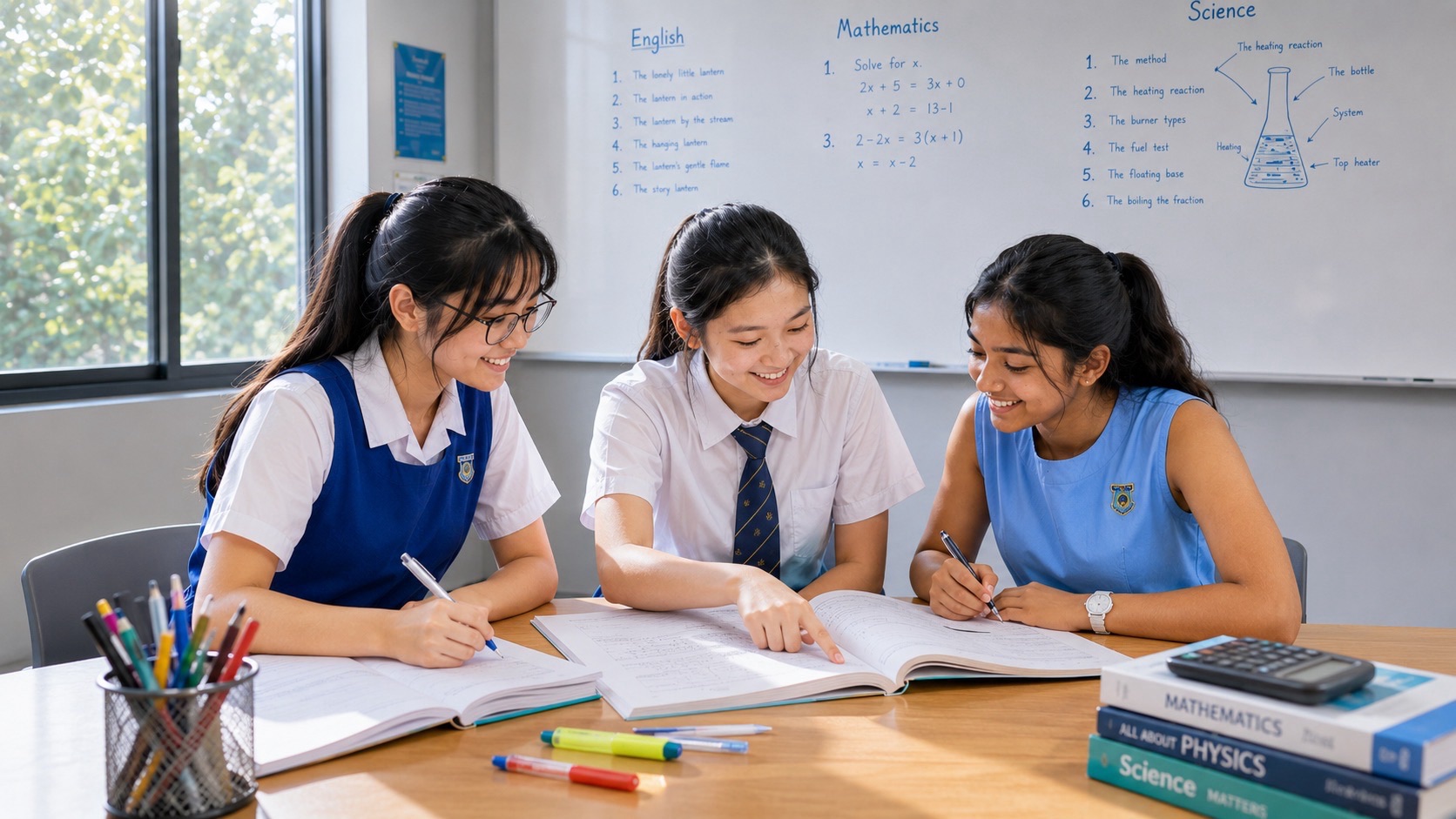
Punggol Science Tuition should teach students how to revise Science, not simply tell them to “study harder.” Families searching for Science Revision often face a familiar problem: the child rereads notes, recognises the pages and feels prepared—then cannot retrieve the concept, select the model or explain the answer when the question changes.
The core aim of Science revision in Punggol tuition is to turn revision from passive exposure into active reconstruction. Strong revision should retrieve old knowledge, connect topics, practise representations, analyse errors, test transfer and gradually move toward timed performance. The student should know not only what to revise, but why each revision activity exists and what evidence will show that the topic is actually becoming stable.
Science Revision Is Not Re-Reading
Re-reading can be useful when a concept is genuinely forgotten, but it is a weak default because familiarity is easy to mistake for mastery.
A student looks at a page and thinks, “Yes, I know this.” The real test begins when the page is closed.
Can the learner define the idea, sketch the diagram, explain the mechanism, solve a fresh question and still remember it next week? That is revision.
The Core Aim: Retrieve → Apply → Check → Repair → Revisit
A useful Science revision loop has five steps. Retrieve without notes. Apply the idea to a question. Check against reliable feedback. Repair the first broken step. Revisit after a delay.
This loop is simple enough for Primary students and strong enough for Secondary and SEC preparation.
The delay matters because immediate success after correction can be deceptive. Stable learning survives time.
Revision Should Begin With Diagnosis
Students often start revising the chapter they dislike most or the chapter at the front of the book. That is not always the best use of time.
A better starting point is evidence: recent papers, error logs, old quizzes, retrieval checks and practical questions.
Which concepts are missing? Which are slow? Which are known but poorly expressed? Which representations repeatedly cause trouble?
Use an Error Map Before a Revision Timetable
- Concept gap.
- Retrieval gap.
- Graph or table error.
- Diagram or representation error.
- Practical-design error.
- Calculation or unit error.
- Scientific-language error.
- Command-word error.
- Transfer error.
- Timing or checking error.
Once the error map is visible, the timetable can allocate effort intelligently.
Revision Should Be Weighted by Expected Return
Equal time for every chapter feels fair but is often inefficient.
A cross-cutting problem such as graph reading or unit conversion can affect many topics. Repairing it may recover more marks than another hour spent polishing a strong chapter.
Science tuition should help students identify high-return repairs.
Closed-Book Retrieval Is the Engine of Revision
Retrieval means forcing the brain to produce the knowledge rather than recognise it.
Write the equation. Draw the process. State the definition. Explain the graph. Name the variables. Predict the outcome.
Then check. The struggle to retrieve is part of the learning.
Spacing Keeps Old Topics Alive
A topic should not disappear after one successful revision session.
Bring it back after a few days, then a week, then later again. Each successful retrieval strengthens access.
Spacing is especially important in cumulative examinations such as PSLE Science and final-year Secondary Science.
Interleaving Teaches Model Selection
Blocked revision practises one topic at a time. Interleaving mixes topics.
The mixed format is harder because the student must identify which scientific model applies before solving.
That difficulty is useful once the basics are stable, because examinations do not announce the chapter.
Revision Should Include Words, Diagrams, Graphs and Data
Science is represented in many forms. A student who revises only prose may still struggle when the same idea appears as a graph or diagram.
Each revision cycle should include several representations where relevant.
Translate between them: words to diagram, graph to explanation, equation to physical meaning, table to claim.
Primary Science Revision: Build Retrieval Without Killing Curiosity
Primary students need cumulative review, but revision should not become endless paper drilling too early.
Use short retrieval, open-ended explanation, diagrams, simple inquiry and changed-context questions.
Near PSLE, mixed papers and time control can increase, but understanding should remain the foundation.
PSLE Science Revision: Open-Ended Answers Need Reconstruction
Students often revise PSLE Science by memorising model answers. This can create fragile knowledge.
A better routine is to identify the question family, reconstruct the causal chain and then compare with the model answer for precision.
The student should be able to express the same valid Science in fresh wording.
Lower Secondary Revision: Protect the Foundations
Secondary 1 and 2 students should keep graph reading, units, variables, scientific vocabulary and model selection active.
These cross-cutting skills become increasingly important in upper secondary.
Revision should therefore include both topic knowledge and general scientific habits.
Upper Secondary Revision: Manage a Portfolio
Secondary 3 and 4 students may be balancing Combined Science or separate Physics, Chemistry and Biology.
A revision system should keep every component alive while allocating deeper time to current weaknesses.
One difficult subject should not consume the entire week and allow the others to decay.
G1, G2 and G3 Revision Should Match the Actual Level
Under Full Subject-Based Banding and the SEC framework, students take subjects at specific levels.
Revision resources should match the student’s actual G1, G2 or G3 Science syllabus.
The relevant routes are G1 Science Tuition, G2 Science Tuition and G3 Science Tuition.
Science Revision Notes Should Become Smaller Over Time
Detailed notes may help when learning a new concept. Revision notes should gradually compress.
A strong one-page core map can hold the central model, key terms, equations, diagrams, practical ideas and personal errors.
Compression shows that the student knows which relationships matter.
Flashcards Are Useful When They Ask for Relationships
Definition cards can help vocabulary, but Science revision needs more than term recall.
Better cards ask: what happens if this variable changes? Why does this structure help? Which graph pattern would you expect? What evidence would support the claim?
These prompts train reasoning as well as memory.
Concept Maps Should Be Rebuilt From Memory
A copied concept map can look impressive and teach very little.
Students should reconstruct the map without notes, then compare and repair missing links.
The value lies in retrieving the relationships.
Past Papers Are Late-Stage Integration Tools
Past papers are powerful because they mix topics and skills, but they should not replace earlier concept repair.
Use them to measure cumulative control: retrieval, switching, timing, practical reasoning, calculations and answer precision.
Then change the next revision block based on the paper.
Paper Count Is a Weak Revision Metric
The number of papers completed says little about whether the same errors are recurring.
A better metric is closure: which error categories have disappeared after retesting?
One deeply analysed paper can be more valuable than several rushed ones.
Practical Revision Should Be Regular
Students often revise theory heavily and leave practical work until late.
Include variables, method design, measurement, reliability, precision, anomalies and evaluation throughout the revision cycle.
Practical reasoning is a cross-topic skill.
Graphs Should Be Revised as a Skill, Not a Chapter
Graph reading appears in Physics, Chemistry, Biology and Primary Science.
A dedicated revision block on axes, units, scale, trend, anomalies and explanation can improve several topics at once.
That makes it a high-return skill.
Calculations Need a Revision Routine
For quantitative Science, the revision routine should be consistent.
- Identify the required quantity.
- Write the relationship.
- Convert units.
- Substitute clearly.
- Calculate.
- State the unit.
- Sense-check.
Consistency is more useful than last-minute formula cramming.
Vocabulary Revision Should Use Contrasts
Students remember scientific terms better when boundaries are clear.
Compare similar terms directly: mass and weight, element and compound, respiration and breathing, accuracy and precision.
Contrast reduces substitution errors.
Open-Ended Revision Should Focus on the Relationship
Do not memorise a whole paragraph when the mark depends on one causal link.
Identify the condition, mechanism and effect. Then practise expressing the relationship concisely.
Different valid wording should still preserve the same Science.
MCQ Revision Should Include Why the Wrong Options Are Wrong
A correct MCQ answer can hide guessing.
Ask the student to justify the chosen option and reject at least one distractor scientifically.
This turns MCQ into a misconception diagnostic.
A Seven-Day Science Revision Plan
- Day 7: diagnose with mixed retrieval.
- Days 6–5: repair major concept and representation gaps.
- Days 4–3: mixed application, practical questions and calculations.
- Day 2: timed section or paper plus error analysis.
- Day 1: short retrieval, error-map review and rest.
The exact timing can change, but the sequence—diagnose, repair, integrate, simulate—is durable.
A 30-Day Science Revision Plan
With a month, the student can use weekly cycles.
Week 1 repairs high-value gaps. Week 2 increases mixed retrieval. Week 3 adds more timed paper sections. Week 4 consolidates, simulates and tapers.
The student should keep old repaired topics active throughout.
A 90-Day Science Revision Plan
With three months, avoid permanent exam mode.
Spend the early phase rebuilding models and retrieval. Use the middle phase for integration and transfer. Use the final phase for timed performance and checking.
This sequence is more sustainable than doing full papers for twelve straight weeks.
Revision Should Include Recovery Practice
Real examinations contain difficult moments.
Students should practise what to do when stuck: identify what is known, write a useful starting point, move on strategically if necessary and return later.
Recovery is part of exam readiness.
Sleep Is Part of Revision
Memory consolidation and attention depend on rest.
A revision plan that requires chronic sleep loss may increase study hours while reducing learning quality.
Sustainable revision is not soft. It is efficient.
Parents Should Ask About the Revision System, Not Only Hours
- What is the current top error category?
- Which old topic was retrieved this week?
- Which correction was retested?
- What mixed work has been done?
- What practical skill was reviewed?
- Is timed performance improving?
- Is the schedule sustainable?
How the eduKate Ecosystem Connects
For timed final-year work, see Science Exam Preparation. For practical revision, use Science Practical.
Students who need a short recovery schedule can also use 7-Day, 14-Day and 30-Day Science Improvement Plans.
For notes and memory tools, see How to Make Science Notes, Concept Maps and Flashcards That Actually Help.
Frequently Asked Questions
What is the best way to revise Science?
Retrieve without notes, apply to fresh questions, check, repair the first broken step and revisit after a delay.
Is rereading notes useful?
Useful for initial review or genuine forgetting, but it should be followed by closed-book retrieval and application.
How often should old Science topics be revisited?
Often enough that they remain accessible. Spaced review after days and weeks is usually more effective than one large revision block.
Should students do topical or mixed revision?
Both. Use topical practice to build initial fluency, then mixed practice to train model selection.
How many past papers should a student do?
As many as can be properly analysed and repaired within the schedule. Paper count alone is not a useful target.
Are flashcards good for Science?
Yes when they test retrieval and relationships, not only definitions.
How should Science revision change near an exam?
Increase mixed and timed work, continue targeted repair and taper the workload near the paper while protecting sleep.
How do we know revision is working?
Old topics remain accessible, repeated errors decrease, mixed questions become easier to classify and performance stays stable after delays.
The Core Aim, in One Sentence
The core aim of Science revision in Punggol tuition is to turn passive familiarity into durable access: retrieve, apply, check, repair, revisit and transfer.
Good revision is not the art of looking at Science for longer. It is the art of making Science available when the notes are closed and the question is new.


