
Coordinate geometry is where algebra learns to draw. A line can be written as an equation. A distance can be calculated from coordinates. A circle can be described symbolically. A geometric condition can become an algebraic constraint that the student can solve.
For Punggol students learning Advanced Mathematics, this is an important turning point. The subject stops feeling like separate chapters and starts behaving like one connected language. Shapes live on graphs. Graphs come from equations. Equations can be rearranged, compared and solved.
Coordinates give geometry an address system
A point on a plane is no longer described vaguely as “over there”. Coordinates make position exact. Once position is exact, distance, midpoint, gradient and line relationships can be calculated rather than guessed.
This is why coordinate geometry becomes a bridge between spatial reasoning and algebraic reasoning.
Gradient turns direction into a number
The gradient of a line describes how much vertical change occurs for a given horizontal change. That same idea later connects to rate, graph behaviour and calculus.
Students should therefore see gradient as more than a formula. It is a numerical description of direction and change.
The equation of a line compresses an entire geometric object
A single linear equation describes infinitely many points lying on the same line. This is one of the beautiful moments in Advanced Mathematics: a whole geometric object can be stored inside a short symbolic relationship.
The learner should be able to move both ways — from two points to a line equation, and from an equation back to its graphical meaning.
Parallel and perpendicular become algebraic conditions
Parallel lines share gradient. Perpendicular lines have a special gradient relationship. A geometric statement can therefore be translated into algebra, manipulated and then returned to the diagram.
That translation habit is a core part of Advanced Mathematics.
Circles deepen the connection
A circle can be understood geometrically through centre and radius, and algebraically through its equation. Completing the square can reveal the centre and radius hidden inside an expanded expression.
This is a perfect example of topic connectivity: algebraic manipulation reveals geometric information.
Use the existing coordinate-geometry owner for focused repair
The article Advanced Coordinate Geometry, Circles and Linearisation provides a deeper technical owner for students who need focused practice.
A good coordinate-geometry question should trigger four checks
- What geometric information is given?
- Which quantities can be translated into coordinates, distances or gradients?
- Which algebraic relationship represents the geometry?
- Does the final algebraic answer still make geometric sense?
Why diagrams still matter
A diagram should not replace calculation, but it can prevent impossible answers. If the final gradient points the wrong way, if a midpoint lies outside the expected segment or if a supposed radius is negative, the picture can expose the contradiction.
Advanced students use multiple representations to check one another.
Punggol makes this connection easy to notice
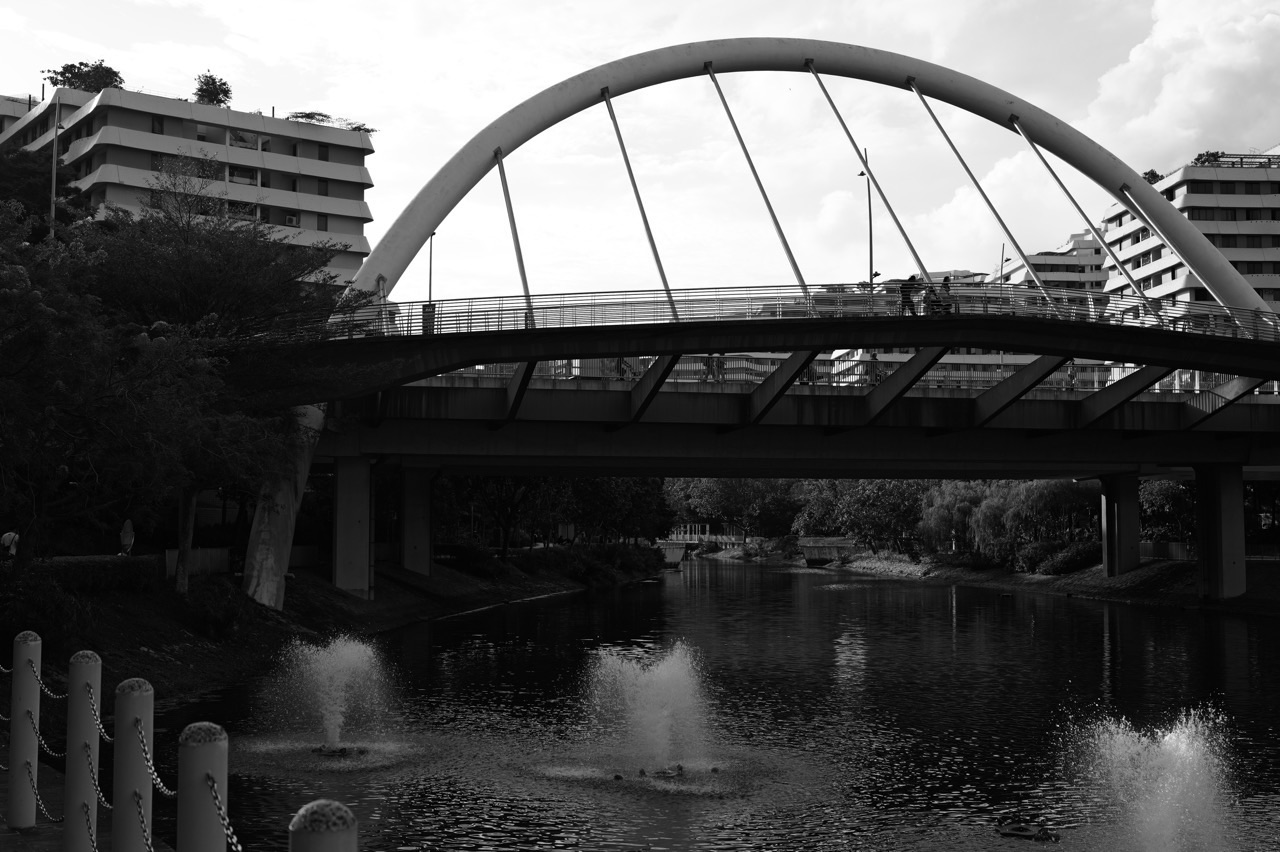
Roads, bridges, LRT tracks, building edges and Waterway paths create a town full of lines, curves, intersections and relative position. A Punggol streetscape is a useful reminder that coordinate geometry is a mathematical way of describing space.
A practice sequence that builds transfer
- Find gradient from two points.
- Find an equation from a point and gradient.
- Move between equation and graph.
- Use parallel and perpendicular conditions.
- Calculate midpoint and distance.
- Translate a circle from geometric information into algebra.
- Solve a mixed question where the geometric condition is hidden inside the wording.
Continue the Punggol Advanced Mathematics journey
- The Long Journey From Primary Number Sense to SEC Additional Mathematics
- Secondary 1–2 as the Hidden A-Math Preparation Years
- Secondary 3 — Build One Connected Map
- Secondary 4 and SEC — Turn Knowledge Into Independent Exam Control
- Logarithms and Exponentials — Powers, Scale and Growth
- Trigonometry as a Connected System
- Patterns to Generalisation — Sequences and Binomial Theorem
- Mathematical Metacognition — Plan, Monitor, Check, Recover
Continue through the wider eduKate Punggol ecosystem
- Mathematics Tuition at eduKatePunggol
- Punggol Mathematics Reading Library
- Additional Mathematics Tuition in Punggol
- Additional Mathematics Article Index
- The Secondary Pathway
- Science Tuition at eduKatePunggol
- eduKatePunggol Atlas
Coordinate geometry becomes powerful when students see that algebra and space are not competing methods. They are two views of the same structure. The stronger the translation between them, the more routes the learner has when a problem becomes unfamiliar.


