
Secondary 4 advanced mathematics is where knowledge has to become independent exam control. By this stage, many Punggol students have already seen most of the important Additional Mathematics ideas. The problem is no longer simply exposure. The problem is whether those ideas remain available when the paper is mixed, timed and unfamiliar.
This is why the final stage of the Punggol advanced mathematics journey should not be built around endless new notes. It should be built around retrieval, route selection, transfer, timing, verification and repair.
The student is learning to control a paper, not merely complete a worksheet.
Layer 1: retrieve before looking
If a student needs the formula sheet, worked example or chapter heading before they can begin, the knowledge is not yet exam-ready. Secondary 4 practice should repeatedly ask the learner to start from a blank page.
Retrieval reveals what is actually available under assessment conditions. It also makes later revision faster because the student knows which ideas are stable and which still require rebuilding.
Layer 2: recognise the route when the topic label is gone
School worksheets often group similar questions together. Examination papers do not. Students must decide whether a question is really about factorisation, functions, identities, coordinate geometry, differentiation, integration or a combination.
This is why the How to Choose the Best Method in Additional Mathematics owner matters. Method selection is a separate skill from method execution.
Layer 3: survive mixed-topic transfer
A-Math questions often become difficult because two familiar ideas are joined. The student may know both chapters separately but not recognise the connection quickly enough.
Mixed practice should therefore be deliberate. Pair an older algebraic structure with a current calculus idea. Join a graph with an equation. Combine trigonometric manipulation with an interval restriction. The point is to train recognition across boundaries.
Use Improve Additional Mathematics Mixed-Topic Problem Solving when this is the main bottleneck.
Layer 4: build timing without training panic
Timing practice should not begin by telling a student to rush. First make the route stable. Then reduce hesitation. Finally use realistic paper windows.
A slow but correct student often needs better recognition and retrieval, not faster handwriting. A fast but careless student may need deliberate checkpoints. Timing is therefore a diagnostic problem, not a personality label.
The exam-control loop
- Scan the question and identify the mathematical object.
- Mark the conditions: interval, exact form, domain, diagram information or required result.
- Choose the route and estimate what the answer should roughly look like.
- Execute with readable working.
- Pause at natural checkpoints to catch sign or substitution errors.
- Verify the final answer against the original condition.
- If stuck, leave a clean restart point and move on rather than destroying the rest of the paper.
Create an error budget before the examination
Students often speak about “careless mistakes” as though they are random. Many are not. They belong to repeated categories: sign errors, omitted solutions, wrong intervals, copied coefficients, calculator inputs, algebraic cancellation, missing constants, weak diagrams or answering the wrong target.
A Secondary 4 error log should therefore answer three questions: What type of error was it? What triggered it? What checkpoint would have caught it?
That turns correction into prevention.
Full papers are diagnostic instruments
A full paper should produce more than a score. After marking, classify lost marks by cause:
- Knowledge missing.
- Knowledge known but not retrieved.
- Wrong method selected.
- Algebra or notation failed.
- Question condition missed.
- Time allocation failed.
- Checking failed.
- Confidence collapse after one difficult question.
The same score can therefore imply completely different next-week plans.
Do not let revision become chapter tourism
A common Secondary 4 mistake is to “revise” by briefly revisiting every chapter. This feels productive because many pages are touched, but little is retrieved deeply.
A better cycle is narrower: diagnose, repair, retrieve, mix, retest. If an error disappears under changed conditions, the repair is working. If it returns, the underlying dependency is still alive.
A practical runway from school term to SEC
- Early year: close Secondary 3 prerequisite gaps and stabilise current Secondary 4 work.
- Mid-year: increase delayed retrieval and begin more mixed sets.
- Prelim runway: introduce regular timed sections and full papers.
- After prelims: convert actual school-paper errors into a focused repair map.
- Final weeks: protect sleep, retrieval and confidence; do not rebuild the entire syllabus from scratch.
The existing Secondary 4 A-Math Term 1 and Term 2 owners give more detailed seasonal guidance.
What to do after a disappointing test
Do not immediately double the workload. First determine whether the loss came from concept, recognition, algebra, timing or checking. More questions only help when they attack the right failure mode.
A middle grade can improve when the student stops leaking marks through repeated mechanisms. The guide Move From a Middle Additional Mathematics Grade Toward Distinction focuses on that progression.
What strong students should do differently
Strong students do not need infinite routine repetition. They need changed surfaces, harder representation shifts, cleaner explanations, more independent checking and selected stretch.
The objective is robustness, not exhaustion. Use How Strong A-Math Students Should Stretch Beyond Routine Practice for that lane.
Why the three-student model still matters near the exam
As SEC approaches, students often need different things at the same time. One may need calculus repair, another may need faster method recognition, and another may be losing marks mainly through checking.
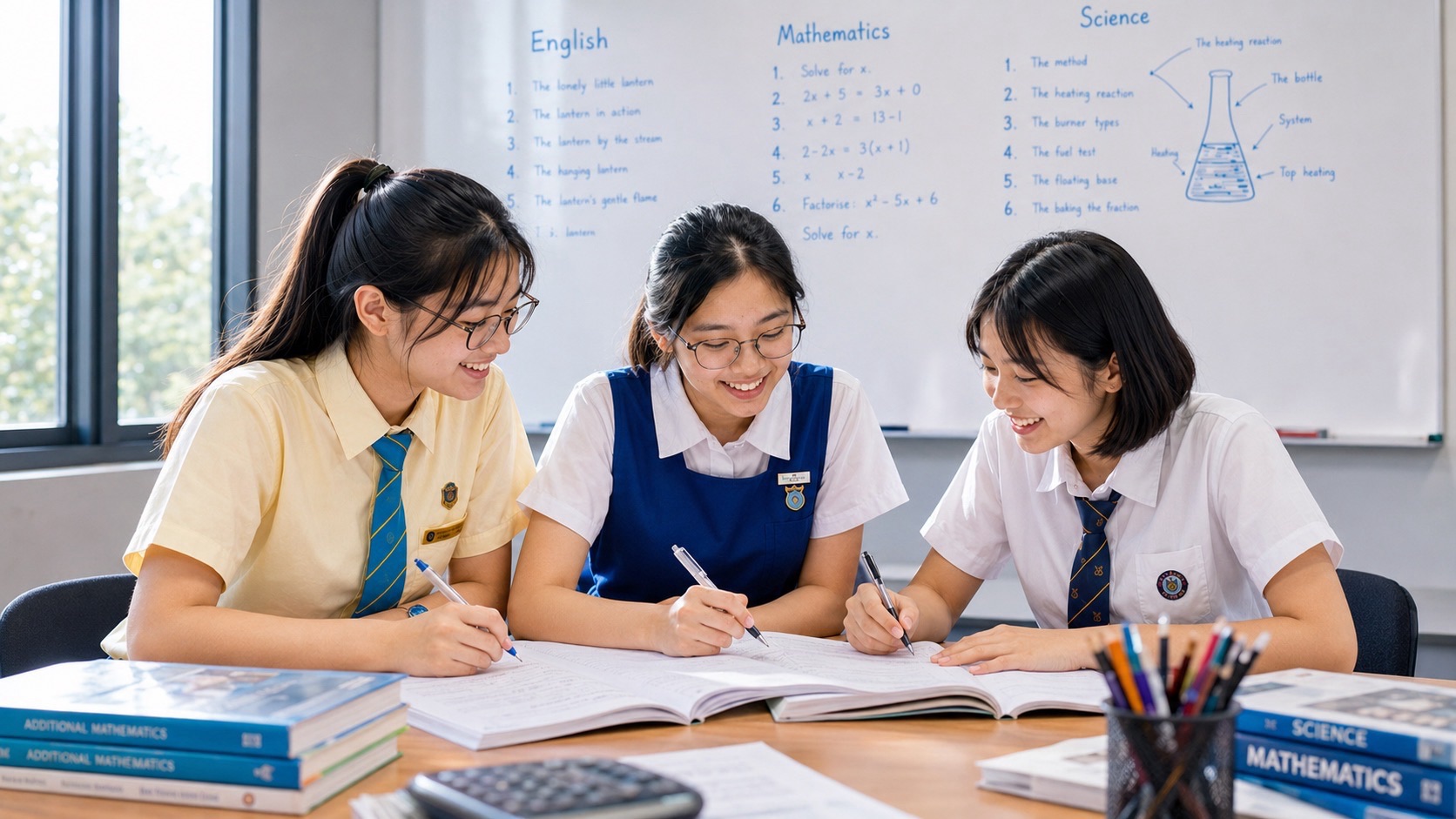
A small group of up to three students allows the shared lesson to focus on common examination structures while individual work targets the specific leak in each student’s paper.
The class is small enough for the tutor to see working, not just answers. That matters because the line where reasoning changes direction is often where the real problem lives.
Language and emotional control are part of exam performance
Dense questions can create unnecessary load. Students should train themselves to underline conditions, identify the target and translate the wording into a mathematical object before calculating.
They also need a recovery routine after a difficult question. One hard item should not consume the next twenty minutes. Good exam control includes the ability to leave, reset and return.
Beyond SEC: keep the structures that transfer
The strongest parts of Additional Mathematics continue beyond the examination: algebraic fluency, functions, graph sense, trigonometric structure, calculus thinking, exact reasoning and disciplined working.
The guide From SEC Additional Mathematics to JC H2 Mathematics — What Carries Forward shows how the journey continues for students taking later Mathematics.
Even for students who do not pursue H2 Mathematics, the habits of modelling, checking assumptions, representing relationships and reasoning carefully remain useful in Science, Computing and many quantitative fields.
The final Secondary 4 checklist
- Can I start without notes?
- Can I identify the method when the chapter is hidden?
- Can I connect two topics in one question?
- Can I maintain exact values and restrictions?
- Can I finish realistic paper sections within time?
- Do I know my repeated error categories?
- Do I have checkpoints that catch them?
- Can I recover calmly after one difficult question?
- Can I explain why my final answer satisfies what was asked?
Continue through the eduKate Punggol ecosystem
- Mathematics Tuition at eduKatePunggol
- Punggol Mathematics Reading Library
- The Secondary Pathway
- Additional Mathematics Tuition in Punggol
- Additional Mathematics Article Index
- Science Tuition at eduKatePunggol
- eduKatePunggol Atlas
Official references: SEAB 2027 SEC G2 syllabuses and SEAB 2027 SEC G3 syllabuses.
The Secondary 4 goal is not perfection on every worksheet. It is control: retrieve the Mathematics, recognise the route, execute clearly, manage time, verify the result and recover when the paper becomes difficult. That is how two years of Additional Mathematics become an examination-ready system.


