
Learning advanced mathematics in Punggol is a journey, not a sudden jump into a difficult Secondary 3 subject. Long before a student meets formal Additional Mathematics, the foundations are already being built through number sense, fractions, ratio, algebra, graphs, geometry, problem reading, working discipline and the habit of checking whether an answer makes sense.
In this series, advanced mathematics is an editorial description of that growing mathematical capability. The official examinable subject is Additional Mathematics. For the 2027 Singapore-Cambridge Secondary Education Certificate (SEC), SEAB lists Additional Mathematics at both G2 and G3 levels. The important idea for families is simple: the later subject becomes much easier when the earlier mathematical system is strong.
For Punggol students, this means we should not treat Primary Mathematics, PSLE Mathematics, Secondary Mathematics and Additional Mathematics as four disconnected worlds. They are one learning road. Each stage carries forward structures, language and habits that the next stage quietly assumes.
The journey starts with number sense, not formulas
A student who understands fractions, ratio, percentage, rate, factors, multiples and place value is already building the mental machinery used later in algebra. These are not “primary school topics” that disappear after PSLE. They become the arithmetic layer underneath equations, surds, trigonometry, logarithms and calculus.
For example, a learner who is uncomfortable with fractions may later struggle with algebraic fractions. A learner who treats ratio as a memorised method may find similarity, trigonometric relationships and rates harder to organise. A learner who does not notice magnitude may accept a calculator answer that is obviously unreasonable.
That is why an advanced mathematics journey can begin with something as ordinary as asking, “Does this answer make sense?”
PSLE is a gate, but not the end of the Mathematics story
After PSLE, the surface of Mathematics changes. There are more symbols, more abstraction and more expectation that students explain relationships rather than only complete a familiar procedure. The transition can feel abrupt even for a child who did well in Primary 6.
A useful starting owner is the Post-PSLE Mathematics Diagnostic. It checks what should be repaired before Secondary 1 rather than assuming that a good PSLE result means every prerequisite is equally secure.
The companion guide After PSLE — Should My Child Start Secondary 1 Maths Early? explains why early preparation should build understanding rather than simply race ahead.
Secondary 1 is where arithmetic starts becoming a language
Variables, terms, coefficients, expressions and equations create a new mathematical language. Students now need to understand that symbols carry relationships. The expression 3x + 5 is not a string of characters to manipulate mechanically; it describes a structure.
This is also where negative numbers, brackets, indices and factorisation begin to matter more. A small sign error can travel through an entire solution. A weak distributive law can later damage quadratic work, algebraic fractions and calculus simplification.
The goal is not speed first. It is clean symbolic control. Speed should arrive as a consequence of repeated correct thinking.
Secondary 2 quietly becomes an A-Math preparation year
Secondary 2 is often underestimated because formal Additional Mathematics may not have started. Yet this is where students can consolidate the algebra, graphs, equations, geometry and trigonometric thinking that make the Secondary 3 transition smoother.
The strongest preparation is not to force an A-Math textbook too early. It is to make ordinary Mathematics increasingly transferable. Can the student rearrange an unfamiliar equation? Can they interpret a graph without a template? Can they explain why a method works? Can they move between words, diagrams, symbols and graphs?
Those are signs that the learner is becoming ready for more advanced mathematics.
Secondary 3: Additional Mathematics changes the density of ideas
When Additional Mathematics begins, the subject can feel faster because chapters are more tightly connected. Algebra supports functions. Functions support graphs. Trigonometry uses algebra. Coordinate geometry uses equations. Calculus sits on top of functions, graphs and symbolic manipulation.
The Additional Mathematics Prerequisite Map makes those dependencies visible. A student who sees the map can repair the right earlier skill instead of repeatedly practising the chapter that happens to be failing now.
This is a major eduKate principle across the Mathematics ecosystem: diagnose the dependency before adding more workload.
Secondary 4: knowledge must become performance
By Secondary 4, the question changes. It is no longer only, “Do I know this chapter?” It becomes, “Can I recognise the method when the chapter name is hidden, retrieve it under time pressure, combine it with older ideas, and check the answer independently?”
That is the difference between local topic knowledge and examination control. Full papers expose whether a learner can move between different mathematical objects without losing accuracy or time.
The journey therefore shifts from teaching more content to integrating, retrieving, mixing and verifying what is already known.
One learning engine can run through the whole journey
Across Primary Mathematics, Secondary Mathematics and Additional Mathematics, the same six-step engine remains useful:
- Diagnose: find the real prerequisite or misconception.
- Explain: understand the relationship before memorising the procedure.
- Retrieve: solve without looking at the worked example.
- Vary: change the surface so the student learns what stays constant.
- Mix: combine the idea with older topics so transfer develops.
- Verify: check signs, restrictions, units, reasonableness and the question asked.
The content becomes more advanced, but the learning architecture stays remarkably stable.
Mathematical language matters more as the subject becomes harder
Advanced Mathematics is not language-free. Students must read command words, interpret conditions, distinguish “show that” from “solve”, understand domains and intervals, and explain why a conclusion follows.
This is where the wider eduKate ecosystem matters. English comprehension habits support mathematical question reading. Vocabulary precision supports definitions and conditions. Science gives mathematical relationships physical meaning. Study routines determine whether retrieval happens between lessons.
A student does not carry separate brains into English, Mathematics and Science. The same attention, language, memory and reasoning systems travel between subjects.
Science gives Mathematics somewhere to go
Rates, graphs, vectors, exponential relationships and change become more meaningful when students see how Mathematics supports Physics, Chemistry, Computing and later quantitative study. The 2027 G3 Additional Mathematics syllabus itself emphasises connections within Mathematics and between Mathematics and the sciences.
That does not mean every Mathematics lesson needs a science story. It means students should understand that abstract Mathematics is powerful because it can describe structure far beyond the worksheet.
What small-group tuition can do on this journey
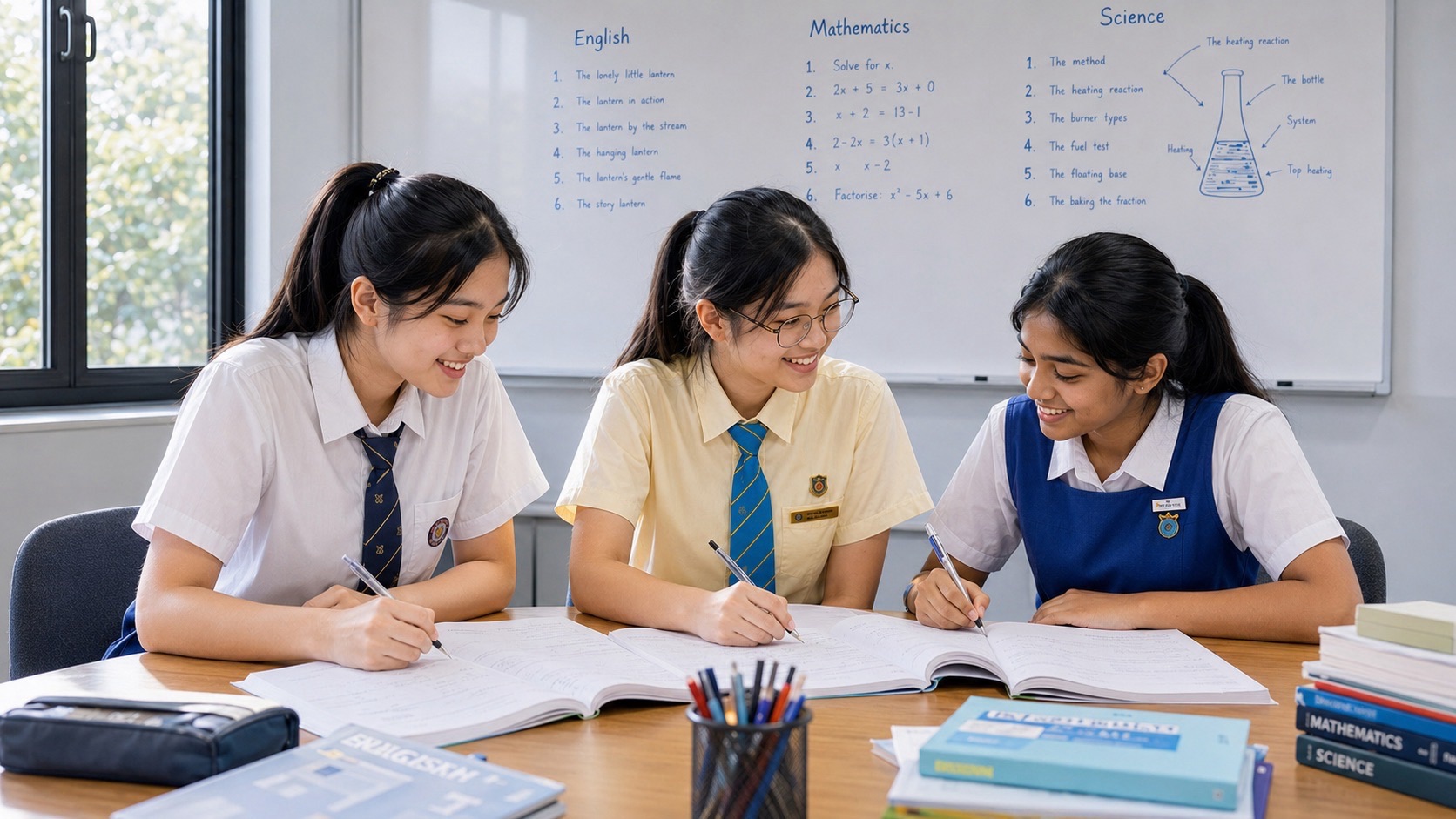
At eduKate Punggol, Mathematics tutorials are taught in small groups of up to three students. That format is useful because three different mathematical states can be visible in the same lesson: one student may need prerequisite repair, one may be consolidating, and one may be ready for transfer or stretch.
The aim is not to give every student exactly the same number of minutes. The aim is to give each learner the intervention that unlocks the next useful step.
This becomes especially valuable in A-Math, where two students can make the same final mistake for completely different reasons.
How parents can recognise healthy progress before the grade changes
- The student starts a question without waiting for a hint.
- Working becomes easier to read and defend.
- The learner can explain why a method applies.
- Fewer errors repeat from week to week.
- Old topics remain usable after a delay.
- Changed-surface questions feel less threatening.
- The student checks answers without being reminded every time.
- Homework becomes more efficient because less time is spent guessing the first step.
Grades matter, but these are the mechanisms that usually make grades more durable.
The Punggol Advanced Mathematics journey map
- Primary foundations: number sense, fractions, ratio, percentage, rate and problem solving.
- PSLE transition: diagnose what must be carried forward.
- Secondary 1: build algebra language and symbolic discipline.
- Secondary 2: strengthen graphs, equations, geometry, trigonometry and transfer.
- Secondary 3: learn Additional Mathematics as a connected system.
- Secondary 4: convert topic knowledge into mixed-paper control.
- SEC and beyond: carry the strongest algebraic, graphical and reasoning habits into later Mathematics and Science.
Continue through the eduKate Punggol ecosystem
- Mathematics Tuition at eduKatePunggol
- Punggol Mathematics Reading Library
- The Secondary Pathway
- Additional Mathematics Tuition in Punggol
- Additional Mathematics Article Index
- Science Tuition at eduKatePunggol
- eduKatePunggol Atlas
Official references: SEAB 2027 SEC G2 syllabuses and SEAB 2027 SEC G3 syllabuses.
The central idea is simple: advanced mathematics is not one chapter, one year or one examination. It is a long accumulation of clear concepts, strong language, disciplined working, retrieval, transfer and checking. Build those layers well, and the later Mathematics journey becomes far more manageable.


