Living near Meridian LRT (PE2) is a decision about the school day as much as the commute. A useful home here connects the people and places your family already depends on: the child’s actual school, the adult’s workplace, the caregiver’s starting point and the errand that needs doing before dinner. The station helps connect those journeys; it does not make every nearby address equally convenient.
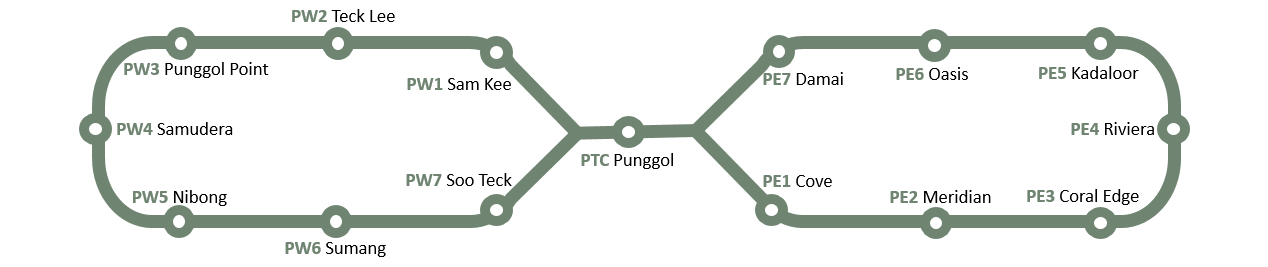
Meridian sits between Cove and Coral Edge on the Punggol LRT East Loop. Its position gives residents different directions to investigate: towards Punggol through Cove, or towards Coral Edge and the eastern part of the loop. A school gate on Edgedale Plains and an office reached through the North East Line may therefore draw the family in different directions. That is the practical choice this guide helps you examine.
The school addresses and transport references below were checked on 30 September 2026. They are starting points for a real journey, not promises about vacancies, admission priority, walking times or a particular home’s condition. The examples are illustrative family situations rather than testimonials from residents.
Meridian at a glance: what the location tells you
| Question | Useful answer | What remains address-specific |
|---|---|---|
| Where is Meridian? | PE2 on the East Loop, between Cove and Coral Edge. | The walk from the residential entrance to the station. |
| How does it connect to the NEL? | The rail connection is at Punggol. | Whether walking, LRT or a current bus route best starts your trip. |
| Which schools should a family investigate? | Use the named school’s official address, not a station-centred radius. | Admission rules, the pupil’s gate and the caregiver’s route. |
| Where can larger errands happen? | Consider Punggol Plaza, Oasis Terraces or the Town Centre according to the task. | The exact shop, opening conditions and return with purchases. |
| Is it a quiet place to live? | No station label answers that for an individual room. | Unit orientation and observations at the times you need quiet. |
| Who might find it useful? | A household whose school, care and travel arrangements connect here. | The complete week, including late days and alternative caregivers. |
The rail relationship follows SBS Transit’s Punggol LRT map. The table deliberately avoids rating the neighbourhood as the best, the most school-dense or the calmest. Those comparisons would require evidence about defined areas and comparable households, not just a collection of names on a map.
Read the loop before deciding how far away you are
Meridian’s code is an identifier, not a travel-time estimate. Along the Cove side, the station sequence to the interchange is Meridian, Cove, Punggol. That is two station-to-station segments in that direction. It says nothing about the walk from your block, the wait, the transfer to the NEL or the journey beyond it. Read the direction display before boarding rather than treating every train around a loop as equivalent.
A parent can explain this to a child without making the lesson complicated. Find Meridian on the map, locate the intended destination, and trace the direction needed. Then ask the child to name the next station they expect. The exercise turns a memorised instruction into a route the student can recognise. Rehearsal should match the child’s needs and the family’s judgement about supervision.
For service information, use SBS Transit’s train information. Keep a network map for orientation and current information for the journey being made. They answer different questions. A clear map remains useful even when operating arrangements change, provided nobody treats it as a live timetable.
Edgefield Plains and Edgedale Plains need careful reading
These similar road names are an easy source of mistakes when someone is moving, arranging school collection or sending a relative an address. Read the complete school name and street together. A message that says only “the school at Edgefield” may leave the receiving adult to guess whether it means the primary school, secondary school, a road or the broader neighbourhood.
The official school addresses give the distinction substance. Edgefield Primary lists 41 Edgefield Plains, whereas Edgefield Secondary lists 36 Punggol Field. Their shared name does not make them the same destination. The person travelling should receive the correct address and the school’s current visitor or collection instructions.
Use the same care with a housing listing. Copy the actual block and postal address into the viewing plan instead of relying on the advertiser’s area description. A wrong street can make a property appear closer to a school than the usable route allows. Correcting the address first is more valuable than refining an estimate built on the wrong starting point.
Four primary-school addresses worth distinguishing
| School | Official address | Source |
|---|---|---|
| Mee Toh School | 21 Edgedale Plains, Singapore 828867 | School contact page |
| Greendale Primary School | 50 Edgedale Plains, Singapore 828848 | School contact page |
| Edgefield Primary School | 41 Edgefield Plains, Singapore 828869 | School contact page |
| Horizon Primary School | 61 Edgedale Plains, Singapore 828819 | School contact page |
This is an orientation table, not a list of schools within one kilometre of Meridian or every home around it. It is also not a ranking or a promise that the family can obtain a place. Several schools can be relevant to a wider home search while requiring different journeys from the exact properties on the shortlist.
Place the child’s real school beside the candidate address before comparing optional amenities. If the child is already enrolled, start with that arrangement rather than assuming a move should bring a school change. For a new application, use MOE’s current Primary 1 registration guidance. A local guide can organise questions, but it cannot determine an individual registration outcome.
Choose the school journey separately from the admission question
Two different conversations often become tangled. The first asks whether a family can apply under the relevant process and what the current rules require. The second asks how the child will reach school and return every day. An answer to one does not automatically answer the other. Even a desirable admission arrangement can leave the household with a difficult collection route.
Keep separate notes. Under admission, record the official process and any documents or clarifications required. Under travel, record the permitted gate, arrival requirement, escort and return arrangement. This prevents a property agent’s proximity description from becoming both an admission assurance and a journey plan without either claim having been established.
Discuss the child’s existing support as well. A move may affect friendships, care, learning arrangements and the adults who can help. The family does not need to make all those changes simply because one address looks more attractive. A good decision recognises what should remain stable as well as what could become easier.
The morning starts before the station
The school run begins in the home: finding the uniform, checking the bag, finishing breakfast and leaving with the right materials. A shorter outdoor journey is valuable, but it cannot fully compensate for a departure routine that changes unpredictably every morning. Identify which difficulties occur before leaving and which genuinely belong to the route.
For a Meridian-area home, rehearse the route to the actual gate at an appropriate time. Notice crossings and the final approach. Use the child’s normal pace, not the fastest pace an adult can sustain during a viewing. Leave room for an ordinary delay rather than relying on the best result from one trial.
A practical evening preparation might be modest: tomorrow’s clothing ready, essential books in the bag, and a clear understanding of who accompanies the child. The child can take a growing share of those tasks without becoming responsible for the adults’ entire calendar. The aim is a morning that requires less last-minute rescuing, not an elaborate household inspection.
What changes when the adult continues to work?
When a parent drops a child at school before commuting, evaluate the combined journey. A home-to-school route may look easy while the onward route sends the parent back past the starting point. Another home may make the school leg slightly longer but connect the parent naturally to work. Neither can be judged by the child’s walking distance alone.
Draw the sequence on one page: home, school gate, transport connection, workplace entrance. Use actual requirements rather than a vague “CBD” destination. The end of the commute might involve another walk or building access process after leaving the station. Those minutes belong in the morning even when a route planner omits them.
Then ask who performs the sequence when the usual parent cannot. If the alternative adult starts elsewhere, their route needs its own check. A family arrangement becomes less fragile when the substitute can follow a clear plan instead of reconstructing the routine from hurried messages on the morning itself.
Service 381 adds a road-based option
Go-Ahead’s Service 381 route lists Meridian Station Exit B, stop 65161, in the direction towards Punggol Coast, and Exit A, stop 65169, towards Punggol Interchange. Check the destination and stop code, not only the route number. The published service also passes other eastern Punggol destinations.
This gives the household another option to investigate when the trip is not simply about reaching the NEL. A bus may suit a particular destination or reduce a transfer; it may also follow a route that is less direct than expected. Compare the actual door-to-door alternatives at the times needed. Do not assume that a single-seat journey is automatically the fastest or most comfortable.
Teach the return as a separate instruction. The stop on the other side of the road can have a different name, code and approach. A child or visiting caregiver should not be expected to infer those details from the outward journey. Use the current operator information before the first trip, then keep the familiar route simple enough to remember.
Dismissal has its own geography
At dismissal, the child may have a different bag, a different energy level and a different accompanying adult. The next destination may be student care rather than home. A morning route that worked well therefore should not be copied backwards without considering the actual afternoon.
Confirm the school’s current collection arrangements, including the permitted gate and any procedure affecting the person collecting. Put the next destination into the plan before adding groceries or another child’s activity. The task is to get the child into the next agreed setting reliably, not to maximise the number of errands completed along the way.
Where collection is shared, one concise message can prevent several misunderstandings: the child, the date, the place, the responsible adult and the next handover. Avoid expecting the pupil to reconcile conflicting instructions. A child can learn the routine while adults remain responsible for making sure the agreed supervision actually exists.
Student care must connect to the particular school
A centre can be near Meridian without serving the child’s school or offering the required collection arrangement. Ask directly about the school’s name, the age group, the days needed and the transport or escort process. A general claim that student care is available in the neighbourhood does not close those questions.
Compare the complete arrangement, including collection after care. A provider near school may reduce one transfer but create a detour for the working parent. A provider near home may work differently. The better option is the one whose confirmed terms connect with the household’s actual timetable and the child’s needs.
Do not treat homework supervision as evidence that the child understands everything completed. A simple family conversation can distinguish work finished independently from work finished with help. That information helps decide what, if anything, needs attention at home. The goal is continuity between settings, not asking every adult to repeat the same lesson.
Late CCA days deserve a different evening
A later school finish often removes the gap in which the household normally eats, rests or starts homework. Rather than trying to compress the entire normal evening, decide what must remain and what can move. A routine that becomes impossible every Wednesday is not rescued by calling Wednesday an exception.
Start with collection and dinner. Then identify the essential school preparation for the next day. An optional shopping trip or non-urgent task may belong elsewhere. The family can preserve a reasonable bedtime without claiming that every child needs the same amount of evening work or that local transport alone determines learning.
For a child who is frustrated after the longer day, ask about the specific difficulty before adding another activity as a solution. The problem might be a missed meal, a confusing assignment, a route that feels uncomfortable or a task that is simply too long for that evening. Repair the identified problem rather than treating tiredness as a lack of ambition.
A worked family week: one change at a time
Consider an illustrative family with a Primary pupil, one parent working regular office hours and a grandparent handling two afternoon collections. They are comparing two homes, one near Meridian and another closer to the Town Centre. They should first keep the work schedule, school and care agreement the same so that the location comparison remains meaningful.
The Meridian option might make the grandparent’s school-to-home journey easier but require a feeder connection for the parent. The Town Centre option might simplify work travel while adding an afternoon detour. Record both differences. A larger time saving for the parent does not automatically outweigh a fixed collection requirement that the grandparent cannot meet.
Now test one possible adjustment, such as a different collection day or a confirmed care arrangement. Recalculate only what actually changes. This is more useful than imagining that every difficulty will disappear through unspecified future help. A home earns its place on the shortlist when its practical compromises can be named and accepted.
Count time without counting the same journey twice
Here is a hypothetical calculation, not a set of Meridian travel times. Home A adds six minutes to each of ten weekly work journeys, which is sixty minutes. It removes fifteen minutes from each of four caregiver journeys, also sixty minutes. The total difference is zero within those assumptions, but the family may still prefer one arrangement because of a deadline, comfort or who bears the extra travel.
If groceries are collected during the journey home from work, count the detour rather than another full commute. If a caregiver makes a special trip, include it even though the parent does not see it in their own schedule. Shared trips should be recorded once when calculating total household travel, while each person’s experience can be discussed separately.
Keep the maths understandable to the family. A complicated score assembled from guessed numbers can conceal more than it reveals. The calculation is useful when it identifies the trade-off and exposes missing evidence. It is not a machine for deciding how much a grandparent’s comfort or a child’s reliable collection should matter.
Punggol Plaza and Coral Edge are useful, distinct destinations
The shopping trip should name the destination rather than referring vaguely to “the mall near Meridian”. Punggol Plaza is associated with Coral Edge and is a separate place to investigate. Its operator’s directory lists a supermarket, food facilities and a wet market. Those functions do not make every outlet open at the same time.
A family cooking most evenings may value a practical shopping route more than a long list of recreational possibilities. Try the errand with a realistic carrying load and consider who performs it. The adult who does the viewing may not be the person bringing groceries home with a child after school.
Choose a local top-up option separately from the larger shop. A household can use different places for different baskets without making the routine complicated. The useful question is whether ordinary essentials can reach home comfortably, not whether Meridian should be ranked above or below Coral Edge on an unmeasured convenience scale.
Oasis Terraces is not the Meridian station building
For a visit to Punggol Polyclinic, use the clinical provider’s address. SingHealth lists it at 681 Punggol Drive, Oasis Terraces, #02-01. Its official location page provides the appropriate reference. A neighbourhood-centre directory does not replace appointment or registration information.
Plan that journey independently from the usual Town Centre commute. The destination is on a different part of the East Loop, and a suitable bus or walking alternative may be relevant from the particular home. Check the actual approach and the return after the visit, especially for a person who needs assistance.
Keep the article’s role practical rather than clinical. The provider handling the appointment determines the service and instructions. For a medical emergency, follow SCDF’s guidance and call 995 as appropriate. Choosing a convenient home is not the same task as deciding how an emergency should be handled.
A school-day library trip needs enough usable time
NLB lists Punggol Library at 1 Punggol Drive, One Punggol. Use the library’s current information for the service intended. Borrowing, a booked programme and a study session are different uses of the building, with different practical requirements.
For a Meridian family, first ask how much time remains after travel. A short gap between school and another activity may allow a book return but not a useful study session. A teenager intending to work for longer should also plan the journey home rather than treating arrival at the library as the end of the task.
Let the visit serve a real purpose. A younger child might choose two books and talk about one interesting page. An older pupil might use a clearly defined work period. Neither requires turning the whole outing into another class. When the travel costs more attention than the intended task can justify, a simple home arrangement may be the better choice that day.
Two possible afternoons from the same school gate
Consider an illustrative pupil leaving a school on Edgedale Plains. In the first arrangement, an authorised caregiver collects the child, they return home for food, and the child starts one short piece of work before a parent returns. In the second, the child goes to an agreed care setting and the parent collects after work. Neither is inherently better. They solve different adult schedules and may suit different children.
Compare the transitions rather than only the distance. In the first arrangement, someone must be available at dismissal and remain responsible afterward. In the second, the provider’s confirmed collection and closing arrangements become important. A home nearer the school may help either plan, but it cannot supply an adult who is not available or a care place that has not been secured.
Then consider what the child experiences. Are instructions clear? Is there time to eat? Are school materials available in the setting where work happens? Does the evening repeat tasks already completed because the adults have not communicated? These questions can reveal why a seemingly compact route still produces an exhausting day. The repair may be a clearer handover or fewer transitions rather than another change of address.
Put the chosen arrangement into plain language that a substitute caregiver can follow. The explanation should identify the child, collection place, responsible adult and next destination. Keep private background information out unless it is genuinely required for care. A reliable afternoon is usually built from a few well-understood commitments, not a continuous stream of messages.
Ask the question the school or provider can actually answer
Before contacting a school or care provider, separate a general preference from the information needed. “Is your school good for our family?” is too broad to resolve a practical problem. “Which entrance should an authorised grandparent use for this collection arrangement?” is a question the responsible staff can answer within their process.
For a prospective care setting, describe the child’s school, level, required days and collection needs. Ask how the proposed arrangement works rather than assuming the centre’s location proves it can provide the required service. Where a payment or commitment follows, retain the current terms and seek clarification about anything material that remains unclear.
For a route enquiry, state the destination as well as the starting point. The appropriate stop for a visitor may differ from the entrance used by pupils. A parent can respect institutional procedures while still obtaining the practical information the household needs. Clear questions reduce the likelihood of a confident but irrelevant answer being carried into the move.
When the schoolbag becomes the missing connection
A child may move smoothly between school, care and home while the work materials do not. The worksheet stays in another bag, a book is needed in two places, or instructions are remembered differently by the adults. The result can look like reluctance to study when the immediate problem is missing information.
Use a small handover habit. Before leaving the care setting, the child checks which work is complete, which item must go home and what is needed tomorrow. An adult provides support appropriate to the child’s age. At home, the family deals with the specific unfinished task rather than restarting the whole school day.
This is particularly useful when different adults share collection. The person carrying the bag should not have to infer the homework plan from loose papers. Equally, a tutor should not be asked to repair every administrative gap as though it were an academic weakness. A simple materials routine preserves more useful learning time than adding pages merely because the evening felt unproductive.
What to do with a small amount of time saved
A shorter school route does not need to be immediately filled with another lesson. The family might use the margin for a less hurried breakfast, an earlier return, a short conversation or preparing tomorrow’s bag without rushing. Those are valid benefits even when they cannot be translated into a promised examination result.
Let the child’s actual work guide academic decisions. Suppose the child can explain a method accurately when rested but makes avoidable mistakes after a crowded evening. That observation suggests examining the task conditions. It does not, by itself, establish a diagnosis or prove that the school, neighbourhood or teaching is at fault.
Try a bounded adjustment and observe again: a clearer task, a different time, a brief explanation or fewer simultaneous demands. Keep the result specific. “Completed this task independently under these conditions” is more informative than “the new neighbourhood made the child smarter”. The value of a well-arranged week is that it creates opportunities to learn; the learning still has to be demonstrated.
Keep current connections separate from a future family
A home search often includes a picture of the family several years ahead. The young child becomes a teenager, an adult changes workplace, and care needs may change. Those possibilities deserve consideration, but they should not outweigh a present arrangement that has not yet been made workable.
Assess a small number of plausible changes rather than every imaginable future. Could an older student explain the route to Punggol independently? Is there a reasonable alternative if the usual caregiver becomes less available? Would a different workplace leave the household dependent on a journey it has not considered? These questions are useful because they identify adaptability without pretending to predict the family’s life.
The answer does not have to be perfect. A suitable home can serve the current household and leave options for later. What matters is knowing which benefits exist now, which require a confirmed future service and which depend entirely on personal circumstances. A station’s location is relatively stable; the family’s use of it can change considerably.
Home study begins with the work, not the furniture
When viewing a home, imagine an ordinary piece of schoolwork being done there. Where would the child place a book and write? Can they find the materials without occupying a passageway? Is the same space needed by another person at that time? A large desk is not helpful if the household cannot use it when required.
Different tasks need different arrangements. Reading aloud should not have to compete with a sibling’s quiet work in the same moment. A task needing adult explanation may belong at a shared table for a short period, while independent practice can happen elsewhere. Decide the sequence before assuming that a bigger home or another enrichment class is the only solution.
Keep evidence small and useful. Ask what the child completed independently, where they became stuck and what the next manageable step is. The neighbourhood’s schools and transport can support the week, but learning still requires an appropriate task and enough attention to attempt it. Location alone does not produce grades.
Choose enrichment with the whole evening visible
A class near a familiar station may be easier to reach, but suitability still comes first. Confirm the actual venue, level, timetable and teaching arrangement with the provider. Do not assume a branch exists at Meridian because a service markets itself to Punggol families.
Then add the surrounding time: travel, arrival margin, waiting for siblings, dinner and the return home. A lesson that looks convenient in isolation can create an awkward evening when added to CCA and care. The parent should be able to explain what need the class addresses and how the week makes room for it.
Review whether the support is helping the intended task. A child producing more pages with increasing adult assistance is a different result from a child becoming more independent. The response might be a changed method, a better-timed session or less additional work. A place guide should not turn every family concern into an automatic enrolment recommendation.
When two children finish at different times
The first question is supervision, not the fastest vehicle. Establish where the earlier-finishing child can be, who is responsible and when the later collection occurs. A parent cannot solve overlapping responsibilities merely by assuming the short journeys around the neighbourhood will fit.
Write the combined sequence once. If a gap remains, change a flexible activity time, arrange another authorised adult or confirm an appropriate care option. Keep the instruction concise enough that the person performing it can act without reading a long conversation. The child should receive a clear plan rather than being made the courier for several conflicting messages.
After trying the arrangement, inspect the actual result. Were both children collected comfortably? Did dinner become rushed? Was one adult repeatedly delayed? A recurring problem deserves a redesign. The neighbourhood is helping when the complete sequence is workable, not when each separate leg is described as only a short trip.
Grandparents should not inherit invisible travel
A home may appear convenient because a grandparent quietly absorbs the difficult journeys. Make those journeys visible during the decision. Start from the grandparent’s home, include the child’s collection and account for the return. Ask which route they prefer and what makes it manageable.
A familiar direct bus might be more comfortable than a faster-looking rail transfer. Conversely, a predictable station connection may suit someone who dislikes uncertain road travel. The right answer belongs to the person making the trip. Do not use the younger adult’s pace and carrying ability as the default for everyone.
Agree on limits and backups. A caregiver needs room for their own appointments, rest and changes of plan. A reliable arrangement is a defined agreement, not unlimited availability. That clarity protects both the child and the adult helping the family, while allowing the home comparison to reflect the true amount of support required.
Inspect the home, not just its relationship to schools
A convenient address cannot repair a layout that does not meet the household’s needs. Consider sleeping arrangements, shared space, storage, work and study. A room count tells only part of the story. A family may need separation between activities more than an impressive open area that everyone must use simultaneously.
Stand in the places where daily tasks would happen. Imagine leaving for school with bags, bringing groceries home and setting out work after dinner. Check the actual entrance route and the common areas you would use. Seek appropriate professional advice for technical or contractual questions beyond an ordinary viewing.
Do not infer condition from age alone. A newer property is not automatically trouble-free, and an older one is not automatically unsuitable. Keep the housing decision property-specific. The purpose of a Meridian guide is to help locate practical questions, not to certify unseen buildings or recommend a purchase.
Quietness is a room-and-time question
A station area cannot be honestly labelled quieter than another for every resident. The room’s orientation, nearby activity and the hours when the household needs quiet matter. A person sleeping after a night shift has a different requirement from a family usually away during the day.
Where access permits, observe the actual room at relevant times. Record what is heard, when and with the windows in which position. Avoid inventing decibel readings or turning one quiet visit into a guarantee. A school visible from a window also does not establish its daily sound pattern without further evidence.
Use the observation to guide the decision. Some households accept activity in exchange for a useful route; others need a different arrangement. Neither preference makes one neighbourhood objectively superior. The important outcome is a home whose known conditions are acceptable to the people who will live there.
Prices, leases and categories need separate evidence
This guide does not rank Meridian-area properties by expected return or claim that a station creates a guaranteed premium. A meaningful financial comparison needs current property-specific information and appropriate advice. Asking prices, completed transactions and rental agreements should not be mixed as though they measure the same thing.
Identify the layout, condition, relevant lease or tenure and recurring charges before comparing homes. A private-development label does not remove the need to investigate tenure; an HDB label does not tell you the condition of an individual unit. Facilities matter when the family can actually use them under the relevant terms.
Keep affordability ahead of the story attached to the location. The home should support a workable life at a cost the household understands. Future infrastructure, a popular school name or an attractive viewing should not be used to hide an unresolved budget or contractual question.
Rain changes the route, not the child’s responsibility
Plan the altered school journey before heavy rain arrives. Decide which adult acts, where collection happens and which optional errand can wait. A child should not be expected to improvise a new route because the family’s usual plan depends on dry weather.
Check the gaps between sheltered sections. A covered station entrance does not establish a covered path from every block. A route that is manageable for one adult may be awkward with schoolbags, a stroller or a person needing assistance. The alternative could be a different departure, a suitable bus or paid transport, but it should be realistic for the people involved.
Do not promise an instant private-hire booking at an unchanged price. Leave margin for an essential trip and follow current official warnings when conditions are hazardous. The objective is a safe, clear handover and a manageable return, not completing every item in the original timetable regardless of circumstances.
Teach the teenager to explain the journey
A student ready for greater independence should be able to describe the route in ordinary language: where they start, the direction needed, the transfer if any, the final destination and what they will do if something changes. Knowing a station code without understanding the route is a limited form of readiness.
Practise in stages suited to the child. Travel together, let the student lead and ask them to explain the return. Agree on a small communication routine rather than relying on continuous remote instructions. The goal is someone who can recognise an error and ask for appropriate help.
Do not assume familiarity with a daytime school journey automatically covers a late or unfamiliar trip. Review the particular conditions. Independence grows through successful responsibility, and a household can expand it without either taking over every decision or withdrawing support before the student understands what to do.
A useful neighbourhood learning exercise
An older pupil can turn one ordinary trip into a short observation task. Ask them to draw a simple route from home to a familiar destination, name two decisions along it and explain what information would change the plan. The drawing does not need to be a professional map. Its value is making their understanding visible.
Separate observation from assumption. “We crossed at this point during our walk” is something the student can report. “This is always the safest or quickest route” is a wider claim that one outing does not establish. The distinction is useful in English explanations, mathematical modelling and everyday judgement without pretending a walk has become formal transport research.
Keep the activity proportionate. Do not collect strangers’ photographs, private home details or recordings of schoolchildren. The learner needs a clear description of their own journey and a sensible explanation of its limits. A short accurate account is better than a long report filled with invented certainty.
The first month: settle the essential routes before adding more
During the first week, establish the school or work route, a basic food arrangement and the relevant contacts. Avoid making the family explore every facility at once. The immediate aim is ordinary functioning: leaving with the right things, arriving where required and getting home without confusion.
In the following weeks, investigate the friction that repeats. Perhaps the wrong entrance creates a detour, groceries are too heavy, or a care handover needs a clearer message. Change the specific cause and observe whether the week improves. Do not answer every difficulty by adding another app, service or class.
Once the important journeys work, allow the routine to become ordinary. Reconsider it when something material changes, such as a school, workplace, caregiver or access need. A family does not need to keep proving that Meridian was the best possible choice in order to enjoy a home that suits its present life.
Questions families ask about Meridian
Does PE2 mean two minutes from Punggol?
No. PE2 is Meridian’s station code. The Cove-side rail sequence reaches Punggol in two station-to-station segments, but a complete journey includes walking, waiting and any interchange. Use the current service information and the actual address rather than converting a code or stop count into minutes.
Are all the schools listed here within one kilometre of every Meridian home?
No. The table gives verified school addresses for orientation. It does not define a radius from the station or establish an official distance band for a home. Check the exact address and current registration process, then assess the pupil’s practical route separately.
Should a family choose Meridian mainly because of a school name?
A school may be important, but include the child’s actual place or application process, care, travel and the home’s suitability. A name alone cannot establish access or educational fit. A good decision keeps the child’s existing needs visible instead of treating admission hopes as the only consideration.
Can the bus be more useful than the LRT?
For a particular journey, it may be. Compare the current route from the relevant stop with the rail alternative, including the final walk. A single-seat bus ride is not automatically faster, and the nearest station is not automatically the best beginning. The destination and time determine what needs testing.
Is Meridian automatically quieter than the Town Centre?
That cannot be established for every home. Inspect the actual room and relevant times. The household may prefer a residential setting, but the preference should not be confused with a measured comparison of sound conditions. Two units in the same development can require different assessments.
What should remain unchanged when comparing two homes?
Start with the same school, workplace, care commitments and budget requirements. This makes the effect of the location easier to see. Change an arrangement only when there is a realistic alternative, then record what that change costs and who performs it.
When does the family have enough information?
When the essential journeys are workable, the home meets the important needs and the remaining compromises can be explained. More research is useful when it can change the decision. It becomes less useful when it merely repeats attractive descriptions while a fixed collection or budget question remains unanswered.
Choosing a home that supports the school week
Meridian’s practical value is not an unverified ranking of school density. It is the possibility of connecting a particular home with a child’s education, the adults who provide care and the transport that carries everyone beyond the neighbourhood. The details are ordinary, but they are the details the family repeats.
Keep the distinction between a school address and an admission result, between a route map and a timed journey, and between a nearby service and a confirmed arrangement. Once those are clear, the family can decide whether the compromises are acceptable without needing a universal verdict about the area.
Continue with Cove on one side or Coral Edge on the other. For wider planning, use Living in Punggol Without a Car, the Punggol LRT Guide and the Complete Punggol Guide.