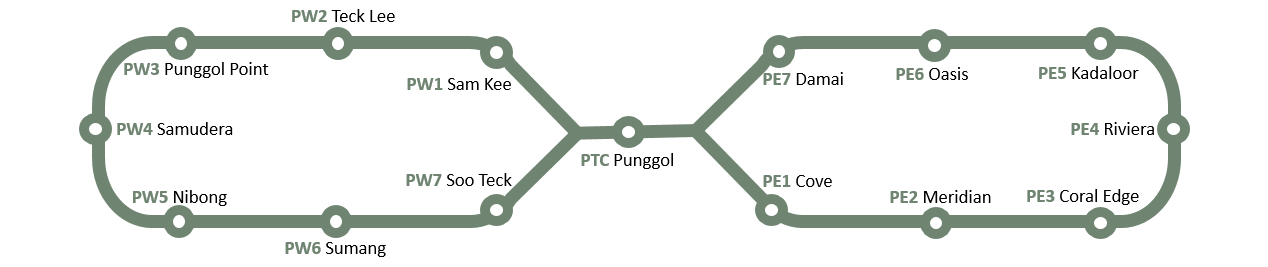
Living near Coral Edge LRT (PE3) is worth considering when everyday errands matter as much as the journey to work. Punggol Plaza and Punggol 21 Community Club give the area two distinct destinations to investigate: one commercial, the other community-based. Neither should be confused with Waterway Point or One Punggol at the original Town Centre.
The practical attraction is not that every service is automatically available downstairs. It is the possibility of completing an ordinary task close to a journey already being made: buying a few ingredients, collecting a child from an agreed activity, or visiting a service without first travelling to the larger centre. Whether that works depends on the particular home, entrance, provider and time.
This guide was checked against operator and institutional information on 30 September 2026. It distinguishes the Plaza’s wet market from its supermarket, a community club from a shopping mall, and a current service from a provider announcing a future opening. The household examples are illustrative, not accounts of residents interviewed for this article.
Coral Edge at a glance
| Reference point | What it establishes | What it does not establish |
|---|---|---|
| Coral Edge PE3 | An East Loop station between Meridian and Riviera. | A guaranteed walking time from every nearby home. |
| Punggol Plaza | A neighbourhood shopping destination at 168 Punggol Field. | Identical hours or availability for all businesses inside. |
| Punggol 21 Community Club | A separate community destination at 80 Punggol Field. | An automatic place in a class or permission to use every facility. |
| Punggol Town Centre | A different destination for MRT access and particular errands. | The necessary route for every local journey. |
| Oasis Terraces | The location of Punggol Polyclinic and other services. | A clinic located at Coral Edge station. |
| A home marketed near Coral Edge | A property to assess within this wider geography. | A school-admission advantage, quiet bedroom or financial return. |
The station relationship follows SBS Transit’s map. Use the precise destination when planning a visit; similar area names can hide different entrances and different tasks.
The Plaza and the community club are separate places
Punggol Plaza is at 168 Punggol Field, an address corroborated by the Watsons outlet listing. The OnePA directory lists Punggol 21 Community Club at 80 Punggol Field and identifies Coral Edge as its nearest LRT station. Those are useful anchors for a newcomer, not interchangeable meeting points.
A parent saying “meet at Punggol 21” should still name the relevant entrance or agreed point. A person travelling to a class needs the venue and room instructions. Someone buying groceries needs the shop rather than the club. Clear names prevent people from arriving in the general area while still being in the wrong place.
On an early visit, walk between the places the family expects to use. Notice the actual crossing and entrance arrangement, then decide whether combining the tasks makes sense. Do not import a two-minute walking estimate from another person’s route. The person with a stroller, groceries or a child may use a different approach and pace.
The market is a wet market, not a dry-market promise
The Plaza operator’s published directory identifies a wet market at Basement 1, a food court on the first level and FairPrice on the third level. The distinction is useful because a market trip and a supermarket trip are not necessarily the same errand. Describing the whole fresh-produce offering as a dry market would be inaccurate.
A household that prefers selecting ingredients from individual stalls may use the building differently from someone buying a standard supermarket basket. Each should investigate the relevant sellers and current hours. The existence of a market does not guarantee a particular stall, item, price or operating period on the day of the visit.
Start with a real meal plan. Decide which ingredients the family needs and where the suitable purchases are likely to happen. A visit then has a clear purpose rather than becoming a general tour of shops. The advantage of a nearby centre appears when the routine can be repeated without requiring extra travel for essentials that were overlooked.
Fresh-produce shopping and a supermarket basket solve different tasks
Separate preference from necessity. A family might enjoy comparing produce at a market while using a supermarket for packaged goods. Another might prefer one predictable shop. Neither arrangement is inherently more thoughtful or economical without comparing the actual basket and the household’s circumstances.
The practical difference includes carrying, payment, opening times and the number of separate stops. An adult with flexible time may appreciate visiting several sellers. A caregiver collecting a child might need a smaller, simpler basket. Choose the plan around the person performing the task rather than assuming everyone should shop in the same way.
Keep a record only where it helps. A short list of frequently used items can prevent repeated forgotten purchases. A detailed comparison of every shop becomes unnecessary if it does not change what the family buys. Local convenience should reduce work, not create a second unpaid job managing the shopping process.
A worked grocery example without invented local prices
The following prices are imaginary and demonstrate arithmetic, not current prices at Punggol Plaza. Suppose one package costs $4 for 500 grams and another costs $5.40 for 750 grams. The first is $8 per kilogram; the second is $7.20 per kilogram. The larger package has the lower unit price under those assumptions.
That does not automatically make it the better purchase. If the household cannot use the quantity, lacks storage or must carry it through an awkward journey, the lower unit price may not justify the extra load. The family should compare the usable purchase, not only the number on a unit-price calculation.
This can be a simple learning task for an older child. Ask them to explain the calculation and one reason the family might still choose the smaller package. The lesson is not to declare a winner between market and supermarket. It is to connect mathematics with a decision whose conditions are visible.
The journey home is part of the shopping plan
A centre can be easy to reach empty-handed and less convenient after a large shop. On a home search, test the return from the actual outlet to the residential entrance. Include the crossing, lift and final corridor. The route used for a relaxed viewing may not represent the person returning with bags and a child.
Divide purchases by carrying difficulty. A small basket may fit naturally into the trip home. Heavy household supplies may need a different visit or delivery. A shopping trolley can help in some situations, but buy equipment only after understanding the route it must serve.
Consider who receives a delivery and when. A slot that overlaps with the only caregiver’s school collection creates a new problem rather than removing one. An effective arrangement often mixes methods modestly: local top-ups, a planned larger shop and an occasional delivery for a particular load.
Do not assume the entire building shares one opening schedule
A shopping centre’s general opening period, a supermarket’s hours, a market seller’s operating period and a clinic’s registration window may differ. Plan the visit around the service actually required. Seeing an entrance open does not establish that every business inside can serve you.
Ask a precise question when the timing matters. Instead of “Is the Plaza open tonight?”, identify the outlet and the task. An appointment, a repair collection and a grocery purchase may each require a different answer. Keep that information with the provider rather than treating a broad building description as permanent.
For holidays and unusual schedules, reconfirm rather than copying the previous year’s arrangement. This does not mean every small errand requires extensive research. It means a time-sensitive journey deserves a current check before a caregiver, child or older resident makes a trip that cannot achieve its purpose.
An old shuttle timetable is not a current transport commitment
The Plaza operator’s page includes a shuttle timetable marked as revised on 1 June 2014. That date makes it historical material, not sufficient evidence of a shuttle operating on the same schedule in September 2026. A page remaining online does not automatically refresh every item within it.
A resident considering that option should obtain current confirmation before making it part of a fixed journey. Do not assume the shuttle has stopped simply because the information is old; equally, do not promise it is available. The responsible conclusion is that the old schedule alone does not settle today’s access.
This distinction is useful beyond one bus. Provider pages may contain old promotional graphics, past events or earlier instructions beside current contact details. Read the date attached to the particular fact. A recent website footer is not proof that every schedule embedded above it was checked that day.
Read the LRT direction before counting the trip to Punggol
Along the Meridian and Cove side, the rail sequence is Coral Edge, Meridian, Cove, Punggol. This is three station-to-station segments in that direction. It is not a three-minute claim, and it does not include the home-to-station walk or transfer at the interchange.
The other direction continues towards Riviera. A loop can offer more than one path to a destination, so the relevant display matters. Use SBS Transit’s current train information when timing or service changes affect the trip. A familiar route is easier when the traveller understands the direction rather than memorising only a platform instruction.
For family planning, compare complete journeys. A home nearer the station may still have a less useful school route than another address. The relationship between stations is valuable orientation, but it should not become a ranking of all properties in the surrounding neighbourhood.
Two bus routes illustrate why stop codes matter
Go-Ahead’s Service 381 information lists Coral Edge Exit B at 65171 towards Punggol Coast and Exit A at 65179 towards Punggol Interchange. Its Service 386 page also lists Exit B, but on a loop itinerary. The same stop can serve different onward journeys.
Do not board solely because the bus number is familiar or the destination area sounds right. Read the current route for the particular trip. A loop service should not be understood as a simple outward journey with an identical reversed return. The useful question is where the next part of the route takes you.
For a newcomer, compare one bus journey with the rail alternative and keep the result specific. A direct ride may remove a transfer but follow a longer road route. Waiting, the destination entrance and the traveller’s needs determine whether it is useful. There is no need to declare one mode universally better for Coral Edge residents.
Punggol 21 Community Club is not One Punggol
The names can create confusion, especially for a visitor reading an abbreviated message. Punggol 21 Community Club at Punggol Field and One Punggol at Punggol Drive are separate destinations. The club’s OnePA entry is the starting point for checking its address and current contact route.
A course, a facility booking and a public event need separate checks. The relevant listing should establish the date, venue, intended participants and registration conditions. A community building nearby does not guarantee that a class exists at the required level or that a space is available when the family needs it.
The club can be valuable without being a compulsory part of family life. A household might use one activity regularly or visit occasionally. Give that use the weight it deserves in the home comparison, rather than counting every possible programme as a benefit the family will definitely receive.
How to judge a class by more than its distance from home
Begin with the purpose. Is the child trying an interest, practising a skill, getting appropriate learning support or joining a social activity? A nearby class is not automatically the right class, and a longer journey should have a clear reason rather than being justified by a vague claim that the provider is the best.
Confirm the actual level, venue, schedule and terms. Then place the session into the child’s week. Count travel, waiting, meals, sibling arrangements and the return home. The fact that the venue is near Coral Edge does not mean the complete activity occupies only the lesson period.
Decide what would show the activity is worthwhile. That might be the child’s sustained interest, a demonstrated skill or a manageable opportunity to participate. Avoid demanding a performance outcome that the programme never promised. After a reasonable trial, keep, adjust or stop the arrangement according to evidence rather than its convenient postcode alone.
An announced opening is not an operating care arrangement
At this check, PlayFACTO’s Punggol Plaza page is labelled opening in October 2026. On 30 September 2026, that should be read as a provider-announced future opening, not confirmation that a child can already attend. No exact opening day or current place is assumed here.
A family interested in that option should confirm the actual commencement, eligibility, collection arrangements, fees and availability directly. A list of nearby schools on a provider page is not proof that collection from every one of those schools is operating or suitable for the child.
The existing care arrangement should not be abandoned on the strength of an announced month alone. Establish the transition and the date on which responsibility changes. A future service can be useful to investigate while the household continues to rely on the confirmed arrangements that keep the present week working.
School proximity needs the exact school and address
A Coral Edge home can sit within a useful wider school geography without being within a particular official distance band. Use the actual address and MOE’s current Primary 1 registration process. A station-centred circle, property advertisement or provider’s nearby-school list is not an admission result.
For orientation, Greendale Primary gives its address as 50 Edgedale Plains, and Horizon Primary gives 61 Edgedale Plains. Use the school’s own current instructions for the pupil’s gate and collection. An address establishes identity, not a guarantee that the journey works from every block.
For a child already enrolled, begin with the existing school and care needs. A home search does not automatically require another educational transition. Compare the actual routine the family intends to preserve before imagining a different school simply because it appears nearby on a map.
Buying groceries after collection can help—or overload the trip
A parent may see the nearby shopping centre as an opportunity to combine collection and groceries. That can work when the basket is small, the timing is flexible and the child can manage the outing. It can become difficult when the child is tired, several bags need carrying or another collection deadline follows.
Choose the minimum useful errand for that day. A short top-up may fit; a full shop may belong elsewhere. Leave one task movable so that a late dismissal or weather change does not force the whole family to rush. Efficiency is not the same as completing the greatest number of tasks in one trip.
Review the actual result rather than the attractive idea. Did the combined journey remove a separate outing, or did it make dinner later and homework harder to start? A locally convenient centre provides options. The household still chooses which option suits the people travelling.
A worked example: the caregiver and the basket
Imagine an illustrative grandparent collecting a pupil and returning through the Coral Edge area. The original plan adds a large grocery purchase because the family assumes the centre is conveniently located. The grandparent then has to supervise the child, manage school materials and carry the week’s supplies.
A better version might separate the tasks. The grandparent collects only two light essentials; another adult arranges the larger shop or delivery. The family retains the benefit of the nearby centre without making the caregiver absorb the entire logistical burden. The changed arrangement should be agreed, not silently expected.
The lesson is not that older adults cannot shop or that children cannot help. It is that the real load should be visible. Ask the person doing the journey which arrangement is comfortable, and let that answer influence the plan. A home is convenient when it reduces the household’s work rather than merely transferring it to somebody less visible.
Two adults may need different versions of the same route
A parent commuting through Punggol might naturally buy groceries after work. Another adult travelling from a different place may find that detour inefficient. The family does not need one shopping or collection rule that ignores those different starting points.
Assign tasks according to the real journey and availability, not habit alone. If an adult passes the required outlet, a small collection may fit. If the task requires a separate cross-town trip, it should be recognised as such. Avoid making the person working from home the automatic solution to every errand without considering their work commitments.
A shared plan can remain simple. Identify the task, responsible person and deadline. If something changes, update the relevant person directly. There is little benefit in a long family chat that contains several versions of the plan and leaves everyone unsure which one still applies.
Appointments and walk-in services should not be mixed together
A business listed inside the Plaza may offer appointments, walk-in service or a mixture of both. Check the particular task before leaving home. A provider’s location does not establish immediate availability, and a published closing time may not be the final time it accepts a new customer.
For a repair, alteration or collection, confirm what needs bringing and when the item can be ready. For a consultation, follow the provider’s process and professional guidance. The practical value of a local service is strongest when the visit can actually accomplish the required task.
Keep receipts, references or appointment details where the person travelling can find them. Sharing responsibility for an errand is easier when the second adult has the necessary information, not just an instruction to go to the building. This is a small form of preparation that can prevent a repeat journey.
Healthcare at the Plaza and public primary care are different routes
HMI OneCare’s Punggol Plaza page lists a clinic at 168 Punggol Field, #02-09A. This is provider information, not a recommendation for an individual’s medical needs. Check its current service and registration arrangements rather than assuming a shopping-centre clinic operates continuously.
For Punggol Polyclinic, SingHealth lists 681 Punggol Drive, Oasis Terraces, #02-01. Its official page gives the relevant location information. The polyclinic is not at Coral Edge or Punggol Plaza; a household should plan the actual appointment journey.
For a medical emergency, follow SCDF’s emergency medical guidance and call 995 as appropriate. The existence of a nearby clinic should not be used as a substitute for emergency assistance. A local guide can clarify addresses while leaving clinical decisions with the appropriate professionals.
Dental access is a separate appointment question
Advanced Dental Punggol Plaza publishes its location at 168 Punggol Field, #01-13 and identifies Coral Edge PE3 in its directions. The listing supports the address and access reference; it is not an endorsement of treatment or evidence that an appointment is available immediately.
Use the provider handling the appointment to establish what the visit requires. A child may need an accompanying adult and particular documentation. The return journey may also need to follow advice specific to the visit. Do not assume the ordinary commute is the correct transport arrangement in every circumstance.
For a home comparison, count how often the family actually needs that destination. An occasional appointment deserves different weight from daily care. The aim is to understand the practical pattern without turning the number of clinics nearby into a ranking of healthcare quality.
Accessibility must connect the whole journey
A building can offer accessible features while the path from a particular home remains inconvenient. Assess the route from the unit, through shared access, across the street and into the actual destination. A lift at one end does not remove every barrier along the way.
Test with the person and equipment involved where practical. The pace and carrying ability of the adult conducting the viewing should not stand in for a wheelchair user, a grandparent or a caregiver with a stroller. Confirm material access questions with the relevant building or operator.
Keep a suitable alternative for essential journeys. It might be another entrance, a changed route or appropriately booked transport. The household should not have to abandon an essential appointment because the plan assumed one lift or entrance would always be available. Accessibility is a requirement to accommodate, not a minor inconvenience to dismiss.
Rain changes the usefulness of a short detour
A shopping stop that works comfortably in dry weather may add too much carrying and waiting during a downpour. Decide which errands can move and which are essential. A flexible grocery task can wait; a child’s collection still requires a clear responsible adult.
Inspect the actual sheltered sections rather than assuming that the presence of a station and mall creates continuous protection. The crossing between them matters, as does the final walk to the block. A route described as a short distance may still be difficult for the people and items travelling.
Do not build the alternative around a guaranteed instant private-hire booking. If paid transport is part of the plan, consider realistic availability and cost. For hazardous weather, follow current official warnings and venue or transport instructions. The household’s safety and care arrangements matter more than keeping an optional itinerary unchanged.
The market can become a modest learning activity
A child can practise describing an ordinary shopping decision without turning the outing into a formal lesson. Ask them to compare quantities, read a label or explain why the family chose one item. The task should fit their age and the real errand rather than prolonging the trip for an artificial worksheet.
An older pupil might keep a short record of two actual prices, their dates and the quantities compared. They can calculate a unit price and state what the calculation does not show: quality, preference, waste, carrying difficulty or whether the household needs the larger quantity. Avoid presenting one observation as a permanent price claim.
Respect sellers and other shoppers. Do not photograph people or record conversations unnecessarily. The learning can come from the child’s own notes and explanation. An accurate small observation is more useful than a long report pretending the family has surveyed the entire neighbourhood economy.
A centre does not make the home itself suitable
Convenient groceries cannot repair a layout that does not fit the household. Inspect the actual space for sleep, study, care and ordinary family use. A larger-looking room may still be awkward if several activities must happen there at once or if the passage through the home interrupts work.
Imagine the recurring tasks: leaving with schoolbags, bringing groceries upstairs, doing homework while another adult cooks, and storing belongings without blocking movement. The practical route begins inside the unit. The building entrance and lift arrangement belong in the assessment as well.
For technical, legal or contractual concerns, seek appropriate professional advice. This article does not certify a property. It helps a family identify the local connections that matter so that the surrounding conveniences do not distract from an unresolved problem in the home itself.
Older and newer homes need the same basic questions
A home’s age is relevant context, but it does not establish its condition, layout or suitability. Do not assume an older block is automatically more spacious or that a newer property automatically requires less work. Inspect the particular unit and obtain the relevant information.
Lease, tenure, recurring charges and proposed repairs also need property-specific checks. A private-development label does not eliminate lease questions; an HDB label does not explain the condition of every flat. Compare homes that satisfy a reasonably consistent brief before attributing every difference to the neighbourhood.
There is no price forecast in this guide. Use current, comparable evidence and qualified advice for a financial decision. A nearby centre may be valuable to your daily life without establishing what a future buyer will pay or whether a particular asking price is justified.
Listen from the room at the time that matters
The presence of shops, roads and rail does not determine the sound inside every home. A room’s orientation and the hours when the family needs quiet matter. A person sleeping after a night shift should not rely only on an evening viewing conducted by someone with a different routine.
Observe directly where possible. Note the time, window position and identifiable activity without inventing measurements. A quiet visit does not guarantee permanent quiet, and one unusual sound does not establish a constant problem. Ask follow-up questions when the issue could materially affect the choice.
Some households accept activity in exchange for a useful location. Others prefer a different arrangement. Both are reasonable preferences. The article should help them inspect the trade-off rather than declaring Coral Edge universally busy, peaceful or better suited to one age group.
The Saturday example: convenient does not mean unlimited
Consider an illustrative family planning a Saturday class, shopping and lunch around Coral Edge. The child attends a confirmed session while a parent buys a small basket, then they meet for a meal and return home. That arrangement can be sensible if the time, venue and carrying load fit.
Now add a second child’s activity at another location and a fixed family visit afterward. The same plan may become rushed. The difficulty is no longer simply the distance to the Plaza. It is the interaction between appointments, waiting and the number of adults available.
Choose what the morning is for. Keep the essential commitment and move a flexible task if needed. A neighbourhood centre gives the family opportunities to combine errands, but does not require every Saturday to become a sequence of purchases and activities. Time saved can remain time at home.
A second worked example: the class is local, the return is not
Consider an illustrative teenager attending a confirmed activity near Coral Edge after school elsewhere. The family initially describes the class as convenient because the venue is near home. The student’s actual journey, however, begins at the school, not the front door. The pupil may need food and time to change or organise equipment before the session starts.
Write the sequence from the school gate to the activity, then home. Decide where the student waits if there is a gap and whether that setting is appropriate and available. A public shopping centre should not automatically become an unsupervised holding place for a younger child simply because the next venue is nearby.
The family may find that the arrangement works well after a small adjustment. A different start time, lighter equipment or a clearer collection point may remove the difficulty. Alternatively, the lesson may be genuinely unsuitable for that day. The useful conclusion comes from the student’s whole journey, not the distance between the activity and home considered in isolation.
After a trial, ask what the student can manage independently and where help is still needed. Keep the answer task-specific. Successfully travelling one familiar afternoon route does not automatically establish readiness for every late or unfamiliar trip.
Use waiting time without claiming public space as a private classroom
A parent waiting for a child may reasonably want to read, make a short note or complete a small task. Choose a place where that use is permitted and considerate of other visitors. A food outlet’s seating, a booked room and a public passageway are not interchangeable workspaces.
Do not plan a long study session on the assumption that a business will provide seating, power or quiet without conditions. Check the venue’s current expectations. For a teenager, the appropriate place depends on the duration, the task and the family’s judgement, not simply whether the building is close to transport.
Keep the task matched to the gap. Ten spare minutes may be enough to read a page or review tomorrow’s materials, but not to unpack a complicated project. Trying to turn every interval into intensive work can make the outing less manageable rather than more productive. Sometimes the most useful waiting activity is simply being ready for the agreed collection.
The useful difference between browsing and buying
Living near shops can make it easy to visit without a defined task. That may be enjoyable, but distinguish leisure from an errand when evaluating time and spending. A relaxed browse and a necessary grocery trip should not be counted as the same household requirement.
For a busy weekday, enter with the short list that serves that evening. For an unhurried outing, allow browsing to be the activity rather than pretending the family is still optimising a commute. Both uses can be reasonable when the adults understand the purpose and budget.
A home near a centre becomes more useful when the family can choose how to use that access. It need not create more purchases or commitments. The practical benefit may be that an essential item is easy to obtain when needed, leaving the rest of the evening free for ordinary family life.
Budget the complete outing
An activity’s stated fee is only one part of what the household spends. Add transport, meals, incidental purchases and any sibling arrangement that follows regularly from attending. These are not necessarily reasons to reject the activity; they belong in an honest comparison.
Use actual receipts or current terms rather than a neighbourhood-wide estimate. A family choosing a cheaper class but repeatedly paying for an awkward journey may reach a different conclusion after the whole outing is counted. Another may willingly pay more for a provider who meets an important need. The reasoning should remain visible.
Avoid comparing financial categories inconsistently. A one-off registration fee, a monthly charge and an occasional meal should be identified as different items before combining them. The exercise is simple household planning, not a claim about the average cost of raising a child in Coral Edge.
A clear handover is more useful than constant messaging
When several adults share a child-related task, send the information needed to act: which child, when, where, who collects and who receives them next. A substitute caregiver should not have to read an entire family discussion to discover the current plan.
Keep private information proportionate. The person buying groceries may need the list without needing details of a child’s learning difficulties. A tutor may need the revised arrival time without receiving the family’s disagreements about transport. Good communication supplies what the recipient can use.
Review the handover after a repeated problem. If two adults keep arriving at different points, name the meeting point more precisely. If an item is repeatedly forgotten, change the packing routine. Repair the specific failure instead of adding more messages to a process that nobody can follow.
Compare Coral Edge with Meridian through actual tasks
A Meridian-area home may align well with the child’s school journey. A Coral Edge-area home may align well with a frequently used Plaza or club destination. Those are possibilities to test from real addresses, not universal attributes of every property carrying the station name.
Hold the important requirements constant: the school, work destinations, care arrangements, usable home space and budget. Then compare what changes. Otherwise, a larger renovated unit in one location may appear to prove that the whole neighbourhood is superior to another represented by an unsuitable property.
Discuss who gains and who accepts extra work. A parent’s shorter commute can coexist with a caregiver’s longer pickup. The household does not need equal savings for every person, but the trade-off should be understood rather than hidden behind a positive overall score.
Compare Coral Edge with Oasis by the destination you use most
Oasis Terraces and Punggol Plaza are distinct centres. A family regularly attending Punggol Polyclinic has a different priority from a family frequently using a particular Plaza business or Punggol 21 CC programme. Count real use rather than awarding points for every facility on a directory.
Test the complete journey, including the destination entrance and return. An LRT connection may help, but a bus or walk may be more suitable from the particular block. Avoid writing a compulsory route for every resident outside one preferred station area.
The home still matters. A convenient destination cannot compensate for unacceptable unit conditions or an unaffordable commitment. A sensible comparison balances present access with the actual property and household responsibilities, rather than selecting the station with the longest amenities list.
Decide what belongs in the first week after moving
Learn the essential routes first: work or school, the basic grocery arrangement, the correct collection point and the return home. A new resident does not need to master every bus and provider immediately. A small dependable map is easier to use than a directory of possibilities.
During the following days, investigate the repeated inconvenience. Perhaps the wrong entrance creates a detour, a shopping load is too heavy or the activity’s collection instructions were unclear. Change the identified cause and see whether it improves the week.
Let optional exploration come later. The family can discover interests and services without treating the first month as a test of whether the move was perfect. A neighbourhood becomes familiar through ordinary successful journeys, not through completing every item in a guide.
Keep a dated note where a fact can change
A short record can distinguish a confirmed appointment from an advertised possibility. For example, note the provider, the particular service, the date checked and the next action required. Do not let an announced opening month become a permanent claim that the centre is already operating.
The same applies to routes and hours. A useful note might identify the stop and intended direction, with a reminder to consult current information when the schedule is critical. It need not freeze a full timetable into the family’s records.
Discard detail that no longer helps. The objective is not a growing archive that someone must maintain indefinitely. Keep the information necessary for the next decision and use the responsible provider when a changing condition needs confirmation.
Questions families ask about Coral Edge
Is Punggol Plaza’s market a dry market?
The operator identifies a wet market at Basement 1. Use that description rather than relabelling it as a dry market. Current sellers, stock and operating periods still need their own checks when those details matter to the visit.
Are Punggol 21 Community Club and One Punggol the same?
No. Punggol 21 CC is at 80 Punggol Field, while One Punggol is a separate destination. Name the venue and meeting point explicitly, especially when arranging a child’s activity or sending a visiting caregiver directions.
Can the old Plaza shuttle schedule be relied on?
The timetable found on the operator’s page carries a 2014 revision date. That alone is not current operating confirmation. Check directly before relying on a shuttle for a fixed journey; do not assume either current operation or cancellation from the old information alone.
Does a nearby student-care announcement solve next week’s pickup?
Only a confirmed arrangement can do that. An opening month, nearby-school list or promotional page does not establish the child’s place, start date or collection process. Keep the existing care plan until the new responsibility and commencement are clear.
Does three LRT segments mean a fixed journey time?
No. The stop sequence describes the network in a particular direction. Walking, waiting, transfer and the final destination still matter. Use current operator information and test the actual journey rather than converting a stop count into a guaranteed number of minutes.
Is it a good place for a family without a car?
It can be when the particular home’s work, school, care and errands connect well. That conclusion needs the whole household routine, including mobility requirements and late returns. Occasional paid transport can be a deliberate part of the arrangement rather than proof that it has failed.
What is the most useful viewing task?
Complete one journey the family will repeat, beginning at the actual residential entrance and ending at the relevant destination. Include the return with a realistic load. That observation often tells more than a broad claim that everything is near the station.
Living near a centre means knowing which tasks it can actually solve
Coral Edge can offer a useful neighbourhood routine when the Plaza, club and transport connections fit the family’s real life. Its value lies in a meal that is easier to organise, an errand completed without another trip or an activity whose confirmed schedule genuinely works.
Keep each claim at the right level. A wet market is not a promise about every stall. A community club is not automatic admission to a programme. A station relationship is not a walking-time guarantee. A provider’s future opening is not an operating care arrangement today.
Continue towards Meridian or Riviera for the neighbouring areas. For wider context, use Living in Punggol Without a Car and the Complete Punggol Guide.