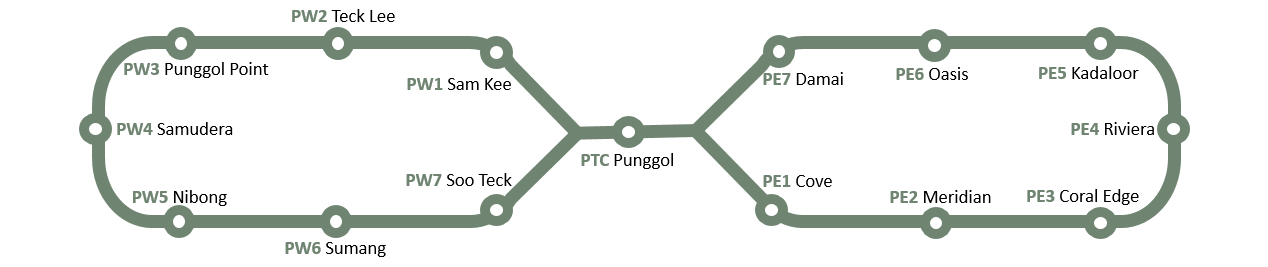
Cove LRT is PE1 on Punggol’s East Loop. On SBS Transit’s network map, Cove sits between Punggol and Meridian. That is a useful starting point for understanding the neighbourhood, but it is not a measurement of the walk from every home advertised as “near Cove”.
A good Cove home can offer a practical connection to the wider town while keeping the household close to its own school, care and everyday routes. Whether that works depends on the particular address, entrance and people making those journeys. The station name alone cannot establish school-registration distance, noise levels or a property’s value.
This guide helps residents and families inspect those differences. It keeps the railway map separate from walking routes, identifies useful destinations without pretending they are all at Cove, and explains how to compare a home using the ordinary week it must support.
Reference check, 30 September 2026: the station relationships below follow SBS Transit’s Punggol LRT map. Use current station displays and operator information for the train to board; a route around a loop should not be reduced to “take any train”.
Understand the East Loop before counting stops
The operator’s map places the stations in this order around the East Loop: Punggol, Cove, Meridian, Coral Edge, Riviera, Kadaloor, Oasis, Damai and back to Punggol. That order describes the network. It does not tell you which direction the next train will serve or how long you will wait.
For Cove, the important relationship is that one side connects towards Punggol while the other continues towards Meridian. A statement that Cove is “one stop from Punggol” needs that directional context. Someone following the other way around a loop is making a different journey.
Look at the current direction information before boarding. For first and last trains or a service change, use SBS Transit’s station-information service. The map is valuable because it gives you a mental picture; the live operating information tells you how to use that picture now.
Cove is an LRT station, not a North East Line station
A home near Cove may use the LRT to reach Punggol for the NEL, but that transfer should remain visible in a commute estimate. Do not describe the home as having direct NEL access merely because the stations connect. Walking or a bus may be another practical option from the particular address.
LTA describes the Punggol LRT as a two-loop system linking residential areas with Punggol MRT and the bus interchange. Its official system page supports that distinction. It does not guarantee the easiest mode for every household.
When comparing homes, count from the front door to the destination rather than from one station symbol to another. The walk to Cove, waiting, the LRT journey, the transfer at Punggol and the final walk all belong in the calculation. A short rail segment can still have a meaningful access cost before and after it.
A station label is not a residential boundary
Listings may use Cove to orient readers to homes across a wider area. That is not a reason to treat every listed development as equally close or served by the same entrance. Ask for the exact block or address, then inspect the route yourself.
A development’s name also does not establish the usable path. The nearest-looking entrance may be restricted, inconvenient or not the route a visitor should take. A large site can have internal walking time that disappears from a simple map comparison.
This guide therefore does not offer an unmeasured list of “Cove condos” or promise that named schools lie within a particular radius. Those claims need address-specific evidence. The useful question is more concrete: can the person living in this home reach the place they need, at the required time, using a route they can comfortably repeat?
The neighbourhood questions worth answering first
| Question | Evidence to gather |
|---|---|
| How will I reach the NEL? | Compare the actual walk, LRT connection and any relevant current bus option. |
| Which way around the East Loop do I need? | Read the operator’s map and current direction display. |
| What can I do locally? | Verify the particular shop, service or care arrangement rather than relying on a broad amenities list. |
| Is the school journey workable? | Use the school’s actual gate, timing and collection instructions. |
| Does the home suit the household? | Inspect the unit, building access and conditions at relevant times. |
| What changes in rain or with a heavy bag? | Test the exposed sections, crossings and return journey. |
| What is outside the Cove area? | Keep Town Centre, Coral Edge, Oasis and Punggol Coast destinations distinct. |
A home can be suitable without winning every category. It should, however, meet the requirements the household cannot reasonably give up.
Compare walking with the LRT rather than assuming the answer
For a home near Cove, it is sensible to investigate whether walking to Punggol is practical. It is not sensible to declare that the walk is always better or always too far without knowing the address and person travelling. Weather, carrying load, mobility and time can change the answer.
Try equivalent journeys. Begin at the same residential entrance, finish at the same destination and note the conditions. If the walking trial ends outside the station while the LRT trial ends at the platform, the comparison is inconsistent. Include the relevant access within the buildings as well.
A household can keep both options. One may suit an unhurried dry day; another may suit rain or a heavier load. You do not need a single rule for all trips. What matters is knowing the alternatives well enough that choosing between them does not become a new problem every morning.
A simple route comparison with invented numbers
Suppose a family tests two possible ways from a candidate home to the same destination. In this illustrative example, walking takes eighteen minutes, while walking to Cove, waiting, riding and transferring takes seventeen. These are invented figures, not measured timings for the neighbourhood.
The one-minute difference should not dominate the decision. The walking route might involve an exposed section; the LRT route might depend on a wait that varies. A caregiver using a stroller may prefer one arrangement, while an adult travelling alone prefers another. The numbers become useful only when the conditions are visible.
Repeat the relevant trial where practical and record a reasonable range rather than adopting the fastest result. If the route serves a fixed appointment or school arrival, leave margin. If the task is flexible, comfort may matter more than a small nominal time advantage. The point is to make the choice understandable, not to manufacture a precise neighbourhood average.
Give Punggol Town Centre destinations their full names
Punggol MRT, Waterway Point and One Punggol are connected parts of a wider Town Centre routine, but they are not one interchangeable meeting point. Tell a visitor which place to reach and identify a suitable entrance or landmark before separating.
For residents near Cove, this can prevent an unnecessary round trip. A person buying groceries at a particular shop has a different final destination from someone attending a library programme. A parent meeting a child should not leave “the centre” undefined and hope both people choose the same exit.
Walk the last part on an early visit. Once the route is familiar, the household can combine tasks intelligently. Until then, allow time for orientation rather than using an optimistic estimate borrowed from someone whose route begins at a different block or entrance.
Waterway Point is one shopping option, not the compulsory grocery trip
Waterway Point’s current store directory lists FairPrice Finest. It is one verifiable grocery option to consider when the journey already takes you towards the Town Centre. The listing does not guarantee a particular item, price or promotion on the day you travel.
For a small top-up, a closer suitable outlet may save the trip. For a larger household shop, compare carrying capacity, delivery or a planned visit with another adult. Do not judge convenience solely by the size of the destination.
Keep the return home in view. Carrying a full basket after shopping is different from walking out with an empty bag. Check the crossing, lift and route to the residential entrance. A grocery arrangement works when the household can repeat it comfortably, not merely when the shop is present somewhere along the rail network.
Punggol Plaza belongs to a different stop in the mental map
Punggol Plaza is at 168 Punggol Field; the address is listed by its Watsons outlet. The mall operator’s page identifies its retail, food, supermarket and wet-market uses. It should not be described as though it sits at Cove station.
Coral Edge is the relevant LRT reference for the Plaza. A provider located in the building, Advanced Dental Punggol Plaza, identifies Coral Edge PE3 in its access directions. That establishes a useful location distinction; it is not a clinical recommendation or a reason to copy the provider’s walking-time estimate for every visitor.
From a Cove-area home, decide whether the trip suits the errand you intend. The East Loop relationship makes the destination understandable, but walking, waiting and the return load remain part of the outing. Treat it as a separate shopping choice rather than adding all its facilities to an unqualified list of amenities “at Cove”.
Oasis Terraces and the polyclinic are another distinct destination
SingHealth lists Punggol Polyclinic at 681 Punggol Drive, Oasis Terraces, #02-01 and names Oasis as the nearest LRT station. Use its official location information when planning an appointment there. Retail hours at the surrounding development are not the same as clinic registration or appointment arrangements.
For a journey from Cove, check the current route and the direction around the loop. Do not use “go via Punggol” as a compulsory instruction for every trip without considering the other direction or a suitable alternative. The network map and the actual starting address should inform the choice.
Care access also needs the patient’s circumstances. A person who is unwell, uses mobility equipment or has particular clinical instructions may need a different transport arrangement from a healthy commuter. A local guide helps identify the destination; it does not decide which clinical service a person should use.
Punggol Coast is not another name for the Town Centre
Punggol Coast MRT opened on 10 December 2024 and became the North East Line’s northern terminus. LTA records that in its opening factsheet. Use the full name when giving directions so that nobody arrives at the wrong hub.
For a Cove household travelling to Punggol Digital District, JTC’s current directions identify Punggol Coast MRT and Teck Lee LRT as access points. That does not mean every office or campus entrance is equally near either point. Confirm the actual building and the final approach.
This distinction matters when selecting a home for a new workplace. A home near Cove may be a reasonable base, but the onward journey must be counted. Do not borrow the convenience of one Punggol destination to describe another without checking the connection between them.
Future Riviera infrastructure does not make Cove a current CRL station
LTA’s Cross Island Line programme includes a Punggol Extension expected in 2032, with interchange connections at Punggol and Riviera. Cove remains an LRT station in the current network; a future project elsewhere on the loop should not be presented as an operating service at Cove. See LTA’s project page.
A future connection may be relevant to longer-term planning, but keep it separate from today’s journey. The family still needs a workable commute before that infrastructure opens. A target date does not establish the precise benefit for a particular home, workplace or school.
Avoid converting the project into a price prediction. The household can consider future access without being told that a property will appreciate or become universally preferable. Current affordability and present-day needs deserve their own evidence.
Start a school enquiry with an address, not a neighbourhood label
Cove’s station name is not evidence of a home’s official distance from a school. Use the exact address and MOE’s current Primary 1 registration guidance for the applicable process. A convenient walking route and an admission priority are separate questions.
For example, Edgefield Primary publishes its address as 41 Edgefield Plains on the school’s contact page. That is a reliable location reference. It does not prove that every property described as “near Cove” lies within a particular distance band, nor does it establish the appropriate gate or reporting instruction for a specific pupil.
Check the child’s actual school arrangement before changing the home routine. For a child already enrolled elsewhere, consider whether the existing journey and care network remain workable. Moving near one station should not automatically trigger a school change or a tuition recommendation.
The school gate matters more than a straight line
A child’s daily route ends at the gate the school permits them to use, not at the centre of the campus on a map. Confirm the current arrival and collection arrangements with the school. Then walk the route at a pace appropriate to the child, with the usual materials where practical.
Notice crossings, waiting points and the final approach. A route that feels simple to an adult may need rehearsal for a younger child. Avoid converting one successful walk into an automatic decision about independent travel. Readiness depends on the child and the journey, not only the distance.
Build a manageable morning sequence around the reporting requirement. Prepare materials before departure and make clear which adult is responsible. A parent can help the child learn the route without expecting the child to carry all the family’s scheduling and communication responsibilities.
Student care is an arrangement, not an icon on a map
A nearby student-care provider is useful only when the actual terms fit the child. Verify whether it serves the school, how pickup works, which days and hours apply, and whether a suitable place is available. Do not infer those details from a signboard or another family’s older experience.
For the daily handover, identify who owns each part. The school, care provider and family may each have different responsibilities. The child should not have to reconcile inconsistent pickup instructions or decide which adult’s message is current.
A home near Cove may simplify one leg and complicate another. Put the school-to-care journey beside the caregiver’s collection route and the final trip home. If the complete chain works, the arrangement has value. If a gap remains, station proximity does not close it; the family needs a confirmed solution.
Compare the normal day with the CCA day
A school journey can work well after ordinary dismissal and become difficult when CCA finishes later. The weather, child’s energy, adult availability and dinner timing may all be different. Map that later day explicitly before adding more evening commitments.
The route home need not be identical every day. A family may use public transport normally and another arrangement for a particular late finish. The important point is to recognise the recurring exception and include its cost rather than calling it an emergency every week.
For siblings, draw one combined timetable. If one adult must collect two children, verify that the timings and supervision arrangements actually connect. The best neighbourhood for the family may be the one that removes this conflict, even if another home appears closer to a major shopping destination.
A grandparent’s familiar route deserves weight
Grandparents providing care may prefer a route that differs from the parent’s choice. A familiar stop, fewer transfers or a comfortable place to pause can matter more than a small difference in estimated travel time. Ask the person who will perform the journey.
Begin from the grandparent’s real starting point and include the return home. A comparison that records only the parent’s commute can hide much of the household’s transport work. Carrying a child’s belongings or accompanying a younger sibling should also be considered.
Make the agreement specific. Which days are dependable? What changes when the grandparent has an appointment or needs rest? Respecting those limits produces a stronger arrangement than assuming unlimited help. A home that supports the care network can be valuable for reasons that do not appear in a property listing.
What an independent teenager needs to know
A teenager using Cove should be able to explain more than the station code. They need to recognise the intended direction, the transfer if one is required, the destination entrance and the return plan. Practise unfamiliar journeys before relying on them for a fixed appointment.
Agree on how to communicate a delay or changed meeting point. The useful message describes where the student is and what has changed. It does not need to become a continuous commentary on every stop. A phone can support independence, but should not be the only reason the young person knows where to go.
Do not assume that confidence on one familiar route transfers automatically to a late-night or unfamiliar trip. Add responsibility gradually according to the family’s judgement and the student’s needs. The goal is a person who can make sensible decisions and ask for help, not one who follows remote instructions without understanding the area.
An LRT-adjacent home is not automatically the quietest home
Assess sound from the actual rooms and at the times that matter. A station label cannot determine whether a particular bedroom is comfortable for sleep or study. Orientation, surrounding activity and building conditions can differ between units in the same development.
During a viewing, note what can be heard and under which conditions. Were the windows open? What time was it? Could the source be identified? A short observation is useful, but it should not become a claim about the entire day or every neighbouring block.
A person working shifts may need another viewing period from a family primarily concerned with evenings. Ask relevant questions and seek appropriate advice for material concerns. Avoid both blanket assurances that the area is quiet and blanket warnings that proximity to transport makes a home unsuitable.
Do not borrow another unit’s condition or layout
A housing guide can explain what to inspect, but it cannot establish the condition of an unseen property. Check the actual rooms, storage, ventilation arrangements, usable workspace and movement through the home. The household’s needs should determine what counts as a workable layout.
A family with siblings studying at different times may value separation. A caregiver may need an accessible route through the flat. A person working from home may need a space that is not also the main circulation path. None of these needs can be answered by the number of bedrooms alone.
When technical or contractual questions arise, use the appropriate professional rather than relying on a location article. Transport convenience is one part of a home decision. It should not persuade a household to overlook a unit-level problem that will be experienced every day.
HDB and private homes both need property-specific checks
Do not frame the choice as “remaining lease for HDB, facilities for condos” and stop there. Lease and tenure questions can matter for private homes too. Maintenance, condition, recurring charges and actual access should be assessed for the particular property rather than inferred from its category.
For facilities, ask what the household will use and under which terms. A feature has little practical value if the required times or access conditions do not fit. Equally, a simple home may serve the family very well when its layout and routes are appropriate.
This guide does not rank projects or predict prices. Use current transaction, listing and legal information for the decision you are making, with appropriate qualified advice. A list of familiar development names near a station would not replace that work and can easily obscure differences between individual entrances and units.
For tenants: compare the complete arrangement
A tenant should clarify what the current agreement includes: the usable space, furnishings, utilities, responsibilities and any conditions affecting daily access. The asking rent is not the whole living arrangement. Obtain appropriate advice when terms are unclear.
Then assess whether the location changes a journey the household actually makes. A shorter route to Cove may help one commuter but do little for a family whose most difficult task is school collection elsewhere. Do not justify a higher cost using a hypothetical saving that nobody has tested.
Keep the commitment and possible changes in view. A school, workplace or care arrangement may change later. You cannot predict every event, but you can avoid claiming that a location will remain perfect under all circumstances. A reasonable present choice does not need a promise about every future version of the household.
Shops should be evaluated one errand at a time
A directory tells you that a business is listed. It does not establish stock, appointment availability, dietary suitability or the time required for your task. Choose the particular errand before deciding where to go.
For a Cove-area household, this often means comparing a local option with a trip towards the Town Centre, Coral Edge or Oasis. The right answer may differ for groceries, an appointment and a family meal. There is no need to force every task through one preferred hub.
Avoid freezing an extensive tenant list into a neighbourhood decision. Use the current operator or business page for details that can change, and retain the stable geography in the mental map. That combination is more useful than a long list of names treated as permanent amenities attached to every home near the station.
A practical grocery week might use three methods
One household may collect light items during an existing journey, make a planned larger shop and use delivery for heavy goods. Another may prefer two smaller shopping trips. These are possible arrangements, not recommendations for a particular retailer.
Work out who carries the goods and where they need to be taken. Include the station access, crossings, lift and final corridor. A full grocery load can make the return route feel very different from the walk used during the property viewing.
If delivery forms part of the plan, confirm service to the actual address and arrange receipt without conflicting with school collection. The objective is not to create a sophisticated shopping system. It is to ensure that ordinary essentials reach home without consuming an unreasonable share of the family’s time and effort.
Meals, waiting gaps and the trip home
A parent may have a gap while a child attends an activity, but that does not automatically create enough time for shopping or a library visit. Count the walk away, the task and the return before deciding the gap is usable. A short interval may be better spent nearby.
For dinner, consider where family members will be before they meet. A takeaway along one person’s route may remove another journey. A home meal may be simpler on a day when everyone returns tired. The area does not need to provide an endless choice for the family to have a satisfactory routine.
Keep discretionary spending visible. Small meals and snacks around recurring activities can become part of the real cost. This is not a reason to avoid them; it is a reason to compare the complete arrangement instead of judging convenience only by lesson duration or travel time.
Borrowing books and studying require different plans
NLB lists Punggol Library at 1 Punggol Drive, One Punggol, with Punggol MRT and Sam Kee LRT as relevant access points. Its current library page is the reference for services. From a Cove-area home, include the last part of the journey rather than treating “Town Centre” as the final entrance.
A family returning books may need only a short visit. A teenager intending to study may need a suitable seat and enough time to use it. A registered programme introduces its own access conditions. Do not assume those uses are identical simply because they happen in the same building.
Keep reading larger than the logistics. A simple, repeatable borrowing trip can support a household well without turning every visit into another supervised lesson. The home-to-library connection matters when it fits a habit the family actually wants to maintain.
Ordinary healthcare and emergency care are separate decisions
For a routine appointment, use the provider’s current address and instructions. The nearest listed clinic may not be the provider handling the service you need. Opening hours, appointment requirements and registration cut-offs should be checked directly where relevant.
A destination such as Punggol Polyclinic at Oasis Terraces is outside the immediate Cove station reference, even though it is part of the same wider town. Plan the actual journey and consider the return after the visit. A person who feels unwell may need a different arrangement from their usual commute.
For a medical emergency, follow SCDF’s emergency medical guidance and call 995 as appropriate. Neither a nearby clinic nor a private car is a substitute for that guidance. A neighbourhood article can clarify locations; it should not direct clinical triage.
Rain reveals the gaps between convenient places
Two destinations may each have sheltered areas while the route between them remains exposed. Inspect the actual connection instead of assuming continuous cover. This matters with schoolbags, groceries, strollers and mobility equipment.
Decide what changes during heavy rain. The family may leave earlier, use a different route, postpone an optional errand or arrange suitable paid transport. Do not assume an immediate booking at an unchanged price will always be available when everyone else is also trying to travel.
For hazardous weather, use current official warnings and operator instructions. A route plan should be flexible enough to change. Completing the original itinerary is not more important than the people making the journey, especially when the task itself can wait.
Accessibility begins at the home entrance
The complete journey includes leaving the unit, using shared access, reaching transport, making any transfer and entering the destination. A station lift is one component, not a guarantee that every part of the route is suitable.
Where practical, assess the route with the person and equipment involved. Do not use an able-bodied adult’s pace as a proxy for everyone. The location of an accessible entrance may alter both distance and the preferred mode of travel. Confirm material questions with the operator or building rather than assuming the most visible entrance is the right one.
Keep an appropriate alternative for essential journeys if a lift or usual access point is unavailable. A household may sensibly combine public transport with accessible booked transport. That is a response to real needs, not evidence that the rest of the neighbourhood routine has failed.
Evening journeys need a return decision before the activity starts
Check the route available at the expected leaving time. A service used earlier may not operate in the same way later, and a final feeder connection can be important even when the main train journey is still available. Use current operator information rather than an undated screenshot.
Agree on the meeting point and communication for a teenager or family group. “Back at Cove” may not be enough if people mean different entrances or nearby landmarks. Choose a suitable, clear point and know what happens if somebody is delayed.
For recurring late work, include the actual transport cost in the household budget. A trip is not exceptional merely because it happens after ordinary office hours. A home can still fit a shift worker, but the comparison must use the shift that person actually works.
A bicycle does not erase the route’s conditions
Cycling may be worth considering for particular trips, but check the continuous route, current rules, parking, weather and the rider’s ability. A map showing a short connection does not establish that every part is suitable for the intended activity.
Use LTA’s active-mobility information and relevant current path notices. Do not infer permission from another person’s behaviour. For children, the supervision and route decision must fit the rider rather than a general claim that the area is cycle-friendly.
Think about arrival and return. Where will the bicycle be secured? What must be carried? What happens if rain makes the planned ride unsuitable? Cycling can expand a household’s choices without being presented as the answer to every first-mile problem.
A worked example: one address, two different priorities
Imagine two illustrative households considering the same Cove-area home. One adult mainly needs a regular NEL commute and is comfortable comparing a walk with the LRT connection. The second household includes a child with a fixed school pickup and a grandparent travelling from a different starting point.
The first household may find the home straightforward. The second needs a more careful combined route and care arrangement. The fact that Cove connects towards Punggol does not settle the caregiver’s journey or the school’s collection deadline. Both households can reach different conclusions without one misunderstanding the map.
The useful comparison names the constraint. If the school arrangement can be made reliable, the home may remain suitable. If not, another address may fit better. These are reasoning examples, not testimonials or claims about the performance of particular properties.
A second example: a station connection is only part of a savings calculation
Suppose a trial shows one route saving six minutes on each of eight weekly journeys. That is a hypothetical saving of 48 minutes. If the same home creates a separate weekly errand that takes forty minutes, the apparent advantage becomes much smaller. These numbers are invented to demonstrate the calculation.
Do not count the same trip twice. If shopping happens along the route home from work, add the detour rather than another full commute. Conversely, include a caregiver’s separate journey even when it does not appear on the parent’s personal calendar.
Keep feasibility beside arithmetic. A small saving may be decisive if it solves a fixed deadline; a larger saving elsewhere cannot compensate for a collection that becomes impossible. The point is to understand the household’s actual trade-off, not to produce an attractive annual number for living near a station.
Inspect three routes before trusting the phrase “everything is nearby”
The first route is the most frequent commute, measured to the actual destination entrance. The second is the most constrained family journey, often a school or care handover. The third is an ordinary errand with a realistic carrying load. Together, these checks expose more than a general stroll around the area.
Use the person who will perform the task where practical. A parent may find a walk comfortable while a grandparent prefers another option. A teenager carrying school materials may experience a different return journey from an adult conducting a leisurely viewing.
Write down what remains untested. Do not award an advantage merely because the task seems likely to work. A provider enquiry, an additional route trial or a different viewing time may settle the question. Prioritise those checks over optional features that would not change the decision.
A first-week orientation plan for a new resident
On the first day, identify the home entrance, a basic route to the station and one reliable way to obtain essentials. There is no need to explore every nearby centre before the household can function. Keep important addresses and contacts accessible without publishing private routines unnecessarily.
During the next few days, test the actual school or work journey and the return after dark where relevant and appropriate. Identify the correct direction around the LRT loop and a sensible meeting point. A familiar route becomes less demanding when the family no longer needs to reconstruct it at every departure.
At the end of the week, review the small difficulties. Was the problem an inconvenient route, an unclear handover or simply materials not ready before leaving? Repair the cause rather than adding general pressure. Settling into a neighbourhood is a process of learning specific connections, not proving that the move was flawless.
Keep the viewing record short and honest
A useful note states the date, time, starting point, destination and what was observed. “The walk included an exposed crossing” is more defensible than “the neighbourhood has poor shelter”. “The room was quiet during the evening viewing” is more precise than “the unit is always quiet”.
Photographs can help recall an entrance or layout when taken appropriately, but they do not establish every condition along a route. Respect residents’ privacy and do not photograph children unnecessarily while documenting a home search.
The record should guide the next question. If a missing fact could make the home unsuitable, verify it. If it would not change the decision, further detail may be unnecessary. A small set of dependable observations is more useful than a large folder of impressions repeated as facts.
When a route changes, change the route—not the whole conclusion
A temporary closure, moved entrance or service disruption may require a different journey without making the home permanently unsuitable. Check the current responsible source and identify an appropriate alternative. Do not follow an old detour through restricted space simply because it once appeared online.
At the same time, repeated difficulty deserves attention. If the same transfer or timing conflict causes trouble every week, it may no longer be a minor exception. Compare another mode, change a flexible commitment or consider a different arrangement.
The distinction is between tolerable variation and a recurring failure on an essential task. A practical family plan can handle ordinary changes. It should not require constant extraordinary effort from one caregiver while describing that effort as proof of convenience.
A home near Cove should still be compared with the actual alternatives
Compare a realistic Cove-area home with the particular alternative, not with an idealised version of the Town Centre or another town. Keep size, condition, budget and the household’s main requirements sufficiently consistent to make the comparison meaningful.
A home closer to the NEL may reduce a feeder journey but cost more or fit the family less well in another way. A home farther around the loop may lie closer to the child’s school or care network. Those trade-offs need not produce a universal ranking of stations.
Do not use future property appreciation to resolve an uncertain practical choice. Current affordability, home suitability and working daily routes are legitimate reasons to choose. They do not need to be supported by a prediction about what another buyer will value later.
The point at which the decision is sufficiently clear
Write the main reason the home fits, the main compromise and any remaining condition that needs checking. If the explanation depends on several unverified promises, the decision is not yet ready. If the important requirements are established, more browsing may not improve it.
Discuss the compromise with the people who will live it. A longer caregiver journey, a smaller study area or a less convenient late return should not be hidden inside a positive overall score. Agreement is stronger when everybody understands the cost they are accepting.
After moving, allow the routine to become ordinary. Reopen the question when a real circumstance changes, such as a school, workplace, mobility need or care arrangement. The household does not need to keep proving that Cove is better than every alternative in order to enjoy a home that works.
Frequently asked questions
Is Cove the first stop from Punggol?
On SBS Transit’s map, Cove is adjacent to Punggol on the East Loop side leading towards Meridian. Direction matters. Do not interpret “first stop” as permission to board any train around the loop. Read the current display and use the operator’s information for the journey you intend.
Can every Cove-area resident walk easily to Punggol MRT?
No universal claim is justified. The particular block, permitted entrance, route, weather and person’s needs determine whether the walk is practical. Compare it with the LRT or a suitable current bus option from the actual address rather than adopting somebody else’s timing.
Is Punggol Plaza at Cove?
No. Keep Punggol Plaza at 168 Punggol Field and Coral Edge PE3 as a separate destination in the mental map. Its shops may still be useful to a Cove-area household, but their existence should not be described as though every home near Cove has them immediately downstairs.
Does Cove provide direct NEL travel?
Cove is an LRT station. A rail journey to the NEL involves the connection at Punggol. Some households may instead walk or use another route to begin the main journey. Count the actual access and transfer rather than describing LRT proximity as direct NEL access.
Does living near Cove guarantee priority for a nearby primary school?
No. The station name is not a home–school distance assessment or an admission guarantee. Use the exact address and current MOE process. A route that feels convenient and a rule determining registration priority must be checked separately.
Should the family choose a condo or an HDB flat here?
There is no general answer from the station location. Compare the actual home, terms, lease or tenure, condition, recurring charges and routes, with appropriate professional advice where required. A category label cannot determine the household’s best fit.
Is a home beside the LRT always noisy?
The article cannot establish that for an unseen unit. Inspect the actual rooms at relevant times and distinguish direct observations from assumptions. Transport proximity alone does not provide a reliable room-level sound assessment.
Is the future CRL already useful for today’s journey?
It is not an operating route in this 2026 plan. Keep the Punggol Extension’s expected 2032 programme separate from current travel. Its potential future value does not remove the need to manage the intervening years or establish a guaranteed benefit for every address.
What should a newcomer learn first?
Learn the home entrance, the station direction needed for frequent trips, the actual school or work destination and a clear return meeting point. Add other centres as real needs arise. A small dependable mental map is more useful than memorising every facility in Punggol at once.
Cove’s value is found in the journeys you repeat
Cove is useful to understand because its relationship to Punggol and the East Loop is clear. Whether a home near it suits a family depends on the less glamorous details: the entrance used every morning, the caregiver’s route, the grocery load, the room where a child studies and the return after a long day.
Keep the local facts precise and the conclusions personal. Do not turn a station connection into a walking guarantee, a school address into admission priority or an attractive listing into evidence about every neighbouring unit.
For wider context, use Living Near Punggol MRT and Town Centre, Living in Punggol Without a Car and the Complete Punggol Guide. Let current operators and providers answer questions about today’s access, then let the household’s own evidence decide whether the particular Cove-area home belongs on the shortlist.