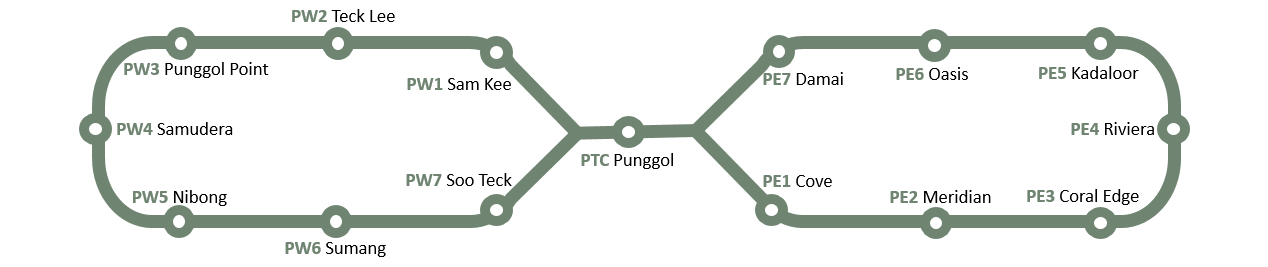
Living near Kadaloor LRT (PE5) starts with a useful correction: a higher station number does not necessarily mean a longer route to Punggol. Kadaloor sits between Riviera and Oasis on the East Loop. Through Oasis and Damai, the rail sequence reaches Punggol in three station-to-station segments. It is not necessary to travel around the longer side simply because Kadaloor is numbered PE5.
The area’s practical relevance for a family can also come from Waterway Primary School, the journey to Oasis Terraces and the particular connection from home to the eastern waterway. Those are distinct destinations to inspect, not a promise that every home carrying the Kadaloor label is equally close, quiet or suitable.
This guide uses school, transport and public-agency information checked on 30 September 2026. It separates school location from admission, kindergarten hours from childcare coverage, and an official park description from a guarantee about the route outside an individual home. Family situations and numerical examples are illustrative rather than reports about named residents.
Kadaloor at a glance
| Reference | What it tells you | What still needs checking |
|---|---|---|
| Kadaloor PE5 | An East Loop station between Riviera and Oasis. | The correct service direction and the actual home entrance. |
| Route through Oasis and Damai | Three rail segments to Punggol. | Walking, waiting, interchange and the final destination. |
| Waterway Primary | The school identifies Kadaloor as its nearest LRT station. | The child’s gate, current school arrangement and address-specific admission process. |
| MOE Kindergarten @ Waterway | A separate kindergarten programme at the same school address. | Enrolment and any care required beyond the programme. |
| Oasis Terraces | The location of Punggol Polyclinic and other services. | Appointment requirements, provider hours and the complete route. |
| Waterway recreation | A possible part of local family life. | The particular public entrance, permitted route and current conditions. |
The station relationships come from SBS Transit’s Punggol LRT map. Stop counts are calculated from that diagram; they are not measured door-to-door travel times.
Read the loop in both directions
From Kadaloor, one sequence is Kadaloor, Oasis, Damai, Punggol. The other is Kadaloor, Riviera, Coral Edge, Meridian, Cove, Punggol. Those paths contain three and five segments respectively. The distinction corrects the misleading idea that Kadaloor must have a longer feeder journey than Riviera simply because its number is higher.
The shorter sequence by segment count is not a promise that every traveller should always make the same choice. The service available, waiting, the final destination and a useful onward errand may influence the trip. Read the current direction display and use SBS Transit’s train information for operating details.
A child can learn this with a pencil and the map. Locate the starting station, trace both ways and count connections rather than labels. Then add the parts the diagram does not show: leaving home, waiting and reaching the destination entrance. A correct map calculation becomes more useful when its limits are understood.
PE5 is a code, not five minutes or five compulsory stops
Station codes make a network easier to identify, but they should not become invented journey measurements. A person reading PE5 might assume it means five stops from the interchange. On a loop, that interpretation overlooks the other direction. The map must be read as a connected circuit rather than a numbered list.
The same caution applies to distance from a home. A building advertised as near Kadaloor may have an entrance some way from the point marked in a listing. A resident using a lift or a permitted crossing may take a different route from a person measuring a straight line on a map.
For a home comparison, start and finish in equivalent places. Compare residential entrance to workplace entrance or school gate, not one home’s doorstep with another home’s station platform. The method is simple, but it prevents a plausible-looking comparison from favouring an option through inconsistent measurements.
Waterway Primary gives a clear school-location reference
Waterway Primary School gives its address as 70 Punggol Drive, Singapore 828802. Its visitor information identifies Kadaloor PE5 as the nearest LRT station and lists buses 50 and 381 among its access options.
Those facts make the school relevant to a Kadaloor-area enquiry. They do not establish the walking time from every property, the entrance a pupil should use or an admission outcome. A visitor heading to the office and a child reporting for school may need different practical instructions.
Begin with the child’s actual situation. A pupil already attending Waterway has a concrete route to test. A family considering application needs the current official process as well. The home search should not convert “nearest LRT” into an assurance that the school can provide a place or every supporting service the family requires.
Kindergarten, primary school and student care are different arrangements
The presence of several education-related services around a school can make a family routine easier, but they should be investigated separately. A kindergarten programme, a primary-school place and after-school care are not one combined enrolment obtained through a nearby address.
For each arrangement, establish who provides it, the relevant age or level, the actual hours and the admission or enrolment process. Then identify the transfer between settings. The family needs to know where responsibility changes, not simply that the services share an address or appear on the same website.
This is particularly important when siblings are at different stages. A preschool child’s day can end at a different time from a Primary pupil’s day. Co-location can reduce travel while leaving a supervision gap. The household should solve that gap explicitly before treating the combined school site as a complete care plan.
The published kindergarten programme is a four-hour morning session
The school’s MOE Kindergarten @ Waterway page describes K1 and K2 programmes running from 8am to noon. It also explains priority eligibility under Phase 2A for its children while stating that a Waterway Primary place is not guaranteed. Consult the current official process for the child’s cohort.
The practical implication is that the published kindergarten session does not itself cover an adult’s full working day. A parent who needs longer care should confirm the appropriate separate arrangement, its hours and availability. Do not infer that a four-hour education programme automatically includes every period before and after it.
Keep the schedule beside the parent’s actual work and the other child’s timetable. A shared school address can simplify part of the day without solving every handover. The correct conclusion may still be that the arrangement fits well, but that conclusion should follow confirmed coverage rather than a convenient assumption.
School-based student care needs its own confirmation
Waterway Primary’s vendor information identifies NASCANS for its school-based student-care service. That supports the provider identity shown by the school; it does not establish a current vacancy for a particular child or every term of enrolment.
Ask how the child’s transfer into care works, when collection is required and what changes on school holidays or unusual school days. Use the current school’s and provider’s instructions rather than guessing from a general day-care description. A working parent needs a clear agreement, not merely an encouraging location.
For homework, understand what the service undertakes and what the family should review afterward. Work completed with support is not the same as independent mastery. A short, specific handover about unfinished or difficult work can prevent the evening from repeating tasks unnecessarily while still identifying what the child needs next.
A current webpage can contain an older school notice
A school website may display current contact details beside an older book-sale, transport or uniform notice. Read the date on the actual item that matters to the purchase or visit. A recent footer does not automatically make every embedded schedule current for a new cohort.
This is useful during a move when families are ordering materials and arranging the first week. Ask which list and sales arrangement applies to the child’s year. Keep the confirmation with the order or enquiry rather than relying on a screenshot whose context has been lost.
The family does not need to investigate every historical document. It needs to distinguish the current instruction for its task from older reference material. That small check can prevent a trip on the wrong day, an unsuitable purchase or an assumption that a provider’s earlier terms still apply unchanged.
Admission needs a current process, not an old balloting anecdote
A previous year’s application count can attract attention, but it does not guarantee a later result. This guide does not reproduce an unverified 2026 applicants-to-vacancies figure or describe future admission as safe. The family should use MOE’s current registration guidance for the relevant cohort.
Keep home–school distance separate from a route trial. The practical walk may help the family understand daily life, but it is not an official determination of a registration distance band. A station name, property listing or school’s nearest-LRT statement cannot make that determination either.
A sound school decision also considers the child’s existing place, care network and needs. Changing home need not automatically mean changing school. The family can investigate a closer arrangement while recognising what would be disrupted and what information remains necessary before making a commitment.
The morning route ends at the child’s actual gate
Confirm the school’s current reporting and entrance instructions. Then rehearse from the actual home, with the child where appropriate. The route should reflect their pace, usual materials and supervision needs rather than an adult’s quickest viewing walk.
Notice the final approach. A path that looks direct on a map may lead to a different entrance from the one the pupil should use. The parent continuing to work needs the onward journey counted as well. An easy home-to-school leg does not automatically make the whole morning efficient.
Prepare enough before departure that the trial measures the route rather than a last-minute search for belongings. A modest evening check of clothing and essential materials can reduce avoidable delays. Keep the child involved at an appropriate level without making them responsible for the adults’ entire schedule.
A worked morning with siblings at different stages
Consider an illustrative household with one child in kindergarten and another in Primary school. The adults initially assume that a shared campus makes the morning and afternoon identical. In reality, reporting requirements, authorised entrances, session hours and care arrangements may differ.
Write one line for each child: where they report, the required time, who accompanies them and who is responsible afterward. Then combine the lines. A shared destination can reduce transport while still requiring a careful sequence at arrival. The answer should come from current institutional instructions, not the family’s best guess.
Repeat the exercise for collection. The shorter kindergarten programme does not extend itself because the older sibling is still in school. If additional care is required, confirm it separately. The arrangement becomes reliable when the family can explain the whole day without leaving an unnamed adult or unconfirmed service to fill the gap.
A worked timetable: the convenient campus still has a midday gap
Imagine an illustrative parent who starts work after taking a child to a morning kindergarten programme and assumes another child at the primary school will allow one combined collection later. The physical location looks simple, but the younger child’s session finishes before that later collection. The missing element is supervision during the gap, not transport between buildings.
The family should confirm an appropriate care arrangement or an available authorised adult before adopting the schedule. Once that is established, write who receives the younger child, where the child remains and how the final collection works. The parent’s workday can then be planned around a real handover rather than an unnamed person who is expected to appear at noon.
For the older pupil, check the separate care or dismissal instructions. Siblings can share parts of a journey without sharing every rule or timetable. A clear plan recognises their different stages and gives each child the information needed for the next step. The benefit of co-location is preserved without pretending it removes the need for adult coordination.
A short review at the end of a busy term
After the family has used the routine for a while, choose one ordinary week and review what actually happened. Which journeys were reliable? Which task repeatedly required an unplanned rescue? Which activity remained worthwhile, and which created more waiting than the family had expected?
Keep the discussion concrete. A missed worksheet suggests a different repair from a collection deadline that overlaps with work. A child who understands the work but cannot find materials needs a different response from a child who requires a specific explanation. The review should identify the next useful change, not assign a general blame to the home, school or neighbourhood.
Change a small number of things and observe again. Perhaps a grocery delivery moves to another day, a caregiver receives a clearer message or one optional activity is reduced. Retain the parts already working. A mature routine does not need constant redesign; it needs enough attention to notice when the family’s circumstances have genuinely changed.
The after-school return should not restart the entire day
A pupil returning from school or student care needs a manageable handover. Identify what is finished, what remains and what materials are needed tomorrow. A parent arriving later should be able to understand the important issue without reconstructing several hours from loose papers.
Choose a small, useful review. The child might explain one difficult question or show the task that still needs help. Avoid demanding a complete retelling of every activity before the family can eat or rest. The aim is continuity, not a second full school session at home.
If the same task repeatedly becomes difficult after a long day, inspect its conditions. Is the instruction unclear? Are materials missing? Does the child need a specific explanation? A change in method or timing may help, while a genuine learning need may require appropriate support. The neighbourhood alone does not answer that educational question.
Oasis is adjacent on the rail map, but the clinic is not on the platform
The operator’s map places Oasis next to Kadaloor. SingHealth lists Punggol Polyclinic at 681 Punggol Drive, Oasis Terraces, #02-01. Use the provider’s location and service information for an appointment rather than treating the neighbouring station as the final destination.
The complete trip includes reaching the station, selecting the appropriate service, leaving at Oasis and reaching the clinic. A practical walk or bus may also be worth considering from a particular home. A one-segment rail relationship is helpful orientation, not proof that every patient can make the whole journey effortlessly.
Plan the return as well. A person who feels unwell or has received specific instructions may need a different arrangement from their usual commute. For a medical emergency, follow SCDF’s guidance and call 995 as appropriate. A nearby polyclinic is not a substitute for emergency assistance.
Use Oasis Terraces for a defined task
A neighbourhood centre can be useful without being the destination for every errand. Identify the actual task first: an appointment, a particular purchase, a meal or an activity. Then verify the provider and the timing that applies to that task.
The centre’s facilities do not all share one set of conditions. A retail outlet, clinical service and registered class answer different needs. A building’s general accessibility or opening description should not be used to promise a specific service or place.
For a Kadaloor household, the opportunity is to use a nearby centre intelligently while retaining simple options at home or along another route. Combine compatible errands, but do not overload a trip involving a child, patient or heavy bags. Convenience should be measured by what the outing actually accomplishes.
Bus access should be checked at the stop the person will use
Waterway Primary’s visitor page lists buses 50 and 381. That gives a family additional routes to investigate beyond the LRT. Use the current Service 381 information where relevant, and confirm the particular stop, direction and final approach rather than assuming the school address describes every nearby bus journey.
A bus may suit a caregiver whose starting point differs from the parent’s. It may also provide a useful alternative for a particular destination without being faster on every trip. Compare the complete journey under the conditions that matter, including any waiting and the walk at the destination.
Teach the return separately. The opposite-side stop may have a different name or approach, and a loop or directional route should not be guessed from the outward ride. A few clear details can make a new journey manageable without requiring the family to memorise the whole town network.
The waterway connection begins at a specific entrance
A home described as Waterway East does not automatically have a direct, step-free or sheltered route to every part of Punggol Waterway Park. Choose the particular entrance and outing the family intends to use, then inspect the path from the residential entrance.
NParks’ park page describes four themed areas: Nature Cove, Recreation Zone, Heritage Zone and Green Gallery. It also places Sunrise Bridge on the eastern side. These are useful park references, not proof that every feature is equally near Kadaloor or available without checking current conditions.
Give the outing an achievable purpose. A short family walk, a gentle observational task or a planned longer route may each be appropriate in different circumstances. The location’s benefit appears when the household can use it comfortably, not when an ambitious itinerary is added to an already crowded school day.
A walk needs a return point, not just an attractive beginning
Before leaving, decide how long the outing should occupy and where the family can comfortably turn back. The point is not to prescribe an exact distance for everybody. It is to prevent a casual start from becoming a much longer journey than the youngest or least mobile participant expected.
Consider the return under changed conditions. The group may be carrying purchases, a child may be tired, or the weather may no longer suit the original plan. Choose an outing with an understandable way home rather than relying on an improvised shortcut.
A family can keep several versions: a short ordinary outing and a longer one when time and conditions suit. Repetition does not make the short route less worthwhile. A manageable walk that becomes part of family life can be more useful than a spectacular plan that is rarely attempted.
Observe the environment without claiming to test it
A child can notice shadows, surfaces, plants and movement during a public outing. Those observations can become questions without being treated as scientific findings about water quality or ecological health. A clear-looking water surface, for example, is not evidence that water is safe to drink or suitable for contact.
Use a bounded task: describe two visible differences along the route, record the time and weather as observed, and explain one question that would need more evidence. The student can distinguish “we saw” from “we think this might mean”. That is a useful habit in writing and reasoning.
Keep the activity respectful and safe. Stay on permitted public routes, do not disturb wildlife or collect water for an improvised home experiment, and avoid photographing strangers unnecessarily. The learning comes from a careful account of the outing, not from treating a family visit as environmental monitoring.
The park’s rules are not the same as nearby recreational advertisements
NParks’ Punggol Waterway Park page states that fishing is not permitted in the park. A general advertisement for fishing or water activities elsewhere in Punggol should not be used to override the rules of this particular place.
The same principle applies to route access and organised activities. Identify the exact venue and responsible operator. A photograph of an activity near water does not establish permission to repeat it at every waterway location. Follow current site notices and the applicable authority’s guidance.
For parents, the useful explanation to a child is simple: a place name covers different spaces with different purposes. The family checks the rules of the actual space it uses. This teaches respect for shared facilities without turning an ordinary outing into a long lesson on regulation.
A mathematical comparison of the two loop paths
The three-segment and five-segment paths from Kadaloor provide a useful example of a network with two routes between the same points. A student can draw the loop, count the connections and explain why reading a station code as a distance gives the wrong result.
Then introduce a hypothetical condition: one service requires a longer wait. The shorter path by segment count might still be preferable, but the count alone is not enough to calculate the complete journey. No invented waiting times need to be presented as actual Kadaloor service information.
For a more advanced pupil, write the total as walking time plus waiting time plus travel time plus the final approach. Each quantity needs evidence appropriate to the problem. This shows how mathematics can clarify a practical decision while remaining honest about unknown inputs.
A written explanation can be short and accurate
Ask a student to explain the journey to a visiting relative in a few sentences. They should name the starting point, destination, route direction and the detail the visitor must check on arrival. The purpose is communication, not filling a page with every possible alternative.
A useful explanation distinguishes a location fact from a personal estimate. “The school names Kadaloor as its nearest LRT station” is supported by the school. “It always takes everyone five minutes to walk there” is a different claim that the source does not establish. The child should learn not to exchange one for the other.
Read the explanation as though unfamiliar with the area. Does it confuse Punggol Drive with Punggol Field? Does it stop at a station when the destination is a school entrance? Revise the missing detail. A small piece of real-world writing can reveal more understanding than a copied list of landmarks.
A school-day routine can protect both work and rest
A family considering Kadaloor may hope to keep the child’s day compact. Test that hope with the actual sequence: departure, school, care, collection, food, necessary work and preparation for tomorrow. Proximity helps only when those parts genuinely connect.
Do not automatically fill time saved on travel with another activity. The margin might make breakfast less rushed, allow a calmer return or give the child time to organise materials independently. Those are legitimate benefits without a promised grade improvement.
When the evening becomes difficult, identify the particular cause. A confusing task, missing worksheet, hungry child and overlapping adult commitments require different responses. A broad label such as poor discipline or bad location does not tell the family which part to repair.
A worked after-school arrangement with a grandparent
Consider an illustrative pupil at Waterway Primary whose grandparent handles two collections each week. A home near Kadaloor may seem useful, but the grandparent’s journey begins at their own home and includes the return afterward. Record that full sequence before assuming the location is convenient for everyone.
Ask about the preferred route and carrying load. A familiar bus may be easier than a transfer that looks faster in a planner. A walk that suits the parent may need a different pace or pause for the grandparent. The person doing the work should help choose the arrangement.
Agree on what happens when the grandparent is unavailable. A defined backup protects the child’s supervision without treating family help as unlimited. The arrangement is strongest when the adults can explain who is responsible at each point and the child receives one clear plan.
When a second child creates a different timetable
A household can have one very convenient school route and still struggle because a sibling finishes elsewhere at an overlapping time. Put both children’s schedules together. The adult performing the collections needs a feasible sequence, not two separate descriptions of short journeys.
Confirm any waiting or care arrangement before relying on it. The earlier-finishing child must be under appropriate agreed supervision. A transport estimate cannot substitute for that responsibility. Where the times genuinely conflict, consider another authorised adult, a different activity time or a confirmed care option.
After trying the plan, review its ordinary performance. Does dinner become late every time? Is the caregiver rushing? Are materials repeatedly forgotten? A recurring problem deserves a small redesign rather than repeated emergency effort. The neighbourhood should support the household, not hide work that one adult must constantly absorb.
Study space should match the child and the task
During a viewing, imagine where a particular task would happen. Reading aloud, writing a composition and working through mathematics with help may need different conditions. A desk is useful when it can actually be used at the relevant time without interfering with the rest of the household.
For siblings sharing space, coordinate competing activities rather than assuming everyone should work simultaneously. A parent can provide a short explanation at a shared table and leave independent work for another period. The arrangement should be simple enough to repeat on a normal evening.
Review the child’s work directly. Note what was completed alone and what required support. The proximity of a school or library does not prove learning has occurred. The useful evidence is the child’s ability to perform an appropriate task under understood conditions.
The library is a separate outing, not an extension of the school gate
NLB lists Punggol Library at 1 Punggol Drive, One Punggol. Its current page should be consulted for the intended service. That address is distinct from Waterway Primary and from Oasis Terraces, even though all may be part of a family’s wider Punggol routine.
Decide whether the visit is for borrowing, a programme or a study session. Travel can consume much of a short gap. A quick book return may fit one afternoon, while a longer session should be planned with enough usable time and an appropriate return arrangement.
Keep the activity purposeful without overloading it. A child choosing books does not need to complete a formal report every visit. A teenager studying independently should understand the route and access conditions rather than assuming a particular seat is always available. The facility supports a habit; it does not replace the need for a workable plan.
Food planning is easier when the return journey is visible
Identify where the family members will be before dinner. Someone returning through a useful shopping or food location may be able to collect a small meal without another journey. On another day, cooking at home may avoid a detour after a late collection.
Verify the particular provider’s current hours and any dietary requirement that matters. A cuisine label or older recommendation does not establish suitability. A general centre description is not a guarantee that the required outlet is open when the family arrives.
A household can keep a few ordinary options rather than searching for the best meal every evening. The benefit of local access is often reliability: knowing how dinner will happen without an argument about another trip. That is different from counting every restaurant in a wide radius as a reason to choose a home.
Heavy purchases need a different plan from a small basket
Test the carrying route from shop to home, including the lift and final approach. A weekly grocery load is different from one item bought after school. The person conducting a viewing may not be the caregiver who usually brings the purchases back.
Separate light essentials from bulky goods. Delivery, a planned larger trip or another suitable arrangement may help, but check the actual service and receiving window. A delivery that conflicts with collection can replace one burden with another.
Avoid buying equipment before identifying the problem. A trolley, additional storage or a different bag may help a particular route; sometimes changing the shopping frequency is simpler. The household needs an arrangement it can sustain, not an idealised system that adds work to every errand.
Kadaloor is not a guarantee of quiet or freedom from construction
A station-level description cannot establish the sound or works affecting every home. It would be misleading to promise that Kadaloor avoids all Riviera-related disruption or is necessarily quieter than Coral Edge or Oasis. The particular unit, route and time matter.
Observe the actual rooms under relevant conditions where possible. A daytime worker, a night-shift sleeper and a child studying after school may each need a different assessment. Keep notes about what was seen or heard rather than turning one visit into a permanent claim.
For access affected by works, read the current responsible notice and check the route used by the household. A map showing a nearby project does not settle the impact at an individual entrance. The useful response is specific evidence, not reassurance or alarm applied to an entire station area.
Future Riviera rail remains future for a Kadaloor household too
LTA lists the CRL–Punggol Extension for 2032, including the planned Riviera interchange. The possibility of reaching a future connection through a neighbouring LRT station is relevant context, not an operating route in 2026.
Keep current journeys complete before discussing that possibility. A family’s work, school and care arrangements must function during the intervening years. The published project date should not remove the present feeder journey or be used as a guaranteed property-value benefit.
A home can be chosen because it fits today and still offer possibilities later. That is different from accepting an unworkable current arrangement on the assumption that a future project will solve several unrelated problems. The distinction protects a practical decision from an attractive but incomplete story.
Inspect housing through the tasks the family will perform
A home near a relevant school still needs suitable sleeping, study, care and shared space. Imagine an ordinary weekday inside the unit rather than focusing entirely on the surrounding map. Where do schoolbags go? Can someone work while another family member moves through the home? Is the entrance manageable with the usual load?
Compare condition and layout directly. A newer or older label does not establish how much work a particular unit needs. Seek appropriate professional advice for technical or contractual issues beyond a normal viewing.
Keep the building’s shared access in the assessment. The route from a bedroom to a station begins before the street. A long internal walk or an inconvenient entrance can change the practical meaning of a property advertised as close to transport.
Affordability should not depend on a forecast
This guide offers no promised resale return, rent estimate or recommended premium for being near Kadaloor. Those questions need current property-specific evidence and appropriate advice. A school name or future rail project is not a substitute for valuation.
Distinguish the figure being compared: an asking price, completed transaction, rental agreement or estimate. Account for the actual size, condition, lease or tenure and recurring charges. Comparing different properties without those distinctions can make location appear responsible for differences it does not explain.
A family may rationally value a shorter school route or a suitable layout. It does not need a prediction about future buyers to justify those priorities. Choose an affordable arrangement whose practical benefits are clear, then keep uncertainty about later market conditions separate.
Accessible travel needs a complete connection
The existence of a station lift or a park’s accessibility designation does not establish the route from every home. Assess the full journey with the person and equipment involved where possible: unit, common area, crossing, transport, destination entrance and return.
Ask the relevant operator or building about material access needs. A route that is step-free may still involve a long detour or difficult surface. The person using it should influence the choice rather than having another adult’s pace treated as the normal measure.
Keep an appropriate alternative for an essential trip if the usual entrance or lift is unavailable. That may include suitable booked transport. A mixed arrangement is often more realistic than insisting one mode must solve every journey regardless of the traveller’s needs.
Build a wet-weather alternative before collection time
Decide which adult acts, where the child is collected and what optional task can move when weather changes. A child should not be expected to negotiate a new route between several adults whose messages disagree.
Check the exposed gaps along the actual path. A covered destination does not prove continuous shelter from the block. Bags, strollers and mobility needs can alter the best choice. The alternative should be realistic for the people travelling, not merely a line drawn between two sheltered places.
For hazardous conditions, follow current official warnings and relevant school or operator instructions. Do not assume immediate paid transport will always be available at the usual cost. A clear plan with some margin is more useful than attempting to keep every errand in a tightly packed afternoon.
A first-month routine for a family new to the area
Begin with the essentials: the home entrance, school or work route, collection agreement, basic groceries and important contacts. There is no need to explore every possible amenity before the family can function. A small dependable routine gives newcomers time to learn the area gradually.
During the next weeks, review the difficulty that repeats. Perhaps the wrong gate creates a detour, the schoolbag handover is unclear or groceries are being carried by the wrong person at the wrong time. Change the particular cause and observe the result.
Once the arrangement works, stop treating the move as a daily test. Revisit the plan when a real circumstance changes: school, work, care, mobility or an actual transport service. A home can suit the family well without being declared the best option for every future version of its life.
Questions families ask about Kadaloor
Is Kadaloor necessarily farther from Punggol than Riviera?
Not by the shortest segment count on the East Loop. The route through Oasis and Damai uses three segments from Kadaloor, whereas Riviera has four either way. Complete journey times still depend on access, waiting and operating conditions, so the map calculation is not a timing guarantee.
Does Waterway Primary identify Kadaloor as its nearest LRT?
Yes. The school’s visitor information provides that reference. It helps orientation but does not establish the walk from every home, the pupil’s permitted gate or an admission outcome. Use the school’s current instructions for the actual visit.
Does the kindergarten programme cover the whole working day?
The published programme is a four-hour morning session. Any additional care required by the family should be confirmed separately. A shared campus address does not automatically provide continuous supervision across all the hours an adult needs.
Can last year’s application figures predict a school place?
No guarantee follows from a previous cohort’s count. Use the current official process and the child’s circumstances. The article does not repeat an unverified applicants-to-vacancies statistic or describe future admission as safe.
Is the polyclinic at Kadaloor station?
No. Punggol Polyclinic is at Oasis Terraces. The neighbouring rail relationship can be useful, but the full route and clinical appointment instructions still matter. The station platform is not the final destination.
Can the family assume every nearby waterway activity is permitted?
No. Check the rules of the exact public space and the relevant provider. NParks states that fishing is not permitted in Punggol Waterway Park. A general advertisement for an activity elsewhere does not override that rule.
Is this automatically a quiet, construction-free choice?
No such guarantee is made. Inspect the individual home and current access conditions. A station label is insufficient evidence about sound, works or the experience of a person using the home at particular times.
What should decide between Kadaloor and Oasis?
The actual addresses and repeated tasks. One home may suit a child’s school route, another a frequently used service, and another the caregiver’s journey. Compare the complete household arrangement rather than awarding a universal winner from the names of nearby facilities.
A family base understood through its real connections
Kadaloor is easier to assess once the loop is read correctly and the different school and care arrangements are kept separate. The useful question is not how high its station number is, but whether a particular home connects the family to the places and people it needs.
A reliable school handover, a workable journey to Oasis, a suitable room for study and a modest outdoor routine can all matter. Each should be grounded in the actual address and current information, not borrowed from a general description of Waterway East.
Continue to Riviera or Oasis for neighbouring areas. The Punggol LRT Guide, car-free living guide and Complete Punggol Guide provide wider orientation.
Kadaloor audited edition 2026-09-30
Fact-check date: 30 September 2026. This audited extension corrects the earlier article’s unsupported P1 applicant-count statement and removes broad station rankings. SBS Transit is used for East Loop geography; MOE owns the current Primary 1 process; SingHealth owns Punggol Polyclinic information; and LTA owns the future CRL programme.
What Kadaloor actually establishes
Kadaloor is PE5 on the East Loop between Riviera and Oasis. That is reliable network orientation. It does not establish the walking distance from every home, a school admission result, room-level noise, property value or whether Kadaloor is better than a neighbouring station.
Audit correction
The earlier page overstated several comparisons. This edition removes the unsupported Primary 1 applicant-count claim and does not describe Kadaloor as universally quieter, calmer or stronger than neighbouring stations.
East Loop geography
SBS Transit’s network map places Kadaloor PE5 between Riviera and Oasis. The map establishes station order, not door-to-door travel time.
Exact home entrance
A property marketed as near Kadaloor still needs an address-specific walk from the permitted residential entrance to the station and other destinations.
Waterway Primary
Use Waterway Primary School’s current official address and access information for the school journey. A station relationship is not an MOE distance-band result.
Primary 1 registration
Use the exact residential address and MOE’s current registration process. Do not predict a ballot from an older year’s applicant numbers.
School gate
Confirm the current pupil entrance and collection arrangements with the school before timing the daily route.
Morning routine
Separate delays inside the home—breakfast, bags and clothing—from delays created by transport. Repair the cause that actually repeats.
Dismissal
Afternoon heat, bags, CCA and a different caregiver can make the return unlike the morning journey. Test it separately.
Student care
A nearby centre matters only if its current school, age, hours and collection terms fit the child.
CCA day
A recurring late finish belongs in the normal weekly plan. Decide what moves so dinner, preparation and sleep remain workable.
Two children
Two short journeys can still conflict when one adult is expected in two places at the same time. Supervision comes before route optimisation.
Grandparents
Start from the grandparent’s actual home and use the route they can comfortably perform. Their time is part of the household system.
Teen independence
Teach direction, transfer, final entrance and what to do when the expected journey changes, not only the station code.
Oasis relationship
Oasis is adjacent to Kadaloor in the East Loop sequence. Treat Oasis Terraces as a separate destination with its own final walk and current providers.
Punggol Polyclinic
SingHealth lists Punggol Polyclinic at 681 Punggol Drive, Oasis Terraces, #02-01. Provider information controls appointments and services.
Healthcare boundary
A location guide can identify a provider; it should not choose clinical care. Medical emergencies follow current SCDF guidance.
Groceries
Separate a small top-up from a heavy weekly shop. The carrying load and return route can matter more than the number of stores listed nearby.
Punggol Plaza
Punggol Plaza is a distinct Coral Edge-area destination. Do not collapse Coral Edge, Kadaloor and Oasis into one generic shopping node.
Town Centre
Punggol MRT, Waterway Point and One Punggol are different final destinations. Name the one the household actually needs.
Punggol Coast
Punggol Coast is a different NEL station and northern hub. Do not use Punggol and Punggol Coast interchangeably.
Work commute
Measure home door to workplace entrance, including the LRT feeder, transfer, waiting and final walk.
Shift work
Check the service available at the real reporting and finishing time rather than assuming daytime access represents an early or late shift.
Bus alternative
A current bus may suit some local journeys better than the LRT. Verify the stop, direction and route with the operator.
Walking alternative
Walking can remove a wait while adding weather and carrying effort. Compare equivalent start and end points.
Cycling
Cycling can expand the local radius for a suitable rider, but route continuity, current rules, parking and weather remain dependencies.
Waterway access
The Waterway can support recreation where the actual home has a practical route to it. Do not promise a direct waterfront path from every Kadaloor-labelled property.
Rain
Check exposed segments and one realistic alternative before heavy rain. Shelter at either end does not prove continuous shelter.
Accessibility
Assess the complete journey with the person and equipment involved. A station lift is only one part of a step-free route.
Stroller
A stroller changes lift, kerb, crowding and carrying decisions. Use the family’s real equipment when the issue is material.
Older resident
Seating, crossings, shelter and healthcare access may matter more than a small difference in nominal travel time.
Home layout
Transport convenience cannot repair a home that fails the household’s sleep, study, care or storage requirements.
Noise
Do not label Kadaloor universally quieter than Riviera, Oasis or Coral Edge. Assess the actual room, orientation and time.
LRT proximity
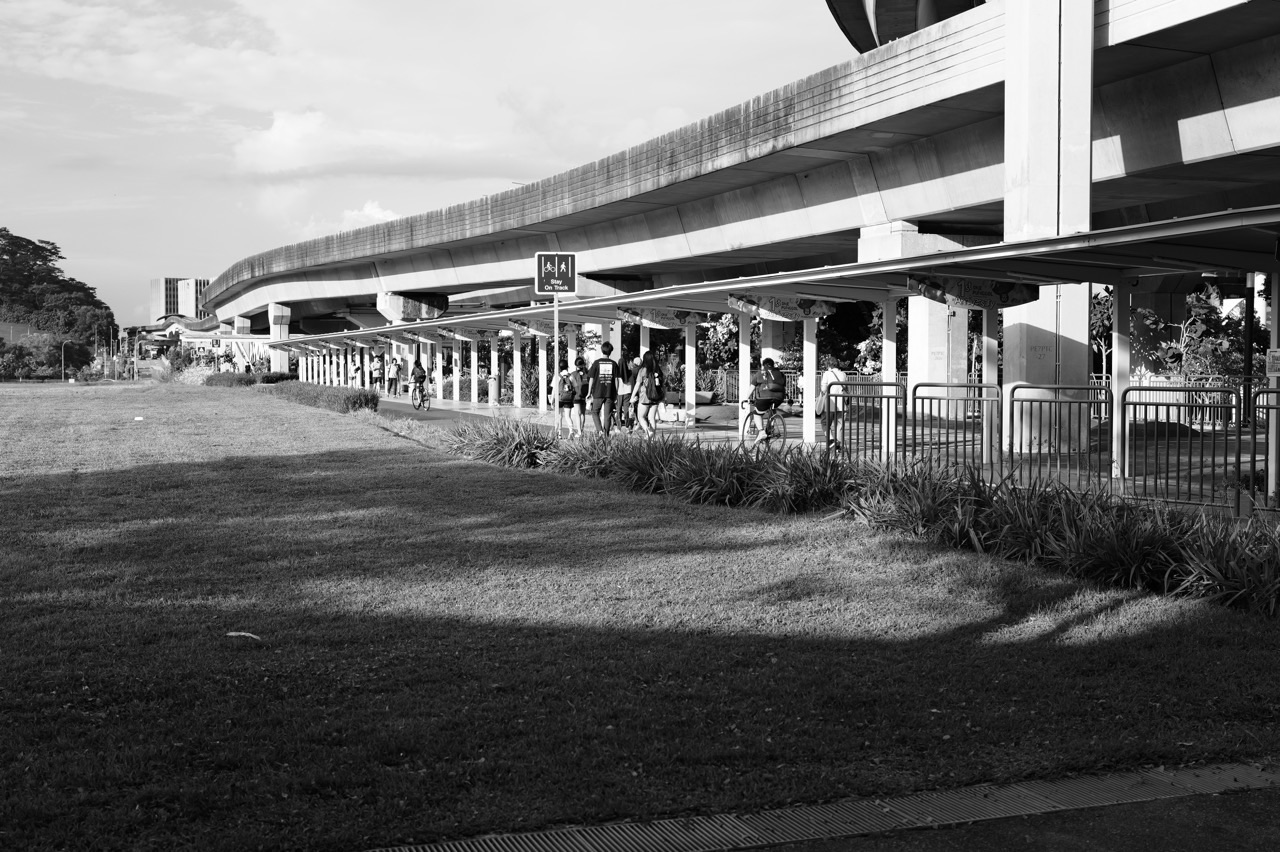
A unit near the viaduct can differ from another unit in the same project. Proximity is not a sound measurement.
Road activity
Punggol Drive and local roads can affect different stacks differently. Keep observations unit-specific.
School activity
A school-facing home may experience activity at certain times, but one viewing does not establish a permanent pattern.
HDB comparison
Compare the exact flat, remaining lease, condition, access and current transaction evidence rather than a station-wide price story.
Private housing
Verify tenure, recurring charges, facilities and the actual route. A private-housing label does not establish superior fit.
Renting
Clarify the current tenancy terms, included items and responsibilities before allowing location convenience to dominate the decision.
Property-price boundary
This article does not predict appreciation or a Kadaloor premium. Future prices require current property-specific evidence.
CRL boundary
Riviera’s future CRL interchange is not current Kadaloor MRT service. LTA targets the Punggol Extension for 2032.
Construction boundary
Do not claim Kadaloor has lower construction impact without defining the project, date and exact home.
Normal Tuesday
Test school, work, groceries, dinner and return on an ordinary weekday. Weekend impressions can hide repeated friction.
Wet Tuesday
Re-run essential journeys in rain and keep the fallback simple enough for another caregiver to understand.
Late evening
Check the return at the time an activity actually ends. Afternoon service assumptions may not describe a late trip.
Weekend reset
Groceries, laundry and school materials often cluster on weekends. A useful location helps the family reset without forcing every errand through one hub.
Delivery
Delivery can solve a carrying problem but adds a fee and receiving window. Count it honestly when it is part of the normal routine.
Private-hire backup
Occasional paid transport can be a legitimate backup. If it becomes frequent, include it in the normal budget.
Car-free boundary
Car-free living is not a purity test. The transport mix must reliably support the household’s essential journeys.
Time budget
Repeated small frictions can matter more than a rare long outing. Weight journeys by frequency and fixed deadlines.
Coordination load
Several handoffs can create more friction than a solo commute on the same route. Count who must communicate and wait.
Single-adult weekday
Test whether one adult can operate the essential chain when another is unavailable.
Sick-child day
Illness changes pace, destination and supervision. Follow the relevant school and healthcare processes rather than forcing the normal timetable.
LRT disruption
Use current operator guidance and a known fallback rather than improvising through restricted areas.
Family calendar
Put work, school, CCA, care and appointments into one calendar before calling a scheduling conflict a transport problem.
Information handoff
Send the responsible adult the time, place, child and next action. Avoid making the child the only messenger.
Privacy
Share only what a caregiver or provider needs to perform the task. Logistics do not require broadcasting private family details.
Learning at home
A shorter route can create time, but it does not guarantee academic improvement. Look at what the child can explain or complete independently.
Homework repair
Identify the specific missing knowledge, material or attention problem before adding more work.
Tuition boundary
Choose tuition for the student’s learning need and teaching fit, not merely because a provider is geographically close.
Enrichment boundary
Add an activity only after travel, dinner, homework and sleep still form a workable evening.
Library trip
Punggol Library is at One Punggol, a separate Town Centre destination. Decide whether the available time justifies the journey and intended use.
Family meal
Food access matters when it fits the return route. Many outlets do not automatically produce a manageable dinner plan.
Meeting point
Use a precise station exit, building entrance or landmark when family members meet.
First-week orientation
Learn the essential school/work route and one reliable grocery option before exploring every amenity.
One-month review
Distinguish recurring structural friction from one-off mistakes. Repair the cause that repeats.
Observation discipline
Record date, time, route and conditions. Do not convert one visit into a permanent neighbourhood claim.
Comparison discipline
Compare realistic homes with similar requirements. Do not make Kadaloor win by choosing an unsuitable alternative.
No universal winner
Kadaloor, Riviera, Oasis and Coral Edge can each fit different households. Expose trade-offs rather than ranking stations.
Refresh trigger
Refresh when transport, school access, a major local facility or an official project status materially changes.
Retirement condition
Stop researching when essential routes, home requirements and budget are sufficiently clear. Reopen when a real circumstance changes.
Worked household example
Consider an illustrative family with one Primary pupil, one adult travelling to work through Punggol, and a grandparent handling two afternoon collections. A Kadaloor-area home may simplify one school route while adding a feeder segment to work. Put both effects on the same weekday before deciding that the location is convenient.
If a tested home hypothetically saves eight minutes on ten adult journeys but adds twelve minutes to four caregiver journeys, the weekly arithmetic favours the adult by thirty-two minutes. A fixed collection deadline can still outweigh that total. The numbers are illustrative; feasibility and who bears the burden remain visible beside them.
Kadaloor versus Oasis without a ranking
Compare realistic homes, not station reputations. Oasis may simplify a healthcare or shopping trip; Kadaloor may fit a particular school route or unit better. Weight the journeys by how often they happen and whether they have fixed deadlines. Different households can rationally choose differently.
Household evidence synthesis
Across these checks, keep four fields beside every important journey: the person travelling, the exact start and destination, the current owner of any changing fact, and the condition that would make the family alter the arrangement. This gives the article one reusable method without repeating the same instruction after every section.
Final audit boundary
The page is publishable when current facts are attributable, school admission is not inferred from station proximity, future Riviera CRL service remains future-tense, property and noise claims stay unit-specific, and the reader can act without being given a universal station ranking.