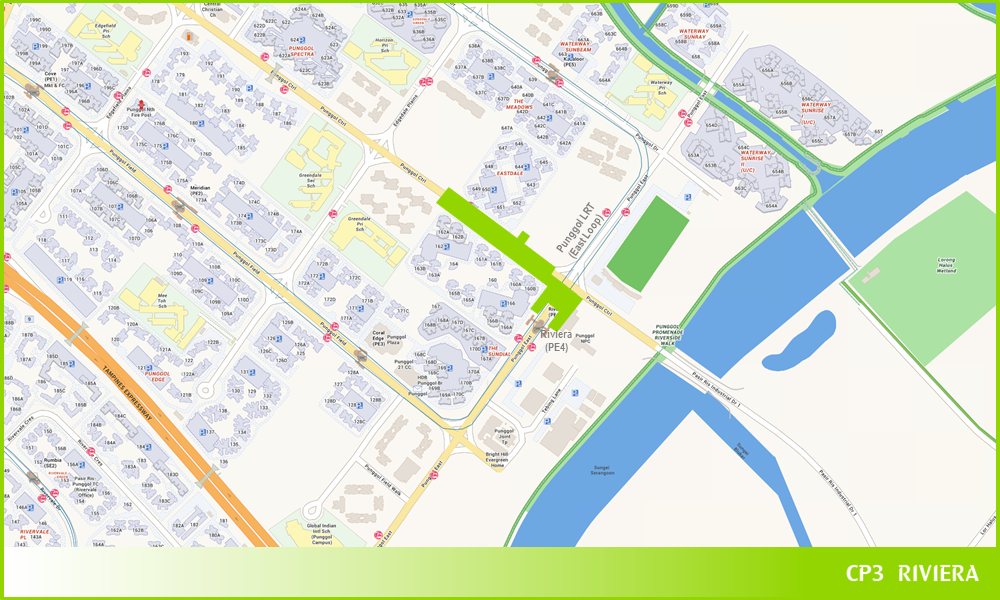
Riviera has two different transport identities that must be kept separate when choosing a home: PE4 is the operating Punggol LRT station; CP3 is the planned Cross Island Line connection. The future station is not a train service a resident can use in September 2026. Today’s home, commute and school arrangements still need to work on their own terms.
The planned interchange makes Riviera an important place to understand, but not a property bet that every household should make. A family may value its present location, find a suitable home and welcome the future connection. Another may need a different current commute or find the conditions at a particular unit unsuitable. The reasonable decision depends on evidence about the home and the people living there.
This guide separates those questions. It explains the existing LRT relationship, the dated official project record, what a construction announcement can tell a resident, and how to assess a home without confusing a plan, a photograph, a travel-time example and an operating service. Sources were reviewed on 30 September 2026.
Riviera now and Riviera later
| Question | Current position | How to use it |
|---|---|---|
| What rail service operates at Riviera? | Punggol LRT, station PE4. | Plan today’s journeys with current operator information. |
| What is CP3? | The planned Riviera station on the CRL–Punggol Extension. | Keep it in the future part of a household comparison. |
| What programme applies? | LTA currently lists the Punggol Extension for 2032. | Read this as the published target, not a guaranteed personal outcome. |
| Where is the planned station described? | Along Punggol East and Punggol Central in LTA’s project material. | Distinguish the project location from conditions at an individual unit. |
| Does a nearby home automatically benefit equally? | No address-specific benefit is established by the station name. | Assess the entrance, actual destination and household timetable. |
| Is a price rise promised? | No. | Use current property evidence and appropriate professional advice. |
Use LTA’s current CRL programme alongside the dated project releases below. A current programme page and an older announcement play different roles: one states the current published plan, while the other records what was announced at that earlier point.
The existing LRT neighbourhood is the starting point
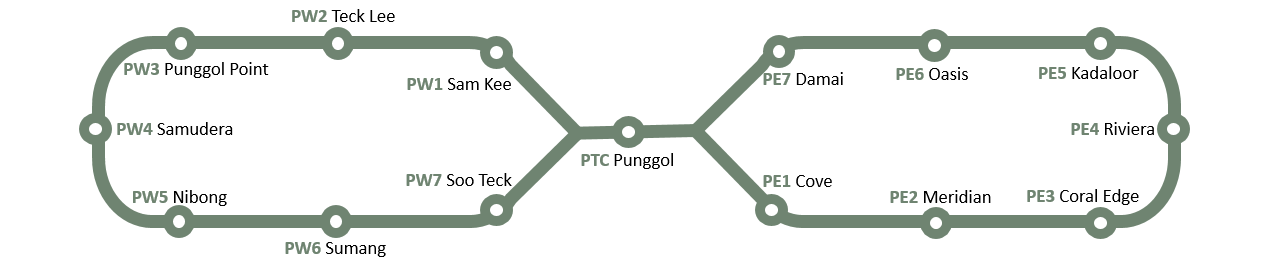
On SBS Transit’s Punggol map, Riviera lies between Coral Edge and Kadaloor. A resident can understand the local network before making any assumption about the future MRT. The useful first questions are how to reach PE4 from the home and which direction serves the intended destination.
A rail journey towards the North East Line currently uses the connection at Punggol. The home-to-station walk, wait, LRT segment and interchange all belong in a door-to-door comparison. A property described as near Riviera should not be treated as having an operating MRT entrance simply because the title or advertisement includes CP3.
Some trips may be better served by another arrangement. A suitable bus, a practical walk or occasional paid transport can have a place in the household’s week. Start with the destination and the person making the journey rather than deciding that every trip must use the same mode.
Riviera is the midpoint of the East Loop by segment count
The East Loop has eight connections around its circuit between Punggol and the seven numbered eastern stations. Tracing the operator’s map from Riviera to Punggol gives four segments through Coral Edge, Meridian and Cove, or four through Kadaloor, Oasis and Damai. This is a calculation from the map, not a published travel-time guarantee.
Equal numbers of segments do not prove equal arrival times. Waiting, the service available and the destination entrance can still affect the decision. A useful traveller understands the two possible sequences and reads the current display rather than assuming a direction from the station code alone.
This distinction is particularly helpful for families comparing Riviera with Kadaloor. The numbers PE4 and PE5 are identifiers, not a simple increasing measure of distance from Punggol. A loop is not a straight line. The route should be traced before describing another station as deeper, farther or necessarily slower.
The 2022 contract is a dated milestone, not a live progress report
LTA’s 30 September 2022 civil-contract announcement describes the planned underground Riviera station along Punggol East and Punggol Central. It also discusses ground improvement and phased traffic diversions. Those details establish the announced location and construction approach at that date.
They do not establish which activity is happening outside a particular block this week. A resident needs current local notices for that narrower question. Reading a contract announcement as a daily work schedule would attach certainty to something the source was never intended to describe.
Keep historical and current evidence together without blending them. The older document explains how the project entered construction. A later official update may change the programme or provide new details. An observation made from a home adds information about that viewing, but cannot rewrite the project’s official status by itself.
The 2023 groundbreaking confirms a different step
On 10 October 2023, LTA recorded the groundbreaking for the Punggol Extension at the future Riviera station site. The construction-start release is evidence that this milestone occurred. It is different from the earlier contract award and from a future opening.
A household can use this chronology to understand why “announced”, “under construction” and “operating” should not be interchangeable words. They answer different questions. The visible presence of work does not tell a reader that all planned systems are complete, and a published target does not mean passengers are already being carried.
For a home decision, give each piece of information its proper job. The programme informs the longer-term picture. Current access and unit conditions inform the present. The family needs both, but should not use an attractive future description to suppress a difficult current requirement.
Why 2030 and 2032 should not be merged
LTA’s current programme distinguishes CRL Phase 1, expected by 2030, from the Punggol Extension, expected in 2032. Pasir Ris is part of the Phase 1 interchange programme; the extension is a separate connection. Those dates should not be compressed into one approximate year for all future travel in the east.
The difference can matter to a family’s actual time horizon. A child may be in a different school stage, a tenancy may have ended or a caregiver’s arrangements may have changed before the later programme date. The household should not assume that a future benefit will arrive during the particular period for which it is choosing a home.
Use the target as planning information and identify the interim arrangement. Can the current journey be sustained? Is the home suitable without the new service? What would the family do if its own destinations change? Those questions remain useful even when the project proceeds according to the published programme.
Read working names as working names
The 2023 LTA release refers to Elias and explicitly marks it as a working name. The current project page uses CP2 Station in its location section. A reader should therefore recognise the historical name without assuming that an older caption settles the final public name.
This is a small but important habit when reading development material. A code, a working name and an operating station name can appear in different documents for legitimate reasons. Check which document and date the label belongs to rather than treating every variation as evidence that an entirely different project exists.
For ordinary family planning, the exact future branding matters less than the distinction between an existing service and a proposed connection. Keep the present address and station clear. When the eventual passenger information is issued, use that current information for the actual journey rather than relying indefinitely on an early diagram.
The official time-saving example has specific endpoints
LTA’s October 2023 release illustrated a future Punggol-to-Pasir Ris journey of about 15 minutes, compared with a bus journey of around 40 minutes in that release’s context. It was not a published Riviera timetable, a September 2026 measurement or a door-to-door guarantee for every household.
That difference matters when a figure is repeated in a property discussion. A resident must still reach the station, wait where necessary, make any onward connection and reach the final entrance. The correct comparison starts and ends at equivalent places for the particular household.
The planning example remains useful when accurately labelled. It explains the type of connection the project intends to improve. It should not be multiplied into a promised annual saving for a resident whose workplace, school or home was never part of the example.
Put the family’s dates beside the project’s dates
A railway programme is measured in years, while family commitments often turn on a term, a tenancy or a particular working arrangement. Put those dates beside each other. A household choosing a two-year rental in 2026 is making a different decision from one considering a much longer stay. The same future station can therefore have different relevance without either household misunderstanding the project.
For a child, use the actual current stage rather than an imagined future identity. A Primary pupil may have different school, activity and care arrangements by the time a later project opens. The family can allow for that possibility without claiming to know the school the child will eventually attend or the route they will use.
The practical question is whether the interim years are acceptable. If a present commute is difficult, calculate its frequency and identify a real alternative. If the current arrangement works, the future connection may add flexibility. The project timeline should clarify the period the household must manage, not make that period disappear from the decision.
Equal stop counts can still produce different choices
Imagine two possible journeys with the same number of rail segments. In a simplified example, one train is available sooner, while the other direction places the traveller closer to a useful onward errand. The household’s choice depends on the task, not solely on the equal segment count. These are illustrative conditions, not a claim about today’s Riviera service.
A traveller making a fixed work arrival may prioritise the more reliable total journey. Someone combining a flexible errand may choose differently. A caregiver might prefer the route with an easier final approach even when another option looks marginally faster. The purpose of tracing the loop is to reveal choices rather than impose one instruction for every trip.
A student can express this simply: count the connections first, then add the conditions that the count leaves out. Waiting, walking and the destination entrance are not errors in the map. They are additional parts of the journey. That is a useful modelling lesson because it shows how a correct calculation can still be incomplete for a real decision.
A modest review after moving is better than permanent uncertainty
Once a household has moved, it needs a routine rather than a daily referendum on the decision. Settle the essential current journeys first. Keep the relevant contact information and identify which official notices could change the route. There is no need to read every article repeating an old programme date.
After an initial period, review the practical questions that mattered: work arrival, school collection, access, rest and ordinary errands. Which concerns proved manageable? Which difficulty recurs? Change the specific arrangement where possible, and seek the relevant advice when a material issue cannot be resolved through scheduling or route choice.
This does not mean ignoring a genuine problem. It means distinguishing a problem that requires action from uncertainty that adds no useful information. A clear response to an actual change is more helpful than constantly speculating about the next construction stage. The family’s attention is also a limited resource, and the home should make room for ordinary life while the wider project progresses.
A personal commute comparison needs two complete routes
Write the current route first. Begin at the residential entrance and finish at the actual workplace, school or appointment. Include the parts that are easily omitted: the lift, access within a large development, transfer walking and the final approach. Use the time at which the journey will actually happen.
Then describe the future possibility separately, using only what the official plan establishes. Leave unknown elements unknown. A route can be expected to change without assigning a made-up final journey time, fare or service frequency. The family can still discuss whether that possible connection is relevant.
Compare the decision under both conditions. If the home is unsuitable today and only becomes acceptable through several unverified future assumptions, the uncertainty is material. If it already suits the family, the planned connection may be a welcome additional consideration rather than the reason every current difficulty has been dismissed.
A worked example: the destination is not the station
Consider an illustrative adult who works in an eastern industrial area. A future station nearer that district may sound like a complete solution. The actual job, however, may begin before a convenient service, require entry through a particular gate or sit beyond a substantial final journey.
The family should map the complete present commute and identify which part the future connection could change. If only the main rail leg is improved while the early start or last mile remains difficult, the benefit is narrower than the headline suggests. It may still matter, but it should be described honestly.
This example uses no invented local travel times. Its purpose is to show why an interchange’s general promise and one worker’s practical routine are different scales of question. A home decision becomes stronger when those scales are connected explicitly instead of assuming the larger project description has already answered the smaller personal problem.
A bus can be relevant before the future line opens
Go-Ahead’s Service 381 route lists Riviera Exit B, stop 65231, towards Punggol Coast and Exit A, stop 65239, towards Punggol Interchange. This is a current road-based option to investigate, not a promise that it is the best journey for every resident.
The same household may use rail for one destination and a bus for another. Check the actual route and final entrance. A single-seat ride can avoid a transfer while still taking a less direct road path. The useful comparison includes timing, walking, carrying and the person travelling.
Do not let interest in a future project make current choices invisible. A change of departure time, a better-understood bus stop or a different combination of errands may improve the present week. Those adjustments can be useful without any claim that future infrastructure is unnecessary or already available.
How to read a construction notice as a resident
Begin with the information that changes your movement: location, dates, affected access and the instruction relevant to pedestrians or vehicles. A project title alone is not enough. The notice should be read for the particular route the family uses rather than treated as a general statement about the entire neighbourhood.
Record the exact question you still need answered. Does the usual pedestrian approach remain available? Where is the authorised alternative? Is the affected entrance the one used by the family or another part of the site? Contact the responsible party when the notice does not settle a material access need.
Keep the note dated. A route that was appropriate during one phase may change later. Neither the family’s memory nor an old social-media image should override a current instruction at the site. The objective is clear, lawful access, not finding a clever shortcut through space that is not open to the public.
The home can be close to a project without sharing every impact
Construction effects should be assessed at the actual property. Two homes described as near Riviera may face different directions and use different entrances. A station-level guide cannot certify that one is affected more or less without appropriate evidence.
During a viewing, consider the rooms and times that matter to the household. A person working at home during the day has a different requirement from someone usually away. A night-shift worker’s sleep period may require a separate visit or further enquiries rather than an assumption based on an evening viewing.
Record what is observed without exaggeration. A particular sound at a particular time is evidence about that visit. It is not automatically a permanent pattern. Conversely, one quiet moment does not prove the absence of recurring activity. Use observations to decide which questions need further checking.
A useful observation record has limits built into it
| Record | Helpful detail | Avoid turning it into |
|---|---|---|
| Viewing time | Date and relevant period of the day. | A claim about every hour of the week. |
| Room | The actual room and window position. | A verdict about the entire development. |
| Sound or activity | What was directly heard or seen. | An invented measurement or identified cause without evidence. |
| Walking access | The permitted route used that day. | A permanent guarantee that no diversion will occur. |
| Official notice | The issuer, date and instruction relevant to the task. | A prediction beyond what the notice says. |
| Open question | The information that could change the decision. | A gap filled with a confident assumption. |
Good records are not necessarily long. A few precise observations can guide a second visit or enquiry. A large folder of photographs becomes less useful when nobody can explain which question each image answers or whether it shows the part of the home the household will actually use.
Pedestrian access deserves a separate check from driving access
A notice about a road arrangement may not describe the pedestrian path in enough detail for a family with a stroller or an older resident. Check the route used by the actual traveller. An available vehicle entrance does not automatically establish a comfortable public walking approach.
Where mobility equipment is involved, assess the complete chain: leaving the home, crossing the relevant streets, entering transport and reaching the destination. Ask the operator or building about material access questions. The existence of a lift at one point does not remove every barrier elsewhere.
Keep an appropriate alternative for essential journeys. That may require a different route or suitable booked transport. An accessible plan should accommodate the person rather than demand that they tolerate a route that does not meet their needs. This remains true whether the surrounding works are temporary or permanent infrastructure is already complete.
What the engineering announcement explains—and what it does not
The 2023 LTA release describes a 12.6-metre tunnel-boring machine intended to create a bore wide enough for two MRT tracks. It also mentions selected lower-noise equipment and digital coordination methods. These are dated descriptions of the project’s methods, not confirmation that every machine is operating beside a given home today.
A resident can use the information to understand why an underground rail project is more than an entrance building. Different tasks concern tunnels, stations, supporting works and their connections. Seeing progress on one visible element does not provide a complete measure of the whole project.
For practical decisions, resist estimating completion from appearance alone. A tidy surface, installed structure or impressive photograph may show progress, but does not establish public operation. Wait for the responsible authority’s current statement about the specific milestone before changing a journey plan.
A simple scale exercise for students
A student can use a published diameter as the beginning of a mathematical exercise without claiming to inspect the worksite. Given a hypothetical circle, they can calculate its area, compare it with a smaller circle and explain why doubling a diameter changes area by more than twice. The arithmetic is general mathematics, not a site-capacity calculation.
Keep the model’s assumptions explicit. The area of a geometric circle is not automatically usable passenger space or the final arrangement inside a tunnel. Real structures contain components and requirements that the simple diagram omits. The student should say what the model represents and what it leaves out.
This creates a useful link between school mathematics and a local project while preserving accuracy. The child learns to reason with a stated quantity, not to make engineering assurances. There is no need to enter restricted areas, photograph workers or present a family outing as a professional inspection.
Artist impressions are proposals to read, not places already visited
A project illustration can help readers imagine the intended arrangement. It should remain labelled as an artist impression or proposed design when that is what the source calls it. It is not a photograph proving that the depicted entrance, planting or surrounding business is operating today.
When showing such an image to a child, ask what can actually be learned from it. It may suggest the appearance of a planned structure, but cannot establish current access, exact opening conditions or every detail that will exist later. That distinction also helps adults read property marketing more carefully.
Use the final passenger and access information when the service becomes available. A familiar early image can remain part of the project’s history without functioning as today’s route guide. The useful habit is not scepticism about every plan; it is matching the claim to the type of evidence being shown.
The school day must work before the new railway arrives
A child needs a current journey to the actual school gate. A future interchange may become relevant years later, but it cannot solve this term’s collection deadline. Begin with the child’s existing place or current application process and the adults responsible for travel.
For orientation, Waterway Primary lists 70 Punggol Drive, while Greendale Primary lists 50 Edgedale Plains. These are separate destinations. They are not evidence that every Riviera-area home is within a particular school-registration distance.
Use MOE’s current registration guidance where relevant and the school for current gate or collection instructions. A home can be worth considering without promising admission to a named school. Keep the educational decision separate from enthusiasm about a future transport project.
School transport and the caregiver’s route belong together
A child may be taken to school by one adult and collected by another starting from elsewhere. Map both journeys. A home-to-school route alone can hide a difficult caregiver trip that the parents do not perform themselves.
For a household using student care, confirm the transfer arrangement directly. The provider’s location does not establish that it collects from the relevant school, accepts the child’s level or has a place. The same care is needed if a family is changing providers after moving.
Keep responsibility clear during temporary route changes. A child should not be asked to interpret a construction diversion and resolve conflicting adult instructions alone. The adults agree on a suitable plan; the pupil receives the part needed to understand the next action. That clarity matters more than whether the destination is described as nearby.
A worked example: the shorter adult commute is not the whole answer
Imagine a family in which one adult expects to benefit from the future eastern rail connection, but a grandparent provides daily care under the current arrangement. The family is comparing a Riviera-area home with another property near the grandparent’s usual route.
The future benefit deserves consideration, but it should be recorded separately from the caregiver’s present work. If the Riviera option adds an unreliable collection transfer today, that is a real issue to solve. A promised later saving for another adult does not make the immediate care gap disappear.
The decision may still favour Riviera after a workable arrangement is confirmed. It may favour the alternative because the existing support network matters more. These are illustrative possibilities, not recommendations for a particular property. The useful method is to make both the future opportunity and present responsibility visible.
Punggol Plaza remains a Coral Edge reference
A Riviera household may choose to use Punggol Plaza, but the mall should not be described as though it sits at Riviera station. The Plaza operator’s directory provides current business references, and a provider’s directions within the building identify Coral Edge PE3.
Decide which errand makes the trip worthwhile. A planned market or supermarket visit may suit one household; a small top-up elsewhere may suit another. The route should include the actual entrance and return with purchases rather than borrowing an unmeasured walking distance from a property description.
Keep the distinction between access and availability. A nearby building does not guarantee the required product, appointment or programme. A local guide is useful when it helps the resident reach the right provider and ask the right question, not when it treats every listed business as a permanent service attached to the home.
Oasis Terraces is a different journey again
Punggol Polyclinic is at 681 Punggol Drive, Oasis Terraces, #02-01, according to SingHealth’s official page. A visit there should follow the provider’s appointment and registration information rather than the general hours of the surrounding centre.
From Riviera, the LRT map places Kadaloor between Riviera and Oasis. That relationship helps orientation, but the household still needs to choose the appropriate service and include both ends of the journey. A person who is unwell or uses mobility equipment may need another transport arrangement.
For a medical emergency, follow SCDF’s guidance and call 995 as appropriate. The nearest-seeming clinic or a familiar route should not replace emergency assistance. Housing convenience and clinical decisions are different questions.
Make groceries and meals work during the present routine
A household living through changing access may benefit from a simple food plan with more than one practical option. Identify the ordinary grocery route, a small top-up alternative and the way heavy purchases reach home. The plan should serve the people doing the carrying and collection.
For dinner, consider where each family member will be before returning. A takeaway along an existing route can remove another outing; a home meal may be simpler after a late school day. There is no need to insist on one method for every evening.
Avoid making the family adapt silently to every inconvenience. If an errand repeatedly creates a difficult detour, change its timing or method. The goal is not to prove that living near a project requires no adjustment. It is to make the adjustment explicit, proportionate and workable.
Working from home changes what needs inspection
A person working from home may experience the unit at hours when a conventional viewing would not reveal its normal surroundings. Ask which activities require concentration, conversation or privacy, and identify where they would happen in the actual layout.
Observe at relevant times where possible. A room that suits a short evening visit may not be the best workspace during the day. Conversely, a concern based on the general presence of a project may not describe the actual room. Keep the assessment specific rather than assuming all Riviera homes share the same conditions.
A temporary alternative workspace may help some tasks, but it should not be treated as unlimited or costless. Check access, booking, travel and whether it is appropriate for the work. A home should be evaluated honestly against the use the resident expects to make of it.
A child’s study space needs a realistic evening
Choose where the child would read, write and organise materials. The answer depends on layout, family use and the time the work normally happens. A bedroom count or advertised floor area does not establish that the required space is available when needed.
Separate tasks that compete. Reading aloud, an adult work call and a sibling’s independent practice may need different times or places. A modest sequence can solve some conflicts without requiring a larger home or another class. Other constraints may be important enough to change the shortlist.
Look at the child’s work before deciding what additional support is needed. An unfinished task might reflect missing materials, unclear instructions or a genuine learning difficulty. The property decision should leave room for learning, but the neighbourhood itself should not be credited or blamed for results without appropriate evidence.
Renting near a future station is still a present-tense agreement
A tenant’s decision should begin with the actual agreement: usable space, current rent, responsibilities, access conditions and the period of commitment. Obtain appropriate advice for material contractual questions rather than relying on an article about the neighbourhood.
The future line may not open during that tenancy. Even a longer stay does not establish that the resident’s workplace or family circumstances will remain the same. Assess what the home offers during the period that matters rather than paying attention only to an eventual interchange.
Keep any discussion of works specific to the property and the available evidence. Ask clear questions and retain relevant information. Do not assume that an attractive future plan changes the terms of the tenancy or removes the need to understand the present living conditions.
Buying does not require a prediction about future prices
A family can reasonably value a location for its intended use without predicting what the property will be worth later. Current affordability, layout, care arrangements and practical journeys are legitimate reasons to choose a home. A future station is not a guaranteed financial return.
Use comparable current property information for any price discussion. Distinguish asking prices from completed transactions and account for differences in size, condition, lease or tenure and location. A broad label such as “future MRT property” is not a valuation method.
Seek appropriate qualified advice where needed. This guide does not recommend buying, selling or paying a particular premium. Its job is to keep the information used in the household decision accurate enough that the family can understand the commitments and uncertainties it is accepting.
Separate a useful project timeline from a prediction
A useful timeline records what happened, what is currently stated and what remains future. For Riviera, the contract award, groundbreaking and expected opening belong to different categories. A sequence of those entries can explain the project without pretending every intermediate step has already been verified.
A prediction goes further by claiming what will occur or what benefit a person will certainly receive. That requires assumptions beyond the dated record. Keep such assumptions visible or avoid making the claim. The absence of a daily update is not evidence that work has stopped, just as a recent photograph is not proof that the whole programme is ahead of schedule.
For a household, the timeline should help decide when to revisit an important question. A new official access notice or confirmed passenger-service announcement may change the plan. Another article repeating the old target may add little. The reader needs the update that changes the decision, not a stream of identical announcements.
How to ask a useful question about a worksite
Be specific about the location, date and practical concern. A question about a pedestrian route needs the relevant entrance and destination. A question about activity affecting a room should describe the observation without asserting a cause that has not been established.
Use the responsible contact route identified in current official notices. Avoid publishing personal information, accusations or speculative claims about workers. A factual enquiry is more useful when it can be checked and answered by the appropriate party.
Keep the response with the question it answers. An explanation about one entrance should not be expanded into a statement about all access around the station. A general project reply may still leave a property-specific issue open. Recognising that limit helps the resident obtain clarification rather than assuming more certainty than the response provides.
Three visits can answer three different questions
The first visit can establish the home’s layout and normal route to current transport. The second can inspect a relevant time period, such as daytime work or the after-school return. The third may be another route trial or a provider enquiry rather than another physical viewing.
Give each visit a purpose. Repeating a comfortable inspection without checking the concern that could change the decision adds little. A family worried about a fixed school collection should test that sequence before spending more time comparing optional amenities.
Respect access and privacy during observations. A public route is not permission to enter a worksite, photograph private homes or record children unnecessarily. The household needs evidence about its own prospective routine, not an intrusive survey of other people’s lives.
A comparison with Coral Edge should stay property-specific
Coral Edge may be relevant when the household uses Punggol Plaza or Punggol 21 CC frequently. Riviera may be relevant because of a particular home, current route or the planned interchange. Neither description establishes the better choice for every family.
Compare realistic properties under a consistent brief. Keep the same school, work and care commitments while examining the effect of location. If one arrangement changes, identify the real replacement rather than assuming unspecified help will make everything fit.
Do not claim that every Coral Edge home experiences less construction impact than every Riviera home. The map does not establish unit conditions. Use actual observations and current information where those conditions matter, then discuss the compromise the household is willing to make.
Kadaloor should not be dismissed because its code is higher
A station code is not a measure of how inconvenient a home is. The East Loop’s circular arrangement means a route should be traced rather than assumed from numerical order. For a family connected to Waterway Primary or Oasis, a Kadaloor-area address may deserve careful comparison.
Keep the child’s route and caregiver’s needs in the discussion alongside the adult commute. A household may value a different present arrangement more than the planned interchange. Another may find that Riviera works well now and later. The result should follow actual destinations, not a general hierarchy of station names.
The comparison can be complete without one place winning every category. A clear main benefit, an accepted compromise and a workable budget are more useful than a perfect-looking score assembled from claims that have not been checked.
Questions families ask about Riviera
Is Riviera already an MRT interchange in 2026?
No. PE4 is the operating LRT station. CP3 refers to the planned CRL connection. Use current LRT and bus arrangements for today’s journeys and keep the future project separate in a home comparison.
Does the 15-minute example describe my journey?
Not automatically. The dated LTA example concerns Punggol and Pasir Ris. It is not a Riviera timetable or a door-to-door promise. Your home, waiting, transfers and final destination need their own assessment.
Can a construction photograph show that the station will open early?
It can show what is visible in that image, but does not by itself establish the project’s full progress or opening date. Use the responsible authority’s current statement for a programme change rather than inferring it from appearance.
Does a future MRT label justify a higher property price?
That is a property-specific financial question requiring current evidence and appropriate advice. This guide offers no promised return or recommended premium. Evaluate the home’s current suitability and affordability separately from future transport possibilities.
Are all Riviera-area homes affected similarly by works?
No such conclusion has been established here. Orientation, entrance routes and the times a household uses the home can differ. Inspect the actual unit and use current information for the particular access or activity concern.
Should a family wait for the new line before testing routes?
No. The present school, work and care journeys must be workable during the period the household will live there. Test those arrangements now. Revisit the route when an actual service change becomes available.
How should a child learn about the construction?
Use public official material and a bounded question: distinguish a plan from a photograph, trace a route or perform a clearly labelled mathematical exercise. Do not enter restricted areas or turn a simple learning activity into unsupported claims about engineering safety or progress.
A home that works now, with the future described accurately
Riviera is a useful place to study the difference between present life and planned infrastructure. The household needs a real home, reliable current journeys and clear care arrangements. The project record adds a longer-term possibility, but should not replace any of those essentials.
The sound decision is specific: this home suits these people under these known conditions, with these compromises. It does not require predicting property prices, claiming every construction effect or pretending the future train is already part of the timetable.
Continue to Coral Edge or Kadaloor for the neighbouring areas. The Punggol LRT Guide, three-town comparison and Complete Punggol Guide provide wider context.