
Mathematics does not become certain because many examples worked.
A pattern can look perfect for ten cases and fail on the eleventh. A diagram can look convincing and still hide a false assumption. A calculator can confirm a thousand numerical examples without establishing why the same relationship must hold in every admissible case.
Proof is the part of Mathematics that asks for something stronger.
What exactly is being claimed? Which definitions and assumptions are allowed? What follows logically from them? Could a counterexample destroy the claim? If the statement survives, can the reasoning be made general enough that the conclusion does not depend on a convenient picture or a few chosen numbers?
This is why mathematical proof is not merely a final chapter for advanced students. Its foundations begin much earlier, whenever a child is asked, “How do you know?”
Featured answer: what is mathematical proof?
Mathematical proof is a logically valid argument showing that a mathematical claim must be true under clearly stated definitions, assumptions and conditions. A proof does not rely only on examples, measurement, authority or visual appearance. It connects accepted premises to a conclusion through valid reasoning so that the conclusion applies to every case covered by the claim.
The learning arc can be written as: definitions → conjecture → counterexample → deduction → justification → generalisation.
1. Proof begins by stating the claim precisely
“This seems to work” is not yet a mathematical claim.
Proof requires precision about what is being asserted. Does the statement apply to all integers, positive numbers, triangles, functions or only a restricted class? Are there exceptional cases? What conditions must be present?
A precise claim gives reasoning a target.
Without that target, a student may produce a correct argument for a different statement from the one actually asked.
2. Definitions create the boundaries of proof
A square is not a square because it looks like one.
Its defining properties determine category membership. Likewise, an even integer is not defined by a list of examples but by a structural condition: it can be written as twice an integer.
Definitions matter because proofs depend on them. They tell us what information is legitimately available before deduction begins.
Students become stronger reasoners when definitions stop being vocabulary to memorise and become tools that can generate consequences.
3. A conjecture is a claim waiting for stronger evidence
Patterns often come first.
Mira notices that the sum of two odd numbers appears even. Ben checks several cases. Clara tries larger values. The pattern survives.
At this point, the students have evidence for a conjecture.
The How Mathematical Reasoning Works article follows this broader movement from pattern to conjecture, representation, justification and generalisation.
Proof begins when we ask why the pattern must continue beyond the examples checked.
4. Examples can suggest a theorem but cannot usually prove a universal claim
Testing 2 + 4, 6 + 8 and 10 + 12 confirms that some sums of even numbers are even.
It does not establish the result for every pair of even integers.
This distinction is one of the most important transitions in mathematical maturity.
Examples provide evidence. A general proof explains why all admissible examples must behave the same way.
5. One counterexample can destroy a universal claim
Suppose someone claims that multiplying two numbers always produces a larger number.
One-half multiplied by one-half produces one-quarter.
The universal claim is false.
This asymmetry is powerful: many confirming examples may fail to prove a statement, while one valid counterexample can disprove it.
Counterexample searching should therefore become a normal habit whenever students form broad conjectures.
6. Counterexamples improve definitions as well as claims
Sometimes a counterexample reveals that a statement is almost right but missing a condition.
“Every quadrilateral with equal sides is a square” fails because a rhombus can have equal sides without right angles.
The failure sharpens the category boundary.
The learner begins asking which properties are necessary, which are sufficient and which are merely common appearances.
Proof improves when counterexamples are treated as information rather than as embarrassment.
7. Deduction is the engine that moves from premises to conclusion
A proof is not a collection of true statements placed near one another.
Each step must follow from what came before through a valid rule, theorem, definition or established relationship.
This creates a dependency chain.
If one step lacks justification, later steps may still look plausible while resting on an unsupported bridge.
Mathematical proof trains students to inspect not only whether statements are true, but whether the connection between statements is valid.
8. A proof should expose the reason, not only the result
Suppose two angles are equal.
Why?
Perhaps they are vertically opposite. Perhaps they are corresponding angles in parallel lines. Perhaps they are base angles of an isosceles triangle.
The equality alone is an observation. The cited relationship is the justification.
The How Mathematical Communication Works article treats written working as the mechanism that makes such reasoning inspectable.
9. Proof and explanation overlap but are not identical
An explanation can make an idea intuitive without establishing it with full logical generality.
A diagram may explain why a theorem feels true. A numerical pattern may make the relationship visible.
A proof asks for a stronger standard: does the argument establish the claim for every case covered by the statement?
Good teaching uses both. Intuition gives the learner a model; proof gives the claim logical security.
10. Visual evidence is powerful and limited
A diagram can reveal structure quickly.
But diagrams are particular. They may not be drawn to scale. A line can look perpendicular without being given as perpendicular. Two lengths can appear equal without any theorem establishing equality.
Visual reasoning becomes proof only when the relevant relationships are justified independently of accidental appearance.
Geometry is therefore an excellent training ground for distinguishing seeing from knowing.
11. Algebra allows proofs to become general
Particular numbers disappear when variables represent whole classes.
Let one even integer be 2m and another be 2n. Their sum is 2m + 2n = 2(m + n), which is twice an integer and therefore even.
The proof works because m and n were arbitrary integers.
The How Algebraic Thinking Develops article explains why algebra is so powerful: symbols can represent entire families of cases rather than one numerical instance.
12. Arbitrary does not mean random
Students sometimes misunderstand the phrase “let n be an arbitrary integer”.
It does not mean we choose a convenient value at random.
It means n represents an unspecified member of the entire class. The argument must not depend on a special feature of one chosen number.
This is the bridge from example checking to universal reasoning.
13. Direct proof follows the claim’s structure forward
In a direct proof, we begin from accepted assumptions or definitions and derive the desired conclusion.
To prove the sum of two even integers is even, start with the definition of even, combine the two general forms and factor out two.
The argument moves forward naturally.
Students often find direct proof easiest when the definitions already contain the structure needed for the conclusion.
14. Working backwards can discover a proof even when the final proof is written forwards
Proof discovery and proof presentation are not always identical.
A learner may ask, “What would be enough to establish this result?” Then, “What would establish that?”
This backwards search can reveal useful intermediate goals.
Once discovered, the final proof can be organised into a clean forward argument.
This distinction matters because students should not assume that polished proofs appear fully formed on the first attempt.
15. Proof by contradiction changes the route
Sometimes a claim is difficult to establish directly.
A contradiction argument temporarily assumes the opposite of what we want to prove, then derives an impossibility.
The power comes from showing that the alternative cannot coherently exist under the assumptions.
This method introduces students to a broader idea: proof is not one fixed template. It is a strategic search for a valid route between premises and conclusion.
16. Proof by cases is useful when the mathematical world naturally splits
Some claims depend on whether a number is positive or negative, even or odd, inside or outside a range.
In such situations, one argument may not cover every possibility cleanly.
Proof by cases partitions the domain and handles each exhaustive case separately.
The important discipline is completeness. If a possible case is omitted, the proof has a hole.
17. Exhaustion is different from sampling
Checking examples can become a proof when every possible case has genuinely been checked.
If a problem concerns a finite set of six possibilities and all six are examined validly, the reasoning is exhaustive.
This differs from checking six examples out of infinitely many.
The distinction depends on the domain. Proof quality always returns to what exactly the claim ranges over.
18. A biconditional proof has two directions
Statements using “if and only if” require both directions.
Proving A implies B does not automatically prove B implies A.
Students often overlook this because ordinary language blurs necessary and sufficient conditions.
Mathematical proof forces the distinction into the open.
This precision is one reason proof improves logical thinking beyond the immediate theorem.
19. Necessary and sufficient conditions should not be confused
A condition can be necessary without being sufficient.
Having four sides is necessary for being a square, but not sufficient. Having four equal sides is still not sufficient. Additional conditions are required.
Proof teaches students to classify logical relationships rather than rely on association.
When definitions become precise, these relationships become easier to inspect.
20. Primary Mathematics already contains proof-like reasoning
Primary students may not write formal proofs, but they can justify mathematical claims.
Why is 47 greater than 39? Why does this bar model represent the relationship correctly? Why must the answer be smaller than the whole?
These questions build the habit of supporting conclusions with relationships rather than authority.
The proof culture begins when “because the teacher said so” gradually becomes “because this property implies it”.
21. Number bonds teach reversible justification
If 8 is 5 + 3, then 8 − 5 = 3.
This may look elementary, but it teaches that claims are supported by relationships that can run in more than one direction.
As children become more fluent, they can explain why connected facts belong to one number family.
The groundwork for proof is not formal notation. It is the habit of seeing consequences inside structure.
22. Pattern questions should ask for reasons, not only next terms
Predicting the next item trains observation.
Explaining why the rule must continue trains a stronger form of reasoning.
A learner who can say “add three each time” has described a local rule. A learner who can express the nth term has abstracted the relationship. A learner who can justify why the expression generates every stage is moving toward proof.
The developmental sequence matters more than prematurely attaching formal labels.
23. Geometry makes reasons visible
Geometry is often where school students first experience explicit statement-reason chains.
An angle equality is followed by a reason. A pair of triangles is shown congruent because specific conditions are satisfied. A conclusion follows from a theorem whose hypotheses have been checked.
This format trains students to separate what they know from why they know it.
That distinction is central to proof across all of Mathematics.
24. A diagram should never silently donate a fact
If two sides look equal, students may treat them as equal.
This is a common proof failure.
The diagram can suggest a conjecture, but the equality must come from given information, construction, definition or theorem.
This teaches a general intellectual habit: evidence must support the claim independently of appearance.
25. Algebraic identities are ideal proof training
An identity is true for all admissible values in its domain.
Students can test examples, but a proof requires valid transformations that preserve equality until one side becomes the other or both reduce to a common form.
This makes algebraic identities excellent training for symbolic deduction.
The learner must respect equivalence at every step rather than manipulate symbols toward a visually desired destination.
26. An equation and an identity make different claims
x + 3 = 7 is true for a particular value of x.
2(x + 3) = 2x + 6 is true for every admissible x.
The difference changes the reasoning task.
An equation is solved for values that satisfy it. An identity is justified as a relationship holding generally.
Distinguishing mathematical object types prevents students from applying the wrong proof or solving behaviour.
27. Additional Mathematics increases the proof burden even when questions are computational
Additional Mathematics is often experienced as calculation-heavy.
Yet many questions require implicit proof discipline: transformations must be valid, domain restrictions preserved, identities justified and conclusions interpreted.
The Additional Mathematics Tutor Punggol | Why Every Line of Working Should Be Defensible, Not Merely Familiar article treats each line as part of an auditable mathematical argument.
The student may not label the work “proof”, but validity still depends on proof-like control.
28. Trigonometric identities expose invalid transformation quickly
Identity questions tempt students to manipulate both sides until they happen to look similar.
A disciplined approach tracks equivalence carefully.
Which identity is being used? Is cancellation valid? Has division by a possibly zero quantity introduced a restriction?
Proof thinking slows the student just enough to preserve correctness while still allowing fluent manipulation.
29. Calculus arguments depend on conditions
A derivative equal to zero identifies a stationary point candidate, not automatically a maximum.
Further evidence is required: derivative sign change, second derivative information, endpoints or contextual restrictions.
This is proof thinking in applied form.
The student learns that a mathematical condition licenses only certain conclusions.
30. Proof and verification serve different jobs
Verification asks whether a particular answer appears consistent with available checks.
Proof establishes a general conclusion through valid reasoning.
The two support each other but should not be confused.
The How Mathematical Verification Works article follows estimate → solve → check → reverse → compare → trust.
A thousand successful checks can support confidence in a conjecture. A proof explains why the claim must hold across its entire domain.
31. Verification can discover that a proof is wrong
Even a polished symbolic derivation can contain a hidden invalid step.
Testing a simple numerical case can expose the failure.
This does not replace proof. It is quality control around proof.
A counterexample tells us the argument cannot be correct even before we locate the exact broken line.
Strong mathematical practice uses both deductive validity and independent checking.
32. Proof depends on mathematical communication
A correct idea that cannot be followed cannot function well as a proof for another reader.
Definitions must be clear. Variables must be introduced. Reasons should appear where they matter. The chain should avoid unnecessary leaps.
Communication is not decoration added after logic.
Good writing makes the logical structure visible enough to audit.
33. Proof should be complete without being bloated
Beginning students often write too little because key reasons feel obvious.
Other students write every arithmetic detail and bury the logical spine.
A good proof includes enough information that the critical inferences can be checked without overwhelming the reader with irrelevant steps.
Mathematical maturity includes deciding which steps require explicit justification and which can be safely compressed.
34. Proof fluency grows from repeated argument forms
Experienced students recognise common proof structures.
An even-number claim suggests 2n. Divisibility suggests a factor. Geometry may suggest congruence or similarity. A universal claim invites counterexample testing before proof investment.
This is proof fluency: not memorising complete proofs, but recognising useful argument families.
The How Mathematical Fluency Works article explains how repeated reliable structures free attention for more demanding reasoning.
35. Proof practice should vary the surface while preserving the structure
If students only prove one familiar divisibility statement repeatedly, they may learn the template without understanding why it works.
Vary the claim. Change parity to divisibility. Change numerical proof to algebraic identity. Mix true statements with false conjectures requiring counterexamples.
The How Mathematical Practice Works article treats variation and interleaving as mechanisms for learning structure rather than surface.
Proof practice should train selection as well as execution.
36. Students should practise deciding whether a claim is even true
A classroom can accidentally train students to assume every statement presented under “prove that” must be true.
Better reasoning practice sometimes asks, “Prove or disprove.”
Now the learner must explore before choosing a route.
Should we search for a counterexample? Is there a plausible invariant? What does the definition suggest?
This turns proof from ritual into investigation.
37. A failed proof attempt can be productive
Students sometimes believe a failed argument proves they are bad at Mathematics.
In reality, proof discovery often includes dead ends.
A route may depend on an unjustified assumption. A proposed lemma may be false. An algebraic manipulation may not move the argument closer to the target.
The important skill is recovery: identify what the route was trying to achieve, locate the first unsupported step and decide whether to repair or abandon it.
38. Metacognition helps proof discovery
Proof problems can create long periods of uncertainty.
The learner needs questions that regulate the search.
What is given? What exactly must be shown? Which definitions unpack the claim? Can I test a simple case? What would be sufficient? Have I assumed the conclusion?
The How Mathematical Metacognition Works article follows plan → monitor → check → recover → reflect → transfer.
Proof is one of the clearest places where managing the search matters as much as executing known procedures.
39. Abstraction makes proof scalable
Proof becomes powerful when individual examples can be replaced by general mathematical objects.
Instead of checking hundreds of even numbers, represent an arbitrary even integer as 2n.
The How Mathematical Abstraction Works article explains how Mathematics removes irrelevant detail while preserving the invariant structure.
Proof then reasons about the abstraction so one argument can cover an entire class.
40. Connections help proof by activating known structures
A proof problem becomes easier when the learner recognises related Mathematics.
A divisibility claim activates factors. Similar triangles activate proportional relationships. A function inequality may activate graph behaviour.
The How Mathematical Connections Work article treats the subject as a network rather than isolated chapters.
Proof discovery often depends on navigating that network intelligently.
41. A proof is also a compressed explanation
A strong proof does not list every possible example.
It identifies the common reason all examples behave the same way.
This makes proof a form of compression.
The conclusion is general because the reasoning operates on the structure shared by the whole class.
That is one of Mathematics’ deepest efficiencies: one argument can replace infinitely many checks.
42. Proof can reveal more than the theorem states
A proof sometimes exposes the mechanism behind a result.
Two different proofs of the same theorem may reveal different connections. An algebraic proof may show factor structure. A geometric proof may reveal symmetry. A combinatorial proof may reveal counting structure.
Proof is therefore not only a certificate of truth.
It can be a source of understanding.
43. Different proofs can be compared for explanatory power
If two proofs are both valid, one may still be more illuminating.
Which proof exposes the central invariant? Which generalises more easily? Which depends on fewer specialised facts? Which is easier to verify?
Comparing valid arguments teaches students that Mathematics values elegance and structure after correctness has been secured.
This is a higher-level form of route selection.
44. Proof should preserve domain restrictions
Algebraic transformations can silently change the set of allowable values.
Dividing by an expression assumes it is non-zero. Taking square roots introduces sign considerations. Logarithms require valid arguments.
A proof that ignores such restrictions may look fluent while being incomplete or false.
Proof discipline therefore includes tracking the conditions under which every transformation is legitimate.
45. Circular reasoning is a hidden proof failure
A student can accidentally assume the very statement she is trying to establish.
The argument then appears to move forward while actually travelling in a circle.
This is why premises and target should be separated clearly.
Ask: did this step come from a definition, a given fact, an earlier theorem or the conclusion itself?
Proof trains source awareness inside reasoning.
46. Hidden division by zero can make false arguments look convincing
Classic false proofs often contain one illegal operation hidden among ordinary algebra.
A division step may divide by a quantity that is actually zero. Everything afterwards can look legitimate.
This is educationally valuable because it shows why line-by-line audit matters.
Mathematics is not protected by neat notation. Validity depends on the conditions beneath each transformation.
47. Proof and problem solving interact
A proof problem is a problem-solving problem whose final product is a valid general argument.
The learner must understand the target, choose representations, search strategies, execute a route, verify the chain and communicate the result.
The How Mathematical Problem Solving Works article describes that wider operating loop.
Proof adds a stricter burden: every logical connection in the route must be defensible.
48. Proof and mastery interact
A student who can reproduce a memorised proof may not yet have mastered the reasoning.
Change the claim slightly. Ask which definition matters. Remove one line and ask the learner to repair the gap.
The How Mathematical Mastery Works article treats transfer and independence as stronger evidence than immediate reproduction.
Proof mastery means the learner can reconstruct argument logic, not merely remember wording.
49. Proof should become less dependent on teacher prompts
At first, the teacher asks, “What definition can you use?” “Can you search for a counterexample?” “What would be enough to prove?”
Over time, those prompts should become internal.
The student begins proof by unpacking the claim herself. She notices missing conditions. She tests special cases and chooses a likely route.
This gradual transfer of control is the movement from guided reasoning toward mathematical independence.
50. Small-group teaching can make proof thinking visible
Proof benefits from hearing alternative routes.
Mira may begin from a definition. Ben may test examples and discover a pattern. Clara may find a counterexample to the first conjecture and force the group to revise it.
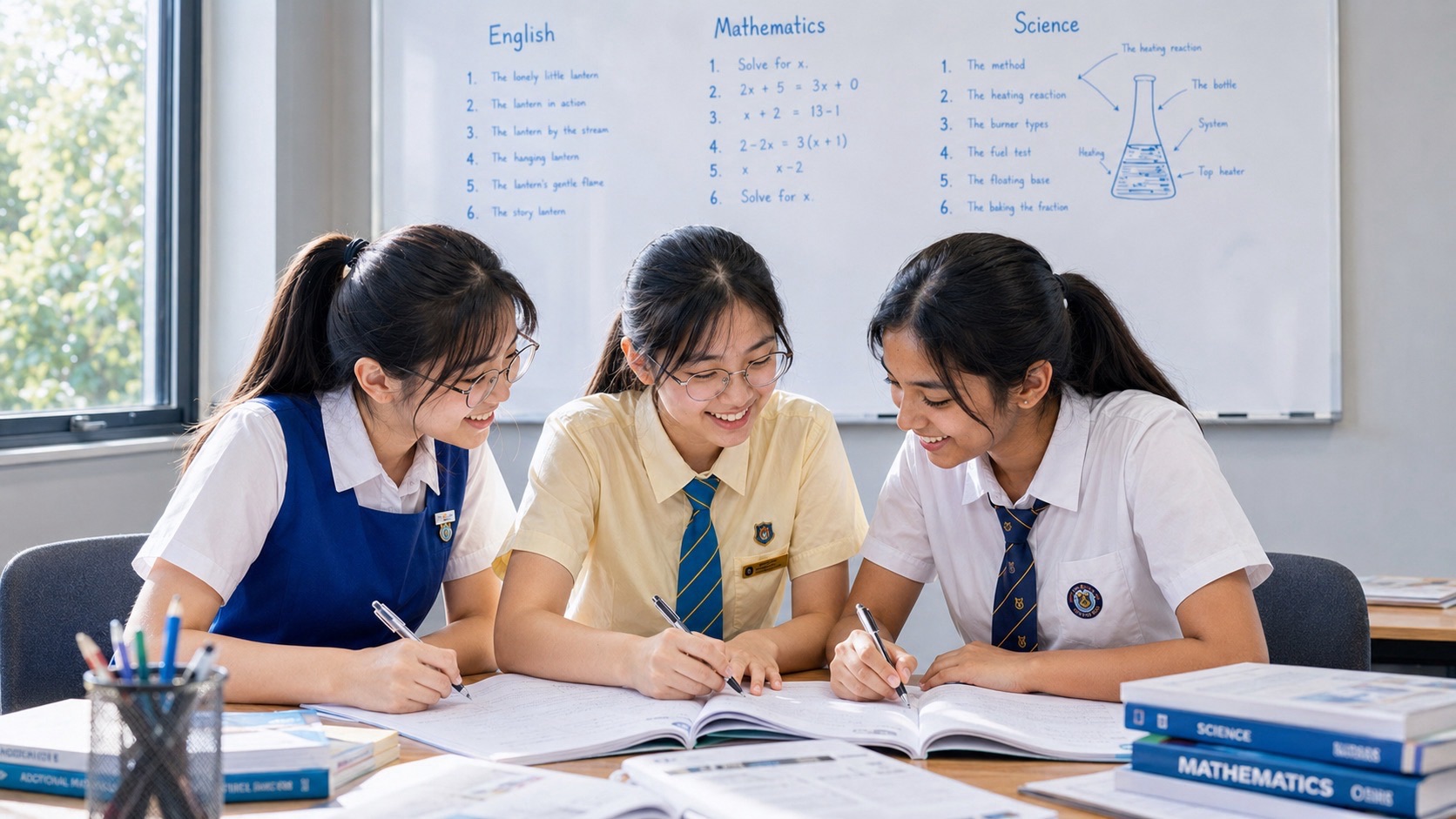
In a three-student group, these different reasoning paths can be compared without turning the lesson into a lecture.
The tutor can ask which step changed the argument and why.
Proof becomes a visible process of refinement.
51. Parents can support proof by asking one powerful question
“How do you know?”
The question works from Primary number sense through Secondary geometry and JC Mathematics.
Parents do not need to supply the theorem. They can ask what evidence supports the statement, whether another case could behave differently, or what rule permits the step.
The aim is not cross-examination.
It is to normalise the idea that mathematical conclusions should have reasons.
52. Family life can support a culture of reasons without turning every dinner into school
Children encounter claims constantly.
Which route is faster? Which purchase is better value? Why do you think this estimate is reasonable?
Occasional reasoning questions help children distinguish preference, guess, evidence and deduction.
eduKatePunggol’s Family Life Education Local Expert approach treats these everyday conversations as part of a broader learning environment while preserving the family’s ordinary life.
53. Punggol can provide conjectures that return to formal Mathematics
Local maps, structures and repeated patterns can generate mathematical questions.
Does a route that looks shorter on a map necessarily have shorter travel time? Which geometric assumptions are legitimate in a building plan? What scale relationship is preserved?
The Punggol as a Classroom article connects local experience with Mathematics, Science, Geography and urban design.
Reality can generate the question. Formal Mathematics decides what can actually be proved from the model.
54. Technology can help explore conjectures without proving them
Graphing and dynamic geometry tools can generate hundreds of examples quickly.
This is excellent for conjecture formation.
Move a point and watch an angle relationship remain. Change a parameter and observe a graph property persist.
The repeated behaviour suggests an invariant.
But the tool’s visual persistence does not replace proof. It tells the learner what may be worth proving.
55. Computer algebra can verify transformations without explaining why a theorem is true
A symbolic tool can expand both sides of an identity and show that they simplify to the same expression.
This can be useful verification.
But students should still understand the transformations and domain conditions that make the equivalence meaningful.
Tools are strong assistants for checking. Proof remains a reasoning standard, not a software button.
56. AI makes plausible proof-shaped errors easier to produce
An AI system can produce an argument that looks formal, fluent and confident.
That appearance should not be confused with validity.
A generated proof may introduce an unsupported claim, ignore a domain restriction or use a theorem under the wrong conditions.
The stronger automated reasoning becomes, the more valuable proof literacy becomes for the human reader.
Every line should still answer the question: why does this follow?
57. Students should learn to audit a proof they did not write
Proof literacy is broader than proof production.
Give students a completed argument and ask them to find the weakest step.
Which statement lacks justification? Was a theorem applied under all required conditions? Did the argument prove both directions? Was a special example mistaken for a general case?
Auditing teaches students to read Mathematics as an active reasoner rather than a passive recipient.
58. Proof errors should be classified by mechanism
“Proof wrong” is too broad for useful feedback.
Was the claim misstated? Was a definition misunderstood? Was a non-general example used? Was an implication reversed? Was there hidden division by zero? Was a case omitted?
Each error requires a different repair.
Precise diagnosis shortens the route from failed argument to improved reasoning.
59. A proof audit for one argument
- Claim: Is the statement precise?
- Domain: Which objects or values does it cover?
- Definitions: Which definitions can be unpacked?
- Premises: What is genuinely given or already established?
- Examples: Are examples being used only as evidence rather than universal proof?
- Counterexample: Has the claim survived reasonable attempts to disprove it?
- Steps: Does each line follow validly from earlier information?
- Conditions: Are theorem hypotheses and domain restrictions preserved?
- Completeness: Have all necessary cases or directions been covered?
- Conclusion: Does the final statement match exactly what was required?
This audit gives students a repeatable structure for reading and improving proofs.
60. A proof-discovery ladder
- Read: separate givens, definitions and target.
- Test: examine simple cases to understand behaviour.
- Challenge: search for a counterexample.
- Represent: rewrite using algebra, diagrams or other useful forms.
- Unpack: expand key definitions.
- Search: work forwards from premises and backwards from the target.
- Connect: activate relevant theorems and known structures.
- Draft: build a candidate chain.
- Audit: inspect every critical inference.
- Rewrite: present the argument clearly and economically.
The ladder distinguishes discovery from presentation while preserving the logical standard of the final result.
61. A proof-practice ladder
- Explain why a numerical answer is reasonable.
- Give a reason for one geometry relationship.
- Identify a missing step in a worked argument.
- Find a counterexample to a false conjecture.
- Complete a partially structured proof.
- Write a direct proof from definitions.
- Compare two valid proofs of the same claim.
- Choose between direct proof, cases or contradiction.
- Audit an unfamiliar argument for hidden assumptions.
- Generalise a result beyond the original problem.
Proof development should progress from justification habits toward increasingly independent argument design.
62. The proof loop
- Define: establish precise objects and conditions.
- Observe: inspect examples and patterns.
- Conjecture: state a possible general relationship.
- Challenge: search for counterexamples and missing conditions.
- Represent: choose algebraic, geometric or other useful forms.
- Deduce: build a valid chain from premises toward conclusion.
- Justify: make each important inference defensible.
- Verify: test the argument against examples, conditions and alternate representations.
- Generalise: determine the true scope of the result.
- Communicate: present the proof so another reader can audit it.
The loop may repeat. A failed counterexample search can strengthen a conjecture. A proof gap may reveal that the statement needs another condition. A successful proof may suggest a broader theorem.
63. The deepest lesson of proof is that confidence should follow reasons
Mathematics teaches an unusual standard of intellectual responsibility.
A claim can be attractive, intuitive and supported by many examples—and still be false.
Proof asks us to separate confidence from evidence and evidence from logical necessity.
This habit matters far beyond formal theorem proving. It trains students to ask what a conclusion depends on, which assumptions are hidden and whether a reason really supports the claim attached to it.
64. Mathematical proof converts pattern into knowledge
A pattern gives us something worth investigating.
A conjecture states what we think may be true. Counterexamples test the boundary. Definitions reveal the structure. Deduction links the structure to the conclusion. Justification makes the chain inspectable. Generalisation identifies how widely the result applies.
This is how Mathematics moves from “I noticed” to “I know why”.
The transition is one of the great intellectual achievements available to a student.
65. Proof is the discipline of making every important bridge carry weight
A proof is a chain of bridges.
Definitions connect objects to properties. Theorems connect conditions to consequences. Algebra connects equivalent forms. Logic connects premises to conclusions.
The chain is only as strong as the first unsupported bridge.
This is why proof fits naturally inside eduKatePunggol’s wider first-weak-link philosophy. When an argument fails, find the earliest place where validity is lost.
Repair that bridge, and the rest of the structure may stand.
Continue the Mathematics Education Systems series
- Mathematics Education Systems in Singapore
- How Mathematics Curriculum Works
- How Mathematics Teaching Works
- How Mathematics Assessment Works
- How Mathematical Reasoning Works
- How Mathematical Problem Solving Works
- How Mathematical Representation Works
- How Mathematical Modelling Works
- How Mathematical Communication Works
- How Mathematical Metacognition Works
- How Mathematical Fluency Works
- How Mathematical Practice Works
- How Mathematical Mastery Works
- How Algebraic Thinking Develops
- How Mathematical Verification Works
- How Mathematical Connections Work
- How Mathematical Abstraction Works
eduKatePunggol: Family Life Education Local Expert. Mathematical proof is the discipline of turning a pattern into a claim, challenging that claim, and building a chain of reasons strong enough that the conclusion no longer depends on trust, appearance or repetition.


