
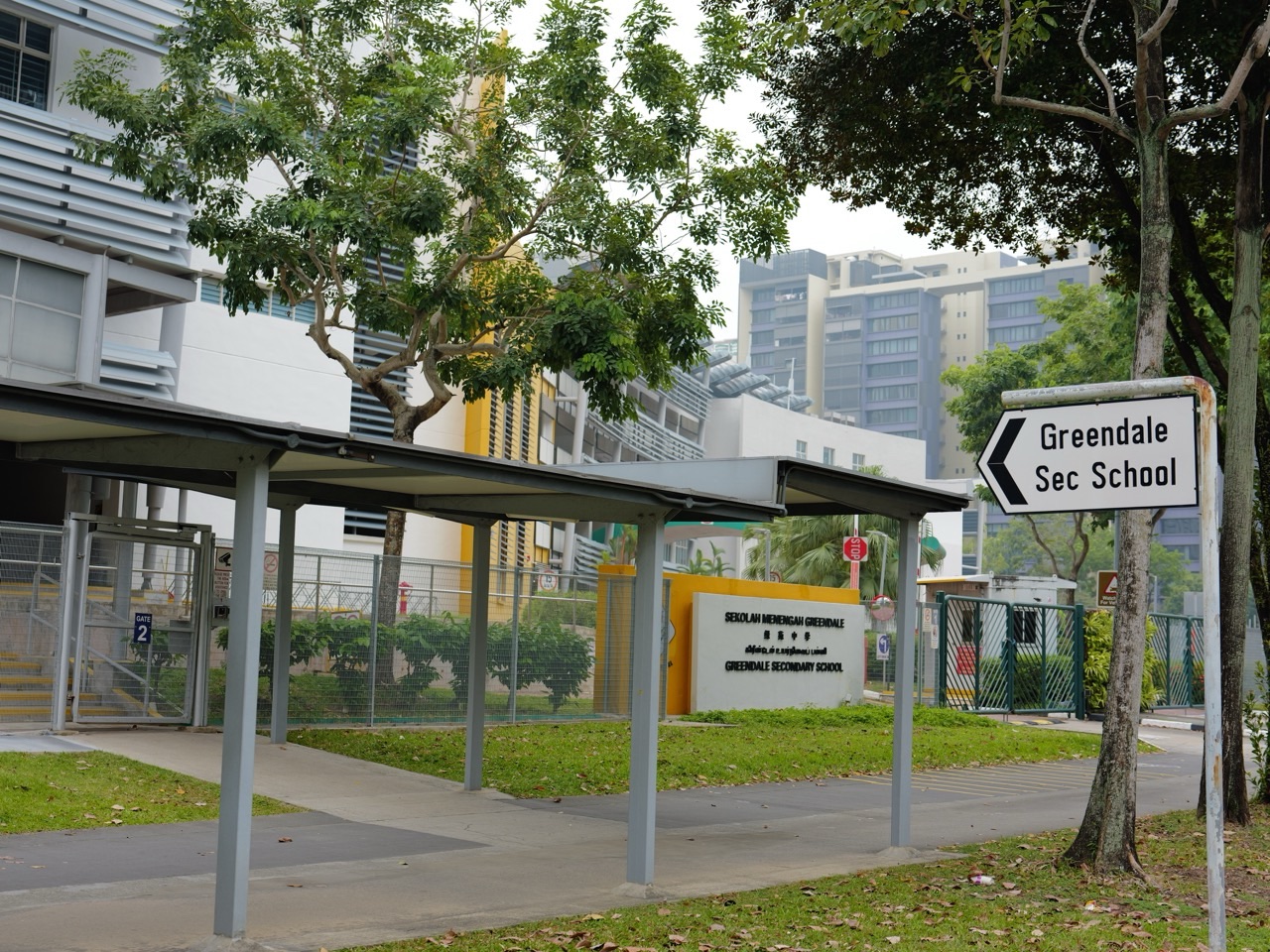
For a Punggol child with PSLE Score 24, the ordinary Secondary 1 admission group is Posting Group 2 (PG2). If your family is considering Greendale Secondary School, its last-posted PG2 cutoff from the completed 2026 Secondary 1 intake was 23—1 point more stringent than Score 24. The school is located at 51 Edgedale Plains, Singapore 828866 and its educational emphases include Design, Technology and Engineering (DTE) and Outdoor Adventure Education. A school’s older cutoff and programmes are useful research evidence, not a guarantee that a particular child will be posted in January 2027.
The first parent move is to check that the child is comfortable with most subjects starting at G2, compare the school’s classroom support and actual activities, and build six school choices the child would willingly attend. The four mainstream Punggol schools had previous PG2 last-posted scores of Punggol Secondary 24, Edgefield 23, Greendale 23 and Yusof Ishak 22. Use MOE SchoolFinder for current group-specific profiles and test the journey from your home block. The 2026 PSLE result is released on 24 November at 11.00am; the online six-choice window closes on 30 November 2026 at 4.30pm.
- Score: PSLE 24 ordinarily enters PG2, not the PG1/PG2 option band that begins at Score 25.
- Greendale Secondary: 51 Edgedale Plains, Singapore 828866.
- Previous 2026-entry PG2 cutoff: 23; 1 point more stringent than Score 24.
- Four Punggol campuses: 2026-entry PG2 cutoffs 22, 23, 23 and 24; each campus has a different programme mix and journey.
- Applied Learning: Design, Technology and Engineering (DTE).
- Learning for Life: Outdoor Adventure Education.
- Risk management: include eligible schools the child actually likes, with previous less stringent PG2 cutoffs of 25 where suitable; none is assured.
- Portal: six genuine choices, Singpass submission by Monday, 30 November 2026 at 4.30pm.
Quick information: compare all four Punggol schools
| School | 2026-entry PG2 last posted | Score 24 historical relationship | School-specific question |
|---|---|---|---|
| Punggol Secondary | 24 | Exact former boundary; not guaranteed | Would environmental inquiry and community leadership motivate the pupil? |
| Edgefield Secondary | 23 | One point more stringent | Does the child like G.E.M. creative problem-solving and sports character? |
| Greendale Secondary | 23 | One point more stringent | Does the child enjoy designing, coding, building and outdoor learning? |
| Yusof Ishak Secondary | 22 | Two points more stringent | Does smart-city STEM and civic leadership feel meaningful? |
The score ranges are for the 2026-entry intake following PSLE 2025. The new 2027-entry cutoffs are not fixed before the November 2026 exercise. A cutoff reflects the last posted pupil in a particular group, not a ranked measure of teaching quality. The numerical direction matters: lower PSLE totals are stronger, so an earlier cutoff of 25 would be less stringent than 24, while 23 is more stringent.
MOE encourages families to include two or three historically less stringent choices where possible. For a Score-24 PG2 child, some schools in Hougang, Serangoon or Pasir Ris with former cutoff 25 may help widen the list, but an old one-point margin is not an admission guarantee. The school’s actual location, subject options, culture and the pupil’s true preference should be checked for every entry.
Greendale at Score 24: attractive learning, uncertain admissions
Greendale Secondary’s 2026-entry historical PG2 last-posted score was 23. A pupil receiving Score 24 is one numerical point outside that previous boundary. The family may still investigate the school and consider it a genuine preference, but it should not be called a matched or safe PG2 choice before the new cohort’s cutoffs are known.
Greendale is at 51 Edgedale Plains, not the same campus as Edgefield Secondary at Punggol Field. Parents should not merge the two names or assume that identical previous PG2 cutoffs mean their subject programmes, CCAs or student cultures are identical.
The school’s distinctive Design, Technology and Engineering Applied Learning Programme and Outdoor Adventure LLP can suit a child who enjoys making, testing and working in teams. A parent should ask whether the pupil enjoys the process of correcting a prototype after it fails, rather than only the excitement of seeing a finished machine.
A realistic preference order should compare programme fit, G2 teaching support, school belonging and actual transport, then apply the historical cutoff information honestly. If Greendale is the child’s favourite, it may appear above a prior cutoff-24 school in the list because of genuine preference, but the family must prepare other schools it would willingly attend.
Design–Code–Build: what a Secondary 1 pupil learns
Greendale’s official ALP page says students engage in design thinking, coding and hands-on building with equipment such as Arduino microcontrollers, modelling software and rapid prototyping tools. In Secondary 1, its examples include making buzzers sound, switching LEDs, controlling servo motors and applying coding to the school’s hydroponics systems.
This is not just gadget play. A student must understand the sequence of instructions, what a particular component is doing, and how a change in the design affects the output. A child may find this satisfying because an idea becomes something observable. Another may prefer less technical projects but still gain useful problem-solving habits through the broad programme.
The school also describes learning computer-aided design and using 3D printing or laser cutting. Parents should ask what the ordinary incoming cohort actually uses, what safety instructions apply and how teachers help beginners who have never attended private robotics classes.
A pupil with a Score-24 profile might be confident with hands-on tasks but uncertain in formal Mathematics. Ask how the school helps pupils connect measurements, negative numbers, algebra and explanatory writing to practical work. An ALP can motivate learning, but it should not replace precise instruction and feedback in G2 subjects.
Hydroponics: connect sustainability with evidence
Greendale uses hydroponics and aquaponics as practical contexts for engineering and sustainability. In a school hydroponics setup, pupils may encounter questions about monitoring conditions, making a device reliable and interpreting measurements. The most important educational habit is to distinguish what the data show from what a student hopes are true.
A pupil who enjoys gardening but has never coded may still connect with the problem of keeping a system running. Another who loves programming may discover the need to understand biology and resource use. These interdisciplinary questions show why the ALP is more than preparation for one technical career.
Parents can ask the child to propose a simple monitoring system on paper. What should it measure, what could go wrong and what would make the recorded result unreliable? This is a safe, low-cost way to explore curiosity without trying to recreate the school’s actual classes.
The school should confirm whether specific plant-growth projects are broad-based or selective and how results are assessed. A photo of a hydroponics rack does not prove every pupil gets the same amount of time with it or automatic access to a competition.
Secondary 2 engineering and the Young Engineers Award
Greendale’s official ALP page describes Secondary 2 progression into more advanced Arduino work, wireless interfaces, AI and drone-related concepts. It also describes a Singapore Institute of Technology Community Challenge that asks pupils to co-create solutions with a community partner and present ideas for feedback.
This progression can help a child move from operating a simple controller to considering whether an intervention actually helps people. Parents should ask how students are taught to handle disagreement, avoid copying ready-made solutions and explain trade-offs when a prototype is not workable.
The school states that students who complete the relevant Secondary 1 and 2 ALP programme receive a Young Engineers Award (Applied Learning). This is a recognition attached to programme completion under the school’s stated arrangements, not a guarantee of admission to a polytechnic, an engineering diploma or employment.
Additional trips and competitions are often for selected students. Do not assume a child who joins Greendale will automatically attend overseas STEM enrichment or win a project award. The standard school experience, including academic subjects and friendships, should carry the decision.
Outdoor Adventure: how does it include a hesitant child?
Greendale’s Learning for Life Programme in Outdoor Adventure Education develops teamwork, resilience and leadership through supported physical and social challenges. A child who loves outdoor activities might find the experience motivating, while a pupil who hesitates around heights, water or unfamiliar environments may need sensitive preparation.
Ask which experiences are part of the incoming Secondary 1 programme, what safety and supervision procedures apply, and whether activities are adapted to different physical needs. The school might list historical experiences such as kayaking or rock climbing, but a family should confirm whether each applies to the specific cohort instead of promising it.
Outdoor character development should be judged by the ability to communicate, support peers and reflect constructively after setbacks, not only by athletic performance. A pupil who is not naturally daring can still develop responsibility and confidence when teachers introduce challenges appropriately.
The family should also ask how regular CCAs fit the week. Outdoor adventures and engineering may be exciting, but the pupil still needs time for dinner, sleep, G2 assignments and friendships. The best school choice will make those commitments sustainable.
Greendale vs Edgefield vs Punggol Secondary at Score 24
Greendale and Edgefield recorded the same previous PG2 cutoff of 23. They therefore have the same one-point historical gap for a Score-24 child, but their distinctive programmes differ. Greendale emphasises technology engineering and outdoor learning; Edgefield emphasises entrepreneurial thinking and character education through Taekwondo.
Punggol Secondary recorded an older PG2 cutoff of 24, an exact historical numerical match. A parent interested in one-point margins may investigate it as well, but should not rank it higher unless the child prefers that school overall. Environmental education and community leadership may suit a different pupil from engineering and outdoor adventure.
Regional schools with old PG2 last-posted scores of 25 can provide additional numerical variety in a six-school shortlist. Yuying, Serangoon Secondary, Peicai and Meridian are examples, but they are not identical commutes or guaranteed outcomes. Every added school must be genuinely acceptable to the child.
The family can use a three-column table: programme fit, actual previous PG2 cutoff, and travel-plus-support. This keeps the decision educational rather than an attempt to exploit a number. A higher cutoff is not proof of weaker teaching, and an exact old cutoff does not reserve a seat.
How the selected Posting Group relates to actual subject levels
Posting Group 2 determines the admission pool and generally indicates that most initial subjects are studied at G2 under Full Subject-Based Banding. It does not mean every subject must remain at the same level forever. Subject-specific Achievement Levels, MOE eligibility rules and school arrangements can lead to individual G-level offerings where eligible. An aggregate Score 24 does not automatically guarantee G3 Mathematics, Science or English.
Parents should read the child’s individual PSLE English, Mathematics, Science and Mother Tongue results. A pupil may have strong reading skills but need to repair algebra, or enjoy experiments while struggling to write conclusions. Those needs lead to different support plans even when the overall number is identical. Ask the receiving school what it actually offers and how it helps students learn from a weak assessment.
A school programme can motivate a child to persevere, but it is not a substitute for ordinary teaching. A child interested in engineering still needs quantitative reasoning; one interested in community work must understand sources and express ideas clearly. Ask prospective schools how lower-secondary G2 subjects are taught, how teachers return corrections and whom pupils approach when a concept remains confusing.
From 2027 the Singapore-Cambridge Secondary Education Certificate (SEC) operates under the new Full SBB framework. A child entering Secondary 1 in 2027 would ordinarily reach graduating examinations several years later; actual later admission pathways depend on subjects, levels, grades and future policies. Neither the school name nor the PSLE total guarantees a JC, polytechnic, PFP or ITE place.
Compare school routines, not only colourful programme photographs
School belonging begins with ordinary lessons, friendships, a form teacher and a predictable way to seek help. Ask how the school introduces incoming Secondary 1 pupils, how it responds to bullying or exclusion and what support is available when someone struggles with organisation or learning. A public programme page cannot guarantee the precise specialist services needed by a particular pupil; discuss these privately with school staff.
Co-Curricular Activities (CCAs) matter because they occupy real afternoons and can help children develop confidence outside academic work. Verify which CCAs currently welcome beginners, which require tryouts and how late training might run. A pupil who already practices music or sport outside school may have different time needs from one excited to explore several new clubs.
A parent may be impressed by a national competition or an external partnership, but an ordinary student does not automatically receive every selected workshop, prize or leadership role. Ask which Applied Learning and Learning for Life experiences are broad-based for the incoming year level and which are opportunities for specific pupils. The everyday school experience must support a child even without special recognition.
The school’s learning environment should also suit a pupil who is willing to ask questions. If a child fears embarrassment after an incorrect answer, ask how teachers normalise correction and how classmates are taught to respond respectfully. Clear feedback and secure relationships are often more important to long-term progress than an impressive headline about a programme.
A score-24 six-choice worksheet for parents
| School to investigate | Previous PG2 last posted | How to interpret for Score 24 |
|---|---|---|
| Punggol Secondary | 24 | Exact prior boundary; research and compare carefully |
| Edgefield / Greendale | 23 | More stringent by 1 point; historically aspirational |
| Yusof Ishak | 22 | More stringent by 2 points; historically aspirational |
| Seng Kang / Compassvale / North Vista / Hougang | 24 | Exact previous boundary; no guarantee |
| Yuying / Serangoon Secondary / Peicai / Meridian | 25 | One point less stringent in the earlier exercise; still uncertain |
This table is a research map, not a recommended preference order. One family may rank Greendale Secondary first because of educational fit, while another prioritises a school with a more manageable CCA journey or different academic support. The child’s actual opinion should be heard: would they still be willing to attend if their friend chose elsewhere, if a particular club was full or if they needed to work hard in a subject they currently find difficult?
For ordinary S1 posting, applicants compete under the selected group and its available places. Among equal-score pupils vying for final places, the published tie-break sequence can involve citizenship, school choice order and computerised balloting. A cut-off point does not reveal the new cohort’s preferences, and a parent cannot infer a credible admission probability from one previous number.
Use all six school choices with genuine preferences. Do not place an unacceptable school as the sixth choice in the hope that it will not matter, and do not list a campus only because it has a larger last-posted number. Compare the route, programmes, subject levels, practical support and the child’s interests before ranking.
If your family cannot construct six acceptable schools, seek advice from the child’s primary school and widen research thoughtfully. The goal is a supportive Secondary 1 placement, not an online exercise that declares a school automatically safe.
Travel: Punggol is not one starting point
The school’s address is 51 Edgedale Plains, Singapore 828866, but a household in Northshore or Punggol Coast may have a very different journey from a family near Waterway Point, Matilda, Oasis or Punggol Field. Check the actual student entrance, the path from the home block to the first bus or LRT stop, crossing safety and the normal morning reporting time. An estimated travel time using only Punggol MRT as the origin can omit a substantial part of the route.
Repeat the journey at a later CCA dismissal time, when bus frequencies, crowding, weather and fatigue may differ. Have the child practise safely with an adult and identify a trusted contact in case the transport service is disrupted. A short route can improve sleep and homework time, but does not guarantee admission or make an unsuitable school a good fit.
If a regional school offers a more favourable historical cutoff but the commute is exhausting, parents should discuss that openly. A one-point numerical margin cannot compensate for a child repeatedly arriving overwhelmed, and a nearby campus with a more stringent cutoff cannot be described as assured. Treat admissions, teaching and transport as separate facts that must all work together.
How to support a child before Secondary 1 starts
Immediately after results, allow the child to respond before comparisons begin. Some pupils are excited; others feel discouraged or frightened about leaving friends. A useful parental sentence is: “We know what this score means for the posting group, and we will compare schools that fit your learning and daily life. The previous cutoffs are only guides.” This is realistic without pretending the child can control every allocation outcome.
For English, practise reading a short unfamiliar passage and explaining an inference using evidence. For Mathematics, use a few thoughtful problems on fractions, negative numbers or balanced equations and ask the child to justify a step. For Science, discuss a fair test and the difference between an observation and an explanation. Short exercises followed by useful corrections can be more valuable than a large number of advanced worksheets.
After posting, wait for the real receiving school’s booklist, subject-level allocation, uniform and orientation notices. If the family is applying for assistance, follow the school’s instructions before buying items that may not be reimbursed. Practise the travel route and let the pupil learn how to record homework, ask for help and manage a simple weekly routine.
In the first month, listen for patterns rather than treating one difficult day as failure. A child may need time to find friendships and adjust to a new timetable. If problems with attendance, learning or wellbeing persist, contact teachers appropriately and identify a concrete plan. The measure of a successful transition is growing capability and belonging, not immediate superiority to peers.
Official dates for the 2026 PSLE and S1 Posting
| Event | Singapore date and time | Parent action |
|---|---|---|
| PSLE results | Tuesday 24 November 2026, 11.00am | Collect official result; check Posting Group and individual subject ALs. |
| S1 Portal opens | Tuesday 24 November 2026, 11.30am | Select the eligible group and consider six genuine school options. |
| S1 Portal closes | Monday 30 November 2026, 4.30pm | Submit the final ranked list through Singpass; retain confirmation. |
| S1 posting result | Tentatively Friday 18 December 2026 | Follow the final MOE announcement and posted school’s instructions. |
The timetable above comes from SEAB’s 17 November 2026 announcement. The December posting-results date is tentative until later confirmation. Only one parent needs valid Singpass to submit the ordinary S1 choices. Families who require assistance should contact their child’s primary school before the deadline, and children with an accepted DSA-Sec place should follow the specific instructions applying to that admission route.
A parent can use the next few days to visit official school sites, ask focused questions and discuss personal preferences without rushing to submit incomplete data. Posting is not a first-come-first-served reward for clicking at 11.30am, but failing to meet the actual deadline can create serious problems. Keep the confirmation of the choices submitted.
Frequently asked questions: Greendale Secondary at Score 24
Does a Score-24 PG2 pupil match Greendale’s previous cutoff?
No. Greendale’s 2026-entry PG2 cutoff was 23, one point more stringent.
Is Greendale a specialist engineering school?
It is a mainstream secondary school with a Design, Technology and Engineering ALP, not an automatic engineering qualification.
Do all pupils receive the Young Engineers Award?
The school describes an award after completing the relevant lower-secondary programme; confirm conditions for the 2027 cohort rather than assuming automatic recognition.
Does outdoor LLP guarantee kayaking?
No. Cohort activities, eligibility and adaptations should be verified with the school.
Which Punggol campus had a historical PG2 cutoff 24?
Punggol Secondary. That is a previous exact boundary for Score 24, not a new admission guarantee.
Does Greendale have the same programmes as Edgefield?
No. Although both ended at 23 in the earlier PG2 exercise, their ALP and LLP emphases differ.
Is Score 24 eligible to opt for PG1 instead of PG2?
Not ordinarily. PSLE Scores 23–24 are placed in PG2; the PG1/PG2 choice appears at Score 25. Check the child’s official result for any exceptional circumstances.
Does an old cutoff of 25 guarantee admission for Score 24?
No. It is numerically one point less stringent in that completed intake, but the next cohort can have different cutoffs and tie-breaker outcomes.
Should we rank schools only by the highest historical cutoff?
No. Rank genuine acceptable preferences after checking eligibility, student support, programmes and travel. An old cutoff is admissions context, not a teaching-quality rating.
Can every pupil join the headline ALP or competition?
Some curricular activities are schoolwide, while selected competitions, CCAs and talent programmes may have additional requirements. Confirm exact 2027 arrangements with the school.
What if the allocated school was not our first choice?
Follow the official posting result, preserve the assigned place and contact the receiving school about induction. Appeals and transfers, where allowed, follow current conditions and vacancies.
Will PG2 decide my child’s eventual ITE, polytechnic or JC pathway?
No. Later opportunities depend on secondary subjects, actual G-levels, grades and the applicable admissions rules. Focus now on a sustainable learning environment.
Final checklist for parents
- Read the child’s actual PSLE Score 24 and confirm PG2 posting eligibility and subject results.
- Look up Greendale Secondary School and its actual 23 historical PG2 cutoff in the appropriate school profile.
- Keep the 2026-entry figures clearly separate from the as-yet-unknown 2027-entry cutoff.
- Ask about G2 subject teaching, the child’s individual strengths and learning support.
- Research Design, Technology and Engineering (DTE) and Outdoor Adventure Education, including broad-based versus selected opportunities.
- Test the ordinary morning and late-CCA route from your own Punggol block.
- Build a complete six-school list of genuine eligible preferences, including less stringent prior cutoff options where viable.
- Submit in the official S1 Portal before Monday, 30 November 2026 at 4.30pm.
- Keep the confirmation, then follow the allocated school’s actual induction and reporting instructions.
Conclusion: Greendale Secondary offers a distinctive experience in design, technology and engineering (dte) and outdoor adventure education. Edgefield also had a previous PG2 cutoff of 23, but its entrepreneurial and Taekwondo emphases differ from Greendale’s engineering and outdoor learning. The correct choice depends on the pupil’s interests, support needs, actual school-day experience and a realistic six-school list—not a claim that past score ranges can guarantee a new place.
Official starting points: Greendale Secondary’s published school information, MOE SchoolFinder, MOE Full Subject-Based Banding, MOE S1 Posting and SEAB’s 2026 results announcement. Further Punggol parent guidance: the Score-24 PG2 master guide, the four-school Punggol comparison and the results and appeals guide.
Editorial verification: 19 November 2026. The school cutoffs quoted are from the completed Secondary 1 intake for 2026 following PSLE 2025, not the results of the coming 2026 PSLE or the still-uncompleted 2027-entry exercise. School programmes and exact cohort activities should be reconfirmed on official school sites. This is an educational fit guide, not a school-quality ranking or an admission promise.


