
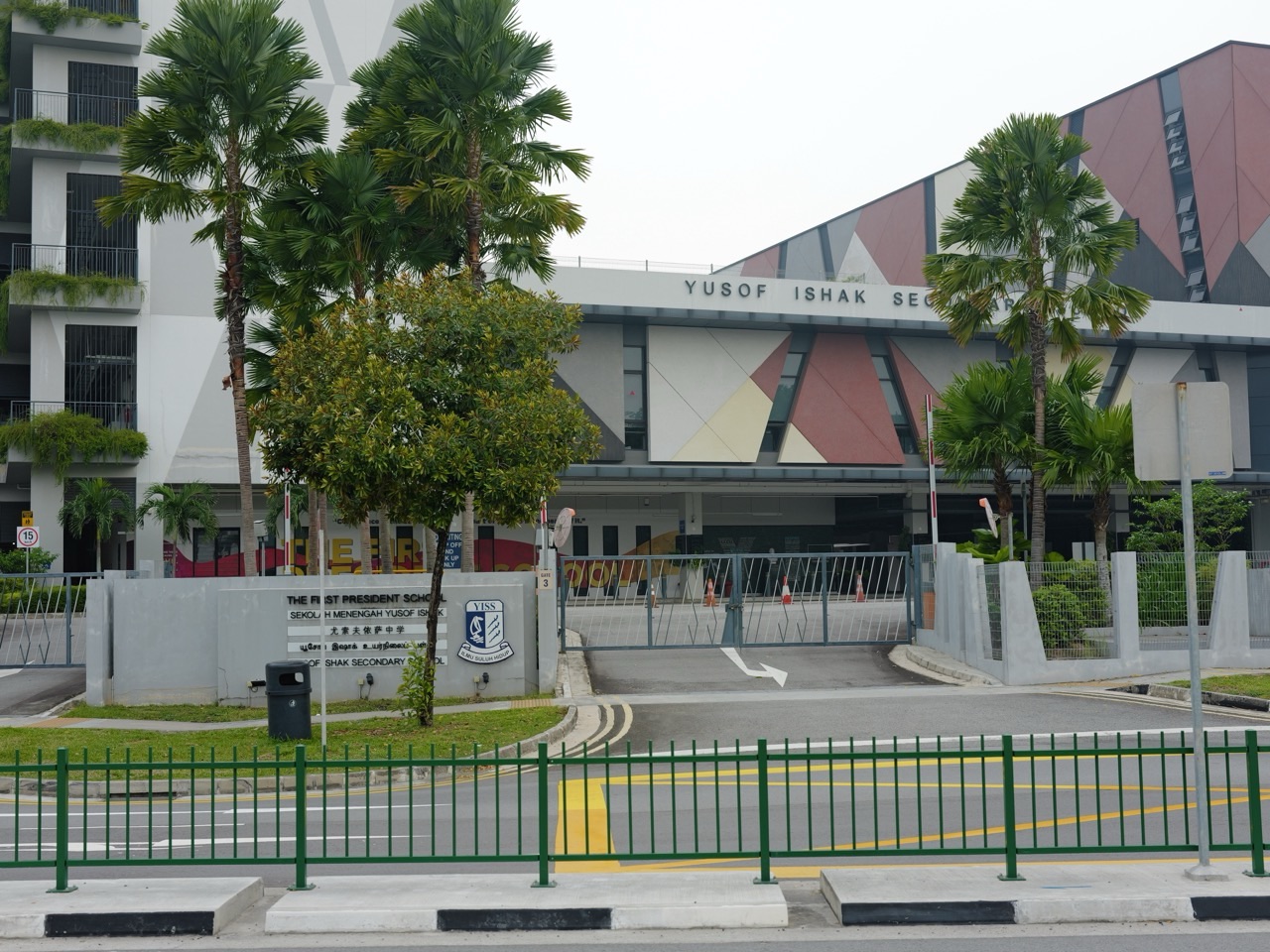
For a Punggol child with PSLE Score 24, the ordinary Secondary 1 admission group is Posting Group 2 (PG2). If your family is considering Yusof Ishak Secondary School, its last-posted PG2 cutoff from the completed 2026 Secondary 1 intake was 22—2 points more stringent than Score 24. The school is located at 8 Sumang Walk, Singapore 828676 and its educational emphases include S4TEM@YI: STEM for a Sustainable and Smart City and YI LEAD+ leadership for the greater good. A school’s older cutoff and programmes are useful research evidence, not a guarantee that a particular child will be posted in January 2027.
The first parent move is to check that the child is comfortable with most subjects starting at G2, compare the school’s classroom support and actual activities, and build six school choices the child would willingly attend. The four mainstream Punggol schools had previous PG2 last-posted scores of Punggol Secondary 24, Edgefield 23, Greendale 23 and Yusof Ishak 22. Use MOE SchoolFinder for current group-specific profiles and test the journey from your home block. The 2026 PSLE result is released on 24 November at 11.00am; the online six-choice window closes on 30 November 2026 at 4.30pm.
- Score: PSLE 24 ordinarily enters PG2, not the PG1/PG2 option band that begins at Score 25.
- Yusof Ishak Secondary: 8 Sumang Walk, Singapore 828676.
- Previous 2026-entry PG2 cutoff: 22; 2 points more stringent than Score 24.
- Four Punggol campuses: 2026-entry PG2 cutoffs 22, 23, 23 and 24; each campus has a different programme mix and journey.
- Applied Learning: S4TEM@YI: STEM for a Sustainable and Smart City.
- Learning for Life: YI LEAD+ leadership for the greater good.
- Risk management: include eligible schools the child actually likes, with previous less stringent PG2 cutoffs of 25 where suitable; none is assured.
- Portal: six genuine choices, Singpass submission by Monday, 30 November 2026 at 4.30pm.
Quick information: compare all four Punggol schools
| School | 2026-entry PG2 last posted | Score 24 historical relationship | School-specific question |
|---|---|---|---|
| Punggol Secondary | 24 | Exact former boundary; not guaranteed | Would environmental inquiry and community leadership motivate the pupil? |
| Edgefield Secondary | 23 | One point more stringent | Does the child like G.E.M. creative problem-solving and sports character? |
| Greendale Secondary | 23 | One point more stringent | Does the child enjoy designing, coding, building and outdoor learning? |
| Yusof Ishak Secondary | 22 | Two points more stringent | Does smart-city STEM and civic leadership feel meaningful? |
The score ranges are for the 2026-entry intake following PSLE 2025. The new 2027-entry cutoffs are not fixed before the November 2026 exercise. A cutoff reflects the last posted pupil in a particular group, not a ranked measure of teaching quality. The numerical direction matters: lower PSLE totals are stronger, so an earlier cutoff of 25 would be less stringent than 24, while 23 is more stringent.
MOE encourages families to include two or three historically less stringent choices where possible. For a Score-24 PG2 child, some schools in Hougang, Serangoon or Pasir Ris with former cutoff 25 may help widen the list, but an old one-point margin is not an admission guarantee. The school’s actual location, subject options, culture and the pupil’s true preference should be checked for every entry.
Yusof Ishak at Score 24: what the old cutoff actually means
For the completed 2026 Secondary 1 intake, Yusof Ishak Secondary had a PG2 last-posted PSLE Score of 22. A child scoring 24 in PSLE 2026 is two points numerically weaker than that previous admission boundary. Parents may investigate the school because of location or educational interest, but it should be treated as historically more competitive rather than matched or safe.
A two-point gap is a fact about one completed intake, not a mathematical prediction. School preferences, cohort results and available places can change; the eventual cutoff for 2027 is not predetermined. A family must avoid saying the child has no legal right to list the school solely because of the older number, while also avoiding promises that the cutoff will shift far enough.
The school is at 8 Sumang Walk. A family near Soo Teck or Sumang may value the possibility of a simpler morning journey and a familiar environment. But proximity does not itself confer general automatic admission priority in ordinary Secondary 1 posting, and another family in Punggol may face a longer route.
The honest question is whether Yusof Ishak is sufficiently attractive to the child to consider as an aspirational school, while the other five preferences represent meaningful and realistic alternatives. If every chosen campus was similarly more stringent in the prior exercise, the family should widen its research rather than hope that all old cutoffs will change in the same direction.
S4TEM@YI: practical learning about a sustainable city
Yusof Ishak Secondary’s Applied Learning Programme is S4TEM@YI, a STEM experience framed around developing a sustainable and smart city. The official school description connects scientific knowledge, environmental understanding and problem-solving to the community. It is broader than a robotics club or a promise of technical employment.
Schoolwide experiences listed in its 2026 material include urban farming, coding and aeronautics. A student who is curious about the way technology affects food production, transport or resource use may find the programme meaningful. Parents should ask what an ordinary Secondary 1 pupil does rather than assume they will enter every specialist activity on the page.
A useful family conversation is how a smart city might help residents while reducing resource waste. What would need to be measured, whose needs might be neglected and what evidence would show a solution actually worked? Such questions connect Science, Mathematics, written explanation and empathy.
A programme name can sound advanced, but a beginner should still be able to learn. Ask how teachers introduce coding and practical enquiry to children who have not attended external STEM enrichment. Do not equate primary-school robotics trophies with overall suitability for an ordinary mainstream curriculum.
Urban farming and the idea of an interconnected system
The school’s official ALP page describes learning through plants grown in soil and hydroponic arrangements, and highlights its AgriSphere garden learning spaces among earlier programme developments. Students can connect technology and ecology by observing conditions, thinking about measurement and reflecting on resource use.
A pupil who enjoys urban farms may be motivated by hands-on work even if written Science explanations are difficult. Parents should ask how school activities help the student translate observations into accurate evidence and a conclusion. Making a system work is valuable, but explaining why it works is also part of sound learning.
Another pupil might approach the same environment through coding or sensors. What should a monitoring system detect? How would false readings be discovered? What should the design do if a sensor fails? These are low-cost questions parents can explore without buying equipment or making assumptions about the school’s exact annual project.
The presence of school facilities does not guarantee every student the same access to selected research or competitions. Confirm which activities are for the full cohort and which require a particular club, opportunity or teacher recommendation.
STEMx and the challenge of working across subjects
The school describes STEM Experiences through Inter-disciplinary Work, or STEMx IPW, to help pupils connect learning that is not confined to a single subject. Sustainable city problems often require technical reasoning and social judgement at the same time. This may suit a child who enjoys asking how systems interact.
For example, an improvement to a water or transport system must be explained in words, tested with data and understood in relation to the people who use it. A pupil confident in Science but hesitant with English will still need explicit support to read and report accurately. Ask how group work is assessed and what teachers do when a quieter child contributes useful research but speaks less during presentations.
The school mentions collaborations and enrichment with organisations such as A*STAR, SUTD, SIT and NParks. These are examples of experiences the institution has provided, not guarantees of internships, scholarships or university entry for an individual new student. Some activities may be selective or intended for older cohorts.
Parents can evaluate the programme by asking a teacher for a routine Secondary 1 example rather than relying on the school’s most impressive competition achievement. A student who learns to question evidence, cooperate and refine an explanation is gaining something useful even without entering a specialised award competition.
YI LEAD+: leadership for people, not only titles
The Learning for Life Programme, YI LEAD+, seeks to nurture honourable leaders who contribute to the greater good. The school’s programme materials mention values such as integrity, gratitude, respect, teamwork and ethical decision-making. Such a focus can balance the excitement of technology with responsibility toward others.
A confident pupil may enjoy leading a service team, but a child who prefers organising quietly can also develop leadership. Ask the school what every Secondary 1 class participates in, what service opportunities require selection and how teachers help pupils express disagreements respectfully.
A smart-city project may fail if it serves only some residents. A leadership programme can help the pupil consider inclusion, affordability and the unintended effects of a proposed technical solution. Parents can ask how students learn to listen before advocating for a change.
Formal leadership roles, dialogue events or selective workshops should not be assumed guaranteed for every entrant. The stronger reason to choose a school is the character of ordinary relationships and learning, not an expectation that the child will immediately be appointed to a prestigious position.
Sumang Walk, PG2 risk and a sensible six-school backup plan
Yusof Ishak’s prior PG2 cutoff of 22 was two points more stringent than a Score-24 result. Punggol Secondary’s prior PG2 cutoff of 24 matched the same child’s result, while Edgefield and Greendale ended at 23. A family who lives near Sumang should understand that Yusof Ishak offers the most challenging historical numerical comparison among the four local mainstream campuses for this score.
That does not mean the family must give up an authentic first preference. It means the remaining options should be ones the child would truly attend. Schools in Sengkang and Hougang with prior PG2 cutoffs of 24 may be investigated, while some regional schools at 25 offer a one-point less stringent historical comparison. Check actual eligibility, culture, programmes and routes in MOE SchoolFinder.
An illustrative research set might include Yusof Ishak, Punggol Secondary, North Vista, Seng Kang Secondary, Yuying and Serangoon Secondary. Their old PG2 cutoffs were 22, 24, 24, 24, 25 and 25 respectively. This is not a guaranteed or universally ranked list; the parent should change entries that the child would not willingly attend or cannot safely reach.
Discuss with the child why a two-point historical gap matters without implying their worth is lower because another pupil achieved a smaller number. The family’s goal is to support an appropriate Secondary 1 start, not to turn cutoffs into a moral judgement.
How the selected Posting Group relates to actual subject levels
Posting Group 2 determines the admission pool and generally indicates that most initial subjects are studied at G2 under Full Subject-Based Banding. It does not mean every subject must remain at the same level forever. Subject-specific Achievement Levels, MOE eligibility rules and school arrangements can lead to individual G-level offerings where eligible. An aggregate Score 24 does not automatically guarantee G3 Mathematics, Science or English.
Parents should read the child’s individual PSLE English, Mathematics, Science and Mother Tongue results. A pupil may have strong reading skills but need to repair algebra, or enjoy experiments while struggling to write conclusions. Those needs lead to different support plans even when the overall number is identical. Ask the receiving school what it actually offers and how it helps students learn from a weak assessment.
A school programme can motivate a child to persevere, but it is not a substitute for ordinary teaching. A child interested in engineering still needs quantitative reasoning; one interested in community work must understand sources and express ideas clearly. Ask prospective schools how lower-secondary G2 subjects are taught, how teachers return corrections and whom pupils approach when a concept remains confusing.
From 2027 the Singapore-Cambridge Secondary Education Certificate (SEC) operates under the new Full SBB framework. A child entering Secondary 1 in 2027 would ordinarily reach graduating examinations several years later; actual later admission pathways depend on subjects, levels, grades and future policies. Neither the school name nor the PSLE total guarantees a JC, polytechnic, PFP or ITE place.
Compare school routines, not only colourful programme photographs
School belonging begins with ordinary lessons, friendships, a form teacher and a predictable way to seek help. Ask how the school introduces incoming Secondary 1 pupils, how it responds to bullying or exclusion and what support is available when someone struggles with organisation or learning. A public programme page cannot guarantee the precise specialist services needed by a particular pupil; discuss these privately with school staff.
Co-Curricular Activities (CCAs) matter because they occupy real afternoons and can help children develop confidence outside academic work. Verify which CCAs currently welcome beginners, which require tryouts and how late training might run. A pupil who already practices music or sport outside school may have different time needs from one excited to explore several new clubs.
A parent may be impressed by a national competition or an external partnership, but an ordinary student does not automatically receive every selected workshop, prize or leadership role. Ask which Applied Learning and Learning for Life experiences are broad-based for the incoming year level and which are opportunities for specific pupils. The everyday school experience must support a child even without special recognition.
The school’s learning environment should also suit a pupil who is willing to ask questions. If a child fears embarrassment after an incorrect answer, ask how teachers normalise correction and how classmates are taught to respond respectfully. Clear feedback and secure relationships are often more important to long-term progress than an impressive headline about a programme.
A score-24 six-choice worksheet for parents
| School to investigate | Previous PG2 last posted | How to interpret for Score 24 |
|---|---|---|
| Punggol Secondary | 24 | Exact prior boundary; research and compare carefully |
| Edgefield / Greendale | 23 | More stringent by 1 point; historically aspirational |
| Yusof Ishak | 22 | More stringent by 2 points; historically aspirational |
| Seng Kang / Compassvale / North Vista / Hougang | 24 | Exact previous boundary; no guarantee |
| Yuying / Serangoon Secondary / Peicai / Meridian | 25 | One point less stringent in the earlier exercise; still uncertain |
This table is a research map, not a recommended preference order. One family may rank Yusof Ishak Secondary first because of educational fit, while another prioritises a school with a more manageable CCA journey or different academic support. The child’s actual opinion should be heard: would they still be willing to attend if their friend chose elsewhere, if a particular club was full or if they needed to work hard in a subject they currently find difficult?
For ordinary S1 posting, applicants compete under the selected group and its available places. Among equal-score pupils vying for final places, the published tie-break sequence can involve citizenship, school choice order and computerised balloting. A cut-off point does not reveal the new cohort’s preferences, and a parent cannot infer a credible admission probability from one previous number.
Use all six school choices with genuine preferences. Do not place an unacceptable school as the sixth choice in the hope that it will not matter, and do not list a campus only because it has a larger last-posted number. Compare the route, programmes, subject levels, practical support and the child’s interests before ranking.
If your family cannot construct six acceptable schools, seek advice from the child’s primary school and widen research thoughtfully. The goal is a supportive Secondary 1 placement, not an online exercise that declares a school automatically safe.
Travel: Punggol is not one starting point
The school’s address is 8 Sumang Walk, Singapore 828676, but a household in Northshore or Punggol Coast may have a very different journey from a family near Waterway Point, Matilda, Oasis or Punggol Field. Check the actual student entrance, the path from the home block to the first bus or LRT stop, crossing safety and the normal morning reporting time. An estimated travel time using only Punggol MRT as the origin can omit a substantial part of the route.
Repeat the journey at a later CCA dismissal time, when bus frequencies, crowding, weather and fatigue may differ. Have the child practise safely with an adult and identify a trusted contact in case the transport service is disrupted. A short route can improve sleep and homework time, but does not guarantee admission or make an unsuitable school a good fit.
If a regional school offers a more favourable historical cutoff but the commute is exhausting, parents should discuss that openly. A one-point numerical margin cannot compensate for a child repeatedly arriving overwhelmed, and a nearby campus with a more stringent cutoff cannot be described as assured. Treat admissions, teaching and transport as separate facts that must all work together.
How to support a child before Secondary 1 starts
Immediately after results, allow the child to respond before comparisons begin. Some pupils are excited; others feel discouraged or frightened about leaving friends. A useful parental sentence is: “We know what this score means for the posting group, and we will compare schools that fit your learning and daily life. The previous cutoffs are only guides.” This is realistic without pretending the child can control every allocation outcome.
For English, practise reading a short unfamiliar passage and explaining an inference using evidence. For Mathematics, use a few thoughtful problems on fractions, negative numbers or balanced equations and ask the child to justify a step. For Science, discuss a fair test and the difference between an observation and an explanation. Short exercises followed by useful corrections can be more valuable than a large number of advanced worksheets.
After posting, wait for the real receiving school’s booklist, subject-level allocation, uniform and orientation notices. If the family is applying for assistance, follow the school’s instructions before buying items that may not be reimbursed. Practise the travel route and let the pupil learn how to record homework, ask for help and manage a simple weekly routine.
In the first month, listen for patterns rather than treating one difficult day as failure. A child may need time to find friendships and adjust to a new timetable. If problems with attendance, learning or wellbeing persist, contact teachers appropriately and identify a concrete plan. The measure of a successful transition is growing capability and belonging, not immediate superiority to peers.
Official dates for the 2026 PSLE and S1 Posting
| Event | Singapore date and time | Parent action |
|---|---|---|
| PSLE results | Tuesday 24 November 2026, 11.00am | Collect official result; check Posting Group and individual subject ALs. |
| S1 Portal opens | Tuesday 24 November 2026, 11.30am | Select the eligible group and consider six genuine school options. |
| S1 Portal closes | Monday 30 November 2026, 4.30pm | Submit the final ranked list through Singpass; retain confirmation. |
| S1 posting result | Tentatively Friday 18 December 2026 | Follow the final MOE announcement and posted school’s instructions. |
The timetable above comes from SEAB’s 17 November 2026 announcement. The December posting-results date is tentative until later confirmation. Only one parent needs valid Singpass to submit the ordinary S1 choices. Families who require assistance should contact their child’s primary school before the deadline, and children with an accepted DSA-Sec place should follow the specific instructions applying to that admission route.
A parent can use the next few days to visit official school sites, ask focused questions and discuss personal preferences without rushing to submit incomplete data. Posting is not a first-come-first-served reward for clicking at 11.30am, but failing to meet the actual deadline can create serious problems. Keep the confirmation of the choices submitted.
Frequently asked questions: Yusof Ishak Secondary at Score 24
Is Yusof Ishak an exact historical PG2 match for Score 24?
No. Its completed 2026-entry PG2 cutoff was 22, two points more stringent.
Does living close to Sumang Walk guarantee admission?
No general automatic locality preference applies in ordinary S1 posting. Check MOE’s group and score rules.
Will all pupils receive aeronautics and urban farming exposure?
The official ALP mentions schoolwide exposure in those areas; confirm the actual arrangements for the 2027 cohort.
Is S4TEM@YI a guarantee of a STEM career?
No. It develops useful learning and interest; later courses and professional qualifications have separate requirements.
Which Punggol school had the previous PG2 cutoff of 24?
Punggol Secondary, an exact historical boundary for Score 24 but not a guarantee.
Does YI LEAD+ guarantee a formal leadership role?
No. Character development can involve every pupil; selected offices or programmes may have distinct conditions.
Is Score 24 eligible to opt for PG1 instead of PG2?
Not ordinarily. PSLE Scores 23–24 are placed in PG2; the PG1/PG2 choice appears at Score 25. Check the child’s official result for any exceptional circumstances.
Does an old cutoff of 25 guarantee admission for Score 24?
No. It is numerically one point less stringent in that completed intake, but the next cohort can have different cutoffs and tie-breaker outcomes.
Should we rank schools only by the highest historical cutoff?
No. Rank genuine acceptable preferences after checking eligibility, student support, programmes and travel. An old cutoff is admissions context, not a teaching-quality rating.
Can every pupil join the headline ALP or competition?
Some curricular activities are schoolwide, while selected competitions, CCAs and talent programmes may have additional requirements. Confirm exact 2027 arrangements with the school.
What if the allocated school was not our first choice?
Follow the official posting result, preserve the assigned place and contact the receiving school about induction. Appeals and transfers, where allowed, follow current conditions and vacancies.
Will PG2 decide my child’s eventual ITE, polytechnic or JC pathway?
No. Later opportunities depend on secondary subjects, actual G-levels, grades and the applicable admissions rules. Focus now on a sustainable learning environment.
Final checklist for parents
- Read the child’s actual PSLE Score 24 and confirm PG2 posting eligibility and subject results.
- Look up Yusof Ishak Secondary School and its actual 22 historical PG2 cutoff in the appropriate school profile.
- Keep the 2026-entry figures clearly separate from the as-yet-unknown 2027-entry cutoff.
- Ask about G2 subject teaching, the child’s individual strengths and learning support.
- Research S4TEM@YI: STEM for a Sustainable and Smart City and YI LEAD+ leadership for the greater good, including broad-based versus selected opportunities.
- Test the ordinary morning and late-CCA route from your own Punggol block.
- Build a complete six-school list of genuine eligible preferences, including less stringent prior cutoff options where viable.
- Submit in the official S1 Portal before Monday, 30 November 2026 at 4.30pm.
- Keep the confirmation, then follow the allocated school’s actual induction and reporting instructions.
Conclusion: Yusof Ishak Secondary offers a distinctive experience in s4tem@yi: stem for a sustainable and smart city and yi lead+ leadership for the greater good. Yusof Ishak’s previous PG2 cutoff 22 was two points more stringent than Score 24; Punggol Secondary at 24 was an exact previous boundary, while Edgefield and Greendale were 23. The correct choice depends on the pupil’s interests, support needs, actual school-day experience and a realistic six-school list—not a claim that past score ranges can guarantee a new place.
Official starting points: Yusof Ishak Secondary’s published school information, MOE SchoolFinder, MOE Full Subject-Based Banding, MOE S1 Posting and SEAB’s 2026 results announcement. Further Punggol parent guidance: the Score-24 PG2 master guide, the four-school Punggol comparison and the results and appeals guide.
Editorial verification: 19 November 2026. The school cutoffs quoted are from the completed Secondary 1 intake for 2026 following PSLE 2025, not the results of the coming 2026 PSLE or the still-uncompleted 2027-entry exercise. School programmes and exact cohort activities should be reconfirmed on official school sites. This is an educational fit guide, not a school-quality ranking or an admission promise.


