
For a Punggol child eligible for Posting Group 2 (PG2), the most useful secondary school is not automatically the school with the lowest previous cut-off point. It is a school that admits the child’s selected Posting Group, can teach the child’s actual subject profile, offers activities the child will attend consistently, and is reachable on ordinary school mornings and late CCA afternoons. The four mainstream secondary schools inside Punggol are Edgefield Secondary, Greendale Secondary, Punggol Secondary and Yusof Ishak Secondary. Their addresses and journeys are different enough that families should compare them from their own block.
For the completed 2026 Secondary 1 intake, the reported PG2 last-posted PSLE Scores were Edgefield 23, Greendale 23, Punggol Secondary 24 and Yusof Ishak 22. These are historical references from the 2025 PSLE cohort, not guarantees for children applying after the 2026 PSLE. Scores 23–24 normally point to PG2; 21–22 may allow a PG2/PG3 choice and 25 may allow PG1/PG2, subject to the individual result notice. Verify the current entries in MOE SchoolFinder before ranking six genuine preferences.
- Four local choices: Edgefield (Punggol Field), Greendale (Edgedale Plains), Punggol Secondary (Edgefield Plains), Yusof Ishak (Sumang Walk).
- 2026 intake PG2 historical COPs: 23, 23, 24 and 22 respectively; these are not 2027 promises.
- Eligibility first: Check whether the child’s score permits PG2 and whether a dual-group decision is required.
- Choose a school, not a label: PG2 controls Secondary 1 admission; G2 and G3 describe individual subject levels.
- Ask about CCA: Check the exact activities, trials, vacancies, training frequency and end-of-day arrangements.
- Cost the journey: Test home-to-gate and gate-to-home, including late training, rain, meals and LRT/bus changes.
- Keep pathways open: Later JC, polytechnic, PFP, ITE and university options depend on secondary results, relevant subjects and subsequent qualifications—not simply the school name.
- Use all six choices: Rank actual preferences while including an informed range of historically accessible options.
1. What kind of school does PG2 actually mean?
PG2 is an admission grouping introduced with Full Subject-Based Banding. It is not a special campus, a separate network of schools, a fourth kind of CCA or a permanent judgement about how capable a twelve-year-old is. In a mainstream secondary school, pupils from different Posting Groups may share a mixed form class and take particular academic subjects at different G levels when the rules and school arrangements permit. Two pupils admitted through PG2 may therefore have noticeably different timetables. One may study Mathematics at G2 and English at G3, while the other has the reverse balance. The parent should ask about the actual offer rather than assume that ‘PG2 school’ predicts everything.
The phrase ‘types of schools’ is more useful when it describes the environment a child encounters: a campus near home, an applied-learning setting, a school with an appealing CCA, a culture of support, a particular subject offering, or a school beyond Punggol that demands a longer journey. Those are practical distinctions. They can affect whether the child has energy to read after dinner, reaches rehearsals punctually, learns to ask questions and remains emotionally settled. These matters continue long after the posting outcome is announced.
2. Read PSLE Scores correctly before studying a map
| PSLE Score | Published group choice in ordinary cases | What a Punggol parent should do |
|---|---|---|
| 21–22 | PG2 or PG3 | Compare two complete possible school-choice plans; select only one Posting Group for the submission. |
| 23–24 | PG2 | Use the PG2 column of historical ranges and assess school fit; do not substitute a PG3 cut-off. |
| 25 | PG1 or PG2 | Compare learning demands and possible school admission outcomes under the two permitted routes. |
| 26–30 | Usually PG1 if qualifying conditions are met | Do not assume PG2 eligibility; read the personalised result and MOE conditions. |
Under the current posting framework, a lower numerical PSLE Score is better. A previous-year PG2 cut-off of 22 means that 22 was the score of the last student posted in that group in the referenced intake; it does not mean every future pupil with 22 will enter or that pupils with 23 have a right to be considered under the same past outcome. The number of applicants, preferences, school places and tie-breakers can shift. No writer can know the current year’s final cut-off before the posting exercise completes. Parents should resist headlines that advertise a ‘guaranteed school’ using last year’s figure.
Score 21 or 22 may open a genuine decision between PG2 and PG3. A child whose strongest subjects are robust might benefit from G3 demands in several areas; another child may begin more confidently with a different load and offer selected stronger subjects where eligible. At score 25, compare PG1 and PG2 with similar care. Do not submit three schools using one Posting Group and three using another: the chosen group applies to the six choices in an ordinary submission. The child’s primary school, current MOE guide and personalised eligibility statement remain decisive.
3. The four schools within Punggol are not one interchangeable cluster
| School | Campus address | 2026 intake historical PG2 COP | First fit question |
|---|---|---|---|
| Edgefield Secondary | 36 Punggol Field | 23 | Would the route, academic support and sports/technology opportunities help this learner? |
| Greendale Secondary | 51 Edgedale Plains | 23 | Would design-and-engineering learning and outdoor adventure suit this child? |
| Punggol Secondary | 51 Edgefield Plains | 24 | Would environment education, leadership and the actual CCA list suit the child? |
| Yusof Ishak Secondary | 8 Sumang Walk | 22 | Does the north-west Punggol journey and sustainability/STEM environment work? |
These four figures describe the same completed intake and the same Posting Group, so they can form a starting reference. They do not form a school-quality ranking. Punggol Secondary’s historical PG2 result of 24 does not establish that its teachers are weaker; Yusof Ishak’s 22 does not mean it is automatically the best school. A score range reflects an admissions outcome from applications and places. School culture, teaching, attendance, subject combinations and wellbeing are not measured by that single admissions number.
Likewise, a school campus is more than a dot. Edgefield Secondary and Punggol Secondary have names and addresses that are easy to mix up. Greendale Primary is a different institution from Greendale Secondary. Before planning a trial journey or sharing a map with a child, copy the full secondary school’s official name, address and entrance. Include the entrance you would actually use; a route to the middle of a school compound may conceal an extra street crossing or walk.
4. Type one: the genuinely close-to-home school
There is a serious educational argument for a school that allows an uneventful daily journey. A child beginning Secondary 1 must adjust to subject teachers, independent travel, personal belongings, new friendships, heavier schedules, coursework, homework and regular CCA. A school near home may return twenty or thirty minutes of family time on a difficult day. That is not a trivial saving if it means a meal before practice, sleep at an appropriate hour or enough time to correct Mathematics errors rather than rush a worksheet. Yet ‘near Punggol’ is too vague: the best route for a student in Waterway East may not be the best route from Punggol Coast.
Measure the route in real conditions. Start at the household lift lobby, not at Punggol MRT in a map application. Include the walk to the bus stop or LRT platform, actual crossing points, waiting, transfers, the school gate and morning congestion. Then test the reverse journey after a late CCA. A school that appears closer as the crow flies may require an awkward transfer; a slightly farther campus may have a dependable direct journey. There is no honest universal travel-time figure for all Punggol families.
5. Different parts of Punggol need different shortlists
A household near Punggol Field or the eastern LRT loop might find the Punggol Field and Edgedale Plains school locations relatively intuitive to explore. Another household near Waterway Point may connect efficiently through its central interchange, but the final walk from station to gate still matters. A household nearer Punggol Coast or Sumang Walk should not assume the same commuting pattern as a family near Riviera. New routes and bus services can also change what is practical. That is why every comparison should begin with the child’s actual residence rather than the broad estate name.
Create three test routes for each school: the normal early-morning route, the post-CCA route when the child is tired, and the wet-weather route. On the school trial trip, ask the child to identify which stop is theirs, where they should cross, which station exit is useful, what to do if a service is disrupted and when to contact a parent. A route the teenager understands is safer and more reliable than an adult’s complicated plan that has never been rehearsed.
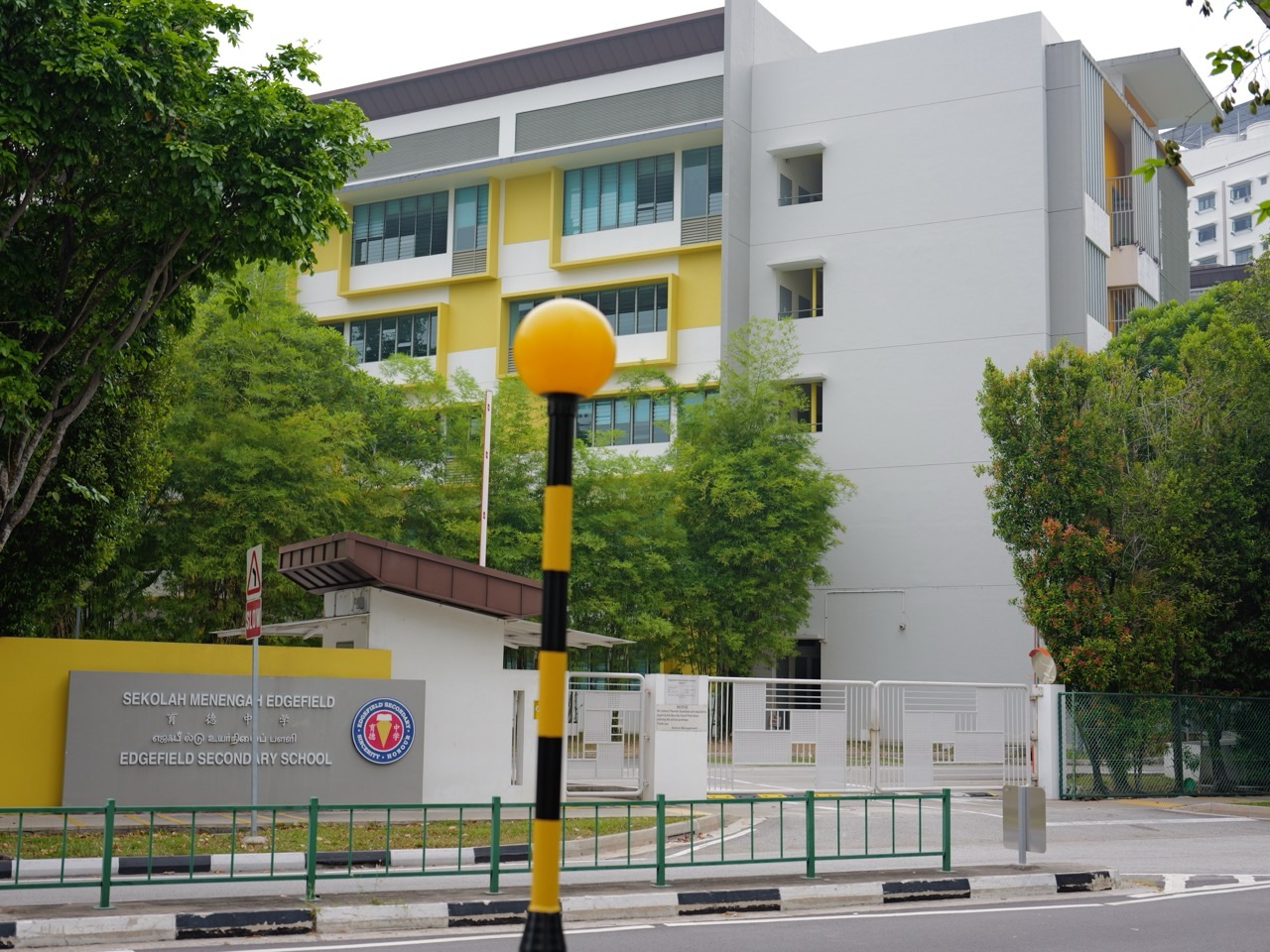
6. Edgefield Secondary: proximity plus actual interests
Edgefield Secondary is at 36 Punggol Field. Its published CCA information includes clubs such as Art, Robotics and aviation-related activities; performing arts including Choir, Concert Band, Modern Dance and Guzheng; uniformed groups such as Girl Guides, NPCC (Sea), NCDCC and Scouts; and a range of sports. These descriptions help parents ask concrete questions. Does the child want to learn how a robot senses and moves, or do they prefer building confidence through a team activity? Is there an entry trial? Are there different expectations for beginners and pupils with earlier experience? An advertised CCA is not a guaranteed place.
Edgefield also describes school-wide opportunities around future-ready thinking and character through sport. A parent should separate the broad experience offered to students from selected teams, competitions or advanced pathways. A school can be attractive for a child who wants to try something unfamiliar without needing to promise that every participant enters a special programme. The next useful conversation with staff is: what exactly would my Secondary 1 child do in Term 1, how often, and with what support when an individual subject is especially demanding?
7. Greendale Secondary: the everyday value of making and exploring
Greendale Secondary is at 51 Edgedale Plains. Its official 2026 programme information describes a Design, Technology and Engineering Applied Learning Programme and an outdoor-adventure Learning for Life Programme. In practical terms, a child might encounter design thinking, coding, construction, tests, reflection and collaboration. The appeal is not the fashionable language of STEM itself; it is the chance to learn how to revise an idea when evidence shows it is not working. That habit can be transferred to school Mathematics, Science explanations and even ordinary study routines.
Greendale’s 2026 CCA information includes Canoeing, Fencing, Floorball, Football and Softball, performing arts such as Angklung, Dance, Chorale, Orchestra and theatre, and clubs connected to robotics and outdoor adventure. Always confirm the current intake’s details and any restrictions. An 11-year-old who enjoys technology at home may prefer a performing-arts CCA at school; pupils need not turn every interest into one narrow future career. Ask about safety, training, transport after practice, equipment and how beginner pupils are supported.
8. Punggol Secondary: environmental action, leadership and choice
Punggol Secondary School is at 51 Edgefield Plains. Its public pages describe environment education, community and youth leadership, and a wide CCA portfolio. Current school information lists activities such as Environmental Club, English Language Drama and Debate, Art Club, AVA and Interact Club; uniformed groups include NCC, NPCC, Red Cross Youth and Scouts. Its sports pages identify Basketball, Football, Netball, Shooting, Table Tennis and Volleyball. The point for parents is to understand the ordinary participation route, not just exceptional award stories.
A child who has never spoken in front of a large group could discover an interest through debate. Another child may join Red Cross Youth and find purpose in first aid and service. Another may simply enjoy the steady accountability of regular sport. These experiences are not substitutes for subject learning, but they can make school a place where the child belongs. Ask how the school’s Secondary 1 CCA allocation works, whether it uses trials and ranked preferences, and what alternatives exist if a highly sought activity is oversubscribed.
9. Yusof Ishak Secondary: the Sumang Walk choice
Yusof Ishak Secondary School is at 8 Sumang Walk. For families in north-west Punggol it may be a natural campus to inspect, although ease of travel depends on the home location. The school’s published CCA list includes Boys’ and Girls’ Brigade, NCC and NPCC; arts such as Art Club, Chinese Orchestra, Choir, Concert Band and Modern Dance; sports such as Badminton, Basketball, Fencing, Softball, Table Tennis and Wushu; and clubs including English Drama, Infocomm Technology, Robotics and STEM. That breadth gives parents specific rather than generic questions to ask at an open house.
The school also describes a sustainability and smart-city STEM emphasis as well as leadership through social action. A family interested in design and technology should ask how the school-wide curriculum differs from club activities and selected enrichment. Do not assume that admission through PG2 promises robotics competition membership, a leadership appointment or a future polytechnic course. The child must still learn well, contribute, meet eligibility requirements and make choices over several years.
10. CCA is a weekly commitment, not merely a list on a school page
Many families read CCA menus as if they were restaurant menus: identify a favourite and assume the child can obtain it. In practice, schools may use trials, ranked preferences, available places, attendance expectations and developmental goals. Competitive teams may train more frequently, while performing-arts groups may intensify rehearsals before a festival. Uniformed groups can involve camps or structured service. Clubs may meet at particular times and require event support. The student needs a second realistic option, especially if the first choice is selection-based.
Ask the school for the current year’s timetable, not the previous cohort’s screenshot. A child returning home after a long rehearsal may need an agreed dinner plan and a lighter study evening. A teenager who chooses a CCA entirely because an adult thinks it looks impressive can lose interest quickly. A good decision gives weight to the child’s voice, the chance to improve, realistic participation and the ability to keep up with subject work.
11. LEAPS 2.0: understand the reward without mistaking it for a shortcut
The LEAPS 2.0 framework recognises Participation, Service, Leadership and Achievement. Excellent attainment can translate into two co-curricular bonus points where applicable, Good into one, and Fair into no such bonus. But the requirements look across several domains, not just competition prizes. A pupil who works hard in a CCA yet neglects participation or service should not assume an automatic Excellent grade. Discuss how the school records contribution and how pupils develop consistently over time.
When evaluating potential post-secondary choices, distinguish gross entry requirements from net ranking after relevant bonus points. Different exercises and routes may use bonus points in different ways. Do not promise that CCA participation will replace a required G3 English grade or convert an ineligible subject profile into a JC offer. The safer view is that an engaged CCA develops a fuller learner and may bring recognition under official rules, while academic prerequisites remain real.
12. A stronger subject is not the same as a stronger Posting Group
Under Full SBB, subject-specific strength deserves recognition. A child may enter through PG2 and qualify to offer a subject at G3 under the applicable PSLE subject criteria or later school reviews. Conversely, a child may benefit from stable G2 foundations in another subject. Parents should ask how subject level is determined, when eligibility is reviewed, how teachers identify readiness and what bridging support is available. Do not interpret one strong assessment as an automatic right to every level upgrade.
This distinction matters because later admission routes depend on actual SEC subject levels and results. For a teenager interested in a course requiring G3 English and specific relevant subjects, those requirements must be discussed early with teachers. The parent need not force a twelve-year-old to choose a profession, but should understand which academic doors require prerequisites. Keep the child’s current learning healthy while revisiting the plan at Secondary 2 and Secondary 3 subject-choice points.
13. JC, polytechnic, PFP, ITE and university: the long route in brief
The Singapore-Cambridge Secondary Education Certificate (SEC) begins in 2027 for graduating cohorts, with subjects examined at G1, G2 or G3. MOE has announced post-secondary admissions changes from 2028, including JC admission using five G3 subjects in the revised L1R4 framework, selected use of a G2 Best subject for direct polytechnic Year 1, and broader PFP access for suitable G2/G3 profiles. These routes each have their own minimum grades, computed scores, subject requirements, merit and vacancies. They are not interchangeable just because a pupil started in PG2.
A child beginning Secondary 1 in 2027 would ordinarily reach Secondary 4 and the SEC in 2030 and apply for post-secondary education for 2031, assuming the standard progression. The 2028 rules are useful current planning evidence, not a promise that every detail will remain unchanged by 2031. University is another later application after an appropriate pre-university, diploma or other recognised qualification. A school can help a pupil prepare; it cannot guarantee a university offer four or more years in advance.
14. Four family examples that show why one school is not right for everyone
Family A: the child thrives on routine
Imagine a child with PSLE Score 24 who needs more time to consolidate English writing and algebra. A family near a convenient direct route might legitimately prioritise a school that supports that daily routine over a longer journey to a campus with a fashionable programme. Score 24 is within the general PG2 eligibility band, but the family still needs to read actual PG2 historical data and apply to suitable choices. Their non-negotiables may be reliable travel, a welcoming CCA for beginners and clear communication with subject teachers. The plan should be built around that child.
Family B: technology is a genuine interest, not a marketing word
Consider a pupil with Score 22 who enjoys electronics and building things, yet hesitates during written explanations. The family could compare Greendale’s design-and-engineering experiences, Yusof Ishak’s sustainability STEM, Edgefield’s clubs and other schools’ offerings. But before ranking, they must decide PG2 versus PG3 in consultation with the child’s results and readiness. They should ask whether the promised activities are school-wide or selective, and which writing skills will be taught and supported. The school’s programme should extend a real interest rather than excuse academic gaps.
Family C: CCA practice changes the route
A pupil drawn to Fencing, Basketball or theatre may find two schools appealing on paper. The decisive questions might become whether a place in that activity is available, whether trials are involved, how many afternoons are needed, and how to return home after practice. A family should never treat a sports list as proof of selection. The child can have a preferred activity and a backup, then choose a school they would still like even if the first-choice team is unavailable. This avoids making the whole posting decision depend on one uncertain outcome.
Family D: the family dreams of university
A parent may ask which PG2 school leads to university. The honest answer is that no simple admission-score table can answer this. University pathways can arise through JC and A Levels, through a polytechnic diploma and later degree admissions, and through some ITE-to-diploma progressions and other recognised routes. The student must ultimately earn the appropriate grades, qualifications and course-specific requirements. Today, the better question is whether the chosen school will teach core literacy and numeracy well, support healthy study habits, provide guidance at subject-selection points and help the child remain motivated.
15. Build the six-school list without guessing that a COP will repeat
Write the chosen Posting Group at the top of the page. Underneath, list schools with their official current published score ranges, nearest practical route and school-specific reasons for interest. Use six genuine choices rather than only prestigious names. When available, include a spread of prior cut-off outcomes, including schools where the child’s PSLE score is numerically better than the prior last-posted score. Such a difference may improve plausibility but is not a safety guarantee. Applicants can still be affected by how the new cohort selects schools.
Rank the list in the child’s genuine preference order. Choice order matters in school posting tie-breaks; it is therefore not a neutral sorting column. A family sometimes puts a less-preferred school first because it appears ‘safer’, without understanding the trade-off. Instead, discuss which school the child would choose if all were available and then check risk spread so the final application is both sincere and responsible. Confirm the current S1 portal instructions and any DSA obligations before pressing submit.
16. How to interview a school without asking for a miracle
- Ask what a typical Secondary 1 day looks like, including the school start, dismissal and CCA days.
- Ask how pupils in mixed form classes move to subject lessons at different G levels.
- Ask which criteria guide first offers and later movement between G levels.
- Ask what support a child receives after two disappointing Mathematics or English assessments.
- Ask which CCAs are available to newcomers and which require trials or selection.
- Ask whether school-wide programmes differ from selected competitions or talent tracks.
- Ask how a parent can monitor wellbeing without creating more pressure for the child.
- Ask for an example of Education and Career Guidance before Secondary 3 subject selection.
- Ask what the published rules mean for a child with a specific special educational need.
- Ask where the current, dated school handbook and official contacts can be found.
A useful school answer describes people, processes and limits. ‘We have a strong programme’ is not enough on its own. ‘All Secondary 1 pupils try this during a compulsory module; selected pupils then apply for additional enrichment’ is more informative. The family should record answers in its own words, distinguish confirmed facts from promises and decide whether the daily reality suits the child. An exciting presentation is one kind of evidence; the ordinary timetable is another.
17. Time, money and the hidden cost of a difficult route
School is compulsory, but families still face practical costs. Transport, extra travel, replacement equipment, meals, activity materials and time away from rest can add up. Some CCA costs may be covered or supported, while others require arrangements; do not assume uniform charges across schools. Ask about official financial assistance, loaned items and the appropriate point of contact. For a household balancing shift work or care responsibilities, a school that is logistically manageable can reduce stress for the whole family.
The most useful cost comparison is not an invented monthly price. It is a clear weekly plan: how many trips require paid transport, who supervises a late return if needed, whether the child can eat before training, and how an occasional disruption is handled. Add the child’s own tolerance for crowded stations or repeated transfers. A commute that a parent would tolerate as an adult may not be appropriate for a new Secondary 1 learner every morning.
18. Protect English and Mathematics regardless of the school chosen
When a student moves from Primary 6 to Secondary 1, English and Mathematics become foundations for the rest of the timetable. Secondary Mathematics involves more algebra, formal reasoning, negative numbers and multi-step solutions; English requires sustained reading, precise explanations and writing with clearer structure. A PG2 child can be uneven across these skills. Parents should identify the actual stumbling point—fraction operations, reading comprehension, vocabulary, paragraph organisation or exam time—rather than simply buy more worksheets.
At eduKate Punggol, small-group teaching can support the transition when it is appropriate for the child. The emphasis is first-principles explanation, worked reasoning, focused correction and steady practice rather than fear-based claims about school placement. Tuition should remain subordinate to a well-chosen school and a sustainable routine. A teenager who sleeps properly and learns to correct mistakes is often in a better position to use every lesson well, whether the secondary-school journey is a short walk or a longer train trip.
19. A practical seven-day decision procedure
Day 1: read the personalised PSLE results and confirm which Posting Group options really exist. Day 2: print or save current MOE SchoolFinder records for the plausible schools, noting the date and the correct group. Day 3: talk to the child about subjects, preferred learning environment and two interesting CCAs. Day 4: plan early-morning and post-CCA journeys from home to each campus. Day 5: review open-house material and ask schools the questions that matter. Day 6: compare your six preferred schools and a few alternatives using admissions history, suitability and commute. Day 7: reread the official instructions and submit carefully within the real deadline.
This is a planning sequence, not a claim that the official school-choice window lasts seven days or that every family can visit all schools. Adapt it to the dates and information actually available. The point is to separate the tasks: eligibility, evidence, fit, travel and honest ranking. Doing them in order reduces last-minute confusion and gives the child a voice without making the child solely responsible for an adult decision.
20. Common questions from Punggol parents
Does PG2 mean the school offers only G2 subjects?
No. PG2 describes an admission group. The school uses Full SBB and may offer individual G1, G2 or G3 subjects according to the relevant criteria and arrangements. Ask about the child’s own subject offer and the school’s teaching timetable.
Which local Punggol school had the widest 2026 PG2 historical last-posted score?
Among the four local school figures cited for the completed 2026 Secondary 1 intake, Punggol Secondary recorded 24, Edgefield and Greendale 23, and Yusof Ishak 22. Do not confuse these with a forecast of 2027 or a quality ranking.
Can my child with Score 25 choose PG2?
Under the published ordinary framework, Score 25 can permit a PG1 or PG2 selection. Read the personalised official notice and assess subject readiness before choosing. The selected group must be consistent across the submitted school list.
Can a PG2 pupil join a sports team with PG3 pupils?
CCA selection is not simply segmented by Posting Group. The school determines availability, trials and placement. Ask the coach or CCA coordinator about current requirements and whether a beginner can participate.
Should I prefer a school because it has robotics?
Only if the opportunity fits the child, is genuinely available under the programme rules and the rest of school life is suitable. Robotics can be a club, an applied-learning experience or a selected competition; distinguish these.
Will two LEAPS points guarantee JC or polytechnic admission?
No. Where applicable, co-curricular attainment can affect ranking or net scores, but subject requirements, gross eligibility, course competition and vacancies still apply. Check the actual exercise rules.
Can a PG2 child reach university?
Yes, possible pathways can involve appropriate G3 results and JC, polytechnic diplomas or eligible ITE-to-diploma progression. Each step has its own conditions; a PG2 label does not prohibit future university admission.
What matters more than kilometres?
The actual route the child can navigate reliably, with safe crossings, transfers, school gate access and late CCA travel. Test that journey from the home block rather than assuming an estate-wide travel time.
Does a previous cut-off of 23 promise a place to a pupil with Score 22?
No. The previous cut-off is historical. A better numerical score may make a school plausible but cannot guarantee the outcome of a new posting exercise. Rank genuine preferences and make a balanced six-school list.
When should career planning begin?
Discuss interests and learning strengths now without locking a career. Revisit G-level choices, subject combinations and Education and Career Guidance later. Check published requirements when the student reaches the relevant cohort and admission year.
Verified sources and connected reading
- MOE SchoolFinder: current school profiles and score ranges
- MOE 2026 announcements: post-secondary admission exercise from 2028
- Edgefield Secondary: CCA categories and programmes
- Greendale Secondary: design, technology, outdoor programmes
- Punggol Secondary: co-curricular experiences
- Yusof Ishak Secondary: official CCA list
- eduKate Punggol PSLE Score 4–32 school-choice hub
- eduKate’s Secondary 1 Mathematics transition and first-principles guide
Information reviewed 14 November 2026. The cited school score figures relate to the completed 2026 Secondary 1 intake, not the next cohort’s eventual cut-offs. CCA offers, transport and admissions conditions can change; consult the school and official MOE announcements before acting.


