
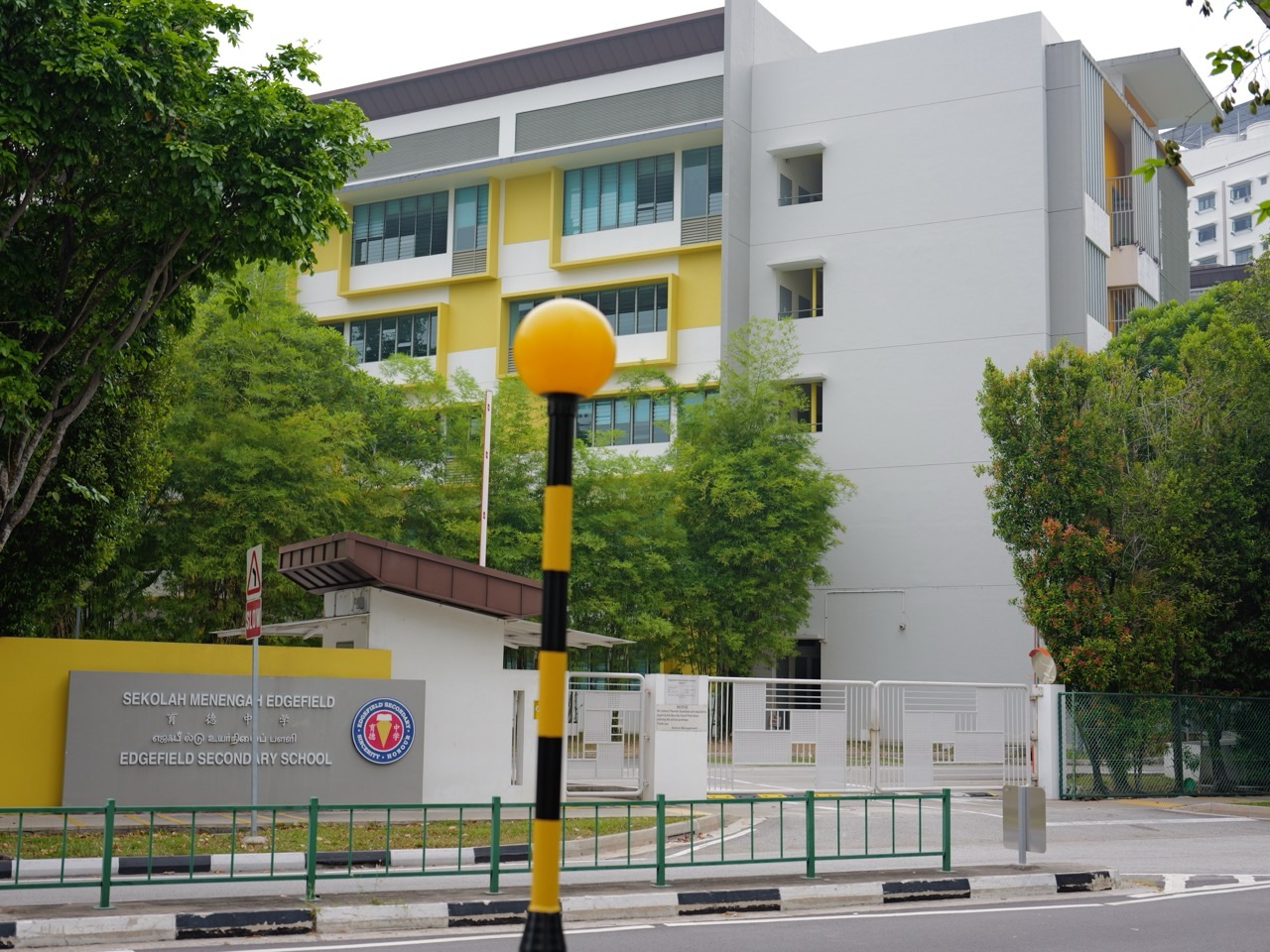
For a Punggol child with PSLE Score 24, the ordinary Secondary 1 admission group is Posting Group 2 (PG2). If your family is considering Edgefield Secondary School, its last-posted PG2 cutoff from the completed 2026 Secondary 1 intake was 23—1 point more stringent than Score 24. The school is located at 36 Punggol Field, Singapore 828814 and its educational emphases include Growing the Edgefield Mindset (G.E.M.) and Character Education through Sports, anchored on Taekwondo. A school’s older cutoff and programmes are useful research evidence, not a guarantee that a particular child will be posted in January 2027.
The first parent move is to check that the child is comfortable with most subjects starting at G2, compare the school’s classroom support and actual activities, and build six school choices the child would willingly attend. The four mainstream Punggol schools had previous PG2 last-posted scores of Punggol Secondary 24, Edgefield 23, Greendale 23 and Yusof Ishak 22. Use MOE SchoolFinder for current group-specific profiles and test the journey from your home block. The 2026 PSLE result is released on 24 November at 11.00am; the online six-choice window closes on 30 November 2026 at 4.30pm.
- Score: PSLE 24 ordinarily enters PG2, not the PG1/PG2 option band that begins at Score 25.
- Edgefield Secondary: 36 Punggol Field, Singapore 828814.
- Previous 2026-entry PG2 cutoff: 23; 1 point more stringent than Score 24.
- Four Punggol campuses: 2026-entry PG2 cutoffs 22, 23, 23 and 24; each campus has a different programme mix and journey.
- Applied Learning: Growing the Edgefield Mindset (G.E.M.).
- Learning for Life: Character Education through Sports, anchored on Taekwondo.
- Risk management: include eligible schools the child actually likes, with previous less stringent PG2 cutoffs of 25 where suitable; none is assured.
- Portal: six genuine choices, Singpass submission by Monday, 30 November 2026 at 4.30pm.
Quick information: compare all four Punggol schools
| School | 2026-entry PG2 last posted | Score 24 historical relationship | School-specific question |
|---|---|---|---|
| Punggol Secondary | 24 | Exact former boundary; not guaranteed | Would environmental inquiry and community leadership motivate the pupil? |
| Edgefield Secondary | 23 | One point more stringent | Does the child like G.E.M. creative problem-solving and sports character? |
| Greendale Secondary | 23 | One point more stringent | Does the child enjoy designing, coding, building and outdoor learning? |
| Yusof Ishak Secondary | 22 | Two points more stringent | Does smart-city STEM and civic leadership feel meaningful? |
The score ranges are for the 2026-entry intake following PSLE 2025. The new 2027-entry cutoffs are not fixed before the November 2026 exercise. A cutoff reflects the last posted pupil in a particular group, not a ranked measure of teaching quality. The numerical direction matters: lower PSLE totals are stronger, so an earlier cutoff of 25 would be less stringent than 24, while 23 is more stringent.
MOE encourages families to include two or three historically less stringent choices where possible. For a Score-24 PG2 child, some schools in Hougang, Serangoon or Pasir Ris with former cutoff 25 may help widen the list, but an old one-point margin is not an admission guarantee. The school’s actual location, subject options, culture and the pupil’s true preference should be checked for every entry.
Score 24 at Edgefield: one point outside the previous PG2 boundary
A child receiving PSLE Score 24 is ordinarily in Posting Group 2. Edgefield’s previous PG2 last-posted score was 23 for the completed 2026 Secondary 1 intake, so a child with 24 would have been one point outside that older numerical boundary. This makes Edgefield a historically more competitive choice—not an impossible application or a school with a place guaranteed if the family ranks it first.
A one-point difference is easy to underestimate. Parents may hear that school cutoffs move every year and assume the number will inevitably shift by at least one. Such movement is possible but cannot be promised. There is no valid admission probability that can be calculated from a single old cutoff without the new cohort’s applicant choices and actual places.
The family’s interest should therefore start with an honest question: would the child genuinely enjoy Edgefield’s learning, culture and journey even if the application is uncertain? A child excited by problem-solving and physically active character education may have strong reasons to investigate the school. A parent looking only for a low numerical school cutoff may have no evidence about whether its daily learning fits.
The appropriate six-school list can contain aspirational options when they are genuine preferences, provided the family also chooses other schools it would accept and understands the historical risk. Score 24 makes the numerical comparison more favourable at Punggol Secondary than Edgefield, but that does not establish which one should be the child’s first preference.
Growing the Edgefield Mindset: problem-solving that can be taught
Edgefield’s G.E.M. Applied Learning Programme develops an entrepreneurial mindset through critical and inventive thinking, collaboration, opportunity recognition and the ability to respond constructively after failure. It is not a programme that guarantees every pupil will start a company or make money in a competition.
The official school page describes a Future Ready Programme that uses scenarios to develop complex problem-solving. Examples include responding to an emergency with drones, investigating future food scarcity, exploring water harvesting and considering designs for a floating city. Those scenarios can be powerful invitations to think, but parents should ask which actual lessons incoming Secondary 1 pupils will experience in 2027.
A child who often asks ‘what if’ may find such questions exciting. Another pupil might be unsettled by tasks without a single correct answer, yet benefit from the right teacher scaffolding. Ask how the school helps beginners identify constraints, gather evidence, split tasks fairly and explain why a proposed solution is plausible.
G.E.M. can teach more than confidence. A thoughtful problem-solver must know the difference between an assumption and a fact, listen to a teammate, check costs and acknowledge a flawed design. These habits can strengthen Mathematics reasoning, English argument and Science enquiry, provided ordinary subject lessons also support the foundations.
Taekwondo as character education, not a compulsory trophy race
Edgefield’s Learning for Life Programme connects character development with sport and Taekwondo. The school describes respect, resilience, self-discipline and leadership as central outcomes. This offers a different educational experience from a school that lists martial arts only as one optional CCA.
Parents should ask what the current Secondary 1 curriculum includes, whether regular students experience Taekwondo in curriculum time and how beginners with different physical confidence are supported. An activity can be character-building without being a competition, and participation should not require a student to be naturally athletic or unusually coordinated.
The family should also consider the practical commitment: PE clothes, physical safety, school rules, and how any grading or progression may be handled. Do not promise a future belt, competition title or special recognition merely because the website lists a pathway. Ask the school about the actual incoming cohort arrangements.
A child who struggles to recover after an academic mistake may find a supportive sporting practice valuable. The important issue is whether teachers frame errors as opportunities for correction, including in English and Mathematics. Good character education is coherent across classrooms, CCAs and relationships.
Future challenges and the need for evidence-based judgement
Edgefield’s future-oriented scenarios can include technology, environmental constraints and community needs. Parents can help a pupil understand why inventiveness must remain responsible. A rescue drone may seem exciting, but how is it deployed safely? A floating city might sound imaginative, but what resources and risks must be considered?
These questions provide an informal test of interest that does not depend on private classes or a portfolio. Ask the child to describe one problem they would like to solve and what information they would need before choosing a solution. The purpose is to explore reasoning, not to predict admission to Edgefield.
The school’s Compassionate Leaders In Action work also invites questions about who benefits from an intervention. A creative design that excludes older people or costs too much to use may not be socially helpful. Parents can ask how the school connects innovation with empathy and the importance of ethical decisions.
Not all enrichment is universal. The school mentions competitions and selected potential-development opportunities; the family should distinguish normal ALP learning from additional competitive pathways. A child should choose the school for everyday culture and opportunities available to them, not an assumption that every impressive partnership will automatically include them.
Compare Edgefield, Greendale and Punggol Secondary honestly
Edgefield and Greendale had the same previous PG2 last-posted score of 23. That equality does not make them interchangeable. Edgefield foregrounds entrepreneurial problem-solving and Taekwondo-based character development; Greendale emphasises design, code, build and outdoor adventure. Punggol Secondary recorded a cutoff of 24 and offers environmental and community leadership learning.
A Score-24 family might reasonably put Edgefield above Punggol Secondary because the child loves its problem-solving culture and can walk there safely. Another family might prefer Punggol Secondary despite the old cutoff match, because environmental learning and its ordinary school routines feel better suited. Both orders can be honest if the family understands the different previous cutoffs and builds a complete list.
If the child is new to coding, neither an advertised robotics scenario nor a high-achieving competition team proves that the school will be unsuitable. Ask about the general S1 curriculum, how complete beginners are taught and whether students may explore arts, sports and service alongside technical themes.
Parents should not rank based on imagined admissions percentages, and should not use Edgefield’s PG1 cutoff to assess a PG2 choice. The selected group applies to all six schools, and Score 24 ordinarily offers PG2 rather than the Score-25 PG1/PG2 option.
A Punggol Field family planning the real weekday
For a household near Punggol Field, Edgefield’s address at 36 Punggol Field may be attractive. A simple journey can help a young student sleep and manage CCAs. But a parent living near Punggol Coast or Northshore may find a different campus or transport pattern much easier; there is no universal ‘closest Punggol school’ without the home starting point.
Try the door-to-gate route at the intended morning time and again after a late school activity. Ask where the student entrance is, what happens in heavy rain and whether the pupil knows whom to contact if a service is disrupted. Transport is part of a sustainable school choice, not evidence that the child has a place.
A practical preference worksheet can separate school interest, academic support, wellbeing, CCA participation and admissions history. If the family cannot find six realistic PG2 schools inside Punggol, investigate Sengkang, Hougang, Serangoon or further places with historical PG2 cutoffs of 24 and 25, as their actual travel and school experience permit.
A child who likes Edgefield but is posted elsewhere can still have a successful Secondary 1 start. Do not make an unconfirmed preference the only acceptable future. All six schools should be ones the family would welcome.
How the selected Posting Group relates to actual subject levels
Posting Group 2 determines the admission pool and generally indicates that most initial subjects are studied at G2 under Full Subject-Based Banding. It does not mean every subject must remain at the same level forever. Subject-specific Achievement Levels, MOE eligibility rules and school arrangements can lead to individual G-level offerings where eligible. An aggregate Score 24 does not automatically guarantee G3 Mathematics, Science or English.
Parents should read the child’s individual PSLE English, Mathematics, Science and Mother Tongue results. A pupil may have strong reading skills but need to repair algebra, or enjoy experiments while struggling to write conclusions. Those needs lead to different support plans even when the overall number is identical. Ask the receiving school what it actually offers and how it helps students learn from a weak assessment.
A school programme can motivate a child to persevere, but it is not a substitute for ordinary teaching. A child interested in engineering still needs quantitative reasoning; one interested in community work must understand sources and express ideas clearly. Ask prospective schools how lower-secondary G2 subjects are taught, how teachers return corrections and whom pupils approach when a concept remains confusing.
From 2027 the Singapore-Cambridge Secondary Education Certificate (SEC) operates under the new Full SBB framework. A child entering Secondary 1 in 2027 would ordinarily reach graduating examinations several years later; actual later admission pathways depend on subjects, levels, grades and future policies. Neither the school name nor the PSLE total guarantees a JC, polytechnic, PFP or ITE place.
Compare school routines, not only colourful programme photographs
School belonging begins with ordinary lessons, friendships, a form teacher and a predictable way to seek help. Ask how the school introduces incoming Secondary 1 pupils, how it responds to bullying or exclusion and what support is available when someone struggles with organisation or learning. A public programme page cannot guarantee the precise specialist services needed by a particular pupil; discuss these privately with school staff.
Co-Curricular Activities (CCAs) matter because they occupy real afternoons and can help children develop confidence outside academic work. Verify which CCAs currently welcome beginners, which require tryouts and how late training might run. A pupil who already practices music or sport outside school may have different time needs from one excited to explore several new clubs.
A parent may be impressed by a national competition or an external partnership, but an ordinary student does not automatically receive every selected workshop, prize or leadership role. Ask which Applied Learning and Learning for Life experiences are broad-based for the incoming year level and which are opportunities for specific pupils. The everyday school experience must support a child even without special recognition.
The school’s learning environment should also suit a pupil who is willing to ask questions. If a child fears embarrassment after an incorrect answer, ask how teachers normalise correction and how classmates are taught to respond respectfully. Clear feedback and secure relationships are often more important to long-term progress than an impressive headline about a programme.
A score-24 six-choice worksheet for parents
| School to investigate | Previous PG2 last posted | How to interpret for Score 24 |
|---|---|---|
| Punggol Secondary | 24 | Exact prior boundary; research and compare carefully |
| Edgefield / Greendale | 23 | More stringent by 1 point; historically aspirational |
| Yusof Ishak | 22 | More stringent by 2 points; historically aspirational |
| Seng Kang / Compassvale / North Vista / Hougang | 24 | Exact previous boundary; no guarantee |
| Yuying / Serangoon Secondary / Peicai / Meridian | 25 | One point less stringent in the earlier exercise; still uncertain |
This table is a research map, not a recommended preference order. One family may rank Edgefield Secondary first because of educational fit, while another prioritises a school with a more manageable CCA journey or different academic support. The child’s actual opinion should be heard: would they still be willing to attend if their friend chose elsewhere, if a particular club was full or if they needed to work hard in a subject they currently find difficult?
For ordinary S1 posting, applicants compete under the selected group and its available places. Among equal-score pupils vying for final places, the published tie-break sequence can involve citizenship, school choice order and computerised balloting. A cut-off point does not reveal the new cohort’s preferences, and a parent cannot infer a credible admission probability from one previous number.
Use all six school choices with genuine preferences. Do not place an unacceptable school as the sixth choice in the hope that it will not matter, and do not list a campus only because it has a larger last-posted number. Compare the route, programmes, subject levels, practical support and the child’s interests before ranking.
If your family cannot construct six acceptable schools, seek advice from the child’s primary school and widen research thoughtfully. The goal is a supportive Secondary 1 placement, not an online exercise that declares a school automatically safe.
Travel: Punggol is not one starting point
The school’s address is 36 Punggol Field, Singapore 828814, but a household in Northshore or Punggol Coast may have a very different journey from a family near Waterway Point, Matilda, Oasis or Punggol Field. Check the actual student entrance, the path from the home block to the first bus or LRT stop, crossing safety and the normal morning reporting time. An estimated travel time using only Punggol MRT as the origin can omit a substantial part of the route.
Repeat the journey at a later CCA dismissal time, when bus frequencies, crowding, weather and fatigue may differ. Have the child practise safely with an adult and identify a trusted contact in case the transport service is disrupted. A short route can improve sleep and homework time, but does not guarantee admission or make an unsuitable school a good fit.
If a regional school offers a more favourable historical cutoff but the commute is exhausting, parents should discuss that openly. A one-point numerical margin cannot compensate for a child repeatedly arriving overwhelmed, and a nearby campus with a more stringent cutoff cannot be described as assured. Treat admissions, teaching and transport as separate facts that must all work together.
How to support a child before Secondary 1 starts
Immediately after results, allow the child to respond before comparisons begin. Some pupils are excited; others feel discouraged or frightened about leaving friends. A useful parental sentence is: “We know what this score means for the posting group, and we will compare schools that fit your learning and daily life. The previous cutoffs are only guides.” This is realistic without pretending the child can control every allocation outcome.
For English, practise reading a short unfamiliar passage and explaining an inference using evidence. For Mathematics, use a few thoughtful problems on fractions, negative numbers or balanced equations and ask the child to justify a step. For Science, discuss a fair test and the difference between an observation and an explanation. Short exercises followed by useful corrections can be more valuable than a large number of advanced worksheets.
After posting, wait for the real receiving school’s booklist, subject-level allocation, uniform and orientation notices. If the family is applying for assistance, follow the school’s instructions before buying items that may not be reimbursed. Practise the travel route and let the pupil learn how to record homework, ask for help and manage a simple weekly routine.
In the first month, listen for patterns rather than treating one difficult day as failure. A child may need time to find friendships and adjust to a new timetable. If problems with attendance, learning or wellbeing persist, contact teachers appropriately and identify a concrete plan. The measure of a successful transition is growing capability and belonging, not immediate superiority to peers.
Official dates for the 2026 PSLE and S1 Posting
| Event | Singapore date and time | Parent action |
|---|---|---|
| PSLE results | Tuesday 24 November 2026, 11.00am | Collect official result; check Posting Group and individual subject ALs. |
| S1 Portal opens | Tuesday 24 November 2026, 11.30am | Select the eligible group and consider six genuine school options. |
| S1 Portal closes | Monday 30 November 2026, 4.30pm | Submit the final ranked list through Singpass; retain confirmation. |
| S1 posting result | Tentatively Friday 18 December 2026 | Follow the final MOE announcement and posted school’s instructions. |
The timetable above comes from SEAB’s 17 November 2026 announcement. The December posting-results date is tentative until later confirmation. Only one parent needs valid Singpass to submit the ordinary S1 choices. Families who require assistance should contact their child’s primary school before the deadline, and children with an accepted DSA-Sec place should follow the specific instructions applying to that admission route.
A parent can use the next few days to visit official school sites, ask focused questions and discuss personal preferences without rushing to submit incomplete data. Posting is not a first-come-first-served reward for clicking at 11.30am, but failing to meet the actual deadline can create serious problems. Keep the confirmation of the choices submitted.
Frequently asked questions: Edgefield Secondary at Score 24
Is Edgefield an exact PG2 match for Score 24?
No. Its previous PG2 last-posted score was 23, one point more stringent. The new cutoff is not known.
Is Taekwondo a normal part of Edgefield learning?
Its official LLP centres on Taekwondo and character education. Confirm the precise Secondary 1 activities and access for the 2027 cohort.
Does G.E.M. require children to run a business?
No. It develops creative, critical, entrepreneurial and collaborative problem-solving, not an automatic business qualification.
Is Greendale easier to enter than Edgefield?
They shared a previous PG2 cutoff of 23, but equal historical numbers do not prove equal 2027 demand or admission chances.
What does Punggol Secondary’s prior cutoff 24 mean?
It was an exact historical boundary for Score 24, not a guarantee. Compare its different programme fit and actual travel.
Can a Score-24 pupil choose PG1 to use Edgefield’s PG1 cutoff?
Not ordinarily. Scores 23–24 are PG2; the PG1/PG2 option band begins at Score 25.
Is Score 24 eligible to opt for PG1 instead of PG2?
Not ordinarily. PSLE Scores 23–24 are placed in PG2; the PG1/PG2 choice appears at Score 25. Check the child’s official result for any exceptional circumstances.
Does an old cutoff of 25 guarantee admission for Score 24?
No. It is numerically one point less stringent in that completed intake, but the next cohort can have different cutoffs and tie-breaker outcomes.
Should we rank schools only by the highest historical cutoff?
No. Rank genuine acceptable preferences after checking eligibility, student support, programmes and travel. An old cutoff is admissions context, not a teaching-quality rating.
Can every pupil join the headline ALP or competition?
Some curricular activities are schoolwide, while selected competitions, CCAs and talent programmes may have additional requirements. Confirm exact 2027 arrangements with the school.
What if the allocated school was not our first choice?
Follow the official posting result, preserve the assigned place and contact the receiving school about induction. Appeals and transfers, where allowed, follow current conditions and vacancies.
Will PG2 decide my child’s eventual ITE, polytechnic or JC pathway?
No. Later opportunities depend on secondary subjects, actual G-levels, grades and the applicable admissions rules. Focus now on a sustainable learning environment.
Final checklist for parents
- Read the child’s actual PSLE Score 24 and confirm PG2 posting eligibility and subject results.
- Look up Edgefield Secondary School and its actual 23 historical PG2 cutoff in the appropriate school profile.
- Keep the 2026-entry figures clearly separate from the as-yet-unknown 2027-entry cutoff.
- Ask about G2 subject teaching, the child’s individual strengths and learning support.
- Research Growing the Edgefield Mindset (G.E.M.) and Character Education through Sports, anchored on Taekwondo, including broad-based versus selected opportunities.
- Test the ordinary morning and late-CCA route from your own Punggol block.
- Build a complete six-school list of genuine eligible preferences, including less stringent prior cutoff options where viable.
- Submit in the official S1 Portal before Monday, 30 November 2026 at 4.30pm.
- Keep the confirmation, then follow the allocated school’s actual induction and reporting instructions.
Conclusion: Edgefield Secondary offers a distinctive experience in growing the edgefield mindset (g.e.m.) and character education through sports, anchored on taekwondo. Punggol Secondary’s previous PG2 cutoff of 24 was an exact match for Score 24, while Greendale also ended at 23. Their learning emphases and transport are distinct, and none should be ranked by cutoff alone. The correct choice depends on the pupil’s interests, support needs, actual school-day experience and a realistic six-school list—not a claim that past score ranges can guarantee a new place.
Official starting points: Edgefield Secondary’s published school information, MOE SchoolFinder, MOE Full Subject-Based Banding, MOE S1 Posting and SEAB’s 2026 results announcement. Further Punggol parent guidance: the Score-24 PG2 master guide, the four-school Punggol comparison and the results and appeals guide.
Editorial verification: 19 November 2026. The school cutoffs quoted are from the completed Secondary 1 intake for 2026 following PSLE 2025, not the results of the coming 2026 PSLE or the still-uncompleted 2027-entry exercise. School programmes and exact cohort activities should be reconfirmed on official school sites. This is an educational fit guide, not a school-quality ranking or an admission promise.


