
If your Punggol child is strong in Mathematics but struggles with PSLE Science, choose a secondary school that can sustain mathematical curiosity while teaching the actual Science concepts, inquiry skills and written explanations the child finds difficult. Do not automatically select the school with the most prominent STEM banner or assume that a high Mathematics AL guarantees a higher-level Science subject. The four mainstream secondary schools within Punggol—Edgefield Secondary, Greendale Secondary, Punggol Secondary and Yusof Ishak Secondary—provide different applied learning experiences. Their suitability depends on the child’s official PSLE total, Posting Group, current subject offerings, teaching and learning support, and realistic family travel.
2026 PSLE results will be released on Tuesday, 24 November at 11.00am. Parents should read the individual Mathematics, Science, English and Mother Tongue Achievement Levels (ALs), the overall total and the personalised Posting Group options before making a shortlist for Secondary 1 entry in 2027. A child who loves calculations but struggles to explain evaporation or fair testing needs a different plan from a child who understands Science but misreads questions. Under Full Subject-Based Banding, pupils can study individual subjects at G1, G2 or G3 levels when eligible; the school must confirm actual offers. This guide compares real Punggol school programmes and the completed 2026-entry cut-off points, provides a practical four-week Science bridge and shows how to rank six genuine school choices before Monday, 30 November 2026 at 4.30pm.
Quick parent summary
• Read the child’s actual four PSLE ALs and Posting Group options, not just the total.
• Strong Mathematics may indicate useful numerical reasoning but does not automatically mean strong Science explanation or inquiry.
• Identify the real Science obstacle: concepts, vocabulary, reading, experiment design, graph interpretation or written explanation.
• Compare Punggol Secondary’s Environment Education, Greendale’s engineering projects, Yusof Ishak’s S4TEM@YI and Edgefield’s problem-solving approach.
• Check individual G1, G2 or G3 subject-level options under Full SBB with the receiving school.
• The four Punggol schools’ previous PG3/PG2/PG1 cut-offs refer to the completed 2026 intake, not guaranteed 2027 thresholds.
• Rank six schools the child would genuinely attend, including suitable historically less stringent choices, and submit before 30 November.
First understand why good mathematicians can still struggle with Science
Primary Mathematics often rewards identifying quantities, forming an efficient model and carrying out accurate calculations. Primary Science requires scientific concepts, explanations based on evidence, experimental reasoning and communicating a cause-and-effect argument. The two subjects share logical thinking but make different demands. A pupil may manipulate numbers accurately and yet confuse a plant’s respiration with photosynthesis, mix up physical and chemical changes, or write an explanation that does not actually answer the question.
The difficulty might not be conceptual. A pupil who speaks confidently about forces may write too little in an examination answer. Another might know the Science idea but misread words such as constant, variable, observe, infer or evidence. Yet another may misinterpret an experimental diagram because they do not understand which condition the test changed. Identifying the true obstacle will lead to better teaching than assigning endless general Science worksheets.
Invite the child to explain a recent Science question orally, then compare that explanation with what they wrote. If the idea is clear orally but not on paper, writing and vocabulary may be the first targets. If they cannot explain the idea at all, teach the concept using appropriate diagrams, observations and counterexamples before expecting formal answers. If graphs cause trouble, draw on their Mathematics strengths to build Science interpretation.
Four sample results: identical interests, different school routes
| Illustrative English / Maths / Science / MTL ALs | Total | Ordinary school-entry interpretation |
|---|---|---|
| AL5 / AL2 / AL7 / AL6 | 20 | Usually PG3; need a plan for Science foundations |
| AL6 / AL2 / AL7 / AL7 | 22 | Possible PG2/PG3 option band; compare both |
| AL7 / AL3 / AL7 / AL7 | 24 | Usually PG2; consider subject-level offers and support |
| AL6 / AL2 / AL6 / AL7 | 21 | Possible PG2/PG3 choice with Science still relatively weaker |
These examples are hypothetical calculations, not real student records or guaranteed personal eligibility. The actual official PSLE result and individual school-choice documents control what route is available. A numerically smaller total represents stronger aggregate PSLE performance. If an option band is offered at 21–22, the family should prepare a separate PG2 and PG3 school comparison rather than mixing historical cut-offs in one ordinary application.
At score 20 a child usually follows PG3, even if Science is not their strongest subject. A school may need to help the pupil cope with more demanding Science lessons. At score 22, the family may evaluate whether PG2 or PG3 starting academic pace is a better fit, taking into account the whole subject profile. In either case, the pupil’s Mathematics confidence should be supported rather than treated as irrelevant.
PG1, PG2, PG3 and individual Science levels are different
Posting Groups guide ordinary admission and the initial level for most subjects. Under Full Subject-Based Banding, the levels G1, G2 and G3 describe an individual subject. Eligible pupils can offer selected subjects at more demanding levels when their individual results and current criteria permit it. A family must not assume that a strong Mathematics AL automatically changes Science to G3, or that a weaker Science result should permanently restrict Mathematics.
Ask the receiving school which subjects the child can actually offer at entry and how adjustments are reviewed. A pupil may be confident in algebraic thinking but need support with the language of scientific explanations. The school’s ordinary English and Mathematics teaching therefore remain relevant to a Science difficulty. The selected Posting Group also determines which historical admission ranges matter across the six school choices.
From 2027, the Singapore-Cambridge Secondary Education Certificate (SEC) replaces the older separate school-leaving examinations for applicable graduating cohorts and records subjects at their relevant levels. A child entering Secondary 1 in 2027 is not taking the terminal SEC that year; an ordinary four-year route would typically reach that stage around 2030. No parent should promise the exact future Biology, Chemistry or Physics combination several years before upper-secondary subject selection.
Compare the four Punggol schools through genuine educational questions
Punggol Secondary — Science, nature and environmental reasoning
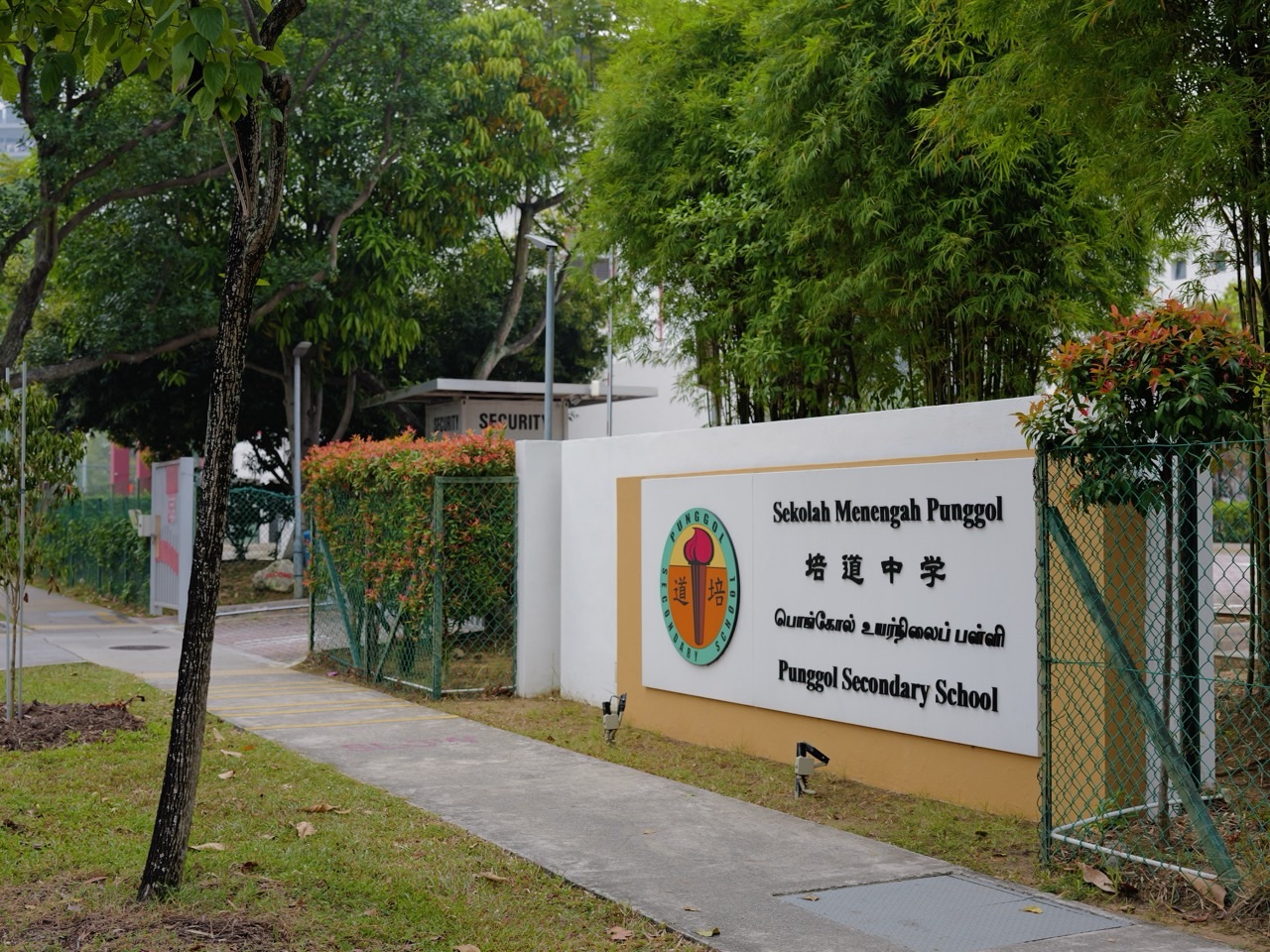
Punggol Secondary at 51 Edgefield Plains highlights Environment Education and community leadership. A pupil who struggles with abstract Science might respond positively to learning about plants, environmental processes, biodiversity or sustainability through authentic contexts. Ask which investigations are part of ordinary Secondary 1 lessons and how teachers help pupils connect an observation to the correct concept.
A school’s environmental programme is not proof that every child automatically joins Environmental Club or takes upper-secondary Biology. Check the current curriculum, assessment feedback and available CCAs. A child who enjoys Mathematics can also learn how to use tables, counts and graphs responsibly when investigating an environmental issue.
Greendale Secondary — measurement, engineering and practical explanation
Greendale at 51 Edgedale Plains publishes a Design, Technology and Engineering ALP that includes design thinking, coding and practical prototyping. This can give a strong Mathematics pupil engaging contexts in which measurement, patterns, ratio and variables matter. Ask whether pupils are expected to explain the scientific principles underlying their designs and how mistakes lead to better reasoning.
A child may enjoy building sensors but still struggle with a Science concept or written conclusion. Teachers can help separate the working device from the scientific claim. Parents should not promise a place in a selected robotics activity or higher-level Science subject based solely on the ALP.
Yusof Ishak Secondary — sustainable city STEM
Yusof Ishak Secondary at 8 Sumang Walk offers S4TEM@YI, an applied learning approach connecting Science, Technology, Engineering and Mathematics to a sustainable smart city. Its published experiences include coding, aeronautics and urban farming. A child who likes numbers and systems may find these motivating, but it remains important to ask how Science concepts are explicitly taught and assessed.
The school’s STEM Club is distinct from school-wide ALP exposure. Verify 2027 CCA recruitment, available teaching support and the journey after late activities. A programme that looks exciting must also be sustainable for the child’s day-to-day learning.
Edgefield Secondary — enquiry and explaining solutions
Edgefield at 36 Punggol Field develops initiative, inventive thinking and authentic problem-solving through the Growing the Edgefield Mindset programme. A Mathematics-strong child may enjoy finding efficient ways to solve a problem, but Science may demand careful testing and written explanation before accepting a solution.
Ask how teachers encourage pupils to state assumptions, evaluate evidence and communicate why a proposal works. Its enterprise-oriented ALP should not be confused with a specialist Science curriculum, but it can complement scientific habits. Also examine English feedback, pastoral support and CCA options.
The official historical Punggol school cut-off comparison
These are the completed 2026 Secondary 1 intake cut-off points, following the 2025 PSLE. They are retrospective last-admitted scores for different Posting Groups, not known 2027 admission thresholds or quality rankings. Check current school profiles using MOE SchoolFinder.
| School | Historical PG3 COP | Historical PG2 COP | Historical PG1 COP |
|---|---|---|---|
| Edgefield Secondary | 14 | 23 | 27 |
| Greendale Secondary | 16 | 23 | 27 |
| Punggol Secondary | 19 | 24 | 27 |
| Yusof Ishak Secondary | 15 | 22 | 27 |
At PG3 score 20, all four local previous PG3 endpoints—14, 16, 19 and 15—were numerically more competitive than the child’s score. It would be unsafe to present these four as sufficient backup choices. Research eligible PG3 schools in Sengkang, Hougang and other reachable areas, checking actual previous score ranges and daily travel.
At score 22, an eligible PG2 application would compare old PG2 endpoints of 23, 23, 24 and 22, while a PG3 application would use 14–19. Choosing the starting group changes the historical school list. At PG2 score 24, only Punggol Secondary was at its earlier PG2 boundary, not a guaranteed place. A strong Mathematics result cannot transform the wrong Posting Group’s cutoff into a valid admission comparison.
At score 25, a PG1/PG2 option may be offered; all four local old PG1 endpoints were 27, while PG2 endpoints were 22–24. The family should discuss the whole academic profile and suitable starting pace. A single strong subject does not determine a permanent educational identity.
A seven-part Science diagnostic parents can discuss with teachers
| Skill | Example of a genuine difficulty | Specific help to ask about |
|---|---|---|
| Scientific concepts | Confuses a description with an explanation | Conceptual teaching and counterexamples |
| Question comprehension | Misses words such as ‘explain’ or ‘compare’ | Reading and instruction-word practice |
| Fair testing | Changes several conditions at once | Guided variable diagrams |
| Observation versus inference | Writes a conclusion not supported by data | Evidence statements and model answers |
| Graph literacy | Reads numbers but misunderstands axes or trends | Links to existing Mathematics skills |
| Written explanation | Knows the idea but cannot express its cause | Claim-evidence-reasoning and vocabulary feedback |
| Study organisation | Memorises topics without diagnosing errors | A short misconception and practice log |
A helpful teacher can use one real example to identify whether the child requires a diagram, a concrete demonstration, better vocabulary or more practice explaining reasoning. The goal is not to label a pupil as ‘weak in all Science’ or ‘good at all Maths’. It is to work on observable barriers and check whether understanding improves independently.
A four-week Science transition plan without excessive drilling
Week 1: investigate one misconception
Choose one Science topic the child recently found difficult, such as the roles of plant parts or the difference between heat and temperature. Ask the pupil to explain it before showing a correct explanation. Make a short note of the exact misunderstanding rather than spending several days repeating full examination papers.
Week 2: read and describe evidence
Use an age-appropriate school explanation, picture or simple safe observation. Ask what is directly observed and what is inferred. A student who already likes numbers can practise recording a small table, but should also explain what the data cannot prove.
Week 3: build a clear written response
Teach a simple sequence: identify the question, state the relevant concept, connect the evidence and explain the effect. Ask the pupil to write a few sentences without copying the model. Then compare the reasoning rather than merely checking for a keyword.
Week 4: apply and explain independently
Give a small unfamiliar problem at the same level. Ask the student to plan a response, record a diagram if useful and state what they would test next. Keep the work manageable. A positive final week should build confidence and curiosity instead of making the child dread Science before Secondary 1 begins.
Do not reproduce unsafe laboratory demonstrations from videos at home. Use ordinary observation and age-appropriate supervised activities. Safety and accurate explanations are more valuable than spectacle.
Questions to ask prospective secondary schools
- Which Science and Mathematics subject levels can this particular pupil actually offer in Secondary 1?
- How does the school identify a pupil who understands calculations but struggles to explain a scientific process?
- What practical investigations do ordinary new pupils experience at the appropriate G level?
- How are scientific vocabulary, evidence and written explanations assessed and fed back?
- Which ALP activities are school-wide and which require a selected CCA or DSA admission?
- Does the school provide targeted learning support where the Science foundation is unstable?
- What upper-secondary Science and Mathematics subjects are currently offered, without promising a future cohort’s exact combinations?
- How does the school support a student with strong Mathematics interest and a developing Science result?
- What are the ordinary school-day and late CCA journeys from the family’s Punggol home?
- Would the child enjoy the school even if a first-choice STEM club were not allocated?
Building a six-school shortlist
- Read the official total, individual ALs and personalised Posting Group options.
- For an option band, prepare separate PG comparisons and decide the route using readiness and actual schools.
- Verify subjects, ALP, LLP and CCAs through current official school resources.
- Look for useful Mathematics extension and genuinely responsive Science teaching.
- Use only the previous COP belonging to the selected Posting Group.
- Include two or three schools with less stringent previous cut-offs where suitable, following MOE advice.
- Research eligible alternatives beyond Punggol if the local historical admission range is narrow.
- Test the school-day journey and what happens after late activities.
- Discuss six real preferences with the child and check application school codes.
- Submit through the S1 Portal before the closing time and retain the acknowledgement.
Ordinary S1 posting considers academic merit first, then citizenship, school preference order and computerised balloting when applicable same-score ties remain. A Punggol residence does not itself secure a local secondary-school place. A STEM interest is relevant to the child’s education, but does not override admission criteria.
The official PSLE results and school-choice timeline
| Action | 2026 timing |
|---|---|
| PSLE results released | Tuesday, 24 November at 11.00am |
| S1 Portal opens | Tuesday, 24 November at 11.30am |
| Six-school submission deadline | Monday, 30 November at 4.30pm |
| S1 posting outcome | Tentatively Friday, 18 December; await confirmation |
SEAB announced the release and choice window on 17 November 2026. Families can use MOE S1 Posting with one parent’s valid Singpass; contact the primary school for assistance before the deadline where necessary. Confirmed DSA-Sec cases have separate official requirements.
Frequently asked questions
If my child scores AL2 in Maths and AL7 in Science, must they enter PG3?
No. The overall PSLE total and personalised eligibility determine the available entry route. One strong Maths grade does not, by itself, decide PG3 or a future Science level.
Is Greendale better for my child because it has engineering?
Greendale’s DTE programme is worth investigating, particularly for a pupil interested in design, but no school is universally best. Compare Science teaching and feedback, actual subject options, school culture and CCA arrangements.
Can a PG2 student take Mathematics at G3 and Science at G2?
Individual subject levels can differ when current eligibility and the school’s arrangements allow it. The pupil’s subject results and the actual offer matter; do not assume a combination is guaranteed solely from the PSLE total.
Does strong Mathematics mean Chemistry or Physics will be easy later?
Not necessarily. Upper-secondary Science combines concepts, evidence, mathematical reasoning and written explanation. Check the actual pupil’s progress and later subject selection when the time comes.
Should we book Science tuition immediately?
Not automatically. Identify the precise conceptual, language or investigative difficulty and seek targeted feedback first. Additional teaching may help if it addresses a real gap, but an indiscriminate workload can overwhelm the child.
Do old cut-offs measure Science teaching quality?
No. Historical COPs record earlier admissions outcomes, not teacher effectiveness or the child’s future scientific development.
Official sources and related eduKate articles
- SEAB: 2026 PSLE release and S1 school-choice dates
- MOE: Posting Groups and Full Subject-Based Banding
- MOE SchoolFinder: school programmes, subjects and previous COPs
- Greendale: official Design, Technology and Engineering ALP
- Yusof Ishak: S4TEM@YI programme
- Punggol Secondary: environment education and school direction
- Edgefield: G.E.M. problem-solving and initiative
- eduKate Punggol: the opposite profile—Science strong, Mathematics developing
- eduKate Punggol: safe practical Science and investigation
- eduKateSG: immutable Clementi first-principles learning and small-group support
Final parent move: Keep the child’s mathematical strength alive while identifying the actual Science gap. Choose schools based on formal eligibility, genuine Science teaching, subject-level support and school-day fit—not a STEM label or a promised future cut-off. A good six-school application should protect both ambition and manageable learning.


