
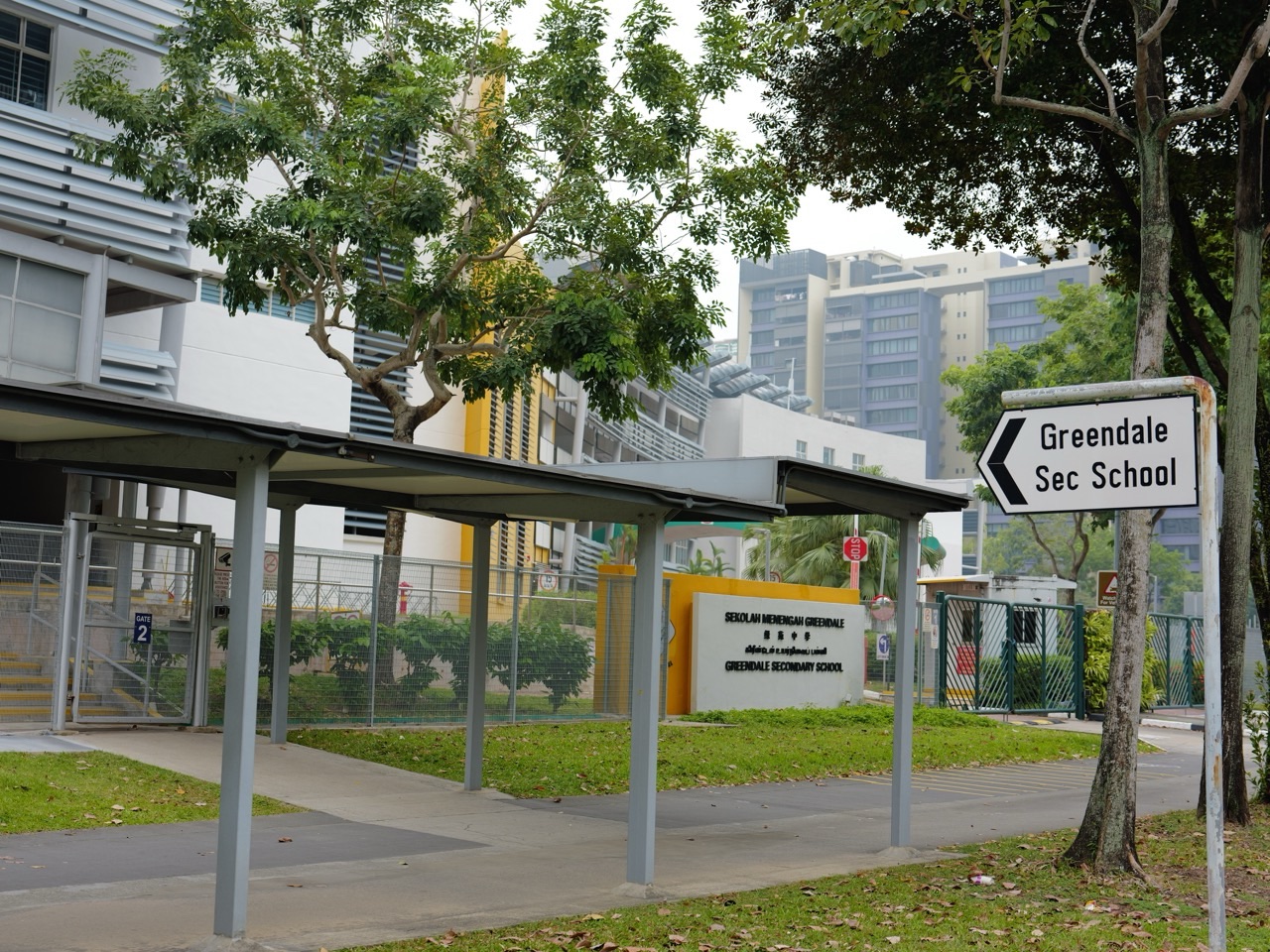
PSLE Scores 27 and 28 both qualify for conditional Posting Group 1 (PG1) only if English Language and Mathematics are each AL7 or better, but they have different historical local school positions. In the completed 2026 Secondary 1 intake, all four Punggol mainstream schools—Edgefield, Greendale, Punggol Secondary and Yusof Ishak—recorded PG1 cut-offs of 27. A Score 27 pupil exactly matched those old endpoints; Score 28 was one numerical point beyond them. Neither result determines a guaranteed 2027 posting. MOE’s Posting Group table confirms the eligibility condition.
For an eligible Score 28 child, school research can move beyond Punggol toward North Vista, Xinmin, Meridian and Junyuan, which had previous PG1 endpoints of 28, plus suitable schools at 29 and 30. The Score 27 family can investigate these options too, while understanding that some offer a more favourable old numerical comparison. The correct choice still depends on classroom support, Full SBB subject options, the child’s interests, CCA access and a realistic route from the family’s actual home. Six genuine preferences matter more than selecting schools mechanically by previous cut-off.
- Eligibility: both scores need English AL7 or better and Mathematics AL7 or better for ordinary PG1.
- All four Punggol schools: previous PG1 COP 27 in the completed 2026 intake.
- Score 27: exact historic match at local schools; not a guaranteed place.
- Score 28: one point beyond old local PG1 27; widen research without treating any school as impossible.
- Neighbouring schools: North Vista, Xinmin, Meridian and Junyuan had old PG1 28 references; research actual school fit.
- Wider comparisons: Yuying, East Spring and Montfort (boys) at old PG1 29; verify suitable 30/30* schools.
- 2026 schedule: results 24 November at 11am, six-school choices due 30 November at 4.30pm.
Editorial check: 19 November 2026. Numerical values refer to the 2025 PSLE cohort entering Secondary 1 in 2026. The 2027 cohort’s cutoffs are unknown before posting, and each current school profile should be verified with MOE.
Chapters — When Punggol’s historical PG1 27 becomes more selective
- 1. What changes between PSLE Scores 27 and 28
- 2. Conditional PG1 eligibility: check English and Mathematics
- 3. Four Punggol schools: the same old cutoff, different school experiences
- 4. Punggol Secondary: environment and community learning
- 5. Edgefield and Greendale: innovation, design and sport
- 6. Yusof Ishak: investigate the school beyond its old cutoff
- 7. Compassvale and Seng Kang also had previous PG1 27
- 8. North Vista and its previous PG1 cutoff of 28
- 9. Xinmin, Meridian and the selected school comparison
- 10. Junyuan and the journey to Tampines
- 11. Yuying, East Spring and Montfort at previous PG1 29
- 12. Understanding historical PG1 30 and 30*
- 13. School quality cannot be read from a cutoff
- 14. Full SBB and individual subject strengths
- 15. Helping the child explore a wider school list
- 16. Test the real journey from Punggol
- 17. Building six genuine school preferences
- 18. Posting order and the official tie-breakers
- 19. Confirmed 2026 posting dates for 2027 entry
- 20. Frequently asked questions about Scores 27 and 28
- 21. Official sources and related score guides
1. What changes between PSLE Scores 27 and 28
The completed 2026 intake showed PG1 cutoff 27 at Edgefield, Greendale, Punggol Secondary and Yusof Ishak. A child receiving Score 27 is an exact numerical match with those older last-posted results. A child with Score 28 is one point numerically beyond them. Both are eligible for ordinary PG1 only if English and Mathematics are AL7 or better, so the difference is not a change in the Posting Group option.
Parents should treat an exact match as historical context, not as a seat held in the next intake. A later cohort may have a different cutoff. Likewise, a Score 28 family can still like one local school while recognising that the old admission data do not support calling it a safe option. The most useful response is to widen the research basket with genuine school preferences.
This is a particularly important Punggol boundary because all four local schools had the same previous PG1 endpoint. A one-point change therefore shifts the historical comparison at every local campus at once.
Family action: Mark the four Punggol PG1 27 schools ‘exact old boundary’ at 27 and ‘old cutoff below our score’ at 28.
Chapter 1 · MOE SchoolFinder · Punggol PSLE school-choice hub
2. Conditional PG1 eligibility: check English and Mathematics
MOE’s score-to-Posting-Group table puts totals from 26 to 30 in the conditional PG1 band. Both English Language and Mathematics must be AL7 or better. A total of 27 or 28 does not by itself establish the child’s ordinary PG1 eligibility. Parents should read the subject grades and the official result slip, not just the overall number.
If either relevant subject is AL8, the family should ask the primary school about the child’s actual progression route. It would be misleading to suggest that a pupil who fails the condition can simply choose PG2 or use a school’s historical PG1 30 cutoff to gain entry. Score 25 is the separate PG1/PG2 option band; these two scores are not.
For eligible students, G1 is the indicative subject level for most subjects on entry, with individual higher-level subject options possible under current Full SBB rules. The school and individual ALs determine those offers, not the single aggregate.
Family action: Confirm the two subject ALs before creating any PG1 shortlist.
Chapter 2 · MOE SchoolFinder · Punggol PSLE school-choice hub
3. Four Punggol schools: the same old cutoff, different school experiences
Edgefield, Greendale, Punggol Secondary and Yusof Ishak may share an old PG1 27 cutoff, but their educational experiences differ. School programmes, class routines, CCA selection, student support and transport from the family’s actual home are not identical. An admissions table cannot say which campus would feel welcoming to a particular pupil.
Ask how an incoming Secondary 1 student is introduced to lessons, what help exists for difficult concepts and whether ordinary pupils participate in the school’s featured programmes. A child attracted to environmental work may have different preferences from one interested in design, sport, performing arts or community projects. Verify the current official school sites before treating old descriptions as promises.
The family should also ask the child for their own impressions. A previous boundary match at Score 27 or a one-point difference at Score 28 is not sufficient to decide a four-year school experience.
Family action: For every local school, write one verified attraction and one unresolved practical question.
Chapter 3 · MOE SchoolFinder · Punggol PSLE school-choice hub
4. Punggol Secondary: environment and community learning
Punggol Secondary has described environment education and opportunities for community and youth leadership. These may appeal to pupils interested in sustainability, service and working with others. But parents should ask which experiences reach ordinary Secondary 1 students, which are optional or selective and what the current timetable involves.
For Score 27, the school’s previous PG1 27 was an exact historical match. For Score 28, it was one point stricter. A family could still rank the school highly if it is genuinely preferred and officially eligible, but must understand the uncertainty and create other acceptable school choices. It is incorrect to tell the child that the next outcome is already known.
Location also matters. A Punggol Central family may experience a different route to the campus from a household at Punggol Coast or Northshore. Test the actual school gate and a return after a realistic CCA.
Family action: Ask the child what they like about Punggol Secondary other than being located in Punggol.
Chapter 4 · MOE SchoolFinder · Punggol PSLE school-choice hub
5. Edgefield and Greendale: innovation, design and sport
Edgefield has highlighted innovation and entrepreneurial learning, as well as character development through sport, while Greendale has described design, technology and outdoor experiences. These ideas are useful prompts for current questions but are not guarantees that every pupil joins a specialist team or a particular activity. Verify the actual programme and student participation rules.
A child who learns well by building or designing may enjoy asking about project work, while another may be excited by a sport or performance CCA. Those interests can justify a school preference independently of whether the previous cutoff was an exact match or numerically more selective than their result.
Parents should not assume similar names or a shared district make routes identical. Check public transport connections, walking and after-school return from the family’s own block before deciding which school belongs higher in the six choices.
Family action: Use the same teaching, CCA and commute questions at both Edgefield and Greendale.
Chapter 5 · MOE SchoolFinder · Punggol PSLE school-choice hub
6. Yusof Ishak: investigate the school beyond its old cutoff
Yusof Ishak also recorded previous PG1 27, giving Score 27 an exact old match and Score 28 a one-point stricter comparison. The school may appeal to families for its learning experiences and the location of its campus near the northern part of Punggol. What matters is the child’s current school fit, not the former numerical endpoint alone.
Ask what new students do during the first term, how they meet subject teachers and how the school helps them build independent study habits. Check current programmes and CCAs, including whether a child can participate as a beginner. A school that looks attractive on an open-house day may have normal routines the family needs to understand.
The family can be hopeful without making a promise based on last year’s number. Keep other school options in the list because this year’s final cutoff is not determined before posting.
Family action: Ask one real Year 1 learning question of Yusof Ishak before choosing it.
Chapter 6 · MOE SchoolFinder · Punggol PSLE school-choice hub
7. Compassvale and Seng Kang also had previous PG1 27
Compassvale and Seng Kang Secondary recorded historical PG1 27 for the completed 2026 intake. That makes them exact old matches for Score 27 and numerically stricter by one point for Score 28. Merely moving the search into Sengkang does not automatically create a new cutoff buffer for a Score 28 pupil.
This is where accurate research helps: neighbouring towns do not necessarily have less competitive historical scores. Parents should look at the actual school range rather than assume every non-Punggol school is easier to enter. The educational experience and commute should be examined separately.
From some Punggol homes, a Seng Kang school could be a sensible journey; from others, LRT transfers or walking may complicate the route. The family should investigate current school programmes and a complete daily journey rather than relying on the town boundary.
Family action: Do not label Compassvale or Seng Kang Secondary as a safe Score 28 alternative solely because they are outside Punggol.
Chapter 7 · MOE SchoolFinder · Punggol PSLE school-choice hub
8. North Vista and its previous PG1 cutoff of 28
North Vista Secondary in Sengkang recorded a previous PG1 cutoff of 28. At Score 27, the child is one point numerically stronger than that old endpoint. At Score 28, the child is an exact match. This creates a different historical research category from Punggol’s four old 27 schools, although it does not guarantee a new posting result.
A family considering North Vista should check its current teaching support, CCAs, programmes and exact address. The school may offer a practical journey from some blocks in Punggol and an inconvenient one from others. A numerical match should prompt a school investigation, not complete it.
Ask your child for a positive reason to attend North Vista if offered, and a realistic account of how they would travel there. An acceptable school is one the family can support day after day.
Family action: Mark North Vista as an exact historical Score 28 match and trial the actual route.
Chapter 8 · MOE SchoolFinder · Punggol PSLE school-choice hub
9. Xinmin, Meridian and the selected school comparison
Xinmin Secondary in Hougang and Meridian Secondary in Pasir Ris were among schools reporting earlier PG1 28 in the completed intake. A Score 28 pupil can investigate them as exact historical boundary comparisons. For Score 27, the old endpoint was numerically less stringent by one point. These are meaningful planning differences, not admissions probabilities.
Hougang and Pasir Ris can create very different journeys from a Punggol home. A pupil might have a convenient bus to one school and multiple transfers to another. Verify campus locations, morning arrival and return after CCA. A town name does not determine the full journey.
Each school also has its own academic and co-curricular environment. Parents should investigate what ordinary first-year pupils experience and how help is provided when the child needs support. A matching old cutoff cannot rank those experiences.
| School / area | Previous PG1 COP | For Score 27 | For Score 28 |
|---|---|---|---|
| Edgefield Secondary — Punggol | 27 | Exact historical match | One point beyond previous COP |
| Greendale Secondary — Punggol | 27 | Exact historical match | One point beyond |
| Punggol Secondary — Punggol | 27 | Exact historical match | One point beyond |
| Yusof Ishak Secondary — Punggol | 27 | Exact historical match | One point beyond |
| Compassvale Secondary — Sengkang | 27 | Exact historical match | One point beyond |
| Seng Kang Secondary — Sengkang | 27 | Exact historical match | One point beyond |
| North Vista Secondary — Sengkang | 28 | One point numerically stronger | Exact historical match |
| Xinmin Secondary — Hougang | 28 | One point stronger | Exact historical match |
| Meridian Secondary — Pasir Ris | 28 | One point stronger | Exact historical match |
| Junyuan Secondary — Tampines | 28 | One point stronger | Exact historical match |
| Yuying Secondary — Hougang | 29 | Two points stronger | One point stronger |
| East Spring Secondary — Tampines | 29 | Two points stronger | One point stronger |
| Montfort Secondary — Hougang (boys) | 29 | Two points stronger | One point stronger; boys’ intake only |
Family action: Compare one Hougang and one Pasir Ris school using the same questions.
Chapter 9 · MOE SchoolFinder · Punggol PSLE school-choice hub
10. Junyuan and the journey to Tampines
Junyuan in Tampines is another school that recorded an older PG1 endpoint of 28 in the references used by this series. It can help a Score 28 family build a wider research list, provided the exact current programme and school range are verified. For Score 27 it represents a numerically less stringent historical comparison.
A school farther east may offer an activity the pupil would enjoy but also a longer return journey. Ask how the student will manage homework and rest after CCAs. If the household cannot support that routine, remove the school from the final six rather than preserve it only because of the old number.
The purpose of a wider basket is to find genuine educational options. No parent is required to choose the school with the largest old cutoff or the farthest journey to be ambitious.
Family action: Keep Junyuan or another PG1 28 school only if its ordinary school week is workable.
Chapter 10 · MOE SchoolFinder · Punggol PSLE school-choice hub
11. Yuying, East Spring and Montfort at previous PG1 29
Yuying in Hougang, East Spring in Tampines and Montfort Secondary in Hougang have historical PG1 29 references in the completed 2026 intake. Montfort is a boys’ school, so families must check that the child meets its intake conditions. For a Score 28 pupil, an old PG1 29 is numerically one point less stringent and may help diversify the shortlist.
For a Score 27 pupil, the numerical difference is two points. Neither score receives a guaranteed place based on that comparison. The schools vary in programme, culture and journey, so a family should avoid using the three names as interchangeable fallbacks.
Parents can ask about ordinary classroom support, first-year CCAs and travel after activities. A school with a suitable timetable and appealing learning experience may deserve a high preference even when its previous cutoff was less selective than a local school.
Family action: Research only eligible and reachable schools at PG1 29, including the child’s gender intake where relevant.
Chapter 11 · MOE SchoolFinder · Punggol PSLE school-choice hub
12. Understanding historical PG1 30 and 30*
Some schools beyond the immediate Punggol area reported previous PG1 results of 30 or a displayed 30* vacancy notation. These can provide numerically less stringent historical comparisons for Scores 27 and 28, but they are not promises of admission or measures of school quality.
The star at 30* means the last actual pupil posted in the previous exercise had a score better than 30 while places remained, so the historical range was displayed with that special indication. The family should keep the star, school, group and year together. It does not mean the school will necessarily have places next year.
A Score 28 family need not list a distant school simply to obtain a 30*. Investigate the child’s interests, learning support and route. A school that fails these checks may not be a sensible family choice despite its former admission figure.
Family action: Verify any 30 or 30* school in SchoolFinder before using the number.
Chapter 12 · MOE SchoolFinder · Punggol PSLE school-choice hub
13. School quality cannot be read from a cutoff
A cutoff describes the last admitted pupil’s score in a specific previous exercise. It is not a direct measure of how approachable teachers are, whether the school supports a quiet learner, or how much a pupil will enjoy the CCA programme. A school with PG1 29 is not educationally worse simply because it was less selective than one at 27.
Ask what happens when a pupil cannot understand a Mathematics method, struggles to express an English response, or feels uncertain about joining a club. Current school procedures are more useful evidence for those needs than an isolated historical admission value.
Parents should support their child’s interest and independence while meeting official eligibility. A school selected for fit can be a positive outcome even if it is not the school with the smallest numerical prior COP.
Family action: Identify one school strength that is independent of admission scores.
Chapter 13 · MOE SchoolFinder · Punggol PSLE school-choice hub
14. Full SBB and individual subject strengths
Both Score 27 and Score 28 children qualify for PG1 only when English and Mathematics are AL7 or better. That rule cannot be replaced by an aggregate calculation. Where a pupil is PG1 eligible, the initial level for most subjects is typically G1, but individual higher-level subject options may be offered under Full Subject-Based Banding.
MOE’s published criteria identify a Standard-level AL6 or better as relevant to a G2 subject offer and AL5 or better for a G3 subject, alongside separate Foundation-level criteria. The receiving school will explain actual offers and arrangements. Parents should not infer a particular subject level solely from the total.
This flexibility means the school-choice conversation can recognise a child’s strength in one area while protecting their confidence in others. It is not necessary to regard the initial Posting Group as a permanent label of every academic ability.
Family action: Write the child’s individual ALs and ask how the chosen school supports the appropriate levels.
Chapter 14 · MOE SchoolFinder · Punggol PSLE school-choice hub
15. Helping the child explore a wider school list
Some pupils may feel upset that a school whose old cutoff was 27 is at the historic boundary for one child but numerically more selective for a classmate with 28. Parents can explain that admissions information changes by year and that a one-point difference does not define a person’s worth or capacity to learn.
Ask what the child hoped to gain from the local school. It may be a friend group, an easy commute, an exciting activity or a feeling of familiarity. Some needs can be met by another school with a suitable route or programme. Give the child an opportunity to learn about alternatives instead of describing them as failures.
The parent should make the application factually correct and help the pupil approach secondary school with a sense of agency. Honest information and a positive school choice can coexist.
Family action: Ask your child to identify two schools they could feel good about attending.
Chapter 15 · MOE SchoolFinder · Punggol PSLE school-choice hub
16. Test the real journey from Punggol
Punggol is not a single transport origin. A family near Northshore may have a different route to a Sengkang school than one near Punggol Central, Sumang or the waterway developments. The same is true for Hougang and Pasir Ris. Do not calculate a universal journey from one MRT station and apply it to every home.
Test the full trip from the residential block to the correct school gate, including walking, waiting, transfers, crossings and the school start time. Then test or plan a return after a realistic CCA session. A school that is convenient in the morning might be more difficult to reach home from later.
Consider who can help if a bus is missed or it rains heavily. A longer but dependable route may still be appropriate, while a numerically favourable school with an impossible daily journey should not remain as an arbitrary sixth option.
Family action: Record a normal morning, after-CCA return and disruption backup for every final candidate.
Chapter 16 · MOE SchoolFinder · Punggol PSLE school-choice hub
17. Building six genuine school preferences
SEAB recommends including at least two or three schools with previous cutoffs less stringent than the child’s score as part of a six-choice list. At Score 27, Punggol’s former 27 was an exact match, making prior 28–30 schools useful to research for historical diversity. At Score 28, Punggol’s former 27 was stricter, while schools at prior 28 were boundary matches and those at 29–30 could provide numerically less stringent references.
That does not dictate a particular school order. A family might genuinely prefer a previous PG1 29 school over one at 28 because of culture, CCA access or commute. Arrange the six by real preference after each passes eligibility and household-fit checks.
The fifth and sixth positions deserve as much care as the first two. If the family would not willingly attend a school, it should not be used merely to make the list appear statistically balanced.
Family action: Compare the six-school lists separately for Score 27 and 28 rather than copying the same list.
Chapter 17 · MOE SchoolFinder · Punggol PSLE school-choice hub
18. Posting order and the official tie-breakers
MOE’s ordinary S1 Posting Exercise uses PSLE score as the primary academic merit comparison. If equal-scoring pupils compete for the last places, citizenship, school choice order and computerised balloting are the relevant tie-breakers in the published sequence.
An old boundary match does not mean a tie will occur in the new year. A family cannot know the 2027 cutoff before posting. Ranking a school first does not automatically override a stronger PSLE score, but genuine preference order can matter among otherwise tied applicants.
Check current programme conditions such as affiliated admission, gender intake, language or DSA commitment where they are relevant. A number from a different category may mislead the family even when it comes from the correct year.
- Confirm the official score, English AL and Mathematics AL
- Compare previous PG1 27, 28, 29 and 30 only in the correct intake
- Visit or research actual school environments and support
- Check gender, programme, affiliated and other conditions
- Test morning and after-CCA routes from home
- Rank six schools the child could genuinely attend
- Save the final official S1 Portal acknowledgement
Family action: Keep each school’s official code and programme condition beside the final preference order.
Chapter 18 · MOE SchoolFinder · Punggol PSLE school-choice hub
19. Confirmed 2026 posting dates for 2027 entry
SEAB confirms that 2026 PSLE results are released on Tuesday, 24 November at 11.00am Singapore time. The online S1 choices open at 11.30am that day and close on Monday, 30 November at 4.30pm. Posting results are tentatively scheduled for Friday, 18 December, with any later change to be announced officially.
Eligible Score 27 and 28 families should read their official results and individual English and Mathematics ALs before using the PG1 school finder. Confirm school names, codes, options and ranking. Save the portal acknowledgement rather than relying on an earlier screenshot of a private shortlist.
Prepare the sixth school well before the official deadline so that transport and current programme questions can be resolved. Where the English/Mathematics eligibility condition is not met, seek personal guidance through the primary school rather than guessing a different Posting Group.
Family action: Set a family deadline earlier than 30 November and verify the saved form.
Chapter 19 · MOE SchoolFinder · Punggol PSLE school-choice hub
20. Frequently asked questions about Scores 27 and 28
Are both scores in PG1? Yes, but only when English and Mathematics are each AL7 or better. Does Score 27 guarantee a Punggol school with old COP 27? No. It matches a completed-year last-admitted score. Does Score 28 have no chance at Punggol Secondary? The previous 27 was one point stricter, but future cutoffs may change; do not make a categorical prediction.
Is North Vista a guaranteed choice at Score 28? No. Its former PG1 28 is an exact historic match. What about Yuying, East Spring or Montfort at former PG1 29? They may be useful research candidates for an eligible pupil, subject to gender, travel, programmes and the next cohort.
Can a PG1 child take an eligible G2 subject? Potentially, under current individual subject criteria. How should six schools be ranked? By genuine preference among eligible schools with realistic educational fit and travel.
Family action: Explain to your child what each of the final six schools offers.
Chapter 20 · MOE SchoolFinder · Punggol PSLE school-choice hub
21. Official sources and related score guides
Continue with Score 27 — conditional PG1 school guide and Score 28 — conditional PG1 school guide. The Score 26 versus 27 school comparison covers the preceding boundary, while the Punggol PSLE Scores 4–32 hub connects the entire score series.
Verify the official admission band at MOE Posting Groups, current schools in MOE SchoolFinder, tie rules in MOE S1 posting process, Full SBB information at MOE Full SBB, and exercise dates in SEAB’s 2026 results release. The child’s primary school can assist when individual eligibility or documents are unclear.
A final worksheet should show the actual score and subject grades, dated PG1 comparisons, six real school names with programme codes, child-specific reasons, verified transport and the official acknowledgement. No historical cutoff is a guarantee for the next intake.
Family action: Keep the final six-school evidence and official confirmation together.
Chapter 21 · MOE SchoolFinder · Punggol PSLE school-choice hub


