
Yes. Citizenship is the first tie-breaker when eligible pupils with the same PSLE Score compete for the final places in a secondary school. The ordinary Secondary 1 posting sequence begins with academic merit, then—in a relevant same-score tie—considers citizenship, the order in which the pupil listed the school, and computerised balloting. The citizenship priority order is Singapore Citizens, then Singapore Permanent Residents, then international students. This is not a blanket rule that a Singapore Citizen with a numerically weaker PSLE Score overtakes a Permanent Resident with a better score. For Punggol parents receiving 2026 PSLE results on Tuesday, 24 November at 11.00am, the practical task is still to construct six real school preferences based on the child’s official eligibility.
In Punggol, the four mainstream local schools are Edgefield Secondary, Greendale Secondary, Punggol Secondary and Yusof Ishak Secondary. Each had different historical cut-off points for PG3, PG2 and PG1 in the completed 2026 Secondary 1 intake. A past cut-off is the last admitted score for that completed exercise and cannot guarantee entry in 2027, especially when a pupil sits at the historical boundary and multiple applicants compete. This guide explains what citizenship actually changes, how two equal scores can lead to different outcomes, why choice order matters, and what a parent should check before the 30 November 2026, 4.30pm S1 submission deadline.
Quick parent summary
• A numerically lower PSLE Score is stronger; academic merit is considered before citizenship.
• Citizenship matters only when otherwise eligible pupils with equal scores compete for the remaining place or places.
• The ordinary priority is Singapore Citizen, Permanent Resident, then international student.
• Among pupils still tied, a higher school preference position matters before computerised balloting.
• Compare the child’s selected PG1, PG2 or PG3 with the school’s same-group previous cut-off.
• A previous COP, including a score exactly equal to the child’s score, is never a 2027 guarantee.
• Build six genuinely acceptable choices and submit through the MOE S1 Portal within the official window.
What happens first: score before citizenship
The first point is easily lost in anxious result-day conversations. MOE’s S1 placement starts with the student’s PSLE Score within the applicable entry route. For the PSLE aggregate, a smaller number indicates stronger results. A child who has score 14 under PG3 performed more strongly on that aggregate than a child with score 17 under PG3. Citizenship does not simply reverse those numbers. It is used to break ties when otherwise eligible candidates with the same PSLE Score are competing for a last available school place.
Imagine one eligible pupil is a Singapore Permanent Resident with PSLE Score 14 and another eligible pupil is a Singapore Citizen with Score 16 in the same relevant posting route. It would be wrong to say the citizen automatically outranks the PR just because of passport status. The stronger score is considered first. A separate example, in which both pupils have Score 16 and are competing for one remaining place, can bring citizenship into play.
This distinction matters for both fairness and responsible parent advice. A family should not interpret a school’s historical cut-off as a secret nationality penalty, and a school should not be described as ‘reserved for citizens’ merely because an equal-score tie-breaker exists. The student’s actual score, eligible route, available places and school list remain the core starting points.
The three tie-breakers in the correct order
| Stage | What MOE considers | What parents should not assume |
|---|---|---|
| Academic merit | Eligible PSLE aggregate within the applicable route | A weaker numerical score beats a stronger one by choosing the school first |
| Tie-breaker 1 | Citizenship | Every application is automatically decided by citizenship regardless of score |
| Tie-breaker 2 | Position of this school on the pupil’s submitted preference list | The school-choice order never affects the outcome |
| Tie-breaker 3 | Computerised balloting if the earlier criteria remain tied | Every applicant has an equal lottery for every school |
The citizenship ordering gives Singapore Citizens priority, followed by Permanent Residents, then international students, at that particular tie stage. After that, choice order recognises that one pupil may have genuinely placed the school first while another selected it lower. If the pupils remain indistinguishable after the earlier stages, computerised balloting resolves the tie. The precise operation is described in MOE’s S1 Posting guidance and its PSLE scoring guide.
There are school-specific nuances, including admissions programmes, affiliation rules and Higher Chinese considerations for Special Assistance Plan schools. This article explains the ordinary tie-breakers; a family should not apply a general illustration to an IP, affiliated or special route without reading that route’s actual official requirements.
Example 1: Two pupils with Score 16 want Greendale
Suppose a Singapore Citizen and a Permanent Resident both have PG3 Score 16 and compete for the last relevant place at Greendale Secondary. If all other applicable conditions are comparable and there is just one place left, citizenship is the first tie-breaker. Under the general ordinary framework, the Singapore Citizen has priority at that stage. This is a hypothetical teaching example, not a claim about any actual 2027 vacancy, applicant or posting result.
Now change the example: the PR has PG3 Score 14 while the citizen has PG3 Score 16. The numerical aggregate is stronger for the PR, so it is misleading to declare a citizenship override. A parent needs to understand both examples to avoid interpreting a historical cut-off as a simple ‘citizens only’ requirement.
Greendale’s completed 2026 PG3 cut-off was 16. An applicant sitting at 16 is looking at a previous final admitted score, not a current available seat. Even where the past boundary is relevant, the school may have different applicant numbers in 2027. Do not calculate a personal admission probability from citizenship and one old boundary.
Example 2: Two Singapore Citizens have Score 15
Imagine two Singapore Citizen pupils in the same relevant posting route each hold Score 15 and both hope for Yusof Ishak Secondary. One places the school first; the other places it third. If their applications otherwise reach an equal-score competition for a final place and the citizenship stage does not resolve it, school-choice order can matter. The child who placed it higher is considered ahead in the applicable comparison.
This does not mean every pupil should rank the historically easiest school first. The correct order is the family’s genuine preference order. A numerically stronger eligible pupil does not lose their priority simply because somebody else wrote the school as choice one. The preference rule becomes useful specifically in a tie at the relevant stage.
Yusof Ishak had a historical PG3 endpoint of 15 for the 2026 S1 intake, but the family must check the 2027 exercise’s reference information and the child’s actual route. A previous boundary does not tell you how many pupils will share that score or which tie-breaker will finally matter.
Example 3: Same score, same citizenship, same choice order
Suppose two Singapore Citizens share PG3 Score 19 and both listed Punggol Secondary at the same preference position. They compete for the final place and neither academic merit, citizenship nor choice order distinguishes them. In that simplified scenario, computerised balloting may be used. Parents should not invent a 50% probability without knowing how many pupils and places are involved. There may be more than two applicants, several vacancies or other relevant school rules.
It is understandable to want certainty, but the responsible conclusion is that being on the former cut-off line does not establish an individual outcome. A pupil who just meets an old boundary is neither guaranteed an offer nor categorically refused on that historic data alone. The family should keep real backup choices.
Punggol’s four schools and the previous admission figures
These are the historical last-posted scores for the completed 2026 Secondary 1 intake, which followed the 2025 PSLE. They are not advance thresholds for Secondary 1 admission in 2027. The school list is alphabetical, not a quality ranking.
| Punggol school | Previous PG3 COP | Previous PG2 COP | Previous PG1 COP |
|---|---|---|---|
| Edgefield Secondary | 14 | 23 | 27 |
| Greendale Secondary | 16 | 23 | 27 |
| Punggol Secondary | 19 | 24 | 27 |
| Yusof Ishak Secondary | 15 | 22 | 27 |
Each group has a separate comparison. A pupil with Score 18 ordinarily follows PG3 and should inspect the PG3 column. A pupil with Score 24 ordinarily follows PG2 and should compare the PG2 numbers. A pupil with Score 25 may be offered PG1 or PG2; choosing one route changes which historical school range is relevant. The chosen option in the ordinary exercise is not a licence to mix PG1 and PG2 cut-offs across six schools.
The same citizenship tie-breaker framework operates within the relevant comparison, but the historical numbers still reflect past applicants, seats and preferences. A PG2 Score 23 pupil should not borrow Punggol Secondary’s PG3 COP of 19 or Edgefield’s PG1 COP of 27 as if they were admission thresholds for PG2.
What makes the four schools different beyond their cut-offs?
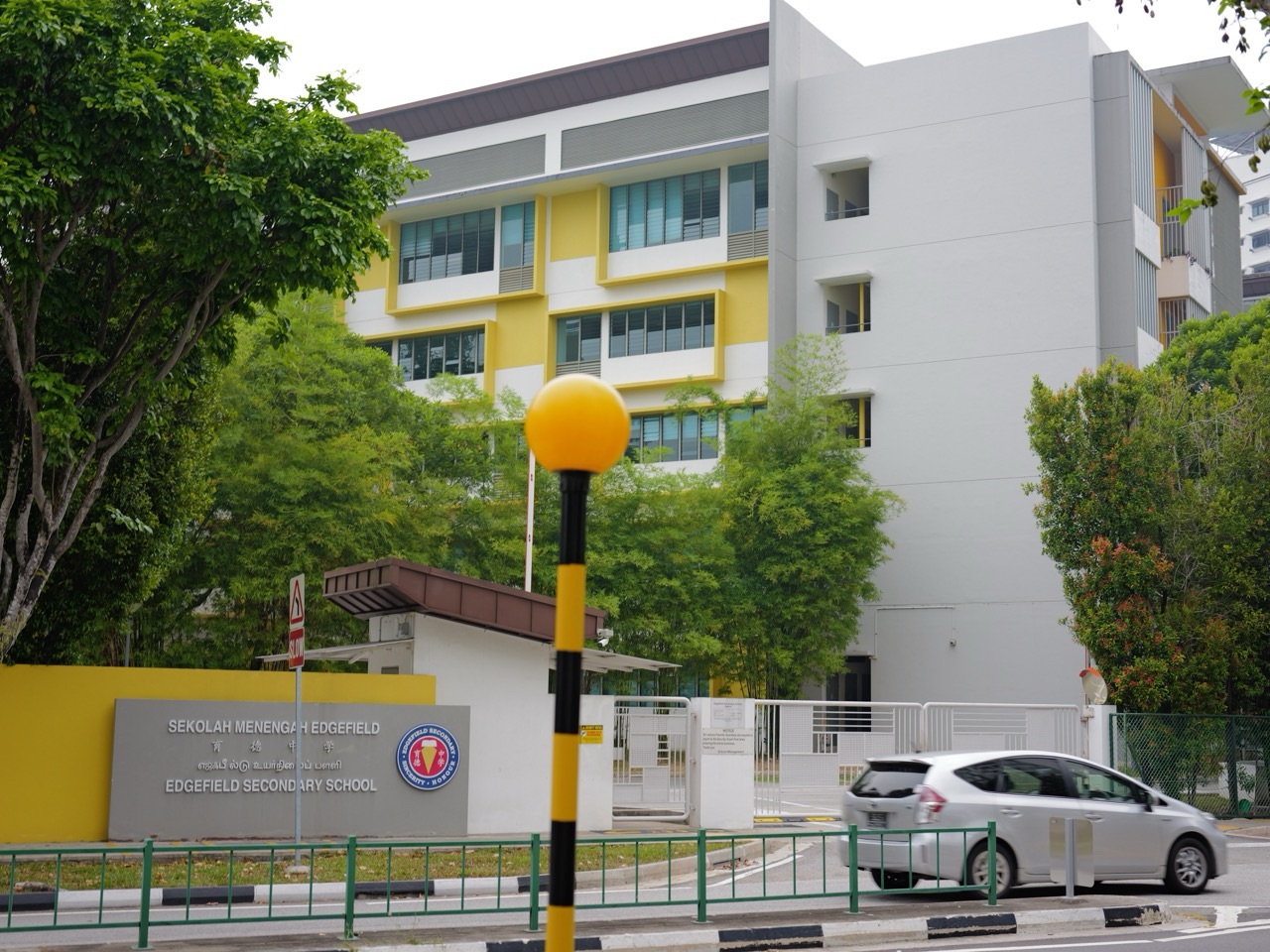
Edgefield Secondary, 36 Punggol Field
Edgefield’s G.E.M. — Growing the Edgefield Mindset — programme links initiative, enterprise and practical problem-solving. Its character-related work includes sport. A parent should ask how a new Secondary 1 pupil encounters those programmes, what subject support exists, and which CCAs require selection. An old PG3 COP of 14 is an admissions reference, not proof that every child there learns more effectively than at another school.
Greendale Secondary, 51 Edgedale Plains
Greendale highlights Design, Technology and Engineering as applied learning and outdoor adventure as learning for life. For an interested pupil, ask how coding, prototyping and teamwork appear in ordinary lessons. A robotics or technology demonstration does not guarantee a selected CCA place. The child’s commute and wellbeing matter alongside the group-specific past COP.
Punggol Secondary, 51 Edgefield Plains
Punggol Secondary’s environmental learning and community leadership work may engage children interested in ecology, Science and service. Its historical PG3 endpoint of 19 was numerically less stringent than Edgefield’s 14 in the earlier intake, but this is not evidence that the school is less capable of helping students grow. Families should compare the environment in which the particular child can thrive.
Yusof Ishak Secondary, 8 Sumang Walk
Yusof Ishak’s smart-city STEM and leadership programmes may appeal to students with technical or scientific interests. A household near Sumang may find the journey practical; one near Oasis may experience a different route. Home-to-school distance is a family consideration, not an ordinary tie-breaker for a contested selected school place.
What should a Permanent Resident or international family do?
Do not make a school list from an assumption that citizenship makes admission either impossible or guaranteed. Instead, establish the student’s actual S1 eligibility, school options and correct Posting Group. The official form and school conditions are authoritative, especially where international-student arrangements differ from the ordinary local cohort. If the pupil is in a nonstandard admission situation, contact the primary school or MOE rather than guessing.
Use the previous cut-off scores as a broad guide, paying special attention to schools where the child’s score sits exactly at a historical endpoint. An equal-score tie may bring the citizenship rule into play; a school with a numerically less stringent previous endpoint may provide a different historical planning context. Neither circumstance yields a scientifically valid individual probability.
Every family should compare school culture, subjects, CCA access and actual daily travel. These are valid considerations for Singapore Citizens, Permanent Residents and international applicants alike. Nobody should claim a neighbour’s citizenship story is a reliable prediction of the next year’s placement.
How the school-choice order should be decided
- Write down the child’s official total and individual Achievement Levels from the result slip.
- Confirm the actual selected Posting Group and any programme-specific eligibility.
- Use MOE SchoolFinder to verify each school’s previous COP within that same group.
- Ask the child which schools they genuinely prefer and why, instead of ranking by gossip.
- Include a reasonable mix of preferences and, where suitable, two or three schools with less stringent prior cut-offs.
- Consider schools in Sengkang, Hougang or other reachable areas if the four local Punggol schools do not provide a balanced range.
- Test the ordinary school morning and late CCA journey from the family’s actual home.
- Rank six distinct eligible schools in authentic preference order; check school codes and submit.
- Retain the official confirmation and do not disclose the child’s personal result slip publicly.
MOE has specifically encouraged families to include two or three schools whose previous cut-off was less stringent than their child’s PSLE Score, where suitable. If the child has PG3 Score 16, a previous PG3 COP of 19 is numerically less stringent; an old COP of 14 is more stringent. This is a helpful way to avoid a list made entirely of historically ambitious schools. It is not an instruction to place an unliked school first or to assume the historic cut-off will repeat exactly.
The 2026 school-choice timetable parents must meet
| Event | Timing |
|---|---|
| PSLE results released | Tuesday, 24 November 2026 at 11.00am |
| S1 Portal opens | Tuesday, 24 November at 11.30am |
| Ordinary S1 school-choice submission closes | Monday, 30 November at 4.30pm |
| Posting results | Tentatively Friday, 18 December; MOE to confirm final date |
SEAB confirmed the result release and application window in its 17 November 2026 announcement. One parent with a valid Singpass can submit the ordinary options on MOE’s S1 Portal. Families needing help with submission should contact the primary school before the closing time. Where a pupil has a confirmed DSA-Sec placement or another special route, follow the personalised instructions.
Frequently asked questions from Punggol families
Does a Singapore Citizen with a weaker PSLE Score beat a PR with a better score?
Not under the general ordinary academic-merit-first rule. Citizenship is the first tie-breaker when eligible candidates have the same PSLE Score and compete for the remaining place in the applicable posting context.
If two Singapore Citizens have the same score, what comes next?
Where an equal-score competition remains unresolved, the position of the school in each pupil’s genuine preference order can matter, followed by computerised balloting if needed.
Does living across the road from Edgefield guarantee extra priority?
No ordinary selected-school distance priority should be assumed. Home location can be a good reason to prefer a school because of the commute, but it is not the same as the S1 academic and tie-breaker sequence.
Are the old COPs separate for PG1, PG2 and PG3?
Yes. The four Punggol schools’ past PG1, PG2 and PG3 final admitted totals differ. Compare only the applicable route, and follow the child’s personalised S1 option.
Will citizenship guarantee a place when the child’s score equals last year’s COP?
No. Historical COPs are earlier outcomes, not known 2027 seat allocations. The new applicants and vacancies may differ. The tie-breakers are relevant only under particular conditions.
Can we select schools outside Punggol?
Yes, subject to the child’s actual admission eligibility and school conditions. Sengkang, Hougang and other reachable estates can provide a broader and more balanced shortlist when local historical ranges are too narrow.
Should we rank the school with the least stringent previous COP first?
Not solely for that reason. Rank eligible schools by genuine preference and build the whole list responsibly. Where children have identical scores, the preference position is meaningful, so it should reflect the family’s real wishes.
Official references and related eduKate reading
- SEAB: official 2026 results release, six-school guidance and S1 dates
- MOE: PSLE scoring, citizenship and school-choice tie-breakers
- MOE: Secondary 1 Posting
- MOE SchoolFinder: prior cut-offs and school conditions
- eduKate Punggol: four local secondary schools and historical COPs
- eduKate Punggol: why living nearby is not ordinary S1 priority
- eduKate Punggol: balancing the six-school list
Parent conclusion: Citizenship can matter when the scores really tie, but the most useful plan is still to prepare six genuine, eligible schools with an appropriate historical score range and a workable journey. Treat the actual PSLE Score and personalised Posting Group as the starting point; follow the proper tie-breaker order, verify school details and submit before 30 November at 4.30pm. A reliable explanation should help families make better decisions, not create panic or a false admission guarantee.


