
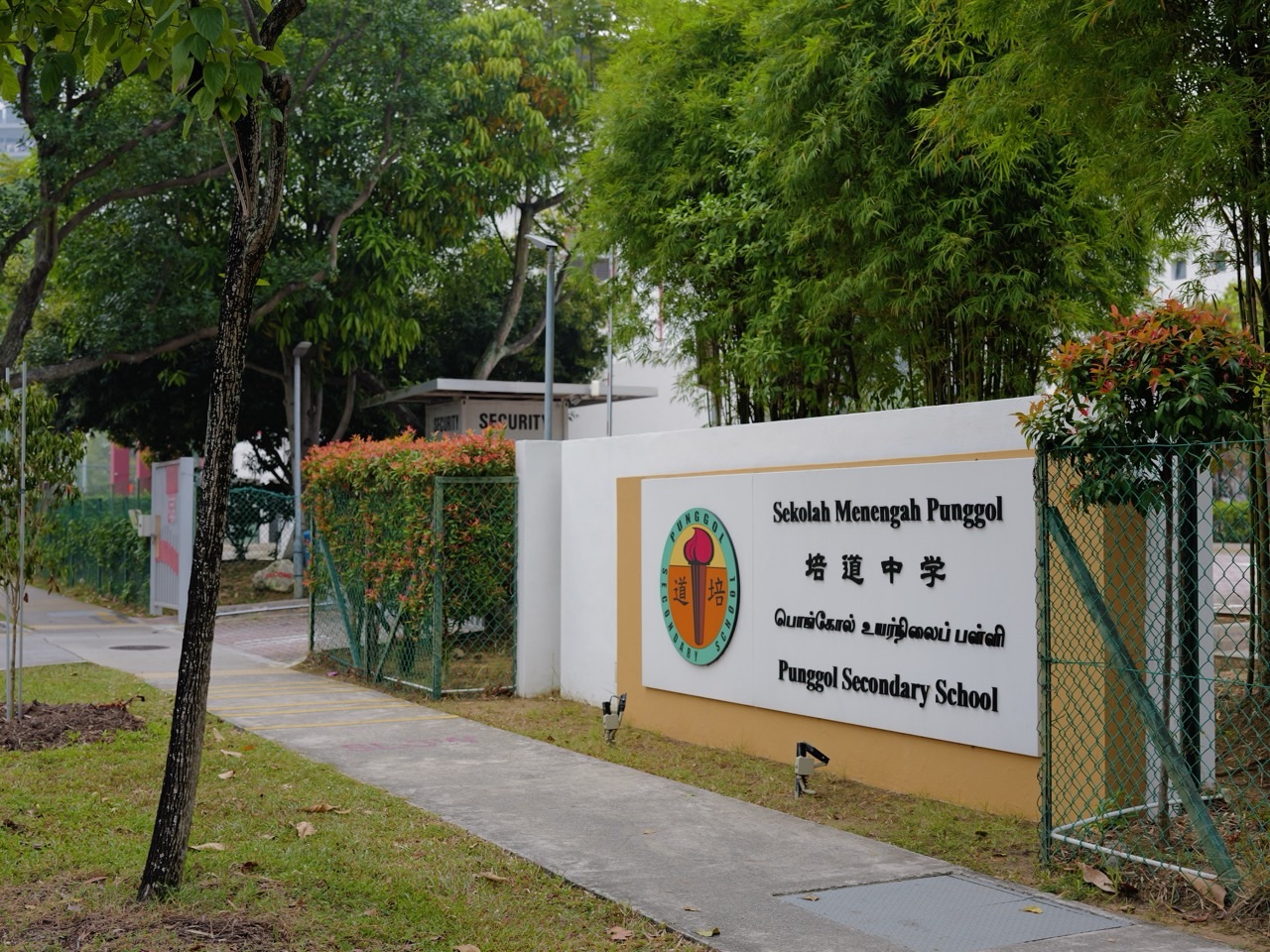
Punggol Secondary School is a coeducational mainstream school at 51 Edgefield Plains, Singapore 828870. For Punggol parents, the practical reasons to investigate it include Environment Education and Community and Youth Leadership. It offers Full Subject-Based Banding with G3, G2 and G1 subject-level arrangements rather than a Secondary 1 Integrated Programme or International Baccalaureate Diploma route.
For the completed 2026 Secondary 1 intake, Punggol Secondary School’s historical PSLE last-admitted scores were PG3 19, PG2 24 and PG1 27. These are not 2027 admission guarantees. Check MOE SchoolFinder for the current school profile, then compare programme fit, actual subject opportunities, CCAs, learning support and the home-to-gate journey from the Edgefield Plains, Edgedale and Punggol Field corridor.
- School and location: 51 Edgefield Plains, Singapore 828870.
- Historical completed-2026 intake: PG3 19, PG2 24, PG1 27; future cut-offs are unknown until the new posting is completed.
- Distinctive learning: Environment Education and Community and Youth Leadership.
- Compare the child’s real Posting Group and G1/G2/G3 subject strengths separately.
- IP and IBDP are programmes elsewhere; neither is a fourth local subject level.
- Use six realistic school choices and check both ordinary and late-CCA travel.
What Punggol Secondary School can offer a particular learner
The value of Environment Education and Community and Youth Leadership depends on the student and on the teaching. A pupil who enjoys investigating a real problem may engage deeply with applied learning, while a pupil who needs more structured reading or number practice may ask the school for examples of its support. The right question is what a child learns and can explain independently, rather than what an impressive photograph suggests. The next sections separate school-published facts from parent decisions that still require a visit.
Environment Education is the school’s Applied Learning Programme
The school’s principal describes an approach linking Science and Nature to sustainable living. Parents should ask what evidence a pupil collects, how the class investigates a problem and what the school means by a sustainable outcome. A programme can be intellectually rigorous without requiring every pupil to join a specialised competition. Ask about the ordinary curriculum first, then advanced opportunities.
Community and Youth Leadership is the Learning for Life Programme
The school describes service and youth leadership as part of building active citizens with concern for others. A child may contribute through supervised service, communication and organising rather than by collecting formal leadership titles. Families should ask how shy or newly transferred pupils participate, and how teachers provide feedback on responsibility and teamwork.
Actual academic electives can matter more than a programme slogan
The school’s current academic pages discuss Mobile Robotics, Computer Applications, Elements of Business Skills and Principles of Accounts, alongside English, Mathematics, Science, Humanities and Craft & Technology. The presence of a subject in an official list is not proof that every upper-secondary combination or General level is open to every pupil. Ask the school for the specific year-level requirements.
An example of honest environment education
A parent can use a local issue such as the quality of a waterway, household waste or energy use to ask what the pupil would need to observe. Counting objects is not enough: the learner must choose a meaningful measure, compare evidence and explain how an action might affect another group. The same topic can connect Mathematics, Science, Geography and English. This is an example for discussion, not a claim that the school runs that exact project every year.
Student support should be part of the decision
The school’s published Student Support Team page identifies school counsellors, Special Educational Needs Officers, welfare support and education/career guidance. Families with particular support needs should read the current arrangements and discuss the child’s actual requirements with the school. A support-team page is valuable evidence of a formal contact route, but it does not replace a personal discussion.
How learning really changes in Secondary 1
A primary-school pupil accustomed to arithmetic may struggle with algebraic expressions; one who recalls Science facts may find evidence-based explanations difficult. Teachers can help by diagnosing the precise error. The parent should ask whether the school uses clear formative assessment and correction, rather than assuming that a comfortable PSLE result guarantees an easy first term.
Co-curricular activities: what to ask at Punggol Secondary School
A CCA matters because it gives a pupil an opportunity to persist, build friendships and practise responsibility. It can also make a school day significantly longer. Parents should distinguish what an official website lists, what the child may try, what requires selection and where particular sessions meet. A current list is not a promise of the same activity allocation or timetable in every future year.
| Child’s interest | Investigation for this school |
|---|---|
| Environment-related club or project | Check whether the child wants regular conservation work or merely enjoys a single activity day. Ask about participation and whether tasks are supervised. |
| Choir or performing arts | Ask whether audition or allocation applies, and how rehearsals work with homework and transport. |
| Volleyball and other sports | Check selection, actual training venue and the late return after practice. |
| Uniformed group | Ask about typical commitment, service opportunities and the child’s own willingness to participate. |
| Science and technology interest | Ask about subject electives or enrichment and distinguish these from the formal CCA list. |
Do not assess a CCA only by possible bonus points or competition results. A beginner who enjoys learning an instrument or a sport may gain far more from consistent participation than from joining a fashionable activity they dislike. Conversely, a very committed pupil may benefit from a challenging programme when the family understands its true time cost. The parent’s task is to help the child make an informed commitment.
Travel from the real Punggol home zone
| Origin | A specific route trial to make |
|---|---|
| Edgedale and Oasis | Inspect the actual walk or bus connection to 51 Edgefield Plains and compare Greendale’s campus along Edgedale Plains. |
| Punggol Field and Central | Compare direct access to Punggol Secondary with Edgefield Secondary at 36 Punggol Field. |
| Sumang and Soo Teck | Test a route across Punggol and compare the more western Yusof Ishak campus. |
| Northshore / Punggol Point | Add first feeder, station waiting and final walking to the time recorded. |
| Matilda / West Punggol | Include the real transfer and late CCA return rather than relying on map distance. |
This is a geography-based shortlist, not a table of invented journey minutes. The relevant route begins at the actual home door and ends at the school gate. Record the morning arrival journey and the return after a chosen CCA, including the first feeder trip, transfer waiting and walking safely in wet weather. Compare Punggol Secondary School with other realistic schools only after this test. See the Punggol school travel guide for additional route-planning prompts.
Four illustrative families and how their conclusions can differ
PSLE 18 and an interest in biological systems
The child is PG3-eligible under normal mapping and numerically one point better than Punggol Secondary’s 2026 historical PG3 boundary of 19. This is not a 2027 offer. The family investigates Environment Education, upper-secondary science prerequisites and the pupil’s own enthusiasm. It keeps other genuinely suitable schools in the list.
PSLE 24 and a community-minded learner
A score of 24 normally maps to PG2, and matches the historical last-admitted PG2 number at Punggol Secondary. The family checks current eligibility, considers school support and other schools with appropriate PG2 ranges, then asks whether the leadership experience suits a child who enjoys helping others but dislikes public performance.
PSLE 25 and an uneven academic profile
The family is allowed to compare PG1 and PG2 in the normal mapping. The old Punggol Secondary PG1 figure was 27 while PG2 was 24. That means the score had a larger historical numerical margin at PG1, but it cannot determine the child’s appropriate starting subject demands. The school and primary teachers can advise based on actual strengths.
PSLE 14 and a possible IP question
The child could explore suitable IP schools under their separate entry requirements. The family should also consider whether Punggol Secondary’s more local environment and leadership focus might suit the student better. Choosing a mainstream school is a legitimate positive decision, not a failure to seek the most demanding brand.
Five abbreviations parents must separate
A Secondary 1 Posting Group (PG3, PG2 or PG1) is about a pupil’s ordinary school-admission route. A G3, G2 or G1 subject level is the level of an individual school subject under Full Subject-Based Banding. With Full SBB, students may take particular subjects at different levels when they meet the relevant conditions. This distinction is important for pupils whose PSLE subject ALs show an uneven learning profile.
The Integrated Programme (IP) is a school-specific integrated secondary-to-pre-university route. The International Baccalaureate Diploma (IBDP) is a pre-university qualification offered through particular institutions, including some IP schools, but not all IP schools. Punggol’s four mainstream secondary schools are not IP schools. A child does not lose access to higher education because the family chooses a mainstream secondary school.
| PSLE score | Normal Posting Group route | Essential check |
|---|---|---|
| 4–20 | PG3 | Use official PG3 school ranges, not a schoolwide ranking. |
| 21–22 | PG2 or PG3 | Select one group for all six choices in the normal S1 exercise. |
| 23–24 | PG2 | Compare PG2 admissions and actual subject learning. |
| 25 | PG1 or PG2 | Examine both the academic starting level and the available schools. |
| 26–30 | PG1 if English and Mathematics are both AL7 or better | Check each core-subject AL on the official result. |
| 31–32 | Not an ordinary PG1/2/3 posting route | Request school and MOE advice on authorised alternatives. |
The four Punggol schools in one historical table
| School | PG3 2026 COP | PG2 2026 COP | PG1 2026 COP | Local reference |
|---|---|---|---|---|
| Edgefield Secondary | 14 | 23 | 27 | 36 Punggol Field; entrepreneurship-oriented ALP. |
| Greendale Secondary | 16 | 23 | 27 | 51 Edgedale Plains; Design, Technology & Engineering. |
| Punggol Secondary | 19 | 24 | 27 | 51 Edgefield Plains; Environment Education. |
| Yusof Ishak Secondary | 15 | 22 | 27 | 8 Sumang Walk; sustainability and smart-city STEM. |
Every number in this table is a historical last-admitted PSLE score for the completed 2026 Secondary 1 intake, based on the previous PSLE cohort. These are not the 2027 final cut-off points. The next result depends on the new cohort’s preferences, vacancies and admission process. A lower number describes more selective historic admission, not better teachers or a better educational fit.
A parent at score 23 should not read a PG3 number such as 15 to decide their PG2 application. A parent at score 25 should not assume the same group can be selected for different schools in one regular submission. Use MOE SchoolFinder for the most recent official individual-school references and the current S1 Posting instructions for the actual process.
School fit: academic demands, student support and daily life
A school is not just a sequence of examinations. The child will spend hundreds of days moving from classroom to classroom, building friendships, joining activities and learning how to ask for help. Parents should investigate whether the school offers a teaching pace the child can engage with, whether it gives clear feedback, and how it supports a pupil who is stronger in one subject than another. The child should be part of the decision, not merely the subject of an adult ranking exercise.
A secondary-school transition often changes the kind of thinking required. In Mathematics, arithmetic becomes algebraic structure. In English, pupils must infer, justify and write with more precision. In Science, evidence and explanation become more demanding. A child can have done well at PSLE and still need specific bridging work. Helpful tutoring or school support starts by identifying the exact misunderstood concept, not by assuming that an overall Posting Group explains every difficulty.
Six realistic school choices and the meaning of a backup
The ordinary Secondary 1 posting process offers six schools in preference order. At an eligible choice-band score, the selected Posting Group applies across all the school choices. Merit is the primary basis of allocation, while citizenship, choice order and a computerised ballot are used as relevant tie-breaks. A family should rank the schools it genuinely prefers, but be realistic about last year’s ranges. A sixth choice can become the student’s actual school; it should not be a place the family cannot accept.
MOE recommends considering at least two or three schools with previous last-admitted scores numerically higher than the child’s result, which means a better score margin for the pupil. Historical margin reduces overreliance on competitive options but does not guarantee admission. Parents should be particularly careful when every preferred school in the locality was historically more competitive than the child’s current score. It is better to widen the eligible list than invent vacancies.
What Punggol geography changes
Punggol Central, Punggol Field, Sumang, Matilda, Edgedale, Oasis, Waterway East, Northshore and Punggol Point are not one transport origin. A child near an interchange may have a very different journey from one who needs a bus or LRT feeder. Compare morning arrival, normal return, late return after CCA and a disruption scenario. A map distance or station-to-station trip does not measure a pupil’s real door-to-door daily burden.
A family should trial the actual route at a representative school-day time and observe the final walk, road crossings, waiting, crowded stations and wet-weather alternatives. A shorter journey can release time for sleep, exercise, reading and homework. But a distinctive school programme may justify a longer journey for a particular child if the whole week remains sustainable. This is a decision to be made consciously rather than hidden behind a school name.
Later routes: JC, polytechnic, ITE and university
The child’s eventual progression depends on the qualification, the subject levels and grades achieved, prerequisites and the application rules at the relevant year. The new Singapore-Cambridge Secondary Education Certificate (SEC) is examined from 2027 at applicable General levels. Reforms to post-secondary admission processes are underway. A pupil entering Secondary 1 in 2027 will make the main post-secondary decision years later, so a blog should not promise that one 2026 formula will continue unchanged.
A school STEM activity does not guarantee an engineering diploma; leadership service does not guarantee a law course; a lower-secondary Posting Group does not permanently determine university eligibility. The best strategy is to develop useful foundations in English, Mathematics, scientific evidence, ethical judgement and sustained independent work, then review upper-secondary subject combinations and later course requirements when the student is ready.
A first-term routine built for actual learning
| Period | What parents should observe | A useful next action |
|---|---|---|
| Weeks 1–2 | Travel reliability, school belonging, timetable and ability to ask teachers | Solve any practical arrival or communication problems. |
| Weeks 3–4 | First algebra, reading and Science explanation tasks | Identify a real gap rather than assigning a broad label. |
| Weeks 5–8 | CCA participation, homework pace and sleep | Adjust the timetable if normal days are unsustainable. |
| Weeks 9–12 | Teacher feedback, learning confidence and friendships | Agree on one concrete subject improvement and how to check it. |
| After the term | Evidence of stronger independent thinking and appropriate student support | Review support or subject-level questions where school rules permit. |
For example, if a child treats 2(x+3) as 2x+3, they need to understand distribution, not merely finish more questions. If a Science response offers a claim without evidence, they need help connecting observation to a reasoned explanation. If English comprehension is weak because a child cannot distinguish an inference from a quotation, teach that distinction explicitly. Meaningful progress can be observed in corrected reasoning, independent explanations and sustained participation.
A practical parent research week
- Read the official PSLE eligibility and application instructions before discussing school names.
- Filter the shortlist by the selected Posting Group and the actual year of each historical PSLE range.
- Inspect the four local Punggol schools, plus suitable Sengkang or other nearby schools if the local options are not sufficient.
- Ask the child what kind of learning, CCA or school environment they would willingly engage with.
- Ask the school about subject options, special educational support, current CCAs and late dismissal.
- Run the school-day commute from the actual home block and note safety, rain and transfer issues.
- Rank six schools the family could actually accept, remembering that the sixth choice is a real possible outcome.
This is a suggested method, not an official seven-day posting timetable. The application deadline may require doing the tasks more quickly. Keep the current official dates and instructions ahead of any planning sequence published on a website.
Which school comparison questions matter most?
- How does the school teach environmental reasoning and ensure that pupils can distinguish data from assumptions?
- How does Community and Youth Leadership include children who are not appointed student leaders?
- Are Mobile Robotics and Principles of Accounts available at the levels and year groups relevant to this child?
- Where do the chosen CCAs usually meet, and what does the timetable look like after an ordinary school day?
- What support is available when a student is struggling in a particular subject but doing well in other subjects?
- Which current academic results and conditions govern future subject-level movement?
- How do parents contact form teachers, the Student Support Team and the education/career guidance staff?
A school official should be able to clarify present programmes and relevant rules. Parents should feel comfortable asking about how learning support works for an ordinary pupil, not only asking to see the most successful competition team. It is also reasonable to ask who to contact when there are concerns about peer relationships, homework overload or special educational needs.
The parent evidence worksheet
| Evidence | What to record | Avoid this assumption |
|---|---|---|
| Admission route | Official score, subject ALs, selected group and school-specific intake | All four Punggol schools will accept every applicant. |
| Historical range | Completed intake year and correct PG column | Last year’s COP is a guaranteed future result. |
| Teaching and subjects | Examples of feedback, subject-level rules and upper-secondary prerequisites | Every elective is open to every pupil. |
| CCA access | Actual 2027 offerings, selection, location and timing | A website image is an allocation letter. |
| Journey | Home-to-gate morning and CCA-day return | MRT ride time measures the whole trip. |
| Wellbeing | The child’s own view, support needs, sleep and social adjustment | A prestigious label will solve a difficult timetable. |
| Long-term possibilities | Subjects and skills the pupil should develop now | A twelve-year-old’s PG guarantees university or career admission. |
Questions Punggol families frequently ask
Does this school offer IP or the IB Diploma?
No. The school offers mainstream Full SBB. Other schools have their own IP and IBDP arrangements; the child’s qualifications and later applications determine future paths.
Are the stated PSLE cut-offs for 2027?
No. The numbers are from the completed 2026 intake, based on the 2025 PSLE cohort. The 2027 final scores will be known after the relevant posting exercise.
Can a PG2 child take some subjects at G3?
Subject-level opportunities may be available under the current Full SBB placement criteria. Ask the school about the actual requirements for the child.
Does PSLE score 22 allow a PG3 or PG2 choice?
The normal mapping allows either; the family must choose one group for all six regular school choices.
What is special about PSLE score 25?
The normal mapping permits PG1 or PG2. Match the group’s academic demands and actual school possibilities with the child’s abilities and needs.
Can a child move between subject levels later?
Where permitted by school and MOE criteria, subject levels may be reviewed; changes should not be assumed or promised.
Does an applied programme secure a polytechnic or university offer?
No. Later admissions depend on actual qualifications, grades and prerequisites.
Does a CCA guarantee two LEAPS bonus points?
No. Recognition follows LEAPS criteria and the student’s documented sustained activity and achievements.
Does living very near the school create automatic Secondary 1 proximity priority?
Do not assume Primary 1 proximity mechanisms apply; verify MOE’s secondary posting criteria.
How should we compare Sengkang alternatives?
Check correct eligibility, programmes and door-to-door routes, not merely the estate name.
Should we follow only a school ranking?
No. Historical score selectivity, pedagogy, interests, subject options, care and journey can point to different choices.
What should the family do after posting?
Settle routines, inspect real schoolwork, identify precise learning gaps and communicate with teachers before adding extra workloads.
Official school sources and companion Punggol guides
- School homepage and current announcements
- Principal’s description of ALP and LLP
- Academic departments and subject options
- Mobile Robotics, Computer Applications, EBS and POA
- Student Support Team
- LEAPS 2.0 domains
- MOE SchoolFinder
- MOE Secondary 1 Posting
- MOE Full SBB
- Punggol score-by-score school-choice hub
- Punggol school transport and walking guide
- G3 and PG3 school choice
- G2 and PG2 school choice
- G1 and PG1 school choice
- IP and IB route explained
- Edgefield school-specific guide
- Greendale school-specific guide
Editorial verification: 14 November 2026. Published campus and programme information is drawn from official school sources; historical PSLE reference scores are for the completed 2026 Secondary 1 intake. Current-year choices, school programmes, CCAs, routes and later admissions should always be verified before the family acts.


