
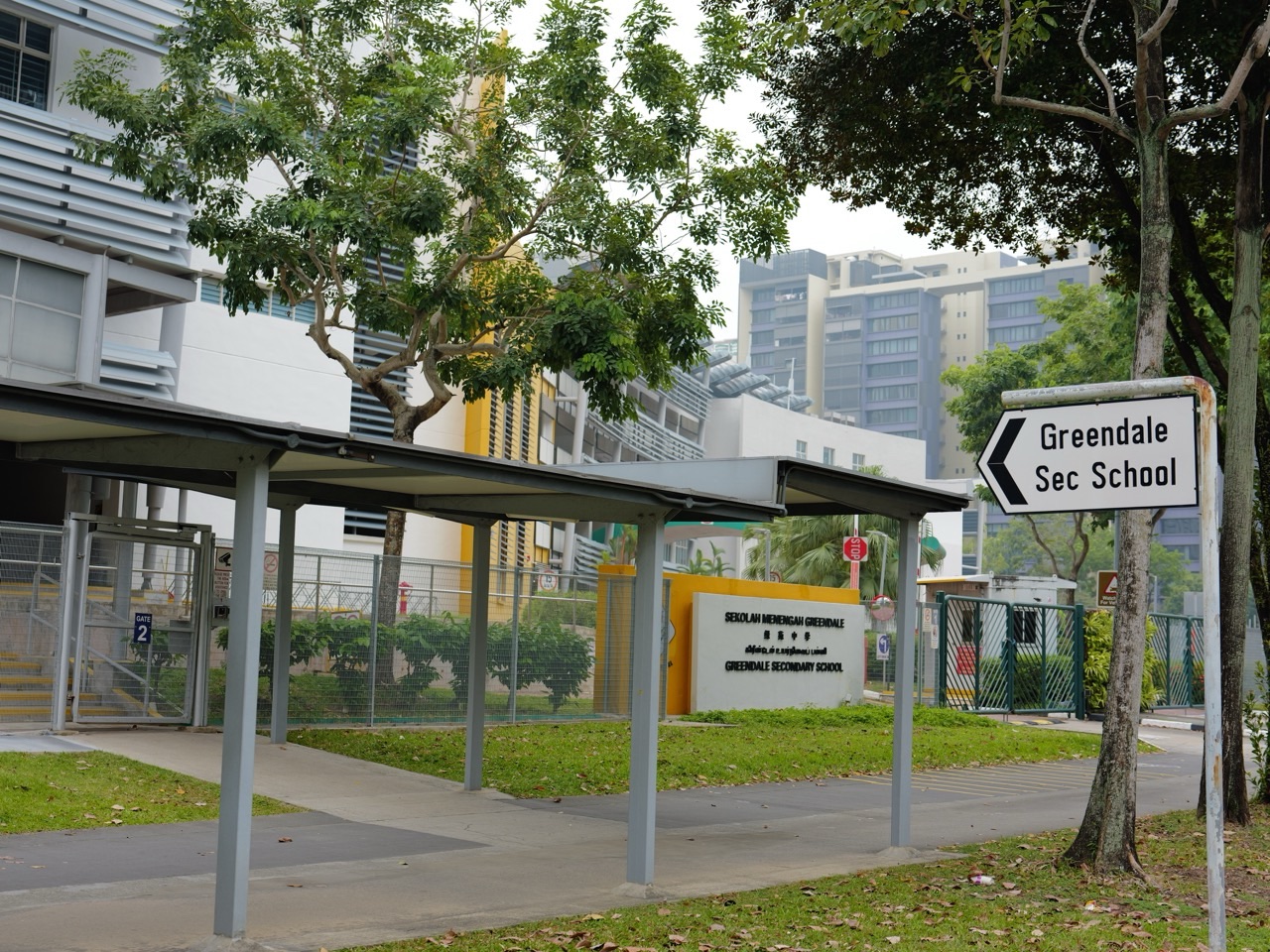
Greendale Secondary School is a coeducational mainstream school at 51 Edgedale Plains, Singapore 828866. For Punggol parents, its clearest decision value is design-and-build thinking with outdoor learning and managed challenge. It offers a local Full Subject-Based Banding pathway rather than an Integrated Programme or IB Diploma at Secondary 1; check the child’s posting eligibility before comparing its name with an IP school’s reputation.
For the completed 2026 Secondary 1 intake, Greendale Secondary School’s historical last-admitted PSLE scores were PG3 16, PG2 23 and PG1 27. These are previous-cohort figures, not 2027 guarantees. A family should compare the right Posting Group with current MOE SchoolFinder information, then test the journey from Edgedale Plains, Oasis and the eastern Punggol corridors, programme fit, subject options and the actual CCA timetable.
- School identity: 51 Edgedale Plains, Singapore 828866; mainstream Full SBB, not IP or IBDP.
- 2026 historical cut-offs: PG3 16; PG2 23; PG1 27, all subject to official current-year verification.
- Programme: Design, Technology and Engineering (DTE) Applied Learning Programme, with coding, design and engineering.
- Learning for life: Outdoor Adventure Education Learning for Life Programme, with teamwork, risk awareness and outdoor activity.
- Investigate CCAs and subject-level pathways individually; attractive programme descriptions do not imply guaranteed access to every specialised activity.
- Plan six realistic school choices and test home-to-gate routes, including a late CCA return.
What makes Greendale Secondary School worth investigating?
At Greendale Secondary School, the most useful starting question is not whether the school has a lower or higher last-admitted PSLE score than another school. The useful question is whether its distinctive programmes will allow a particular child to practise important skills, make friends and build understanding. The school describes design, technology and engineering (dte) applied learning programme, with coding, design and engineering and outdoor adventure education learning for life programme, with teamwork, risk awareness and outdoor activity. That gives parents concrete questions to ask rather than vague claims that one school is better.
A family that values a specific programme should look for evidence of teaching: what do pupils make, write, measure, investigate or present? How does a teacher notice when a pupil is not understanding? What would a modest but real improvement look like after a term? These questions are particularly important for pupils whose PSLE scores are uneven across subjects, because they may need a mix of academic stretch and careful consolidation.
The verified programme description: separate school-wide learning from selective experiences
The school’s July 2026 Greendale Xperience description identifies coding, design and engineering in its Applied Learning Programme.
Its May 2026 LLP page describes hands-on kayaking, rock-climbing and orienteering as examples of learning through challenge, teamwork and risk assessment.
The school publishes active sports and performing arts pages, including canoeing, fencing, floorball and orchestra. Check actual allocations and 2027 timetables rather than assuming a preferred place is guaranteed.
Its official open-house notice invited the public on Saturday, 14 November 2026, 9am–1pm, without registration. This is a dated 2026 event, not an evergreen annual schedule.
Use the school’s current programme pages, including Applied Learning Programme information and Learning for Life Programme information, to ask what was offered in 2026 and what is planned for the next intake. An official page can describe an authentic programme without promising that every student takes every specialist module, competition or off-site trip. Parents need to understand access and the normal curriculum, not only the best photographs.
What the five abbreviations mean before you compare schools
Posting Group 3 (PG3), Posting Group 2 (PG2) and Posting Group 1 (PG1) determine ordinary Secondary 1 admission eligibility. G3, G2 and G1 name subject levels under Full Subject-Based Banding. The Integrated Programme (IP) is a defined school pathway and the International Baccalaureate Diploma Programme (IBDP) is a later pre-university qualification. The five labels in a parent’s web search are not five parallel streams of the same school. Greendale Secondary School is a mainstream Full SBB school, not an IP school. A child who studies here can still consider appropriate post-secondary pathways through the actual qualifications eventually achieved.
A child with PSLE Score 4–20 generally uses PG3. At 21–22, the published score mapping permits PG2 or PG3; at 23–24, PG2; at 25, PG1 or PG2; at 26–30, PG1 subject to the published English and Mathematics AL7-or-better conditions. The official individual eligibility letter governs the case, and an aggregate of 31 or 32 must not be treated as an ordinary PG1 posting entitlement. Check the current MOE Full SBB guidance and the pupil’s official results.
| PSLE score | Normal group mapping | What to confirm |
|---|---|---|
| 4–20 | PG3 | Current-year school’s PG3 score reference and options. |
| 21–22 | PG2 or PG3 | One group selected for all six school choices; compare realistic schools under both routes first. |
| 23–24 | PG2 | Use PG2 comparisons rather than an old PG3 number. |
| 25 | PG1 or PG2 | Compare learning readiness with the school lists under each permitted group. |
| 26–30 | PG1, if English and Mathematics meet the condition | Check individual subject ALs and the official eligibility letter. |
| 31–32 | No ordinary PG1/2/3 mapping | Seek primary-school/MOE advice on the actual authorised options. |
The historical 2026 reference below is for the completed 2026 Secondary 1 intake, which uses the 2025 PSLE cohort. It is not the cut-off point for 2027 entry. The coming cohort’s last-admitted score can only be determined after its posting exercise. The 2026 figures help families understand past selectivity and why they should not compare a PG2 applicant with a PG3 figure.
| Punggol Secondary School | PG3 (G3 entry route) | PG2 (G2 entry route) | PG1 (G1 entry route) |
|---|---|---|---|
| Edgefield | 14 | 23 | 27 |
| Greendale | 16 | 23 | 27 |
| Punggol | 19 | 24 | 27 |
| Yusof Ishak | 15 | 22 | 27 |
Keep the score and the year together when taking notes. For example, a historical PG3 number of 14 is not a promise for a PSLE-14 pupil, and PG1 number 27 is not a comment on the worth of a child taking G1 subjects. When the actual application opens, inspect MOE SchoolFinder for the most current official school profile, score range, subjects and CCAs, not merely a reposted chart.
Why ‘suitable’ is different from ‘lowest last-admitted score’
A historical cut-off says something about that earlier cohort’s preferences and allocation, not how any teacher in the school will explain a difficult idea to your child. Parents need to compare whether their pupil can engage with the teaching, seek help and participate in the community. A school that was more selective last year can still be a poor match for a pupil whose preferred learning activities, commute or support needs are different.
Ask a child two questions before looking at rankings: ‘Which kind of question do you enjoy solving even when you do not know the answer immediately?’ and ‘When you are stuck, what makes a teacher’s explanation helpful?’ A child who enjoys building things may seek applied design work; a child who likes stories may value reading and the arts; another might need a school where a long day does not erase time for rest. These are legitimate considerations alongside the official score and subject levels.
What the six school choices actually do
The regular Secondary 1 posting process gives up to six school choices in order of preference. If the child has two possible Posting Groups, the chosen group applies across all six choices; parents cannot mix PG2 at one school with PG3 at another within the same submission. Ranking matters in ties: MOE uses PSLE merit first and, when applicants share the same score for the last available seat, the published tie-breaks include citizenship, school choice order and computerised balloting.
Use a realistic spread. MOE’s school-choice guidance encourages families to consider two or three schools whose historical last-admitted score is numerically worse than the child’s score (the child has a better PSLE score). These are reference margins, not ‘guaranteed safe schools’. A choice in the sixth slot should still be one your child can accept. Avoid a list with six very competitive schools if past patterns suggest little margin and avoid filling the form with schools that do not actually admit the selected group.
Why IP and IB do not appear in the school’s mainstream intake columns
None of Punggol’s four mainstream secondary schools offers an IP route. Schools such as St. Joseph’s Institution and Anglo-Chinese School (Independent) have their own established IP-to-IB Diploma pathways; other IP schools lead to A-Levels. A family considering one of those routes must investigate its particular admissions, campus, subject structure and travel rather than infer that this local mainstream school secretly has a separate IP or IB class. The purpose of comparing IP and IB is understanding alternatives, not suggesting that a local school is incomplete.
For a child who ultimately wants JC, polytechnic, ITE or university, the later decision depends on actual subject levels, examination grades, prerequisites and evolving admissions policy. From the 2027 exam series, the Singapore-Cambridge Secondary Education Certificate (SEC) records subject results at applicable General levels. Current post-secondary reforms and future changes should be checked again in the child’s graduating year. At age twelve the reliable task is to protect genuine learning and keep the student’s interests visible, not promise a particular JC, diploma or degree.
Greendale Secondary School in the local neighbourhood: four routes to test
This school sits in Edgedale Plains, Oasis and the eastern Punggol corridors. The word Punggol includes several distinct transport starting points. A resident near an LRT station does not have the same first leg as a family in Northshore, and a school trip at 7am is not the same as driving past the building on a weekend. The correct measurement runs from the family’s home door to the school gate and back on a CCA day.
| Home zone | Specific test before choosing |
|---|---|
| Edgedale / Oasis | Start with the actual gate at 51 Edgedale Plains. Determine if walking or a nearby bus/LRT connection is genuinely simpler than a route through Punggol MRT. |
| Waterway East / Punggol Field | Compare the eastward access route, including wet-weather walking and the return after CCA. |
| Sumang / Matilda | Do not mistake a route across the estate for a short one just because both addresses say Punggol. Time each transfer. |
| Northshore / Punggol Point | Add feeder transport and test whether the full late-afternoon return leaves adequate time for sleep and homework. |
Do not publish a fabricated universal journey time such as “all Punggol pupils need 12 minutes.” The length of a walk, station access, waiting, transfers, crowded gates, rain and a pupil’s independent travel readiness change the actual result. Use a live route planner and make a normal school-day trial. The Punggol school transport guide provides useful checklist prompts, while the final route should be measured for the actual household.
What a CCA preference can and cannot tell you
Greendale Secondary School’s published opportunities include canoeing, fencing, floorball, football, softball, orchestra, performing arts, uniformed groups and clubs. These are credible subjects for a conversation with teachers and pupils, not a guarantee that every Secondary 1 applicant can join a particular team, orchestra or club. Ask whether the CCA is offered to beginners, whether auditions or trials apply, how many sessions occur weekly, whether the activity is held outside the school and how dismissal time affects the journey home.
A particularly important question at this school is whether canoeing or another outdoor CCA requires travel from the school to an external training location. Parents sometimes calculate the commute to the main campus and stop there. A student may have a different venue or a later return on particular CCA days. The child who is regularly exhausted cannot enjoy the supposed benefits of a school programme as fully as one who is rested enough to participate. Check the official CCA information and the intake-year allocation process.
Five questions about learning at G3, G2 and G1
- Which current academic levels and entry arrangements are available to this pupil under the official Posting Group eligibility?
- How does the school decide whether a particular English, Mathematics, Science or Mother Tongue subject should be taken at a more demanding level?
- What are realistic examples of school homework and assessments in Secondary 1, and which concepts do many new pupils find unfamiliar?
- If a student finds algebra difficult but can do practical engineering, can teachers diagnose the mathematical gap and respond specifically?
- What happens when a child achieves strongly in one subject and falls behind in another? Who guides the family through subject-level decisions?
It is a mistake to infer subject-level entitlement from the school having a programme with a demanding name. A technology project may require reasoning without conferring automatic entry into a G3 subject. Equally, a student learning a core subject at G1 or G2 should not assume that practical or leadership experiences are meaningless to them. Real education is the combination of academic progression, participation and support.
Three Punggol family case studies
The child who likes design but hesitates with algebra
An Oasis-area pupil enjoys designing prototypes and explaining how objects work. The DTE programme makes Greendale an interesting research candidate. But design projects still need measurement, reasoning and careful reading. The family asks whether the school connects those foundations to the project work, and whether a pupil taking G2 Mathematics can still participate in appropriate applied learning.
The pupil who wants outdoor adventure
A Waterway East pupil loves climbing and water activities. The family should establish whether outdoor experiences are whole-cohort LLP activities, selective enrichment or a particular CCA. They also ask about safety instruction, equipment requirements and off-campus travel. An illustrated rock-climbing scene on a site cannot establish automatic access to a specific expedition.
The academically strong pupil choosing between two models
A family with a PG3-eligible child compares Greendale with a more distant school reputed to be academically selective. They visit both, review actual subject opportunities and find that the child connects strongly with the design ethos and peers at Greendale. That can justify Greendale as a first choice if the score and programme fit are real. A school decision need not rank all children by their PSLE numbers.
Worked examples: how to use the historical PSLE numbers responsibly
| Illustrative child | Correct interpretation of the old 2026 number | Decision still needed |
|---|---|---|
| PG3 child, PSLE 14 | Numerically two points better than Greendale Secondary School’s old PG3 last-admitted score 16. | No guarantee; check real preference, subjects, transport and the next intake’s official information. |
| PG3 child, PSLE 16 | Equal to the old PG3 boundary 16. | A previous match is not a booked place; build a spread of six choices. |
| PG2 child, PSLE 23 | Equal to the old PG2 boundary 23. | Use PG2 evidence only and confirm school fit rather than importing PG3 comparisons. |
| PG1 child, PSLE 25 | Numerically two points better than the old PG1 boundary 27. | Decide whether the pupil is choosing PG1 or PG2 under official eligibility and evaluate the learning demand. |
| PG1 child, PSLE 28 | Numerically one point weaker than the old PG1 boundary 27. | Do not invent a likely offer; widen the official eligible school list and seek advice if needed. |
These examples compare one pupil’s number with one previous cohort’s last-admitted number. They do not estimate an admission probability or imply that a pupil at a weaker historical margin should not apply to a preferred school. They explain why the sixth choice needs to be viable. A pupil applying at the old boundary faces uncertainty; a pupil with a stronger numerical margin still faces a new cohort and new choice patterns.
A deliberate comparison with other Punggol schools
Greendale Secondary School should be compared with the other three local mainstream schools rather than considered alone. Edgefield has an entrepreneurship and sport-character emphasis; Greendale emphasises design-and-build and outdoor adventure; Punggol Secondary highlights environment education and community youth leadership; and Yusof Ishak Secondary develops STEM around sustainability and smart cities alongside leadership for social action. These programme descriptions are starting points, not rankings. Students can receive excellent general education in every school while having different personal reasons to prefer one.
For a family interested in a particular activity, the comparison should ask whether that experience is genuinely available, what the pupil would do in the first year, how much of it is selective, and how the weekly timetable fits the rest of life. For a family prioritising English or Mathematics, the central issue may be the school’s teaching and feedback rather than its applied programme. Recheck the exact 2026 historical figures in the table above and distinguish these from a later 2027 posting outcome.
A step-by-step seven-day parent preparation plan
- Day 1: obtain the official PSLE score and actual Posting Group choices; read the current application timeline.
- Day 2: enter six or more school candidates into a worksheet and remove any that do not offer the required admission route.
- Day 3: read the current Greendale Secondary School school pages, list two real learning interests, and check the published subject and CCA offerings.
- Day 4: ask the child to identify what makes them curious about each school rather than how prestigious it sounds.
- Day 5: perform the home-to-gate morning travel rehearsal and investigate late CCA dismissal logistics.
- Day 6: check historical score ranges from the correct year and group; create a reasonable mix rather than six extreme reach choices.
- Day 7: order six genuinely acceptable schools by informed preference and submit within MOE’s official window.
Seven days is a planning sequence, not a claim that MOE provides a seven-day period for the exercise. If deadlines are shorter, compress the plan. The most important order is eligibility first, then school fit and logistics, then a final preference list that all family members can understand.
What happens after posting: a twelve-week transition plan
Secondary school changes both the academic language and the demands on personal organisation. In Mathematics, a pupil who succeeded through arithmetic may need to reason with algebraic symbols, negative numbers and equations. In English, reading comprehension now requires more explanation, inference and evidence. Science questions may require interpreting graphs and explaining causal relationships. A pupil can be capable and hardworking while still needing deliberate teaching for these new forms of thinking.
| Stage | Useful parent focus | Practical evidence |
|---|---|---|
| Weeks 1–2 | Adjust to travel, timetable, school communication, textbooks and new peers | Child knows whom to ask for help and reaches school without regular panic. |
| Weeks 3–4 | Check reading comprehension and mathematics foundations | One corrected schoolwork task the child can explain without prompting. |
| Weeks 5–8 | Observe homework load, CCA participation and sleep | A normal week that does not regularly depend on late-night work. |
| Weeks 9–12 | Discuss learning strengths and difficulties with subject teachers | One precise next action for each subject that needs attention. |
| After the term | Review school belonging, learning progress and longer-term opportunities | A student who can describe what improved and what still needs practice. |
An effective academic support plan names the error. If the child writes 3(x + 2) = 3x + 2, the problem is distributive reasoning; piling on random hard questions may not help. If a Science answer repeats a sentence without explaining the evidence, the child needs practice connecting a claim to observed facts. When adults see the actual mistake and teach the first principle, the pupil has a better chance of becoming independent.
Five-year or ten-year questions: JC, polytechnic, ITE and university
Parents naturally ask where this school could lead. The responsible answer begins with the student’s actual subjects, subject levels and later results. PG1, PG2 and PG3 describe admission to Secondary 1, not fixed university outcomes. From 2027 the SEC takes the place of earlier N- and O-Level exam structures for the relevant cohort. Eligibility for a JC or Millennia Institute route, a polytechnic diploma, a foundation programme, ITE Higher Nitec or subsequent university application must be checked at the correct stage against the applicable course requirements.
To protect options, teach the child to read and write clearly, reason with quantities, interpret scientific evidence, work with others and complete projects responsibly. In Secondary 2, examine the available upper-secondary subject combinations. In Secondary 3 and 4, ask about the formal admissions prerequisites that apply to the pupil’s actual results and qualifications. A family should avoid promising an IB Diploma or particular degree merely because the pupil is interested in a STEM or leadership activity at twelve.
Open-house interview questions to take on paper
- What does a Secondary 1 DTE project look like in practice and which skills does it teach?
- Which activities are school-wide versus selective clubs, competitions or outdoor trips?
- How are physical confidence and risk management taught safely in the LLP?
- If the pupil wants canoeing or fencing, how are applications, off-campus sessions and late returns organised?
- Can a pupil with uneven PSLE ALs receive subject-specific placement and support?
- What are the school’s actual homework, assessment and learning-support practices?
- How does a family judge future upper-secondary subject combinations without assuming all electives are open?
A parent worksheet: evidence, uncertainty and next action
| Decision question | What to record | Who can clarify |
|---|---|---|
| Is the child actually eligible to apply? | Official PSLE notice, chosen Posting Group and current-year requirements | Primary school or MOE. |
| How does the programme fit this learner? | One concrete task the child would enjoy and one difficulty they may face | Subject teacher or programme coordinator. |
| Are the desired CCAs truly accessible? | Current list, selection, typical practice and venues | CCA teacher-in-charge. |
| Will schooldays be sustainable? | Actual journeys, CCA returns, homework and sleep budget | Child and family, with school timetable details. |
| How will learning be monitored? | Examples of marking feedback, subject placement criteria, pastoral contacts | Form and subject teachers. |
| How reliable is the score comparison? | Year of historical intake, correct group, no guarantee stated | MOE SchoolFinder / official S1 information. |
A school choice is an evidence problem with a human purpose. The parent is not trying to maximise one school’s reputation score. The parent is choosing where the child will spend hundreds of ordinary mornings learning to read more deeply, ask questions, use evidence, accept correction and build friendships. The right school makes those ordinary days possible.
Frequently asked questions
Is the school an IP or IB school?
Greendale Secondary School is a mainstream secondary school under Full SBB, not an IP or IBDP campus. Read the separate IP/IB guide for those routes.
Does an old score equal a guaranteed place?
No. The last-admitted PSLE score for the coming intake is determined only after the new cohort makes its choices.
Can a PG2 student take a G3 subject?
Depending on the current Full SBB subject-specific criteria and the school’s arrangement, some pupils can offer a more demanding subject. The school should confirm eligibility.
Does PG1 mean the child cannot later enter higher education?
No. Later qualifications and entry criteria determine options. PG1 is not a lifelong verdict.
Can we mix Posting Groups across six school choices?
Where two groups are offered, the selected Posting Group applies to all six choices under the ordinary process.
Will joining a school guarantee its popular CCA?
No. Participation or selection can depend on school policy, trials, capacity and suitability.
Does an ALP guarantee admission to a science or engineering course?
No. Applied learning is educational enrichment, not a post-secondary admission guarantee.
Is living close to the school an admissions priority?
Do not assume Primary 1 proximity rules apply to Secondary 1. Use MOE’s posting criteria for the relevant route.
Can a pupil with a high score benefit from this mainstream school?
Yes, if academic programmes, support, activities, culture and family logistics align with the pupil’s needs.
Where should parents check the date of a cut-off?
Use MOE SchoolFinder and write down which completed Secondary 1 intake supplied the reference.
How should we handle a child who feels disappointed by posting?
Discuss the child’s actual concerns, contact the school if a support issue needs solving and establish new opportunities for participation and learning.
What is the strongest final check?
Ask whether the child would willingly attend the school for an ordinary week, not only during an open-house visit.
Official sources and companion pathways
- Greendale Secondary School official contact and address
- Greendale Secondary School official school / programme description
- Greendale Secondary School official Applied Learning Programme
- Greendale Secondary School official Learning for Life Programme
- Greendale Secondary School official CCA overview
- MOE SchoolFinder (current school eligibility, programmes and score references)
- MOE Secondary 1 Posting
- MOE Full Subject-Based Banding
- Punggol PSLE Score 4–32 school-choice hub
- Punggol walking, LRT and transport guide
- Punggol–Sengkang cross-town school choices
- G3 parent guide
- G2 parent guide
- G1 parent guide
- IP/IB parent guide
Editorial verification for 14 November 2026: school addresses and programme descriptions were checked against current official school pages. The cut-off numbers shown are historical figures for the completed 2026 Secondary 1 intake; they are not 2027 admission results, enrolment promises or live transport times. Recheck the relevant official pages at application.


