
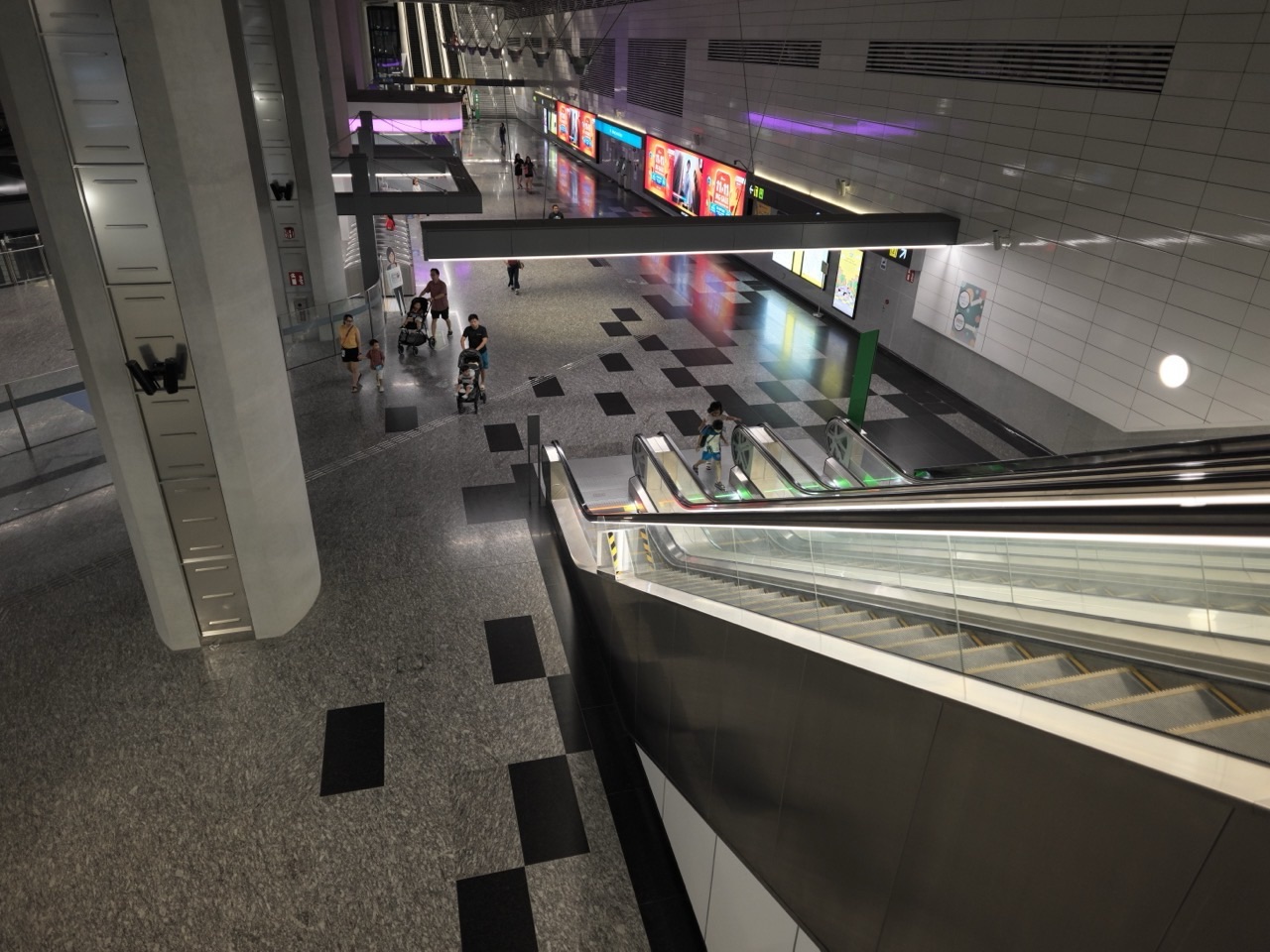
For a short architecture walk in Singapore’s northeast, take the North East Line to Punggol Coast MRT, NE18. Look at how the high concourse, the exits and the public space outside fit together. Use Exit 1 for the direct route to the Singapore Institute of Technology, and finish after a short look at the public approach to Campus Boulevard.
Allow around 25 to 40 minutes for the station and public connection at an unhurried pace. There is no attraction ticket. Normal fares apply to your train journey or access through fare gates. The point of the walk is to see what makes this station work as part of a neighbourhood, from its tall concourse to the way people continue into the district.
- Use Punggol Coast MRT, NE18, at the end of the North East Line. Punggol MRT, NE17, is a different station.
- SIT directs visitors to Exit 1 for direct campus access.
- Look at the station’s double-height concourse and the connection from the entrance to public space.
- LTA describes cooling from the district system for air-conditioned areas and fans at platform level.
- Keep moving where the station is busy. Use public paths and follow the university’s access signs.
1. Start at the right Punggol station
Punggol Coast is NE18. It is the North East Line station beyond Punggol NE17. If you are visiting from another part of Singapore, check the name on the journey planner and station signs. Punggol MRT is the place to go for the LRT interchange and Waterway Point. Punggol Coast is the end station for the district and campus route in this walk.
The Land Transport Authority says Punggol Coast opened to passengers on 10 December 2024. It was built as the line’s extension into Punggol Digital District. For a visitor arriving by train, the journey already shows how the station changes access to the area. You can step out of the railway and follow the signed route to a university campus instead of treating the station as a separate building beside it.
Meet before or after the fare gates
Decide whether your group is meeting in the public area or arriving together by train. Station platforms and the paid side are for travellers following normal fare rules. There is no reason to enter the paid area for a second look if you are already meeting outside. The public entrance and connections give you enough to discuss even when part of the interior is outside your route.
For a meeting message, include ‘Punggol Coast MRT NE18’ and the chosen public location. A companion arriving by bus may take a different path from someone coming from the platform. If you are going to SIT afterwards, name Exit 1 and the campus. Agree where to wait so the group does not block the entrance or the main walking line.
Decide how much of the walk you want
A short visit can include the concourse view you naturally pass on the way out, the public entrance and the campus approach. A longer visit can add part of Campus Boulevard or a meal nearby. Give the station its own few minutes before moving on. If you combine too many stops, the detail that makes this walk distinct can get lost in the trip to the next place.
2. What makes the concourse feel different
LTA describes a double-volume space at Punggol Coast. In ordinary terms, the station has a tall interior that can be read across more than one height. As you move through the concourse, look for where the ceiling and upper edges are visible. You can see how a route ahead relates to the larger interior without needing to stop in the centre of commuter movement.
Notice where a passenger has to make a choice
Think about the moments when you need information. A person leaving the train needs the direction to the exit. A person at the concourse needs to distinguish destinations, fare gates and routes to lifts or escalators. Look for the sign you used first and see what you could see around it. A useful design helps passengers choose before they reach the place where several routes divide.
If you are walking with a child, ask them to read the next sign aloud while you keep the group moving. Once outside, compare what the two of you used to orient yourselves. One person may remember an exit number and another a large opening or a change in floor level. The combination explains why signs and architecture both matter.
Look up without stopping in a busy route
LTA explains that high-level mechanical and electrical services were positioned behind the concourse walls so they can be reached for maintenance. That detail is worth knowing even though visitors cannot see the services themselves. The tall space affects how easy it would be to work directly above it. The published design account explains how the station handles a practical problem that its shape creates.
A school-age visitor can sketch the tall hall as a rectangle and add the concourse walls. Mark where someone might work on a service if it were mounted high over the public space. Then mark the alternative described by LTA. The two drawings give a simple explanation of how a passenger’s experience and a maintenance team’s needs can shape the same building.
Contents · Previous section · Next section
3. Walk through Exit 1 towards SIT

SIT lists Exit 1 as the direct station access to its Punggol Campus. Follow the signs at the station, then look at how the public approach joins the district. A campus visitor may need to find a particular block after leaving the MRT. Use SIT’s campus wayfinder when the building matters, and follow current signs for which routes are open.
Read the route as a sequence of spaces
Start with the concourse, then the entrance and then the public pedestrian space outside. Look at what changes as you pass each point. Inside, the route helps passengers sort themselves towards gates and exits. Outside, people can continue towards shops, campus areas and other destinations. The station design connects these movements without making them all serve the same purpose.
Pause only where there is room. If a path is full of people travelling to class or work, keep moving and use the next open spot to look back. You can make a useful observation even while walking. For example, notice whether the next sign appears before or after the point where you need to turn. That detail is often more interesting than taking a picture of every entrance.
Keep the walk on public routes
SIT is a working university. The direct MRT route leads to the campus area, while individual buildings and rooms can have different access. Use public links and follow signs and staff directions. A visitor can study the connection from station to campus without entering teaching rooms, labs or workspaces.
If you want to add Campus Boulevard, check where you will turn back. A short extension can show how the public path continues beyond the station. A longer campus outing can be planned separately. The short station walk works best when you have enough time to notice each transition rather than following the path until everyone is tired.
Contents · Previous section · Next section
4. How the station is cooled and why the difference matters
LTA describes a hybrid approach. Air-conditioning for the station’s air-conditioned areas draws on the Punggol Digital District cooling system, while fans are used at platform level. The account describes two different methods used in the same station. It does not give a visitor a way to infer how much energy was saved during a particular trip.
Explain district cooling in plain language
Think of a district cooling system as shared cooling infrastructure that can serve more than one place. For the station, the relevant point is that it draws on the district system for its air-conditioned areas. The equipment doing that work is not part of the public walk. Use LTA’s information to understand the design, and use the walk to notice the spaces passengers actually use.
A platform fan and an air-conditioned part of the station have different jobs. A fan can move air where passengers are waiting. Air-conditioning provides a different kind of temperature control. LTA’s description helps you see that a station need not use exactly the same method in every area. An older child can ask why a designer might choose different approaches for spaces with different activities.
Separate the experience from a measurement
You may notice that a platform feels different from a concourse. Temperature, air movement, the number of people and your own activity can influence that impression. A single observation does not tell you how the system performs across a day. Describe what you felt and where you were. Use published specifications for how the system was designed.
LTA lists Green Mark Platinum certification for the station and also describes features such as LED lighting, escalators that can operate at two speeds and lifts with a sleep mode. Treat certification as a fact about the design and assessment, not as a claim about the results of your visit. A useful question is which parts of the railway serve people continuously and which are able to respond to demand.
Contents · Previous section · Next section
5. Notice how the station serves the area outside it
Compare the two broad approaches
LTA identifies two station entrances, one within Punggol Digital District and one along New Punggol Road. Exit 1 is the campus approach SIT recommends. If you are going to another destination, check the station’s current signs instead of assuming the campus exit is shortest. An entrance can be good for one person’s journey and inconvenient for another’s.
The station connects to covered links, nearby bus stops and places to pick up or drop off passengers. LTA also describes bicycle parking as part of the design. Look at the ways people leave the station. A person continuing by bus has a different route from a person walking to class. Making the next step easy is part of how a station supports everyday travel.
See where a transport entrance becomes public space
LTA notes that the entrance was designed with a public space capable of hosting community programmes. On an ordinary day, look at how the space serves people passing through or waiting for someone. A place used for an event can have different access and movement arrangements. Check current signs if the setup has changed.
For a family, this makes a useful final stop. Ask which places seem intended for quick movement and where people can wait without disrupting it. The answer can differ depending on the time of day. A picture taken while the area is quiet and a description of a busy commuter period can show different sides of the same design.
Contents · Previous section · Next section
6. How this walk differs from a visit for the artwork
The station contains Trajectories, an Art in Transit work by Zul Othman, also known as ZERO. SBS Transit describes it as a visual account of Punggol’s transformation through the artist’s own connection to the area. Look at it if it is on the route you are already using. The artwork and the station’s physical design give you two different ways to think about the district.
If the artwork is the main reason for your trip, allow time to look at its individual details and read the operator’s description. If you are here for the architecture, keep the focus on the concourse, route choices and public entrance. You can connect the two subjects afterwards by asking how a station presents the history of the place and how it moves people through the place today.
A useful photo sequence can reflect the difference. Take a public view of the station entrance or concourse where permitted, then make a separate note of something you noticed in the artwork. Caption each image according to what it actually shows. This avoids using a picture of the station as evidence for a detail that appears only in the work.
Children can choose the part they prefer. Some will want to read the artwork. Others will be more interested in the station’s escalators or signs. Ask each person to name one detail before moving on. The group can enjoy the same short outing without everyone approaching it as the same kind of lesson.
Contents · Previous section · Next section
7. Three ways to use the route
A first look before lunch
Arrive by train, follow the concourse and look at the entrance from outside. Use Exit 1 if you want the SIT approach. Finish with a nearby meal rather than committing to a longer outdoor route. This version gives first-time visitors a clear understanding of where they are and how to get back to the station.
An architecture visit with a student
Choose a question before leaving home. How do passengers decide which way to go? How does a tall concourse affect maintenance? How does the public entrance connect to a campus? Pick one, write down two visible observations and check one published source. A short, focused explanation is more useful than a long list of features copied from an information page.
A walk between two transport modes
Use the train for arrival and look up a bus or other connection for the onward route. Work out which public path takes you there. Notice how the signs change as you leave the station and how they help you find the next mode. If the group is only doing a short visit, check the onward route before exploring farther so nobody has to hurry back.
When visiting with someone who needs a step-free route, check the relevant lift and path before setting out. Ask for the precise connection rather than general station information. A person can enjoy the visit with fewer changes of level if the main observation points are chosen around the route they will already take.
Contents · Previous section · Next section
8. A quick design exercise to take home
Draw the station entrance in the centre of a page. Add one arrow towards the train and another towards SIT. Add a third for a different onward destination, such as the bus interchange. Give each arrow the sign or public landmark you used to find it. This creates a small map of how the station works for a visitor.
On another part of the page, sketch the difference between the tall concourse and the lower path into the district. Label where you saw the difference rather than guessing a height. Use LTA’s description for the maintenance detail and describe your own observations in your own words. The sketch then shows both your view and the source you used to explain it.
To compare with another MRT station, use the same questions next time. What can you see before choosing an exit? How does the station open into the street? Is there a public space where waiting and movement can coexist? The answers depend on the site and the reason people travel there. That makes one short Punggol walk a starting point for reading the design of another place.
Contents · Previous section · Next section
9. Compare Punggol and Punggol Coast as two different arrivals
A 1.6-kilometre extension changes the trip beyond the train
LTA describes the North East Line extension from Punggol to Punggol Coast as 1.6 kilometres. For a visitor, the important difference is what happens after leaving the train. At Punggol, the LRT interchange and Waterway Point are common destinations. At Punggol Coast, the campus and digital district are closer to the exit. The same train line serves two distinct places.
Think about a trip a student might make from a different part of Singapore. It includes the rail journey, the choice of station exit and the final walk to a campus building. An extension can change the last part of that trip even when most of the train route is unchanged. Use the campus wayfinder for the final destination. NE18 is a useful meeting point, while the actual classroom or public venue can be a separate distance away.
Compare the view you see when you emerge
At each station, see what you notice before you read a sign. One view might emphasise the next transport mode or a mall. Another might open towards a large public space. These differences reflect the destinations and routes around each station. A visit to Punggol Coast can make sense on its own, while a second visit to NE17 gives you something nearby to compare.
If you want to see both in one outing, choose which one is the main stop and follow normal fares. A long station comparison is unnecessary when a child is mainly interested in one visible feature. You can make a note on one trip and remember the same question the next time you pass through the other station. This keeps the activity short and makes use of a journey you already wanted to take.
Look at the station as part of a larger project
LTA says the station was built alongside Punggol Digital District and designed to connect with it. Take the fact outside with you. Look at how the entrance leads into the public space and how signs send people towards different destinations. Some parts of the district are places to pass through. Others are places to sit, study, work or meet. A station gives these uses a common point of arrival.
Contents · Previous section · Next section
10. Try a three-stop public route even when you arrive by bus
Begin outside and read the public approach
If you arrive by bus, first locate the public station entrance. Stand back in a place that allows people to pass. See which signs direct people towards the railway, and compare them with the signs directing you towards your next place. You can do the exercise from the public side without entering the paid area. The station is still the subject of the walk even when you did not travel there by rail.
Look for a change in height or enclosure
From an available public position, notice where the taller interior gives way to the route outside. If your arrival route does not give you a view of the concourse, use the station entrance and a second publicly accessible point farther along the approach. Compare the openness, the direction of movement and the signs. The photographs in this guide give you another view of the inside if you want to discuss it afterwards.
Follow one public connection and return by the route you need
Choose the campus direction or another public destination you have checked. Observe where the route becomes clear. If you need to return by bus, check the correct stop and direction before walking farther. This part of the exercise explains why the station’s design needs to be read alongside what is next to it. A rail connection serves people who arrive, leave or change modes on different sides of the entrance.
End by describing one movement the design makes easier and one part you would check again. A visitor might say that the campus exit is easy to find, but that reaching a specific block requires the campus map. Another might focus on the view across the public entrance. Specific observations are useful because a friend can repeat them on a later visit and see whether the route works the same way for them.
Contents · Previous section · Next section
Frequently asked questions
Is Punggol Coast MRT the same as Punggol MRT?
No. Punggol is NE17 and Punggol Coast is NE18, the next station and the line’s terminus.
Which exit goes to SIT?
SIT directs visitors to Exit 1 for direct campus access.
Do I need to pay for the walk?
There is no attraction ticket. Normal MRT fares apply to travel and access through fare gates.
How much time should I allow?
Around 25 to 40 minutes for a short public route, with longer for photographs, rests or a campus extension.
What is special about the concourse?
LTA describes a double-volume interior and maintenance access for high-level services behind the concourse walls.
How is the station cooled?
LTA describes district cooling for air-conditioned areas and fans at platform level.
What is the artwork called?
The Art in Transit work is Trajectories by Zul Othman, also known as ZERO.
Can I walk into any part of SIT from the station?
The station connects directly to the campus area. Use public routes and follow access rules for individual buildings.


