
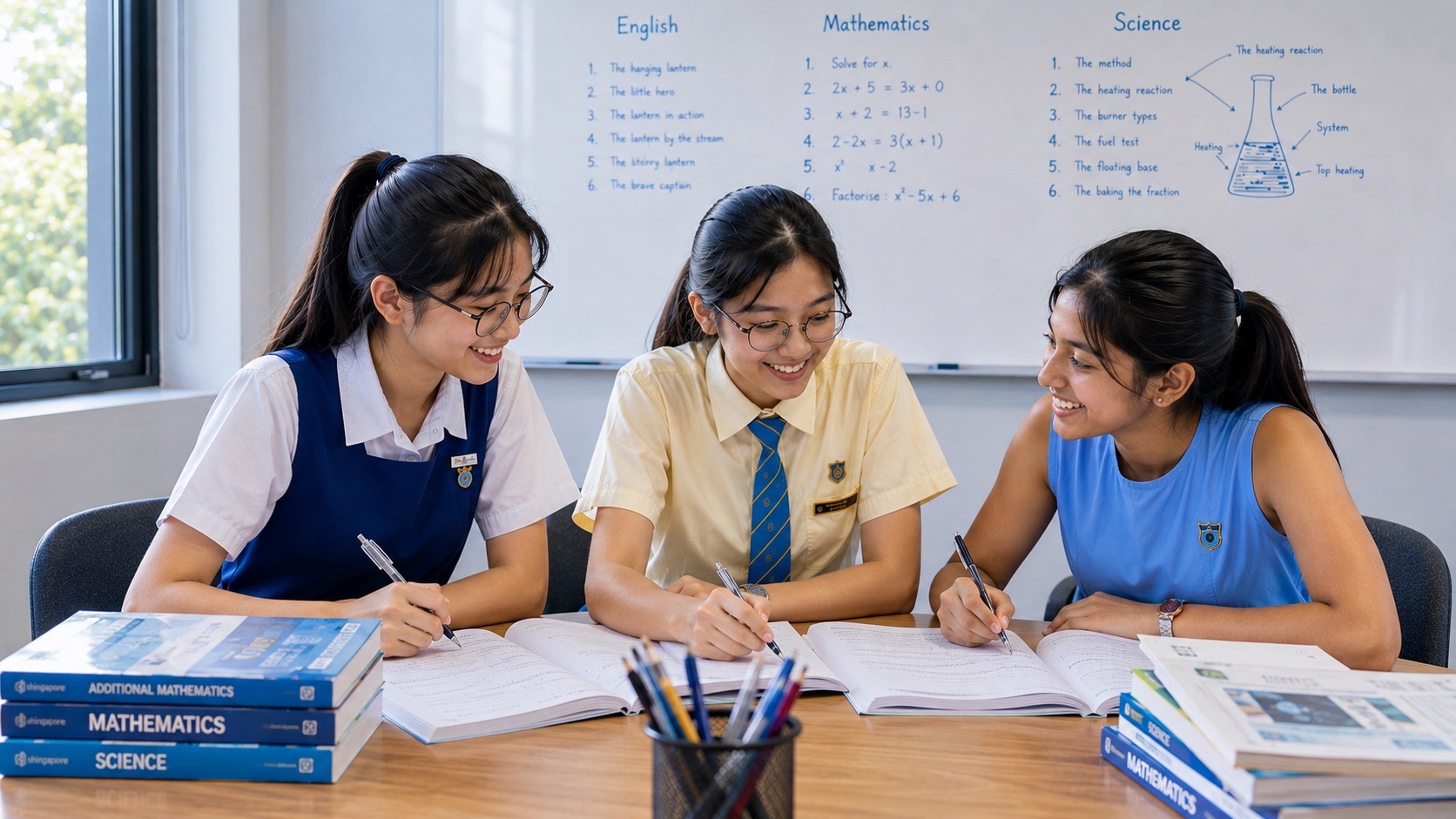
Secondary 4 G2 Mathematics tuition in Punggol should begin by identifying the student’s real examination year, syllabus and most costly recurring mathematical errors. eduKatePunggol offers small groups capped at three learners, normally for about 1.5 hours. The tutor can see whether a pupil loses marks through a misread percentage base, an invalid algebraic manipulation, inaccurate geometry or a timing decision, then make the correction explicit and check an unfamiliar question independently.
A Secondary 4 pupil graduating in 2026 follows the applicable existing GCE arrangements, including the relevant N(A)-Level Mathematics subject where enrolled. SEAB’s 2027 G2 Mathematics K210 document describes the first SEC graduating cohort; it is not automatically the paper that a 2026 Secondary 4 candidate sits. For 2027 K210, both papers last two hours and are worth 70 marks each, with a distinctive Section B choice on Paper 2. The class must use the actual pupil’s national and school requirements before assigning practice.
Quick answers for Punggol parents
- Confirm the examination year. A 2026 Secondary 4 G2-route candidate follows applicable 2026 GCE papers; the first SEC with code K210 is in 2027.
- 2027 K210 has Paper 1 and Paper 2, two hours and 70 marks each, weighted equally at 50%.
- In 2027 Paper 2 Section B, candidates choose one of two questions based on underlined Geometry/Measurement or Statistics/Probability content.
- Approved calculators may be used in both 2027 K210 papers, but essential working, accuracy, units and method selection remain examinable.
- Small-group tuition should identify the first error and test changed problems; no 90-minute class or group of three guarantees an SEC or GCE result.
Find what you need: MOE / SEAB · Why three students? · Worked Mathematics problems · 90-minute tutorial · Parent decisions · FAQs · Official sources
Singapore Mathematics: course scope and examination year
The 2027 G2 Mathematics K210 syllabus contains Number and Algebra, Geometry and Measurement, and Statistics and Probability. It is not identical to G3 K310: the assessment objective emphasis and paper arrangements differ. The document gives approximately 60% to routine technique, 30% to problem-solving in varied contexts and 10% to mathematical reasoning and communication. This combination means students need both reliable procedures and the ability to recognise when a familiar technique does or does not apply. A tutor should use the student’s actual enrolled syllabus and school practice papers to choose the next teaching priority.
Under Full Subject-Based Banding, a pupil’s G2 or G3 Mathematics level is the subject actually enrolled, rather than a fixed label based solely on the admission Posting Group. The level matters because MOE defines distinct content scope and progression. A private tutor should request the school’s current chapter sequence, the actual exam route and original working before selecting exercises. Giving a student a more advanced worksheet is not necessarily an improvement if the present concept remains unclear.
The published 2027 K210 assessment contains two written papers. Paper 1 is two hours, approximately 23 short-answer questions and 70 marks. Paper 2 is two hours and 70 marks. Section A includes 9–10 questions culminating in a real-world application; Section B offers two questions of equal marks (either seven or eight), one from underlined Geometry and Measurement content and one from underlined Statistics and Probability content, with candidates answering one. Both papers carry half of the total weight. Approved calculators are allowed in both, but omission of essential working can lose marks. The standard accuracy note is three significant figures for non-exact numbers and one decimal place for angles in degrees unless otherwise directed. These are 2027 rules, not a guarantee that a particular 2026 paper uses the same blueprint.
MOE G2/G3 Secondary Mathematics content-by-level syllabus · SEAB 2027 G2 K210 syllabus · Official 2027 subject list.
The 2027 K210 national examination structure
| Paper and section | Duration | Marks and weighting |
| Paper 1 — about 23 short-answer questions | 2 h | 70 marks, 50% |
| Paper 2 — Section A and choice of one Section B question | 2 h | 70 marks, 50% |
Paper 2 Section B is distinctive: the two choices involve underlined content from Geometry and Measurement and Statistics and Probability, and a candidate answers only one of them. The official paper specifies which options are available. Every candidate must follow the instructions on their actual examination-year paper rather than blindly borrow the K210 choice from another cohort.
A 2026 Secondary 4 pupil follows their applicable 2026 GCE examination, not the first 2027 SEC. The K210 paper is an accurate reference for 2027 and a useful comparison of the educational direction, but revision timetables and practice paper conditions must be checked against the school entry. This is especially important where a tuition centre talks broadly about ‘G2 Mathematics’ without naming the year.
What makes Secondary 4 G2 Mathematics difficult in a useful way
At Secondary 4, the same mathematical mistake can have several consequences: an incorrect fraction operation can lead to a bad percentage, a sign error can spoil an equation and a misidentified graph gradient can make a physical context meaningless. Under time pressure, a child who knows the correct method may still select the wrong quantity or forget to check the answer’s unit. Effective preparation begins with the student’s original errors and asks whether the weakness is conceptual, procedural, interpretive or due to exam control. Each requires a different teaching intervention; more full papers alone will not solve all four.
A wrong final answer is only the end of a chain. The learner read the question, identified relevant quantities, selected a relationship, performed operations and interpreted the result. A tutor should trace the first unsupported step. If the operation was inappropriate, practising the arithmetic faster does not solve it. If the model was right but units or signs were wrong, the next lesson should target those details instead.
Mathematical development becomes durable when the child can explain why a transformation is valid. Changing the numbers, rotating a diagram or asking for a different unknown forces genuine method selection. A tutor can use that change as an independent transfer test, then revisit the same principle later. This is more revealing than giving the pupil a corrected version of the original question to copy.
Why a tutorial capped at three can help
A maximum of three learners can give the tutor time to examine several approaches to one mathematical idea. One child may draw a diagram, another use an equation and the third check the result through substitution or estimation. The group can help make assumptions visible. But the strongest student must not provide the first step for everyone: each learner should begin independently and complete a changed question after the discussion.
- Inspect the child’s actual school working, not merely the final mark.
- Separate concept misunderstanding from a procedure, arithmetic, notation or timing error.
- Use a clear model or contrasting example that explains the first false step.
- Allow students to compare valid alternative methods respectfully.
- Require a changed problem to be solved individually without model hints.
- Return to a previously corrected principle after several lessons.
- Check that the group is appropriately matched and the student benefits from the extra academic hours.
The small-group format has limits. Some students require prolonged one-to-one support, some learn well through school and ordinary independent practice, and some are too tired to gain value from another session. A responsible tutor should discuss those possibilities openly. Class size is an opportunity for effective feedback, not a guaranteed grade or the only appropriate educational arrangement.
Even within a shared topic, three learners can need different corrections. In a ratio problem one may misunderstand which amount is the total; another may make a fraction computation error; the third may answer the wrong question. The tutor can use a brief common explanation and still set separate independent follow-ups. The value of the group depends on those choices.
The diagnose–repair–transfer–return loop
Inspect the first attempt
Ask what the pupil believed each number or symbol represented, and at which point the chosen method ceased to follow the given conditions. Keep the uncorrected line visible to inform the intervention. ‘Careless’ should not be the entire diagnosis; it does not tell the student what decision to change next time.
Repair one mathematical relationship
A short contrast often teaches more than a long model solution. Compare part-to-part with part-to-whole ratio, a valid cancellation with cancellation across addition, or a right triangle with a non-right triangle. Explain which condition matters and have the pupil repeat that explanation in their own words.
Remove the original example
Change the values, diagram orientation, units or required unknown. Every learner should solve the new question without the tutor supplying the next operation. A correct second attempt is more encouraging when the situation is genuinely unfamiliar than when only one digit has been replaced.
Return after time has passed
Include an earlier principle in a later mixed question, without announcing its topic. If the learner slips again, check whether a prerequisite has been lost. If the method is stable, consider a more complex application or suitable timed section. A short error ledger records what changed and what still needs attention.
32 Maths misconceptions with precise correction examples
1. Examination cohort and the correct paper pack
First difficulty. A family buys 2027 K210 papers for a child graduating in 2026 and calls them the child’s official examination papers.
Correct mathematical explanation. Confirm the student’s current-year registration and school notice first. The 2027 K210 SEC specification is a reference to a later cohort; 2026 candidates use their applicable GCE N(A) or other enrolled examinations.
Three-person lesson. Each pupil identifies their own subject code and the examination rules before the tutor chooses a timed section.
Changed independent test. A changed practice source is accepted or rejected based on its actual year and code, not its cover colour.
Important limit. Paper counts, timings and option choices must never be copied across years without checking.
2. Rational numbers and signed calculations
First difficulty. The child computes −4−(−7)=−11 because the operation involving a negative quantity was misunderstood.
Correct mathematical explanation. Subtracting a negative is adding its opposite, so −4−(−7)=3. A number line and estimate check the direction before the calculation.
Three-person lesson. One pupil draws the model, another works symbolically and the third checks reasonableness; each answers a changed task.
Changed independent test. With −6−(−2), the student obtains −4 and explains why the result is not −8.
Important limit. A short prerequisite repair can prevent repeated mistakes across algebra and geometry.
3. Primes, HCF and LCM
First difficulty. The student memorises a factor tree but chooses the least common multiple when the word problem asks for the largest equal grouping size.
Correct mathematical explanation. Prime factorise 36=2²3² and 48=2⁴3. HCF is 12; LCM is 144. The context determines whether a common divisor or a shared multiple is required.
Three-person lesson. Three learners independently identify the scenario, calculate and check the answer’s real-world meaning.
Changed independent test. For 18 and 30, the pupil obtains HCF 6 and LCM 90 and justifies the chosen one in a new story.
Important limit. A correct factorisation cannot fix a misunderstanding of the question’s objective.
4. Indices and standard form
First difficulty. A candidate adds exponents during addition, writing x²+x³=x⁵, or misplaces a negative power of ten in a large-number conversion.
Correct mathematical explanation. Multiplying powers with the same nonzero base adds exponents: x²·x³=x⁵. Addition does not. Standard form requires 1≤A<10 in A×10ⁿ with integer n.
Three-person lesson. Students compare valid and invalid transformations and use a substituted value to refute a false one.
Changed independent test. Write 0.00045 as 4.5×10⁻⁴ and explain its order of magnitude.
Important limit. Keep notation rules and the operation being performed distinct.
5. Ratio and the named whole
First difficulty. The pupil reads 3:5 as ‘three fifths of the whole’ even when the two numbers describe two parts.
Correct mathematical explanation. Three parts and five parts make eight units. A total of 96 divided 3:5 gives 36 and 60, while the first share is 3/8 of the whole.
Three-person lesson. Each learner draws, computes or checks the relationship and then solves a different allocation privately.
Changed independent test. Split $72 in ratio 5:4 into $40 and $32, identifying the denominator nine.
Important limit. Labels matter more than a stock bar model copied into every problem.
6. Direct and inverse relationships
First difficulty. The student assumes doubling any input must double the output, even when constant total work is divided among more people.
Correct mathematical explanation. Identify the quantity held constant. At a fixed unit price, cost rises with quantity; at fixed work and equal productivity, increasing workers reduces time inversely.
Three-person lesson. Three pupils classify different idealised scenarios and explain what makes each proportional.
Changed independent test. On an unfamiliar journey of fixed distance, doubling speed correctly halves the time.
Important limit. Real applications require explicit assumptions rather than reflexively applying a formula.
7. Reverse percentages
First difficulty. A learner is told $72 is the price after a 20% discount and calculates another 20% off instead of recovering the original.
Correct mathematical explanation. The final price is 80% of the original, so original =72÷0.8=$90. Label the base, changed amount and remaining amount before calculating.
Three-person lesson. Students independently model a 100% bar, equation and inverse check, then practise changed contexts.
Changed independent test. If 75% of an amount is $60, the original is $80.
Important limit. The ‘100%’ base is the key reasoning step, not a calculator key sequence.
8. Compound growth and financial context
First difficulty. A pupil applies simple-interest multiplication to a compound-growth problem where each period’s interest changes the next base.
Correct mathematical explanation. For an illustrative annual 5% increase on $100 compounded twice, the value is 100×1.05²=$110.25. Explain that the second growth acts on $105 rather than $100.
Three-person lesson. Each child distinguishes the base, growth factor and number of periods before attempting a fresh model.
Changed independent test. Another percentage-growth story is set up correctly with repeated multiplication rather than an unrelated formula.
Important limit. Financial questions are mathematical models; avoid presenting examples as personal investment advice.
9. Rates and mixed units
First difficulty. The student divides speed in km/h by time in minutes without converting, then trusts the resulting calculator display.
Correct mathematical explanation. Use consistent units. At a constant 60 km/h for 30 minutes, distance is 30 km. A result must describe the requested quantity and use an appropriate unit.
Three-person lesson. Three students check unit conversion, equation choice and reasonableness separately before a new question.
Changed independent test. Convert 72 km/h to 20 m/s correctly using 1000/3600.
Important limit. Time, distance and speed must all refer to the same model and units.
10. Algebra with a negative bracket
First difficulty. The candidate expands −2(3x−5) as −6x−10 because the second multiplication sign was lost.
Correct mathematical explanation. Distribute the negative factor to both terms: −6x+10. At x=1, the original and expanded forms both equal 4.
Three-person lesson. Students identify the first false line, perform a substitution check and each attempt a different bracket.
Changed independent test. Expand −3(2x−4) to −6x+12 and verify it.
Important limit. A valid identity preserves value on every allowed input, not just the appearance of terms.
11. Algebraic fractions and valid cancellation
First difficulty. The child cancels x from (x+2)/x across addition and obtains two.
Correct mathematical explanation. Cancellation requires a common multiplicative factor. For x≠0, 6x²/(3x)=2x, while (x+2)/x=1+2/x and does not equal two generally.
Three-person lesson. Three learners compare a valid example, false one and a numerical counterexample, then solve separately.
Changed independent test. With x≠0, simplify 8x²/(4x)=2x without cancelling a term from a sum.
Important limit. The denominator’s zero restriction must remain part of the reasoning.
12. Linear equation equivalence
First difficulty. The pupil moves a positive term across equality with the wrong sign and cannot explain why an operation should work.
Correct mathematical explanation. For 4x+7=31, subtract seven from both sides and divide by four to get x=6, then substitute back into the original statement.
Three-person lesson. Each learner describes one inverse operation and checks the resulting value against the given equality.
Changed independent test. Solve 3(x−2)=12 to get x=6 with a correct substitution check.
Important limit. An equation is a relationship that must be preserved through each transformation.
13. Simultaneous equations in context
First difficulty. A candidate finds values that satisfy only the first equation in a two-condition problem.
Correct mathematical explanation. For x+y=11 and x−y=3, elimination gives x=7 and y=4. Both values must satisfy both original equations.
Three-person lesson. Three students use elimination, substitution and checking, then each handles a fresh system alone.
Changed independent test. Solve 2x+y=13 and x−y=2 to get x=5, y=3, verifying the pair.
Important limit. The meaning of the variables and context belongs in the conclusion.
14. Quadratic factorisation
First difficulty. The student expands correctly but factorises x²+7x+12 as (x+7)(x+12).
Correct mathematical explanation. Find two integers whose sum is seven and product twelve: three and four. Thus (x+3)(x+4) reproduces the expression.
Three-person lesson. Each pupil proposes, tests and verifies a different factor pair before an unfamiliar task.
Changed independent test. Factorise x²−x−6 into (x−3)(x+2) and check by expansion.
Important limit. A factorised expression is not automatically an answer to an equation without an equality condition.
15. Quadratic equations by the zero-product rule
First difficulty. The child writes x=2 only for (x−2)(x−3)=0, overlooking the second possible factor being zero.
Correct mathematical explanation. The product is zero when either factor is zero, so x=2 or x=3. Test both in the original equation.
Three-person lesson. Each student identifies a factor, root and verification method, then solves an unfamiliar quadratic alone.
Changed independent test. For x²+x−12=0, the student obtains x=3 or x=−4.
Important limit. The number of real solutions depends on the equation; do not assume one answer.
16. Linear graphs and gradient
First difficulty. The student calls a point’s y-coordinate the gradient, confusing height with rate of change.
Correct mathematical explanation. For the line through (1,3) and (3,7), gradient=(7−3)/(3−1)=2. It describes vertical change per horizontal unit.
Three-person lesson. Three pupils use a coordinate table, plot and algebraic check, then each handles a new graph.
Changed independent test. An unfamiliar linear relation with points (0,1) and (2,5) has gradient two.
Important limit. Graph scales and units are part of interpretation, not decoration.
17. An appropriate graph-based model
First difficulty. The learner plots a relation correctly but draws a conclusion outside the displayed data range as though it were observed.
Correct mathematical explanation. Read axis labels and domain; distinguish observations, reasonable interpolation and unsupported extrapolation. Connect the chosen model to the actual relationship.
Three-person lesson. Each student states one observed fact, one possible estimate and one limitation using a different display.
Changed independent test. A changed time-series graph is interpreted within its available data rather than with invented future certainty.
Important limit. A graph is a representation of given information, not automatic proof of cause.
18. Angles and parallel lines
First difficulty. The pupil declares two angles equal because they look alike in a rough drawing despite no parallel-line condition being stated.
Correct mathematical explanation. Apply vertically opposite, straight-line and corresponding or alternate angle rules only when their conditions are satisfied. State the justification beside working.
Three-person lesson. Students each check a different condition on a marked diagram and then solve a new layout alone.
Changed independent test. If adjacent angles on a line include 65°, the other is 115° with a reason.
Important limit. Diagrams are often not to scale and should not substitute for given geometric properties.
19. Congruence and similarity
First difficulty. The candidate confuses similar triangles of different sizes with congruent triangles, then uses an invalid length comparison.
Correct mathematical explanation. Congruence preserves shape and size; similarity preserves angles and proportional corresponding sides. Mark correspondence before using a scale factor.
Three-person lesson. Each student matches a side pair, checks a ratio and rejects an inconsistent claim, then works alone.
Changed independent test. If 4 cm corresponds to 10 cm, a 6 cm corresponding side becomes 15 cm.
Important limit. Rotating a shape does not change its mathematical correspondence.
20. Pythagoras and the right-angle condition
First difficulty. The child applies a²+b²=c² to any triangle that contains a long sloping edge.
Correct mathematical explanation. Identify the given right angle. In a 6–8–10 triangle, the hypotenuse is opposite that angle and the squares of the legs sum to its square.
Three-person lesson. Students check the condition, select sides and compute a new missing length independently.
Changed independent test. With hypotenuse 13 cm and another side 5 cm, the missing leg is 12 cm.
Important limit. A theorem cannot be applied merely because the diagram resembles a familiar shape.
21. Right-triangle trigonometry
First difficulty. The student labels the opposite side based on where it appears on the page rather than the reference angle.
Correct mathematical explanation. Determine the opposite, adjacent and hypotenuse relative to the given acute angle. Use sine, cosine or tangent when the stated triangle condition fits.
Three-person lesson. Each learner labels a rotated triangle and justifies the chosen ratio before using a calculator.
Changed independent test. With opposite 3 and adjacent 4, tanθ=3/4, interpreted in the correct triangle.
Important limit. Angle modes and rounding should follow the question’s directions and syllabus.
22. Length, area and volume conversions
First difficulty. The candidate converts 1 m² to 100 cm² by applying the length conversion once rather than squaring it.
Correct mathematical explanation. One metre equals 100 cm, so one square metre equals 100×100=10,000 cm². Similarly cubic units scale by the cube of the length factor.
Three-person lesson. Students illustrate conversions with square and cube models, then check another example alone.
Changed independent test. Convert 0.5 m² to 5,000 cm² with a meaningful explanation.
Important limit. Dimensional analysis is a useful check before and after arithmetic.
23. Solids and surface area
First difficulty. The learner uses a volume formula when asked for wrapping material or includes an internal face twice.
Correct mathematical explanation. Separate external area from enclosed volume. Sketch the solid’s exposed faces or net and sum only the relevant areas; label square or cubic units appropriately.
Three-person lesson. Each pupil checks face count, dimensions or unit before solving an unfamiliar solid.
Changed independent test. A 4×3×5 cm cuboid has volume 60 cm³, distinct from surface area 94 cm².
Important limit. A net is a representation; missing or overlapping faces must be identified.
24. Circle measurements and precision
First difficulty. The pupil substitutes a diameter as radius in a circle-area formula, then rounds prematurely.
Correct mathematical explanation. For a circle of diameter 14 cm, radius is 7 cm. If the question directs π=22/7, area is 154 cm²; circumference is 44 cm.
Three-person lesson. Three students interpret the given quantity, select a formula and check the units, then solve a new example.
Changed independent test. A new diameter of 10 cm yields radius 5 cm before calculation.
Important limit. Use the stated value of π and precision requirements, not an automatic favourite approximation.
25. Interpreting tables and grouped statistics
First difficulty. The student reads the largest class frequency as the overall average and forgets class intervals.
Correct mathematical explanation. Explain that frequency counts observations and the mean uses values or appropriate midpoints. Keep grouped estimates labelled as such; the original data are not fully known.
Three-person lesson. Each learner identifies frequencies, class midpoint or an estimation limitation before new independent work.
Changed independent test. An unfamiliar grouped table is interpreted without pretending the exact raw observations are available.
Important limit. Charts do not supply information that has been aggregated away.
26. Mean, median and mode in context
First difficulty. The learner gives the mean of a skewed data set as a typical value without checking whether an outlier distorts the picture.
Correct mathematical explanation. For 2,3,3,6,11 the mean is 5, median 3 and mode 3. Each describes a different aspect; use the question’s purpose to decide which is informative.
Three-person lesson. Students each compute and explain one measure, then compare whether the conclusion fits the data.
Changed independent test. A changed five-value list is analysed accurately and the effect of an outlier explained.
Important limit. One measure is not universally the best description of every data set.
27. Probability and relevant outcomes
First difficulty. The candidate assigns probability one-half to two category labels even if the underlying elementary outcomes are not equally likely.
Correct mathematical explanation. Define the sample space. For a fair six-sided die, even outcomes are 2,4,6 and probability is 3/6=1/2. State the fairness assumption.
Three-person lesson. Three students enumerate, count favourable outcomes and check a changed event individually.
Changed independent test. A new two-coin example uses HH, HT, TH and TT before calculation.
Important limit. Uncertainty in real situations cannot always be treated as equally likely choices.
28. 2027 Paper 1: short-answer working
First difficulty. The student writes a final calculator number with no method for a multi-step task, risking loss of marks when working is required.
Correct mathematical explanation. Show concise intermediate equations, name relevant units and check the unknown quantity. The official 2027 Paper 1 has about 23 short-answer questions in two hours.
Three-person lesson. Each pupil reviews one genuine method error and writes a compact correct route before trying an unfamiliar short answer.
Changed independent test. A new two-part question includes sufficient working and a plausible final interpretation.
Important limit. The current 2026 examination may have different requirements; use the correct year-specific paper.
29. 2027 Paper 2 Section A application
First difficulty. The pupil makes a quick calculation from the first number in a real-world question without reading the later conditions.
Correct mathematical explanation. Identify which quantities are given, what the scenario asks and how topics connect. Set up the model first; then calculate and interpret the result.
Three-person lesson. Three learners inspect different assumptions and compare a proposed solution against the full scenario.
Changed independent test. A new cost or travel application is solved with a stated method and practical conclusion.
Important limit. The final Section A problem tests application, not only isolated calculations.
30. 2027 Paper 2 Section B choice
First difficulty. The child thinks both questions in Section B must be answered or selects the first option without seeing whether the relevant content is secure.
Correct mathematical explanation. The 2027 K210 Section B gives two questions, one from designated Geometry/Measurement content and one from designated Statistics/Probability content, each seven or eight marks; candidates answer one.
Three-person lesson. Each learner compares preparation strengths and practises reading both options before choosing a route.
Changed independent test. In a changed mock section, the student selects an appropriate option and completes only the required one.
Important limit. The exact choice belongs to the 2027 K210 blueprint and must not be assumed for 2026 GCE papers.
31. Rounding and calculator discipline
First difficulty. A candidate rounds an intermediate result too early and obtains a final answer outside the required accuracy tolerance.
Correct mathematical explanation. Keep adequate intermediate precision and round the final non-exact answer to three significant figures, or angles to one decimal place when the 2027 K210 instruction applies.
Three-person lesson. Students compare early-rounding and full-precision routes and identify why final values differ.
Changed independent test. A new trigonometric result is reported to the specified precision with correct units.
Important limit. Read each actual paper’s instructions; some questions specify a different accuracy.
32. A personal pacing and checking strategy
First difficulty. The pupil spends twenty minutes on one difficult item and leaves several easier tasks unread, or finishes early without checking the requested unit.
Correct mathematical explanation. Use timed sections to diagnose whether time is lost reading, choosing the method, calculating or checking. Teach a flexible move-on-and-return decision matched to the child.
Three-person lesson. Three learners track different timing behaviours and practise specific adjustments independently.
Changed independent test. A fresh mixed section contains fewer omitted accessible tasks without sacrificing mathematical correctness.
Important limit. Timing practice cannot substitute for missing conceptual understanding.
Two examples of meaningful small-group intervention
A wrong answer with a specific missing relationship
A Secondary 4 G2 candidate correctly recognises a 20% discount but treats the price after discount as the original 100%. The tutor asks which value the question calls original and marks $72 as 80%. The learner divides by 0.8 and obtains $90, then checks that $90 minus 20% equals $72. A classmate draws a bar model; each student then works a fresh discount or reverse-percentage situation. This is an illustrative teaching example, not a result from an identified pupil.
A corrected step that must work in a new context
Another learner gives x=5 after solving only one part of a pair of simultaneous equations. The tutor asks whether the problem requires one unknown or two and writes both original constraints in view. The group checks the pair x=5, y=3 against 2x+y=13 and x−y=2. The student then solves a changed system independently and verifies both equations. The correction targets completion and checking, not simply algebra speed.
These are hypothetical tutoring scenarios, not testimonials and not verified examination improvements. Parents should ask what the tutor observed in their own child’s first working and whether a later unfamiliar response was completed independently. One corrected worksheet does not establish durable understanding.
One possible 90-minute Punggol Mathematics tutorial
| Illustrative minutes | Learning task |
| 0–10 | Independent retrieval of a previously corrected idea |
| 10–25 | Review original schoolwork and identify the first misunderstanding |
| 25–45 | Model one mathematical relationship with a helpful contrast |
| 45–65 | Individual tasks, focused feedback and short comparison of methods |
| 65–80 | Unseen transfer problem, possibly timed when suitable |
| 80–90 | Self-check, error note and proportionate independent follow-up |
This is an instructional example, not a promise that every lesson uses the exact minute divisions. A learner missing an algebra prerequisite may require longer on the meaning of an operation. Another may be ready for a mixed paper task or a real-world application. What should remain consistent is individual first work, purposeful feedback and an independent changed example. A three-person tutorial loses its advantage when the class merely copies a continuous explanation.
Parents can ask to see a short progress note showing a first mistaken decision and what the student could subsequently do unaided. A complete paper score is useful in context, but a clear changed-context check more directly demonstrates whether the specific tutoring intervention was successful.
An eight-week plan that changes with evidence
Weeks one and two can confirm the subject level, exam year where relevant, and a baseline using current school scripts. Weeks three and four focus on one or two high-cost misconceptions, such as invalid algebraic cancellation, misread geometric conditions or percentage bases. Weeks five and six interleave the corrected ideas with the school chapter and add new representations. Weeks seven and eight revisit earlier errors after a delay, compare independent work and determine whether the student needs consolidation, extension or a different format. This is not a promised timetable of mark improvements.
Timing should enter when understanding is reasonably secure. When a pupil still cannot identify the right relationship, a stopwatch may make the same mistake happen faster. A timed task is valuable when it reveals a correctable decision about reading, method selection, execution or checking. After a test, review which part of the time was spent productively rather than simply assigning a longer paper next week.
Five questions beyond how many papers were finished
What graduating in 2026 changes about the paper pack
The first SEC graduating cohort is 2027, and the 2027 G2 Mathematics code K210 corresponds to the older reference subject code 4045. A Secondary 4 learner in 2026 needs the actual current-year GCE arrangements, not a practice pack silently renamed ‘SEC 2027’. Older questions can still develop overlapping skills, but the tutor should label them as practice rather than claim they match the student’s national paper exactly. The school notice, examination entry and relevant year-specific SEAB publication should govern timing and assessment choices. This is a simple factual check with large consequences for the family.
A useful follow-up is an unfamiliar independent task with the same underlying principle. If the learner still needs the tutor’s first hint, the concept is not yet stable. A clear delayed retest and a specific record of the change are better evidence than a claim that tuition is automatically effective because there are only three students.
Why the K210 Section B choice should not become a guessing trick
In the 2027 G2 final paper, Section B is a genuine examination choice between specified underlined content from two strands. A pupil should prepare responsibly for the syllabus rather than assume that only one strand will ever matter. During final practice, the student can learn to read both option questions, judge which is more manageable and commit to one. This is a decision based on understanding and the paper’s actual instructions. It should not be carried into a 2026 GCE paper without verification, and it should never replace core geometry or statistics teaching.
A useful follow-up is an unfamiliar independent task with the same underlying principle. If the learner still needs the tutor’s first hint, the concept is not yet stable. A clear delayed retest and a specific record of the change are better evidence than a claim that tuition is automatically effective because there are only three students.
Why mathematical working remains necessary with calculators
SEAB allows approved calculators in both 2027 K210 papers, but a calculator cannot identify the relevant mathematical relationship. A student may enter the correct numbers for an irrelevant formula and produce a precise but wrong answer. Essential working makes the method inspectable and can protect marks. A tutor should train pupils to label quantities, show the transformation and check units before and after computation. In geometry, a diagram can make assumptions visible; in algebra, substitution can expose an invalid line; in finance, a percentage base can reveal the wrong calculation before the calculator is used.
A useful follow-up is an unfamiliar independent task with the same underlying principle. If the learner still needs the tutor’s first hint, the concept is not yet stable. A clear delayed retest and a specific record of the change are better evidence than a claim that tuition is automatically effective because there are only three students.
A short targeted repair can be better than another full paper
Full papers are useful to measure pacing and integrated performance when most concepts are secure. They are less helpful when a recurring algebraic error ruins every new question in the same way. After a diagnostic, the tutor can spend a focused segment on the misconception, then introduce three or four changed-context examples and return to it later. If the student now succeeds independently, mixed-paper practice can resume. The quality of review matters more than the sheer number of files completed in a week, especially when school commitments and rest need protection.
A useful follow-up is an unfamiliar independent task with the same underlying principle. If the learner still needs the tutor’s first hint, the concept is not yet stable. A clear delayed retest and a specific record of the change are better evidence than a claim that tuition is automatically effective because there are only three students.
Why a three-person class must still produce individual results
Three learners can collectively find a correct solution even when one pupil does not understand how to begin. The tutor should therefore gather first attempts privately, use peer discussion to expose different methods and provide separate retests. A pupil who can now solve a new similar equation without a hint has acquired a usable skill. If the same support is needed each week, the plan or class match should change. No group size guarantees a distinction; its value lies in the actual attention and feedback used with each person.
A useful follow-up is an unfamiliar independent task with the same underlying principle. If the learner still needs the tutor’s first hint, the concept is not yet stable. A clear delayed retest and a specific record of the change are better evidence than a claim that tuition is automatically effective because there are only three students.
How families can support mathematical independence
Parents can ask which quantity the question requests, what the student knows, why the proposed operation is appropriate and whether the final result makes sense. These questions help a child develop a checking habit without requiring the family to teach the whole secondary syllabus. Keep one original incorrect solution for the tutor to analyse; do not rewrite it as a perfect copy before the lesson.
The family should also protect school assignments, CCA commitments and sleep. More sheets are not necessarily better when an earlier misunderstanding persists. If a pupil is steadily self-correcting and learning comfortably through school, extra tuition may add little value. If a different teaching format is needed, a well-run centre should say so.
Parent checklist before choosing a tutor
- Verify the actual Mathematics G level from the school and the correct year of national assessment.
- Bring school scripts with the original uncorrected working and current teacher feedback.
- Ask how the group of three is matched and how each pupil receives individual attention.
- Request an example of the changed problem used to test a correction independently.
- Find out how the lesson handles mixed G levels or different school chapter sequences.
- Confirm fees, times, availability and missed-lesson arrangements directly.
- Review whether the student remains overburdened or could learn well without an extra class.
Existing Punggol year-level Maths guide · Mathematics tuition enquiries
eduKatePunggol provides small-group tuition in Punggol, but this article does not confirm a vacancy in a specific G-level class or make a promise about a current fee. SEAB’s published syllabuses do not endorse any private tutoring service.
Frequently asked questions
Does a 2026 Secondary 4 G2-route pupil sit SEC K210?
No. SEC starts with the 2027 graduating cohort. A 2026 Secondary 4 student follows the applicable current GCE examination arrangements; confirm with the school.
What is the 2027 K210 Paper 1 format?
Two hours with about 23 short-answer questions worth 70 marks, carrying 50% of the final assessment.
What is the 2027 K210 Paper 2 format?
Two hours and 70 marks. Section A has 9–10 questions ending with an application, and Section B requires a choice of one of two questions.
Can candidates answer both Section B options?
The 2027 scheme requires candidates to answer only one of the two alternatives. Follow the actual paper instructions.
Are calculators allowed in 2027 G2 Maths?
Approved calculators are allowed in both K210 papers, but relevant working and units remain necessary.
What accuracy applies in the 2027 syllabus?
Non-exact answers are generally given to three significant figures, or angles in degrees to one decimal place, unless the question specifies otherwise.
Should the child do full papers every day?
Not automatically. Targeted repairs and unfamiliar retests may be better when a repeated error is still undermining performance.
Does a group of three guarantee a G2 grade?
No. Quality of teaching and the pupil’s independent performance matter; no grade can be promised.
The measure of an effective class-size lesson
A sound Secondary 4 G2 Mathematics tutor does more than produce a completed worksheet. The learner should increasingly recognise which mathematical relationship applies, carry out a valid method, check the result and solve a new question without hints. Three learners can provide close observation and thoughtful comparison when the tutor uses the format deliberately.
Parents should evaluate the quality of the feedback, the student’s independent transfer and the balance with school life. The most successful tuition can eventually make itself less necessary. A national examination grade remains uncertain until the actual assessment.
More Punggol G-level English and Mathematics small-group guides
Secondary 1 G2 English | Effective Class Size Tutorials · Secondary 3 G2 English | Effective Class Size Tutorials · Secondary 2 G3 Mathematics | Effective Class Size Tutorials · Secondary School Small Groups Tuition parent guide
Official references and further Punggol routes
MOE G2 and G3 Mathematics content by levels · SEAB 2027 G2 K210 full syllabus · SEAB 2027 subject level list.
Related year-level small-group Maths tutorial guide · Punggol Maths tuition enquiry.
Editorial source review: 6 November 2026. National paper details are those of the specified 2027 SEC subject and must be checked again for another cohort. A Secondary 2 school assessment or a Secondary 4 2026 GCE examination may follow different requirements. MOE/SEAB do not endorse this private tuition page.


