
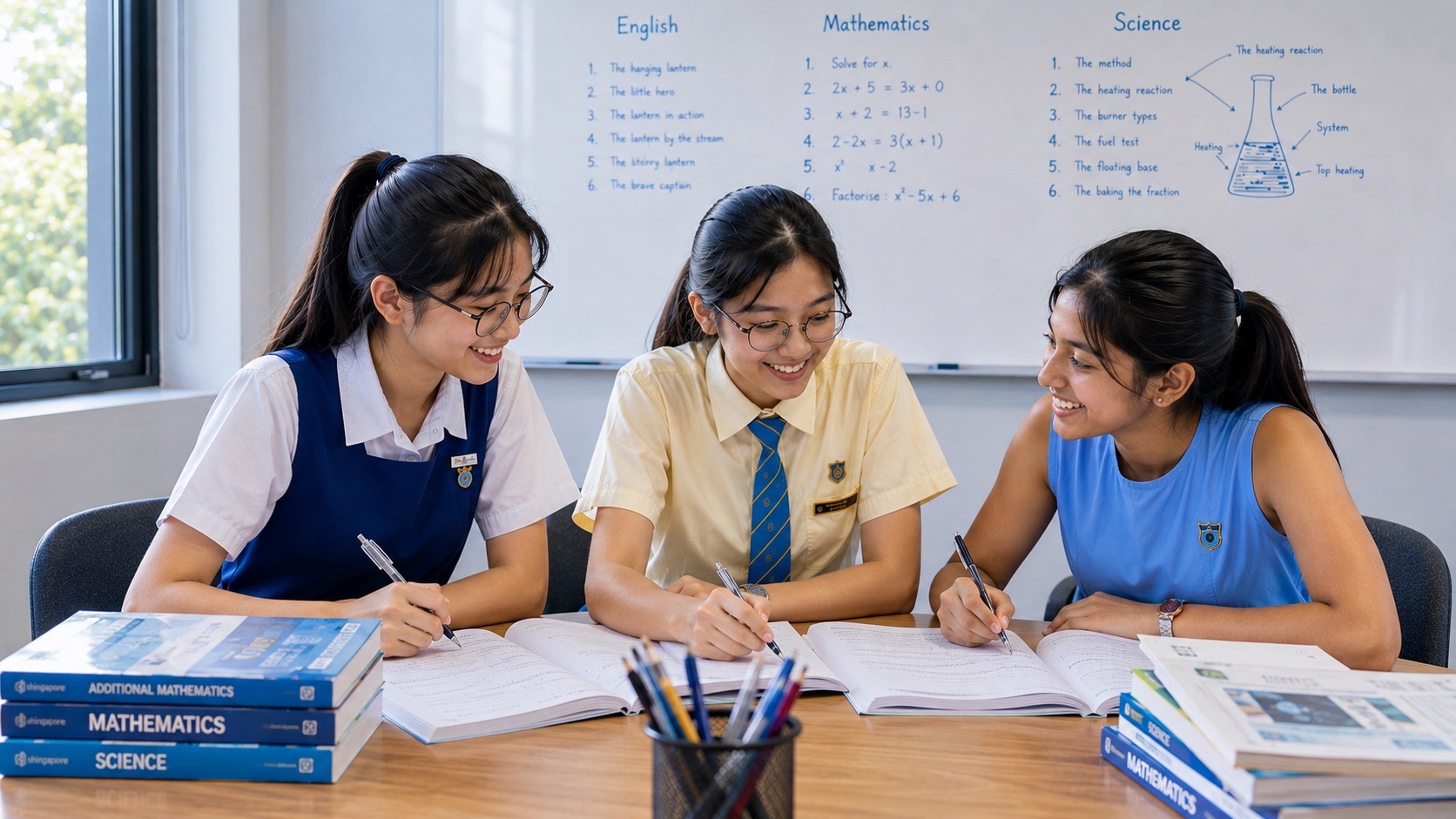
Secondary 4 Mathematics tuition in Punggol must begin with the student’s actual graduating examination, subject level and the pattern of mistakes visible in their own work. eduKatePunggol provides small-group Mathematics tutorials capped at three students, normally lasting 1.5 hours. The benefit of that size is the opportunity for the tutor to inspect each student’s working, identify whether an error came from mathematical understanding or examination control, and test the correction on an unseen problem under appropriate conditions.
The examination year matters. Students graduating in 2026 remain under the relevant GCE examination arrangements, while the Singapore–Cambridge Secondary Education Certificate (SEC) begins in 2027 for subsequent graduating cohorts. The published 2027 SEC Mathematics codes are K110 (G1), K210 (G2) and K310 (G3), with different paper structures. A tutor should never apply the 2027 G3 format mechanically to a 2026 candidate or describe G1 and G2 as simpler copies of one G3 paper.
The most effective final-year tutorial does not simply speed through a pile of papers. It distinguishes a missing algebra rule, a misinterpreted graph, an unjustified geometry angle, an incorrect data conclusion and a timing problem. Each needs a different correction. A group of three gives room for individual diagnosis while peers compare legitimate methods, but no class size guarantees an A1, a specific SEC grade or a preferred post-secondary pathway.
Essential information in one minute
- Confirm whether the candidate sits a 2026 GCE or a 2027 SEC examination; paper codes and applicable rules may differ.
- For 2027 SEC, G1 Mathematics K110: two 90-minute papers, 50 marks each. G2 K210: two 2-hour papers, 70 marks each. G3 K310: two 2-hour-15-minute papers, 90 marks each.
- Approved calculators may be used in both 2027 G1/G2/G3 Mathematics papers, according to the respective SEAB syllabuses; use only permitted models and current exam rules.
- 2027 G2 Paper 2 contains Section B with a choice of one of two questions; G3 Paper 2 includes a final extended real-world scenario. These are not interchangeable structures.
- A small-group tutorial is effective only if each learner can correct a precise error and apply the method to a fresh task, with adequate sleep and realistic practice.
What Secondary 4 Mathematics demands
Final-year Mathematics asks the student to decide among several valid strategies while managing examination time. A quadratic can be factorised, solved using a formula or read through a graph depending on the task. A geometry diagram can invite a familiar theorem, but that theorem is only valid when its conditions hold. A probability calculation requires a clearly defined sample space. A statistics graph must be read with the axis and class intervals in mind. And a real-world scenario may combine multiple topics. The tutor’s job is to make these decisions reliable under novel conditions, not just increase the number of completed papers.
At upper secondary level the best diagnostic question is rarely ‘Which chapter are you weak in?’ A more useful question is ‘At which line did the mathematical relationship stop being valid?’ A student may have the right formula and the wrong measurements, know the correct theorem but apply it to an unsuitable diagram, or use a calculator perfectly while modelling the wrong unknown. A tutor should separate these cases before choosing work.
The purpose of tutoring is not to convert every student into a fast answer machine. Reliable Mathematics requires interpretation, a valid transformation, a clear result and an appropriate check. Shortcuts may be efficient after the structure is understood, but dangerous when used as a substitute for it. In a class of three, the tutor can ask each learner to defend the first decision and compare a different legitimate method without letting group discussion replace individual performance.
The MOE syllabus, Full SBB and the national examination
The MOE G2 and G3 Mathematics Syllabuses and separate G1 Mathematics syllabus set out the conceptual and application demands of the different Full SBB subject levels. At the upper-secondary end, G3 core Mathematics includes standard form and indices, quadratic equations and functions, inequalities, set language, matrices, circle properties, coordinate geometry, trigonometry, vectors, statistics and probability. The G2 and G1 scopes have differences in both content and emphasis. Some students also offer Additional Mathematics, a separate elective and national examination with its own paper structure. A responsible Secondary 4 tutor must use the candidate’s actual subject code, not a generic ‘E-Math’ package without checking the registration.
A pupil’s Posting Group is not identical to a universal academic level for all subjects. Under Full Subject-Based Banding, Mathematics may be taken at G1, G2 or G3. Schools can provide advice about subject-level readiness and the registered pathway. A tutor should not treat a G1 learner as a failed G3 learner or automatically impose an advanced G3 question where it is not part of the child’s requirements. The goal is the most appropriate mastery for the course taken.
The distinction between the 2026 GCE and 2027 SEC examinations is especially important at Secondary Four. A course booklet published for 2027 cannot silently replace the paper applicable in 2026. School assessment also differs from the national paper in presentation and topics at different points of the year. Before recommending an examination pack, the tutor should check the student’s actual subject code and current-year SEAB specification.
Official source routes: MOE G2/G3 Mathematics Syllabuses · MOE G1 Mathematics Syllabus · SEAB 2027 G1 · SEAB 2027 G2 · SEAB 2027 G3.
2027 SEC Mathematics: know which paper applies
| 2027 subject | Paper 1 | Paper 2 | Important distinction |
|---|---|---|---|
| G1 K110 | 1 h 30 min, 50 marks (50%) | 1 h 30 min, 50 marks (50%) | Largely short-answer work plus two longer contextual items in each paper |
| G2 K210 | 2 h, 70 marks (50%) | 2 h, 70 marks (50%) | Paper 2 has Section A and a Section B choice between two questions |
| G3 K310 | 2 h 15 min, 90 marks (50%) | 2 h 15 min, 90 marks (50%) | Paper 2 ends with a longer real-world application question |
SEAB’s published 2027 Mathematics syllabuses allow approved calculators in both papers at these three levels. They also note that missing essential working can cost marks. The G1, G2 and G3 formats are not interchangeable; even when a topic title looks familiar, the expected reasoning and paper design can differ. These facts are relevant to the 2027 graduating cohort and should not be projected backwards as a 2026 GCE format.
For candidates graduating in 2026, SEAB’s GCE O-Level Mathematics code 4052 remains an appropriate reference for those entered in that paper. It has two papers of 2 hours 15 minutes and 90 marks each, with equal weighting. Other 2026 GCE courses have their own papers; consult the candidate’s actual entry and syllabus. The 2027 SEC table above is presented for clear comparison, not as an instruction to disregard the earlier cohort.
Parents should use the appropriate SEAB document and school notices to confirm approved materials, calculator rules and final examination administration. Tuition guides are secondary sources; a provider does not set national examination policy. The centre can help the learner interpret what the paper requires, but it cannot guarantee the paper’s questions or the resulting grade.
How a maximum-three-student tutorial can improve thinking
eduKatePunggol provides small-group Mathematics tuition in Punggol. A class with up to three learners and a typical 1.5-hour session is small enough for close observation of each student’s decisions. In Secondary 4, that means examining how an equation was set up, why an angle theorem was selected and which values were entered into a calculation. The small size matters only if the tutor actually uses it for diagnosis and feedback.
Peer comparison adds another instructional opportunity. One learner can solve by substitution, another by elimination and the third can test both results. In geometry, a pupil may identify a condition that another overlooked. These differences can make misconceptions visible without relying on the tutor to supply every step. But the group must remain balanced. A confident student should not answer for the others, and a quiet student should not be spared every difficult question.
- Ask every learner for an original, unaided attempt before revealing the model.
- Use the original workings to identify the first misconception, not merely the last incorrect number.
- Make pupils explain why a formula or theorem fits the particular conditions.
- Invite a peer to challenge a method respectfully by checking the underlying assumption.
- Provide individual feedback when group members have different errors.
- Check one unfamiliar problem immediately and another after a delay.
- Adapt the plan if the child’s workload, subject level or readiness changes.
Parents also need to know what the format does not promise. One-to-one support may suit a student with unusually intensive needs; a well-managed school support programme may be sufficient for another; extra tuition may be harmful when a learner is already overtired. A three-student maximum is a teaching design, not a guarantee of national examination performance. The correct decision is the one supported by the child’s actual needs and the opportunity to gain usable feedback.
An experienced tutor should be willing to distinguish an error caused by fragile understanding from one caused by timing or copying. If the pupil can solve an unfamiliar question when untimed, the next step may be strategic exam control. If the child cannot explain the underlying concept, a stopwatch is not the remedy. Both are important, but they must be addressed in the correct order.
The five stages of effective correction
1. Diagnose the first wrong mathematical decision
Begin with a real school or past-paper response. Ask what the question requires, what was given and why the chosen method applies. The aim is to find the point where an unsupported assumption was introduced. An answer can be wrong even though every subsequent calculation is accurate. Only identifying that first decision makes correction efficient.
2. Use a discriminating contrast
Present two similar examples where one important condition differs. A right triangle and an oblique triangle can separate Pythagoras from a general-triangle rule. Two percentage problems can expose the wrong base. A line with positive and one with negative gradient can reveal a sign mistake. The learner must state what changed and why the mathematical method changes.
3. Explain the rule with a mathematical reason
A rule should be supported by the relevant property. Factoring a quadratic follows multiplication. Circle theorems require a specific geometric configuration. Statistical averages depend on the number of observations. A tutor who gives only a formula and an answer may create short-term performance but leave the next unfamiliar question unsolved.
4. Make the student do a fresh task without the example
Remove the worked solution. Change the diagram, wording or values so that the child must recognise the relationship rather than recall the same answer. Give enough time for a genuine attempt. The learner’s first independent response tells the tutor whether the teaching worked, and what still needs help.
5. Return later and adjust the plan
Review the same thinking skill in a later session, sometimes under timed conditions. If the misconception returns, revisit the prerequisite or use a clearer contrast. If the concept remains secure, connect it to a mixed or real-world problem. A short error ledger should record the mistaken rule, corrected rule, independent attempt and delayed result.
Twelve practical Secondary 4 Mathematics corrections
1. Paper codes and accurate 2027 SEC comparison
The observable problem. A parent buys G3 Mathematics practice papers because the cover says ‘Secondary 4’, while the student is actually registered for G2 or a 2026 GCE route. The material and paper structure may not match.
A reliable teaching route. SEAB’s 2027 K110 G1 scheme has two 1h30 papers of 50 marks each. K210 G2 has two 2h papers of 70 marks each; Paper 2 Section B requires one of two questions. K310 G3 has two 2h15 papers of 90 marks each; Paper 2 ends with an extended real-world problem. All are 50/50 weighted between papers.
What the three-student tutorial can add. The tutor should first read the student’s actual code and use a matching diagnostic question. Three different students may require three different paper scopes even when the term ‘Mathematics’ appears on all.
A new independent test. A later mixed practice uses the correct paper format and time, and the pupil can state which requirements apply to their own examination.
Important limitation or caution. These figures are specific to 2027 and must not be imposed as the 2026 GCE arrangements for every cohort.
2. Writing essential working rather than hiding the method
The observable problem. A pupil arrives at a correct numerical answer with a calculator but omits the steps needed to show the mathematical relationship, risking marks in a structured question.
A reliable teaching route. Show the key equation, valid transformation and final answer with units. For 3x + 7 = 31, write 3x = 24 and x = 8, then substitute to check. Not every trivial mental step needs a full explanation, but the important relationship should be visible. SEAB explicitly warns that omission of essential working can cause a loss of marks.
What the three-student tutorial can add. Each learner shows a different valid route to a question, then identifies which lines demonstrate the method. The tutor corrects unexplained leaps without demanding ornamental pages of algebra.
A new independent test. An unfamiliar structured problem is completed with concise, traceable working and an appropriate final answer.
Important limitation or caution. Good working is not a decorative style. It helps the examiner and also makes a student’s own errors easier to find and repair.
3. Quadratic roots by a suitable method
The observable problem. A student uses the quadratic formula on every equation and makes unnecessary arithmetic errors, or insists all quadratics factor into simple integers.
A reliable teaching route. For x² – 5x + 6 = 0, factorisation gives (x – 2)(x – 3) = 0 and roots 2 or 3. For a quadratic not conveniently factorisable, the quadratic formula may be suitable within the student’s syllabus. Choosing the right method requires inspecting coefficients and understanding validity, not a fixed habit.
What the three-student tutorial can add. One pupil factors, another checks with the formula and the third verifies by substitution. Each then independently selects a method for a new equation.
A new independent test. Solve 2x² + x – 3 = 0 to obtain x = 1 or x = -3/2, and show valid working.
Important limitation or caution. The available methods differ by G-level. Match the current SEAB syllabus and do not introduce an unsupported advanced method as compulsory.
4. Graphs and their correct interpretation
The observable problem. A learner reads a quadratic maximum as a minimum, or confuses the intercept of y = mx + c with the gradient m.
A reliable teaching route. With y = -2x + 5, m = -2 means y falls by 2 when x increases by 1, while c = 5 is the y-intercept. For y = -(x – 1)² + 4, the turning point (1,4) is a maximum. State which property is read and why.
What the three-student tutorial can add. Students independently inspect a line, a parabola and a data plot, then justify which features each diagram supports. The tutor challenges claims that rely on picture orientation rather than scales.
A new independent test. Given y = 3x – 2, the student identifies gradient 3 and y-intercept -2, checks two points and sketches correctly.
Important limitation or caution. Graph reading is an evidence task. A neat shape drawn with incorrect axis labels is not reliable mathematical communication.
5. Simultaneous equations and consistency
The observable problem. A pupil solves one equation accurately but assumes the result automatically satisfies a second constraint, or copies an incorrect sign during elimination.
A reliable teaching route. For 2x + y = 11 and x – y = 1, addition gives 3x = 12, so x = 4 and y = 3. Substitute into both: 2(4) + 3 = 11 and 4 – 3 = 1. A valid ordered pair must satisfy both equations simultaneously.
What the three-student tutorial can add. Each learner uses substitution, elimination or a graphical check as appropriate. The tutor checks that individual new work is consistent with both constraints.
A new independent test. Given 3x + y = 14 and x – y = 2, obtain x = 4, y = 2 and verify both.
Important limitation or caution. Do not assume a chosen method is correct because the first equation was satisfied. The second is an independent condition.
6. Circle theorems and conditions
The observable problem. A student applies the same-segment theorem to angles with different subtended arcs or uses a tangent rule where no tangent is given.
A reliable teaching route. Draw and mark the relevant chord, arc, centre or tangent. The angle between a tangent and the radius at the point of contact is 90 degrees. The angle at the centre subtended by a given arc is twice the corresponding angle at the circumference. State the theorem only when the diagram’s conditions match.
What the three-student tutorial can add. One child identifies the actual construction, another applies the theorem, and the third checks the claim against a rotated diagram. Each then works alone.
A new independent test. Where a central angle is 108 degrees on the relevant arc, the matching circumference angle is 54 degrees, with a clear reason.
Important limitation or caution. Geometry marks are not earned by guessing theorem names; the diagram must justify each step.
7. Sine rule, cosine rule and right-angle trigonometry
The observable problem. A learner applies SOH-CAH-TOA to a triangle without a right angle or presses the cosine button while the calculator is set to the wrong angular mode.
A reliable teaching route. Identify whether the triangle is right-angled. For general triangles in the appropriate G3 syllabus, select the sine or cosine rule according to the known sides and angles. Check the calculator’s degree mode when angles are in degrees. If a = 6, b = 8 and the included angle is 60 degrees, c² = 36 + 64 – 96(0.5) = 52, so c ≈ 7.21.
What the three-student tutorial can add. Students label known values, explain the chosen rule and perform an independent reasonableness check before comparing answers.
A new independent test. Another new triangle gives two sides and an included angle; the learner states why cosine rule applies and rounds only as directed.
Important limitation or caution. Do not import G3 trigonometry beyond the student’s G-level requirements.
8. Vectors: magnitude is not the sum of components
The observable problem. A pupil finds the magnitude of (3,4) by adding 3+4 and reporting 7, confusing a displacement’s components with the length of the vector.
A reliable teaching route. For a vector (3,4), magnitude is √(3² + 4²) = 5. Its components describe horizontal and vertical displacement; the length follows Pythagoras. Vector addition of (3,4) and (-1,2) produces (2,6), not the sum of component magnitudes.
What the three-student tutorial can add. One student draws the displacement, a second calculates the magnitude and a third checks the right-angle triangle. Each then handles a fresh vector.
A new independent test. For a vector (-5,12), the student finds magnitude 13 and explains why direction matters even though the length is positive.
Important limitation or caution. Vectors are in G3 core Mathematics. A G1/G2 student’s revision should follow their different official content.
9. Probability and the sample space
The observable problem. A student calculates the probability of rolling an even number on a fair die as 2/6 because there are two ‘types’ of even outcomes, rather than counting the actual equally likely results.
A reliable teaching route. List the sample space: {1,2,3,4,5,6}. Favourable even outcomes are {2,4,6}, so probability is 3/6 = 1/2. Explain when outcomes are equally likely and what event is being counted. More complicated probability situations require correct sample-space modelling.
What the three-student tutorial can add. Each pupil lists outcomes, checks whether they are mutually exclusive or overlapping where appropriate, and then gives a reasoned probability calculation.
A new independent test. For a fair die, the probability of an outcome greater than 4 is 2/6 = 1/3, with favourable outcomes 5 and 6.
Important limitation or caution. Probability cannot be calculated by counting verbal categories unless they correspond to equally likely outcomes.
10. Statistics and avoiding misleading interpretations
The observable problem. A pupil reports that the average of two group averages is the combined average even when the group sizes differ, or reads a truncated graph as proof of a huge actual change.
A reliable teaching route. For four people with mean 10, the total is 40. For six people with mean 20, the total is 120. The combined mean is (40+120)/10 = 16, not (10+20)/2 = 15. Graph axes, group sizes and intervals determine valid comparisons.
What the three-student tutorial can add. One learner calculates a total, another checks the combined count and a third explains why the unweighted result fails. The group then analyses a new graph’s scale.
A new independent test. A fresh two-group comparison with unequal sizes is solved by recovering the totals before combining the average.
Important limitation or caution. Data interpretation is a mathematical reasoning skill. A chart’s appearance may mislead if the axis or category size is ignored.
11. Real-world application without guessing the model
The observable problem. A student sees an unfamiliar transport or household-finance question and starts multiplying every visible number because no chapter title tells them which formula to use.
A reliable teaching route. Read the scenario to identify what is known, the target quantity, units and assumptions. For a trip of 180 km taking 3 hours, average speed is 60 km/h. If the question includes stops or different legs, total time must include the relevant intervals. For household finance, percentages apply to a stated base, not to whichever amount looks convenient.
What the three-student tutorial can add. Three students independently describe the situation in a table, equation and verbal account. The tutor compares which representation is most transparent before asking for a changed case.
A new independent test. A new travel schedule has two legs and a pause. The pupil calculates the overall rate using correct total distance and total elapsed time as defined in the question.
Important limitation or caution. The 2027 G3 Paper 2 has an extended real-world question; the purpose is modelling, not guessing a hidden standard trick.
12. Time management and checking under SEC conditions
The observable problem. A pupil can answer questions accurately when untimed but spends too long on one difficult item. Another finishes early but never checks a miscopied coefficient or unit.
A reliable teaching route. Use the candidate’s actual 2026 GCE or 2027 G-level paper specification. Develop a realistic read–plan–solve–check routine and practise in short timed sections before full papers. SEAB’s 2027 G3 K310 includes two 2h15 papers, while G2 and G1 timings differ. Do not teach a single universal seconds-per-mark rule.
What the three-student tutorial can add. Observe whether each learner tends to overthink, rush or omit checks. Test one targeted adjustment and review the accuracy of a new task rather than judging only the number completed.
A new independent test. A new mixed section is completed within a sensible time, includes enough working, and leaves the pupil able to identify one error through a final check.
Important limitation or caution. Time pressure should be added after the mathematical method is reasonably stable; speed cannot repair a missing concept.
Two close-up teaching situations
One correct-looking line with a hidden error
A Secondary 4 learner correctly finds the intercept of a straight line but writes the gradient as the opposite sign. The tutor asks the student to identify two known coordinate points and calculate rise divided by run. When the plotted line falls left-to-right, the negative gradient now has geometric meaning. The child then solves another line-equation task without the original graph. The tutorial has corrected the evidence used, not merely a plus-minus sign.
A theorem that does not fit the diagram
Another pupil solves a circle question by naming a theorem that sounds correct but does not fit the marked arc. The tutor stops before the computation and asks what points, chord and arc actually appear. The group compares the correct condition with a near-miss diagram, then revisits the question using a rotated circle. The student justifies a new angle relation independently. This is the kind of precise geometry correction that a small group can make visible.
These scenes are illustrative, not factual reports about identifiable students. Their role is to show how a tutor can uncover reasoning and correct it. The right measure of an actual lesson is whether the child can reproduce the principle independently on new material, with fewer prompts. A polished model answer alone does not establish learning.
An effective 90-minute lesson in Punggol
| Illustrative period | Student work and feedback |
|---|---|
| 0–10 min | Unaided retrieval of a previously corrected misconception |
| 10–25 min | Review original script and locate the first unreliable step |
| 25–45 min | Teach the mathematical property with a worked contrast |
| 45–65 min | Guided, individual practice and peer comparison where useful |
| 65–80 min | Unseen application or suitable timed section, without the model |
| 80–90 min | Self-check, concise feedback and next retrieval target |
This is an illustrative arrangement, not a guarantee that every class follows identical minute marks. Some pupils need a deep conceptual repair; others need an examination-style exercise and detailed review. The teaching sequence must respond to the student’s actual mathematical understanding and school commitments. A productive class provides individual attention without leaving two pupils idle while one receives correction.
A small-group lesson should combine independent quiet working with short purposeful discussion. The tutor may ask one student to compare two valid methods while another explains why an assumption fails. Then each pupil returns to a new private task. The final evidence comes from what the child can do alone, not from the most confident class member’s explanation.
A practical eight-week progress pathway
First phase: confirm the exact 2026 GCE or 2027 SEC syllabus and review a recent school paper for errors in concept, method, working and timing. Next phase: repair the highest-cost two or three patterns through targeted examples, then changed-context practice. Middle phase: interleave topics and begin calibrated timed sections after accuracy improves. Final phase: use appropriately matched full or partial papers, review every consequential error, protect recovery and retest earlier misconceptions. A high scorer may require precision and unfamiliar modelling; a struggling student may need foundation recovery. There is no fixed one-size-fits-all quota of papers.
The schedule is a model for parent discussion, not a guaranteed path to a particular grade. It should be modified as the learner’s school assessments and national examination approach. An accurate diagnostic may show that a pupil needs a Secondary Two algebra prerequisite more urgently than another practice of an advanced formula. It may show that a capable pupil needs control of essential working under time rather than more theory. A good tutor does not hide these distinctions under a generic promise to cover the entire syllabus.
A brief progress record should include one baseline solution, a specific correction and a later unseen attempt. Exam marks can be tracked, but papers vary in difficulty and familiarity. A direct measure of taught skill is whether the same error occurs less often when the question’s presentation changes. This makes feedback meaningful for the learner and parent and helps prevent tutoring from drifting into repetitive, low-value worksheets.
When exam practice is useful—and when it is just volume
Practice papers are valuable tools when the pupil has a functioning method and the review of wrong answers is detailed. They reveal timing habits, misunderstandings triggered by unfamiliar wording and the ability to connect multiple topics. But completing paper after paper without revisiting the mistakes can train hurried repetition. A student who copies the answer key after a bad attempt may recognise the solution the next day without being able to produce it.
Short timed sections can be more diagnostic than a full paper when the learner is repairing one skill. Choose a small set, ask for honest independent working and inspect which part failed. After the correction, use different questions at comparable difficulty. Progress should be tested again later, not assumed after one guided success.
Schoolwork, sleep and recovery must still fit. Intensive revision is not an unlimited resource; fatigue can increase careless transcription, reduce working-memory capacity and lead to mistaken method choices. If the chief issue is exhaustion, adding a new class may be counterproductive. A responsible tutor should help families review whether the extra instructional value justifies the time and cost.
The parent decision: when to choose three-student tuition
Parents should begin with actual evidence: a recent school paper, a repeated mathematical misconception, poor transfer to unfamiliar contexts or a gap between untimed knowledge and timed performance. Ask the tutor to explain which part of the thinking must change. A centre should not merely say that a student is weak in E-Mathematics and offer more questions. The explanation should be specific enough to guide the next lesson.
- Confirm the candidate’s examination year, subject level and actual Mathematics syllabus code.
- Bring original workings; a wrong line is often more useful than a final score.
- Ask what three students can do in the lesson that would not happen through independent practice.
- Confirm how the tutor retests a corrected error on unfamiliar questions.
- Check current fees, suitable G-level groups, timing and absence arrangements directly.
- Ask for progress through evidence rather than an AL or grade guarantee.
- Reassess the decision if the pupil is exhausted, already independent or would benefit from a different format.
Secondary 4 Mathematics tuition at eduKatePunggol · Punggol Secondary 4 Mathematics tutor information
eduKatePunggol has small-group tuition in Punggol. Group availability, specific lesson times and costs can change, so those details require direct confirmation. The site provides independent tuition and information; it is not a government assessment authority and must not imply that SEAB or MOE endorses a class.
Parent questions answered
Is 2026 Secondary 4 Mathematics under the SEC?
No. The SEC begins in 2027. Graduating 2026 candidates follow the applicable earlier GCE national examination arrangements; check the child’s actual examination entry.
What are the 2027 SEC Maths codes?
G1 Mathematics is K110, G2 Mathematics K210 and G3 Mathematics K310. The papers have different contents, durations and question structures.
How long are the 2027 Mathematics papers?
K110 has two 90-minute papers, each 50 marks. K210 has two 2-hour papers, each 70 marks. K310 has two 2h15 papers, each 90 marks. Each paper carries 50% of its subject assessment.
Can a calculator be used in SEC Mathematics?
The 2027 Mathematics K110, K210 and K310 documents permit approved calculators for both papers. Follow the actual current-year approved models and examination instructions.
Is E-Mathematics the same as Additional Mathematics?
No. Core Mathematics and Additional Mathematics are separate subjects; the latter is an elective at relevant levels, with its own syllabus code and examination.
Does a three-student group guarantee an A1?
No. Class size helps only when quality feedback produces independent improvement. National grades depend on actual examination performance and cannot be guaranteed.
How should we choose between G1, G2 and G3 practice papers?
Use the subject level and code recorded by the school. Do not automatically give a G1/G2 learner G3 materials simply because they appear more advanced or popular online.
What does real revision progress look like?
Fewer repeated mathematical misunderstandings, appropriate and legible workings, accurate units and stronger unfamiliar-question performance under realistic conditions.
What genuinely effective class size should achieve
A strong Secondary 4 Mathematics tutorial should steadily make its own help less necessary. The learner begins to check notation, choose a valid method, spot a missing condition and communicate working without waiting for the tutor to intervene. If a child can solve the same type of unfamiliar problem independently after a delay, that is more useful than the memory of one guided model.
The small-group format can support this goal by providing individual diagnosis and disciplined peer comparison, but it cannot guarantee marks. Parents deserve transparent examples of what was corrected, how it transferred and which skills remain difficult. These are the reasons to choose, adjust or eventually leave a tuition programme.
MOE and SEAB official sources, and local tuition routes
- MOE Secondary G2 and G3 Mathematics Syllabuses (Secondary 1–4)
- MOE Secondary G1 Mathematics Syllabus
- SEAB 2027 SEC G1 K110 Mathematics
- SEAB 2027 SEC G2 K210 Mathematics
- SEAB 2027 SEC G3 K310 Mathematics
- SEAB 2026 GCE O-Level Mathematics 4052
- eduKatePunggol Secondary 4 Mathematics Tuition
- Punggol Secondary 4 Mathematics Tutor
- Secondary 1 Mathematics small groups tutor | Effective Class Size Tutorials
- Secondary 2 Mathematics small groups tutor | Effective Class Size Tutorials
- Secondary 3 Mathematics small groups tutor | Effective Class Size Tutorials
- Enquire about Mathematics tutorial availability in Punggol
Editorial check: 5 November 2026. All 2027 codes and formats cited here refer to the SEAB 2027 SEC syllabuses; the older O-Level 4052 source refers to the 2026 GCE format. Confirm candidate-specific arrangements and any later-year revisions from the examination authority or school. This is guidance from a tuition provider, not an official examination publication.


