
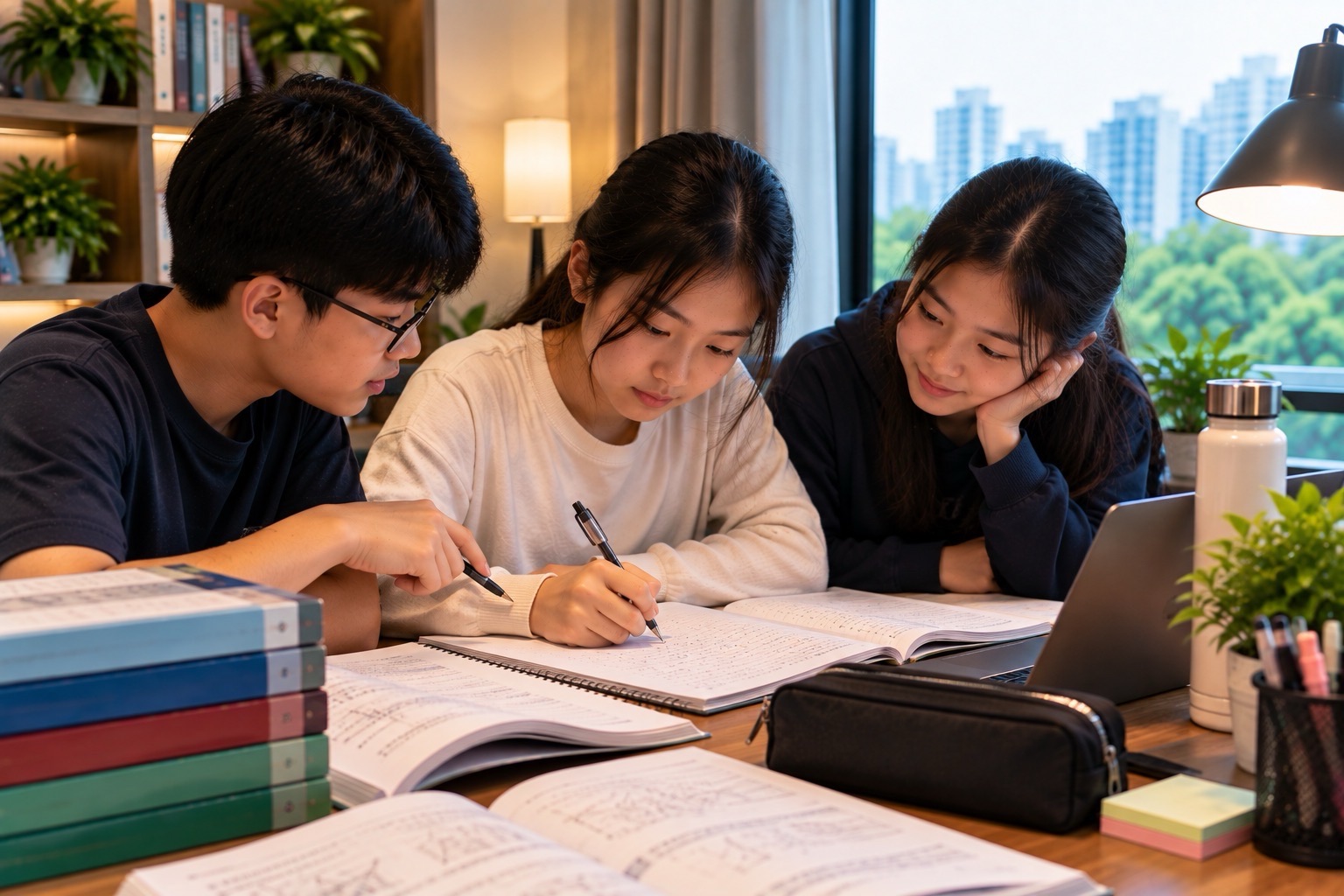
Secondary 3 G2 English tuition in Punggol should help students prepare intelligently for upper-secondary schoolwork and, for a 2026 Secondary 3 cohort progressing normally, the first SEC examinations in 2027. eduKatePunggol offers small-group tutorials capped at three students, normally for 1.5 hours. At this stage, the benefit of close feedback is the tutor’s ability to distinguish a missing main idea from an unsupported inference, an incomplete situational-writing response from a grammar problem, and a nervous oral answer from a response that never addresses the question.
SEAB’s 2027 G2 English Language K200 syllabus assesses Writing (35%), Comprehension (35%), Listening (10%) and Oral Communication (20%). The Writing paper has editing, 180–250-word situational writing and 250–400-word continuous writing; the comprehension paper includes an approximately 80-word summary. The oral paper involves planning a response to a video and participating in spoken interaction. These are national examination specifications for the 2027 cohort, not a promise of a specific tuition class, a guaranteed grade or a format for another examination year.
The essentials for a Punggol parent
- The 2027 G2 English K200 examination has 180 marks across four papers, weighted 35% Writing, 35% Comprehension, 10% Listening and 20% Oral Communication.
- Paper 1 Writing: 70 marks, 1 h 50 min, with editing, 180–250-word situational writing, and 250–400-word continuous writing.
- Paper 2 Comprehension: 50 marks, 1 h 50 min, including narrative and non-narrative reading and an approximately 80-word summary.
- Paper 3 Listening includes an 8-mark note-taking task heard once; Paper 4 includes a video-based planned response and spoken interaction.
- The tutor should connect each current school error to a new independent task, rather than promise that a small class automatically raises grades.
Find your answer: MOE/SEAB · Three-student tuition · Teaching examples · 90-minute tutorial · Parent questions · FAQs · Official sources
MOE English development and the 2027 SEC reference
SEAB’s G2 English K200 syllabus describes a course grounded in the 2020 English Language curriculum and assessment aims including reading varied written and multimodal texts, language for effect, main ideas, inference, synthesis, summarising, purposeful writing, listening and interactive speech. The syllabus’s writing and comprehension tasks involve several distinct text types. The tutor should check the student’s current school’s Secondary 3 sequence and the precise eventual examination year. A 2026 Secondary 3 child normally enters the 2027 SEC graduating cohort, but actual subject registration and school circumstances remain decisive.
The reader should distinguish what the school teaches now from what a future examination will assess. The 2027 K200 document specifies the national G2 English route for its stated graduating cohort. It does not mean that every Secondary school uses the same term tests or that a younger pupil automatically faces identical future examination arrangements. A responsible tutor should inspect the child’s actual enrolled G2 English level, term materials and teacher comments before choosing what to teach.
The curriculum develops the capacity to receive information critically and communicate appropriately. In a practical lesson, that means interpreting a question accurately, supporting an inference with text evidence, selecting relevant information for a reader, writing complete and purposeful sentences, and speaking in response to someone rather than reciting an unrelated monologue. The exact mix should change as the student progresses.
Official documentation: SEAB 2027 SEC G2 English K200 full syllabus · 2027 G2 school-candidate subject index.
K200’s four national papers: what 2027 candidates actually face
| Paper | Duration | Marks | Weight |
| 1 — Writing (editing, situational, continuous) | 1 h 50 min | 70 | 35% |
| 2 — Comprehension (visual, narrative, non-narrative and summary) | 1 h 50 min | 50 | 35% |
| 3 — Listening (including note-taking) | About 45 min | 30 | 10% |
| 4 — Oral Communication (planned response and interaction) | About 20 min including 10 min preparation | 30 | 20% |
SEAB’s G2 English K200 syllabus describes a course grounded in the 2020 English Language curriculum and assessment aims including reading varied written and multimodal texts, language for effect, main ideas, inference, synthesis, summarising, purposeful writing, listening and interactive speech. The syllabus’s writing and comprehension tasks involve several distinct text types. The tutor should check the student’s current school’s Secondary 3 sequence and the precise eventual examination year. A 2026 Secondary 3 child normally enters the 2027 SEC graduating cohort, but actual subject registration and school circumstances remain decisive.
For Paper 1, editing is worth 10 marks, situational writing 30 marks and continuous writing 30 marks. The published 2027 situational-writing range is 180–250 words, while continuous writing is 250–400. Paper 2 includes a visual or multimodal text section, a narrative or recount section, and a non-narrative section with an approximately 80-word summary. For Listening, the eight-mark informational note-taking task is heard once. The Oral Communication assessment includes a video-based planned response and spoken interaction. These are separate skills; copying one polished essay cannot prepare all four.
Because Secondary 3 in 2026 ordinarily leads into the 2027 graduating cohort, this examination map can guide the transition. However, the tutor must still match the current school’s syllabus and actual school papers. A child who struggles with basic references or grammar needs foundational repairs before spending most tutorial time on timed final-year papers.
Why this year needs a different kind of teaching
The upper-secondary change is not merely that every passage becomes longer. A student needs to decide which information matters, how it serves a reader or examiner, and whether the response remains accurate under a new topic. The difference between a plausible and a well-supported inference can decide a comprehension answer. The difference between a polite email and a purposeful email can decide whether situational writing fulfils its instructions. The difference between prepared speech and actual listening can decide how a candidate handles a follow-up question. These skills need diagnosis and transfer practice, not only memorised model paragraphs.
A mistake should be examined from its beginning. If a comprehension response is wrong, the problem may be decoding, meaning, pronoun reference, overconfident inference or misunderstanding the question command. If a writing piece misses the reader’s purpose, more advanced vocabulary will not repair it. The tutor needs to identify that first unsupported decision, explain the difference and ask the learner to try an unfamiliar task alone.
Transfer is the most important check. A student who can repeat the original teacher-corrected answer may have learned its wording rather than its principle. Ask whether they can solve a changed situation using different characters, a new text type or a new audience. Return again after time has passed: lasting independence is a more credible sign of tuition quality than the number of marked pages.
Why a group of three can be effective—and when it may not
A three-student tutorial can let a tutor observe each learner’s first answer and use peers to test alternative interpretations. One student might notice an explicit clue, another identify the writer’s purpose and a third question whether an inference is too strong. The tutor should make sure these parts form a valid explanation and then require each individual to answer a changed example independently. Group agreement without an individual retest is weaker evidence.
- Let each pupil read or write privately before revealing a model answer.
- Ask a specific diagnostic question about the first incorrect line or unsupported interpretation.
- Give the hesitant speaker preparation time and prevent the fastest learner from taking over.
- Use peer comparison to test reasons, not only to vote on which final answer is right.
- Set a new independent task that changes text, audience or context.
- Revisit a corrected point in a later lesson to test delayed retention.
- Review class composition, current workload and whether tuition is still needed.
The limit of three is a class-structure choice, not a scientifically guaranteed optimum. A pupil who requires extensive private intervention may learn better one-to-one; a child already progressing with school instruction might not need further tuition at all. A suitable group must share a workable learning focus and allow different personal corrective tasks. The session should not become a miniature lecture in which three people copy the same answers.
The strongest long-term result is that the student increasingly no longer needs the tutor to point out the next line. A clear personal progress note can describe the initial problem, the teaching contrast, an unfamiliar second response and a delayed check. That is more informative than a generic promise of examination grades.
A method for repairing language errors
Identify the first unsupported decision
Look at the original school response before displaying the answer key. Ask whether the pupil interpreted the question correctly and which detail justified the chosen answer. If a text is genuinely ambiguous, an appropriate response may acknowledge that uncertainty. A tutor should resist treating every difficulty as simply weak grammar.
Teach a contrast rather than a slogan
Select similar examples with one important difference: an instruction that changes the meeting time, two near-synonyms with different intensity, or a message whose audience changes from a friend to a teacher. Ask which condition alters the right response. This helps the pupil learn the boundary of a rule instead of memorising a sentence.
Check a new unseen example
Remove the annotated text and offer a different short passage, image, message or spoken prompt. The learner should explain why an answer is valid without waiting for the tutor’s hint. If the correct explanation only emerges while the original model is visible, the teaching is still in a supported stage.
Revisit after a delay
In a later session include the same idea within a different task. If the misconception returns, adjust the lesson or revisit a prerequisite. If it holds, provide a more demanding example or reduce prompting. A small record of these checks helps parents see whether the skill is becoming independent.
24 specific English difficulties and classroom solutions
1. The writer’s actual purpose
Original difficulty. A pupil begins a situational email with elaborate formality but omits the action the intended reader is asked to take.
How to repair it. Identify the writer, recipient, purpose, relevant facts and requested action. Draft an opening that tells the reader why the message exists, then check from the reader’s perspective.
What a group of three contributes. Three students analyse different recipients and privately draft an appropriate request before comparing tone.
Fresh individual test. An unfamiliar event-planning prompt is fulfilled completely without copying the previous email.
Important boundary. The 2027 K200 exam tests purpose, audience and context, not decorative greetings.
2. Interpreting a visual prompt for writing
Original difficulty. The learner describes a poster’s colours at length but omits a key date and eligibility condition that should appear in the message.
How to repair it. Annotate which parts of the visual supply information needed by the recipient. Distinguish decorative images from facts that govern what the message can truthfully say.
What a group of three contributes. The group separates audience, constraints and facts, then each student drafts an original response.
Fresh individual test. A changed notice with a new deadline produces an accurate message respecting the stated condition.
Important boundary. A fluent but inaccurate message is not task fulfilment.
3. Situational writing’s 180–250-word range
Original difficulty. A student repeatedly writes forty words and assumes the message must be sufficient because all sentences are grammatical, or writes four hundred without a reason.
How to repair it. Teach a plan that allocates space to required facts, explanation, tone and action. The 2027 K200 specification gives 180–250 words for this final national task; practise proportion, not padding.
What a group of three contributes. Each learner marks a different missing requirement in a sample, then writes a distinct complete piece.
Fresh individual test. A new prompt produces a purposeful response within the stated examination range when preparing for 2027.
Important boundary. School exercises may use different lengths, so distinguish the actual school assignment from the national specification.
4. Editing grammar rather than every spelling
Original difficulty. The student changes a correctly spelled unusual word during editing while missing a true agreement error, because anything unfamiliar seems suspect.
How to repair it. The 2027 K200 editing task targets grammatical errors, not spelling or punctuation. Read the sentence’s structure, subject and time reference before deciding what needs changing.
What a group of three contributes. Each learner identifies a different genuine grammar error and explains why an odd-looking but correct term should remain.
Fresh individual test. On a fresh continuous-prose text, the student edits grammar accurately without altering unrelated spelling.
Important boundary. A correction must have a grammatical reason, not simply a different-looking word.
5. Argument versus narrative topic choice
Original difficulty. The pupil chooses the most dramatic-looking continuous-writing topic but cannot sustain a relevant plot or argument after one paragraph.
How to repair it. Compare what each of the four prompts actually requests, identify available content and choose a form the student can develop coherently. Outline a central claim or story turn before drafting.
What a group of three contributes. Three learners propose plausible plans for different prompts, then write their chosen pieces alone.
Fresh individual test. An unfamiliar set of topics leads to a defensible choice and complete original plan.
Important boundary. An exciting opening is not enough if the piece cannot fulfil the prompt.
6. Continuous writing within 250–400 words
Original difficulty. A learner produces a memorised six-hundred-word accident story regardless of topic and assumes greater length guarantees stronger marks.
How to repair it. SEAB’s 2027 K200 range is 250–400 words. Teach controlled development: a purposeful opening, connected middle and meaningful conclusion, with each paragraph advancing an argument or event.
What a group of three contributes. The group identifies unnecessary repetition while each writer keeps ownership of their original piece.
Fresh individual test. A changed continuous-writing task develops the idea within the official range instead of a copied stock story.
Important boundary. National ranges apply to that examination year; content quality and relevance remain decisive.
7. Narrative consequence and cause
Original difficulty. A story includes shouting, rain and a sudden rescue without explaining why a character decides to act.
How to repair it. Build the story around a goal, obstacle, response and consequence. A credible decision connects the scenes and makes description meaningful.
What a group of three contributes. Each pupil tests a different possible ending against the earlier events and revises their own outline.
Fresh individual test. A new narrative avoids a forced accident and has an intelligible causal sequence.
Important boundary. High-scoring narrative design cannot be reduced to memorising a ‘dramatic climax’ phrase.
8. Argument structure and reasoning
Original difficulty. The student writes three opinions in consecutive paragraphs but provides no example or reason for any of them.
How to repair it. Use claim, explanation, relevant example and consequence, followed by an appropriate qualification when the issue is debatable. Explain why a real supporting example matters.
What a group of three contributes. Group members respectfully challenge an unsupported claim and then independently write a changed argument paragraph.
Fresh individual test. An unfamiliar prompt about school activities yields a clear position supported by a specific reason.
Important boundary. An argument should not present invented statistics or unverifiable quotations as facts.
9. Vocabulary in context and tone
Original difficulty. A pupil replaces every ordinary verb with a rare synonym and changes the intended attitude or register.
How to repair it. Compare near-synonyms by meaning, tone, intensity and word partnership; choose precise language that fits the sentence rather than sounding impressive.
What a group of three contributes. Each student defends one choice and explains why an apparent synonym would distort the passage.
Fresh individual test. A new paragraph uses accurate natural diction instead of an unrelated phrase bank.
Important boundary. Vocabulary knowledge should improve clarity and effect, not make communication artificial.
10. Language for effect in a narrative
Original difficulty. The learner says a writer uses imagery ‘to attract the reader’ without identifying what the particular word reveals.
How to repair it. Locate the exact expression, explain its literal or figurative implication and connect that effect to the scene’s mood or a character’s perspective.
What a group of three contributes. Three students offer different interpretations and locate support in nearby sentences.
Fresh individual test. An unfamiliar metaphor is explained specifically rather than through a generic examination phrase.
Important boundary. Different images have different functions; one stock sentence cannot fit all of them.
11. Identifying point of view
Original difficulty. The pupil mistakes a narrator’s assumption for an established fact about another character.
How to repair it. Distinguish what the narrator observes, what they believe and what the wider story establishes. Examine pronouns and tone as clues.
What a group of three contributes. The group compares the narrator’s claims with a second character’s actions; each student interprets a new passage alone.
Fresh individual test. An unseen first-person narrative is analysed without treating every opinion as objective truth.
Important boundary. Interpretive precision requires awareness of the source of a statement.
12. Tracking references across paragraphs
Original difficulty. A student cannot tell which person ‘he’, ‘they’ or ‘their’ refers to after several characters have been introduced.
How to repair it. Trace names and actions through neighbouring sentences and test candidate antecedents. Acknowledge genuine ambiguity if the text does not settle the matter.
What a group of three contributes. Each learner marks a separate reference chain, then answers a new two-character paragraph privately.
Fresh individual test. A fresh narrative is interpreted without exchanging the actions of two people.
Important boundary. Reference mistakes can affect several comprehension answers at once.
13. Text 1 and visual information
Original difficulty. The child claims a poster guarantees a benefit that is not actually stated in either its text or design.
How to repair it. Separate what is explicitly shown from what is suggested and from what remains unknown. Explain how a caption or image supports a claim without inventing sponsor intentions.
What a group of three contributes. Three pupils identify one direct fact, one plausible inference and one unsupported overclaim.
Fresh individual test. A new multimodal page is interpreted accurately with reference to its actual features.
Important boundary. Section A of 2027 K200 includes visual and written texts; this is not simply an aesthetic judgement.
14. Narrative comprehension’s cause-and-effect
Original difficulty. A learner copies a line telling what a character did when asked why it was done.
How to repair it. Locate the event, read preceding and following clues, and write the cause or motivation with textual support. Distinguish a reason from an emotion label.
What a group of three contributes. The group tests three candidate explanations and then individually answers a new narrative question.
Fresh individual test. An unfamiliar passage receives a precise evidence-linked reason rather than a copied action.
Important boundary. Text 3 in the official 2027 assessment is narrative or recount based.
15. Non-narrative comprehension and writer purpose
Original difficulty. The student reads an article like a story and overlooks the recommendation or explanation that its paragraphs develop.
How to repair it. Identify the informational text’s main position, how supporting sections are organised and which evidence or example develops each part.
What a group of three contributes. Each pupil summarises a different section and checks whether the combined account still reflects the writer’s purpose.
Fresh individual test. A fresh article about water conservation is interpreted by structure and central message.
Important boundary. Text 4 and the summary task require reading beyond narrative event sequences.
16. Selecting relevant points for summary
Original difficulty. A pupil copies every interesting example and omits two key reasons the source actually provides.
How to repair it. Identify the summary’s focus before selecting details. Mark relevant distinct ideas, remove repeated examples and check that each chosen point answers the question.
What a group of three contributes. Each student proposes a set of summary points and explains why a tempting example is less essential.
Fresh individual test. On a new text, the learner selects essential facts without including unsupported additions.
Important boundary. Selection comes before paraphrase; an elegant summary of the wrong points is still weak.
17. Paraphrasing without distorting meaning
Original difficulty. The student replaces a term with a superficially similar word and inadvertently changes the author’s claim.
How to repair it. Explain the original proposition, identify which technical terms must stay precise and use an alternative sentence structure or accurate common synonym where possible.
What a group of three contributes. Three pupils compare original and paraphrased statements for meaning, then write their own.
Fresh individual test. A changed summary uses natural wording while retaining causal and conditional relations.
Important boundary. Paraphrase is not a requirement to replace every word.
18. An approximately 80-word summary
Original difficulty. The learner writes 140 words with repeated examples despite the 2027 K200 instruction to produce about 80 words.
How to repair it. After selecting points, compress repeated phrasing and combine related ideas without dropping necessary qualifications. Count carefully at the end rather than deciding content solely by length.
What a group of three contributes. Each pupil edits a different long summary and checks whether the key ideas survive.
Fresh individual test. A fresh non-narrative text is summarised around the stated length and focus.
Important boundary. The 80-word figure is from the published 2027 G2 syllabus, not an automatic rule for every school task.
19. Listening: first information versus revision
Original difficulty. A pupil chooses the first time named by a speaker and misses the later change to the schedule.
How to repair it. Listen for correction signals, contrast and concluding instructions. Short notes can record the final information when necessary, but the student must interpret the whole message.
What a group of three contributes. Students first answer separately, then locate the audio clue that changed the earlier plan.
Fresh individual test. A new announcement produces the final venue and date without the tutor’s hint.
Important boundary. Listening is not a game of catching the earliest keyword.
20. Listening note-taking heard once
Original difficulty. The learner tries to transcribe every sentence and misses the organised facts needed in the note grid.
How to repair it. Preview headings or the structure where permitted, predict the type of information needed, and record concise key terms while the informational recording is delivered once.
What a group of three contributes. Three students compare which notes capture the decisive information, then practise a new recording independently.
Fresh individual test. An unseen informational audio leads to accurate concise notes instead of a partial transcript.
Important boundary. The 2027 K200 Paper 3 Section B is an eight-mark one-play note-taking task.
21. Oral planned response to video
Original difficulty. A candidate retells a video frame by frame but never answers the prompt or offers a developed opinion.
How to repair it. Choose one relevant observation, a defensible view, a reason and an example. Prepare a coherent response rather than a memorised unrelated speech.
What a group of three contributes. Each pupil plans a different view of a short appropriate clip and presents individually.
Fresh individual test. On a new clip, the student gives a focused response up to two minutes, tied to the actual question.
Important boundary. SEAB’s 2027 K200 planned response is worth fifteen marks; the format is a reference for the appropriate cohort.
22. Spoken interaction after a planned response
Original difficulty. The student repeats the two-minute speech verbatim when the examiner asks for a different perspective.
How to repair it. Listen to the exact follow-up, answer it, give a reason and interact naturally. It is legitimate to qualify a view or acknowledge another interpretation.
What a group of three contributes. Peers ask varied respectful questions; each student responds privately before discussing general feedback.
Fresh individual test. A new discussion topic prompts an answer that changes appropriately with the examiner’s question.
Important boundary. Oral interaction is not measured by uninterrupted speaking alone.
23. Timing and the real paper mix
Original difficulty. The student devotes most of writing time to the opening paragraph and leaves situational-writing facts or the conclusion unfinished.
How to repair it. Use a timed rehearsal to observe whether planning, drafting or checking causes delay. Train an individual decision to move on when stalled, then review content and clarity.
What a group of three contributes. All three learners log different timing difficulties and test a targeted adjustment.
Fresh individual test. A new mixed task is completed more evenly without abandoning the required reader and purpose.
Important boundary. A universal seconds-per-mark rule ignores differences in items and students.
24. Evidence-based progress instead of a predicted grade
Original difficulty. The child can reproduce a corrected passage answer but still waits for a teacher to point to the relevant line on a fresh text.
How to repair it. Record first error, teaching explanation, unseen independent response and later retention. Compare specific skills such as correct summary selection or purposeful writing.
What a group of three contributes. The tutor assigns different new tasks to each student and shares concise non-sensitive progress evidence.
Fresh individual test. A later unfamiliar question is answered without a prompt, showing reduced dependence.
Important boundary. National outcomes cannot be guaranteed by group size or completed paper counts.
Two examples from a well-managed tutorial
The first response that reveals the true problem
A Secondary 3 G2 pupil writes a polished email proposing a recycling activity, but the prompt also asks for a reason the school should accept the plan and a specific date. Both are missing. The tutor has the child read the scenario from the recipient’s perspective: what decision must be made, and which information is necessary? A classmate identifies the missing reason, while another checks whether the email’s tone fits the audience. The learner then plans a new, unrelated situational-writing prompt alone. The point is fulfilment of purpose, not polishing an incomplete message.
A corrected idea that needs to work elsewhere
Another student prepares a two-minute planned response to a video about public transport by memorising a generic speech on environmental protection. The answer barely refers to the actual prompt. The tutor asks the child to identify one visible observation, a relevant view and a personal example; a peer provides a different perspective. The next task uses a video topic about community volunteering, requiring the student to plan and present without recycling the transport speech. These are illustrative scenarios, not actual pupil testimonials.
These scenarios illustrate how tuition can respond to a learning difficulty. They are not claims about named pupils, actual student testimonials or guaranteed grade changes. In a real lesson the child’s own original work should be treated privately and reviewed to determine a relevant next task.
How a 90-minute tutorial can be structured
| Illustrative time | Teaching purpose |
| 0–10 minutes | Independent recall of an earlier concept or language pattern |
| 10–25 minutes | Read an original school response and locate the first error |
| 25–45 minutes | Teach through a focused short text, contrast or worked example |
| 45–65 minutes | Individual reading, writing or discussion with focused feedback |
| 65–80 minutes | Unfamiliar task without the earlier model |
| 80–90 minutes | Self-check, short progress record and manageable follow-up |
These minute ranges describe one possible structure and are not a claim that every lesson follows an identical timetable. A learner who needs more time on reading should receive it; another may need to revise a real writing task or practise oral follow-up questions. Pupils should remain active while one child receives more focused feedback. A small group has little advantage if most of the session consists of watching a teacher perform the work.
Correction should remain respectful. A quiet student may need thinking time, while a confident speaker may need to learn to listen. The tutor can allow different tasks within a shared lesson theme and then assess each student individually. Where the group is badly matched or the pupil is overburdened, the centre should discuss changes rather than insist that every child benefits from the same class.
An eight-week learning review
Weeks one and two can identify the student’s enrolled G2 English course, the current school texts, an original writing sample and a short oral response. Weeks three and four target a few recurring issues, such as pronoun reference, purpose-and-audience writing or summarisation. Weeks five and six connect the new skill with a different genre and an unfamiliar prompt. Weeks seven and eight revisit the first difficulty after a delay, compare independent work and decide whether to consolidate, extend or reduce tuition. This is an illustrative progress process rather than a timetable guaranteeing marks.
The record should state the exact change: ‘The student previously copied a character’s action when asked for the reason, and can now identify and explain a relevant clue in two unfamiliar paragraphs.’ Or: ‘The student now includes the required action and date in a new functional message.’ These observations give the parent and teacher usable feedback. A school mark can be supportive evidence, but paper familiarity and task difficulty can change the result independently of tuition.
Further questions that influence the decision
Why G2 English deserves deliberate upper-secondary teaching
G2 English has a distinct national specification and should not be treated as simply a smaller selection of G3 essays. It places substantive weight on writing and comprehension, with further listening and oral communication tasks that require different preparation. A student may be strong in narrative writing but weak in visual texts or factual summaries; a fixed weekly composition cannot address everything. The tutor needs school scripts to identify the expensive recurring errors and a plan to test whether those errors have disappeared. Respecting the child’s subject route is educationally important and also prevents families from buying unrelated papers.
A useful follow-up is a new example without the tutor’s original wording. The student should be able to describe what the question asks, locate the relevant evidence or make a purposeful communication choice independently. If the same prompt is still needed each time, the next lesson should change its method rather than simply assign more work.
What good summary feedback looks like
A useful summary review distinguishes missing content points, repetition, word choice that changes meaning, and over-length expression. These are different issues. The tutor should first check which ideas the child selected and only then examine the language used to compress them. It is possible to have accurate grammar and an incomplete summary because the relevant points were never chosen. A fresh article with a different structure is needed to test transfer. The desired result is the student’s ability to decide what matters, not simply produce a visually shorter paragraph.
A useful follow-up is a new example without the tutor’s original wording. The student should be able to describe what the question asks, locate the relevant evidence or make a purposeful communication choice independently. If the same prompt is still needed each time, the next lesson should change its method rather than simply assign more work.
Why one-to-one rehearsals may be appropriate inside a small group
A class with three learners can compare how different people plan oral responses, but the actual speaking performance remains individual. The tutor can conduct short private turns, record one actionable observation for each pupil and then ask another participant to offer a respectful alternative view. The student learns both prepared communication and unscripted listening. A fast or confident child must not dominate the practice. If the pupil needs extensive private support, a different setting may be better. A small group is a design opportunity rather than an automatic guarantee.
A useful follow-up is a new example without the tutor’s original wording. The student should be able to describe what the question asks, locate the relevant evidence or make a purposeful communication choice independently. If the same prompt is still needed each time, the next lesson should change its method rather than simply assign more work.
How to plan final-year readiness without constant panic
A Secondary 3 learner in 2026 is normally preparing toward the 2027 SEC cohort. That makes the official K200 format relevant, but school commitments and current chapter work still matter. A sensible year plan can begin by repairing comprehension and writing foundations, add accurate summary and functional-text work, and introduce timed combinations as independent skills stabilize. Full papers should be reviewed carefully instead of completed solely for volume. The family should also protect rest, CCA obligations and school assignments. A pupil who learns to check and self-correct will be better served than one who simply has more paper files.
A useful follow-up is a new example without the tutor’s original wording. The student should be able to describe what the question asks, locate the relevant evidence or make a purposeful communication choice independently. If the same prompt is still needed each time, the next lesson should change its method rather than simply assign more work.
How families can support language without overloading the week
A parent can ask one natural question about a story, school notice, message or conversation. Invite the child to say which detail supports an interpretation and why another option would not fit. For writing, ask who is meant to read it and what the reader should do next. These are manageable questions; the family does not need to run a second full examination class each evening.
Reading for enjoyment, ordinary conversation, schoolwork, rest and co-curricular activities deserve time. A student who is already succeeding without supplementary help may not need a new weekly commitment. If persistent literacy problems remain, the school can advise whether specialist support or a different format would fit better than the current three-person class.
Parent decisions before enrolling
- Confirm G2 English is the actual enrolled subject level and understand the school’s current term requirements.
- Bring one original uncorrected comprehension or writing task and any teacher comments.
- Ask how the tutor will make each learner read, speak and write independently.
- Check the unfamiliar transfer task and delayed review used to judge progress.
- Ask how the group is matched and whether one-to-one or school support might be better.
- Confirm current fees, available times, tutor details and missed-lesson arrangements directly.
- Review whether the child needs more tuition after independence has improved.
Upper secondary English transition · Secondary 3 English tutor · Comprehension and summary writing · Enquire about English tuition
eduKatePunggol offers small-group tuition in Punggol, but an article cannot verify a vacancy for a particular school level or a current price. The centre’s teaching is independent of MOE and SEAB; citing official documents does not mean the examination authority endorses any tuition provider.
Frequently asked questions
What is the 2027 G2 English K200 paper weighting?
Writing and Comprehension are 35% each; Listening is 10% and Oral Communication 20%.
How much writing is required in the 2027 K200 exam?
The published situational-writing range is 180–250 words, and continuous writing is 250–400 words.
Does the comprehension paper include a summary?
Yes. The 2027 G2 syllabus describes an approximately 80-word summary on a non-narrative text.
Is the listening note-taking task heard twice?
No. The 2027 Paper 3 Section B informational text for note-taking is heard once; Section A recordings are heard twice.
How does the K200 oral assessment work?
It includes a planned response to a video prompt and a spoken interaction with examiners, with a combined 30 marks and 20% weighting.
Is Secondary 3 in 2026 aiming for the first SEC?
Under normal progression, a Secondary 3 student in 2026 reaches Secondary 4 in 2027, the first SEC graduating year. Verify the child’s actual course and exam registration.
Should every lesson be a full paper?
No. When a concept is unstable, focused repair and unfamiliar tasks may be more effective than completing another unreviewed paper.
Can small-group tuition guarantee a G2 distinction?
No. A tutor can support independent language skills but cannot guarantee a national result.
What effective class-size tuition should leave behind
The goal of Secondary 3 G2 English tuition is not dependence on a perfectly annotated worksheet. A learner should gradually read for meaning, select the right language, write for a real reader and answer spoken questions more independently. Three pupils can allow close observation and useful comparison, but only when the tutor uses that attention well and every student attempts a fresh task alone.
Parents should judge the learning from the original response, the new independent attempt and a delayed return. When the learner’s school and home routines are sufficient, continuing tuition is not mandatory. An honest class should have a purpose and a point at which its value is reassessed.
More Punggol G-level English and Mathematics small-group guides
Secondary 1 G2 English | Effective Class Size Tutorials · Secondary 2 G3 Mathematics | Effective Class Size Tutorials · Secondary 4 G2 Mathematics | Effective Class Size Tutorials · Secondary School Small Groups Tuition parent guide
Official references and further Punggol reading
SEAB 2027 G2 English K200 syllabus · Official 2027 G2 subject list · Secondary English Punggol overview.
Upper secondary English transition · Secondary 3 English tutor · Comprehension and summary writing · Punggol English tuition enquiries.
Editorial source review: 6 November 2026. The cited national paper format applies to K200 in 2027 and may not be identical for later examination years or other G levels. The actual school term’s teaching and assessments must be checked. MOE/SEAB do not endorse this private tutor.


