
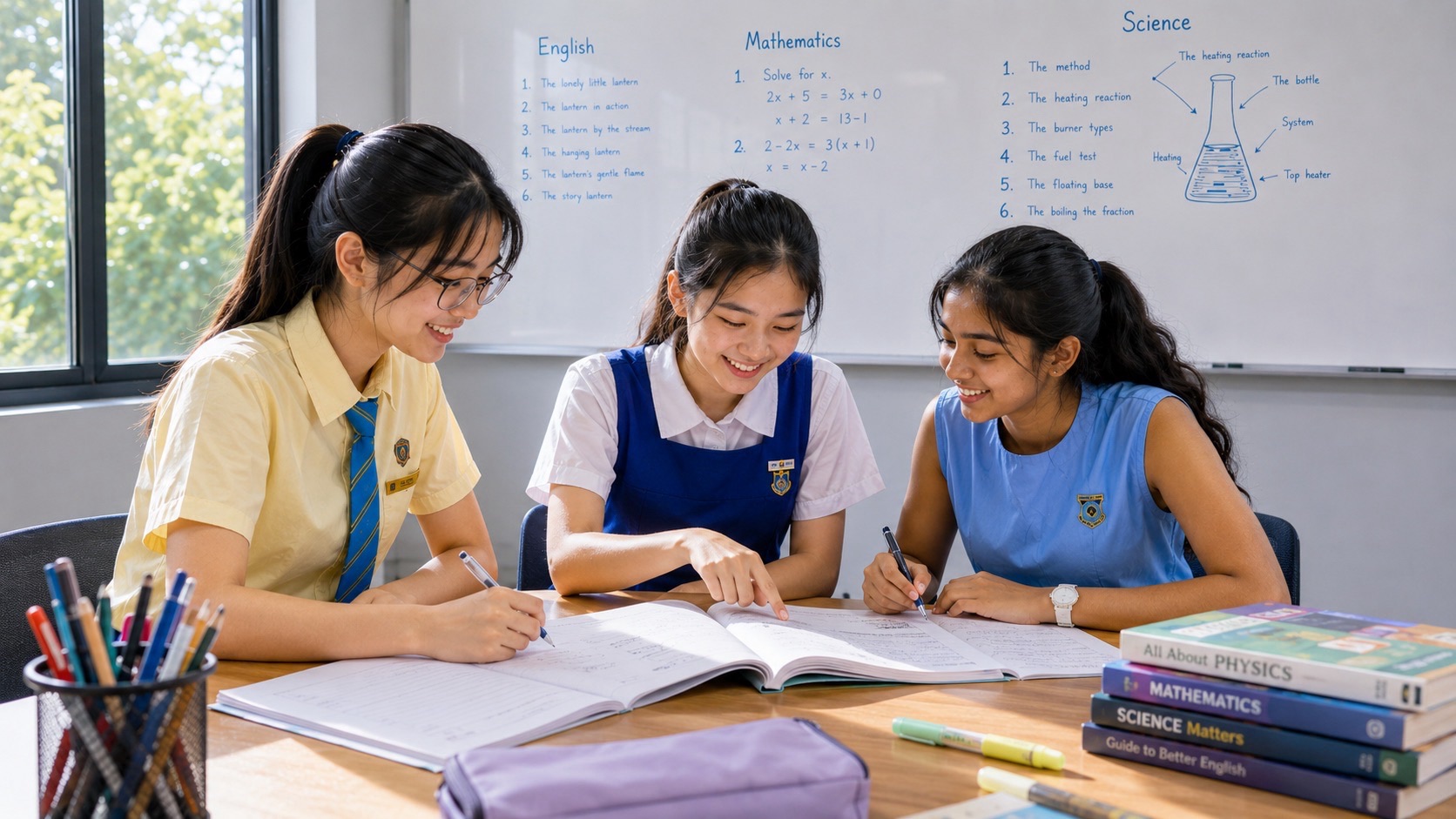
Secondary school small groups tuition in Punggol is available through eduKatePunggol, using a published tutorial format capped at three students for 1.5 hours. This guide helps parents navigate Secondary 1–4 English, Mathematics, Additional Mathematics and Science, understand which subject-level demands apply under Singapore’s Full Subject-Based Banding system, and identify the learning problem a small class should actually solve. Actual subject matching and current class openings must be confirmed with the centre.
From the 2024 Secondary 1 cohort, students learn under Full SBB and may take subjects at G1, G2 or G3 according to their school arrangements. In 2027, the Singapore-Cambridge Secondary Education Certificate (SEC) begins for the applicable graduating cohort. A Secondary 1 pupil in 2027 is not taking the final SEC that same year. A parent’s decision should therefore begin with the child’s actual school year, current subject levels and marked work, not a generic examination slogan or an assumption that every student must take the hardest available worksheet.
- **Punggol tutorial:** a maximum of three students, 1.5 hours weekly in the centre’s published model.
- **Subjects in this directory:** Secondary 1–4 English, Mathematics and Science, plus Secondary 3–4 Additional Mathematics.
- **Curriculum check:** Posting Group and individual G1/G2/G3 subject levels are not identical concepts.
- **The teaching aim:** diagnose, repair, practise, transfer and review an actual misconception or examination habit.
- **The right question:** which specific independent capability should be stronger after tuition?
Choose the exact Secondary 1–4 subject guide
- Secondary 1 English — reading becomes reasoning
- Secondary 1 Mathematics — arithmetic becomes algebra
- Secondary 1 Science — observation to investigation
- Secondary 2 English — repairing comprehension drift
- Secondary 2 Mathematics — equations, graphs and method choice
- Secondary 2 Science — systems and evidence
- Secondary 3 English — argument with evidence
- Secondary 3 E-Mathematics — connected upper-secondary methods
- Secondary 3 Additional Mathematics — algebra first
- Secondary 3 Science — Physics, Chemistry, Biology and inquiry
- Secondary 4 English — examination communication
- Secondary 4 E-Mathematics — accuracy and paper control
- Secondary 4 Additional Mathematics — calculus and algebra control
- Secondary 4 Science — Pure and Combined examination readiness
Secondary 1 English — reading becomes reasoning
Secondary 1 readers may be fluent in everyday English yet struggle to support an inference with a relevant detail. Longer passages and unfamiliar question demands make interpretation more important. A useful small-group lesson distinguishes vocabulary difficulty from weak evidence selection and helps a learner express a complete answer without adding irrelevant words.
The tutor can hear each child’s interpretation before showing a model response, then use a different passage to test transfer. Parents should bring marked comprehension and a short writing sample rather than assume the problem is simply a shortage of advanced vocabulary.
Secondary 1 Mathematics — arithmetic becomes algebra
The first year of secondary Mathematics introduces more abstract symbols, negative numbers, expressions and equations. A pupil who solved Primary 6 arithmetic confidently may find a familiar relationship harder when expressed as 3x = 21. The difficulty may be notation, algebraic rules or an earlier numerical prerequisite.
A tutor can ask the child to explain why an equation stays balanced when the same operation is applied to both sides. Changed questions show whether the reasoning has become independent, rather than merely a shortcut learnt from one worked example.
Secondary 1 Science — observation to investigation
The lower-secondary Science transition involves more explicit models, data, variables and experimental reasoning. A learner may name scientific ideas correctly but make unsupported claims about a graph or confuse observation with an explanation. The relevant teaching task is to identify the evidence and the conditions that make a conclusion defensible.
A small group can use safe diagrams and hypothetical investigations to compare interpretations, while each pupil receives targeted corrective practice. Parents should match the material to the school’s actual Science subject level and sequence.
Secondary 2 English — repairing comprehension drift
By Secondary 2, a student can appear comfortable reading while gradually losing accuracy through unsupported inference, weak vocabulary in context or incomplete written reasoning. The drift is easy to miss when individual answers are corrected without looking for a repeated pattern.
A tutor should compare several passages and identify what consistently fails: question interpretation, locating the relevant clue or connecting evidence to a claim. A fresh passage later shows whether the learner has learnt the process, rather than remembered one correct response.
Secondary 2 Mathematics — equations, graphs and method choice
Secondary 2 Mathematics draws connections between expressions, linear equations, ratios, graphs, geometry and other level-appropriate applications. The child may complete topical exercises easily but struggle when a mixed problem offers no chapter heading. This is a method-selection issue, not always a calculation problem.
The tutor can distinguish a learner who cannot manipulate an equation from one who cannot recognise when the equation is appropriate. Mixed practice should follow targeted repair, with each pupil required to explain their first useful step independently.
Secondary 2 Science — systems and evidence
Secondary 2 Science develops understanding of interacting systems and scientific models at a level suited to the school course. The learner may understand a familiar diagram but fail to interpret a changed graph or an experimental comparison. Science becomes more manageable when concepts are connected to the actual conditions and evidence.
A well-run tutorial asks pupils to separate what was measured from what is inferred and explains why a proposed conclusion is valid or unsupported. The class should develop inquiry rather than become a pile of memorised model answers.
Secondary 3 English — argument with evidence
At Secondary 3, writing increasingly requires deliberate control of purpose, audience, reason and evidence. A pupil can hold a sensible opinion but fail to support it with relevant examples or a coherent paragraph. Comprehension and summary tasks also require more precise selection and explanation.
A small-group tutor can let students compare defensible interpretations and practise acknowledging a reasonable alternative view. Individual written work then reveals whether the student can develop an argument on a new topic rather than reuse a memorised paragraph.
Secondary 3 E-Mathematics — connected upper-secondary methods
General Mathematics at Secondary 3 may combine algebra, functions, graphs, geometry and data. A student can be correct on a single-topic worksheet and uncertain when a different representation appears. A weak expansion or sign operation may damage several seemingly unrelated chapters.
The tutor should identify high-impact prerequisites and then practise choosing a method under mixed conditions. The actual G-level determines content depth, and E-Mathematics should be distinguished from the separate Additional Mathematics syllabus.
Secondary 3 Additional Mathematics — algebra first
Additional Mathematics places heavier demands on symbolic reasoning. Fractions, indices, surds, factorisation and function notation become important prerequisites for subsequent methods. A student may remember a formula yet cancel an algebraic term illegally or confuse an expression with an equation.
A tutor should repair the earliest invalid transformation before increasing speed. Learners need to know not only which algebraic operation to use but why it preserves the relationship. The exact upper-secondary subject offering and assessment expectations come from the school and official syllabus.
Secondary 3 Science — Physics, Chemistry, Biology and inquiry
Secondary 3 Science becomes more specialised, with Pure and Combined Science routes depending on school offerings. A pupil may lose marks through a Physics unit, a Chemistry symbolic step or a Biology explanation that names structures without linking them to their functions. These are different repair targets.
The tutor should first identify the student’s actual Science combination, G-level and school topics. A group of three can support common habits such as graph reading and evidence evaluation while still using subject-specific practice.
Secondary 4 English — examination communication
Final-year English readiness depends on writing for purpose and audience, interpreting unfamiliar texts, using language accurately and communicating appropriately in spoken tasks. A polished memorised essay may fail if it does not address the actual prompt. A tutor should diagnose the point at which the student’s response loses relevance or clarity.
Timed practice becomes useful once the skill is stable. The centre should match G1, G2 or G3 material to the pupil’s exact subject level and examination year, without promising that one template secures a particular grade.
Secondary 4 E-Mathematics — accuracy and paper control
A Secondary 4 Mathematics pupil may know every chapter individually but lose marks in mixed work because of method selection, signs, graph interpretation, units or time allocation. The tutor should use actual paper scripts to classify the error rather than issue another full paper before explaining the source of repeated losses.
A small group can offer quick diagnosis while each student works independently on a different weakness. The 2027 G3 Mathematics code is K310, while G2 and G1 have separate examination specifications. The exact student entry controls paper practice.
Secondary 4 Additional Mathematics — calculus and algebra control
Additional Mathematics revision may involve advanced algebra, trigonometry, calculus and other topics according to the syllabus and school sequence. A small sign error or wrong differentiation rule can carry through a long solution. Final-year support should identify such repeated high-impact mistakes and check the underlying principle.
The tutor can combine focused repair with mixed practice and controlled timing. The 2027 SEC G3 Additional Mathematics entry is K341; G2 also has a separate Additional Mathematics entry where offered. Students should work with the correct official subject and cohort, not an assumed old code.
Secondary 4 Science — Pure and Combined examination readiness
Science examination readiness depends on the actual Pure or Combined subject entry, retrieval of earlier topics, numerical accuracy, practical reasoning and evidence-based explanations. Physics, Chemistry and Biology share habits of careful data use but have distinct concepts. A generic science worksheet can be inappropriate for a learner’s actual combination.
A well-matched group should check what is taught and what is not required, then use targeted correction and unfamiliar retesting. Parents must confirm the current availability of their precise Science route rather than assume every combination has an open place.
Posting Groups and subject levels are different decisions
Posting Groups were introduced for secondary school admission under Full SBB. Once enrolled, pupils may study particular subjects at G1, G2 or G3 according to school arrangements and eligibility. A parent should not assume that a child’s Posting Group describes every subject they take or proves they need the same difficulty across English, Mathematics and Science.
A consultation should begin with the actual current subject levels and school programme. One student may need G2 Mathematics material and G3 English support, while another has a different combination. Teaching must adapt to the pupil rather than to a broad label.
What changed with Full Subject-Based Banding?
Full SBB began for the Secondary 1 cohort in 2024 and replaces the older Express, Normal (Academic) and Normal (Technical) stream labels as the organising framework. The national examination transition follows from 2027 for the relevant graduating cohort, with SEC subject levels replacing the corresponding GCE examination routes.
The change matters for tuition because an older workbook or website may use an earlier syllabus code or school-stream label. Such materials can still contain useful exercises, but the correct official curriculum determines the examination requirements. Parents should check the actual subject entry and year before relying on a familiar name.
The first useful diagnostic requires visible working
A learner’s overall mark cannot show whether a mistake arose from misunderstanding, execution or time pressure. The tutor should examine the original answer before correction. Which instruction did the child follow? What did they believe a number or word meant? Which relationship did they assume? Where did the first invalid step appear?
This process can look different across subjects. In English it may involve unsupported inference, in Mathematics an incorrect algebraic transformation and in Science a conclusion not justified by experiment data. A small group is valuable when those differences remain visible to the tutor.
Three pupils should not receive three copies of the same diagnosis
Imagine a group of three Secondary 2 pupils. One knows fractions but repeatedly drops negative signs. Another writes fluent English but cannot identify evidence for an inference. A third recalls Science definitions but confuses measured results with explanations. They share a year level, not a learning deficit.
Useful small-group tuition can include shared explanation and discussion, but each learner should receive a distinct next task. Parents can ask the tutor to name that task and the independent check that would show improvement. A smaller class without differentiated feedback is not automatically better than a larger well-taught class.
A ninety-minute lesson should include more than correction
A plausible tutorial begins with retrieval of a prior skill, reviews the current school error, teaches the underlying principle and moves into guided practice. Every student then attempts a changed problem without the model. The tutor uses that evidence to decide what practice is needed between lessons. The lesson should not end merely because a worksheet is marked.
The time balance can change with subject and examination proximity. Science may require graph analysis, English a writing conference and Mathematics a worked derivation. What matters is the learning loop of diagnosis, explanation, practice, transfer and review, not a rigid minute-by-minute script.
Why peer comparison helps some learners
Three pupils create opportunities to hear alternative explanations, detect a mistaken assumption and practise defending a choice. An English learner might compare two interpretations of a passage; a Mathematics learner might compare a bar model and algebraic method; a Science learner might explain why an experimental control matters.
Peer interaction is not always beneficial without supervision. A confident student can dominate, a shy pupil may stop speaking and competition can become stressful. A skilled tutor manages turn-taking, protects individual work and uses peer contributions selectively. Parents should ask what participation looks like for the specific child.
The Secondary 1 priority is transition, not maximum acceleration
Entering secondary school changes lesson pace, independence and subject language. A student may be capable but uncertain with algebra notation, inference-based comprehension or scientific variables. The useful first intervention is to make that new language intelligible and repair any prerequisite brought from Primary 6.
Racing ahead to upper-secondary examination questions can conceal the present difficulty. A tutor should first show that the child can keep up independently with the current school programme, then extend when readiness and interest justify it. A calm transition is a valuable achievement.
The Secondary 2 priority is preventing drift
By Secondary 2, some learners can complete familiar homework while gradually losing accuracy in mixed problems. Repeated signs, incomplete paragraphs or experimental reasoning errors may become habits unless identified early. A tutor should compare work across several weeks rather than react to one unexpected mark.
The benefit of a focused repair is greatest when it reappears correctly in a changed context. A corrected equation copied once is weak evidence; a fresh equation solved alone after a delay is stronger evidence. The same principle applies to comprehension and Science.
The Secondary 3 priority is managing deeper content
Secondary 3 often introduces a greater breadth or depth of material and may include more specialised subject combinations. A student who was comfortable in lower secondary can suddenly need more deliberate note organisation, concept maps and practice with longer reasoning chains. The right small-group lesson follows the selected school subjects rather than treating every student as a Pure Science or Additional Mathematics candidate.
Parents should ask which content is part of the current syllabus and which is optional extension. Doing the wrong difficult work consumes time without improving the required skill. Specific diagnosis protects both learning and motivation.
The Secondary 4 priority is making knowledge available under conditions
Final-year readiness requires retrieval, accurate execution, strategy choice and time control across a full syllabus. Some pupils need conceptual repair before timed work; others understand the content but lose marks through incomplete checking or poor pacing. The teacher should analyse real scripts to separate these cases.
Full-paper practice is useful when the results drive a precise next lesson. A score by itself is not a plan. More practice papers that repeat an unresolved mistake can create busyness without progress. The goal is a controlled move from topical mastery to unfamiliar mixed questions and realistic examination conditions.
English support should address the communication process
Students often describe themselves as weak in English without knowing whether the issue is reading comprehension, writing organisation, vocabulary, grammar, summary or oral confidence. Those capabilities overlap but do not always fail together. A child may speak fluently yet write an unsupported paragraph.
A tutor can compare an oral explanation with the written response and ask whether the student’s intended meaning reached the reader. The next task can then target the actual missing step. Learning more sophisticated words is not a universal remedy for weak reasoning or irrelevant evidence.
Mathematics support should address method and representation
A student may know an algorithm but fail to recognise the problem it belongs to. Another chooses the correct method but loses a negative sign. A third uses accurate calculations to answer a different quantity from the one asked. These are separate mathematical processes, and each deserves a targeted repair.
A tutor should teach students to identify what is known, what is unknown and which relationship is valid before computing. The method then needs to survive a changed task without a chapter heading. Reliable mathematical thinking is more useful than permanent dependence on tutor prompts.
Science support should respect the subject combination
Upper-secondary Physics, Chemistry and Biology have distinct scientific mechanisms, calculations and practical expectations. Combined Science pairings differ from Pure Science subjects. The tutor should choose work that matches the student’s actual entry and should not assume the presence of the word Science makes every question relevant.
Shared inquiry habits remain valuable: read the data, identify a variable, distinguish observation from inference and explain the mechanism. These can be practised across subjects, but accurate subject content must remain central. A group of three benefits from targeted matching, not interchangeable workbooks.
What the SEAB 2027 code directory actually establishes
The SEAB 2027 school-candidate listings name subjects at G1, G2 and G3. For example, G1 English is K100 and Mathematics K110; G2 English is K200 and Mathematics K210; G3 English is K300 and Mathematics K310. Science entries and Additional Mathematics differ by level and subject offering. Codes must not be applied to the wrong cohort.
A G1 school-candidate list should not be read as if it includes every G2 or G3 subject. The actual SEC 2027 G1 directory does not list a general Science examination entry alongside its English and Mathematics entries. Always follow the subject list, rather than assuming a universal G1/G2/G3 Science examination for every pupil.
A four-week programme review needs a narrow target
Week one identifies an error from the pupil’s actual work. Week two repairs the underlying concept or language process. Week three changes the example and removes some prompts. Week four checks an independent response and asks whether the original difficulty has improved. This makes learning visible before an entire school grade is reconsidered.
The review is not a guarantee of a specific result. School tests sample multiple topics and can be affected by pressure, health and conditions. The honest question is whether one defined learning decision has become more reliable. A tutor should be able to explain that with an example.
Eight to twelve weeks: is the learner becoming more independent?
A useful longer review checks delayed recall, unfamiliar application and the ability to notice mistakes without the tutor indicating them. In English, that might be selecting an inference from a new passage; in Mathematics, choosing the correct method from a mixed set; in Science, evaluating an unseen experiment.
If the learner still needs the same first hint every week, the programme should be adjusted. The missing piece may be a prerequisite, language issue or unsuitable pace. A good small group has enough individual visibility to detect that problem rather than continue indefinitely with the same practice routine.
When one-to-one help or school support may be preferable
Some students need sustained foundational instruction before they can access a shared group task, while others find peer discussion unhelpful or stressful. A child making consistent independent progress may need no additional tuition. These possibilities should be considered honestly during consultation rather than treating every parent enquiry as a reason to enrol.
The right comparison is educational fit, time, cost and wellbeing. A three-student group offers a useful balance for many learners but cannot be declared universally superior to every other arrangement. The outcome should be a better-supported child, not a particular seating plan.
The timetable and commute influence actual learning
Punggol students often balance schoolwork, CCA, travel, homework, meals and sleep. A tutorial that appears convenient on paper may become exhausting if it creates a rushed transition between commitments. Parents should check the real available class time and the amount of focused home practice expected.
More hours are not automatically more effective. A small, specific task revisited after a few days may produce better insight than another long unexamined packet. The weekly routine must leave space for independent retrieval and recovery, not only scheduled instruction.
A parent consultation should end with a defined hypothesis
Bring a marked English paragraph, Mathematics problem or Science question and ask the tutor to identify the earliest mistaken decision. A good explanation might be that the child can expand brackets but selects the wrong method in a story problem, or understands a passage but cannot support an inference. Such a diagnosis can be tested.
Ask what a suitable group would do next, how individual targets are recorded and how a fresh task would demonstrate improvement. The consultation should also address current fees, subject availability and timetable. Clear evidence is a more useful basis for enrolment than an examination-grade promise.
How this site should function as a learning library
Use the links at the top to locate the child’s exact subject and level. A Secondary 4 Mathematics parent should begin with the final-year paper-control guide, while a Secondary 1 English parent should begin with the reading-to-reasoning guide. If the difficulty reveals an earlier prerequisite, follow the earlier-year link rather than jumping into unrelated pages.
The purpose of this hub is connected navigation. It does not replace the detailed subject guide or the official syllabus. It directs the reader to the next useful explanation, and ultimately to a consultation only when the family has identified a learning need worth discussing.
A parent checklist before choosing a Secondary small group
- Confirm the child’s year, actual G-level subject arrangements and relevant examination cohort.
- Separate Maths, Additional Maths, English and Science into their correct subject routes.
- Bring real marked work and identify the first mistaken step before seeing the answer key.
- Ask how three learners are matched and how individual feedback is delivered.
- Look for changed, unfamiliar and delayed tasks after guided examples.
- Check current seats, fees, lesson times, travel and home practice requirements.
- Protect sufficient sleep, school participation and time for the child’s interests.
- Agree on a review based on independent improvement, not a guaranteed A1 or SEC outcome.
Frequently asked questions
Does eduKatePunggol have small-group tuition in Punggol?
Yes. The published service model is a maximum of three students in 1.5-hour tutorials. Specific subject offerings, group matching, fees and current openings should be confirmed directly.
What is Full Subject-Based Banding?
Full SBB gives students more flexibility to study subjects at G1, G2 or G3 levels according to their arrangements and eligibility, replacing the previous organising academic streams for the applicable cohorts.
Is Posting Group the same as a subject’s G-level?
No. Posting Groups concern secondary school admission, while G1, G2 and G3 refer to subject-level study. A learner’s subjects may be taken at different levels.
When do the SEC examinations begin?
The Singapore-Cambridge Secondary Education Certificate begins in 2027 for the graduating cohort covered by Full SBB. Do not apply a 2027 code to a different examination year without checking.
Does every level offer the same Science subjects?
No. Consult the exact SEAB school-candidate list. The G2 and G3 listings include named Science combinations, while the 2027 G1 list should not be assumed to include the same entries.
Is E-Mathematics the same as Additional Mathematics?
No. They are separate curricular and examination routes. A child may take one or both subject types depending on school arrangements; diagnose their work separately.
Can three students improve faster than a larger class?
It can be easier for the tutor to notice individual work and provide feedback, but no headcount guarantees better outcomes. Teaching quality and suitability matter.
Should a Secondary 1 pupil be doing SEC final papers?
Not routinely as the main curriculum. The student first needs secure foundations and current school learning. Examination awareness can be introduced progressively without replacing core understanding.
Why do topical worksheets not translate to strong exams?
Topical headings cue the method, while mixed papers require independent recognition and selection. A tutor should introduce unfamiliar mixed problems after repairing the underlying technique.
What is a useful 1.5-hour lesson?
A lesson that includes diagnosis, clear explanation, guided practice, individual correction and an independent changed task. The exact allocation depends on the subject and child’s needs.
Should every Secondary pupil take tuition?
No. Some pupils progress effectively with school and independent practice, while others need targeted or individual support. The decision should address a real problem.
How should parents measure improvement?
Track a repeated error and retest it independently in a new context after a delay. School grades are relevant but do not isolate the effect of one teaching repair.
Can tuition guarantee future G-level progression?
No. School subject-level arrangements and progression depend on official criteria and the student’s readiness. Tuition can strengthen learning but cannot guarantee a school decision.
Where do we begin?
Choose the linked subject-year guide and bring representative marked work to a consultation if the family wants a specific diagnosis and suitability discussion.
Official sources and Punggol tuition starting points
- What is Small Groups Tuition? — full teaching-environment comparison.
- Tuition at eduKatePunggol — local service and consultation.
- Small Groups Tutorials reference — the immutable first-principles model.
- MOE Full SBB and SEC transition information — official policy explanation.
- MOE Secondary curriculum — course and subject context.
- SEAB 2027 G1 school-candidate syllabuses — the exact offered subjects.
- SEAB 2027 G2 school-candidate syllabuses — the correct subject codes.
- SEAB 2027 G3 school-candidate syllabuses — the correct subject codes.
Parent case: distinguish subject level from the tutoring problem. Imagine a Secondary 2 pupil studying English at G3 and Mathematics at G2. The family might describe the student using one Posting Group, but the actual English and Mathematics requirements are not necessarily the same. A tutor must first confirm the current subject-level arrangements from the school, then examine a piece of relevant work. If the learner misreads the scale of a G2 Mathematics graph, the immediate task is reading axes and checking how measured quantities relate. Assigning an unrelated G3 worksheet is not evidence of better teaching. Equally, a polished English composition cannot show that a mathematical dependency is secure. A small group is useful when the tutor can notice these differences and set a distinct next task for each learner. The family should agree on a changed independent problem for the review date, not a promised subject-level progression. Parents coming from Primary 6 can use the Primary School Small Groups Tuition guide to identify earlier literacy, numeracy and scientific-thinking foundations. As the student matures, those foundations should support more independent work, while actual syllabus and pathway decisions remain with the school and the relevant MOE/SEAB rules.
Editorial note (5 November 2026): This is an independent tuition and curriculum navigation article, not an MOE or SEAB publication. The SEC subject codes refer to the SEAB 2027 school-candidate listings. Availability of individual subjects or a place in a particular three-student class cannot be inferred from this general guide, and tuition results are not guaranteed.


