
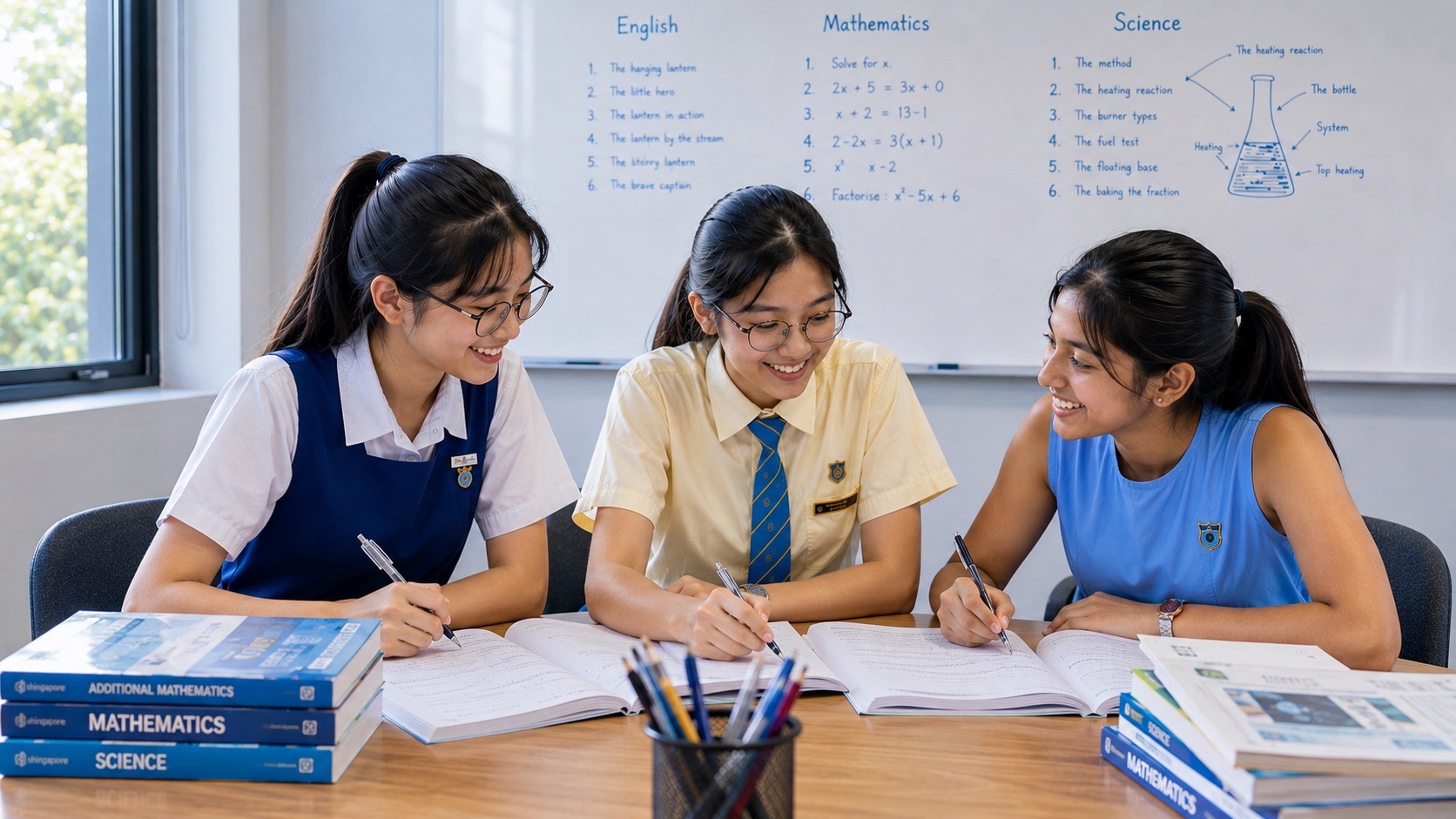
Secondary 2 G1 Mathematics tuition in Punggol should help a pupil connect number sense, ratios, percentages, rates, algebra, graphs and practical geometry rather than complete repeated worksheets without understanding. eduKatePunggol offers small-group tutorials with a maximum of three learners, normally lasting ninety minutes. A tutor can inspect each child’s first mathematical decision, explain the missing relationship and ask for a different independent problem to test whether the principle has transferred.
Under Full Subject-Based Banding, G1 Mathematics is the pupil’s actual subject level, not a description of every subject they take. Secondary 2 students in 2026 are assessed at school; the published 2027 SEC G1 Mathematics K110 paper is an end-of-secondary reference for that cohort, not a national exam sat in Secondary 2. The current school’s topics, the child’s first working and the need for sustainable practice should guide extra tuition.
Quick answers for parents in Punggol
- G1 Mathematics has a distinct syllabus and includes meaningful number, ratio, algebra, measurement and data applications.
- A Secondary 2 pupil follows the school’s actual subject-level curriculum; the 2027 K110 examination scheme is not a Sec2 national paper.
- The published 2027 K110 final assessment is two 90-minute, 50-mark papers, equally weighted; approved calculators can be used.
- The small-group benefit comes from individual first-attempt diagnosis, focused correction and new independent practice.
- Parents should evaluate specific progress, class matching and wellbeing rather than assume three seats guarantee results.
Read by need: MOE/SEAB syllabus · Why small groups? · 30 teaching examples · 90-minute class · Parent questions · FAQs · Sources
The G1 Mathematics learning route and the child’s school year
SEAB’s K110 syllabus has three strands: Number and Algebra, Geometry and Measurement, and Statistics and Probability. Its assessment objectives include standard techniques, solving problems in practical contexts and mathematical reasoning. Those ideas remain valuable at Secondary 2, but the final syllabus and paper scheme are not a promise that every chapter is taught at a particular term or tested identically by every school.
The published 2027 Paper 1 brings together Number and Algebra with Geometry and Measurement; Paper 2 covers Number and Algebra together with Statistics and Probability. Both last one hour thirty minutes and carry fifty marks, equally weighted. Each has short-answer tasks followed by longer questions built around contexts. Essential working remains important, despite calculator permission. These figures describe the 2027 graduating examination, not a current Secondary 2 school assessment.
| 2027 G1 Mathematics K110 | Time | Marks | Weight |
| Paper 1 — Number/Algebra and Geometry/Measurement | 90 minutes | 50 | 50% |
| Paper 2 — Number/Algebra and Statistics/Probability | 90 minutes | 50 | 50% |
A tutor should ask which G1 Mathematics chapters have actually been taught and where the student became confused. For example, a child learning linear equations may need to revisit subtraction with negative numbers. A learner studying graphs may need to check ordered coordinates before gradient. This is purposeful prerequisite teaching, not a sign that the pupil has failed an entire subject.
Official 2027 G1 Mathematics K110 syllabus · 2027 G1 school subject index · Punggol Secondary 1 G1 Maths guide.
The problem is often meaning, not speed
Secondary 2 pupils start to see a mathematical relationship in several forms: a bar, an equation, a coordinate graph and a practical story. A wrong answer can arise from confusing the two parts of a ratio with the whole or interpreting 3x as x+3. Another student might know a formula but apply it to the wrong quantity. A useful tutor asks what each symbol represents and why the proposed operation would answer the question before assigning extra practice.
The strongest evidence comes from transfer. After a correction, change the context or required unknown and remove the worked example. If the student still selects a correct method and checks it, the concept is beginning to become independent. Return later with another changed question to see if it is retained, rather than relying solely on an immediate perfect copy.
What a group of up to three can add
Three learners can present alternative methods and expose different misconceptions while allowing the tutor to see each person’s first response. One pupil may use a number line, another draw a ratio bar and the third verify by inverse calculation. These methods create discussion, but group agreement is not evidence that everyone can solve the next problem alone. Independent work must begin and end the lesson.
- Collect the pupil’s original method before revealing a model solution.
- Identify exactly where a quantity, sign, unit or assumption was misunderstood.
- Use a small diagram or near-miss contrast to explain why the method changes.
- Allow peer comparison without making the fastest student the group’s permanent answer supplier.
- Set changed individual problems to test transfer after guided work.
- Return to the concept later to check whether it was retained.
- Review workload, compatibility and whether tuition remains necessary.
Other formats can be appropriate. Some pupils learn securely through school and home practice without extra tuition; others require prolonged individual support. A class of three is not a scientifically guaranteed optimum, and no tutoring provider can promise an eventual SEC grade. Ask about actual class matching and feedback rather than relying on the number of chairs.
The four-stage repair loop
Diagnose the first step
Start with an original school question. Ask what the pupil believed was given, what was unknown and why they chose a particular operation. A sign error, a quantity-choice error and a comprehension mistake need different teaching. ‘Careless’ is not a sufficiently precise diagnosis.
Explain the condition with contrast
Compare a percentage part with an original price, a boundary with an interior area, or 3x with x+3. Ask what changed and why the previous method cannot be reused unchanged. This teaches the limit of a rule rather than a chant.
Remove the model
Give an unfamiliar question with changed numbers, labels, orientation or unknown. Every learner should solve it independently. If the same prompt remains necessary, the tutorial should revise the explanation instead of adding paper volume.
Retest after a delay
Revisit the idea during a later mixed task. If the corrected habit is stable, offer more complex application or less help. If the earlier error returns, check a missing prerequisite. A concise ledger of first error and later response supports useful parent feedback.
Thirty G1 Mathematics misconceptions with targeted explanations
1. Negative-number comparison
Original mistake. A learner decides −8 is greater than −3 because eight is greater than three, forgetting that both positions lie to the left of zero.
How to explain it. Draw a horizontal number line with zero in the middle. Negative eight lies farther left and is therefore smaller than negative three. Distance from zero is magnitude, not the same thing as signed order.
Three-person tutorial use. The tutor collects three initial orders of signed values, asks each pupil to justify one placement and uses their different assumptions to decide whether the problem is notation or number sense.
Unseen transfer test. On a changed set −9, −2, 0 and 4, each pupil orders the values independently and explains why −9 comes first.
Important condition. Avoid teaching only a slogan about bigger digits. The student should be able to locate a new negative decimal and fraction too.
2. Subtracting a negative
Original mistake. A child calculates −4−(−7)=−11 because all printed minus signs appear to mean moving left.
How to explain it. Subtracting −7 is the same as adding +7, so the result is 3. Show the motion on a number line and verify by adding the opposite of the subtracted quantity.
Three-person tutorial use. Each learner offers a number-line explanation, equivalent symbolic form or numerical check, then receives a different problem without the model.
Unseen transfer test. Compute −6−(−2)=−4 and explain the direction of change from −6.
Important condition. The correct operation is meaningful; blindly changing every pair of signs can cause new errors.
3. Four operations with negative fractions
Original mistake. The student writes −1/2+1/4=−2/6, adding the denominators even though the pieces have different sizes.
How to explain it. Convert −1/2 to −2/4, then add a quarter to get −1/4. A fraction strip or labelled number line shows that the result is still negative.
Three-person tutorial use. The tutor has pupils explain equal-sized pieces, the sign and the final point on a number line, with each attempting a new question on paper.
Unseen transfer test. Solve −3/4+1/2=−1/4 without looking at the original quarters example.
Important condition. A fraction algorithm should preserve the size of the whole and the sign.
4. Prime numbers versus prime factors
Original mistake. A pupil assumes prime factorisation is compulsory because they have seen a factor-tree worksheet from a different G level.
How to explain it. The G1 K110 number strand includes prime numbers but expressly excludes prime factorisation as a required topic. Explain that 2, 3 and 5 are primes, whereas one is not; follow the school’s taught content.
Three-person tutorial use. Each pupil identifies primes in a small set and explains why a tempting composite does not qualify before new examples.
Unseen transfer test. Choose primes from 1,2,9,11,15,17 and give a factor-based reason for rejecting 9.
Important condition. More advanced practice is optional enrichment, not a reason to ignore actual G1 priorities.
5. Square root and equation solutions
Original mistake. The pupil writes √49=±7 because they confuse the principal square-root value with an equation.
How to explain it. The notation √49 means the nonnegative principal root, seven. The equation x²=49 has solutions +7 and −7 because both square to 49.
Three-person tutorial use. One student evaluates the expression, another solves an equation and the third checks by substitution; then all respond to new values.
Unseen transfer test. Evaluate √64=8 and separately solve y²=64 as ±8.
Important condition. The same numbers can yield different answer sets when the mathematical question changes.
6. Significant figures
Original mistake. A child rounds 0.006784 to two significant figures as 0.00, counting leading zeroes as significant.
How to explain it. Locate the first nonzero digit: six. The next digit seven is the second significant digit, and the following eight rounds it up, so 0.0068.
Three-person tutorial use. Each pupil marks significant digits in a different measurement and explains which digit controls rounding.
Unseen transfer test. Round 0.004365 to two significant figures as 0.0044, with a reason.
Important condition. Do not confuse two significant figures with two decimal places.
7. Estimation before calculator work
Original mistake. The learner accepts 49×21=10,290 without noticing the misplaced zero because the calculator display was copied uncritically.
How to explain it. Estimate 50×20≈1000, and verify exactly that 49×21=1029. An approximate size check is a fast way to catch implausible results.
Three-person tutorial use. The group compares an estimate, written multiplication and a calculator verification, then every pupil checks an unseen product.
Unseen transfer test. Estimate and calculate 38×24=912, explaining why an answer of 9120 would be implausible.
Important condition. Estimation supports checking but does not replace an exact answer when one is required.
8. Part-to-part versus part-to-whole ratio
Original mistake. A student treats the first term in 3:2 as three halves of the total, rather than three of five equal units.
How to explain it. A total of 75 shared in ratio 3:2 has five parts of 15; the shares are 45 and 30. The first share is 3/5 of the whole but 3/2 of the second.
Three-person tutorial use. One learner sketches five units, a second labels the parts and a third checks the total; all then solve a changed story alone.
Unseen transfer test. Split 96 in ratio 5:3 into 60 and 36 and identify which named group receives each amount.
Important condition. Ratio values must be tied to their named quantities or a perfectly calculated answer can be mislabelled.
9. Decimal ratios
Original mistake. The student assumes 0.5:1.5 cannot be simplified because the terms are decimals.
How to explain it. Multiply both terms by two to obtain 1:3, maintaining the same comparison. A ratio is not a sum of the two amounts.
Three-person tutorial use. Each pupil uses multiplication, a fraction representation or an equality-of-ratios check on different examples.
Unseen transfer test. Simplify 1.2:1.8 to 2:3 without a model.
Important condition. Scaling both terms is valid; changing only one term alters the ratio.
10. Percentage and its base
Original mistake. A learner says 10 of 40 pupils equals 40%, reversing the part and the whole.
How to explain it. The percentage is 10/40×100%=25%. Identify which number represents the complete surveyed group before calculating.
Three-person tutorial use. The tutor asks all three students to mark the total and selected category in different simple class surveys.
Unseen transfer test. In a new survey, 18 out of 60 is 30%, with 60 clearly labelled as the whole.
Important condition. A percentage must be associated with a specified reference quantity.
11. Discount amount versus payable price
Original mistake. The child reads a 20% discount on a $50 item and reports that the final price is $10.
How to explain it. Twenty percent of fifty is ten dollars off, not the amount payable. The new price is $40. Show original amount, change and remaining amount in a bar.
Three-person tutorial use. Each pupil identifies one of those three quantities and then independently completes a different purchase story.
Unseen transfer test. A $60 item with a 25% discount costs $45 after a $15 discount.
Important condition. The word discount can ask for either the reduction or the final amount; read the question carefully.
12. Reverse percentage
Original mistake. A pupil uses the final price $72 as 100% even though it is after a 20% reduction.
How to explain it. The final amount represents 80% of the original, so the original is $72÷0.8=$90. Check that a $18 reduction produces the given final price.
Three-person tutorial use. One student draws a full 100% bar, another writes the inverse equation and the third verifies, then all work a changed item.
Unseen transfer test. If 75% of the original is $60, the original is $80.
Important condition. The reference base is the key mathematical decision, not a calculator shortcut.
13. Rates and unit labels
Original mistake. A child divides the number of notebooks by total price and labels the numerical result as dollars per book.
How to explain it. At three notebooks for $12, price per book is $12÷3=$4. The unit should be dollars per book, so the division order matters.
Three-person tutorial use. Each student states a unit, performs the corresponding calculation and checks reasonableness on a fresh context.
Unseen transfer test. Five notebooks costing $35 have a unit rate of $7 each.
Important condition. A number with the wrong compound unit answers a different question.
14. Speed and time conversion
Original mistake. The learner calculates a rate using minutes with kilometres per hour but never converts the time.
How to explain it. Thirty minutes is half an hour, so travelling at 60 km/h for that duration covers 30 km. State the unit of every quantity.
Three-person tutorial use. The three students check initial unit, conversion and final distance separately before an individual changed problem.
Unseen transfer test. At constant 40 km/h for 45 minutes, the distance is 30 km.
Important condition. Average speed and constant speed are different models; use the context supplied.
15. Average speed for unequal stages
Original mistake. The pupil averages 40 and 60 km/h to get 50 km/h despite spending different times at each rate.
How to explain it. For one hour at 40 and two hours at 60, total distance is 160 km over three hours; average speed is about 53.3 km/h.
Three-person tutorial use. Each learner calculates one leg, totals the journey or interprets the result and then applies the method to a new timetable.
Unseen transfer test. For two hours at 30 and one at 60, the overall average is 40 km/h.
Important condition. An unweighted mean of speeds is not always the journey average.
16. Algebra: 3x versus x+3
Original mistake. A child sees 3x and says it means three more than x, importing an arithmetic story into multiplication notation.
How to explain it. Explain 3x as three times x. With x=4, the results of 3x and x+3 are 12 and 7, so they cannot be equivalent.
Three-person tutorial use. The tutor asks pupils to create a shopping example, substitute a value and then read a different algebraic statement.
Unseen transfer test. Write the cost of five identical items priced y dollars as 5y, not y+5.
Important condition. A letter represents a quantity and the operation attached to it matters.
17. Squares versus doubling
Original mistake. The student writes x²=2x as though squaring is equivalent to multiplying by two.
How to explain it. For x=4, x² is 16 but 2x is 8. Explain square as a product of two identical factors and check with negative values too.
Three-person tutorial use. Each pupil uses a small square diagram, multiplication expression or numerical test before unseen algebra.
Unseen transfer test. For x=−3, x² is 9 and 2x is −6.
Important condition. The apparent agreement at one special value would not establish identity for all x.
18. Collecting like terms
Original mistake. The pupil combines 2x+3x² as 5x³ because the letter matches.
How to explain it. Terms combine under addition when the variable and its power match. 2x and 3x² are unlike; 4a−2a+3b=2a+3b.
Three-person tutorial use. The group sorts terms by structure, explains one match and independently simplifies unfamiliar expressions.
Unseen transfer test. Simplify 5y²−2y²+y as 3y²+y.
Important condition. The arithmetic coefficients cannot change the power of the variable.
19. Distribution with negative signs
Original mistake. The student expands −2(3x−5) as −6x−10 and overlooks the second negative product.
How to explain it. Distribute the factor over both terms: −6x+10. With x=1 both original and transformed values are four.
Three-person tutorial use. Each learner identifies a sign, explains the distributive property and tests equality with an unfamiliar example.
Unseen transfer test. Expand −3(2x−4) as −6x+12.
Important condition. A transformation should preserve the value of the whole expression.
20. Solving a linear equation
Original mistake. The child ‘moves’ positive terms across the equals sign without a balanced operation or check.
How to explain it. From 3x+4=19, subtract four on both sides, then divide by three to get x=5. Substitute to confirm 19.
Three-person tutorial use. One learner explains each inverse operation and another verifies before every pupil solves a fresh equation.
Unseen transfer test. Solve 5x−7=18 and confirm x=5 in the original.
Important condition. The equal sign describes a relationship, not an arbitrary movement rule.
21. Ordered coordinate pairs
Original mistake. A student plots (2,5) as (5,2), reading coordinate order as interchangeable.
How to explain it. The first coordinate describes horizontal x and the second vertical y. Plot both possibilities to show why they differ.
Three-person tutorial use. The pupils each draw or name a separate coordinate, then complete new grid questions without prompts.
Unseen transfer test. Locate (−3,2) in the upper-left quadrant and explain both signs.
Important condition. A plotted diagram must use correctly labelled axes and scale.
22. Linear graphs and intercept
Original mistake. The pupil assumes every equation y=2x+1 passes through zero, ignoring the added constant.
How to explain it. At x=0, y=1; at x=2, y=5. Make a table and plot the points to show the line’s intercept.
Three-person tutorial use. The group divides table, graph and equation checks, followed by independent work on a changed equation.
Unseen transfer test. For y=−x+3, identify y-intercept 3 and a decreasing line.
Important condition. The graph and equation must represent the same relation.
23. Gradient is change, not height
Original mistake. The learner sees a point with y=7 and calls the gradient seven.
How to explain it. For points (1,3) and (3,7), gradient=(7−3)/(3−1)=2. Explain vertical change per horizontal unit.
Three-person tutorial use. Each pupil checks a different point pair and answers a new graph without tutoring hints.
Unseen transfer test. A line through (0,1) and (4,9) has gradient two.
Important condition. Always read axis scale and units before interpreting slope.
24. Area versus perimeter
Original mistake. The pupil multiplies 7 by 5 to answer how much ribbon is needed around a rectangular display.
How to explain it. A 7 cm by 5 cm rectangle has area 35 cm², but its boundary is 2(7+5)=24 cm. Define the requested object before choosing the formula.
Three-person tutorial use. Each learner identifies a quantity, illustrates it and independently works a changed practical context.
Unseen transfer test. A 9 cm by 4 cm rectangle has area 36 cm² and perimeter 26 cm.
Important condition. A mathematically correct computation can still answer the wrong measurement.
25. Angles on straight lines
Original mistake. The child calls two adjacent angles equal solely because they appear similar in a rough drawing.
How to explain it. Angles that form a straight line sum to 180°. If one is 65°, the adjacent angle is 115°. Give the reason explicitly.
Three-person tutorial use. Each learner marks a different geometry condition before an unfamiliar diagram.
Unseen transfer test. A straight-line pair with 120° has the other angle 60°.
Important condition. A diagram may not be drawn to scale.
26. Scale in a statistical graph
Original mistake. The student says one bar is twice as large as another because the graphic looks twice as tall, overlooking a truncated axis.
How to explain it. Read the tick labels and compare plotted values, not visual height alone. An abbreviated axis can magnify apparent differences.
Three-person tutorial use. Three learners separately inspect title, units and axis origin before responding to a new display.
Unseen transfer test. An unfamiliar bar chart starting above zero is interpreted using actual numerical values.
Important condition. A visually dramatic difference is not necessarily a large numerical change.
27. Mean from a frequency table
Original mistake. The pupil adds scores once each rather than weighting them by their occurrence count.
How to explain it. For scores 2 and 4 with frequencies 3 and 2, total is 3×2+2×4=14 over five observations, so mean 2.8.
Three-person tutorial use. One learner calculates weighted sum, another total frequency and the third interpretation, then all work new tables.
Unseen transfer test. For scores 1,3 with frequencies 2,4, mean is (2+12)/6=7/3.
Important condition. A frequency is a count, not the value being averaged.
28. Probability with a fair die
Original mistake. The learner assumes any named event has chance one-half because there are only two labels in the question.
How to explain it. List equally likely possible outcomes first. A fair die has six faces; three even faces give probability 3/6=1/2.
Three-person tutorial use. Each student enumerates different simple sample spaces and checks an unfamiliar event.
Unseen transfer test. Probability of rolling a six on a fair die is 1/6, not 1/2.
Important condition. Equal likelihood is an assumption about outcomes, not labels.
29. Choosing the next G1 skill
Original mistake. The learner completes familiar drill accurately but waits for the tutor to say ‘this is a ratio question’ before starting an unfamiliar story.
How to explain it. Ask the student to identify the unknown, relevant quantities and relationship before naming the chapter. A small contrast helps develop method selection.
Three-person tutorial use. The group compares first attempts without prompting one pupil to supply the method for everyone.
Unseen transfer test. A fresh mixed word problem is begun independently with an appropriate calculation and unit.
Important condition. A small class should create self-direction, not permanent reliance on topic hints.
Two close-up teaching scenarios
The wrong share in a ratio task
A Secondary 2 learner divides 75 counters in the ratio three red to two blue and says that the red group contains three halves of the total. The tutor asks how many units make the whole, then uses five groups of fifteen to get forty-five red and thirty blue. Peers check the picture and arithmetic, but every student later solves a different ratio independently. This is an illustrative class scene, not a testimonial about a named child.
The algebraic operation chosen without meaning
Another pupil writes 3x as x+3 in a word problem involving three identical purchases. The tutor substitutes x=4 and compares the values: the required cost is twelve, not seven. The child builds an original shopping expression, then solves a new story with a changed number of items. This is the kind of reasoning repair that can improve many related algebra questions.
What a ninety-minute small-group class might contain
| Illustrative minutes | Learning evidence |
| 0–10 | Unaided retrieval of a previously corrected idea |
| 10–25 | Read actual schoolwork and locate the first mistaken step |
| 25–45 | Teach a focused model or contrast and explain its validity |
| 45–65 | Individual practice with short managed peer comparison |
| 65–80 | Fresh unfamiliar problem without the previous model |
| 80–90 | Self-check, progress note and a manageable new task |
This timetable is an example rather than a fixed guarantee. A learner with fragile number sense may need longer on a concrete model; another may be ready for an unfamiliar graph or practical application. The tutor should keep each member engaged while giving individual feedback. A group of three watching one model calculation for most of ninety minutes would waste the opportunity for closer teaching.
An eight-week review rather than a grade promise
In weeks one and two, diagnose current school errors in number, ratio, percentages, algebra and graphical interpretation. Weeks three and four can repair one or two repeated misunderstandings through contrast and changed problems. Weeks five and six link those skills to the actual next school chapter and ask for independent explanations. Weeks seven and eight return to the original errors after a delay and evaluate whether the student now selects methods without hints. The stages are illustrative and should be adapted, not marketed as a guaranteed score increase.
A useful note can state: ‘Previously treated the discounted price as the original whole; now recovers the original on two new problems and checks the result.’ This gives parents a concrete skill to inspect. Test scores can vary with paper difficulty, so a changed independent response is valuable evidence beyond one total mark.
Six deeper decisions for families
Why Secondary 2 is the right time to connect representations
A pupil may understand a percentage in a bar diagram but not in a price story, or solve an equation yet not recognise its graph. Secondary 2 can develop connections across representations while the school still assesses learning in manageable units. The tutor should begin with the pupil’s actual scheme of work and choose one mathematical relationship that appears in two different forms. Then present a fresh context without naming the chapter. The point is not simply to accelerate towards the 2027 national paper. A Secondary 2 student in 2026 ordinarily graduates later, so the actual future examination year’s rules will need confirmation.
For the next review, ask which unfamiliar problem the pupil completed without the original tutor’s starting hint. If that remains difficult, change the explanation or support format; if secure after a delay, increase challenge or reduce prompting.
G1 is a distinct subject with worthwhile mathematical reasoning
SEAB’s G1 K110 course values the use of mathematics in practical situations. It is not just a collection of easier versions of G3 calculations. Ratio, rates, algebra, graphs and data can be intellectually demanding because the student must first interpret a real context. The G1 syllabus also has specific exclusions, including prime factorisation as a required item in its number strand. A tuition provider should not ignore the real course by importing unrelated G3 drill. Optional extension should wait until the student can solve new problems in the enrolled syllabus.
For the next review, ask which unfamiliar problem the pupil completed without the original tutor’s starting hint. If that remains difficult, change the explanation or support format; if secure after a delay, increase challenge or reduce prompting.
Why one correct answer may conceal two different needs
Two pupils can give the same wrong result on a reverse-percentage question for different reasons: one does not know what 100% represents, while the other understands the model but divides incorrectly. A tutor can inspect their original workings and apply different corrections. After teaching, both students should solve a new problem alone. That individual first-attempt and changed-example process is the justification for small-group tuition. A generic sheet with answers written on the board does not exploit the class size.
For the next review, ask which unfamiliar problem the pupil completed without the original tutor’s starting hint. If that remains difficult, change the explanation or support format; if secure after a delay, increase challenge or reduce prompting.
Real-world contexts require well-stated assumptions
A class can learn from a fictional bill, a transport schedule or a recipe without treating the invented numbers as real current prices or services. The tutor should ask what quantities are fixed, what varies and what the final unit means. A rate that is valid in the model may not hold when a real provider changes its pricing. Teaching pupils to recognise a model’s conditions is an important mathematical habit. It also discourages blind memorisation of formula words such as more, cost or discount.
For the next review, ask which unfamiliar problem the pupil completed without the original tutor’s starting hint. If that remains difficult, change the explanation or support format; if secure after a delay, increase challenge or reduce prompting.
When to use timing in Secondary 2
A timer may help a student whose mathematical choices are already correct but slow. It is less useful for a learner who confuses area and perimeter or who cannot explain an equation’s balance. The first goal is to repair understanding with a contrast and independent changed problem. Later, a short mixed school-style section can show whether the pupil reads and checks efficiently. A full graduating-year paper should not be the default when major topics have not yet been taught. Homework, CCA and sleep deserve consideration.
For the next review, ask which unfamiliar problem the pupil completed without the original tutor’s starting hint. If that remains difficult, change the explanation or support format; if secure after a delay, increase challenge or reduce prompting.
How to decide whether extra tuition is still needed
If the child is independently solving school tasks and self-checking without repeated help, another weekly session may add little. Conversely, a pupil who needs a very private pace or specialised support may not benefit from a three-student group. Ask for a small progress record showing the original difficulty, the correction and a later new response. That is more useful than a promise about class size or national marks. Responsible tutoring can recommend a different arrangement or reduced hours when the evidence supports it.
For the next review, ask which unfamiliar problem the pupil completed without the original tutor’s starting hint. If that remains difficult, change the explanation or support format; if secure after a delay, increase challenge or reduce prompting.
How to help at home without another tuition class
Parents can ask what a number represents, which quantity is the whole, why a formula applies and whether the unit makes sense. A short discussion about one repeated mistake can support learning without duplicating the entire lesson. Retain the pupil’s first school working for the tutor to diagnose, even if it contains an error.
School assignments, co-curricular activities, rest and family life deserve time. Extra worksheets without review can rehearse the same misconception. If the learner is self-correcting and managing school Mathematics effectively, another weekly session may not be necessary.
Parent checklist before enrolling
- Confirm the G1 Mathematics subject level and current Secondary 2 topics.
- Bring a recent school script showing the pupil’s first working.
- Ask how all three learners receive individual feedback and changed-context retests.
- Check whether the tutor explains a mathematical relationship rather than only its memorised steps.
- Ask how progress will be reviewed after a delay.
- Confirm actual fees, matched group level, time slots and availability.
- Reassess workload and whether one-to-one, school support or no extra tuition fits better.
Secondary 1 G1 Maths small-group guide · Secondary 3 G1 Maths guide · Punggol Mathematics tuition enquiry
eduKatePunggol offers tuition in Punggol, but this article cannot confirm a specific G1 class vacancy or a fixed fee. SEAB and MOE publish independent syllabus documents and do not endorse the private centre.
Frequently asked questions
Does Secondary 2 G1 Mathematics have a national examination this year?
No. Secondary 2 is assessed by the school. The national SEC is the end-of-secondary assessment for the relevant cohort.
What is K110 in 2027?
K110 is the G1 Mathematics syllabus for the first SEC graduating cohort, with 4046 the earlier N(T)-Level reference code.
What is the 2027 Mathematics paper structure?
Two papers of ninety minutes and fifty marks each, with equal weighting and distinct Geometry and Statistics strands.
Are calculators permitted?
Approved calculators are allowed in both 2027 K110 papers; essential working still matters.
Is prime factorisation required in G1?
The K110 numbers section includes prime numbers but explicitly excludes prime factorisation as required content. Follow the actual G1 scope.
Should a Secondary 2 student start full final-year papers now?
Not necessarily. The school’s current topics and any missing prerequisites should determine the immediate practice.
What if the student knows formulas but gets word problems wrong?
Inspect which quantity is asked, the model assumptions and the units before increasing computation drills.
Can a group of three guarantee marks?
No. The class can offer personal feedback but cannot promise examination results.
What is a meaningful progress measure?
A specific corrected skill applied independently to an unfamiliar problem and retained after a delay.
The outcome that matters
A strong Secondary 2 G1 Mathematics tutorial helps students identify quantities, choose sound methods, communicate reasoning and check unfamiliar results independently. A group of three can offer a useful balance of personal attention and peer comparison when the tutor manages it deliberately.
Parents should judge the child’s new independent work, wellbeing and longer-term confidence. Effective support may eventually make itself less necessary.
More G1 small-group tuition guides for Punggol
Secondary 4 G1 Mathematics | Effective Class Size Tutorials · Secondary 3 G1 English | Effective Class Size Tutorials · Secondary 1 G1 Science | Effective Class Size Tutorials · Secondary school small groups tuition parent guide
Official references and connected Punggol learning
SEAB 2027 G1 Mathematics K110 syllabus · 2027 G1 subject list · Secondary 1 G1 Maths guide · Mathematics tuition enquiries.
Reviewed 6 November 2026. The K110 paper scheme applies to the stated 2027 SEC graduating cohort, not the Secondary 2 pupil’s current school tests or automatically a later cohort. This private tuition centre is independent of MOE and SEAB.


