
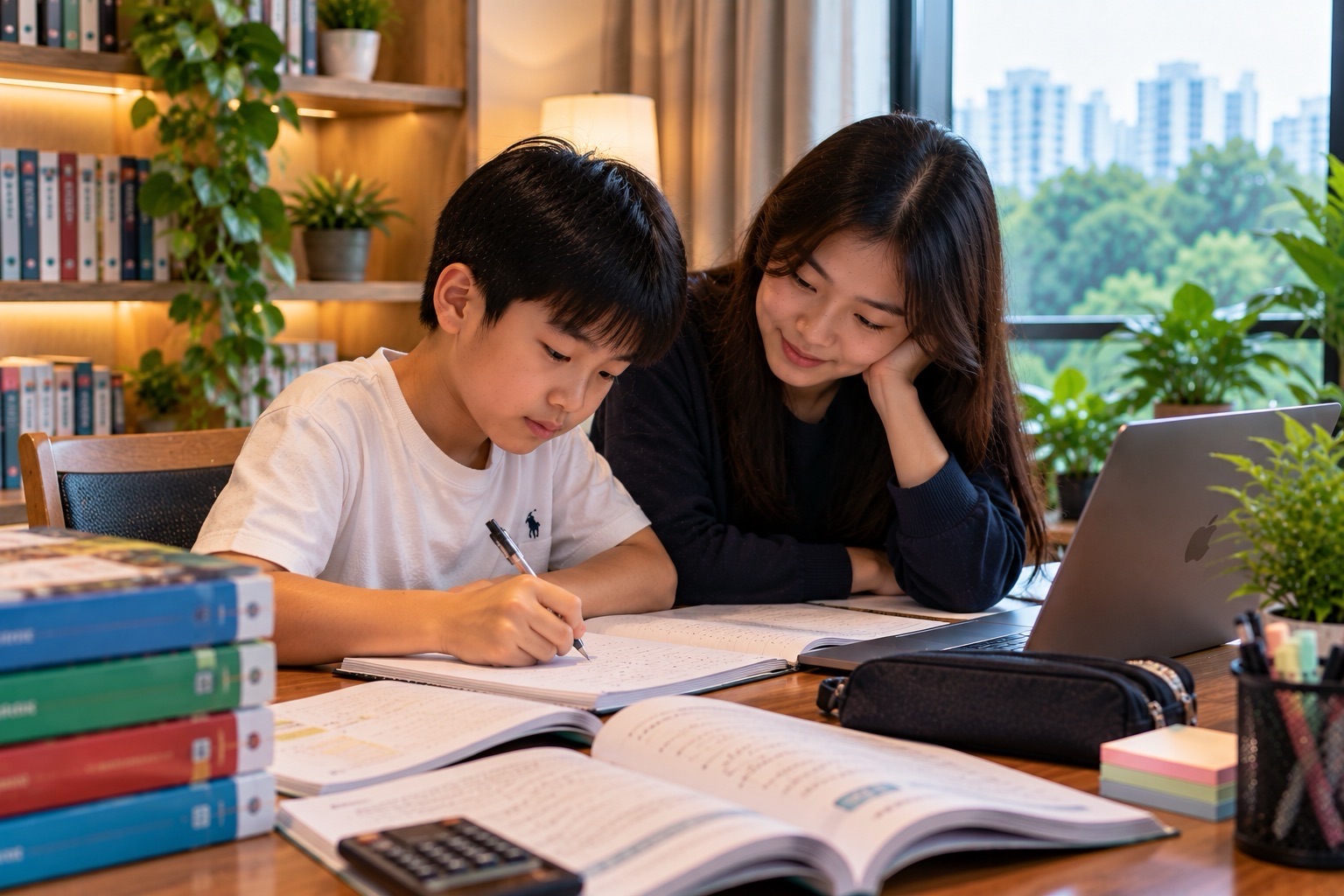
Can parents homeschool a primary-school child in Punggol? Singapore does permit home-schooling under its Compulsory Education Act and Compulsory Education (Exemption) Order, but it is not an automatic right to withdraw a Singapore Citizen child of compulsory primary-school age from school. Parents must seek the required Ministry of Education arrangements or exemption, provide an appropriate proposed curriculum and suitable teaching environment, satisfy applicable parent-competency requirements and comply with any approval conditions. Submitting a plan, buying homeschool textbooks or joining a parent group does not itself mean approval has been given.
For home-schooled children without special educational needs, the current Exemption Order includes conditions involving an assessment before age 11 and the PSLE and National Education Quiz in the relevant age window, at standards determined by the authority. Children with special educational needs may be subject to different approved curriculum and assessment arrangements, depending on their case. The Ministry of Education said in a parliamentary reply in February 2025 that it reviews home-schooling criteria annually and that parents must be capable of providing both effective teaching and a holistic learning environment. This Punggol guide explains the legal questions, daily learning plan, social development, costs, assessment and what to do before making a decision.
- First establish the child’s citizenship, residence and whether Singapore’s compulsory primary-education law applies.
- Do not withdraw a child from their current school or assume an unapproved home-learning plan is an exemption.
- Read the Compulsory Education Act and the current Exemption Order; ask MOE how to apply for your exact case.
- Parents are expected to provide and explain proposed teaching arrangements and curriculum to the official decision-maker.
- The home-school environment must be appropriate and adequate; parents may need to demonstrate relevant teaching capability and permit official home visits.
- For non-SEN home-schooled pupils, statutory assessment and PSLE/National Education Quiz provisions require careful advance planning.
- For a child with special educational needs, obtain MOE guidance on the appropriate mainstream or SPED curriculum and individual conditions.
- Home-schooling is not the same as an occasional MOE school Home-Based Learning day, online tuition or a temporary school absence.
- Create a weekly programme covering English, Mathematics, Science, Mother Tongue where relevant, social learning, physical activity and cultural knowledge.
- Budget for materials, assessment, educational outings, parent work hours and any specialist help; do not assume support funding will match school enrolment.
- Plan friendships, clubs, libraries, outdoor activity and safe participation in the wider community.
- Keep evidence of learning and understand the conditions for any return to mainstream schooling.
The first legal distinction: compulsory primary school is the starting point
The Compulsory Education Act makes national primary-school attendance the normal requirement for Singapore Citizen children of compulsory school age residing in Singapore, unless a relevant exemption or other statutory provision applies. The Act’s definition of compulsory school age and the completion of primary education matter. Parents should not take a social-media claim that “homeschooling is legal everywhere” and treat it as an instruction to stop attending school tomorrow.
For families in Punggol, the correct starting question is whether the particular child falls within this legal framework and whether the family has a valid route to an exemption. A parent’s preference for a different teaching style is a reason to investigate options, not itself an approval. A clear home-learning plan may be part of the application, but it does not replace the authority’s decision. The child should remain within applicable education and attendance requirements while parents work through the permitted process.
What Singapore’s Exemption Order actually requires
The Compulsory Education (Exemption) Order defines home-schooling in this context as primary education provided by a parent to a child away from school. It provides for an appropriate home-schooling curriculum and arrangements approved by the Director-General, with relevant parent teaching qualifications and no obstruction of required home visits. The exact application evidence and conditions are determined through the official process.
This is more than choosing a textbook series or promising to teach for a few hours. The parent must be able to explain what will be taught, how it will be taught, how the child will develop, and how the arrangements meet the regulatory requirements. The authority may impose other conditions under the framework. Families should check the current version of the legislation and obtain application instructions directly from MOE. The details can be revised; a blog written in a different country does not establish Singapore’s requirements.
What to ask MOE before preparing an application
Contact the Ministry of Education through an official channel and explain the child’s citizenship, age, current educational setting, relevant needs and the reason the family is considering home-schooling. Ask for the current application procedure and documentary requirements. Parents should also ask when the process must be completed, how the proposed curriculum is assessed, whether an interview or visit is expected and how the outcome is communicated.
Do not assume the process used by a different family two or three years ago is identical today. A child with identified special educational needs may have an individual education plan, while another family may be proposing mainstream curriculum teaching. The correct documents and assessment obligations can differ. Make a dated record of the official instructions and submit information truthfully. An efficient application is one where the decision-maker can understand both the child’s needs and the family’s ability to deliver a suitable education.
Is home-schooling the same as an MOE Home-Based Learning day?
No. A Home-Based Learning day arranged by a mainstream school is part of that school’s education programme. The pupil remains enrolled in the school, follows its assigned learning and receives instruction or activities through the school’s arrangements. Such days do not give parents permission to remove the child permanently from school or replace formal enrolment with an unrelated curriculum.
Home-schooling under the compulsory-education exemption framework is a separate decision involving a parent-provided educational programme and official approval conditions. Online videos, worksheets, private tuition and supervised homework can be useful tools under many forms of education, but the tools alone do not define the legal status. When a Punggol child attends a normal school and uses the MOE Student Learning Space on some days, the family should continue following that school’s attendance rules. The distinction matters because the word “home learning” is often used loosely for very different situations.
Why a tuition centre is not automatically a homeschool
A parent may imagine replacing school with a daily timetable of private tuition or classes at a learning centre. That does not by itself satisfy a home-schooling exemption. Under the relevant statutory definition, the parent-provided primary education and approved arrangements remain central. A private tutor can potentially be part of a wider family support plan where accepted by the authority, but hiring a paid teacher is not an automatic substitution for the parent’s responsibilities.
Ask MOE how any proposed external teaching would be assessed before assuming it can make up the curriculum. A family should be able to explain who is accountable for lesson planning, child wellbeing, evidence of learning and assessment. It may also need to demonstrate competence across the broader primary experience rather than in one examination subject. The fact that a tutoring provider offers good Mathematics instruction does not establish that the child’s full primary education is appropriately provided.
Homeschooling with special educational needs requires an individual plan
Some families consider home-schooling because a child has special educational needs or has difficulty accessing a particular school environment. Singapore’s framework recognises different arrangements, including government-funded special education schools for eligible pupils. The Education Ministry stated in a February 2025 parliamentary reply that home-schooled children with special educational needs may follow either a mainstream or a special education curriculum, depending on their particular needs.
This is not a universal exemption from education. Parents must still satisfy the applicable official requirements and demonstrate an adequate, holistic learning environment. If the child needs speech-language therapy, occupational support, accessible materials or a tailored learning plan, discuss the actual needs with qualified professionals and MOE rather than trying to fit the child into a generic homeschool template. Every child’s strengths and support requirements differ. A carefully matched official pathway is more important than the ideological label of home-schooling.
Deferment and exemption are not interchangeable
A child who is not medically or developmentally ready to begin Primary 1 may require consideration under a deferment route, which is different from a long-term home-schooling exemption. MOE’s formal deferment application process addresses exceptional circumstances where a child’s entry into formal education may need to be postponed. A family should not assume that deciding to teach at home automatically produces a deferment, or that approval of one arrangement silently grants another.
Explain the actual issue to MOE. Is the family seeking to delay entry temporarily because of a medical condition, asking for education at home under an exemption, considering a government-funded SPED school, or simply looking for better learning support within the existing school? These options solve different problems and carry different responsibilities. The child’s wellbeing and continuity of education should guide the enquiry rather than the convenience of one form.
PSLE requirements for non-SEN home-schooled children
The Exemption Order imposes important conditions on a home-schooled child who does not have special educational needs. These include an undertaking for a specified assessment of home-schooling effectiveness before age 11, and arrangements for the Primary School Leaving Examination and National Education Quiz within the stated age window, with standards determined by the Director-General. The exact applicable schedule and required performance should be confirmed through the individual approval and MOE instructions.
Parents should not plan six years of home learning on the assumption that no formal assessment will ever occur. Build curricular progression and evaluation into the programme from the beginning. Equally, do not assume every individual child with SEN is subject to identical requirements: the law distinguishes cases and approvals may carry specific conditions. The correct information is the current legislation and the letter or instructions issued for the actual child, not a summary from another family’s experience.
What is the National Education Quiz?
The National Education Quiz referred to in the Exemption Order concerns a child’s knowledge of national education at the end of the primary stage. It reflects the idea that education is not only a sequence of academic facts. Learners should also develop understanding of the society in which they live, including responsibilities, history and community. Parents considering home-schooling need to read the relevant MOE instructions on this obligation rather than assuming that PSLE Mathematics and English are the only outcomes that matter.
Home-based learning can include Singapore history, civic life, geography and the experience of people across different backgrounds. For Punggol children, local landmarks, public institutions and stories of the district can form a starting point for age-appropriate discussion. However, a nature walk or casual conversation should not be represented as formal completion of a mandated assessment. The approved programme and actual statutory expectations remain the reference.
A homeschool curriculum must connect knowledge over time
A strong programme is more than a list of worksheets taken from several grades. It needs a coherent sequence: what the child already knows, what comes next, what explanations are required and how earlier concepts will be revisited. In Mathematics, a child moves from quantities and operations to fractions, proportional reasoning and more abstract representations. In language, oral experience and vocabulary develop into reading, writing and sustained explanation. Science learning connects observation, evidence and causal models.
Parents should show how these parts build on one another over several years. A child can appear busy without making durable progress, especially when tasks are chosen only because they are attractive online. The useful question is what new understanding today makes tomorrow’s work possible. Teaching should also permit revision when a misconception becomes visible. An approved curriculum needs a structure that can support independent learning, not merely an impressive timetable on the wall.
English learning: meaning before memorised answers
Children need frequent opportunities to listen, speak, read and write with purpose. An effective home programme might include daily shared reading, oral retelling, discussion of new vocabulary, writing notes to real recipients and reviewing how a sentence conveys meaning. For older pupils, children can learn to distinguish claims from evidence, recognise an author’s intention and revise a paragraph for clarity. The aim is genuine communication and understanding, not only test tricks.
Parents should keep examples of the child’s work across time and look for growth. Does the child understand a story they have not encountered before? Can they explain why an answer is supported by a text? Can they write a clear argument in their own words? A pupil who memorises a polished composition model may still struggle to create an original one. Well-sequenced language learning moves from meaningful experience to increasingly precise expression and supports the wider curriculum.
Mathematics learning: foundations, representations and proof
A home Mathematics curriculum should build number sense, place value, operations, fractions, measurement, geometry and problem-solving at a developmentally suitable pace. Manipulatives and drawings can help children understand relationships before relying on abstract symbols. For example, comparing fractions with strips or number lines helps explain why a particular fraction is larger; memorising a rule alone may not make the concept stable.
Ask the child to explain how they know an answer, and sometimes to find another method. Correct mistakes by examining the step where the reasoning changed, not simply the final number. As the child progresses, include unfamiliar problems that require choosing an approach rather than repeating a rehearsed pattern. If a future assessment is required, understanding remains the most useful preparation. Speed can be built after reliable reasoning develops. A stack of completed books is not a substitute for evidence that the concepts have been learned.
Science learning: the home and neighbourhood as an inquiry setting
Science can begin with age-appropriate observations of light, water, plants, materials, weather and movement. A child in Punggol can observe rain patterns, compare shade along a path or notice changes in plants over time. Parents can help the learner form a question, make a prediction, record observations, compare alternatives and explain what the evidence supports. The child should also learn when a conclusion is uncertain and what more information would help.
Keep activities safe and appropriate for the child’s age, without exposing the family to electrical, chemical or environmental hazards. A home experiment should not attempt to recreate school laboratories with unsafe materials. If the approved curriculum requires particular scientific content or practical competency, seek suitable authorised support. The purpose of science education is to build disciplined curiosity: ask, observe, reason and revise. Everyday wonder becomes scientific learning when it is paired with clear thinking.
Mother Tongue and multilingual family learning
Singapore’s educational environment includes English and Mother Tongue languages, and individual home-school arrangements may need to address the child’s relevant language requirements under the approved curriculum. Parents should clarify official expectations rather than infer that the family can omit a subject because it is inconvenient. A multilingual home can support strong language development when adults use meaningful conversation, stories and cultural experiences.
For Chinese, Malay or Tamil learning, vocabulary becomes more useful when it is attached to real people, activities and situations instead of disconnected lists. A child can speak with relatives, read appropriate books and describe everyday routines. Reading, writing and oral skills should develop progressively and be assessed honestly. Where the parent cannot teach a language at the needed level, discuss suitable support and its role in the submitted plan. Learning support may help; the parent remains responsible for the approved overall education arrangement.
Social development is not optional simply because school is at home
An ordinary classroom gives children repeated contact with peers, group rules, different viewpoints and adults outside the family. Home-schooling may allow more flexible learning, but parents must deliberately provide comparable opportunities for social and emotional development. These should be regular and meaningful, not one large outing at the end of the year. Children need to practise taking turns, resolving disagreement, asking for help and working with people who think differently.
In Punggol, families can explore appropriate community activities, library programmes, sport, volunteering or interest groups, subject to registration and supervision rules. A child should have stable relationships rather than a constant stream of unrelated one-off events. Parents should observe whether the child can cooperate and recover from conflict, not simply whether they are friendly during a prepared performance. A holistic learning environment includes belonging, independence, contribution and the ability to navigate the wider society.
Physical activity and outdoor time have educational value
A home timetable can become sedentary if most learning happens at a desk or screen. Children need movement, physical confidence, fresh air where conditions are suitable, and opportunities to practise motor skills. Punggol Waterway Park and other public spaces can make walking, cycling and observation part of family life, although every outing requires age-appropriate supervision and awareness of weather and safety.
Physical education is not simply using up spare energy. It builds coordination, persistence, self-awareness and teamwork. A student who learns to ride a bicycle or participate in a sport practises responding to feedback in real time. Parents should include movement across the week without turning it into an exhausting performance schedule. If the child has mobility or sensory needs, adapt activities with professional guidance where relevant. Holistic education develops the learner’s ability to participate comfortably in life.
Punggol Regional Library as a learning resource
Punggol Regional Library at One Punggol can support home learning through books, accessible resources and library programmes under the current National Library Board arrangements. A weekly library visit can expose children to topics beyond the parent’s own knowledge, from history and ecology to poetry and engineering. However, library access does not replace the need for a planned curriculum and proper instruction.
Use visits purposefully. A child might choose one fiction book, one nonfiction title and a question to investigate. Later they can explain what each source contributed and how credible it is. Parents can model the difference between finding a fact and understanding an idea. Check the library’s current programme schedule before visiting, because special events, registration and room use may change. The strongest resource is not necessarily expensive; it is one used consistently to develop curiosity and knowledge.
How to organise a typical learning day
A useful home-learning day balances focused teaching, independent practice, movement, reading, discussion and meaningful breaks. For a younger child, several shorter periods of attentive work may be more productive than a long stretch of uninterrupted seatwork. An older learner may be ready for sustained reading or project development. The right schedule should reflect developmental needs and the officially approved arrangements rather than a fixed template copied from another family.
An example could begin with reading and conversation, move into guided Mathematics, take a movement break, include a science or humanities investigation and finish with writing or review. The parent should be able to explain what was learned and what needs attention next. A flexible timetable is not the same as having no learning objectives. Consistency helps the child develop habits, while thoughtful adjustments make room for deep interests and ordinary family life.
How to assess progress without imitating endless school tests
Assessment should show whether the child has learned something that remains available when a question changes. Regular low-pressure checks can include a short written explanation, reading an unfamiliar passage, solving an unpractised Mathematics problem or presenting the findings of a project. The parent should examine errors and adapt teaching. Large scores are not the only evidence of progress.
Keep a dated portfolio of selected work, including early attempts and later corrections. A photograph of a beautiful finished craft may be encouraging, but it does not show which ideas the child can explain independently. Ask the child to describe the process and apply it somewhere new. Any formal assessments mandated by the exemption must still be handled under MOE’s requirements. Informal home checks supplement those obligations; they do not replace them. Good evidence helps both learning and accountability.
Record-keeping and official review
Because home-schooling under the exemption framework involves approved arrangements, parents should prepare to maintain relevant curriculum plans, learning records, progress evidence and correspondence. The Exemption Order provides for official home visits as required, and the authority may need to be satisfied about the adequacy of teaching and learning conditions. Parents should ask MOE what records and reporting schedules apply in their individual case.
Organise information securely rather than uploading private documents into public parent forums. Use a simple structure: approved plan and conditions, weekly teaching notes, examples of student work, assessments and correspondence. If the child’s needs or family circumstances change materially, ask whether the authority requires notification or plan revision. An education plan should be honest about difficulties and improvements. The purpose of records is not to pretend every day was perfect; it is to make the child’s progress and support needs clear.
Financial planning: the hidden cost is often parent time
Some families assume home-schooling is inexpensive because there are no private-school tuition fees. Yet parents may need to reduce paid work hours, purchase resources, organise social activities and pay for specialist teaching or professional assessments where relevant. The biggest cost can be the adult’s time and the opportunity cost of providing consistent instruction over several years. A household needs a realistic budget, not only a box of textbooks.
List recurring materials, books, technology, community memberships, transport, examination administration where applicable and any professional support. Include the cost of care when the teaching parent is unavailable. Avoid assuming every grant provided to a pupil enrolled in a mainstream school automatically applies to a home-schooled child. MOE’s Edusave information includes some specific arrangements for students receiving education outside institutions, but approval and usage conditions need direct verification. Budget with official answers rather than optimistic assumptions.
What happens if a parent becomes sick or returns to work?
A home-school arrangement may depend heavily on one adult. If that person becomes ill, takes a new job or needs to care for another family member, the educational programme could be disrupted. Families should consider this risk before committing. Who will provide continuity? How will progress and safeguarding be maintained? What alternatives are available if the original plan cannot continue?
Discuss how significant changes would be handled with MOE under the exemption conditions. An informal substitute tutor may not automatically satisfy the approved arrangement. Parents should keep the relevant plan and records organised so that another authorised adult or provider can understand what has been taught if required. A resilient educational system is not one that never changes. It is one that can respond safely when real family circumstances shift, without leaving the child’s learning dependent on improvisation.
When a child already attends a primary school
Some Punggol parents consider home-schooling after their child develops school anxiety, experiences bullying or struggles with the classroom environment. These concerns deserve careful attention, but they do not automatically end attendance obligations or mean home-schooling is the only appropriate response. The family should first address safety, communicate with the school and seek appropriate healthcare or specialist support when necessary.
A school may offer learning support, counselling, adjustments or referral pathways depending on the child’s actual needs. If the concern is a move between HDB estates or excessive travel, the relevant primary transfer process may be a better starting point. Home-schooling is a substantial educational and legal decision, not merely a temporary reaction to one difficult term. Parents should compare the possible solutions in terms of what would make the child safe, able to learn and connected to a wider community.
Home-schooling versus international school enrolment
An international school is an institution with its own admissions process, curriculum and fees; home-schooling under Singapore’s Exemption Order is parent-provided primary education subject to official arrangements. The legal question for a Singapore Citizen child is not solved merely by choosing an international brand or an online overseas school. Different routes can involve different eligibility and exemption requirements, and parents should ask MOE about their child’s particular situation.
A household might prefer an international curriculum because of future relocation, while another prefers home learning for a tailored pace. These preferences do not make the options administratively identical. Compare who is responsible for teaching, what qualification the child is pursuing, how attendance and assessments are handled and whether the route has official approval where required. A Punggol family can explore more than one educational model while still recognising that each must operate within the appropriate rules.
Will the child be able to enter secondary school later?
Parents contemplating home-schooling often imagine a return to mainstream Secondary 1 after the primary years. The applicable examination, eligibility and placement process must be understood well before that point. For non-SEN home-schooled children, the Exemption Order’s PSLE conditions are directly relevant. But a completed PSLE does not itself guarantee entry to a chosen secondary school; posting rules, results and eligibility still matter.
Ask MOE how a home-schooled child should register for the required assessment and what the next-stage process entails. If the learner follows a different approved curriculum due to special educational needs, seek individual guidance about suitable post-primary options. Keep educational records and talk about the transition in advance. The objective is not to turn home learning into a dead end. It is to ensure that the route chosen in primary school supports future learning and belonging.
How to distinguish a genuine homeschool plan from an internet fantasy
A convincing home-school story often includes a beautiful study room, flexible travel and a child pursuing their passions all day. These can be appealing, but the daily reality also involves difficult explanations, changing interests, conflict, fatigue and the need to measure learning accurately. Parents must be both caregiver and educator, while maintaining appropriate external relationships and oversight.
Ask ordinary questions. What will happen when the child refuses a challenging subject? Who will identify a Mathematics misconception the parent cannot see? Where will the child meet peers regularly? How will national education and physical development be included? What happens if a parent returns to work? What does official approval require this year? A realistic plan answers these questions without pretending they are all effortless. Honest preparation is more valuable than adopting the identity of a homeschool family before understanding the responsibilities.
A four-week preparation plan before deciding
Week 1 — establish the law and the child’s situation. Read the compulsory-education framework, verify whether it applies and obtain official application guidance. Keep the child’s current attendance arrangement intact unless authorised otherwise. Week 2 — design the curriculum. Show what will be taught, in what sequence, with what evidence of progress, and how the parent’s teaching competence and resources meet the requirements.
Week 3 — plan holistic life. Map social participation, movement, library resources, specialist support where needed, family work schedules and assessment obligations. Week 4 — review with the official authority. Follow MOE’s required submission process and do not assume approval. Discuss alternatives including school support, SPED or deferment when relevant. This is a planning framework, not a substitute for MOE’s actual application deadlines, conditions or decision.
Worked case: a Punggol family attracted by flexible learning
A hypothetical family enjoys project-based learning and wants to spend more time exploring science through the Punggol environment. They read about home-schooling abroad and initially assume the parents can simply stop attending the local primary school. After examining Singapore’s compulsory-education rules, they realise that official arrangements are required. They contact MOE and begin drafting a coherent curriculum rather than immediately buying expensive course packages.
The family also considers whether existing school, library and after-school enrichment opportunities could provide much of the desired flexibility without withdrawing from formal education. They budget the parent’s teaching time, possible assessment requirements and the child’s social needs. Whatever they decide, the process is informed. The child’s future is not made dependent on a misunderstanding of the law or the excitement of an attractive internet lifestyle.
Worked case: a child whose learning needs require a different approach
Another family has a child who finds parts of mainstream school difficult and may require additional support. The parents consider teaching at home because the child appears calmer there. Rather than treating this observation as proof that home-schooling is automatically the correct or authorised option, they obtain professional guidance and talk with MOE about the child’s educational needs and available mainstream, SPED or exempted arrangements.
If an individual home-school plan is considered, they examine teaching resources, therapies or specialist support where relevant, social participation and what evidence of progress will be needed. They do not assume the child is subject to exactly the same assessment conditions as a non-SEN learner. The goal is a safe, appropriate and legally supported learning environment that can be reviewed as the child develops. The child is not being defined solely by difficulty at one school.
Frequently asked questions about homeschooling in Singapore
Is homeschooling legal in Singapore? It is permitted under specified exemption arrangements, not through an automatic parental decision to withdraw from compulsory primary schooling. Can I simply teach a Singapore Citizen P1 child at home? Not without satisfying applicable compulsory-education and exemption requirements. Will the child need PSLE? The Exemption Order sets assessment, PSLE and National Education Quiz conditions for non-SEN home-schooled children; individual conditions must be confirmed.
Can I hire a tutor to do everything? Buying tuition does not automatically substitute for the parent-provided curriculum and approved arrangements. Is online schooling equivalent to home-schooling? Not automatically. What if my child has SEN? MOE can consider individual curriculum and support arrangements; seek the correct guidance. Is MOE Home-Based Learning homeschooling? No; HBL days remain part of an enrolled school’s programme. Can my child later enter secondary school? Discuss the required examinations and relevant posting route with MOE well in advance.
Official references and Punggol next reading
Primary legal sources: Singapore Compulsory Education Act; Compulsory Education (Exemption) Order, including home-schooling terms; MOE exemption information; MOE contact and services. Parliamentary context: February 2025 ministerial reply on home-schooling; September 2026 reply on exemptions.
More eduKatePunggol: Compulsory education and home-schooling overview; Mainstream and SPED support; MOE Home-Based Learning versus independent learning; What to do when school attendance is difficult. Prepared November 2026. This is general information rather than legal advice or an exemption decision. The applicable legislation, individual approval and MOE’s current written instructions control the child’s obligations.


