
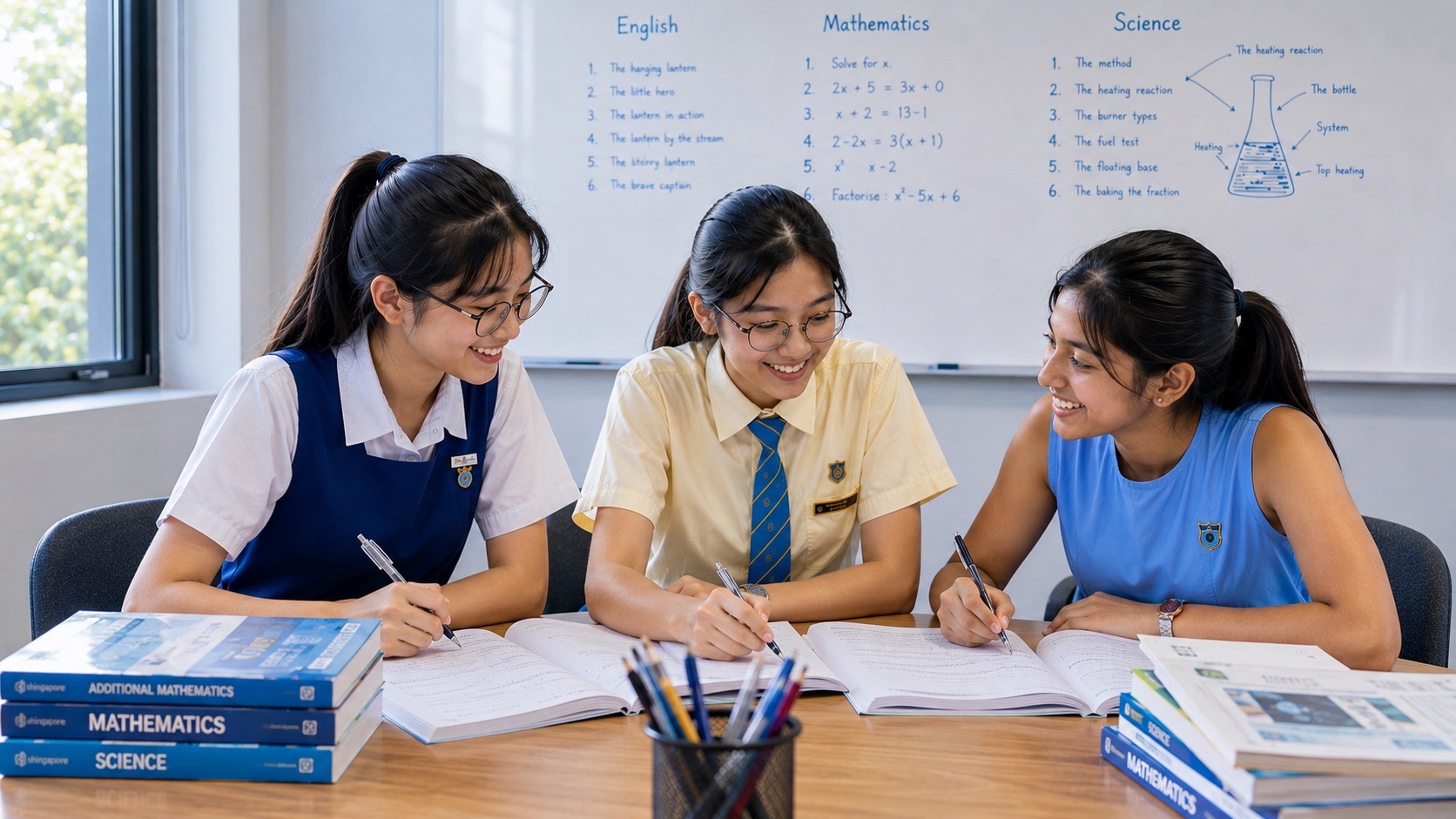
Secondary 1 G1 Mathematics tuition in Punggol should help students understand quantities, signs, ratios, percentages, algebraic expressions, graphs, geometry and everyday problem solving. eduKatePunggol offers small-group tutorials with up to three learners, normally lasting ninety minutes. A useful tutor can examine each child’s first method, identify a specific misunderstanding and check that a corrected principle works in a different task without supplying the answer.
Under Full Subject-Based Banding, G1 Mathematics is the student’s actual subject level, not a permanent label for their whole education. A Secondary 1 pupil in 2026 is assessed by the school rather than through a national SEC paper that year. SEAB’s published 2027 G1 Mathematics K110 syllabus is a longer-term reference: it emphasises Number and Algebra, Geometry and Measurement, and Statistics and Probability, including practical applications. Its examination scheme should not be imposed as the present Secondary 1 paper.
Fast answers for Punggol families
- Verify G1 Mathematics from the student’s actual school subject record rather than assume every subject matches the entry Posting Group.
- Prioritise signed numbers, fractions, ratio, percentage, rates, simple algebra, linear relationships and school-taught geometry and data.
- The 2027 SEC G1 K110 national reference has two 90-minute papers of 50 marks each; a Secondary 1 student does not sit this national paper.
- G1 K110 emphasises practical, real-world Mathematics and has its own scope; it should not be treated as a generic shortened G3 course.
- A group of three helps only when each pupil independently attempts, explains and later retests a changed problem.
Contents: Official syllabus · Why three? · 30 practical examples · 90-minute tutorial · Parent questions · FAQs · Sources
What G1 Mathematics teaches, and what Secondary 1 must do now
The official 2027 G1 K110 syllabus aims to provide mathematical knowledge and skills for everyday decisions and later technical or service-oriented study. It explicitly values thinking, reasoning, communication and the ability to interpret problems in context. Its examination scope contains Number and Algebra, Geometry and Measurement, and Statistics and Probability. That is the full end-of-course destination, not a list that every first-year pupil must complete immediately. Schools organise actual lower-secondary chapters and assessments according to their curriculum.
In 2027 K110, Paper 1 covers Number and Algebra together with Geometry and Measurement; Paper 2 covers Number and Algebra together with Statistics and Probability. Each lasts one hour and thirty minutes, carries fifty marks and is equally weighted. Approved calculators are allowed in both; candidates must still show essential working. The syllabus gives relevant formulae, and the final numerical accuracy guidance generally expects three significant figures for non-exact answers or one decimal place for angles unless specified otherwise.
| 2027 G1 Mathematics K110 | Duration | Marks | Weight |
| Paper 1: Number/Algebra and Geometry/Measurement | 1 h 30 min | 50 | 50% |
| Paper 2: Number/Algebra and Statistics/Probability | 1 h 30 min | 50 | 50% |
The presence of quadratic equations, trig ratios, volume formulae or compound interest in the full K110 document should not lead a tutor to demand all of them from a present Secondary 1 pupil. The relevant school term’s level and earlier understanding are the immediate priorities. A child who is unsure why 3x differs from x+3 needs an algebra bridge, not an advanced paper that happens to contain symbols.
SEAB 2027 G1 Mathematics K110 official syllabus · 2027 G1 school-candidate subject list · Secondary 1 G2 Mathematics comparison.
The primary-to-secondary bridge is about meaning
Numbers and symbols now describe relationships more generally. A negative amount may represent a debt or a temperature below zero; x can represent any allowable quantity; a graph can express a change between variables; a percentage is not meaningful without a reference whole. A student can be confident with familiar calculations and still misread these representations. Effective tuition identifies the precise gap rather than repeatedly telling a child to be more careful.
A good example often begins with a concrete situation and moves to a diagram or symbolic statement. The tutor then changes the story so that the pupil must choose the method independently. If the child only remembers the first completed model, the learning is not yet stable. A later retest in a mixed context can show whether the idea is becoming usable outside a single worksheet.
Why a class of three might make diagnosis easier
Three learners can show different ways to represent a problem while leaving time for the tutor to inspect individual first attempts. One child may draw a number line, another use an equation and a third verify through inverse operations. However, the final answer to a group discussion does not prove that every pupil can work alone. Each learner should receive a different new task after the tutor has explained the relationship.
- Start with quiet individual work rather than one volunteer solving for everyone.
- Identify the first mistaken quantity, operation, sign or assumption.
- Teach the relationship in an age-appropriate concrete, pictorial or symbolic form.
- Allow respectful comparison of methods and time for slower thinkers.
- Ask all three learners to complete an unfamiliar problem without the model.
- Return to earlier corrections after a delay and record whether they held.
- Discuss whether the child’s group and weekly workload remain suitable.
A class capped at three is not universally better than one-to-one help, school support or ordinary independent study. Some students require specialist assistance or a different pace. Another may already manage Mathematics independently and have little need for tuition. An honest centre should consider whether another ninety minutes improves this child’s learning rather than promise a grade because of class size.
How to repair a Mathematics mistake, not merely erase it
Observe the first attempt
Keep the pupil’s original working visible and ask what the numbers mean, what is unknown and why the operation was selected. A wrong result might come from a sign, an unfamiliar word, a wrong model or a simple execution slip. These need different corrections. A general comment such as careless does not tell the learner which decision to change.
Show a discriminating contrast
Compare two closely related questions that change one condition: subtraction of a positive versus negative number, the part of a ratio versus the whole, or area versus perimeter. Ask the student to say why the same procedure cannot be used unchanged. This teaches when a rule is valid.
Remove the model and change context
After guided practice, use a new number, story, diagram or unknown. Every student must choose the method independently. A copied corrected answer to the original task is a beginning but is not proof that the idea transfers.
Return when the example is no longer fresh
A later lesson includes the same principle in a mixed task. If the wrong assumption returns, revisit the prerequisite or use another representation. If the pupil solves it confidently, reduce hints or increase challenge. This makes tutoring increasingly unnecessary rather than creating permanent dependence.
Thirty G1 Mathematics teaching problems with clear repairs
1. Negative integers and a temperature story
Typical first error. The student says −8°C is warmer than −3°C because eight is larger than three.
Mathematical explanation. Use a number line and discuss below zero: −8 is to the left and is colder. Distinguish absolute distance from signed position.
How the three-person group helps. Three pupils compare negative temperatures, explain order and predict a changed reading without the tutor’s highlighted line.
Independent changed question. Rank −7°C,−1°C,2°C from coldest to warmest and explain the ordering.
Important distinction. A number’s distance from zero is different from its value on a signed scale.
2. Subtracting a negative number
Typical first error. A pupil treats −4−(−7) as −11 because the two minus signs are read as a continuous subtraction.
Mathematical explanation. Explain subtracting a negative as adding the opposite: −4−(−7)=3. Walk right seven spaces from −4 on a number line.
How the three-person group helps. Each pupil draws, calculates and checks a different negative subtraction, then completes an unseen problem independently.
Independent changed question. Evaluate −6−(−2)=−4, and check using the original expression.
Important distinction. A mnemonic can help later but should not replace understanding.
3. Positive and negative money balances
Typical first error. A learner adds $15 to a balance of −$20 and says $35 because they ignore the sign of the debt.
Mathematical explanation. Interpret −20 as owing twenty. After a $15 repayment, the balance is −5, meaning five dollars still owed.
How the three-person group helps. Pupils each construct a short borrowing, repayment or credit example and say what the final sign means.
Independent changed question. Starting at −$12 and repaying $20 gives +$8 if overpayment is recorded as credit.
Important distinction. Real financial contexts help only if the quantities and assumptions are stated clearly.
4. Fractions with a negative sign
Typical first error. The child calculates −1/2+1/4 as −2/6, incorrectly combining numerators and denominators.
Mathematical explanation. Express halves as quarters: −2/4+1/4=−1/4. Use a number line or equivalent partitions to show the result.
How the three-person group helps. Each learner converts to a common unit, performs the operation and verifies a separate changed question.
Independent changed question. Compute −3/4+1/2=−1/4 with a reason.
Important distinction. A negative fraction is still a number, and the denominator represents piece size.
5. Squares and square roots
Typical first error. A student says √49 equals both +7 and −7 even though the principal root notation asks for a single nonnegative value.
Mathematical explanation. Explain √49=7 while the equation x²=49 has two solutions, x=±7. Use substitution to distinguish a function value from solving an equation.
How the three-person group helps. Three students evaluate, solve and check different examples before answering new ones alone.
Independent changed question. Evaluate √64=8 and solve y²=64 as y=±8.
Important distinction. Different mathematical questions can share numbers but demand different answers.
6. Cubes and cube roots
Typical first error. The pupil thinks a negative number cannot have a real cube root.
Mathematical explanation. Show (−3)³=−27, so ∛(−27)=−3. Contrast the behaviour of odd and even integer powers.
How the three-person group helps. Each learner cubes a positive or negative value and uses the inverse to justify the root.
Independent changed question. Calculate ∛(−64)=−4 and verify by cubing.
Important distinction. Sign behaviour follows the exponent, not the visual appearance of a symbol.
7. Rounding to significant figures
Typical first error. A child rounds 0.006784 to two significant figures as 0.00 because the two leading decimal zeroes are counted as significant.
Mathematical explanation. Find the first nonzero digit: 6 and 7 are the first two significant figures, with the next digit 8 causing rounding to 0.0068.
How the three-person group helps. Three learners mark the first significant digit in different measurements before solving new examples.
Independent changed question. Round 0.003947 to two significant figures as 0.0039.
Important distinction. Significant figures refer to precision, not the number of printed decimal places.
8. Estimation before calculating
Typical first error. The student accepts 49×21=10,290 without noticing the result is approximately ten times too big.
Mathematical explanation. Estimate near 50×20=1000, then calculate 49×21=1029. Compare exact and approximate answers to find a misplaced digit.
How the three-person group helps. One learner estimates, another computes and a third verifies through a different decomposition.
Independent changed question. Estimate 38×24 around 40×25=1000 and then check the exact answer 912.
Important distinction. Estimating catches implausible magnitudes but does not replace exact work.
9. A ratio as parts of a whole
Typical first error. The learner splits 75 counters in a 3:2 ratio but treats 3/2 as the first fraction of the total.
Mathematical explanation. There are five equal parts. Each has 15; the quantities are 45 and 30. The first is 3/5 of the whole but 3/2 of the second group.
How the three-person group helps. Pupils draw a bar, count units and check the sum; each handles a changed set of labels independently.
Independent changed question. Split 96 in 5:3 ratio to obtain 60 and 36, then check the total.
Important distinction. Part-to-part and part-to-whole comparisons must be named distinctly.
10. Ratios involving fractional values
Typical first error. The child assumes fractions cannot occur in a ratio and adds 1/2 and 3/4 instead of simplifying 1/2:3/4.
Mathematical explanation. Multiply both terms by 4 to preserve their relative size: 1/2:3/4=2:3. Explain the equivalent scaling.
How the three-person group helps. Each pupil demonstrates a picture, arithmetic conversion or value check and then solves a new ratio.
Independent changed question. Simplify 2/3:1/6 to 4:1 without summing the terms.
Important distinction. Ratios compare quantities; they are not automatically addition expressions.
11. Percentage: identify the reference whole
Typical first error. The pupil is told 10 of 40 students chose an activity and reports 40% because the larger number was seen first.
Mathematical explanation. Divide part by whole: 10/40=25%. Check that 25% of 40 is 10.
How the three-person group helps. Three learners mark part, whole and percent in different school survey questions.
Independent changed question. If 18 of 60 students take a bus, report 30% and explain the denominator.
Important distinction. The word percent needs a named reference base.
12. Increase and decrease in prices
Typical first error. A student thinks a 20% price reduction from $50 means the new price is $10, confusing the discount with the amount to pay.
Mathematical explanation. 20% of $50 is $10 off, so the final price is $40. Label original, change and final amount.
How the three-person group helps. Each pupil writes a separate receipt calculation and explains the relation before an unfamiliar purchase story.
Independent changed question. A $60 item discounted 25% costs $45, with discount $15.
Important distinction. A percentage part and a final total are two different requested quantities.
13. Reverse percentages in everyday settings
Typical first error. The learner sees a final price of $72 after a 20% discount and takes another 20% away.
Mathematical explanation. The final $72 represents 80% of the original. Divide by 0.8 to find $90, then check the 20% reduction.
How the three-person group helps. One pupil draws a 100% bar, another forms an equation and a third checks an unfamiliar final-price story.
Independent changed question. If 75% of a price is $60, the original is $80.
Important distinction. The original reference whole is what matters, not the trigger word ‘discount’.
14. Money exchange and relevant units
Typical first error. A student multiplies by a currency rate without checking which currency is being converted, then labels the result incorrectly.
Mathematical explanation. In an explicitly hypothetical rate of S$1=0.75 units of another currency, S$20 converts to 15 units. Reversing the conversion would require division.
How the three-person group helps. Three learners label source, destination and rate units before calculating changed fictional scenarios.
Independent changed question. At a stated 1:0.8 conversion, 50 source units yield 40 destination units.
Important distinction. Rates change in reality; tuition examples must state that the chosen numbers are illustrative, not today’s exchange rates.
15. Speed and journey time
Typical first error. The pupil divides time by distance and labels the answer kilometres per hour.
Mathematical explanation. Speed is distance/time. A 120 km journey lasting two hours has average speed 60 km/h. Name both the measured quantity and the unit.
How the three-person group helps. Students independently compute distance, time or speed for distinct travel stories.
Independent changed question. A 90 km journey at constant 45 km/h lasts two hours.
Important distinction. The problem’s actual conditions determine whether constant or average speed is appropriate.
16. 24-hour and 12-hour clock
Typical first error. A learner thinks 15:30 means 15 minutes after three rather than 3:30 p.m.
Mathematical explanation. Separate hour and minute components. In the 24-hour clock, 15:30 is 3:30 p.m. and 03:30 is 3:30 a.m.
How the three-person group helps. Three pupils convert separate practical schedules and explain which day period each represents.
Independent changed question. Convert 21:15 to 9:15 p.m. and 09:15 to 9:15 a.m.
Important distinction. The colon separates clock fields; time is not an ordinary decimal.
17. Algebra letters represent numbers
Typical first error. The pupil interprets 3x as x+3, not three copies of x.
Mathematical explanation. Explain 3x=3×x. For x=4, 3x is 12 while x+3 is 7. Translate a simple shopping story into a correct expression.
How the three-person group helps. Each pupil describes one expression and tests it at a new value without a tutor’s model.
Independent changed question. Write the cost of five items priced y dollars as 5y, not y+5.
Important distinction. A letter is a quantity, not a decorative placeholder.
18. Squares in algebra are not doubling
Typical first error. The child reads x² as 2x and obtains 8 for x=4.
Mathematical explanation. For x=4, x²=x×x=16, whereas 2x=8. Use small squares or repeated multiplication to show the difference.
How the three-person group helps. Three learners compare x², x+x and x×x in independent examples.
Independent changed question. At x=−3, evaluate x²=9 and 2x=−6.
Important distinction. Parentheses and operation type matter when substituting negative numbers.
19. Like terms and simplified expressions
Typical first error. A student combines 2x+3x² to give 5x³ because both terms contain the letter x.
Mathematical explanation. Like terms have the same variable part; 2x and 3x² are unlike. Simplify 5a−2a+3b to 3a+3b.
How the three-person group helps. Pupils sort different terms, explain compatible groups and check an unfamiliar expression.
Independent changed question. Simplify 4x+2y−x as 3x+2y.
Important distinction. Algebra simplification preserves value; it does not invent powers.
20. Negative brackets and distribution
Typical first error. The child expands −2(3x−5) as −6x−10 by ignoring the product of two negatives.
Mathematical explanation. Distribute the factor to both terms: −6x+10. Substitute x=1 to show the original and result both equal 4.
How the three-person group helps. Each learner expands a separate expression and explains a sign check to a peer.
Independent changed question. Expand −3(2x−4) as −6x+12 independently.
Important distinction. A numerical check can expose an incorrect identity but does not replace explanation.
21. Solving a simple linear equation
Typical first error. The pupil ‘moves’ a number across the equals sign without knowing which operation preserves equality.
Mathematical explanation. For 3x+4=19 subtract 4 from both sides and divide by 3, obtaining x=5. Substitute to verify.
How the three-person group helps. Students share roles of equation, inverse operation and check, then each solves a new one alone.
Independent changed question. Solve 5x−7=18 to get x=5 with a check.
Important distinction. An equation is a balance relationship, not an instruction to shuffle letters.
22. Coordinates and ordered pairs
Typical first error. The learner plots (2,5) as five along x and two up y.
Mathematical explanation. Coordinates are ordered: x first, y second. Compare (2,5) and (5,2) on a labelled grid.
How the three-person group helps. Three pupils plot different pairs and explain quadrants before completing an unfamiliar one.
Independent changed question. Plot (−3,2) correctly in the upper-left quadrant.
Important distinction. Order and sign carry meaning even when both entries are numbers.
23. The meaning of a straight-line gradient
Typical first error. The student reads the value of y at a point as the line’s gradient.
Mathematical explanation. For points (1,3) and (3,7), gradient is (7−3)/(3−1)=2. Explain it as the change in y per unit of x.
How the three-person group helps. One pupil identifies coordinate differences, one finds the ratio and another interprets it.
Independent changed question. A new line through (0,1) and (2,5) has gradient 2.
Important distinction. Graph axes, scales and units must be read before interpreting slope.
24. Angles on a straight line
Typical first error. A learner says two adjacent angles must be equal because the drawing looks roughly symmetrical.
Mathematical explanation. Two angles forming a straight line total 180°. If one is 65°, the other is 115°. Mark the straight-line condition.
How the three-person group helps. Each student applies a different angle property and checks a rotated diagram.
Independent changed question. Given a straight-line pair of 120° and x, find x=60°.
Important distinction. Unscaled diagrams cannot override geometric facts.
25. Area or perimeter in a practical story
Typical first error. The pupil multiplies 7 by 5 to find ribbon for the boundary of a rectangle, giving 35 cm² instead of the needed length.
Mathematical explanation. Area of a 7 cm×5 cm rectangle is 35 cm²; its perimeter is 2(7+5)=24 cm. Explain interior versus boundary.
How the three-person group helps. Students compare an interior-covering task and a border-fencing task before fresh problems.
Independent changed question. Find area 36 cm² and perimeter 26 cm for 9 cm×4 cm rectangle.
Important distinction. An arithmetically correct number can still answer the wrong question.
26. Statistics: reading a scale before a trend
Typical first error. The learner sees a tall bar and assumes a category has twice as many participants despite a truncated y-axis.
Mathematical explanation. Read the axis values and category labels. Compare actual numerical values rather than the visual impression of bar height.
How the three-person group helps. Each pupil interprets one feature of a different display and explains what remains unknown.
Independent changed question. An unfamiliar bar chart beginning above zero is interpreted accurately.
Important distinction. A visually dramatic graph need not represent a large absolute difference.
27. Probability and a fair die
Typical first error. The student gives probability 1/2 for every named category without checking the count of underlying outcomes.
Mathematical explanation. For a fair six-sided die, even outcomes 2,4,6 give 3/6=1/2. The number of elementary outcomes, not the number of labels, justifies the probability.
How the three-person group helps. Each pupil enumerates possible outcomes and identifies favourable cases in new examples.
Independent changed question. For rolling a six on one fair die, probability is 1/6, not 1/2.
Important distinction. Equal likelihood must come from the stated model.
28. Practical recipe quantities and proportion
Typical first error. The child doubles a recipe’s number of portions but leaves half the ingredient quantities unchanged, producing an inconsistent result.
Mathematical explanation. If four servings require 200 g of rice, eight servings require 400 g under a direct proportion model. Scale all applicable ingredients consistently.
How the three-person group helps. Three students check one ingredient each and compare whether the new recipe remains proportional.
Independent changed question. A recipe for six servings needing 300 ml scales to four servings at 200 ml.
Important distinction. Real recipes may require discretion, but the ideal mathematical scaling should be coherent.
29. When a difficult topic is outside current school scope
Typical first error. A parent asks for immediate examination-level trigonometry after seeing it in the K110 full syllabus, although the child is learning fractions and algebra notation.
Mathematical explanation. The K110 document gives an eventual end-of-course scope; the school sets the actual Secondary 1 sequence. Repairing present prerequisites is more useful than assuming every later topic is compulsory now.
How the three-person group helps. The tutor explains the prerequisite chain and makes an individual plan for each student rather than distributing a graduating-year paper.
Independent changed question. A pupil strengthens current linear-equation understanding on a new problem before any optional enrichment.
Important distinction. The course level and school year must both govern topic selection.
Two illustrative tutorial scenes
The negative bracket that changed the quantity
A Secondary 1 G1 learner writes −2(3x−5)=−6x−10. The tutor asks for a simple check at x=1: the original equals four while the incorrect expansion equals minus sixteen. The pupil then learns that the negative factor multiplies both terms, giving −6x+10. Two classmates provide a pictorial and symbolic explanation, but all three must expand a new expression alone. This is a teaching example, not a report about an identified student.
The ratio with the wrong whole
Another child receives a story dividing 75 bottles in the ratio three blue to two green, and reports three halves of the total as blue. The tutor asks how many equal parts make the whole. Five units of fifteen produce 45 blue and 30 green bottles. After a short peer comparison, the pupil solves a new story about red and yellow tickets independently. The correction targets the meaning of ratio rather than speed at division.
How a ninety-minute tutorial might be organised
| Illustrative time | Purpose |
| 0–10 min | Recall one previously corrected mathematical relationship unaided |
| 10–25 min | Attempt a current school task and locate the first error |
| 25–45 min | Build a clear model or contrasting example |
| 45–65 min | Individual practice and feedback with peer comparison |
| 65–80 min | Solve a new unfamiliar question independently |
| 80–90 min | Self-check, short error note and manageable retrieval follow-up |
The time blocks are illustrative, not a fixed promise for every class. A child who needs a number-line prerequisite may spend more time on it; another might be ready to apply algebra to an unfamiliar situation. The tutor should keep all three learners thinking rather than deliver a continuous lecture. A small group is most useful when actual individual mistakes change the next teaching move.
An eight-week monitoring routine
Weeks one and two can assess current signed-number, percentage, ratio and basic algebra foundations through short unseen questions. Weeks three and four target one or two high-impact misconceptions with concrete models and a new response after correction. Weeks five and six connect those ideas to school graphs, geometry and practical data as appropriate. Weeks seven and eight return to the earlier errors after a delay and ask for mixed unfamiliar work without hints. This framework adapts to the school rather than guarantee a mark change.
A useful progress report is precise: ‘Previously treated 3x as x+3; now constructs and evaluates a new algebraic expression correctly without prompts.’ A school mark is supportive evidence but can vary with paper difficulty. What a child can explain and do alone in a changed context is more directly linked to the teaching.
Five decisions behind good G1 Mathematics tuition
The G1 syllabus values useful real-world Mathematics
The 2027 SEAB K110 syllabus explicitly emphasises daily-life contexts: schedules, floor plans, rates, bills, recipes, transport and household decisions. This does not mean mathematical reasoning is optional. A child must identify relevant numbers, understand the units, formulate a valid relationship and interpret the answer. A tutor can turn a short transport schedule or fictional receipt into a meaningful question, then change the layout to see whether the pupil can apply the idea independently. A story is only educationally useful when the mathematical structure is taught, not when it merely makes a worksheet look colourful.
Ask the tutor to show a different independent question the pupil completed after correction. If the same hint was still needed, the concept requires another explanation or prerequisite. If the skill holds after a delay, extension or reduced support may be more sensible than adding a large new worksheet pack.
Why this level should not copy G2 or G3 topic lists uncritically
SEAB’s G1 K110 curriculum defines its own scope. For example, it includes recognising prime numbers but explicitly excludes prime factorisation as a required part of the relevant numbers subsection. Some topics that appear across G levels are taught with different depth or assessed differently. A tutor who automatically gives a G3 worksheet to a G1 student may create confusion without addressing the current school difficulty. Follow the actual G1 content and the school’s plan first, then consider optional enrichment only when the child can transfer present learning to unfamiliar cases.
Ask the tutor to show a different independent question the pupil completed after correction. If the same hint was still needed, the concept requires another explanation or prerequisite. If the skill holds after a delay, extension or reduced support may be more sensible than adding a large new worksheet pack.
The best diagnostic question may be about meaning rather than arithmetic
A student who incorrectly adds two ratio terms may not need more practice multiplying numbers. They may need to understand what the terms represent, what quantity is the whole and why the final answer must match it. Likewise, a learner who writes x²=2x may be confusing operations rather than forgetting a table. The tutor can ask the pupil to describe the quantities in ordinary words, build a small concrete example and compare two similar expressions. The final retest uses changed numbers and no model. This is how a short lesson can solve a recurring problem more effectively than an undiagnosed homework packet.
Ask the tutor to show a different independent question the pupil completed after correction. If the same hint was still needed, the concept requires another explanation or prerequisite. If the skill holds after a delay, extension or reduced support may be more sensible than adding a large new worksheet pack.
Why three students need three independent results
A small group can collectively produce a correct calculation even when one learner does not understand the starting method. A tutor should first collect private attempts, then use comparison to reveal alternative reasoning, and finally remove the model for a new individual task. The strongest student may be asked to test a mathematical claim rather than announce the answer. The quieter student must have time to explain or draw a method before the group discussion. A class of three creates the opportunity for this attention; it does not guarantee that the attention is used well.
Ask the tutor to show a different independent question the pupil completed after correction. If the same hint was still needed, the concept requires another explanation or prerequisite. If the skill holds after a delay, extension or reduced support may be more sensible than adding a large new worksheet pack.
When enough tuition is enough
Secondary 1 students are adapting to new subjects, classrooms and CCAs. An additional ninety-minute Mathematics lesson must fit within a healthy routine. If the pupil understands schoolwork and can self-correct, another worksheet may add little. If a persistent need requires individual pacing, a different support arrangement may be better. A responsible tuition provider should discuss continued need, evidence of progress and fatigue instead of assuming indefinite enrolment. Independent competence is a positive outcome even when it means less tutoring.
Ask the tutor to show a different independent question the pupil completed after correction. If the same hint was still needed, the concept requires another explanation or prerequisite. If the skill holds after a delay, extension or reduced support may be more sensible than adding a large new worksheet pack.
Everyday Mathematics at home
Families can notice numbers in normal life: a bus timetable, a recipe, a fictional discount or a school chart. Ask which quantity is the whole, what the unit means and whether an answer seems plausible. One natural discussion can reinforce a concept without turning the entire evening into a second tuition class. Do not use live currency or shopping prices as though an old worksheet’s figures are current facts.
School assignments, CCA commitments, sleep and family time deserve room. A Secondary 1 learner should become increasingly confident using Mathematics independently. If school teaching and ordinary home practice are sufficient, another supplementary class may not be necessary.
Parent checklist before enrolment
- Confirm the child’s actual G1 Mathematics level and current school topic sequence.
- Bring an original uncorrected question and the school’s feedback.
- Ask how every learner in the group of three gets an independent first attempt.
- Check that new questions test the corrected principle without hints.
- Ask how the tutor handles different learning paces and subject levels.
- Confirm current prices, timetable, vacancy and missed-lesson rules directly.
- Review whether extra tuition is adding genuine independent ability or simply extra homework.
Secondary 1 Mathematics tutor guide · G2 Mathematics comparison · Mathematics tuition enquiry
eduKatePunggol provides tuition in Punggol, but a public article cannot establish that a specific G1 class has an available seat or a current fee. MOE and SEAB publish the syllabus independently and do not endorse the private tuition centre.
Frequently asked questions
Is G1 Mathematics the same as old N(T) Mathematics?
The 2027 SEC G1 Mathematics subject is K110 and SEAB lists 4046 as its 2026-and-earlier reference code. Check the pupil’s actual course and examination year.
Does a Secondary 1 G1 student sit national SEC now?
No. Secondary 1 is school assessed; SEC is an end-of-secondary examination.
How many papers does 2027 G1 Mathematics have?
Two papers of 1 hour 30 minutes and 50 marks each, with equal 50% weighting.
Are calculators allowed in K110?
Approved calculators may be used in both 2027 papers; essential working is still required.
Does K110 require prime factorisation?
The G1 K110 numbers subsection includes prime numbers but explicitly excludes prime factorisation as required content there. Follow the actual school scope.
Should every G1 Secondary 1 child practise quadratic equations?
No. The full national K110 syllabus contains later topics, but school-year readiness and the current teaching sequence should guide practice.
Can a group of three help with ratio?
Yes, when the tutor observes each child’s first explanation, compares methods and checks an unseen ratio story independently.
Can tuition guarantee a future national grade?
No. Grades depend on the pupil’s actual work and many factors beyond a tutor.
The purpose is independent mathematical thinking
A well-run Secondary 1 G1 Mathematics tutorial should make the child increasingly able to name quantities, select valid operations, explain signs and ratios, interpret a graph and check a new answer without the tutor’s starting hint. Three learners may offer a useful balance of personal attention and peer discussion, but only when the tutor manages each child’s independent work.
Parents should look at unfamiliar retests, retention and wellbeing, rather than rely on the class size or a promised grade. Successful tuition may eventually become unnecessary as confidence and ability develop.
More G1 small-group tutor guides for Punggol
Secondary 3 G1 Mathematics | Effective Class Size Tutorials · Secondary 2 G1 English | Effective Class Size Tutorials · Secondary 4 G1 English | Effective Class Size Tutorials · G1/G2/G3 school tuition parent guide
Official syllabus and other Punggol guidance
SEAB 2027 SEC G1 Mathematics K110 syllabus · 2027 G1 school-candidate subjects · G2 Mathematics tutor comparison · Punggol Mathematics tuition information.
Fact check dated 6 November 2026. K110 paper details refer specifically to the published 2027 SEC subject. Secondary 1 school assessments and later cohorts must use their own actual requirements. The private tuition provider is independent of MOE and SEAB.


