
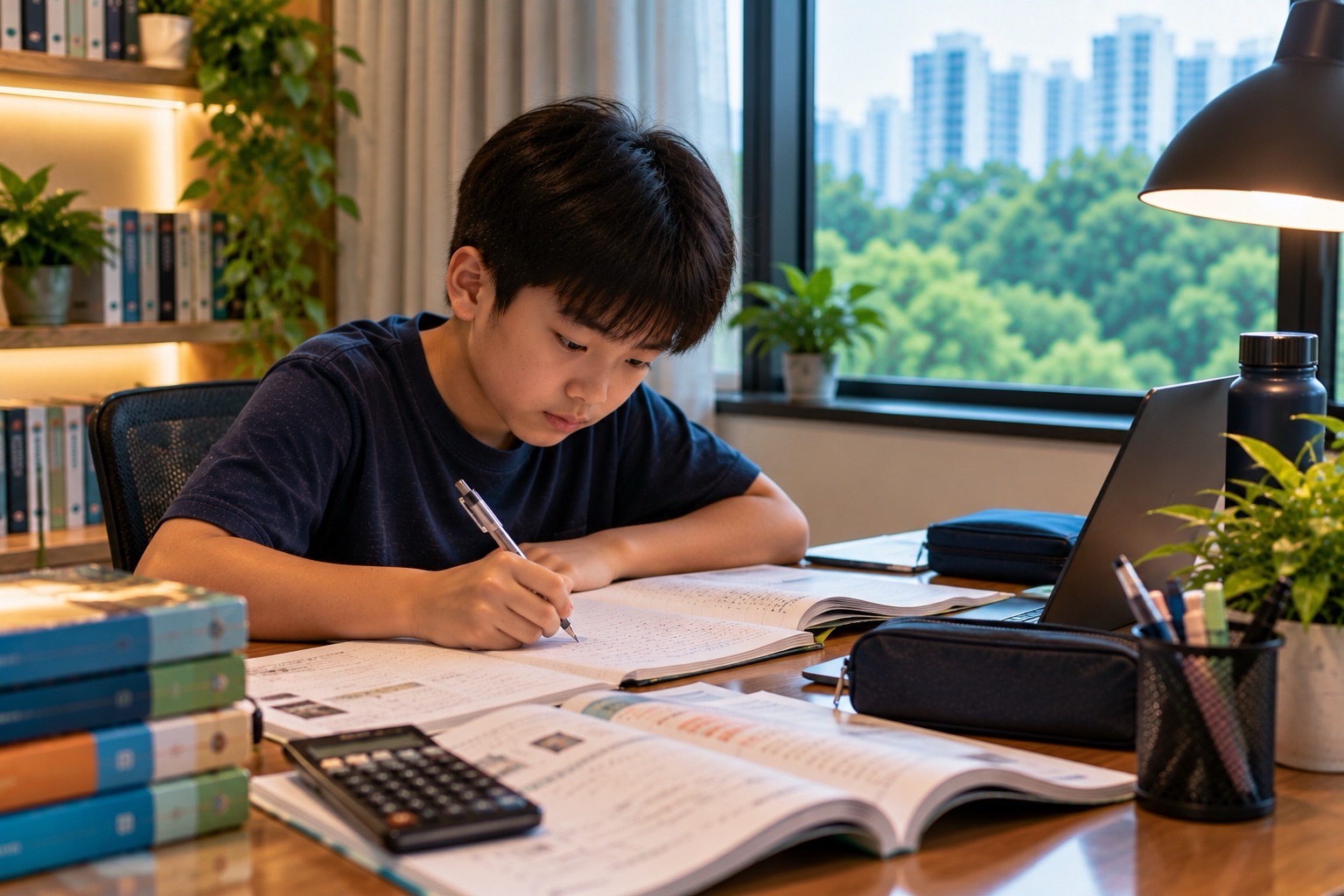
How much should a Punggol family budget for school in 2027? There is no single amount suitable for every household. A Singapore Citizen in an MOE government primary school has a different fee arrangement from a Permanent Resident, an international pupil, a child in private preschool, or a teenager in an independent school. But families face several common cost categories: official school charges, uniforms and books, meals, travel, student care, devices, CCAs and optional tuition or enrichment. Start with your child’s actual school and enrolment status, then get the current 2027 fee and booklist notices rather than relying on a general price estimate.
If the household may qualify for assistance, check the MOE Student Finance System and the MOE Financial Assistance Scheme. The core MOE FAS household means-test threshold published for 2026 is gross monthly household income of S$4,000 or less or per-capita income of S$1,000 or less, subject to the current scheme. Student-care help is a different scheme: from January 2027, MSF’s revised SCFA thresholds include S$6,500 gross household income for eligible households with four or fewer members or S$1,625 per-capita income for larger qualifying families. This guide explains the full budgeting method, not a promise that an individual subsidy or discount has already been approved.
- **Get the right quotation:** school level, citizenship or residency, programme and academic year affect the school charge.
- **List compulsory items separately:** fees, prescribed books, uniforms, compulsory equipment and essential transport.
- **Separate services:** preschool, primary student care, a private tuition centre and the child’s school may issue different contracts.
- **Count ongoing spending:** meals, transport, devices, CCA costs, childcare and external lessons if chosen.
- **Record one-off costs:** registration, deposit, school bag, shoes, initial supplies and device accessories.
- **Check assistance:** MOE FAS, school-based aid, MSF SCFA, ECDA preschool subsidy, relevant bursaries and scheme-specific support.
- **Use approved amounts only:** do not deduct a hoped-for subsidy from the budget as though it has already been granted.
- **Read notice periods:** tuition, student care and private programmes may require advance withdrawal notice.
- **Compare total time:** a cheaper faraway option can create commuting, meal and work-schedule costs.
- **Protect recovery:** more spending on worksheets and classes does not automatically improve learning.
- **Review at transition:** P1, P3, P5, PSLE/Secondary 1, upper secondary and post-secondary each change the cost picture.
The fastest way to make a 2027 education budget
Open a blank page and write the school name, child’s current level, intended 2027 level, citizenship status and the relevant admission or enrolment outcome. Then divide all costs into three groups: predictable school essentials, dependent services such as student care, and optional expenditure such as tuition. Do not start with the biggest tuition advertisement you have seen; begin with what the child actually needs to attend school safely.
For each item, note the provider, whether it is compulsory, when payment is due and whether assistance is confirmed. Include recurring monthly spending and one-off amounts separately. A family with two children should maintain a distinct sheet for each, then create one shared household view. This prevents double counting and makes it easier to see what will change when a child progresses to secondary school or changes its after-school care arrangement.
Government primary school costs versus other school types
Singapore Citizen pupils in government primary schools have the applicable school-fee provisions published by MOE, but families still need to examine standard miscellaneous fees and other essential expenses. Permanent Resident and international-student fees can differ substantially, and independent or privately funded institutions have their own schedules. Parents should read the current official fee information for the actual child, not a copied price table missing the nationality or school-type column.
A child attending a government-aided school, independent school or an international-school curriculum may face a different combination of fees. Admission eligibility and the right programme therefore need to be settled before constructing the budget. Do not describe all Singapore primary education as either completely free or universally expensive. School fees are only one part of a family’s costs; meal, travel and caregiving decisions can be far more significant in the daily cash flow.
Secondary fees and the difference between school and miscellaneous charges
Secondary school introduces additional requirements such as more subjects, changing timetables, possible personal learning device arrangements and CCA commitments. Standard school fees and miscellaneous fees are distinct charges, and the amount payable can vary with citizenship and school type. Independent schools may have separate fee structures and financial assistance arrangements. Families should obtain the actual receiving school’s 2027 notice before assuming a quoted amount from another school applies.
For a pupil entering Secondary 1 after PSLE, the biggest initial risk is buying the wrong supplies before the posting is confirmed. The school will issue instructions about uniforms, textbooks, devices and reporting. A family’s budget can reserve an amount while keeping purchasing decisions flexible. An honest estimate should mark unknown items as pending rather than invent exact fees, particularly where the school assignment is not yet known.
Textbooks: buy the prescribed list, not an entire bookstore display
Booklists differ by school, level and subject combination. In primary school, a child may need workbooks and textbooks according to the class timetable. In secondary school, the correct G1, G2 or G3 subject levels and actual combinations determine what materials are required. A parent who purchases a generic “Secondary 1 complete bundle” before checking the school’s list may spend money on the wrong books.
Wait for the official booklist and verify which items are compulsory, recommended or optional. Ask when books can be collected and whether the school has a second-hand or approved assistance arrangement. For eligible MOE FAS families, textbooks may be supplied through the school’s own procedure; purchasing them in advance should not be assumed reimbursable. Reuse suitable books from siblings only if the edition and subject requirements match the school’s current instructions. Buying less intelligently can be better education spending than buying more impulsively.
Uniforms, shoes and the cost of school-day readiness
Uniform costs depend on the receiving school, required attire and how quickly a child is growing. Secondary pupils may need PE or CCA clothing in addition to ordinary uniforms, while primary pupils may require appropriate shoes and identification items. The family should ask which items are genuinely mandatory in the first week and which can be purchased after the timetable is known.
Avoid ordering too many sets in a size the child may outgrow quickly. Allow for washing, rain and activity, but base the quantity on real use. For eligible financial-assistance families, approved school attire can be covered under specific schemes; verify the school’s collection instructions before making a private purchase. A uniform is a tool that helps a child participate in school, not a justification for competing on accessories or premium brands.
School meals: what an ordinary week really costs
Meals may include breakfast before leaving home, recess, lunch after school and a snack on CCA days. A family should count the number of actual school days and the child’s routine rather than multiply an untested daily amount by every calendar day. The cost can change between a younger child who comes home soon after dismissal and a teenager staying late for laboratory work or sport.
MOE FAS provides meal support under the current scheme for eligible pupils, including specified meal quantities by school level. The way the benefit is used should be checked with the school. Even with support, families should plan for food outside the covered period, holiday days and any individual dietary needs. Good nutrition and a predictable meal schedule affect the child’s capacity to learn, so this is an essential expenditure category rather than a small afterthought.
Transport: public bus, LRT, MRT and school bus
Punggol families may use walking routes, public buses, the Punggol LRT, North East Line or an appointed school bus. These arrangements have different costs and supervision requirements. A school that appears nearby may still require a paid service because the child cannot travel alone or the adults’ work hours are incompatible with walking. The actual home-to-school path matters more than the estate name.
For public transport, estimate the normal number of trips and the student’s applicable fare arrangement. For an appointed school bus, obtain the operator’s written monthly fee, payment schedule, holidays and notice terms. Some eligible MOE FAS pupils may receive transport support under specific conditions; public transport aid and school-bus support are not identical. Avoid budgeting on both at full value unless the school confirms the entitlements. Test a realistic rainy-day and late-dismissal route before choosing.
Student care can cost more than the school fee
A primary pupil may finish classes hours before a working parent can return to Punggol. A school-based or community-based student-care centre can provide supervised time, meals, homework routines and activities. This service has its own fee, availability and contractual terms. A family may therefore pay substantially more for after-school coverage than for the formal school fee itself.
Ask for an itemised quotation that distinguishes monthly care from holiday programme costs, deposits, meals, transport and any extra enrichment. Under MSF’s 2027 revised Student Care Fee Assistance scheme, some qualifying working families may receive up to S$290 monthly toward an eligible child’s care, subject to tier, centre registration and conditions. An approved amount is not guaranteed merely by falling under one income threshold. Read the Punggol student-care guide before setting a net budget.
Preschool fees and ECDA assistance are a separate calculation
Infant care, childcare and kindergarten programmes have different operating hours and fee models. Parents should not compare a full-day childcare quote directly with the charge for a shorter kindergarten programme without explaining what each includes. The age band, available vacancy, meals, deposit and withdrawal rules matter. Some government-supported providers operate under separate fee arrangements from private centres.
For an eligible household, ECDA’s preschool subsidies can affect the actual amount paid after enrolment and approval. Do not assume the subsidy for an older sibling is identical to the next child’s entitlement, or that a published gross fee is a net family invoice. Check through LifeSG Preschool Search and obtain the provider’s written calculation. Preschool and primary student care are different services, so the subsidy applications cannot be merged into a single generic “childcare discount”.
KCare and the move into Primary 1
Kindergarten Care may extend the care day for eligible MOE Kindergarten children. A Primary 1 pupil uses a different school and possibly a separate student-care operator after admission. The family may therefore face a transition in fees, collection point, hours and subsidy rules. It is a common mistake to assume that a familiar kindergarten-care place will simply become the primary-school care place on the first day of January.
Plan two budgets for the transition year: the final kindergarten period and the first primary-school term. Confirm the child’s Primary 1 placement before making assumptions about the receiving school’s centre. Ask whether the relevant programmes have places, how deposits are handled and who collects the child in the first week. Good care planning preserves the parent’s work schedule and the child’s sense of safety; it should not depend on an unconfirmed school admission.
The National Digital Literacy Programme and PLD costs
MOE secondary students use Personal Learning Devices through the National Digital Literacy Programme, with school-specific procurement, device management and usage arrangements. The model, price, warranty and accessories may differ by school and cohort. A family should not buy a generic tablet or laptop simply because it looks similar to a friend’s device. The receiving school will explain approved options and any support arrangements.
Singapore Citizen pupils may have relevant Edusave use or subsidy support under the current rules, while other households may need to budget the full purchase or an approved alternative. Ask whether a device is provided, bought in a school bundle or supported by an existing compatible device. Include replacement risk and storage or transport protection, not unnecessary premium accessories. A personal device is an educational tool only when the pupil uses it safely and purposefully.
Edusave is not simply cash available for any purchase
Edusave supports specified educational uses for eligible students under MOE’s rules. A parent may see an account balance and assume it can be used for any external tuition programme or personal electronics purchase. That is not the correct approach. Edusave withdrawals and uses depend on the approved category, institution and consent procedure. A school may provide specific instructions for a PLD or an approved enrichment programme.
Before setting a net cost, ask whether the actual expense is an authorised Edusave use and what part remains payable. Do not mix Edusave with MOE FAS; they have different purposes and eligibility. A cost sheet can record “possible Edusave use — to confirm” until the school supplies the legitimate form. Making the distinction avoids a budget that assumes money can be moved freely between unrelated expenses.
CCA and enrichment: plan for meaningful participation
Co-curricular activities can develop friendships, teamwork, leadership and interests outside examination subjects. Some school CCAs involve equipment, attire, occasional events or travel, and the details vary. A parent should ask about actual costs and what may be subsidised rather than assume every CCA is either free or expensive. School programmes should be compared using the opportunities the child will use, not merely the count of activities in the brochure.
Private enrichment such as music, art, sport or holiday workshops is a separate, optional category. It can be valuable, but a child need not attend every programme available in Punggol. Write down the activity’s purpose, duration, total fees, equipment and transport. If the family has limited funds, protect basic participation, rest and family life before adding more paid activities. A sustainable interest pursued for years can be more educationally valuable than many short, unrelated certificates.
Tuition: an optional expense that must solve a real need
Private tuition may be offered one-to-one, in small groups, online or in larger classes. The prices and lesson lengths differ. It should not be treated as a compulsory school bill. Begin by looking at the pupil’s actual work and asking what skill is unstable: reading, algebra, scientific explanation, examination strategy or another specific need. A child who is doing well and enjoying learning may not benefit from a fixed extra lesson.
Ask the provider for the total tuition fee, class size, number of lessons, materials charge, missed-lesson policy and withdrawal notice. Evaluate actual teaching feedback, not just a promised grade improvement. eduKate provides small-group tuition in Punggol, but parents should sign up only after the student’s starting position is clear. The Punggol tuition comparison guide separates the value question from price and convenience.
Beware of course packages and prepaid fees
An enrichment or tuition package may appear cheaper when several months are bought at once. The discount should be weighed against the contract’s notice period, refund terms, the provider’s stability and the possibility that the child will not need the service for the full period. Do not assume a family can recover the unused value automatically. Read the actual agreement before paying.
Keep a simple record of all recurring subscription and learning-platform charges as well as physical classes. A low monthly online service can be forgotten after the child stops using it. Evaluate whether it produces learning gains or merely another login. For substantial prepayments, ask whether appropriate consumer protections apply and whether any claimed accreditation can be independently checked. A short trial with clear cancellation terms may be more suitable than a long package that no longer matches the child.
How MOE FAS fits into the 2027 family budget
MOE’s Financial Assistance Scheme supports eligible pupils with specified essential schooling costs. The official published threshold includes gross monthly household income up to S$4,000 or per-capita household income up to S$1,000, subject to the current conditions. The scheme may help with school and miscellaneous fees where applicable, approved textbooks and attire, meals and transport. The receiving school controls collection arrangements and the Student Finance System provides an application route.
A family should check current eligibility, the correct benefit year and any school-based evaluation process. A submitted application is not the same as a confirmed benefit, and approved items may be provided through school arrangements rather than refunded after an independent purchase. Keep the budget before aid and after confirmed aid in separate columns. For a detailed process, read the MOE FAS 2027 guide.
SCFA and school FAS are not one entitlement
Student Care Fee Assistance is administered by MSF for eligible children using centres that meet the scheme conditions, and its income thresholds change from January 2027. MOE FAS helps with specified schooling costs through a different system. A family may qualify for one, both or neither according to the actual criteria. The schemes should not be combined into one fictional payment that can be used for any child’s education purchase.
For ordinary SCFA, the published maximum monthly subsidy is up to S$290 per child, with a possible one-time Start-Up Grant of up to S$400 under the scheme. Approved amounts vary by tier and household circumstances, and the provider must be an eligible administrator. Ask the respective agencies for the outcome and note where each benefit is applied. A written household budget remains useful even when assistance is granted, because meals, holiday programmes or transport outside the benefit may still need family funding.
How to estimate the total without inventing prices
Use real figures wherever possible and clearly label estimates. A practical worksheet has lines for official fees, uniforms and materials, meals, transport, student care, optional tuition, CCA expenses, devices and one-off costs. Add the predictable amounts for the term or year using the actual payment calendar. Do not turn a monthly charge into an annual one without checking whether it is billed during holidays or whether the contract has eleven, twelve or another number of instalments.
A household can create a best-supported case with approved benefits and a cautious case excluding unapproved assistance. The purpose is not to guess the exact amount to the dollar. It is to discover where the family’s exposure is greatest and which expenses can be changed without harming the child’s education. A plan that includes real uncertainty is more useful than a polished number copied from an old school-fee article.
A fictional two-child budget example
Imagine a family with one P1 pupil requiring afternoon student care and one Secondary 2 pupil attending a weekly private tuition lesson. The P1 child has basic school costs, meals, care fees and possibly school-bus expenses. The older student may need public transport, textbooks for current subjects, CCA equipment, device support and the optional tuition fee. The family’s first task is to write two separate itemised lists, then combine only the household totals.
They obtain an actual centre fee quote, ask about SCFA eligibility and check their school assistance status. For the older student, they consider whether tuition is still addressing a real problem. No numerical cost is invented because the relevant school, care provider and tuition contract have not been specified. The exercise shows how different spending can be within one household. A budget that treats both children as identical would conceal the important decisions.
Why a cheaper school or centre can cost more in practice
Suppose two appropriate options differ in their headline fees. The cheaper location is farther from the family’s daily route, needs paid transport and ends its programme before the parent can arrive. The slightly more expensive option may allow a direct walk and a stable caregiver pickup. The true household cost includes money, commuting time and the stress of managing failures in the timetable.
This does not imply that expensive is better. Families should compare the full arrangement on the same basis, asking what is included and what each child will gain. If a school with no extra tuition fees still leaves the child needing support, that is another educational question. If a centre with a premium label provides poor feedback, the price is not a mark of quality. Value comes from educational fit, reliable care and affordability together.
Holiday budgets: the school closes but costs may not stop
The 2027 MOE school calendar includes March, June, September and year-end vacations. School-based student care, kindergarten care, private programmes and school-bus services can follow different operating and billing arrangements. A family should therefore avoid assuming that every monthly cost stops on the first day of a vacation or that an ordinary term-time care fee covers full-day holiday attendance.
Make a separate holiday budget for supervision, transport, meals and a modest choice of activities. A library visit or family walk in Punggol can be educational without a substantial fee. If a camp is booked, verify exact dates, collection times, supervision, weather plans and refund conditions. Parents should protect rest and family life rather than filling every holiday day with paid lessons. The school-holiday planning guide covers the actual calendar framework.
What to do when a payment becomes difficult
An unexpected job change, medical cost or family responsibility can make a previously affordable education plan difficult. The first action is to separate essential school attendance and care from optional programmes, then contact the appropriate institution or scheme administrator about available assistance or payment arrangements. School-based aid may be considered even when a household does not fit the standard national threshold, subject to case-by-case assessment.
For private tuition or enrichment, read the contract and speak to the provider early about reducing lessons, changing a plan or withdrawing under the agreed terms. Do not simply stop paying without checking the obligations. A family should not feel pressured to sacrifice food, health or safe childcare to maintain an unnecessary class. The purpose of financial planning is to protect learning and stability, not to make every childhood activity a permanent expense.
Saving money without making school life smaller
Many useful habits are inexpensive: borrowing books from Punggol Regional Library, reading together, preparing regular meals, reviewing a small number of genuine errors, walking through the neighbourhood and talking about everyday science or history. School resources and targeted support can often address specific needs without an automatic purchase of external tuition. Hand-me-down textbooks or uniforms may help where allowed and current.
Savings should not become deprivation of essential support. If a child has an identified need, ask what assistance is available rather than assuming every effective resource must be costly. A family can choose one meaningful enrichment activity instead of several overlapping ones, or replace an expensive course with a consistent home-learning routine when appropriate. The measure is whether the child learns, participates and remains well, not how impressive the monthly spending looks to other parents.
Four weeks to make a dependable education budget
Week 1 — list the true obligations. Confirm school, level, citizenship, actual 2027 notices and mandatory supplies. Week 2 — collect provider figures. Obtain current care, transport and any optional tuition quotations, including deposits and notice terms. Week 3 — check assistance. Apply through the relevant verified channels and distinguish pending from approved amounts.
Week 4 — make deliberate choices. Reserve for one-off school-start spending, decide which optional activities truly serve the child and confirm the household’s transport and collection routine. Revisit the plan after the first month because schedules can change. If an official application or fee deadline falls earlier, follow that date rather than this generic four-week structure. The aim is to make every major expense understandable and every child’s school day sustainable.
Frequently asked questions about 2027 school costs
Is school free for Singapore Citizens? Government-school tuition-fee arrangements are favourable for Singapore Citizens, but family costs such as meals, uniforms, materials, transport and care still matter. Check the exact school type. Do PR and international students pay the same? No; verify official fee categories. Is private tuition compulsory? No. Does FAS reimburse any books I buy? Do not assume so; follow the school’s covered-item process.
Does a child-care subsidy pay for student care? Different age-based schemes apply; ECDA preschool support and MSF SCFA are distinct. Is SCFA automatically S$290? No; that is a maximum for eligible ordinary care under the published tiers. Are school-bus fees included? Fees and support depend on the arrangement and scheme conditions. How do I get a reliable total? Use actual school notices, provider quotations and confirmed assistance, then review the full family’s schedule.
Official sources and useful Punggol reading
Official: MOE school fees; MOE financial assistance; Student Finance System; MSF 2027 student-care subsidy; LifeSG preschool search; MOE school calendar.
Related Punggol guides: MOE FAS 2027; Student care and SCFA; Tuition class comparison; Complete education guide. Prepared November 2026. No third-party fee estimate can replace the current notice, confirmed enrolment and subsidy outcome for the individual family.


