
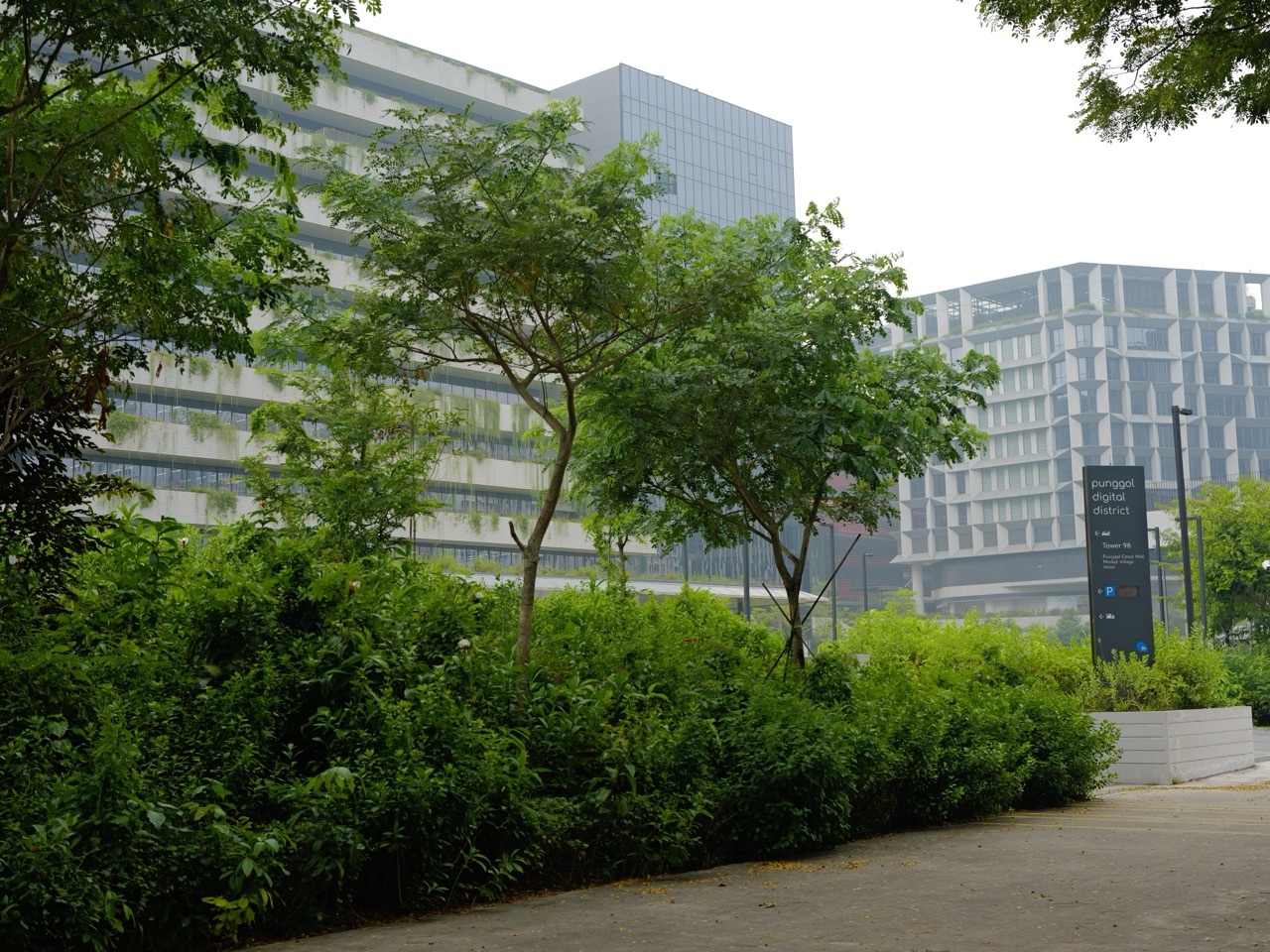
Why was Punggol Digital District designed as a “living lab” rather than simply another place for companies to rent office space? The answer is that technology can perform well in a controlled classroom or a computer simulation and still encounter difficulties when it meets real buildings, lifts, delivery routes, changing weather and people. JTC and the Singapore Institute of Technology (SIT) designed the district so suitable companies, researchers and students could co-develop, test and improve technologies in a managed, real-world environment before considering broader use.
At SIT Punggol Campus’s official opening on 16 September 2025, SIT, JTC and IMDA described the precinct as a district-level testbed supported by SIT’s Living Lab Network and JTC’s Open Digital Platform (ODP). The stated focus includes autonomous robots, smart-city infrastructure, artificial intelligence, cybersecurity and sustainability. A digital twin can help developers simulate conditions and investigate interactions among systems; suitable approved pilots can then test what actually happens on site. This distinction is the reason for the district’s unusual academic-and-business arrangement. It is not permission for any visitor to deploy a robot or probe a live system without authorisation.
- Where: Punggol Digital District (PDD), alongside SIT Punggol Campus and JTC business-park developments.
- Core idea: a living lab uses real environments and operational information to support appropriate research and innovation.
- Partners: SIT, JTC and IMDA described a precinct-level testbed at SIT’s September 2025 campus opening.
- Digital layer: the Open Digital Platform and relevant digital-twin functions allow simulated testing and integration with authorised systems.
- Examples: robotics, cybersecurity, energy management, smart facilities and other applications.
- Three stages: design or simulate, conduct controlled tests, then evaluate whether wider deployment is warranted.
- Important limits: prototypes can fail, permissions and cybersecurity matter, and an announced experiment is not necessarily a permanent public service.
- For students: authentic learning requires problem definition, measurements, supervision and evaluation, not merely access to expensive technology.
- Best sources: JTC’s PDD stories and SIT’s official 2025 campus announcement.
Why a normal office park is not automatically a living lab
An ordinary office park gives businesses premises in which to work. Tenants may develop software or products, but the surrounding streets, lifts and utilities need not be part of any authorised research programme.
A living lab deliberately allows selected technologies to interact with a real environment under agreed conditions. That creates opportunities to discover issues a desk-based project might miss.
PDD combines physical buildings, digital systems and research partnerships to support this process. The property still performs its ordinary functions; its experimental role does not turn the whole district into an uncontrolled workshop.
Why a university belongs in the same district
SIT’s applied-learning model emphasises working with actual industry problems. Being near relevant companies and shared systems can make collaboration easier.
At the September 2025 campus opening, the partners described a location where industry and academia would jointly develop and pilot solutions. The students, researchers and companies can contribute different skills.
This is a specific reason for the co-location: learning and problem-solving can be organised around real operating environments. The separate SIT–Digital District article covers the general planning relationship; this article explains the testing and evaluation mechanism.
Why simulated testing happens before public pilots
A new technology may have errors, unexpected behaviour or unanswered questions about how it interacts with existing infrastructure. Running it immediately in a busy public area can create avoidable risks.
A simulated environment can allow developers to test scenarios, identify conflicts and refine software before requesting appropriate physical deployment.
JTC’s explanation of the PDD digital twin emphasises the ability to test different conditions digitally. This is a risk-reduction stage, not a guarantee that every possible failure can be predicted by a computer.
What a digital twin actually represents
A digital twin is a digital representation linked to information about a physical system. Depending on implementation, it can reflect relevant buildings, equipment, usage and environmental conditions.
JTC describes PDD’s digital-twin component as part of the Open Digital Platform, enabling developers to work with real district information and model systems.
The representation is not the physical city itself. It can omit details, contain errors or depend on the quality and permissions of its data sources. A useful simulation must acknowledge those limits.
Why real data can change an experiment
A developer may assume a corridor is always empty or a lift is available instantly. Real usage can reveal patterns that differ from those assumptions.
Approved operational information can help identify whether a proposed system is likely to encounter congestion or require coordination with other equipment.
But access to data is not unrestricted. Privacy, cybersecurity, commercial sensitivity and legitimate authorisation must shape which information can be used. Realism is valuable only within responsible controls.
Why a simulation is not a risk-free real deployment
A developer can run a hypothetical robot in a digital environment without putting a physical robot next to pedestrians. That may reduce the immediate risks of that particular experiment.

Once a real machine enters a live public or operational area, physical hazards and real-world uncertainty apply. Appropriate approval, safety assessment and supervision remain necessary.
A phrase such as “test with no risk” should be interpreted in its original context of digital simulation, not expanded into a claim that a physical prototype can never injure anybody.
Why autonomous robots need complex routes
A delivery robot may need to travel between a shop, a lift lobby, a corridor and a receiving building. It may encounter doors, slopes, pedestrians or changes in access permissions.
JTC’s digital-twin article gives an example of simulating a delivery robot travelling between a mall and another building while interacting with different facilities.
The challenge is not simply driving forward. It is completing a sequence of authorised movements through shared spaces without creating conflicts or losing track of the delivery.
Why a lift is not just a vertical road for a robot
A lift has its own controls, safety rules and passenger priorities. A robot cannot assume it may press any button or enter every lift whenever it wants.
An integration may require the equipment and building operator to recognise authorised requests and manage competing demand.
JTC describes robot tests involving lift and door systems. This shows why software interfaces matter, but does not imply that every public lift in Punggol already accepts commercial delivery robots.
Why doors create an interoperability problem
Different buildings may use different access-control systems. A robot that can travel along a corridor cannot necessarily open a secure door or enter a restricted area.
For suitable integration, the relevant systems must exchange authorised information under clear rules. The robot needs to know whether access is permitted, while the building needs to control who and what may enter.
This is the practical meaning of interoperability in a smart district: separate systems coordinate for a permitted task without becoming one unrestricted network.
Why different robot brands may need common rules
One company might design a delivery robot while another designs equipment for inspection or cleaning. Their software and hardware can be different.
A district-level platform may provide authorised interfaces that allow suitable systems to coordinate in shared spaces without each company negotiating an entirely incompatible solution.
JTC anticipated the possibility of more than one robot provider testing within the ecosystem. That remains a design objective or pilot opportunity, not evidence that every possible robot brand already works together flawlessly.
Why the Open Digital Platform has a separate role
The ODP integrates selected district-level information and operational systems. It is the digital infrastructure that can help authorised applications exchange data and coordinate functions.
A living lab is the broader process in which companies and students develop, test and evaluate solutions using appropriate facilities and data.
These are related but distinct. A platform alone does not provide a research question, qualified supervisor or evidence of a successful product. The existing ODP article explains the data-integration layer separately.
Why a student project needs a real problem
Authentic applied learning starts with an operational need, such as reducing unnecessary waiting, improving suitable energy efficiency or making an approved service more accessible.
A student then asks which measurements and constraints are relevant before proposing a prototype. Merely being in a high-tech building does not guarantee useful learning.
The living-lab model becomes valuable when the project connects a real question to suitable data, design, testing and evaluation.
Why working near companies can improve feedback
An industrial partner may understand the practical demands of users, operational regulations and cost constraints. Students and researchers may contribute new technical approaches or evidence.
When they collaborate, feedback can arrive before an idea is developed too far in the wrong direction.
The partnership still needs clear responsibilities. An industry collaborator may not approve every proposed experiment, and a student should not treat the partnership as permission to access unrelated company information.
Why a lab result may differ from a real-world result
Controlled laboratory conditions can remove many variables, including unpredictable movement, environmental conditions and equipment interactions.
A real district can expose the technology to some of these factors, helping researchers assess whether earlier conclusions remain valid.
That does not mean the real-world site gives a perfect statistical sample of every town. PDD is one distinctive environment, and successful results may need further evaluation elsewhere.
Why a robot must recognise changing conditions
A delivery route can become wet, crowded or temporarily closed. Sensors and navigation systems may be challenged by these changes.
JTC’s digital-twin story discusses simulated wet-weather conditions to study how a robot might behave during a usual journey.
That is a concrete example of testing an assumption before a public trial. A real robot’s performance must still be assessed safely, because a simulation cannot cover every possible environment or failure.
Why robot safety is more important than novelty
A mobile machine in a shared place must not block emergency exits, collide with pedestrians or enter inappropriate areas.
A responsible pilot therefore needs suitable safeguards, supervision and authorisation before any public operation.
The fact that a prototype moves autonomously is not by itself evidence that it is safe for every setting. A living lab is valuable precisely because these concerns can be evaluated methodically.
Why cybersecurity belongs in a living lab
Digital systems manage data and may control access to physical equipment. Security weaknesses can create privacy, operational or commercial risks.
PDD’s research partnerships include cybersecurity testing, with public JTC accounts describing collaborations involving SIT and relevant security companies.
These programmes are not invitations to attack live systems. Authorised cybersecurity testing follows defined scope and permission. The lesson is that innovation should include responsible evaluation of possible failure and misuse.
Why a cybersecurity test needs authorisation
A company’s application or a district network is not automatically open for anyone to probe because it is described as a testbed.
Professional tests operate within permission, defined targets and safeguards. Without those boundaries, a supposed experiment could disrupt the very system it is intended to improve.
Students should distinguish learning about cybersecurity from attempting unauthorised access. The living-lab idea depends on accountable collaboration, not unlimited experimentation.
Why a digital twin can help cybersecurity research
A simulation or isolated testing environment may help developers study scenarios without exposing actual public services to unnecessary disruption.
JTC describes the Cyberpolygon Sandzone initiative in partnership with SIT as a setting for stress-testing appropriate applications and systems.
The exact current availability and scope need confirmation from the operator. Its published purpose shows how a district can support security research while separating controlled tests from real-world attacks.
Why energy efficiency provides another test case
PDD includes smart energy infrastructure and district cooling. New tools might analyse demand patterns, timing or the coordination of different systems under authorised arrangements.
A living lab offers opportunities to compare a proposed method with measured operating conditions rather than rely entirely on simplified forecasts.
However, an energy dashboard does not establish that a proposal saved a specific amount of electricity unless an appropriate comparison is made. Measurement and evaluation remain essential.
Why a new algorithm does not always save energy
An algorithm may optimise the wrong objective, use incomplete data or ignore a practical constraint such as occupant comfort.
A controlled test should define what is being improved, which requirements cannot be compromised and how the outcome will be measured.
This is why good applied research combines technical development with operational expertise. A clever model is useful only when it improves the actual service under acceptable conditions.
Why the campus is itself a research environment
SIT’s Living Lab Network integrates selected campus systems to provide appropriate learning and applied-research opportunities.
The university can therefore use its premises and operational data as part of teaching and innovation, subject to the relevant permissions.
This does not turn student residences or classrooms into spaces that researchers may enter without consent. A living lab still has privacy, safety and institutional boundaries.
Why a university needs normal operations while experiments occur
Lectures, laboratory sessions, study, building maintenance and public access must continue according to normal operational needs.
An experiment that repeatedly disrupts teaching or blocks a major entrance may be unsuitable regardless of its technical interest.
A managed living lab balances investigation with the obligations of a real campus. The authenticity of the environment is valuable partly because normal users and constraints cannot simply be ignored.
Why the district can support startups
A small company may lack access to a complete network of connected buildings and operational infrastructure for testing an idea.
JTC’s PDD concept offers a shared ecosystem where authorised partners can co-develop and pilot suitable solutions, potentially lowering some costs and helping identify a market.
But access depends on programmes, agreements and practical conditions. Being a startup does not automatically grant free use of all district data, equipment or research facilities.
Why a startup needs evidence before claiming success
A trial may show that a robot can complete one route under defined conditions. That does not prove it can operate across every Singapore city, handle all deliveries or replace all staff.
A useful report states the route, observations, limitations and what would need further testing.
This discipline protects users and helps businesses make better decisions. A narrow verified result is more valuable than a broad unsupported marketing claim.
Why students can learn from an unsuccessful pilot
A prototype that fails safely under an authorised test can reveal problems in assumptions, sensors, user interaction or integration.
The result may support a better redesign or show that the idea is not appropriate for the intended environment.
Research is not limited to demonstrations that succeed. The learning value includes understanding why an approach did not meet its goal and documenting the evidence honestly.
Why a real environment still needs controlled conditions
A living lab is not the opposite of scientific control. Researchers still need a defined test period, procedures, safety arrangements and suitable comparisons.
The environment introduces real-world complexity, while the experimental method tries to identify which factors influence the outcome.
Without such discipline, a change in performance might be caused by weather, human traffic or equipment differences rather than the prototype itself.
Why privacy must be designed into experiments
A district contains workers, students and visitors who have legitimate expectations about how their information is handled.
Projects using cameras, location data or behavioural measurements require an appropriate basis and controls, and not every operational dataset may be available to developers.
An article should not assume that “living lab” grants researchers permission to identify or track individuals at will. Respectful innovation must protect people who are part of the environment.
Why access to building systems must be limited
A robot or software developer may need some information about permitted lift or door interfaces to test an application. That does not justify full access to security systems or every building record.
Authorised interfaces can provide only the information needed for a specific job, subject to the operator’s requirements.
This is a general cybersecurity lesson: interoperability and unrestricted access are different concepts. Useful integration should retain boundaries.
Why a single test site cannot represent all of Singapore
PDD has a purpose-built campus, business parks and connected digital infrastructure. Its users and buildings differ from older HDB estates, hospitals and industrial sites.
A successful test there is valuable evidence, but an application may require further work before adoption elsewhere.
A responsible developer evaluates where the tested conditions match the next site and where they differ. Scaling is a new task, not merely repeating a success claim.
Why test, pilot and scale are different stages
A test may investigate one function. A pilot uses a limited deployment under defined operating conditions. Scaling extends a proven approach to more users, locations or tasks.
SIT and JTC explicitly describe the district as supporting co-development, pilots and scaling of suitable solutions.
Keeping these stages separate prevents a prototype demonstration from being reported as a fully launched nationwide service.
Why the 2025 campus opening is an important milestone
SIT officially opened its Punggol Campus on 16 September 2025, reinforcing the district’s university-industry ambition.
The announcement described SIT’s Innovation-as-a-Service platform, the Living Lab Network and connections with JTC and IMDA.
That is a dated institutional milestone. It does not mean every future research programme, company partnership or autonomous robot service began operating on the same day.
Why the district opened in phases
A large development includes buildings, infrastructure, campus facilities and commercial tenants with different readiness schedules.
Some systems and programmes may be operational while others are being prepared, tested or expanded.
A current article should avoid treating a press-release vision as proof that every component is fully deployed. Use the latest operator information for a specific trial or service.
Why official partners do not all perform the same job
JTC develops and manages industrial and business-park aspects of the district, SIT provides academic and applied-research capabilities, and IMDA contributes to relevant digital-economy initiatives.
Their roles overlap in collaboration but are not identical. A responsible project needs to know which party authorises access, provides data and evaluates outcomes.
A user should not assume a university student’s agreement alone grants permission to alter a JTC-controlled system.
Why the digital twin may include historical playback
JTC has described using a digital twin to examine past information and simulate alternative operating conditions, such as different traffic or energy demand patterns.
Historical playback can help developers explore what happened under a recorded situation before designing changes.
But stored data may be incomplete or limited by collection practices, and it does not automatically prove the cause of an observed event.
Why a real-world pilot needs a baseline
Suppose a proposed facilities tool claims to reduce waiting or energy use. To evaluate that claim, the researchers need an appropriate comparison with previous or alternative operation.
Without a baseline, an apparent improvement might simply reflect a quieter day or different users.
A strong living-lab result reports the metric, observation period and limitations. Good evidence supports both innovation and public trust.
A fictional autonomous delivery experiment
Imagine a company testing a robot’s ability to move from an authorised loading area to a building lobby.
The team first models the route, identifies permitted doors and checks how the robot should behave around pedestrians. It then seeks the required approvals before any controlled physical pilot.
This example illustrates the process. It is not confirmation that a public robot currently follows that exact path in PDD.
A fictional digital-twin wet-weather test
A simulated robot encounters an invented wet-weather condition on a planned route. Its software must decide whether to slow, stop or choose an authorised alternative path.
The team records the result and adjusts its design. A later physical test still needs appropriate safety conditions.
The lesson is that simulation can reveal likely problems without establishing that every real rainstorm will produce the same result.
A fictional lift integration problem
A robot reaches a lift lobby but does not have permission to request access to a restricted level.
The correct system should respect the access rule rather than force entry merely to complete the delivery quickly.
Students learn that a technically possible route is not automatically a lawful or authorised route. Security constraints are part of the design.
A fictional energy experiment
A company proposes an algorithm that reduces cooling energy under certain conditions. The pilot measures energy use and occupant comfort over a suitable defined period.
If electricity use falls but comfort becomes unacceptable, the result may not be a successful operational improvement.
The exercise demonstrates why a prototype should be evaluated against several important outcomes, not one attractive number.
A fictional startup announcement
A founder says, “Our robot crossed one corridor successfully, so we have solved every delivery problem in Singapore.”
The student identifies missing evidence about other routes, access interfaces, weather, safety and maintenance.
The corrected statement describes a successful limited test and the additional work needed before wider use. This is how innovation reporting remains credible.
A fictional student portfolio entry
An SIT student documents a suitable approved project with the problem, method, dataset, findings, limitations and next steps.
That portfolio provides more useful evidence of learning than simply listing the phrase “AI living lab” without explaining a task.
The educational value comes from the student’s reasoning and documented work, not just the prestige of the surrounding district.
Why everyday residents can benefit without joining a trial
Residents may eventually use technologies improved through appropriate research, such as more reliable facilities management or better service information.
That is an anticipated pathway from testing to useful services, not a promise that every proposed product will reach the public.
The strongest community benefit arises when trials respond to genuine needs, protect users and result in dependable improvements rather than technology for its own sake.
Teaching Guide: from prototype to useful public service
Learning goal: explain why PDD combines a real district, digital simulations, industry partners and university learning under managed testing arrangements.
Activity one: choose a fictional problem, such as a delivery robot getting delayed at a lift. Activity two: identify the data, permissions and safety constraints that a developer needs.
Activity three: design a digital simulation, then list what the simulation leaves out. Activity four: propose an authorised limited pilot and a suitable performance measure.
Activity five: explain the difference between a successful trial and a product ready for large-scale deployment. Activity six: identify what privacy, security and public-safety boundaries should remain intact.
Transfer test: evaluate an innovation proposed for an HDB estate, hospital or school, noting which PDD findings may transfer and which require new evidence.
Frequently asked questions
What is a living lab? A managed setting for studying and testing appropriate innovations in or alongside real operating environments.
Why does PDD have one? JTC and SIT aim to connect research, industry and practical district infrastructure.
When did SIT Punggol Campus officially open? On 16 September 2025.
What technologies can be studied? Official examples include robotics, AI, cybersecurity, smart facilities and sustainability.
Is the digital twin the physical district? No. It is a digital representation linked to appropriate information about the district.
Can a startup deploy any robot anywhere in PDD? No. Actual tests require suitable authorisation, access and safety processes.
Does a simulated successful robot run guarantee public safety? No. Physical testing and evaluation remain necessary.
Can anybody access all district sensor data? No. Legitimate permissions, security and privacy controls apply.
Is a prototype the same as an operating public service? No. Testing, pilot deployment and scaling are different stages.
Where can I learn more? JTC’s PDD living-lab articles and SIT’s official campus-opening announcement.
Your next step
Start with SIT’s official Punggol Campus opening announcement, JTC’s Living Lab explanation and JTC’s Digital Twin article.
For the data layer, see Why Punggol | Digital District Needs One Platform. For the campus’s broader land-use role, see Why Punggol | SIT and Digital District Share the Same Neighbourhood.
The one idea to remember is that a living lab makes innovation accountable to reality. A developer can model a good idea, test it responsibly, measure its actual usefulness and learn whether it deserves wider adoption.


