
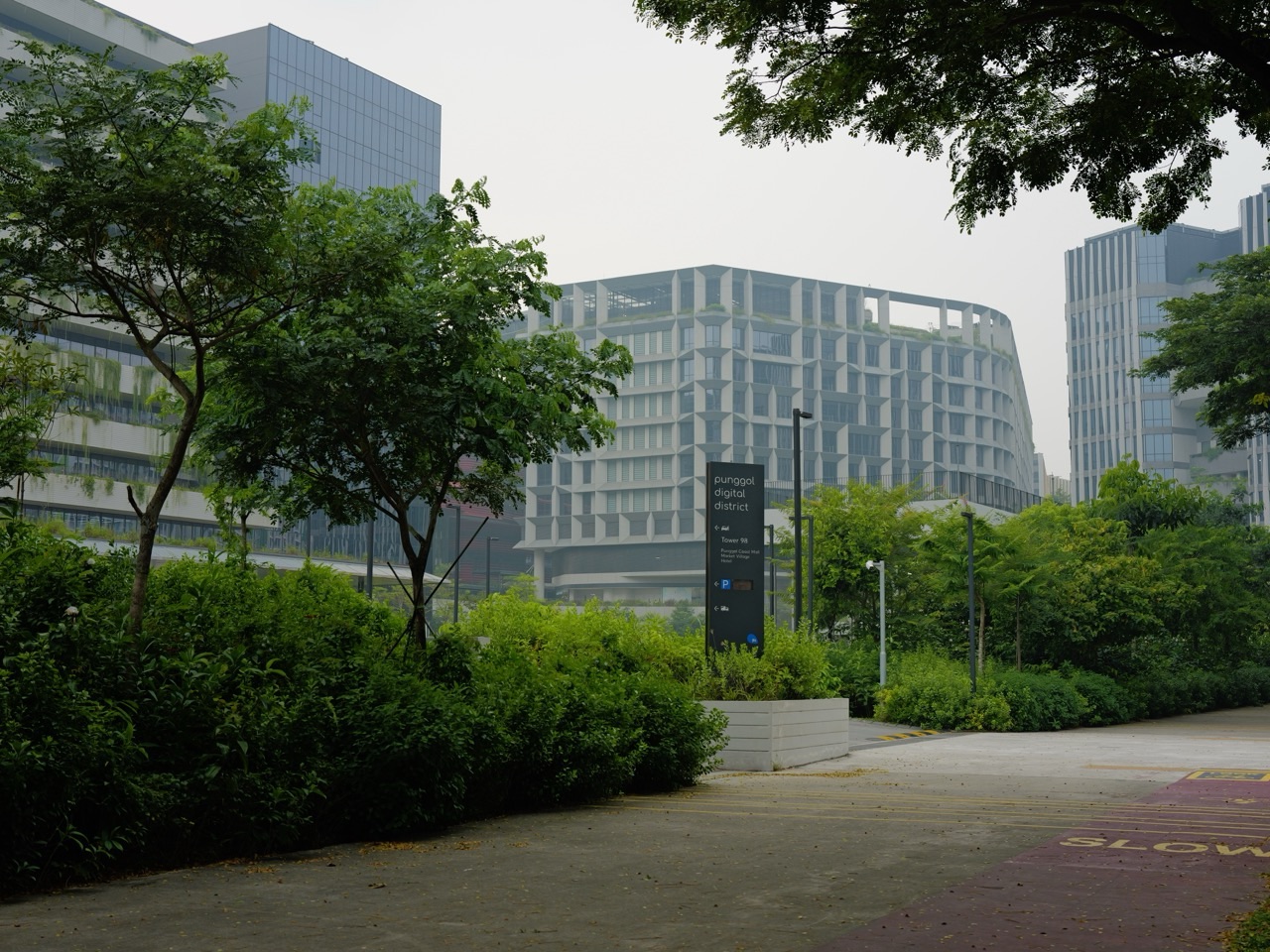
Why would a university campus and a business park be planned as neighbouring parts of the same Punggol district? A university teaches and researches. A company designs, tests, sells and supports products. Their jobs are different, so why put them close enough to share the character of a place?
The answer begins with a simple idea: learning and working can improve one another when organisations have useful reasons to collaborate. Punggol Digital District brings the Singapore Institute of Technology (SIT) and a JTC-developed business park into a planned innovation setting. Physical proximity can reduce some barriers between classroom knowledge, practical problems, laboratories, professional expertise and work opportunities—but only if people deliberately make those connections.
For Punggol residents, this explains why the coastal part of the town is changing from primarily a housing-and-recreation destination into a place associated with university life and digital industry. This easy guide explains the reason for the co-location, what it can and cannot achieve, and what families should understand before treating the district’s published future ambitions as guaranteed personal outcomes.
The answer in 50 seconds
JTC describes Punggol Digital District as a 50-hectare business park integrated with SIT. The district focuses on digital-economy fields such as cybersecurity, artificial intelligence, robotics, financial technology and smart-city solutions. JTC’s published district overview uses figures of 28,000 jobs and 12,000 students to describe the intended scale of the ecosystem. Those numbers should not be mistaken for a verified count of vacancies available today.
The underlying planning logic is that companies can bring real operational problems while university staff and students bring skills, research and fresh questions. Shared infrastructure, public transport and appropriate collaboration arrangements can make knowledge easier to test outside the classroom.
The district’s success is not measured simply by putting buildings beside one another. The real question is whether useful ideas travel from a genuine problem to a safe test, a credible result and a practical improvement.
Why the old picture of a business park is incomplete
A traditional mental picture of a business park is a set of office buildings where employees work during the day and leave at night. A university is imagined as a separate campus where students attend classes, use laboratories, sit for examinations and eventually graduate.
That separation is easy to understand, but it can hide useful links. People who teach engineering, design or computing need to know which problems matter outside textbooks. Companies often need help exploring new techniques, identifying risks or understanding emerging technologies. Students need opportunities to practise judgment under constraints that cannot be fully reproduced in a classroom example.
Putting institutions closer together does not automatically solve all these needs. But it makes some kinds of meeting, project development and shared activity easier to organise. The physical layout can support collaboration by reducing the effort required for people to reach one another.
The important distinction is between ‘near’ and ‘connected’. Two buildings can stand next to each other for years without any meaningful exchange. A district becomes more than a property development when its occupants build real working relationships.
What JTC and SIT each contribute
JTC’s role is to master-plan and develop a business and innovation environment. It provides the district structure and business spaces, alongside shared infrastructure and connections. The business park is designed to attract companies working in areas that can benefit from a digital technology ecosystem.
SIT is a university. Its educational and research work can contribute learners, faculty expertise, applied projects and industry engagement. A university does not exist solely to produce employees for companies beside it; it has a much wider educational mission. Yet proximity can make selected partnerships more practical.
Companies, meanwhile, bring their own projects, constraints, customers and commercial responsibilities. Their contribution may include access to real problems, specialist mentors, technology platforms, or opportunities for joint work where appropriate agreements exist.
Government agencies, professional associations and other partners may also play roles in the wider ecosystem. JTC’s public materials describe a mixture of organisations in the district. However, being listed as part of an ecosystem should not be interpreted as a promise that every organisation offers internships, public tours or access to all its facilities.
A useful way to understand the arrangement is through complementary roles rather than a single organisation controlling everything.
Why practical problems matter to education
A textbook problem often supplies exactly the information needed and expects a clean answer. A real workplace problem may begin with ambiguity. The data can be incomplete. The user may describe a symptom rather than its cause. The proposed solution may carry privacy, cost or safety implications.
Imagine a building team trying to reduce unnecessary energy consumption. A student might first think, ‘Write a program that turns things off.’ That may be a starting idea, but the real task requires understanding how the building operates, which services must remain available, what people need, and how energy use can be measured without compromising comfort.
SIT’s applied-learning context and the district’s industry setting can create opportunities for projects that address such complexity when properly supervised and authorised. The value lies in seeing the constraints together, not merely using the latest software.
For parents, this explains why learning must include more than memorising digital vocabulary. Communication, mathematics, scientific reasoning, coding discipline, ethics and teamwork remain important because real problems rarely arrive as perfectly formatted examination questions.
A collaboration is a sequence, not a slogan
Start with a genuine problem. Someone must identify what is not working or what could be improved. Next, the problem must be translated into a question clear enough for research or design. The partners need to decide who owns the data, what permissions apply, what success looks like and how risks will be managed.
Then comes a test. A prototype may be evaluated in a laboratory, simulation or authorised real environment. The results must be interpreted. The team may discover that the solution is ineffective, expensive, unreliable or less convenient than expected. A disappointing result is still useful if it prevents a poor decision.
Only after sufficient evidence should an organisation consider wider adoption. And even then, a product needs maintenance, support, governance and users who understand it.
This is the difference between an innovation demonstration and a responsible innovation process. A demonstration shows that something can happen under particular conditions. A credible deployment shows that it can continue working safely and acceptably in the setting where people will depend on it.
Punggol Digital District’s co-location is meant to make such exchanges possible. The actual outcomes depend on the quality of the projects and the agreements supporting them.
Why an integrated district can act as a test environment
JTC describes an Open Digital Platform that connects district systems and supports more integrated operations and experimentation. The platform provides opportunities to use district data and test solutions under appropriate arrangements. It is often described through the idea of a living laboratory.
A living laboratory is not a licence to experiment on residents without consent. It is a setting in which solutions can be tested against real operational conditions while respecting safety, privacy, security and applicable permissions. The exact systems and data available to a project must be checked. Public descriptions of a platform do not mean every student, visitor or company has unrestricted access.
Consider a hypothetical system that predicts where cooling demand will be highest during the day. Before using it to change operations, the team would need reliable data, an appropriate evaluation plan and safeguards against reducing comfort or affecting critical systems.
If the model performs well only on the days used to train it, the result is not enough. It must be tested on conditions it has not already seen. If it sometimes makes poor predictions, there must be a way to detect, correct and override them. These are real educational lessons in data science, engineering and professional responsibility.
Why walking distance matters to collaboration
Digital communication can connect people around the world, so physical proximity may appear unnecessary. Yet not every interaction has the same requirements. Teams working with equipment, laboratories, buildings, prototypes or human users may benefit from being able to examine the same physical problem without complicated travel.
A student might need to observe how a machine actually behaves. An engineer may need to explain a design constraint by pointing to an object. A group may need repeated short meetings while correcting a prototype. In such cases, a nearby location can reduce practical friction.
That is a planning advantage, not a universal law. Many projects can be completed remotely. Some organisations can collaborate effectively across cities or countries. The claim is more modest: co-location can make certain forms of repeated, hands-on, cross-disciplinary work easier to arrange.
For a student, understanding this trade-off is useful. Some work requires shared physical spaces; some work benefits from online tools; and many modern roles use both. The best arrangement is determined by the task, not by a belief that one work style is always superior.
Why a digital district still needs ordinary public spaces
It is tempting to imagine Punggol Digital District as a place of computers, secure offices and complicated infrastructure. But people who study and work there still need to move, eat, rest, meet and reach transport. A district that supports collaboration must also function as a place used by ordinary human beings.
JTC describes gardens, green corridors, a campus boulevard, heritage features and shared public spaces in its master plan. URA’s urban-design guidance positions the district as a walkable, cycling-friendly and public-transport-oriented environment integrating industry, academia and the wider community.
The design purpose is not just appearance. Shared spaces can make encounters and daily movement easier. Comfortable circulation supports accessibility. Public interfaces can help a business and university district feel like part of Punggol instead of a sealed-off employment zone.
Not every part of the district is public, and not every facility permits visitor entry. A family should distinguish open public routes and amenities from private workplaces, university teaching spaces and areas that require permission. Public-space design and institutional security must work alongside one another.
Why Punggol Coast MRT is part of the explanation
Punggol Coast MRT station opened on 10 December 2024 as the North East Line’s northern terminal. LTA states that the station serves Punggol Digital District and SIT, while connecting the area to the rest of the rail system. The station has entrances associated with New Punggol Road and the district, along with bicycle parking and links to other transport options.
Why does this matter to the university-business model? A district cannot rely entirely on the people who already live beside it. Students, employees, visitors and partners may come from other parts of Singapore. Transport access affects whether meetings, classes and daily operations are practical.
The MRT station is therefore more than a convenience added after the buildings. Its placement helps make the district reachable. For residents, it also changes the geography of north Punggol by creating a stronger connection between homes, the university, workplaces and other destinations.
Do not infer a specific journey time from the station’s existence. Exact travel depends on the origin, train service, walking route and time of travel. Plan actual journeys with current official information.
The meaning of ‘28,000 jobs’ needs care
One of the most memorable figures associated with Punggol Digital District is its expected job scale. JTC’s district materials refer to 28,000 jobs. It is a planning-scale figure, useful for understanding why the development matters to Singapore’s economic geography.
It is not the same as saying 28,000 jobs are currently vacant. Nor does it mean that all these roles are reserved for Punggol residents or that every university student will receive an offer. Individual job availability is determined by employers, hiring cycles, job requirements and business conditions.
For an adult considering a career move, the correct sequence is to identify actual employers, consult their current vacancies, compare role requirements with existing skills and evaluate the work location and contract. A sector headline is not a substitute for a live job advertisement.
For a secondary-school student, the figure is evidence of the district’s ambition, not a guarantee about their future. Good education keeps options open by developing strong foundations rather than training for one speculative job title.
Why the district focuses on several technologies
JTC identifies sectors such as cybersecurity, artificial intelligence, robotics, financial technology and smart-city solutions. Why such a collection rather than one fashionable technology?
Real digital products often combine several disciplines. A robot may depend on mechanical design, embedded software, computer vision, networks, safety procedures, user interfaces and ongoing maintenance. A digital financial system may require programming, security, human-centred design, risk management, regulation and reliable operations. A smart-building solution can connect sensors, data pipelines, control systems and privacy requirements.
This mixture gives different organisations possible reasons to collaborate. A company may be strong in one layer of a solution and need expertise from another. A university programme can help students see how their specialisation fits into a larger system.
None of this means every technology mentioned publicly is available for students to test immediately. Particular projects depend on access, contracts, resources and safety approvals. The important lesson is that technology is not one subject. It is a set of connected capabilities used to solve constrained problems.
What students should study if they are interested
A parent may ask whether a child should start a specialist technology course immediately because Punggol Digital District is nearby. Sometimes an enrichment activity is enjoyable, but the first priority should be durable learning foundations.
Mathematics trains reasoning about quantities, patterns and models. English supports precise explanation, comprehension and collaborative writing. Science develops habits of evidence, experimentation and causal analysis. Computing can add programming, systems and data thinking. Humanities contribute understanding of people, society, institutions and ethics.
Secondary students exploring future options should check current course entry requirements and the subjects they enjoy and perform well in. Not every digital-economy occupation follows the same academic route. Polytechnic, ITE, junior college, university and work-study pathways may be relevant for different roles, depending on current programme requirements.
The presence of SIT in Punggol is a useful source of curiosity, but families should not assume that every course at the university is suitable for every student or that admissions are automatic for nearby residents.
The difference between a testbed and a finished product
Imagine a company demonstrates a robot moving through a controlled route. The demonstration may be impressive. Yet important questions remain. Can the robot detect unexpected obstacles? What happens when communications fail? Who maintains it? Who is responsible for a safe stop? How does it behave during peak human traffic?
JTC has described Punggol Digital District as a place for technology validation and the journey from laboratory work toward real-world use. The bridge between those stages is evidence. A controlled test should reveal the limits of the system, not merely create a promotional moment.
A good student learns to ask what was actually tested. Did the prototype run once, or was it evaluated repeatedly? Were failures included? Were the conditions representative of intended use? Did the team record limitations? How would the result be checked independently?
Those questions are valuable in all subjects. They turn excitement into disciplined curiosity without eliminating the pleasure of invention.
Why ethics belongs inside the technology discussion
When a district uses connected systems, data and automated decisions, questions about privacy and cybersecurity are central rather than optional. Who can access the data? What purposes are authorised? How long is information retained? What happens when a system is compromised or produces an incorrect result?
A project involving human participants may require additional governance, consent and oversight. A company working with confidential material may have strict limits on what can be shared with student collaborators. A system that changes real operations needs appropriate testing and controls.
These limitations are not obstacles to be ignored for the sake of speed. They are part of responsible professional practice. A student who learns to ask permission before accessing a dataset is developing a valuable capability. So is a team that reports an adverse result rather than hiding it.
The central educational message is that ‘smart’ should never mean ‘unaccountable’. An effective system must be understandable enough to govern and reliable enough for its intended use.
What a parent or resident can actually do
The most practical response to a major development is not to memorise every announcement. It is to distinguish four questions. What is physically there now? What is planned or being developed? Which parts are open to the public? Which opportunities require an application, registration or contractual arrangement?
For a family outing, use current JTC and LTA information to identify public routes and transport access. A public view of a campus building is not a licence to enter teaching or research facilities. For a student seeking a programme, use the official SIT course and admissions pages. For a job seeker, consult current employer and job listings. For a company interested in space, start with JTC’s current business-space information.
This approach turns a large strategic project into a series of manageable decisions. It also reduces disappointment caused by confusing publicity figures, future plans and live availability.
A child can still learn about the district without enrolling in a course or entering an office. Observing how transport, buildings, green spaces and workplaces relate is itself a useful Geography and civic-learning exercise.
Three worked examples that explain the collaboration logic
Example one: a hypothetical building-energy project
Suppose a company notices that one building consumes more cooling energy than expected. It asks a university team to help investigate under a suitable agreement. Students and staff begin by defining the question: is consumption unusually high relative to occupancy, weather and operating needs?
They then identify what data can be used lawfully and safely. They check measurement quality. They may build a model or propose controlled changes. The company assesses whether the findings justify further testing. A reduction in energy use is not a success if users become uncomfortable or essential equipment is affected.
The lesson is that collaboration contributes different strengths: a real problem, technical analysis, access to expertise and the practical authority to evaluate a proposed solution. Proximity might make meetings and observations easier, but careful governance still matters.
Example two: a hypothetical service robot
A technology firm wants a robot to deliver items within a complex facility. The company understands the customer’s operational problem. A research team may help explore sensors, navigation or human-robot interaction. Before any real deployment, the partners need authorisation, safety assessment, realistic test scenarios and a way to stop the system if something goes wrong.
The student sees why coding alone is not enough. The robot must respond to unexpected obstacles, interact with people appropriately and be maintained by someone. A prototype that succeeds in a quiet corridor may behave differently in a crowded space.
The lesson is to measure success under the conditions that matter and to acknowledge what has not been demonstrated.
Example three: a student’s career decision
A Secondary 3 student reads about cybersecurity opportunities and announces that they must become a ‘cybersecurity engineer’ immediately. A more useful conversation asks what the student likes doing, which subjects support the relevant knowledge and what current pathways are available.
They may explore basic computing concepts, read about protecting digital systems and practise clear explanation of risks. They should then compare official course requirements and real job descriptions. Some routes may emphasise software and networks; others involve operations, governance, audit or human factors.
The lesson is that a district can inspire direction without dictating a child’s future. The foundation comes first, and specialisation follows informed exploration.
What would count as evidence that the model works?
It is easy to count buildings and name companies. Those are useful indicators of scale, but the larger promise of an integrated innovation district concerns outcomes. Have partnerships produced useful research? Have projects moved from testing to responsible deployment? Are students gaining meaningful applied experience? Are businesses solving problems? Are public services and spaces working for users?
Not every outcome can be judged from one public webpage. Some data may be commercial or confidential; some projects may be too early to assess. Good evaluation therefore separates documented results from optimistic expectations.
For residents, this provides a balanced way to follow the district’s development. Celebrate genuine successes, but also ask about accessibility, long-term operation and the experience of people who use the area every day. A technology showcase should ultimately improve practical life, not merely collect impressive terminology.
This is how a neighbourhood can be interested in innovation without becoming uncritical about it.
Mistakes to avoid when explaining the district
Do not equate the district with the university. SIT and the JTC business park are connected parts of a wider setting, not the same institution. Do not equate a planning jobs figure with live vacancies. Do not assume that every company listed offers programmes to the general public.
Do not describe the Open Digital Platform as an unrestricted public data service. Access and use depend on the actual project and permission. Do not confuse a laboratory demonstration with reliable commercial deployment. Do not assume that proximity alone creates collaboration or that every innovation project produces a positive result.
Finally, do not tell children that careers have become so specialised that general education no longer matters. The more advanced a technical field becomes, the more its practitioners need careful reading, mathematical reasoning, communication and sound judgment.
These distinctions may sound less exciting than a futuristic slogan, but they make the district more understandable and help families make better decisions.
Frequently asked questions
Is Punggol Digital District the same as SIT?
No. JTC describes the district as a business park closely integrated with SIT. They have distinct functions and governance.
Why put them beside one another?
Proximity can support applied learning, joint projects, research conversations and practical testing, provided the partners build actual collaborations.
Is the district mainly about artificial intelligence?
No. Its stated industry focus includes a range of digital-economy sectors such as cybersecurity, robotics, fintech and smart-city solutions, as well as AI.
Are 28,000 jobs available right now?
Do not interpret JTC’s planning-scale figure as a live vacancy count. Check current employers and advertisements for verified opportunities.
Does living in Punggol guarantee a place at SIT?
No. University admission depends on the institution’s published requirements and selection processes, not proximity to the campus.
Can the public enter all district facilities?
No. Public spaces and private workplaces, laboratories or campus facilities can have different access arrangements. Check official information and signs.
Where is the nearest MRT?
Punggol Coast station is located at the district. LTA confirms it opened on 10 December 2024. The best route depends on the specific destination.
What is a living laboratory?
A real-world environment in which suitable solutions can be tested, measured and improved under the necessary permissions and safeguards. It is not permission to experiment on people without consent.
What should a child learn first to prepare for digital work?
Build strong English, Mathematics, Science and digital literacy foundations, then explore specific programmes and real job requirements as interests mature.
How should residents follow future changes?
Use current official JTC, SIT, URA and LTA information. Distinguish operational facilities from announcements, projections and phased developments.
A Punggol family decision checklist
- Identify whether your question concerns university courses, jobs, business space, public amenities or technology.
- Start with the organisation responsible for that particular subject.
- Read dates carefully; future developments and current operations are different.
- Verify eligibility, access and application conditions before making plans.
- Treat jobs and student figures as context until current availability is checked.
- Ask what real problem a showcased technology solves and what evidence supports it.
- For students, connect curiosity about the district to foundational school skills.
- Choose public transport and walking routes using current official sources.
- Respect private workplaces, campus access rules and data privacy.
- Revisit information when a decision is due rather than relying on an old article.
Where this guide fits in eduKatePunggol
The wider Understanding Punggol Digital District guide explains the district, jobs and the developing coastal centre. The collaboration and visitor-access guide handles specific collaboration and access information. The Open Digital Platform guide explains the technology infrastructure. The jobs guide is the better starting point for current employment research.
This article does a different job. It explains the causal reason for placing a university and businesses in one district. It is about why the arrangement may help learning, testing and work connect, not a directory of employers or a promise of particular opportunities.
Teaching Guide: explain the campus-and-business model
Learning aim. Students should be able to distinguish the roles of a university, a company, a developer and a public transport system, then explain why proximity can support collaboration without guaranteeing it.
First activity. Give the learner a fictional problem: a company wants to reduce energy waste in its building. Ask who supplies the problem, who can study it, who approves a test and who decides whether to deploy a solution. The correct answer separates expertise from authority.
Second activity. Draw four boxes labelled ‘real problem’, ‘research’, ‘test’ and ‘use’. Connect them with arrows. Add a return arrow from a failed test to research. Explain that failure can be valuable when it reveals a weakness before people depend on the system.
Third activity. Ask which parts of the process could be completed remotely and which might benefit from observing equipment or meeting in person. The learner should identify tasks rather than repeat ‘all digital work happens online’ or ‘everyone must be in the same building’.
Fourth activity. Present a fictional headline: ‘A new district expects thousands of jobs.’ Ask whether that means a teenager has been guaranteed employment. The answer is no. The learner should distinguish a projection about a district from an individual hiring decision.
Extension. Invite older students to identify one actual SIT course or a current employer role using official sources. Note the entry requirements or skills listed and connect them to school subjects. Do not invent prerequisites or imply that all courses remain unchanged every year.
Assessment question. ‘Why is an adjacent university helpful but not sufficient to create innovation?’ A strong answer says proximity can lower some practical barriers, but successful collaboration still requires real problems, agreements, expertise, safe tests, reliable evidence and implementation.
Parent checkpoint. Ask the child to explain the district without using the words ‘future’, ‘smart’ or ‘AI’. If they can describe who works with whom and why, they understand more than the slogans.
Official sources and further reading
- JTC: Punggol Digital District overview
- JTC: Punggol Digital District business ecosystem
- JTC: Punggol Digital District design and connections
- URA: Urban design guidelines for Punggol Digital District
- LTA: Punggol Coast MRT station opened 10 December 2024
- eduKatePunggol: Understanding Punggol Digital District
- eduKatePunggol: Education beside SIT and the Digital District
The one idea to remember
The interesting thing about Punggol Digital District is not that a university and a business park share a skyline. It is that learning, research and practical work are being invited into the same neighbourhood. Buildings make the meeting possible. People, evidence and responsible decisions determine whether the meeting becomes genuinely useful.


